For Every One. Jason Reynolds. 2018. Simon & Schuster. 112 pages. [Source: Library]
First sentence: Dear Dreamer, this letter is being written from a place of raw honesty and love but not at all a place of expertise on how to make your dreams come true. I don't know nothing about that.
Premise/plot: For Every One is a poetic essay on the meaning of life. Is that an exaggeration? Maybe. It is a motivational--though realistic and honest--piece on ATTITUDE and PERSPECTIVE. If attitude and perspective don't play a major role in how you define the meaning of life, I don't know what does. Reynolds' piece is above all grounded in reality yet saturated in hope or optimism. This essay is written in verse.
My eyes
are swollen with exhaustion,
my body sputtering
on its way down,
but my dream
won't stop crying,
screaming
like a colicky
infant.
Sometimes I think
it needs to be changed.
Usually
It just needs to be fed.
So I feed it everything
I have.
And it feeds me everything
I have. (52-3)
My thoughts: I read this one twice. I really, really liked it. I hope it gets some love from readers of all ages.
The book celebrates the journey that all dreamers find themselves on. It's a journey that most--if not all--can relate to easily. It is a book for everyone. But even the author acknowledges that not every single book is for every single person. There are many books on dreams, on dreaming, on pursuing your dreams, on pursuing this evasive thing called SUCCESS. Not every book is a keeper. I hope this one is a keeper.
© 2018 Becky Laney of Becky's Book Reviews
Showing posts with label essays. Show all posts
Tuesday, May 15, 2018
Wednesday, July 04, 2012
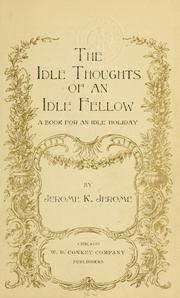
Idle Thoughts of an Idle Fellow
Idle Thoughts of an Idle Fellow. Jerome K. Jerome. 1889. 112 pages.
On idling:
blogging writing:
© 2012 Becky Laney of Becky's Book Reviews
Now, this is a subject on which I flatter myself I really am au fait. The gentleman who, when I was young, bathed me at wisdom's font for nine guineas a term—no extras—used to say he never knew a boy who could do less work in more time; and I remember my poor grandmother once incidentally observing, in the course of an instruction upon the use of the Prayer-book, that it was highly improbable that I should ever do much that I ought not to do, but that she felt convinced beyond a doubt that I should leave undone pretty well everything that I ought to do.Is Idle Thoughts of an Idle Fellow worth reading? Is it as good as Three Men in a Boat? Is it as good as Diary of a Pilgrimage? I do think it's worth reading, just reading in a different way. It is not as good, in my opinion, as Three Men in a Boat or Diary of a Pilgrimage. Both Three Men in a Boat and Diary of a Pilgrimage were travel books, travel books written more to amuse and delight, perhaps, but the books had structure, they were going somewhere, they were doing something. Idle Thoughts for an Idle Fellow, well, it's a book about nothing and everything. Some essays were good--very, very good. Others not so much. But I did like this one!!!
I am afraid I have somewhat belied half the dear old lady's prophecy. Heaven help me! I have done a good many things that I ought not to have done, in spite of my laziness. But I have fully confirmed the accuracy of her judgment so far as neglecting much that I ought not to have neglected is concerned. Idling always has been my strong point. I take no credit to myself in the matter—it is a gift. Few possess it. There are plenty of lazy people and plenty of slow-coaches, but a genuine idler is a rarity. He is not a man who slouches about with his hands in his pockets. On the contrary, his most startling characteristic is that he is always intensely busy.
It is impossible to enjoy idling thoroughly unless one has plenty of work to do. There is no fun in doing nothing when you have nothing to do. Wasting time is merely an occupation then, and a most exhausting one. Idleness, like kisses, to be sweet must be stolen.
On idling:
I like idling when I ought not to be idling; not when it is the only thing I have to do. That is my pig-headed nature. The time when I like best to stand with my back to the fire, calculating how much I owe, is when my desk is heaped highest with letters that must be answered by the next post. When I like to dawdle longest over my dinner is when I have a heavy evening's work before me. And if, for some urgent reason, I ought to be up particularly early in the morning, it is then, more than at any other time, that I love to lie an extra half-hour in bed.On sleeping late:
Ah! how delicious it is to turn over and go to sleep again: "just for five minutes." Is there any human being, I wonder, besides the hero of a Sunday-school "tale for boys," who ever gets up willingly?On alarm clocks:
I think myself that I could keep out of bed all right if I once got out. It is the wrenching away of the head from the pillow that I find so hard, and no amount of over-night determination makes it easier. I say to myself, after having wasted the whole evening, "Well, I won't do any more work to-night; I'll get up early to-morrow morning;" and I am thoroughly resolved to do so—then. In the morning, however, I feel less enthusiastic about the idea, and reflect that it would have been much better if I had stopped up last night.
artful contrivances that go off at the wrong time and alarm the wrong peopleOn love:
Love is like the measles; we all have to go through it. Also like the measles, we take it only once. One never need be afraid of catching it a second time.
A man's heart is a firework that once in its time flashes heavenward.On affection:
Affection will burn cheerily when the white flame of love is flickered out. Affection is a fire that can be fed from day to day and be piled up ever higher as the wintry years draw nigh.On blame:
But we are so blind to our own shortcomings, so wide awake to those of others. Everything that happens to us is always the other person's fault.On truth:
Speak truth, and right will take care of itself.On
It is a most remarkable thing. I sat down with the full intention of writing something clever and original; but for the life of me I can't think of anything clever and original—at least, not at this moment.On cats:
As for cats, they nearly equal human beings for vanity. I have known a cat get up and walk out of the room on a remark derogatory to her species being made by a visitor, while a neatly turned compliment will set them purring for an hour.On sympathy:
I do like cats. They are so unconsciously amusing. There is such a comic dignity about them, such a "How dare you!" "Go away, don't touch me" sort of air. Now, there is nothing haughty about a dog. They are "Hail, fellow, well met" with every Tom, Dick, or Harry that they come across. When I meet a dog of my acquaintance I slap his head, call him opprobrious epithets, and roll him over on his back; and there he lies, gaping at me, and doesn't mind it a bit.
Fancy carrying on like that with a cat! Why, she would never speak to you again as long as you lived. No, when you want to win the approbation of a cat you must mind what you are about and work your way carefully. If you don't know the cat, you had best begin by saying, "Poor pussy." After which add "did 'ums" in a tone of soothing sympathy. You don't know what you mean any more than the cat does, but the sentiment seems to imply a proper spirit on your part, and generally touches her feelings to such an extent that if you are of good manners and passable appearance she will stick her back up and rub her nose against you. Matters having reached this stage, you may venture to chuck her under the chin and tickle the side of her head, and the intelligent creature will then stick her claws into your legs; and all is friendship and affection...
It is in our faults and failings, not in our virtues, that we touch one another and find sympathy. We differ widely enough in our nobler qualities. It is in our follies that we are at one.On flattery:
Fill a person with love for themselves, and what runs over will be your share, says a certain witty and truthful Frenchman whose name I can't for the life of me remember. (Confound it! I never can remember names when I want to.)On novels:
But then not one novelist in a thousand ever does tell us the real story of their hero. It is in the petty details, not in the great results, that the interest of existence lies.On babies:
Odd little people! They are the unconscious comedians of the world's great stage. They supply the humor in life's all-too-heavy drama. Each one, a small but determined opposition to the order of things in general, is forever doing the wrong thing at the wrong time, in the wrong place and in the wrong way. Give an average baby a fair chance, and if it doesn't do something it oughtn't to a doctor should be called in at once.
© 2012 Becky Laney of Becky's Book Reviews
Labels:
1889,
adult fiction,
book I bought,
Books reviewed in 2012,
classics,
essays,
humor
Monday, July 13, 2009
The Art of Reading
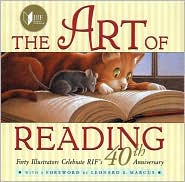
The Art of Reading: Forty Illustrators Celebrate RIF's 40th Anniversary. With a Foreword by Leonard S. Marcus. 2005. Dutton (Penguin).
This is a book for those with curious minds. It asks forty illustrators to talk about which books in their lives have inspired them. Sounds simple, but how would you choose just one? (That's what I'd like to know.) But what is the book like? Well, each artist is given two pages. One page for an illustration--at times this is an "inspired-by" piece. And a second page for text--a paragraph or two for talking about reading, drawing, and imagination. Who was inspired by The Lion, The Witch, and the Wardrobe? Pat Cummings. Who was inspired by The Wonderful Wizard of Oz? Robert Sabuda. Who was inspired by Harold and the Purple Crayon? That would be Bryan Collier. It was interesting to me--and it may be to you as well--to see that novels (both children's novels and more adult titles even) can inspire potential artists just as much as picture books. (For example, The Outsiders inspired David Diaz; The Martian Chronicles inspired Brian Selznick; 2001 A Space Odyssey inspired David Wiesner.) I also loved that this book conveyed passion and enthusiasm. It was a book that showed people excited about reading, about books.
I also want to mention that this is a great browsing-type book. If you like art--no matter your age--you'll probably enjoy the illustrations in this one. It features artists paying tribute to their favorite books. So you'll see art that is inspired by particular books.
Which books have 'inspired' you in your life?
© Becky Laney of Becky's Book Reviews
Saturday, May 30, 2009
Mind-Rain (YA, Adult)
Mind-Rain: Your Favorite Authors On Scott Westerfeld's Uglies Series. Edited by Scott Westerfeld. With original introductions (to each piece) by Scott Westerfield.
Featuring the essays of: Lil Wilkinson, Robin Wasserman, Diana Peterfreund, Sarah Beth Durst, Gail Sidonie Sobat, J. Fitzgerald McCurdy, Rosemary Clement-Moore, Janette Rallison, Linda Gerber, Will Shetterly, Jennifer Lynn Barnes, Delia Sherman. And featuring two special short stories. "Beautiful People" by Charles Beaumont. "Liking What You See: A Documentary" by Ted Chiang.
How to review a collection of essays? Each piece is different. Each has a different focus. Some are Shay related, others David or Zane related, and some are all Tally, all the time. Some focus on the science and technology of the Uglies universe. Other focus on the relationships. Others focus on the society and philosophy behind it all.
I enjoyed almost all of the essays. Some more than others, of course, as is only natural. But I will say that almost all of them made me think. They engaged me and had me reevaluating how I felt about the books, the characters, etc. Some introduced new ideas to me. Ways of seeing the books in a whole new way. And so I think that is clearly an indication of success.
I will say that I just love, love, loved the inclusion of those two short stories. "The Beautiful People" is a short story by Charles Beaumont. He wrote in in 1952. And it was adapted for a Twilight Zone episode, Number Twelve Looks Just Like You, in 1964. (Condensed YouTube version below)
You can see all of the episode as well. one. two. three.
Liking What You See: A Documentary by Ted Chiang inspired Scott Westerfeld. It was the inspiration that led to the Uglies books, the Uglies universe. It is a complex, thought-provoking story. And I loved getting the chance to read it. Both short stories are really. Thought-provoking. I'd definitely recommend these two stories to everyone to read regardless of whether or not they've read the Uglies books.
© Becky Laney of Becky's Book Reviews
Labels:
2009,
adult nonfiction,
essays,
Nonfiction,
review copy,
short stories,
YA nonfiction
Subscribe to:
Posts (Atom)