Showing posts with label slavery. Show all posts

Tuesday, May 21, 2019

Voices from the Underground Railroad

Voices from the Underground Railroad. Kay Winters. Illustrated by Larry Day. 2018. 48 pages. [Source: Library]

First sentence: Tonight's the night.

Premise/plot: Jeb and Mattie are two slaves that have decided to run away. Their stories are told in verse. The perspectives alternate between the two. Occasionally readers hear other voices as well from men and women working on the underground railroad.

My thoughts: I would definitely recommend this picture book for older readers. It is a compelling story told completely in verse. The back matter includes an author's note and extensive bibliography. The illustrations are lovely.

Text: 5 out of 5
Illustrations: 4 out of 5
Total: 9 out of 10


© 2019 Becky Laney of Becky's Book Reviews

Wednesday, July 04, 2018

Barracoon

Barracoon: The story of the Last Black Cargo. Zora Neale Hurston. 2018. HarperCollins. 2018. 256 pages. [Source: Library]

First sentence of the preface: This is the life story of Cudjo Lewis, as told by himself.

Premise/plot: When he was a young man, Kossula was captured by the Dahomey and eventually sold to American slave traders. The year was 1860. Though a slave for just five years--give or take--the experience forever changed him. In 1927, Kossula (aka Cudjo Lewis) met--befriended--a young folklorist named Zora Neale Hurston. His story was important to capture, and Hurston wanted to be the one to do it--in his own words, in his own style. Which meant it was to be written in dialect, in a conversational style. The manuscript did not find a publisher in Hurston's lifetime. But it has now. 

He tells his story in his own way in his own words. He speaks of Africa. He tells of his family, his community, his childhood. He shares memories of visiting his grandfather's home, of his funeral, for example. He talks of learning to hunt and initial training to become a soldier. He was still too young to be a soldier, to join the grown-ups in his village; he was still too young to build his own house and marry. But he didn't get a chance to live the life he thought he would.

His life was interrupted--brutally so. The Dahomey attacked his gated village: capturing some, slaughtering the rest. He was among the captured young men and women. He was kept prisoner in the barracoons of Ouidah (Whydah) until he was purchased by slave traders and loaded as cargo onto the ship Clotilda. He tells of the journey and the destination. He shares his experiences as a slave. He talks of his experiences as a free man. There was no going back. There was no erasing those years. He was cut off from the future that should have been his--his home in Africa. There are stories about his wife, his children, his grandchildren. Make no mistake it's a hard life.

"My Grandpa, he a great man. I tellee you how he go."
I was afraid that Cudjo might go off on a tangent, so I cut in with, "But Kossula, I want to hear about you and how you lived in Africa."
He gave me a look full of scornful pity and asked, "Where is de house where de mouse is de leader? In de Affica soil I cain tellee you 'bout de son before I tellee you 'bout de father; and derefore, you unnerstand me, I cain talk about de man who is father till I tellee you bout  de man who he father to him, now, dass raight ain' it?" (20)
"Ole Charlie, he de oldest one come from de Afficky soil. One Sunday after my wife left me he come wid all de others dat come cross de water and say, 'Uncle Cudjo, make us a parable.'
'Well den,' I say, 'You see Ole Charlie dere. S'pose he stop here on de way to church. He got de parasol 'cause he think it gwine rain when he leave de house. But he look at de sky and 'cide hit ain' gwine rain so he set it dere by de door an' go on to church. After de preachin' he go on home 'cause he think de parasol at Cudjo house. It safe. He say, 'I git it nexy time I go dat way.' When he come home he say to one de chillun, 'Go to Cudjo house and tellee him I say sendee me my parasol.' 'De parasol it pretty. I likee keep dat one.' But I astee dem all, 'Is it right to keep de parasol?' Dey all say, 'No it belong to Charlie.' 'Well,' I say, 'my wife, she b'long to God. He lef' her by my door.'" (92)
 My thoughts: I am so glad I read this one. I have long been a fan of Zora Neale Hurston. I was introduced to her work in college and LOVED, LOVED, LOVED it. I would recommend this one. It isn't necessarily easy reading. Some readers may struggle with the dialect. More readers may struggle with the content. I think many of us--if not most of us--want to look away from pain and cruelty and injustice. Even when we know we shouldn't. We don't want to know how it feels, what it looks like. We don't want to be witness to it. But his story deserves to be known and known widely.

I would recommend it.


© 2018 Becky Laney of Becky's Book Reviews

Tuesday, August 23, 2016

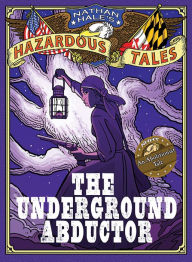
The Underground Abductor

The Underground Abductor. (Nathan Hale's Hazardous Tales #5) Nathan Hale. 2015. Abrams. 128 pages. [Source: Library]

First sentence: It is time to hang this spy! Are you sure? Can't we get one more story out of him first?

Premise/plot: Nathan Hale sets out to prove that America isn't perfectly perfect, and, that America has in fact "taken part in some truly horrible, despicable, abominable, atrocious, downright evil acts." He speaks, of course, of slavery. And in this graphic novel, he tells the story of Harriet Tubman (aka Araminta Ross). It's an intense story without a doubt. He speaks of her growing up in slavery, the abuses she faced, the challenges she overcame, her marrying a free man, her decision to run away, her decision to run back into slavery. For it became her mission to travel back and forth between North and South saving slaves--escorting slaves to safety, to Canada, in fact. All via the "underground railroad" of abolitionists. Some of this information I was familiar with, but, some was new to me. For example, I was not aware of her head injury perhaps leading to her narcolepsy. I had no idea of her visions either!

My thoughts: I am so glad I discovered this series. I really have enjoyed reading these books practically back to back. I would definitely recommend all of the books in the series. I hope it is a very LONG series.


© 2016 Becky Laney of Becky's Book Reviews

Friday, March 18, 2016

My Name Is Not Friday

My Name Is Not Friday. Jon Walter. 2016. Scholastic. 384 pages. [Source: Review copy]

My Name is Not Friday is not a book I could say I "enjoyed." For who would want to ever admit to enjoying a book about slavery?

Could I say it was a good book? Yes, I think I could say it was solidly good. (Maybe not solidly great, but good, yes, I can see that.)

Do I think that it is a book adults will like/love more than kids? Yes, I think that's true. Some kids *do* voluntarily read historical fiction. Some kids do read "heavy" serious books. This one is decidedly heavy. It is set during the Civil War.

But this, to me, seems more like a book adults would try to coax/pressure kids into reading because it is "good for them" or "important." And if My Name Is Not Friday does eventually become assigned reading, well, I don't think kids will "like" it or admit to liking it.

Samuel is the hero of the novel. He and his brother Joshua live in an orphanage for Negroes/free blacks run by Father Mosely. Samuel is the "good" one. He's a "good" student, a "good" brother, a "good" friend. Joshua, his younger brother, is not as "good." Let's just say that learning and following rules isn't as easy and natural as breathing. To protect his brother from punishment (the crime is shocking, and the big reveal at the end even more so) Samuel confesses to something he didn't do. His punishment is that he 'disappears' from the orphanage. Samuel finds himself "kidnapped" by someone--a white man--and taken south to a slave market where he is sold into slavery with forged papers. Before he's sold, he's "stripped" of his name/identity and told that he is now FRIDAY.

Two-thirds of the book focuses on Friday's new life as a slave in the south, in Tennessee, I believe. He's bought by Gerald, the stepson of Mrs. Allen. Gerald and Samuel are about the same age. And Gerald seems more interested in having a playmate and friend than a field worker. But Friday isn't overly grateful to his young master who wants to play baseball and go swimming with him. Especially since Mrs. Allen and everyone on the place--white and black--thinks his place is to work from sunrise to sunset at whatever task he is given. (In the morning, he's in the field, in the afternoons, he's assigned to the house.) Friday does have an ally, of sorts, in Gerald. Part of that friendship is based on a lie, on flattery at that. But Gerald considers Friday to be his friend, and, is completely honest with him and somewhat vulnerable. It violates Friday's conscience to actually be friends with Gerald, but, at the same time he feels guilty for lying and pretending and doing whatever is necessary to appear "good." My impression is that Friday/Samuel has understandably mixed feelings about Gerald and Mrs. Allen both, though especially Gerald.

Readers meet the other slaves on the plantation. Men. Women. Boys. Girls. He makes friends, and, pieces together a family of sorts. Though not everyone treats him as a friend/brother/son. Almost halfway through the novel, he has a revelation of sorts. He feels that God has led him purposefully into slavery so that he can teach others how to read and write. His calling will be questioned and doubted now and then for the rest of the novel, but, he holds onto the idea that there is a purpose for his life for the most part.

I have very mixed feelings on the "Christian" aspects of this one.

Samuel himself seems VERY confused in terms of what Christianity is and what it means to be saved. From start to finish, he carries the notion that it is what he himself DOES that determines the matter. In other words, if every single day of my life, I am good and make more good choices than bad choices, then God will look down on me see my effort and reward me by delivering me from my troubles in this life and letting me into heaven in the next life. Samuel also seems to be a bargainer. Most of his prayers equating to: Lord, I know Joshua was bad today, but, count some of my goodness towards him and keep him safe. I can be good enough for the two of us if I just keep on working and trying. I just have to say emphatically THIS IS NOT the gospel; THIS IS NOT Christianity.

Samuel is not the only one who is confused. The white minister who preaches in the town and makes a once-a-month visit to the slaves to teach to them the joys of slavery and how they will still be slaves in heaven is a mess as well. I have no doubt that there were Southern ministers who did preach that slavery had God's approval. But ministers--then and now--are not infallible in their sermons, their books, or their interpretation of Scripture. The Bible has plenty to say about slavery, but, not celebrating it as wonderful and beneficial and absolutely necessary.

Mrs. Allen does seem to be a woman of faith. She may be a slave-owner, or, the wife of a slave-owner. She may erroneously believe that the slaves are like children, and will always--no matter their age--need to be taken care of. But my impression was she did care about their spiritual needs, and, wanted to do whatever she could to teach them about God. Meeting with them daily, reading to them from the Bible, leading them in songs. These are things that she didn't have to do, or make time to do--especially with the stress and uncertainty of war. There were scenes where I couldn't bring myself to hate her. Then again, some scenes, it wasn't all that hard. I think the author did a good job in depicting Mrs. Allen and Gerald as complex human beings.

Another "layer" of this is the portrayal of some slaves having no faith, or having lost the faith, because of their reckoning that if God exists and if God is good, then slavery wouldn't exist. In other words: because I am a slave, because I have been whipped and scarred, because I have endured much suffering then God doesn't exist.

But there is yet another layer that gives a fuller picture. A handful of the slaves--not all of them--gather together some nights--secretly--go to the woods, and have their own meetings. They sing. They dance. They testify about God's goodness. They talk of the day when He will deliver them from slavery. They speak of God in a vibrant, real way illustrating that their faith is core to who they are. That even though the "white minister" might preach down at them, their faith is stronger and deeper and more substantive than that. God is not defined to them as being "the white man's God." Samuel reads the Bible to them at these meetings. Before they could just look at the pictures and try to remember what they've heard from others through the years. (I don't know where the Bible comes from, or, who owns it. But it is much treasured.)

I am glad I read this one. I think it is a solidly good novel. Adults may be more amazed at it than kids are.

I don't know if I should admit that I didn't "see" the cover properly until I happened to look at it upside down at the time I was reviewing it. The reflection in the water is DIFFERENT. One sees both Friday (the slave) and Samuel (the scholar).

© 2016 Becky Laney of Becky's Book Reviews

Saturday, March 02, 2013

The Lightning Dreamer (2013)

The Lightning Dreamer. Margarita Engle. 2013. Houghton Mifflin Harcourt. 182 pages.

Books are door-shaped
portals
carrying me
across oceans
and centuries,
helping me feel
less alone.

But my mother believes
that girls who read too much
are unladylike
and ugly,
so my father's books are locked
in a clear glass cabinet. I gaze
at enticing covers
and mysterious titles,
but I am rarely permitted
to touch
the enchantment 
of words. (3)

I definitely enjoy Margarita Engle's verse novels. Her newest is a verse novel about Cuban abolitionist poet, Gertrudis Gomez de Avellaneda, who was nicknamed Tula. For a young girl--a young woman--who dreamed so big, wanted so much, her environment was quite oppressive. Her family wanted, NEEDED, her to marry well. But. Tula had different ideas. She held onto the notion that she could have ideas of her own:

Girls are not supposed to think,
but as soon as my eager mind
begins to race, free thoughts
rush in
to replace
the trapped ones. (4)

 Tula discovers a whole new world within the convent library, and once she begins her journey, there will be no dissuading her...

Opinions.
Ideas.
Possibilities.
So many!
How can I choose?
Between bursts
of lightning-swift energy,
I enjoy peaceful moment
when the whole world
seems to be a flowing river
of verse
and all I have to do is learn
how to swim.
During those times,
I find it so easy to forget
that I'm just a girl who is expected
to live
without thoughts. (41)

The novel is rich and descriptive. I love the writing...

"I feel certain that words
can be as human 
as people,
alive
with the breath
of compassion." (26)

So many people 
have not yet learned
that souls have no color
and can never
be owned. (69)


Love is as tricky as a wall
of mirrors that make
narrow hallways
seem open
and wide. (146)

I would definitely recommend this one! 

Read The Lightning Dreamer
  • If you enjoy verse novels
  • If you enjoy historical novels based on real people and events
  • If you enjoy Margarita Engle's works
  • If you are looking for YA books set in Cuba

© 2013 Becky Laney of Becky's Book Reviews

Friday, April 01, 2011

Jubilee

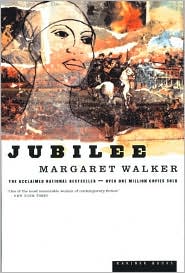
Jubilee. Margaret Walker. 1966. 512 pages.

"May Liza, how come you so restless and uneasy? You must be restless in your mind."
"I is. I is. That old screech owl is making me nervous."
"Wellum, 'tain't no use in your gitting so upsot bout that bird hollering. It ain't the sign of no woman nohow. It always means a man."
"It's the sign of death."

Jubilee chronicles Vry's life. As a child. As a woman. As a daughter. As a mother. As a wife. As a slave. As a freedwoman. Before, during, and after the Civil War. During Reconstruction. It is a story of survival, of endurance, of incredible strength, of incredible integrity, of hope and despair, of fear and courage.

It's not an easy read. Because Vry's life was not an easy life. There's a necessary harshness, cruelty, and pain to it. For Vry was a slave. She may have been biracial. She may have looked white even. But she was a slave and her mistress NEVER let her forget it for a moment. The picture readers get of slavery is not pretty, not romanticized. The language is strong.

I thought Jubilee was wonderfully written. It's a powerful read, a compelling one. Very emotional. Very memorable. I would definitely recommend this one!

Vry's advice to a new slave:

Don't never grin in that white woman's face. She don't know what you mean. I was borned here, and I been here all my life, and you don't see me grinning bout nothing, now does you? Well, they ain't nothing here to grin about, that's how come I ain't grinning. (131)

Vry's prayer:

Lawd, God-a-mighty, I come down here this morning to tell you I done reached the end of my rope, and I wants you to take a-hold. I done come to the bottom of the well, Lord, and my well full of water done run clean dry.
I come down here, Lord, cause I ain't got no where else to go. I come down here knowing I ain't got no right, but I got a heavy need. I'm suffering so, Lord, my body is heavy like I'm carrying a stone. I come to ask you to move the stone, Jesus. Please move the stone! I come down here, Lord, to ask you to come by here, Lord. Please come by here!
We can't go on like this no longer, Lord. We can't keep on a-fighting, and a-fussing, and a-cussing, and a-hating like this, Lord. You done been too good to us. We done wrong, Lord, I knows we done wrong. I ain't gwine say we ain't done wrong, and I ain't gwine promise we might not do wrong again cause, Lord, we ain't nothing but sinful human flesh, we ain't nothing but dust. We is evil peoples in a wicked world, but I'm asking you to let your forgiving love cover our sin, Lord.
Let your peace come in our hearts again, Lord, and we's gwine try to stay on our knees and follow the road You is laid before us, if You only will.
Come by here, Lord, come by here, if you please. And Lord, I wants to thank You, Jesus, for moving the stone! (454-55)

Vry's advice to her son:

Keeping hatred inside makes you git mean and evil inside. We supposen to love everybody like God loves us. And when you forgives you feels sorry for the one what hurt you, you returns love for hate, and good for evil. And that stretches your heart and makes you bigger inside with a bigger heart so's you can love everybody when your heart is big enough. Your chest gets broad like this, and you can lick the world with a loving heart! Now when you hates you shrinks up inside and gets littler and you squeezes your heart tight and you stays so mad with peoples you feel sick all the time like you needs the doctor. Folks with a loving heart don't never need no doctor. (457)

© 2011 Becky Laney of Becky's Book Reviews

Thursday, November 04, 2010

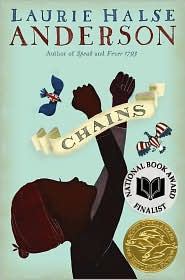
Chains (MG/YA)

Chains. Laurie Halse Anderson. 2008. Simon & Schuster. 320 pages.

The best time to talk to ghosts is just before the sun comes up. That's when they can hear us true, Momma said. That's when ghosts can answer us. The eastern sky was peach colored, but a handful of lazy stars still blinked in the west. It was almost time.

When the novel opens, Isabel, our heroine, is seeking help from her (dead) mother one last time. But it's to no avail, her mother's ghost does not answer her pleas, can provide no further guidance to her two daughters, Isabel and Ruth.

Their mistress has died. Isabel knows that her mistress freed her and her sister before she died; it's in her will. But her mistress's nephew--Mr. Robert Finch--as her only living relative refuses to believe that consulting a will is even necessary. Naturally, all her aunt's property is his. And since Isabel and Ruth are nothing but property, they are his by right. The fact that there's a will, a lawyer, who could say otherwise? Irrelevant. Mr. Robert sells both girls at the first opportunity. Their buyer? The Locktons of New York. Isabel is even given a new name. One that is "easy" to remember. Sal. But Isabel can never be comfortable wearing a new name, being the property of someone else. Isabel dreams of so much more. She dreams of freedom. What keeps her from acting on impulse? Of running away? Her sister, Ruth. But the actions of a cruel mistress--selling her younger sister--means that Isabel has nothing left to lose. Will Isabel believe the British who are promising freedom to some slaves? Or will Isabel believe the Patriots who claim the same thing--freedom to slaves who help their side.

A nation at war. A young country seeking freedom, justice, liberty. Set in New York City during circa 1776-1777, the story is vibrant and heartbreaking. It's a story rich in detail and emotional and powerful in nature. Isobel's story--her struggles--resonates so deeply that I think this one is a must-read.

I first reviewed Chains in November of 2008. I reread it so I'd be ready for the release of the sequel, Forge.


© Becky Laney of Becky's Book Reviews
Monday, September 27, 2010

Nonfiction Monday: Liberty or Death


Liberty or Death: The Surprising Story of Runaway Slaves Who Sided With the British During The American Revolution. By Margaret Whitman Blair. 2010. National Geographic. 64 pages.

Liberty and freedom are not the sole province of any set of people anywhere. The fact that three of the first four Presidents of our nation were slaveholders would seem to suggest that our nation was founded in slavery.

I'll be honest. I was mostly interested in Liberty Or Death because I've been fascinated by a few recent fictional titles on this subject: Octavian Nothing volume 1 and 2 by M.T. Anderson, and Chains by Laurie Halse Anderson. (Forge, the sequel to Chains, releases this fall.)

I'm glad I read Liberty or Death. I found it interesting and informative. It mentions how African Americans fought on both sides of the War. How some chose to trust the British. How some chose to trust the Americans. It not only covers the years of the American Revolution, it tells the bigger story. What happened to these former slaves who fought for the British after the defeat. Where they settled. What kind of lives they led. Their continued struggles.

I found the book very engaging--very compelling.

© Becky Laney of Becky's Book Reviews

Monday, September 06, 2010

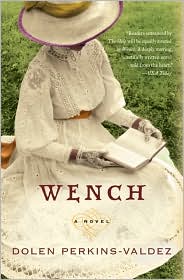
Wench


Wench. Dolen Perins-Valdez. 2010. HarperCollins. 293 pages.

Six slaves sat in a triangle, three women, three men, the men half nestled in the sticky heat of thighs, straining their heads away from the pain of the tightly woven ropes. The six chatted softly among themselves, about the Ohio weather, about how they didn't mind it because they all felt they were better suited to this climate. They were guarded in their speech, as if the long stretch between them and the resort property were just a Juba dance away.

Wench is a historical novel set (primarily) in the 1850s, at a summer resort in Ohio. A resort where slaveowners were able to 'vacation' openly with their slave wenches. (Slaves were still expected to work, to make themselves useful to anyone and everyone.) Wench portrays the struggles of four slave women--their complicated relationships with their masters, mistresses, and even each other. Lizzie, our heroine, has a complex relationship with her master, Drayle, for unlike the other slave women she feels she actually loves him. The relationship is complex--readers see much of this through flashbacks. They learn how the relationship began--and how it has continued through the years resulting in the birth of a son and daughter. Drayle's only children. Lizzie prays for freedom for her two children. Her one desire is to have her children be freed by their father. But so far, her requests have been refused.

Reenie, Sweet, and Mawu are the other three slave women readers meet in Wench. Each has a heartbreaking story. We see these characters through their relationship with Lizzie. We learn their stories through Lizzie. Because of these friendships, Lizzie's life will be changed.

Wench is a compelling novel. Once I started reading, it was difficult to put down. It was easy for me to care about these characters. It was intense and emotional in many ways--because their lives were bittersweet at best. I would definitely recommend this one!

© Becky Laney of Becky's Book Reviews

Friday, June 04, 2010

The Firefly Letters (MG/YA)


The Firefly Letters: A Suffragette's Journey to Cuba. Margarita Engle. 2010. Henry Holt. 160 pages.

I absolutely loved The Firefly Letters. I found it so amazing, so beautiful, so right. This isn't the first Margarita Engle novel I've read--she writes verse novels set in Cuba; all historical. (I've read The Poet Slave of Cuba, The Surrender Tree, and Tropical Secrets.) But I must admit that this one is definitely my favorite so far.

The Firefly Letters is told in verse through three narrators--primarily. Cecilia, a young slave woman still mourning her lost home, her lost family. Elena, the daughter of a wealthy slave owner. Fredrika, a Swedish woman, far from home and on a mission. How are these three connected? How do their stories connect? Fredrika is staying--as a guest--at Elena's home. Cecilia is her translator--she's a slave that has learned to speak English, a valuable asset. Why is Fredrika in Cuba? What brings her around the world? She's a writer. And her mission is to write about Cuba--to write the truth--which means shedding light on the evils of slavery. Her mission brings her into close contact with all sorts of people. How will knowing Fredrika change these two young women? Will Frederika's strange, outlandish ideas of freedom, of equality, make an impact?

This story has staying power. Here is one of my favorite poems--narrated by Cecilia.
Imagine my nervousness
having to translate while Fredrika
scolds the schoolmistress
for keeping girls in class
only one hour per day
and for teaching them nothing
but embroidery, lacemaking,
and saints' lives
while boys study all day long
learning mathematics and science.

Elena looks so astounded
sitting in her classroom,
surrounded by giggling girls
in silk dresses with lace ruffles,
while Fredrika scolds and I translate,
all the time thinking
that one hour of school
is more than any slave girl
can hope to receive in a lifetime. (61-62)
The book is based in part on the life of Fredrika Bremer.

© Becky Laney of Becky's Book Reviews

Wednesday, November 05, 2008

Octavian Nothing Part 2


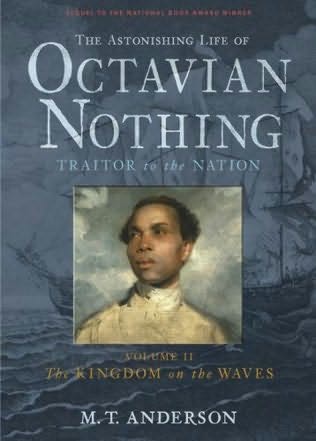
Anderson, M.T. 2008. The Astonishing Life of Octavian Nothing: Traitor to the Nation: Volume 2: The Kingdom On The Waves.

I'm at a loss of words. I almost think this would take a second reading to cement just how I feel about the second volume of Octavian Nothing. I'll start by saying that I loved the two page summary of the first volume. (Is it wrong to admit that it made me smile?) It perfectly sums up the action and motivations of the first volume. The second volume begins right where the other left off. We've got Dr. Trefusis and Octavian on the run. They're lives are at stake, and they're seeking refuge in Boston--a city which at the moment is under British control. (Call them Tories, Loyalists, Redcoats, whatever.) Both know that Boston is a dangerous city. A city that could fall into Rebel hands. And if and when it does, they know that their lives would be forfeit. There hope is to obtain a place within the British army--on a British vessel or ship. Octavian at last is able to join fellow runaway slaves and enlist in Lord Dunmore's army. He has promised to free the slaves of Rebels if they will join his cause and fight.

Here is the scene where he enlists:
"Your name?" said the Serjeant. "Octavian," said I. "Your surname?" I considered. I would no longer be called Gitney. "I have none," I said. "And ye don't have no master." "I have no master, sir," said I, "except the King." To the tatooed Craigie he said, "Write 'Octavian Negro.'" "While I would not trouble the Serjeant, I would beg--" "What then?" "If it please you, sir, put down nothing for the surname. I would rather be called nothing than be named only for my race." Serjeant Clippinger gave an insalubrious smile. "Octavian Nothing?" said he. I regarded my name. Knowing not who I was, it seemed a fair enough appellation. "Octavian Nothing," I agreed. And thus it was inscribed. (129-130)
Army life is hard. And war isn't all Octavian thought it would be. He is keeping a journal of his life, the events as they unfold. (1775-1776) Along the way, he makes new friends and rediscovers old friends. Pro Bono is back wearing the new name of William Williams. The book is a continuation of his quest for freedom, liberty, and identity.

The book is well-written. And the pacing (or action) is much steadier and more intense than the previous volume. Old characters--Dr. Trefusis, Mr. Gitney, Pro Bono, etc--are there alongside new ones: Slant, Will, John, Pomp, etc. There is much depth--heart and spirit--to the two books. There is much to admire and appreciate within the pages. When you think of it as a coming-of-age story it is quite impressively done. Both books showcase humanity--the good, the bad, the ugly, the abominable, the admirable.

© Becky Laney of Becky's Book Reviews
Sunday, November 02, 2008

Chains


Anderson, Laurie Halse. 2008. Chains.

The best time to talk to ghosts is just before the sun comes up. That's when they can hear us true, Momma said. That's when ghosts can answer us.

Isabel and Ruth are two slave girls who have just been freed by their master's will. Their mistress, Miss Mary Finch, has just been laid to rest. And Isabel, though nervous, is excited about their future prospects. Unfortunately, Mr. Robert Finch, the visiting nephew, has different ideas. Ignoring their protests that they have been freed within Miss Finch's will, he insists that they are his property to sell and make a profit from. His. His. His. And the local pastor who witnesses this exchange, Pastor Weeks, well he supports Mr. Finch in whatever he decides. The girls are told to gather their blankets and shoes and come with him.
These two girls are sold to Mr. and Mrs. Lockton. This wealthy loyalist family owns several properties--one in New York City, one in Charleston, I believe. (It is in the south, that much I know.)

Ruth becomes a favored curiosity for a short while in the Lockton household. Unfortunately, her epileptic seizures bring an end to that status. Mrs. Lockton knows beyond a shadow of a doubt that Ruth is possessed of the devil. And she tries her hardest to convince her husband that the demon-child must go. Her husband refuses, but tells her that the girl can stay out of sight and do her work well away from Mrs. Lockton. Everyone is hoping that out of sight will become out of mind. Isabel, though accused of being too talkative, does her best to stay in her lady's good graces. She still dreams of freedom. But she knows that her place is precarious. That Ruth's place is extremely so. If she wants to stay with her sister, she must be cautious.

But several things tempt Isabel. Freedom. She meets a slave of one of the rebels, Curzon, who promises her that the Rebel Army will reward her if she spies for them. Mr. Lockton is a loyalist. He's a conspirator as well. Curzon knows that she could bring back juicy-and-vital details to the Rebels...if she will be brave enough to risk it.

A nation at war. A young country seeking freedom, justice, liberty. Set in New York City during circa 1776-1777, the story is vibrant and heartbreaking. It's a story rich in detail and emotional and powerful in nature. Isobel's story--her struggles--resonates so deeply that I think this one is a must-read.

My only complaint about Chains is that it's one of those cliffhanger books with a big "to be continued" at the end.

© Becky Laney of Becky's Book Reviews
Friday, October 24, 2008

Octavian Nothing


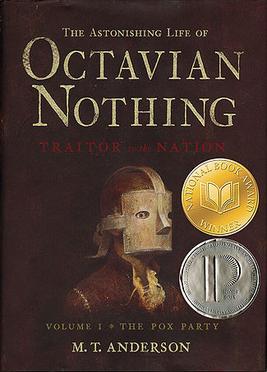
Anderson, M.T. 2006. The Astonishing Life of Octavian Nothing: Traitor to the Nation: Volume 1: The Pox Party.

Let's see...what can I say about Octavian Nothing. It's an award-winning book--winner of the National Book Award, winner of a Printz Honor. It's historical fiction--set in the Colonies right before the American Revolution. It's more literary than your typical teen book--it's heavy in semicolons and rich in detail.

So what is so astonishing about the life of Octavian Nothing? Many things. Many many things. For starters, he's a slave who doesn't quite realize he's a slave. He has little inkling just what he is...or who he is. Who is he? He's a human experiment. He's being studied to determine if Africans are inferior (or equal to) to Europeans. Everything about him is being observed and measured. He's been given the finest clothes, housed in a luxurious way (at least comparatively speaking), taught to play musical instruments, taught in a classical way--learned in many diverse subjects including English, French, Greek, and Latin. He is a child who had a very strange, very odd, very out-there upbringing. Who is raising him the members of the College of Lucidity. Strange men who are fascinated by science, math, philosophy, art, music, etc.

There are several events that change everything for Octavian. That turn his whole world, his whole life, his very being upside down and inside out. Through the course of the book, Octavian goes from a privileged boy who is clueless about the oppression of slavery to a full-grown man who has experienced the oppressive wrath and cruelty of his masters. A man who now longs for freedom.

Even that isn't quite a fair assessment of what this book is about...of what it has to offer readers.

I can't promise you that you'll love it...or even like it. You may, of course, respond that way. But this is a book that requires you to be engaged, to connect emotionally and intellectually with the text. It's a book that requires you to wear your thinking cap.

© Becky Laney of Becky's Book Reviews

Saturday, October 04, 2008

The Adventures of Huckleberry Finn


Twain, Mark. 1884. The Adventures of Huckleberry Finn.

This was my first time to voluntarily read Huckleberry Finn. (Also my first time as an adult.) I think both of those are good reasons why I enjoyed this one so much. We first met the character of Huck Finn in Mark Twain's novel, Tom Sawyer. Sawyer makes for an entertaining narrator. All humor, little substance. But good fun. Finn, on the other hand, is a narrator with a bit more depth. (Okay a lot more depth.) The Adventures of Huckleberry Finn is a true coming-of-age story. Huck Finn grows in heaps and bounds as a person, as a soul, in this American classic.

The plot focuses on Huck and his relationship with a runaway slave, Jim. Huck had his own (very valid in my opinion) reasons for running away from home. While he is hiding out on "his" island, he discovers that he's not the only one hiding. Jim, a slave whom he's had a good amount of contact with in the past, has runaway. He's hoping to escape into freedom. The two end up running away together (by water mostly--various rafts and canoes, etc); their destinies become intertwined.

The two face more than a few hardships along the way. And face more than a couple of close calls. Most of their adventures escalate once "King" and "Duke" arrive on the scene and join these two. These two con men aren't likable, rather they're both despicable characters up to no good, but Huck and Jim can't seem to shake them. They're stuck with these two no matter how much they wish otherwise.

I don't want to go much more into the plot, but I will say that this one was a good read. The characterization of Huck and Jim is great. And the relationship between the two is really intricately and beautifully explored. The villains--King and Duke, Huck's father, etc.--are characters that are meant to be booed and hissed. Which shows--in some ways--that they're developed well enough to be thoroughly hated.

Definitely recommended.

© Becky Laney of Becky's Book Reviews
Thursday, June 12, 2008

The Floating Circus


Zimmer, Tracie Vaughn. 2008. The Floating Circus.

"I shoulda listened to my brother. Right follows Zach like a shadow, but wrong wears me like a skin."

Owen and Zach, two brothers, two orphans from Pittsburgh. When we first meet Owen, he is getting ready to fall into some trouble. Dared to climb a tree to see if he could touch the roof of the orphanage, his attempt is brave but extremely foolish. Now he has lost the use of his left arm. When he overhears two elderly ladies--Miss Jane and Miss Eliza--talking about how no one would want to adopt the pair of them--Owen being both a troublemaker and a somewhat crippled one at that--but how Zach could easily find a home, find a family, if he was alone, if he didn't have his brother around, Owen decides to runaway. If his brother would be better off without him, then maybe it's time that he showed just how much he loved his brother by doing what would be best for him in the long run.

Owen mostly by accident joins a circus boat, the River Palace. He's an assistant to a free black man, Solomon, he helps him take care of the animals on board. It includes a lot of CLEANING as I'm sure you can imagine. Solomon is kind and friendly. Owen and Solomon become easy friends and companions. Most of the others ignore him at least in the beginning.

I don't want to say too much. I hate reading things that spoil the plot even a little bit. But this one is good, really good. If you like historical fiction at all...you really should give this one a try. It was inspired by a real showboat, Rogers and Spalding's Floating Palace.

According to the author's website, the book will be released July 22, 2008.


© Becky Laney of Becky's Book Reviews

Tuesday, May 27, 2008

The Glory Field


Myers, Walter Dean. 1994. The Glory Field.

Recently released in a new paperback edition, The Glory Field is a true must-read. Why? It's practically perfect in every way. It is a novel that traces a family from its Sierra Leone roots to what was at the time of its publishing modern-day, urban America. The Glory Field loosely weaves together the story of one family through multiple generations. Our story begins with a brief vignette (1753) focusing on Muhammad Bilal, a young boy who is captured and sold into slavery in the South. Many settings, many narrators, many individual stories and legacies that collectively capture the African-American experience. (1753, 1864, 1900, 1930, 1964, 1994). It is an emotional, well-written, almost poetic journey. Very heartfelt. Very real. Very moving. The characterization is wonderful. I really came to love, came to care for all the characters across the generations. I've read a few other novels through the years that have sought to tell a multi-generational story...but none have been so effective, so masterfully done.

If you love historical fiction, then you MUST read this one. It's a truly great novel.

"We come a long way and we got a long way to go. You can't make much progress if you don't leave home, but you can sure mess yourself up if you don't remember where home is." (232)

© Becky Laney of Becky's Book Reviews