Showing posts with label "A" authors. Show all posts

Saturday, June 06, 2009

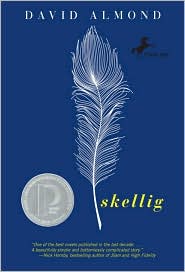
Skellig (MG, YA)


Almond, David. 1998. Skellig. 204 pages. (But it's the Large Print edition)

I found him in the garage on a Sunday afternoon.

I was disappointed with this one. I'm not quite sure what I was expecting. It's probably my expectations and/or my mood to blame for the disappointment. Skellig is pretty much unlike every other book I've read. At least that I can recall. It's a strange little book about a strange little man. And my guess is that readers (other readers at least) find him charming. He's a mystery alright. Is he a man? Is he an angel? Is he paranormal or supernatural? Michael, our hero, is a young man--a teen--whose going through a rough time. He's just moved into a new house, an older house that's not quite what it should be. His mom has just had a baby, a girl, but there were complications. She came too early. There are problems with her heart. No one can say for sure, but it's not looking too good. It's a delicate situation. His newborn baby sister is hovering between life and death. And in a way that means the whole family is hovering. When Michael ventures into the garage, he finds an old man sitting there among the shadows and the spiders and the mice droppings and the like. Not quite sure if he's imagining this man or not, Michael eventually seeks proof--he brings his neighbor friend, Mina, to see. Not right away. Not after he's seen him a few times. Not until after he's taken him leftover Chinese food to eat and aspirin to take. But still, Michael needs a friend to validate him. Well, Michael just needs all the friends he can get really.

It's a strange little book about friendship and family. And some people do really like it. I'm just not one of them. Maybe it's because I have a hard time suspending my disbelief that anyone--rather half-man,half-bird or all-angel would live in filth for years surviving on spiders and mice. Letting spiders and rodents and all crawl all over him. Anyway, for readers willing to go there, to believe, this one could work.

© Becky Laney of Becky's Book Reviews

Thursday, April 09, 2009

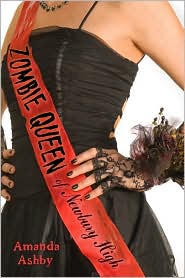
Zombie Queen of Newbury High


Ashby, Amanda. 2009. Zombie Queen of Newbury High. Penguin. 199 pages.

Mia Everett was doomed.

Fun but ever-predictable, this one is a light-hearted read that I tended to enjoy. Predictability. It isn't always a bad thing. Yes, I knew who our heroine would end up falling for by page seven--and I can guess you might as well. But did I enjoy it? Yes. Mostly. Mia is a not-so-popular girl who wants to hold onto her popular boyfriend. Despite the fact that they've been dating for several weeks--five dates and counting--she's insecure in the relationship. Feels threatened, and perhaps rightfully so since her guy is being pursued by a cheerleader who doesn't know the word no. So Mia and her best friend, Candice, seek out a spell--a love spell--to keep Rob, her boyfriend, right where he belongs: by her side. But this spell has some unintended side effects. It's not a love spell at all. And it doesn't just effect Rob--it infects the whole senior class and the teachers who were present at the senior assembly. Fortunately for Mia, someone is there, a witness to it all. Someone who will do anything and everything to keep the situation contained. His name is Chase. And for better or worse, Mia and Chase have to work together or life could get very very messy.

© Becky Laney of Becky's Book Reviews
If you're reading this post on another site, or another feed, the content has been stolen.

Tuesday, March 24, 2009

Mansfield Park Revisited


Aiken, Joan. 1985/2005. Mansfield Park Revisited. Sourcebooks. 201 pages.

The sudden and unexpected death of Sir Thomas Bertram, while abroad engaged on business relating to his various properties in the West Indies, could be a cause of nothing but sorrow, dismay, and consternation to the baronet's friends in England.

I just LOVED this book. It was delightful and charming. But more importantly it is redemptive. With Fanny and Edmund out of the picture--for the most part--the narrative has a chance to focus in on other characters. Susan, Fanny's younger sister, and Tom, Edmund's brother, for example. But it also returns to us the brother-sister villains, Henry and Mary Crawford. (She's come back--and is actually renting a cottage from the Bertrams--but there's a catch: she's dying.) New characters are also introduced--the lovely Mrs. Osborne and her brother, the Reverend Francis Wadham. (He will be taking Edmund's place in the parish temporarily.) The book is full of characters you come to love...and those you love to hate.

Appearances can be deceiving, and such is the case here. All isn't as it first appeared, for example, in Mansfield Park. I have never been a fan of Mansfield Park, but I am a BIG FAN of this sequel. If you're like me, you might want to give this one a try. You might just find yourself surprised!

Like most Austen novels, this one has to do with love and matchmaking. And so much more.

I'm sorry I can't really describe it very well. But it is one of those where sharing a few details might spoil it. It is best to read for yourself and see where the story goes.


© Becky Laney of Becky's Book Reviews
If you're reading this post on another site, or another feed, the content has been stolen.

Friday, January 23, 2009

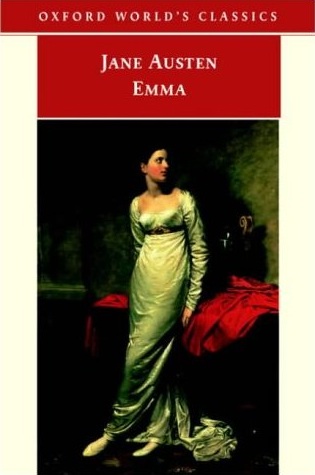
Emma


Emma by Jane Austen. 1815.

Emma Woodhouse, handsome, clever, and rich, with a comfortable home and happy disposition seemed to unite some of the best blessings of existence; and had lived nearly twenty-one years in the world with very little to distress or vex her.

I have a love-hate relationship with Emma. You see, I don't like Emma, the character. On the other hand, Emma is a fun treat because she's so very clueless. She is unaware of herself. She's unaware of the world around her. She just doesn't get it. Once the reader is aware of this, knows that Emma is the joke of the book--an inside joke shared between the reader and the author, then it's a fun book. The reader has a clue while the heroine is helplessly stuck on herself and her misconceptions about reality. Emma may think she's wise in matters of the world, of the heart, of the home. But the reader knows better!

The plot of this one is relatively simple: Emma thinks she's good at matchmaking. Pairing up single men and women. But the fact that she misreads signs of affection and devotion left and right mean that the unfortunate soul she's trying to do good by is in for a messy few months. Emma is the last person who should be giving out advice. In a way, the relationship between Emma and Harriet reminds me of that of Don Quixote and Sancho Panza. Emma is promising Harriet a fine match with a good man, a man of some means, a true gentleman, and handsome too. Just like Don Quixote keeps promising Sancho that he'll reward his service by making him a governor of some province (or the like). But in reality, the faith that their loyal friends place in them is hopelessly misguided.

Of course, the book is more than just about Emma and Harriet. It also features the much-praised Jane Fairfax and the mysterious Frank Churchill. I don't have an opinion of Jane Fairfax really. She's much more patient than I would expect any girl to be under the circumstances. But since we only see her through Emma's eyes, it's hard to know what she's really like. Frank Churchill, I definitely have an opinion of...I think he was awful...and I really have no sympathy at all for him. I think both Emma and Jane have reason to be ticked. And he wouldn't have gotten off that easy if I'd been Austen. Then there is the true hero of Emma, Mr. Knightley. If there is redemption in Emma it is found in the character of Mr. Knightley. He kept me reading.


© Becky Laney of Becky's Book Reviews

Wednesday, November 05, 2008

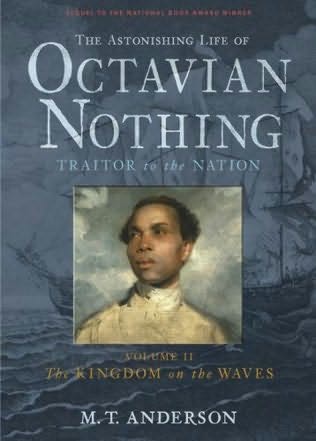
Octavian Nothing Part 2


Anderson, M.T. 2008. The Astonishing Life of Octavian Nothing: Traitor to the Nation: Volume 2: The Kingdom On The Waves.

I'm at a loss of words. I almost think this would take a second reading to cement just how I feel about the second volume of Octavian Nothing. I'll start by saying that I loved the two page summary of the first volume. (Is it wrong to admit that it made me smile?) It perfectly sums up the action and motivations of the first volume. The second volume begins right where the other left off. We've got Dr. Trefusis and Octavian on the run. They're lives are at stake, and they're seeking refuge in Boston--a city which at the moment is under British control. (Call them Tories, Loyalists, Redcoats, whatever.) Both know that Boston is a dangerous city. A city that could fall into Rebel hands. And if and when it does, they know that their lives would be forfeit. There hope is to obtain a place within the British army--on a British vessel or ship. Octavian at last is able to join fellow runaway slaves and enlist in Lord Dunmore's army. He has promised to free the slaves of Rebels if they will join his cause and fight.

Here is the scene where he enlists:
"Your name?" said the Serjeant. "Octavian," said I. "Your surname?" I considered. I would no longer be called Gitney. "I have none," I said. "And ye don't have no master." "I have no master, sir," said I, "except the King." To the tatooed Craigie he said, "Write 'Octavian Negro.'" "While I would not trouble the Serjeant, I would beg--" "What then?" "If it please you, sir, put down nothing for the surname. I would rather be called nothing than be named only for my race." Serjeant Clippinger gave an insalubrious smile. "Octavian Nothing?" said he. I regarded my name. Knowing not who I was, it seemed a fair enough appellation. "Octavian Nothing," I agreed. And thus it was inscribed. (129-130)
Army life is hard. And war isn't all Octavian thought it would be. He is keeping a journal of his life, the events as they unfold. (1775-1776) Along the way, he makes new friends and rediscovers old friends. Pro Bono is back wearing the new name of William Williams. The book is a continuation of his quest for freedom, liberty, and identity.

The book is well-written. And the pacing (or action) is much steadier and more intense than the previous volume. Old characters--Dr. Trefusis, Mr. Gitney, Pro Bono, etc--are there alongside new ones: Slant, Will, John, Pomp, etc. There is much depth--heart and spirit--to the two books. There is much to admire and appreciate within the pages. When you think of it as a coming-of-age story it is quite impressively done. Both books showcase humanity--the good, the bad, the ugly, the abominable, the admirable.

© Becky Laney of Becky's Book Reviews

Sunday, November 02, 2008

Chains


Anderson, Laurie Halse. 2008. Chains.

The best time to talk to ghosts is just before the sun comes up. That's when they can hear us true, Momma said. That's when ghosts can answer us.

Isabel and Ruth are two slave girls who have just been freed by their master's will. Their mistress, Miss Mary Finch, has just been laid to rest. And Isabel, though nervous, is excited about their future prospects. Unfortunately, Mr. Robert Finch, the visiting nephew, has different ideas. Ignoring their protests that they have been freed within Miss Finch's will, he insists that they are his property to sell and make a profit from. His. His. His. And the local pastor who witnesses this exchange, Pastor Weeks, well he supports Mr. Finch in whatever he decides. The girls are told to gather their blankets and shoes and come with him.
These two girls are sold to Mr. and Mrs. Lockton. This wealthy loyalist family owns several properties--one in New York City, one in Charleston, I believe. (It is in the south, that much I know.)

Ruth becomes a favored curiosity for a short while in the Lockton household. Unfortunately, her epileptic seizures bring an end to that status. Mrs. Lockton knows beyond a shadow of a doubt that Ruth is possessed of the devil. And she tries her hardest to convince her husband that the demon-child must go. Her husband refuses, but tells her that the girl can stay out of sight and do her work well away from Mrs. Lockton. Everyone is hoping that out of sight will become out of mind. Isabel, though accused of being too talkative, does her best to stay in her lady's good graces. She still dreams of freedom. But she knows that her place is precarious. That Ruth's place is extremely so. If she wants to stay with her sister, she must be cautious.

But several things tempt Isabel. Freedom. She meets a slave of one of the rebels, Curzon, who promises her that the Rebel Army will reward her if she spies for them. Mr. Lockton is a loyalist. He's a conspirator as well. Curzon knows that she could bring back juicy-and-vital details to the Rebels...if she will be brave enough to risk it.

A nation at war. A young country seeking freedom, justice, liberty. Set in New York City during circa 1776-1777, the story is vibrant and heartbreaking. It's a story rich in detail and emotional and powerful in nature. Isobel's story--her struggles--resonates so deeply that I think this one is a must-read.

My only complaint about Chains is that it's one of those cliffhanger books with a big "to be continued" at the end.

© Becky Laney of Becky's Book Reviews

Monday, August 11, 2008

Don't Talk To Me About the War

Adler, David. A. 2008. Don't Talk To Me About the War.

"Don't talk to me about the war. It's across the ocean, and I haven't even been to Long Island and that's just over the bridge. What I mean is, the war's so far away and we're not even it it. And anyway, it's all Beth talks about, so if there's any war stuff I should know, she'll tell me."

Don't Talk To Me About the War spans the time of May of 1940 through (in the epilogue at least) December 1941. Tommy Duncan. Our narrator is a young boy whose world is about to change. When we first meet him, his primary interest is in baseball. That and hanging out with his friends. Sounds pretty typical, right? True, he is listening to these games on the radio and following his teams in the newspaper instead of watching the games on TV. And what he does with his friends when they're "hanging out" would be different...still there is something universal about Tommy. Especially when it comes to family and friendship and school.

Friendship. His best friend is a girl, Beth. And she's quite a girl--intelligent and compassionate and beautiful. And he's just beginning to notice just how wonderful she is in that way. So innocent, so hopeful, so curious.

Family. His mother is getting sick--really sick--and no one knows why.

School. He hates it. Really hates it. Until he begins to realize that education may just be useful. That there might be a point to all this work.

Don't Talk To Me is about the meaning of life. It focuses on heart and soul issues of what it means to love someone, need someone, want someone. It's about the nature of life itself. The fragility of life. The beauty of life.

Yes, this one is about war--the rightness or wrongness of going to war in the first place. The questioning of what war means. Examining the issues of life, death, and justice. And it is about baseball. Loving the game, following the game, being loyal to your favorite team. And friendship. And first love. And family. It's a novel about growing up, about growing wise, about making right decisions, about loving others more than yourself.

Recommended.

© Becky Laney of Becky's Book Reviews

Ruby's Imagine


Antieau, Kim. 2008. Ruby's Imagine. September 2008 release.

First sentence: A Butterfly the color of my name did tell me that a Big Spin was coming our way.

Ruby, our narrator, is a teen girl with a unique way of seeing the world, a unique way of talking. Let's just say--long story short--that she likes Capital Letters. (I can imagine that this will irritate some readers.) Her own way of speaking does set her apart from others in her New Orleans community, and it irritates the dickens out of the woman who is raising her, Mammaloose, her grandmother. "Mammaloose never hears my words as glad tidings. She says I is constantly putting a target on myself by using my Ruby words." (2) But her best friend, a young guy named Jacob Lazarus, JayEl sees it differently. He appreciates her in a way only a best friend can. One other thing I should mention, Ruby speaks with "Flying People" and "Rooted People." She has a very hands-on approach to nature, and loves to converse with the trees and plants and insects and birds.

Here's just a snippet so you'll see what I mean about Ruby's voice:
I walked the place where I lives--I calls it my Garden of Neighbors--down toward JayEl's Daddy's Corner of Happiness Store. Some people talks about what ward they lives in. I don't do that. I heard Mammaloose once say that calling where you lives a ward make you sound like you living in some kind of institution. I can only be agreeing with her. I says I is a citizen of the Earth and right now I be living in a place somewheres between the old oak next to the yellow-two-story and the gum tree out front of the pale green double shotgun. I lives in the place where the wisteria dips over the fence to hold hands with the magnolia that dips down to say hello to the Place Where My Vegetables Grow. That's where I lives. (11)
Ruby likes to give unique names to all the people and places in her life. In a limited way, I suppose, you could call Ruby a modern-day Anne of Green Gables.

When the book opens, Ruby has just been warned--by a butterfly, though later warnings come from other animals--that a "Big Spin" is on its way. That danger is coming. Danger with a capital D. And Ruby does warn a few folks as the days pass, but it isn't until the radio and TV start talking about a hurricane--a big hurricane--Hurricane Katrina--that folks really start listening. But listening doesn't mean acting, not necessarily. Ruby and her friends--some by choice, some not so much--do end up braving the storm right where they are, in their own homes.

And it is when the storm hits that Ruby's Imagine transitions from a slightly-irritating, slightly jarring book to a true page-turner. The more intense the action--the storm and its aftermath--the more "normal" Ruby becomes. Her speech, her thoughts, change and shift. In the heat of the moment at least, Ruby is too focused on surviving, on clinging to her friends and family, to "bless" the readers with her uniquely capitalized take on the world around her.

The second half of the book is a page-turner. It is here that the action begins to happen. Here where characters begin to develop, begin to matter. Here where family secrets get thrown to the surface. The book loses some of its foolishness and gets down to business.

The book--especially the second-half--is interesting and worth reading. It's not flawless. I can imagine some readers will feel *elements* of the story to be a bit unbelievable, a bit too coincidental. But at the same time, those elements feel good even if they're not quite credible. I can't go into details of exactly what I mean because it would spoil the story. But if you've read it, you'll probably be able to guess what I'm referring to.

I really really enjoyed Mercy, Unbound.

© Becky Laney of Becky's Book Reviews

Wednesday, July 30, 2008

Travel the World: Sweden: I Need You More Than I Love You


Ardelius, Gunnar. 2008. (November release). I Need You More Than I Love You And I Love You To Bits. Translated by Tara Chace. Frontstreet Books.

Not quite poetry, not quite a novel, I NEED YOU MORE THAN I LOVE YOU... is a verse novel of sorts about the joys and sorrows, ups and downs, of young love, of first love. Told from both the male and female perspective, it has a little bit of everything emotionally speaking. It does share quite a bit of the couple's intimate moments, and because of this 'adult nature' of the work, it may not be appropriate for younger teens. But for older teens, it has its rightful place.

Here is the first piece,

Her foot slides over and then back, cautiously
stroking the toes of his left foot. His head quivers
when he glances up and catches her gleaming
eyes, as wide as fie kronor coins. He blushes,
noting the soft tug at his heart.

And here is another a bit further on (p. 37)

My taste has changed. The love songs on the
radio have started describing how everything
really is. I'm not sure I can deal with being
happy, it feels like I'm made out of play dough.
I don't want to be in love like that, like all the
other boring people. Our love is different. It's
about us.

Anyway, it's a nice enough book. These two young lovers are ordinary folks who do ordinary things. They're in and out of love and confused at times. Sometimes they're fighting with their parents. Sometimes they're at odds with the world around them. Sometimes nothing seems to be going right. Sometimes it does.

© Becky Laney of Becky's Book Reviews

Monday, July 28, 2008

Nonfiction Monday: She Touched the World

Alexander, Sally Hobart and Robert Alexander. 2008. She Touched the World: Laura Bridgman, Deaf-Blind Pioneer.
Introduction:
If you had lived in 1841, the name Laura Bridgman would have echoed through your home, your school, your neighborhood. It would have rung out in the streets of Boston, in the halls of Congress, and across the ocean to England and Europe and beyond. By the time Laura Bridgman was twelve years old, she was that famous.
Like all children, you would have loved and admired her. You would have named your favorite doll after her...and then you would have poked out the doll's eyes.
Did that intro make you as curious as it made me? Laura Bridgman first came to my attention last year. She was mentioned briefly in the oh-so-wonderful-and-amazing Miss Spitfire by Sarah Miller. When I saw her name pop up here, I knew I had to read this one and find out more.

Laura Bridgman was not born deaf nor blind. Both were the result of a childhood illness--well, an illness when she was a toddler. This book is the story of how she learned--with much help--to function and communicate in the world. At this time, there was no "help" to be had. No one had ever successfully taught someone who was both deaf and blind to communicate with others. There was no tried-and-true methodology in place. Dr. Samuel Gridley Howe, a doctor and an educator, saw great potential in Laura Bridgman. While he had tried and failed in other cases (all adult cases I believe), he was ready to try again this time with a much younger student.

The book is well-written, well-researched, and interesting. The attention to detail amazed me--I certainly wasn't expecting that much from the book. And it truly is a fascinating story.

Sarah Miller's review.

© Becky Laney of Becky's Book Reviews

Thursday, July 03, 2008

Shift


Agell, Charlotte. 2008. Shift.
"Mom and I have been having the same argument for so many weeks now that we've got it down cold. We can run the long version or the short version, depending on what's up, but it never really changes. It would be funny, if it wasn't boring me to death.

"Adrian, you have to sign up for Vacation Bible School." She usually has her arms crossed, as if that makes what she's saying more serious.
"No."
"It's a graduation requirement now. You know that."
Silence. I can say a lot by not talking.
"If you don't do it soon, it's going to be too late" (5)
Set in a futuristic America, Homestate, where a DISASTER has ushered in a theocratic regime, Adrian and his sister, Shriek (Melody), are soon forced to decide between going with the status quo or making a run for it--through the dangerous Deadlands--and heading North to freedom and the unknown.

From the author's site:
Shift is coming . . . will it be the end of the world? Fifteen year old Adrian lives in a time and place where church has rejoined state. Christianity is required by law. His father is missing in action and his mother must be very careful. She is a scientist who works for the highly suspicious regime. In his quest to untangle all the threads of his life, Adrian heads north across a nuclear wasteland, with his psychic little sister Shriek, an assistant zookeeper named Lenora, and a rescued penguin. Ultimately, he must face down the clumsy but awful forces of evil, deep inside a mountain in what once was Maine. Will he save the world? Will he save himself? Will the earth itself crumble and crack? Stay alert...Shift is nearly here!

Shift had all the makings of a book that I would love, love, love. It's dystopia. It's "end of the world" type drama. On the surface, the premise sounds genuinely interesting. For me, however, it was just an okay read. This is one of those books that exploits "Christianity" and makes it look so unmistakably evil that even though the version of Christianity represented is way way off the deep end (a completely false faith), there isn't anything to counterbalance the insanity. It just uses the narrative to deliver its own new-age-type message.

S
p
o
i
l
e
r

This "Christian" government is manipulating the populace--enforcing belief and faith--through showing false miracles, signs, wonders, etc. They use science and technology to "fake" the signs of apocalypse and the second coming of Christ. They use "Jesus" as a mouthpiece for their government, but the message and messenger are of their own making.

In some ways, Shift reminds me of C.S. Lewis' novel THE LAST BATTLE. In fact, one of the main characters in Lewis' novel is an ape named Shift. A fact I find just a little interesting. In The Last Battle, an ape and a donkey team up--the ape is the mastermind behind the act--to impersonate the lion Aslan. The people fall for this despite the signs not quite lining up. This "Aslan" is different than everything written about him. The message "Aslan" is spreading is contradictory to everything that is known about him. Yet a donkey-in-a-lion-suit fools the masses. When the truth comes to light, the people use this to assume that there was no Aslan to begin with. That the whole idea of Aslan was a sham, a fraud. In the same way in Shift, there are people, the government, the regime, that manipulate the text of the Bible and who use devious means to bring this 'to life' to make a 'show' of the Bible's teachings. But just because the people thumping the Bible in this case are wicked, doesn't make the Bible less true. In Lewis' novel, while the masses get fed up with religion and faith and spirituality, there are handful of believers that do get it. In this novel, Shift, there are no positive representations of Christians. Christians just equal evil in this novel and that is really sad.

© Becky Laney of Becky's Book Reviews

Thursday, June 05, 2008

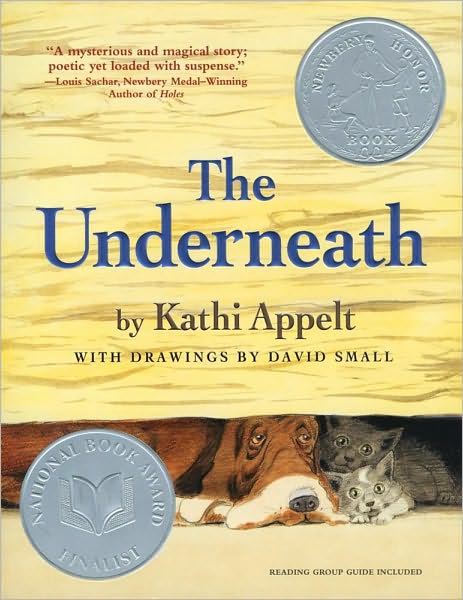
The Underneath


Appelt, Kathi. 2008. The Underneath.

The Underneath is a novel that I would have avoided (at all costs) as a kid. I was a wimp. Big-time. Seeing the dog and two kittens on the cover? That would have made me suspicious or wary from the get go. Reading that it is for folks who love, "Sounder, Shiloh, and The Yearling" would have sealed the deal. I wouldn't have gone near this one. No way. No how.

As an adult, however, how can I help but fall in love with The Underneath? It's beautiful. It's simply beautiful. Like a love letter to the English language. Appelt's poetic style suits this prose novel achingly well. (Appelt has written several poetry books, a short story collection, and more than a few picture books. I've had the pleasure of meeting her as well and have quite a few autographed copies.) Appelt's storytelling is powerful, effective, and oh-so-magically spellbinding.

There is nothing lonelier than a cat who has been loved, at least for a while, and then abandoned on the side of the road. A small calico cat. Her family, the one she lived with, has left her in this old and forgotten forest, this forest where the rain is soaking into her soft fur. (1)

The Underneath is about friendship, about love, about hate, about sacrifice, about revenge, about death, about life in all its shades and colors. It's bittersweet but beautiful. It's sorrows and joys are pure and heartfelt.

For cats, a hound is a natural enemy. This is the order of things. Yet how could the calico cat be afraid of a hound who sang, whose notes filled the air with so much longing? But when she got to the place where the hound sang, she knew that something was wrong. She stopped. In front of her sat a shabby frame house with peeling paint, a house that slumped on one side as if it were sinking into the red dirt. The windows were cracked and grimy. There was a rusted pickup truck parked next to it, a dark puddle of thick oil pooled beneath its undercarriage. She sniffed the air. It was wrong, this place. The air was heavy with the scent of old bones, of fish and dried skins, skins that hung from the porch like a ragged curtain. Wrong was everywhere. She should turn around, she should go away, she should not look back. She swallowed. Perhaps she had taken the wrong path? What path should she take? All the paths were the same. She felt her kittens stir. It surely wouldn't be safe to stay here in this shabby place. She was about to turn around, when there it was again--the song, those silver notes, the ones that settled just beneath her skin. Her kittens stirred again, as if they, too, could hear the beckoning song. She stepped closer to the unkempt house, stepped into the overgrown yard. She cocked her ears and let the notes lead her, pull her around the corner. There they were, those bluesy notes.
Oh, I woke up, it was rainin',

But it was tears came fallin' down.

Yes, I woke up, it was rainin',

But it was tears came fallin' down.

Can't you see I'm tryin'?
Can't you hear my cryin'?
Can't you see I'm all alone?

Can't you throw this old dog a bone?

Then she realized, this song wasn't calling for a bone, it was calling for something else, someone else. Another step, another corner. And there he was, chained to the corner of the back porch. His eyes were closed, his head held back, baying. She should be afraid, she should turn around and run, she should climb the nearest tree. She did not. Instead, she simply walked right up to this baying hound and rubbed against his front legs. She knew the answer to his song, for if she could bay, her song would be the same. Here. Right here. Ranger. (9-11)
I really can't recommend this one highly enough.


© Becky Laney of Becky's Book Reviews

Thursday, May 08, 2008

Crispin: The Edge of the World

Avi. 2006. Crispin: At The Edge of the World.

Have you ever loved a book so much you ended up hating it? I read the first Crispin book a few weeks ago. (Click here to refresh your memory unless you're perfect and know-it-all.) I didn't know what to expect with the first one, but I went into the second with very high hopes. There proved my mistake. It's not that it's awful. It's not. It's that I'm a baby. Let me clarify, the tone of both books is a balancing act between hope and despair and life and death. Crispin is an orphan on the run. In the first book, he teamed up with a man named Bear, a man who was flawed it's true, but a man who was as good as a man could be when it came to loving and protecting and teaching a young boy in great need. It was interesting. It was suspenseful. It didn't end on the brightest note, but it was relatively good ending. Meaning that there was still hope but plenty of doubt and danger thrown in as well.

Crispin: At The Edge of the World opens right where Crispin ended. But in this case, I would have probably been better off not knowing what happened next. My imagination being much kinder towards these characters than Avi's proved to be. Don't get me wrong. My imagination would have been in fantasy land. Clearly in the territory of happily-ever-after. Avi's was much more realistic, much more rustic and down-to-earth. Humanity is very flawed in Avi's novels and that makes them authentic. This book drowns in reality--the death, the danger, the disease, the despair, the confusion--so it may be authentic and true to the time period. Politics and war were deadly, have always been deadly. We do meet a few new characters in this one. And Crispin does make another connection, another friendship, he gets a "sister" of sorts. But everything about this novel--almost--is just so dark and so depressing.

Maybe it's a mood thing. Maybe I'm just being a baby not wanting a certain someone to die. Maybe I'm being a baby because I don't like the characters always always always being on the edge of certain disaster and death. Maybe I like my characters to be safe and loved and happy. I'm sure it's a mood thing. I can handle death and grief and despair at certain times, many a dark book has gotten a good review. But this one, for some reason, I just wanted it to be completely different than what it was. Dare I say, I think I want this one Disney-fied.

© Becky Laney of Becky's Book Reviews

Wednesday, February 14, 2007

Fever, 1793

Anderson, Laurie Halse. 2000. Fever 1793.

Set in Philadelphia in 1793, FEVER follows the spread of yellow fever within the community through the eyes of a young girl, Mattie (Matilda). Mattie's family owns a coffeehouse. At first, when the epidemic first begins their side of town has not been effected yet. In fact, their business is booming because people are scared to go to certain streets/places in town. But all that changes as the disease makes it way through town. Young, old, man, woman...all are at risk...all are at danger. Mattie is no stranger to danger as she watches her mother get sick. Soon her and her grandfather are packing up what they can and trying to leave town. There is a family in the country where they feel they'll be safer. But are they taking the danger with them into the country? Is any place really 'safe' with an epidemic this size? The novel traces the epidemic from August to December. It is a personal, emotional journey of struggles, sorrows, and endurance.

This book pairs excellently with the nonfiction book An American Plague: The True and Terrifying Story of the Yellow Fever Epidemic of 1793 by Jim Murphy.

http://www.writerlady.com/fever1793.html
http://www.writerlady.com/fever1793_teachers.html

Monday, December 04, 2006

Celebrating 100

Today's post is my 100th! I am planning on some other special posts later in the week celebrating my favorite literature. But today I have for you another review.

Armstrong, Jennifer. 2006. The American Story: 100 True Tales From American History

This rather heavy book entitled simply The American Story: 100 True Tales from American History is written by Jennifer Armstrong and illustrated by Roger Roth. It features 100 small portraits of American history from the sixteenth century (1565) to the twentieth century (2000). Some stories are about famous people, places, or events. Other stories are truly unexpected gems highlighting some forgotten heroes and the like. Others highlight some of America's greatest legends. Some stories feature notes that provide more details. It also features Story ARCS (subject guide), bibliography, and index. Readers will find familiar tales about George Washington, Benjamin Franklin, Paul Revere, Thomas Jefferson, Abraham Lincoln, etc. But they will also find unfamiliar tales. Ordinary tales of what makes America great.

Here is just a highlight of what you can find within its pages:

1655 Keeping Watch, Keeping the Faith

New Amsterdam. The governor-general Peter Stuyvesant is unhappy when the first Jewish immigrants fleeing from Catholic Spain (during the Inquisition) arrive. Wanting at first to throw the Jews out of his city altogether, he is refused permission by the Dutch West India Company. But he's a persistent man "determined to place as many restrictions on the Jews as possible. He would not allow them to become burghers, or citizen. They were not to be trusted to keep the watch but instead would have to pay a fee to make up for not performing guard duty" (21). One Jew, Asser Levy was equally persistent. Determined to prove his worth, he refused to pay the tax and began (without permission) to join the other men in guard duty. "He marched with the burghers, kept guard duty with the burghers, and acted like a burgher, until there was no one in New Amsterdam who could honestly say that he was not a burgher. By his unceasing efforts to keep the watch, Asser Levy at last gained the rights of citizenship for all the Jews of New Amsterdam, and there was nothing that Peter Stuyvesant could do about it" (22). Armstrong's note further elaborates: "Asser Levy became the first Jew in North America to own a house and to sit on a jury, and he was a founding member of the first Jewish congregation, Shearith Israel. By 1662, he was one of the wealthiest men in New Amsterdam" (22).

1804 Going Bananas

In this brief story, readers find out the fascinating history of America's importation of bananas. "But possibly the most unusual thing brought into the harbor [of New York City] in 1804 was a shipment of bananas from Cuba" (63). People had no idea what they were or how you ate them. So they rotted. "The next time bananas made an appearance was in 1830, and pushcart vendors at the docks bought the ripening fruit to sell that very day before it spoiled. As the decades wore on, more and more people were introduced to the banana, but for a while it was so exotic that it was reserved for special occasions such as wedding banquets and holiday feasts. In 1876, bananas were sold at the Centennial Exhibition in Philadelphia for a princely ten cents each. By the turn of the century, tropical fruits were so popular that the country was willing to go to war to protect its agricultural business interests in the Caribbean. By 1905, a mere 101 years after its introduction to the United States, the banana was so popular and so easily available that it was known as the 'poor man's fruit.' Today it is the most widely eaten fruit in America" (64).

1812 Uncle Sam

If you're like me you might have always secretly wondered what the deal was with "Uncle Sam" and how "Uncle Sam" became a patriotic symbol in this country...Armstrong presents this fascinating story. In 1812 during the war with Britain, America needed to keep soldiers and sailors well supplied and fed. A meat packer in Troy, New York, Sam Wilson was given a contract to supply soldiers (and sailors) with cured beef in barrels. Since each barrel was intended for the government, it was stamped U.S. But "since Wilson was known locally as Uncle Sam, people began saying 'U.S.' stood for Uncle Sam Wilson" (69). "And as the barrels rolled their way down from New York, the term rolled along with them...eventually the entire nation adopted Uncle Sam as the nickname for the federal government" (70).

1849 This Side Up

Henry Brown's story is a fascinating one. Born a slave on a plantation in Virginia, he remained a slave most of his life until one day while he was praying an idea came to him. "One night while he prayed for deliverance, the word "box" came into his mind. I'll put myself in a box and mail myself to freedom, he thought with wondering awe. He could deliver himself" (99). With help from some local sympathizers, he mailed himself to an abolitionist in Philadelphia. "The box they constructed was just big enough to hold him. It was two and a half feet deep, two feet wide, and three feet long. They lined the rough boards with cloth and drilled airholes for ventilation. Henry packed a canteen of water and supplied himself with some biscuits" (100). Though the box said "This Side Up: Handle With Care," his journey was not easy but when he arrived he was finally free.

1851 Ain't I A Woman

I won't go into too many details here, but I am so glad that Jennifer Armstrong chose to include the story of Sojourner Truth in her collection. Her speech, which Armstrong highlights extensively, is such a powerful piece of literature. I am happy that young readers will discover this story long before they reach college literature classes which is where I discovered this gem.

1884 Hold Your Horses, Here Come The Elephants!

A year after the Brooklyn Bridge opened, people were still fearful that the bridge would collapse. Enter onto the scene P.T. Barnum and his circus, and the crowd need never fear the bridge's stability again: "Barnum would march part of his parade from Manhattan to Brooklyn, across the bridge. The sacred white Incian elephant that had joined Barnum's circus was a celebrity attraction, but no elephant in the world could match the mighty Jumbo in popularity" (161). His circus parade concluded with Jumbo bringing up the rear. "The most prodigious pachyderm in the known world came marching along on ponderous feet, flapping his great ears and tossing his trunk in the air. 'Hooray for Jumbo!' came shouts of delight. Horses reared and snorted at the wild-beast smell of the elephants, and the toll keeper at the end of the bridge let the parade through without asking a nickel: he didn't know what toll to charge an elepant" (162).

1907 The Woeful Plight of Mary Mallon

Typhoid Mary's story told in a kid-friendly style.

1956 All Shook Up

The story of Elvis.

1980 The Fire Mountain

The eruption of Mount Saint Helens.

Each story varies in length between two to five pages, often depending on how large the accompanying illustrations for that particular story are. It concludes with the election of 2000. It is arranged chronologically, but readers will find it easy to browse and scan as well. The subject guide at the back of the book is also convenient for making connections and establishing patterns in history.

Thursday, November 30, 2006

The Nothingness of Octavian

Anderson, M.T. 2006. The Astonishing Life of Octavian Nothing: Volume 1: The Pox Party.

Unless the 'astonishing' quality of this book is how boring it is, Octavian Nothing is anything but astonishing. That doesn't mean that critics aren't praising Octavian, they are if the National Book Award is any indication. It won in the category of 'Young People's Literature.' Here is how they described this book: "Set against the disquiet of Revolutionary Boston, this novel, the first of two parts, re-imagines the past as an eerie place that has startling resonance for readers today." I have two comments. First, The National Book Award has in my opinion always been slightly out of touch with reality. When a book wins an award decided by adults it doesn't reflect or have any connection with how that book will appeal to its targeted age group. Sometimes a book wins that does. Sometimes the book is a dud. Second, I would like a full ten-page explanation as to how the book could possibly have any startling resonance for readers today. Seriously. The book is boring, boring, boring. Then dull. Then back to boring. The only thing that resonates in this reader's mind is: how could a book EVER be so boring and unappealing? In case you're thinking that I am put off because it's historical fiction, know that historical fiction is one of my favorite genres. I am also not put off by the novel's length, theoretically speaking. Its 351 pages is only tedious because of the book's content and drudgery style.

Octavian Nothing is set in Boston in the early years of the Revolutionary War. It is his 'memoir' of his unusual life beginning with his earliest recollections and continuing at least through his fifteenth or sixteenth year. He is a slave, though for the first eight to ten years he is unaware of this fact.

Right thinking is ever a battle, and often I cast my mind back to these early lessons and pursue these early ideals, though now the ghastly purpose of that dim college has been made clear to me; and he who ran it appears to me not like a man but some monster who instructed me, some beast endued with the speech of man, as the centaur Chiron wrote out lessons for young Achilles with his human hands, and spake his lectures with his human mouth, while his glossy hindquarters dropped faeces upon the Senate lawn. (12)

A man in a topiary maze cannot judge of the twistings and turnings, and which avenue might lead him to the heart; while one who stands above, on some pleasant prospect, looking down upon the labyrinth, is reduced to watching the bewildered circumnavigations of the tiny victim through obvious coils--as the gods, perhaps, looked down on beseiged and blood-sprayed Troy from the safety of their couches, and thought mortals weak and foolish while they themselves reclined in comfort, and had only to snap to call Ganymede to their side with nectar decanted.(37)

And so the answer to my perplexities, which must appear in all its clarity to those who look from above, was finally clear to me: that I too was the subject of a zoological experiment (51).

And in case you hadn't picked up on it, the language, sentence structure, and style of Octavian Nothing is grandiose, archaic, and rarely if ever 'resonate.'

Here is how Octavian describes his tutor:

His knowledge was prodigious; his mastery of philosophic depths was total, though his notions were somewhat eccentric. He worked with me word by word, leaning over my shoulder as I parsed my way through Tacitus and Homer; which instruction much have seemed to him not unlike the sea-captain, who having braved the catastrophic blasts and giddy precipices of the maelstrom, and but skated to their side; having passed with expert haste through the clashing Simplegades; having sat in the sick green eye of the hurricane, surrounded by the hulking wrecks of other, less fortunate, fleets; now wades with a little nephew in the warm shallows, collecting trash and pretty bits of shell. He must have looked out to sea with his glass sometimes, and wished for the spray, and men with whom he could truly speak of the rigors of navigation. (58-59)

Perhaps the only resonate line in the book I discovered was: Shed no tear for me; for I shed none for myself(67).

Add to the confusing language and style of the text the fact that only three or four people are given names and the rest are referred to by numbers. It is hard as a reader to care about these characters and what happens to them. How can you get emotionally involved with someone named 03-01 or 09-01, etc.

What I will grant is this, after about 130 or 150 pages into the novel, the reader is finally able to get adjusted to the style and begins to warm up slightly to these characters. But before that each page is dull drudgery. And I ask you this...what reader...what young reader...would ever be patient enough to sit down with a book that is so boring and dull and pointless for over a hundred pages? It is only towards the end of the novel when Octavian is beginning to contemplate escaping from his masters, once he becomes more like the 'average' slave--forced into work, receiving beatings and punishments--that the book becomes slightly worth all the effort the reader had put into it up until that point.

This is hardly best-book-of-the-year material, but I'm sure other best-lists will follow suit and pay homage to this National Book Award winner. My opinion, this is a year where the winner is a fine example of the Emperor's New Clothes. Lots of praise, lots of acclaim and prestige, but the average, honest reader (with a head of common sense) will find a whole lot of nothing.


http://www.nationalbook.org/nba2006_ypl_anderson.html

Saturday, September 09, 2006

Elephants On Parade

Today I am bringing you reviews of three nonfiction picture books on one of my favorite subjects: elephants. These three books highlight the talents and majesty of these magnificent animals. Ballet of the Elephants by Leda Schubert tells the true story of how a team of talented individuals taught a group of fifty elephants an intricate (meaning complex) dance number. Elephants Can Paint Too by Katya Arnold explores the more artistic and creative side of elephants. The third book, An Elephant In the Backyard, shows an intimate picture of how elephants and humans live and work together in Thailand.

Schubert, Leda. 2006. Ballet of the Elephants.

BALLET OF THE ELEPHANTS by Leda Schubert is a charming book telling the story of three talented men and fifty performing elephants. In April 1942, a unique show opened: Circus Polka, the brainchild of three men with very different backgrounds: John Ringling North, George Balanchine, and Igor Stravinsky. The book briefly describes the individual lives of the three men, the collaboration between the three men in the creative process, the training of the elephants in preparation for the show, and the show itself. The book concludes with background notes from the author which adds even more interest to the book. For example, the author notes that during her research she learned that "the elephants, even when they retired, so loved the ballet and were so well trained that they performed it all by themselves, without music." There is also a black and white photograph of the real performance!

Arnold, Katya. 2005. Elephants Can Paint Too.

ELEPHANTS CAN PAINT TOO is a great nonfiction book for young readers. Arnold takes a simple and informative approach to writing. “I teach in two schools. One is in the city. The other is in the jungle. Some of my students have hands. Others have trunks.” She then proceeds to show page by page the similarities and differences between teaching painting to human children and to elephants. Informative sidebars provide more information about elephants without interfering with the flow of the simple text. “Some students eat grass. Others eat peanut butter and jelly. But they all love cookies.” The corresponding side bar reads “Elephants are vegetarians that eat grass, leaves, twigs, and fruit. They also like human food, especially ice cream. Each day they eat about three hundred pounds of food (as much as twelve cows eat) and drink thirty-five gallons of water (as much as a whole bathtub full). They use their trunks to put the food into their mouths and to slurp up the water.” Arnold’s use of comparisons is useful for explaining things to both children and adults. Her writing can also be humorous, one sidebar reads, “Elephants have 150,000 muscles in their trunks. (Our entire body has only 639 muscles.) Some elephants hold the brush by wrapping their trunks around it. Others hold it inside their trunks. If an elephant throws the brush away or eats it, he probably won’t become an artist.” But by far the greatest highlight of ELEPHANTS CAN PAINT TOO are the photographs by the author, Katya Arnold. There is an author’s note providing more information about how you can buy elephant art and support the Asian elephants.

Sobol, Richard. 2004. An Elephant In the Backyard.

Set in Tha Klang, Thailand, AN ELEPHANT IN THE BACKYARD is the latest photo essay picture book by Richard Sobol. Engaging text and photos invite children to explore a unique Thailand village where elephants play an active role in the human community. "Like most villages in Thailand, Tha Klang is filled with all kinds of people...But what makes Tha Klang different from other villages is that it has elephants, too. For the children of Tha Klang, elephants are part of their families." The heroine of AN ELEPHANT IN THE BACKYARD is the village's most famous elephant, Wan Pen. This special elephant is introduced as the four-legged sister of Jak and Muay. "She is friendly and gentle, happy to walk through the neighborhood with the children riding on her back, stopping to pick up friends who run alongside, eager for a ride." Full of factual trivia about elephants and Thailand, Sobol shows readers a whole new world where elephants walk on balance beams, play soccer with the local kids, and attend school--elephant school that is! "Her lessons look more like gymastics class. Even though she weighs as much as a car and has a big fat belly, she learns to balance and walk on narrow boards and steps. She can bow and kneel, dance and shake her butt, and even raise her trunk to say hello or ask for food or drink."

Combining interesting facts with engaging--almost unbelievable--photos, AN ELEPHANT IN THE BACKYARD is an enjoyable book for kids of all ages. Sobol also provides his readers with additional facts about elephants in his afterward.

Thursday, August 31, 2006

Mercy, Unbound

Antieau, Kim. 2006. Mercy Unbound

Mercy is a fifteen year old girl with an eating disorder; she's on the verge of starvation when her parents send her to a treatment facility in New Mexico. But these facts, clearly evident to the reader, allude the patient in question.

Kim Antieau has created an incredible novel narrated by Mercy. Seen through her eyes, her warped, diseased perspective, Mercy is not sick. She doesn't need treatment. Her problem? No one believes what she holds to be true. Mercy is an angel-in-disguise whose wings are always days away from sprouting on her back. She feels the wings itching beneath the surface. She sees the world differently. She feels that once she is an angel she can help people...she could help ease some of the world's pain. As a human, she's useless...but as an angel there's endless possibilities for her to change the world. Food just stands in the way of her destiny. Angels don't eat. And she is almost there. If only people wouldn't pressure her, they would see the truth...

Mercy's breakthrough from almost-insanity to recovery leads the reader on an exciting, realistic journey of the psychological impact of eating disorders.

http://kimantieau.com/