Showing posts with label "D" Titles. Show all posts

Monday, May 18, 2009

Dragon Spear (MG, YA)


George, Jessica Day. 2009. Dragon Spear. Bloomsbury.

"It's a bucket of sand," I said.
"Yes, yes, it is!" Luka was still grinning at me with delight. "Black sand. And we got six bucketfuls!"


Dragon Slippers. Dragon Flight. And now Dragon Spear. This novel continues the adventures of Creel and her friends both human and dragon. If you haven't read the first two books, then this review may reveal spoilers for the first two books. If you've read the first two books, then you'll probably want to read the third one regardless of what I have to say about it! But I will try my best to not have any spoilers about the third one.

Creel is engaged! She's marrying Prince Luka! The date has been set. The plans are underway. Including elaborate plans for her wedding gown--but will the plans go off without a hitch? What do YOU think? Can any wedding really truly go according to plan down to the last little detail? Luka wants the marriage, not the wedding, so he'd be more than thrilled if she'd consent to elope with him. Or if she'd settle for a very small, very private wedding. But Creel--dressmaker that she is--wants to make the PERFECT dress. And a perfect dress needs to be admired, right? If only she could uninvite some of her guests. If only her true friends could be there for her big day. Why oh why did the dragons have to be banished? Why oh why did her family have to come. Her bossy mean old aunt! Her scheming aunt that thinks this is the perfect opportunity for her daughters to marry well. The only person she's happy to meet again is her brother, Hagen.

When the novel opens, Creel and Luka are preparing to go on an extended vacation together to go visit the dragons in their new home, their very beautiful and exotic island home. (Complete with fainting goats). How are the dragons settling into their new home? Are her dragon friends doing well since 'peace' has come into the land?

The heart and soul of this one--like the others--is found in the dragons. Creel has a special bond with the dragons. And her destiny seems to be tied in with hers. The book presents a new danger complete with life-threatening adventures and challenges.

Did I like it? Yes! I don't know that it was as magically thrillingly wonderful as the first in the series. But I love these characters and want to read about them. I'm always happy to get reacquainted with Luka and Creel.

Can it stand alone? Yes and no. I think it's best read as part of the whole. But the book does include little asides--especially in the beginning--that stand as explanations about this world George has created. These catcher-uppers help with characters and setting. So everything you *need* to know for the book to make sense is there within this one volume. Not all fantasy books are that helpful. And some fantasy books that do are too helpful. This information can bog down and be too obvious. But not in this case. Not at all. So if it's been a while since you read the others, or if you're just jumping in now, then I think you'll do fine.

© Becky Laney of Becky's Book Reviews
If you're reading this post on another site, or another feed, the content has been stolen.

Tuesday, April 14, 2009

Someone Like You


Dessen, Sarah. 1998. Someone Like You. Penguin. 281 pages.

I loved this book. I did. If you haven't read Sarah Dessen, you really should. Dessen, in many ways, is in a class all her own. There's the typically-delightful reading of a YA romance. (Something that I do a good bit of. And I enjoy almost everything in varying degrees.) And then there is the oh-so-wonderful-and-satisfying reading of a Dessen YA romance. There's just something about her work that is better, deeper, fresher. (I don't think awesomer is a word.)

In Someone Like You, we've got our heroine, Halley, and her best friend, Scarlett. When the novel opens, Halley is at summer camp when she gets the call that Scarlett's boyfriend, Michael, has just died. And so this often raw always emotional story begins. A story of friendship and love as Halley helps her friend through this trying time but also of loss and confusion as Scarlett discovers that she is pregnant and decides to keep the baby for better or worse. But this isn't just a story of Scarlett's life, of Scarlett's troubles. No, Halley has a life of her own. And her junior year is getting off to a weird--but wonderful--start when she begins falling for Michael's best friend (and ever-so-bad-bad), Macon. As her own relationship gets started, she's ever-questioning her life and love. Is she ready to go all the way? Does Macon love her even if he never says he does? Is she ready to open up herself to that kind of risk? Not only the risk of pregnancy, but the risk of having her heart trampled on by a boy who is more elusive than not. How much does she really know about him? about herself?

The story is compelling. It's masterfully told by Dessen.

Some of my favorite bits:

When I think of Michael Sherwood, what really comes to mind is produce. (41)


Halley's first conversation with Macon (which happens while they're waiting to speak to the school counselor.) He's in trouble; she's looking to change her schedule.

"Now, you know how to handle yourself in there, right?"
I looked at him. "What?"
"How to handle yourself," He blinked at me. "Oh, please. You need big help. Okay, listen up. Firs, admit nothing. That's the most important rule."
"I'm not in trouble," I told him.
"Second," he said loudly, ignoring me, "try to divert them by mention anything about your therapist. For instance, say, 'My therapist always says I have a problem with authority.' Act real serious about it. Just the word 'therapist' will usually cut you some slack."
I laughed. "Yeah, right."
"It's true. And if that doesn't work, use the Jedi Mind Trick. But only if you really have to."
"The what?"
"The Jedi Mind Trick." He looked at me. "Didn't you ever see Star Wars?"
I thought back, "Sure I did."
"The Jedi Mind Trick is when you tell someone what you want them to think, and then they think it. Like, say I'm Mr. Mathers. And I say, "Macon, you're already pushing the limits and it's only the first day of school. Is this any kind of way to start the year?' And you're me. What do you say?"
I shook my head. "I have no idea."
He rolled his eyes. "You say, 'Mr. Mathers, you're going to let this slide, because it's only the first day, it was an honest mistake, and the fire got put out as quickly as it was started.'"
"The fire?" I said. "What fire?"
"The point is," he said easily, flipping his hand, "that you just say that right back to him, very confidently. And then what does he say?"
"That you're crazy?"
"No. He says, 'Well, Macon, I'm going to let this slide because it's only the first day, it was an honest mistake, and the fire got put out as quickly as it started.'"
I laughed. "He will not."
"He will," he said, nodding his head. "It's the Jedi Mind Trick. Trust me." And when he smiled at me, I almost did. (54)


© Becky Laney of Becky's Book Reviews
If you're reading this post on another site, or another feed, the content has been stolen.

Wednesday, February 04, 2009

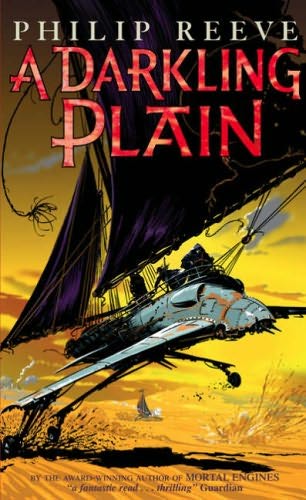
Travel the World: England: A Darkling Plain


Reeve, Philip. 2006. A Darkling Plain. (The Hungry City Chronicles #4). HarperCollins. 559 pages.

Theo had been climbing since dawn; first on the steep roads and paths and sheep tracks behind the city, then across slopes of shifting scree, and up at last onto the bare mountainside, keeping where he could to corries and crevices where the blue shadows pooled.

I don't know if A Darkling Plain was all that much longer than the previous three books in the Hungry City Chronicles, or if it just felt like it. The book is a direct sequel to Infernal Devices. In many ways this is where it all happens, where it all goes down. All the books leading up to this point, this big showdown between warring powers. More action, less set-up. And action is good, right? But here's the thing, I personally liked the less climatic but funnier books which set this one up. That's just me.

There are so many characters--some we've known all along like Stalker Grike, Tom Natsworthy and Hester Shaw; others are newer to us like Wren Natsworthy, Fishcake, and Theo; some have been renamed like Lady Naga; others are completely new. (And let's not forget my personal favorite, Pennyroyal). And the plot is so complex. I'm not even going to try to go there. Needless, to say the "fate" of Earth is to be decided upon in this final book in the Hungry City Chronicles.

I will spend a few minutes, however, trying to convince you that you should read the series for yourself. I liked this series for the most part. The characters were well done. No character was all good or all bad. Most of the 'bad' guys had something about them that made them just a smidgen likable. If not likable, at least understandable. I don't know about you, but one of the things that drives me crazy is when bad guys are bad for no reason. When writers fail to develop these villainous characters, when they expect us to buy into the idea that they're evil incarnate pure and simple and without any humanity at all. The characters are complex. And that's a good thing. No where is that truer than in the case of Hester Shaw, a true love-to-hate, hate-to-love mess of a character. We're conflicted because she's conflicted. The characters are also memorable. Good, bad, or somewhere in between, I don't think I'll be forgetting Pennyroyal or Grike anytime soon. I liked the humor. Yes, this was serious end-of-the-world type drama, but there were enough purely funny moments that it was a delight to read. Mind you, I wouldn't want to live in this world! Bad things can and do happen. The books also had plenty of action and drama. I'm not all-about-action, I'm more character driven than plot driven...but I know plenty of readers who want fast-moving plots--action and adventure and danger and the like. This book had it and then some.


© Becky Laney of Becky's Book Reviews

Sunday, November 23, 2008

The Disreputable History of Frankie Landau-Banks


Lockhart, E. 2008. The Disreputable History of Frankie Landau-Banks.

I may get a few boos for this one. But I couldn't quite like it*. Blame it on the tense. Third person past tense (as far as I can reckon). Or blame it on the expostulating tone, purposefully pretentious and off-putting. A blend of intelligence and condescension. It's not like every page was of this style, but there were little asides by the narrator--I suppose it's the narrator--that just intruded in on the story. Created too much distance for my taste. Added in too much reflection.
How does a person become the person she is? What are the factors in her culture, her childhood, her education, her religion, her economic stature, her sexual orientation, her race, her everyday interactions--what stimuli lead her to make choices other people will despise her for?
This chronicle is an attempt to mark out the contributing elements in Frankie Landau-Banks's character. What led her to do what she did: things she would later view with a curious mixture of hubris and regret. Frankie's mental processes had been stimulated by Ms. Jensson's lectures on the panopticon , her encounters with Alpha, her mother's refusal to let her walk into town on the Jersey Shore, her observation of the joy Matthew took in rescuing her from her bicycle accident, and her anger at Dean for not remembering her. All these were factors in what happened next... (107)
I do like several things about it however. I just have a love-hate relationship with the narrative style. There are paragraphs that I love, and there are paragraphs that I hate. Phrases that I think are a bit too much, and phrases that I think are just right. I like how the first chapter begins, for example, "Though not, in hindsight, so startling as the misdeeds she would perpetrate when she returned to boarding school as a sophomore, what happened to Frankie Landau-Banks the summer after her freshman year was a shock." I think both the prologue and the first few chapters offer quite a hook or incentive to readers.

Frankie is a boarding school student whose sophomore year presents great opportunities for adventure and misadventure. She'll experience the ups and downs of having a relationship with a "popular" boy, a real somebody. Rich too. Her old friendships will be threatened by the aforementioned relationship and all that brings about. Frankie is smart. She's determined. She's got her own way of seeing the world. And none of those things are bad. All quite good actually.

It's not Frankie that I dislike but the meddling narrator who likes to tell instead of show.

*I'll qualify this statement. Based on the all the buzz, the hype, I couldn't "like" it as much as I "should". See, this is one that has been getting love all over the place. People saying it's the best of the best, one of the year's must-reads. A book people are just raving about. I didn't think it was that good, that deserving. But it's a good read. A solid read. I wouldn't put this one in my top ten of the year. I probably wouldn't even have it in the top twenty. But it is a good book all the same. In other words, I've read dozens and dozens that I disliked more than this one.

This is neither here nor there. But one of the things I found unbelievable was that Frankie's sister, Zada, took her under her wing. Zada's a senior. Frankie was a freshman. She let Frankie sit with her and her junior and senior friends at lunch. She allowed Frankie to tag along with her. To be a part of her "cool" set of friends. I have a hard time believing that even a good sister would do this. I shared two years of school with my sister, we overlapped two years I mean, and never once would I have been encouraged/allowed to sit with her at lunch. To hang out with her friends at school. It was one thing to be allowed to tag along after school (on occasion) or at home.

© Becky Laney of Becky's Book Reviews

Tuesday, November 18, 2008

Debbie Harry Sings In French


Brothers, Meagan. 2008. Debbie Harry Sings In French.

Debbie Harry Sings In French is an ambitious novel, the author's first novel in fact. Johnny is a young guy with a troubled past--after his father's death, he became a "goth" which had him drinking and (accidentally) dabbling in drugs, all of which freaked out his mother, which then led to him being sent to his uncle's to stay. (Uncle Sam & his son, Bug)

I thought the beginning--not the very beginning mind you--was awkward. Fifty pages spent just getting him to his uncle's house. Fifty pages to get to the actual starting point for the novel.

His uncle lives in South Carolina. Johnny has some difficulty adjusting to his new school. Here he is bullied and teased. A lot. Everyone is calling him names, labeling him gay, (though that's not the word(s) they use. All the time he has people calling him a fag or faggot. And they call his girl, Maria, a fag hag. Maria is the one reason he can't regret moving here. He needs her. He wants her.

Johnny is unique in a way. He's a teen boy obsessed with Blondie, with Debbie Harry in particular. And when he lets it slip that he sometimes wishes he was Debbie Harry, then his girl is ALL about making that wish come true. Marie is a strange character. One that felt unreal to me. Perhaps there are girls out there--girlfriends out there--who are secretly dying to dress up their boyfriends. Get them in dresses. And bras. Get them in heels. Teach them how to walk in heels. Put makeup on them, etc. Encourage and plead with them to enter drag queen competitions. And maybe just maybe this is within the umbrella of authenticity. But it doesn't strike me as natural. I just couldn't understand Maria's angle.

I felt Johnny was a bit passive. This urge to dress in women's clothes doesn't seem to be coming from Johnny--at least not at first. (By the last few pages of the novel, this isn't the case.) It was Maria. It was Maria who saw a dress in the shop. Maria who bought it for him. Maria that told him to try it on. Maria who encouraged him to try women's shoes. To walk in heels. To do it all. And sure once Johnny's got the get up on--the costume on--then he seems to enjoy it. He enters the drag queen contest not because it gives him a thrill. Not because he's attracted to other guys. Not because he feels he is a woman. But because he wants to win the prize money. He wants to win the money to give it to her so she can go see her mom for Christmas. Sure, when asked if he enjoyed wearing these clothes, this costume, he said yes. He tells us that he likes the experience of wearing women's clothes. But almost all of what we're shown is that he's all about Maria. And all the occasions he's worn women's clothes (once in public, a few times to rehearse)...it was always a dressing up to become one woman in particular Debbie Harry. And the "fun" of it...I'm not sure if it comes down to the fact that it is an opportunity to wear women's clothing...OR if it comes from the thrill of stepping up on stage and being admired, getting attention, being someone--anyone--else.

When Johnny's pressed into conversations about what he is--and what he isn't, he always answers that he's not gay. He's attracted to women. He loves one woman, in particular, Maria. Everyone seems to want to label him as something--gay or queer, gay-but-in-denial, transvestite, etc. He's not easily offended by these questions--especially if they're asked politely and don't come right before a hate crime--but he is more of a saint than I would imagine most people are. But it isn't easy to label Johnny. Johnny's just Johnny. No labels needed or wanted. The book begs the question, why do people have to label anyone. Why can't people just be people, just be fellow human beings, just be unique unto themselves.

Other reviews: Abby the Librarian, Oops...Wrong Cookie, Reading Rants, Worth the Trip. From the Corner of Megan's Mind, The Story Siren, Seven Impossible Things Before Breakfast.

© Becky Laney of Becky's Book Reviews

Thursday, November 13, 2008

The Day I Killed James


Hyde, Catherine Ryan. 2008. The Day I Killed James.

Awful cover. Great book. It's too early to say if it will make my best of the best list, but I thought the writing was great. Theresa is a teen haunted with guilt and regret. James, her next-door-neighbor has had a big crush on her for years. When her boyfriend, Randy, breaks up with her just days before a big party--a party celebrating their graduation from high school--Theresa decides she can't go alone. James, lovesick that he is, readily volunteers to be her date for the evening. Knowing full well that she is just on the rebound. That she's just out to make her ex-boyfriend jealous. Theresa caught up in the moment is selfish. Her world consists of herself and Randy. James? Not her concern. Not really.

With a title like "The Day I Killed James" the reader knows what they're getting. And the book itself is not shying away from the tragedy. We first meet the narrator when she's keeping her journal for her therapist, Dr. Grey. We learn the story bit by bit as it's revealed over the course of the book.

Is Theresa to blame? Should she feel this heavy burden? Is healing possible with a life this messed up?

Other reviews: The Compulsive Reader, The Book Reader, The Book Muncher, The Story Siren.

© Becky Laney of Becky's Book Reviews

Monday, September 08, 2008

The Devouring


Holt, Simon. 2008. The Devouring: Sorry Night.

"Stop, Reggie!" Henry barked from beneath his quilt. "Don't read anymore!" Regina Halloway shut the book. (5)

Regina--called Reggie by most of her friends and family--loves to read horror. Loves it. So much so that she works at a used bookstore devoted to the genre. But perhaps Reggie should have been a bit more thoughtful as to what she was reading her younger--and much more gullible--brother, Henry. Then again, Regina hadn't any idea that her latest book, an old journal she found while unpacking boxes for the store, was nonfiction. That the Vours were real.

When Dark creeps in and eats the light, Bury your fears on Sorry Night. For in the winter's blackest hours Comes the feasting of the Vours. No one can see it, the life they stole, Your body's here but not your soul...(4)

See. Not the stuff for bedtime stories for your younger brother, right? Maybe this would have turned out just fine...if only...if only she wasn't reading it the night before "Sorry Night" the Winter Solstice, December 22nd. If only her brother hadn't been so very frightened at the thought that the Vours were real and coming for him...if only Reggie hadn't left him alone the next night to go off in pursuit of her own chills and thrills...

Then again, if she had, The Devouring wouldn't be such a chilling book.

For more about The Devouring, read my weekly geeks post where Nymeth interviewed me about the book.

© Becky Laney of Becky's Book Reviews

Saturday, September 06, 2008

Dead is the New Black


Perez, Marlene. 2008. Dead is the New Black.

Dead is the New Black is similar in premise to Zombie Blondes which I reviewed earlier this week. Both books feature teen girls hesitant to join cheer leading squads, but who eventually give in despite the fact that there are clues this might prove deadly. But they're very different books in style and tone and theme. I loved Zombie Blondes. But I enjoyed this one too. A lot.

First sentence: "Being dead became fashionable approximately forty-five minutes after Samantha "the Divine" Devereaux came back from summer break."

It continues, "Although stylish as ever, there was still something off about the Divine Deveareaux. She strolled down the hall wearing a cleavage-baring top, a miniskirt, and stiletto heels. Her long blond hair had been freshly highlighted." So far sounds pretty normal, right? Stay with me, "But unlike after previous summer vacations, Samantha didn't have that sun-kissed Cabo glow. Her skin was, forgive the phrase, dead white. A large silver pendant hung around her neck, but I couldn't get a close look at it. I wasn't the only one trying to sneak a peek, because heads turned mor than usual as she strutted down the hall. 'Get out of my way, Daisy,' she snapped at me as she passed by. She was only slightly hampered by the coffin she was dragging behind her."

I think the first page was effective (in my opinion) of drawing the reader in. Our narrator--our heroine--is a teen named Daisy. Daisy has an interesting family--all her family--mother and sisters--have special psychic powers. But Daisy, "poor" Daisy, has none. Her mom helps solve cases--homicide mostly. And when our novel opens, there is an ongoing mystery. Someone (or something) is preying on teen girls. And for some reason, her mother can't get a sense of who or how or why. But Daisy and her best friend, Ryan, will take on the case secretly to see if they can't puzzle this one out on their own.

Family drama. School drama. Light romance. Supernatural mysteries. It's a fun and playful book that entertains. The book is set in the obviously fictional town of Nightshade. And with a name like that, well, expect some supernatural residents. This is the first in a new series, the next book, Dead is a State of Mind, will be out in 2009.

© Becky Laney of Becky's Book Reviews

Monday, September 01, 2008

Dodger and Me


Sonnenblick, Jordan. 2008. Dodger and Me.

Dodger and Me is a gem of a book and the beginning of a new series by Jordan Sonnenblick. The book stars Willie Ryan and his mostly-always best friend, Dodger. Here's how the flap reads, "What would you do if your best friend was: 1) imaginary, 2) an oversize blue chimp in surfer shorts (Potentially embarrassiiing, but, hey, no one else can see him, right?, 3) Proposing a plan to help you improve your life, 4) Did we say imaginary?, 5) Driving you crazy?!?!" And the back reads, "Okay, I was unpopular. But was I so amazingly unpopular that I needed a magical blue chimp for a best friend? Quite possibly."

Here's how the book itself begins, "Look, if I'm going to tell you everything that happened between me and Dodger, you have to promise you won't tell. And you won't laugh. And you won't mention any of this to dumb old Lizzie from England. I have a weird feeling she wouldn't appreciate it. Not that I care what she thinks. Anyway, I guess I'll have to trust you on this, right? Plus, I'm busting to tell somebody about it. So here goes."

Willie Ryan is a baseball loving kid. Of course it's a slight problem that baseball doesn't quite love him as much as he loves it. He's not all that great a player. He wants to be, no doubt about it, he wants it more than anything. But he has a tendency to goof up when he's up to bat. And this is how we first meet him. And how Willie first meets Dodger.

After losing the game, Willie is off on his own. Ignoring his mom's warnings, he is daring enough to take a shortcut through the woods. While there, he picks up a piece of litter. Not something you'd think was life-changing, right? But this piece of trash isn't ordinary. For out springs Dodger--the blue chimp that isn't quite a genie, but passes for one in an emergency. And the powers that be have deemed Willie an emergency. His friendless condition that is. That and the fact that his mom is the most overprotective mom on the planet--or so Willie thinks.

Once Dodger makes his appearance, there is no doubt about it...Willie's life will change. But will it be for better or for worse?

The book is enjoyable. And it's funny. It's the right blend of what a book is supposed to be.

© Becky Laney of Becky's Book Reviews

Monday, August 11, 2008

Don't Talk To Me About the War

Adler, David. A. 2008. Don't Talk To Me About the War.

"Don't talk to me about the war. It's across the ocean, and I haven't even been to Long Island and that's just over the bridge. What I mean is, the war's so far away and we're not even it it. And anyway, it's all Beth talks about, so if there's any war stuff I should know, she'll tell me."

Don't Talk To Me About the War spans the time of May of 1940 through (in the epilogue at least) December 1941. Tommy Duncan. Our narrator is a young boy whose world is about to change. When we first meet him, his primary interest is in baseball. That and hanging out with his friends. Sounds pretty typical, right? True, he is listening to these games on the radio and following his teams in the newspaper instead of watching the games on TV. And what he does with his friends when they're "hanging out" would be different...still there is something universal about Tommy. Especially when it comes to family and friendship and school.

Friendship. His best friend is a girl, Beth. And she's quite a girl--intelligent and compassionate and beautiful. And he's just beginning to notice just how wonderful she is in that way. So innocent, so hopeful, so curious.

Family. His mother is getting sick--really sick--and no one knows why.

School. He hates it. Really hates it. Until he begins to realize that education may just be useful. That there might be a point to all this work.

Don't Talk To Me is about the meaning of life. It focuses on heart and soul issues of what it means to love someone, need someone, want someone. It's about the nature of life itself. The fragility of life. The beauty of life.

Yes, this one is about war--the rightness or wrongness of going to war in the first place. The questioning of what war means. Examining the issues of life, death, and justice. And it is about baseball. Loving the game, following the game, being loyal to your favorite team. And friendship. And first love. And family. It's a novel about growing up, about growing wise, about making right decisions, about loving others more than yourself.

Recommended.

© Becky Laney of Becky's Book Reviews

Monday, July 07, 2008

Revisiting The Dead and The Gone


Yesterday, I finished listening to the audio book of the dead and the gone. And it was good. How could it not be good. Though with audio books, the narrator is an essential component of "liking" or "not liking" a particular production, it remains at heart Pfeffer's stories, words, characters. And they're strong enough to carry any narration. Not that Robertson Dean needs much help. But still. I'm just saying it would be hard to completely ruin the book since it's so compelling and intense on its own.

Robertson Dean. What can I say. His voice is nice, strong, clear, deep, and low. Did I buy him as a 17 year old boy or as a 12 year old girl? Or as a girl of any age for that matter? No. Of course not. But the rare occasions when dialogue is part of the action, when Julie or Briana's voices must be heard--his voices for the two sisters are adequate. (Probably no more odd than when the narrator of Life As We Knew It had to do the voices for Miranda's two brothers Matt and Jonny.)

Scenes. Listening to the audio book made certain scenes even stronger, more vivid. The emotional scenes packed more of a punch. I think this is because in an audio book you can't speed up. You can't rush through a text. You can't get caught up in the drama of racing through to the end. You're stuck in the moment. And if the moment is painful, emotional, and traumatic--if you've read it you probably can guess which scenes I'm talking about--then it's even more so, the situation is magnified. This can be good or bad. Good in that the intensity, the drama, feels immediate. You can't help but feel right along with the characters. Bad in that it can haunt you even more than the text itself.

So if you've got access to the dead and the gone at your library, you should definitely consider giving this one a listen.

I just realized that I've *assumed* you were familiar with the dead and the gone and life as we knew it. You can read my full review here. But here's a bit to ground you.

the dead and the gone is the much-anticipated follow up novel to Life As We Knew It. Though the characters and setting are different--New York not Pennsylvania--the terror and uncertainty of future days is the same. Our narrator is Alex Morales, an older teen (perhaps 17?), whose world is about to be turned upside down. While there was set up in Life As We Knew It, the dead and the gone begins with the BIG event. Wednesday, May 18... At the moment when life as he had known it changed forever, Alex Morales was behind the counter at Joey's pizza, slicing a spinach pesto pie into eight roughly equal pieces. (1). Of course, at that moment, Alex doesn't know that. He's just your average teen. His mom was a nurse called into work that evening unexpectedly. His dad was out of the country attending the funeral of Alex's grandmother. His older brother, Carlos, is away from home and in the Marines. Thus when the calamity happens, it is on Alex and Alex alone to protect his family--his two younger sisters--and begin the fight for their ultimate survival.

Life As We Knew It is a novel that I first reviewed in November of 2006. In September of 2007, I reviewed the audio book . My interview with Susan Beth Pfeffer can be found here.
Blogged with the Flock Browser

Monday, June 16, 2008

A Drowned Maiden's Hair

A Drowned Maiden's Hair: A Melodrama

Schlitz, Laura Amy. 2006. A Drowned Maiden's Hair.

<em>On the morning of the best day of her life, Maud Flynn was locked in the outhouse singing "The Battle Hymn of the Republic."</em>

What a first line! It continues, "She was locked in because she was being punished. The Barbary Asylum for Female Orphans was overcrowded; every room in the wide brick building was in use. There were very few places where one could imprison a child who had misbehaved. The outhouse was one such place, and very suitable for the purpose, because the children hated it." That says something doesn't it. Sets the tone, I mean. This is one of those orphan stories. We learn on the next page that there are two women coming, the Misses Hawthorne, who are looking to adopt a cute, well-behaved child. Maud as an independent free-thinker, and as an eleven year old clearly isn't the girl for them, right? The powers that be know that no one would ever voluntarily take Maud off their hands. But they weren't reckoning on the Misses Hawthorne being quite the way they were either.

It is Maud--the loud, singing, often-rebellious, Maud--that the Misses Hawthorne--especially Hyacinth are drawn to that day. It is Maud that is the girl for them. Maud is ecstatic. She's wanted. She's really and truly wanted. She'll have a home, a real home. A home with three guardians, three protectors. It's her dream come true.

But Maud realizes slowly that the dream isn't quite a good one as she'd hoped. There is something not quite right, something secret, something mysterious about the whole affair, the whole ordeal. Maud won't be kept in the dark for long....

Maud is quite a heroine. You can't help but enjoy spending time with her. And I thoroughly enjoyed A Drowned Maiden's Hair. It may not be for everyone. I could imagine it not sitting so well with some types--those that feel spiritualism is not appropriate for children's literature even if these so-called mediums are phonies and no ghosts actually appear. It's an emotional story--a compelling journey of one girl's quest for love, acceptance, and home--with a satisfying conclusion.

© Becky Laney of Becky's Book Reviews


Blogged with the Flock Browser

Sunday, May 25, 2008

Don't Know Where, Don't Know When


Laing, Annette. 2007. Don't Know Where, Don't Know When.
We'll meet again, don't know where, don't know when, But I know we'll meet again, some sunny day. Keep smiling through, just like you always do, 'Til the blue skies drive the dark clouds far away.
Don't Know Where, Don't Know When is the book that would have been perfect for the eight or nine year old me. It had everything I was looking for then: history, history, and time travel. Oh, and light mysteries to solve. How could I forget that little hook?! I've always always had a thing for time travel whether in tv shows, movies, or books. I've also always been fascinated with history. With learning the ins and outs of daily life in various time periods, in various locales. So this book so would have been right my speed at that age. That's not to say I don't have an appreciation for it now. But the degree has lessened to a certain extent. I enjoyed it now. I did. But I would have been crazy about it as a kid.

Set in three time periods, Don't Know Where, Don't Know When is the story of three children. Two of the children are brother and sister. The third child is a stranger whom the children meet just minutes before this exciting adventure begins. The siblings are Hannah and Alex Dias--though they later go by the names of Hannah and Alex Day. The third child is an African-American child named Brandon Clark. (Yes, race does play a role in this book.) He goes by several different names further along in the text--George Braithwaite, George Clark. The three meet seemingly by chance at the University library. They all three live in the (fictional) college town Snipesville, Georgia.

I mentioned three time periods. The first, the one in which we meet our narrators, is present day America. The other two time periods are a small town in England--Balesworth--both World War II and World War I. If it sounds confusing, don't worry. It flows smoother than it might at first appear. I promise.

These three children know very little about wartime Britain--but they're about to get an up, close, and personal tour of Britain during both World Wars, and the reader is along for the ride.

I won't say the book had me at hello. It didn't. I had to overcome my prejudice of the book cover. No offense is meant to whoever--or whomever--designed it. But it just doesn't say "read me, read me" for this particular reader. And it didn't have me hooked for the introduction and the prologue. However, by the second or third chapter, once the characters had mysteriously or magically time traveled back to 1940 England, I was one curious reader. And by the time Brandon/George vanished to time travel--on his own--to 1915 England, there was no doubt about it. I was liking it. The more I read, the more I wanted to read. So if you decide to pick up this one, please promise me to give it the fifty page test.

Don't Know Where, Don't Know When is an enjoyable treat of a novel. Proof that you NEVER should judge a book by the cover.

© Becky Laney of Becky's Book Reviews

Thursday, May 22, 2008

Double Click for Trouble


Woodworth, Chris. 2008. Double-Click for Trouble.

From the flap:
Eddie McCall is a good kid. He does his homework, picks up around the house, and cooks dinner for his mom when she has to work late at a Chicago hotel. Then Eddie's best friend, Whip, shows him a printout from the Internet--a picture of a full-grown, honest-to-gosh buck-naked woman--and suddenly Eddie can't seem to think about anything else. If only there were a man around he could talk to--but for all of Eddie's thirteen years, his father has been a mystery, absent and unknown.

Try as he might, Eddie can't stay away from the computer. He knows his mom will be upset if she sees the sites he's visiting. Still, he sure doesn't expect her to ship him off to her hometown of Sheldon, Indiana, to live with his great-uncle Peavey for an entire month. Peavey isn't exactly the father figure Eddie's been looking for. He spits tobacco juice into a can, calls a toilet a "commode," and certainly doesn't own a computer. He's never even been on a date!

As it turns out, however, both Peavey McCall and Sheldon, Indiana, hold some very surprising secrets...
There were parts of Double Click for Trouble that I loved, just really really loved. Then there were a few elements that didn't quite work for me. Slight irritants in the plot that just kept me from falling deeply in love with the book. Still, I must say that I'm rather fond of this book. It may not be L-O-V-E with fireworks, but I still liked it plenty. And I loved, loved, loved the ending.

The characters. Loved them for the most part. Loved Eddie. Loved Uncle Peavey. Loved Della. Loved Ronnie (Veronica). There were some other characters that I liked but would need to know more in order to love. I never really got to know the Mom enough or Whip enough for that matter. I was intrigued by Whip's story, however. His deep-and-sensitive and vulnerable side that readers get just a few glimpses of now and then. In my opinion, the novel's top strength is in the characters. The developing relationship between Eddie and his great-uncle. His friction-filled relationship with Ronnie. His whole coming-of-age story, it just works. It might not work completely evenly, but it works.

The setting. I loved the book once he got to Indiana. Everything just seemed better after that. The first setting, the urban setting of Chicago, it isn't that it doesn't work at all. It's just that it doesn't work as well. I'll try to explain it. This Chicago-setting was like climbing the first hill of a roller coaster. It's a bit slow, a bit jerky, and there is just a lot of waiting for everything to really begin. After he goes to Indiana, that is when it gets started, that is where the heart and soul of the novel is. It is here that the energy and focus reside.

The plot. The plot didn't work for me all the time. Parts of it worked--and worked well--other parts not so much. But here's the thing, I cared--really cared--about the characters. So I could be almost completely forgiving of the teeny-tiny didn't-quite-work-for-me bits in the plot. I'll be honest. I think the parts that irritated me slightly still ring with authenticity if that makes sense. Eddie, I believe is 12 or 13--somewhere around there, and there are just a few things about him that while authentic make him slightly irritating. There is a reason that it takes a special calling to work--as a teacher or volunteer--with kids in this age group both girls and guys. It's a difficult age to live through, and it's a difficult age group--in a way--to interact with. Not all the time, not every kid, but there are just rough patches that must be endured. It's not fun for the parent, the child, the teacher, or the sibling.

At its core, Double Click for Trouble is a coming-of-age story. It illustrates in just one of many ways this wonderful quote by Brent Runyon:

"The second hardest thing to do in life is to change from a child into an adult. There are so many ways to mess up. So many ways to get lost. It's like crossing the ocean in a rowboat."--Brent Runyon

http://www.chriswoodworth.com/main.swf

© Becky Laney of Becky's Book Reviews

Saturday, May 17, 2008

Once Upon A Prom: Date


Le Ny, Jeanine. 2008. Once Upon A Prom: Date.

My name is Becky. I am not a cranky pants. I promise. It's just that I seem to be reading a lot of three star books lately that I can't really get excited enough to jump up and down about. These books are perfectly fine--okay--books. And they might strike readers--especially teen readers--as being really something. But they didn't do much for me. So there you have it.

So on to the third installment of the Once Upon A Prom series. This is a series focusing on three friends: Tara, Jordan, and Nisha. At the beginning, each of the girls had their heart set on going to their senior prom. Each girl had a different obstacle in her path. Jordan, the girl who seemingly had it all, began to develop feelings for an emo guy. A guy she met in line at the movies. Her boyfriend, Nate, whom she'd been dating for over a year didn't want to see the movie--I think it was a foreign film. Anyway, it wasn't his "thing." So Jordan struck up a conversation in line with a guy--harmless conversation--and that led to a coffee that led to this that and the other. The first book ends with her "accidentally" kissing him. His name is Shane by the way. Tara's conflicts are threefold. She doesn't have a date. She doesn't have a dress. And she's having some conflicts with the prom committee. She gets a date in the first book--a guy named Victor--but it's a casual, convenience type thing--at least at first. She doesn't see him as a guy she'd really and truly want as a boyfriend. He's an emergency fill-in guy until her real guy comes along. Since prom is just a few weeks away, Victor will have to do. But she's only going to go with him if he gets a make over. As is he just won't do. She wants Victor to be just like Nate. Nisha, an Indian (yes from India), has problems as well. Her parents don't believe in dating (especially in high school) and they especially don't believe in interracial dating. The fact that Nisha has a secret boyfriend, a white boyfriend, of six months can only lead to major trouble if she's discovered. The first book served as an introduction, the middle book served up conflicts galore, and the third book offered spectacularly melodramatic resolutions.

As much as I wanted this series to be more than what it seems, it just didn't work out that way. It's light. It's fluffy. It's got a rare glimpse of substance now and then. But it can't be a substantive and satisfying meal. It just can't. It's light and harmless fun for the youngest of teens. It's formulaic (in part) writing designed to delight middle schoolers. Those who dream of one day having it all in high school themselves. Those who fantasize about dating and going to school dances and having it all. I remember being that age once. I outgrew that stage. But I can remember it. So this series (and others like it) do serve a purpose.

© Becky Laney of Becky's Book Reviews

Once Upon A Prom: Dress


Le Ny, Jeanine. 2008. Once Upon A Dream: Dress.

This is the middle novel in the trilogy 'Once Upon A Prom' focusing on a trio of girls: Jordan, Tara, and Nisha. I don't know quite what to say honestly. It's incomplete at best. Meaning there is no resolution. This is the novel where everything falls apart, where conflicts are introduced one after another after another for all three narrators. The focus is still on proms, dating, and boys. And of course there is emphasis on friendship--how much can it withstand secrets and lies and betrayals (or supposed betrayals) and stress.

On its own, it's not much. With the other two, perhaps, there is something of value. I haven't read the third one yet. It somehow got separated from the first two--so it might take some digging through the boxes to find. So I'll let you know more when I've finished the series.

The good? For teens (younger teens especially) that love soap-opera type action--melodrama--then this series will probably be fun for you. It could work. But for young teens (12-14???) dreaming of high school days this could work.

© Becky Laney of Becky's Book Reviews

Saturday, May 10, 2008

Once Upon A Prom: Dream

Le Ny, Jeanine. 2008. Once Upon A Prom: Dream.

Depending on your expectations, you might just be surprised. Or not. I never know what to think about these original-as-paperback books. Especially when they seem to be gimmicky--tied to a theme like prom or cheerleading or summer romance. No offense. I mean plenty of people love to read about those types of things. The formulaic type approaches to those typical sorts of things. I just don't happen to be one of them. So my expectations were low. I expected average writing and average plot twists. I expected to be entertained certainly. What I found was a bit of substance. (Consider it the Snicker bars of junk food reading.)

The characters have more depth than I was expecting. The novel focuses on three friends: Jordan, Nisha, and Tara. Tara, for some reason, seems to be the only character that isn't working for me personally. Jordan, the cheerleader, turns out to have more substance and a dilemma on her hands when she tries to go beyond her stereotype. Nisha is an Indian. (Yes, I mean from India). Her parents don't believe in dating, and they certainly DO NOT believe in their daughter dating a white boy. The fact that she is and is keeping it a big secret gives her some depth. I don't know if that's the right word. What I mean is that it makes her believable. Call me strange but Nisha is so far one of the big reasons I'm liking this series. It does ring as authentic. In college, my sister got immersed in the Indian circle on campus--most of her friends were Indian. I befriended a few of her friends, but certainly not to the same extent. So we got to know a few families quite well. So I know the debates, the conversations, the conflicts between the generations--on dating, on love, on marriage, on who is and isn't acceptable, on what 'the right age' for settling down is, the matchmaking, etc. And this book does seem to ring true from what I know.

The focus of the novel is on these three girls, their friendship, their relationships with guys, etc. It is the first of three books following these three girls. And as such, it doesn't really end...nothing is really resolved yet...so I'll be finishing up on the series. I'll probably reserve my final judgments for later on. But so far, I'm liking it. Liking doesn't mean loving or proclaiming it the most wonderfully philosophically deep reading in the universe. But it's fun. It's light. Definitely an appetizer and not a main course. But I think it's certainly enjoyable enough for teens if they like this sort of thing.

© Becky Laney of Becky's Book Reviews

Monday, May 05, 2008

Dangerous Angels


[lhs_star_rg3.50.gif]Block, Francesca Lia. 1998. Dangerous Angels: The Weezie Bat Books.

Dangerous Angels is an all-in-one edition of the five Weetzie Bats books: Weetzie Bat, Witch Baby, Cherokee Bat and the Goat Guys, Missing Angel Juan, and Baby Be Bop. Not all books are narrated by Weetzie Bat. In fact, most of them aren't--three of them are narrated by Weetzie Bat's children. What can I say about this series of books? Well, they're all bizarre. But bizarre in a strange-and-surreal-but-beautiful kind of way. They're very original, very unique, very postmodern. The first book, Weetzie Bat, was published in 1989. The remaining four books were published between 1991 and 1995. I would say that the books--especially the first one--were groundbreaking. These books were "edgy" before edgy became so common, so expected, so normal.

I don't believe that everyone will love this book. I would imagine that this is something that you will either love or hate. Block's characters break all the rules of society--broke all the rules of society I should say. And the vision of the world she creates is both harsh and hopeful. There is an ugliness, a painful awareness of hate, of fear, of anger, of "evil" if you will. But there is love and beauty there as well. It's just very bizarre. Weetzie is a character that creates her own family when she meets her best friend, Dirk. Dirk's grandmother, Fifi, gives her a lamp with a genie. "I wish for a Duck for Dirk, and My Secret Agent Lover Man for me, and a beautiful little house for us to live in happily ever after." And sure enough, Dirk gets a guy named Duck and Weetzie gets a boyfriend named My Secret Agent Lover Man. They also get Fifi's house after her sudden death. These four live as a family and bring in nontraditional ways two children into the world, Cherokee and Witch Baby. Family and friendship and love and life seen through various nontraditional perspectives. It's all surreal. Definitely layers of urban fantasy colliding with the real world.

© Becky Laney of Becky's Book Reviews

Nonfiction Monday: Dickens: His Work and His World

Rosen, Michael. Dickens: His Work and His World.

DICKENS: HIS WORK AND HIS WORLD by Michael Rosen is a nice introduction to Charles Dickens life and works. The book does a great job of placing both into their proper context.

The book is divided into five chapters. Chapter one "The Tour" gives a brief overview of Charles Dickens. It provides a glimpse into his talents performing in front of audiences and serves as an introduction as to WHY Dickens is so memorable. Chapter two "The Life" provides the reader a biographical summary of Dickens' life. "Great writers aren't often people born into some special family, nor are they necessarily very rich or very clever or very lucky. They're not always people who have seen or heard hundreds of amazing or odd things. But a great writer has to be someone who spends a good deal of time watching, listening, and wondering--and a good deal more time telling us about it" (12). Chapter Three "London" provides the reader with a description of the world in which Dickens lived and wrote. It discusses the cultural and political as well as physical environment in which he wrote. Chapter Four "The Work" discusses four literary masterpieces: A CHRISTMAS CAROL, OLIVER TRIST, DAVID COPPERFIELD, and GREAT EXPECTATIONS. Rosen devotes most of the chapter to his in-depth analysis of GREAT EXPECTATIONS. Chapter Five "Legacy" is a summary of why Dickens is still relevant to today's culture. The book concludes with a thorough timeline and index. (There is not a bibliography).

Throughout DICKENS: HIS WORK AND HIS WORLD are one and two-page illustrations by Robert Ingpen, winner of the Hans Christian Andersen medal for illustration in 1986, which are magnificent.

Rosen's style is conversational. He writes directly to the reader, often asking the reader to join in his questions and become involved in the text.

© Becky Laney of Becky's Book Reviews

Sunday, February 11, 2007

Double Helix

Werlin, Nancy. 2004. Double Helix.

Enter a world full of secrets. Eli Samuels is a young teen--recent high school graduate--who almost out of the blue gets a dream job offer. Spend a year working at Wyatt Transgenics, a job offer typically reserved for those with a master’s degree at least. But Eli isn’t your typical teen. And Dr. Quincy Wyatt is not your typical employer. Eli’s father knows that some things are too good to be true--particularly in the case of Dr. Wyatt...a name from his past he’d rather forget. But some lessons you’ve got to learn for yourself. As Eli begins his new job, he begins to get suspicious when his new employer wants to be his friend and start hanging out with him...just what does Dr. Wyatt want with him?