Showing posts with label "P" Authors. Show all posts

Thursday, June 11, 2009

Body of Christopher Creed (YA)

Plum-Ucci, Carol. 2000. The Body of Christopher Creed. Hyperion. 331 pages.

I had hoped that a new start away from Steepleton would make my junior year seem like a hundred years ago, rather than just one.

To say that The Body of Christopher Creed is haunting is an understatement. It is compellingly atmospheric. It completely draws you in. It's nearly impossible to put it down. Our narrator, Victor "Torey" Adams, is giving readers a personal glimpse into his nightmare. When the novel opens, we meet Torey. A new student--a senior--at a boarding school. We learn that there's something from his past that still haunts him. Maybe not quite so torturously as it once did. But something still holds him back from being that "normal" kid from two years ago. The football player.The musician. The boyfriend. The oh-so-normal, somewhat-popular guy. What is this something? Or should I say who is this something?

Who is Christopher Creed? Why should the reader care? The reader only sees Chris Creed through the eyes of various characters. We get impressions of him from Torey, from Bo, from Ali, from Alex and Ryan, etc. According to his classmates, Chris was weird. A definite freak. Someone who was out of touch with reality. A guy with a big, goofy grin who never knew when to shut up. Who never could quite sense when he was being obnoxious and annoying just by being there, by being himself. According to his mother, Chris was a happy, well-adjusted teen. He had no reason whatsoever to runaway from home. No reason to commit suicide. Therefore his disappearance must mean foul play. Surely, Chris, her very own son, would never of his own free will vanish. Who's the primary suspect? Well, that would be Bo, a boy from the wrong side of town. In this small-town, apparently, there is a lot of prejudice going on. It's nothing to talk trash about Boons, (folks from Boondocks; aka poor and trashy side of town, you know, where everything bad happens.) The whole town seems to have an us-versus-them mentality which is just freaky to be a little honest. But Ali and Torey believe Bo is innocent. In fact, there is a lot of disagreement. You've got folks thinking he was murdered. Folks thinking he committed suicide. Folks thinking he just ran away to get away from his controlling parents. Which of these theories is the truth? Will anyone ever be able to puzzle out the truth?

All of this is revealed through Torey. His written account of the events that led him to where he is today...to who he is today.

Writing it was supposed to bring me some quote-unquote "healing," at least that's what Dr. Fahdi had said. Maybe it did; who knows? I got a load off my chest. But I was looking for other things, more important things, like the peace you get when things make sense and life seems fair. I never got that peace. Some nights I would remember and write and remember and write, and I was sure I was just being Dr. Frankenstein, trying to re-create a dead human. The dead never come back the way they were in life. Some nights I got convinced I was creating a monster.


The story is a complex blend of realistic fiction and mystery. (It'd also be right at home in the coming-of-age genre.) And It's just-right in the drama department. Plum-Ucci is a great storyteller. The way she weaves together the story, the way she reveals it bit by bit. It's gripping and intense that's for sure. It's atmospheric as well. I feel this town almost has a persona of its own in an eery kind of way.

This book is very well done. It is easy to see why this one earned a Printz Honor.


© Becky Laney of Becky's Book Reviews

Wednesday, May 27, 2009

Sprout (YA, Adult)

Peck, Dale. 2009. Sprout. Bloomsbury. 277 pages.

I have a secret. And everyone knows it. But no one talks about it, at least not out in the open. That makes it a very modern secret, like knowing your favorite celebrity has some weird eccentricity or other, or professional athletes do it for the money, or politicians don't actually have your best interests at heart.

Meet Sprout. The green-haired wonder of a boy who doesn't have it all figured out. He's got some things figured out: he knows he's gay; he knows his father is an alcoholic. But he doesn't have his life all figured out. (Does anybody? If they say they do, are they are lying?) Since his mom died, Sprout's life has been, well, weird. It starts with a sudden move across the country.

"My dad and I moved here four years ago, when I was twelve. Long Island to Kansas. Fifteen hundred miles, most of it on I-70. We drove it in twenty-three hours, pausing only for food--McDonald's, Cracker Barrel, more McDonald's--and gas. There was no reason we didn't stop. It's not like there was anything waiting for us in Kansas. It was more like we were trying to get away--or he was trying to get away, and I was his hostage. I'm not even sure Kansas was our destination, or if it's just where my dad ran out of steam. Maybe it's just where he realized he couldn't run away from his memories."

Sprout is an eccentric teen, no doubt. And it's more than just his green hair. One teacher, Mrs. Miller, notices his genius, his gift for writing, his gift with words. She sees in him a chance to win big. The essay-writing contest. He just needs some polishing, something that she's more than willing to do day after summer day. And since Sprout isn't that popular a kid, he's got the time to spare. Will a summer spent in private with the teacher change a boy's life forever? Maybe, maybe not.

The narrative is practically perfect. Wit. Humor. Heart. This book has everything that I needed and wanted. Loved the writing of this one.

There were a lot of lies in our life, and if I end up telling a few, it's only because I'm repeating what I heard (13)

Mrs. Miller's detentions were famous: thousand-word essays on the history of the wheat; dramatic monologues on the Homestead Act of 1846; or just copying the complete definition of the verb to be from the dictionary--by hand, in crayon, using a different color for each letter. (16)

Sometimes my dad liked to drive. Sometimes my dad liked to take me with him when he drove. Sometimes I didn't manage to sneak into the forest before he found me. This must've been one of those times. So... (22)

I have to admit, though, in the two weeks since Mrs. Miller had put the idea in my head, it had grown on me. The truth is, I do enjoy playing around with words (if you're still reading, you might've noticed that). And I was also beginning to think maybe I had something to say. Like, you know: I'm a creep, I'm a loser, I smell like Teen Spirit but I'm beautiful no matter what they say, and I'm bringing sexy back, yeah! Does that make me crazy? Probably. But now it seemed Mrs. M. was telling me I couldn't write what I wanted. That I had to discuss a topic someone else picked out. This was starting to sound less like an extracurricular activity, more like, well, school. (45)
Should Sprout be allowed to write what he wants? To have the freedom to be himself? The freedom to just be. It's a charming novel about a boy's coming of age...and his first real relationship. This relationship is tastefully portrayed--much more tasteful than what I was expecting. (After reading The Screwed Up Life of Charlie the Second, that is). The emotions are there, but we're not privy to every single detail about Sprout's intimate life. The relationship just is, it doesn't feel like it's there for shock value or anything.

© Becky Laney of Becky's Book Reviews

Friday, March 27, 2009

Streams of Babel


Plum-Ucci, Carol. 2008. Streams of Babel. Harcourt. 424 pages.

I sat very still, waiting for the police and ambulance to arrive.

I liked this one. I really liked it. It wasn't quite what I was expecting. But I liked it all the same. Told through multiple narrators, the book follows a terrorist attack on "Colony One". The water lines for a neighborhood have been poisoned with "Red Vinegar." And the race is on to find just what this Red Vinegar agent is, and to discover a cure before (even more) people die from drinking tap water. At the heart of this story are teenagers. The year is 2002. The threat of terrorism--the doomsday fear--is large. But for this New Jersey community, it is all too real. Unfortunately. With two fatalities already, this is no laughing matter. Can the case be solved? And quickly?! Help may come from two unlikely sources: a boy named Shahzad Hamdani, a v-spy who for some of the book at least lives on the other side of the world (Pakistan); and an American hacker-boy, Tyler Ping, who suspects his own mother of wrongdoing (though not necessarily in this terror cell). They along with the American teenagers of Owen and Scott Eberman, Rain Steckerman, and Cora Holman, are the narrators of the novel. It is through their perspectives that we grasp the terrifying (and isolating) situation.

It's a complex novel, but a good one.

© Becky Laney of Becky's Book Reviews
If you're reading this post on another site, or another feed, the content has been stolen.

Thursday, January 15, 2009

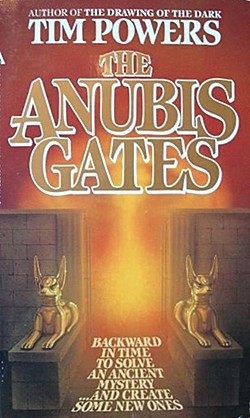
The Anubis Gates


Powers, Tim. 1983. The Anubis Gates.

The Anubis Gates is a pleasantly weird novel. Stealing directly from the back cover, "The Anubis Gates is the classic, Philip K. Dick Award-winning time travel novel that took the fantasy world by storm a decade ago. Only the dazzling imagination of Tim Powers could have assembled such an insane cast of characters: an ancient Egyptian sorcerer, a modern millionaire, a body-switching werewolf, a hideously deformed clown, a young woman disguised as a boy, a brainwashed Lord Byron, and finally, our hero, Professor Brendan Doyle."

When two men--under the direction of a seemingly evil Master--invoke a spell from an ancient Egyptian book, it creates holes in time--among other things. Amenophis Fikee and Doctor Romany are the two men responsible. Fikee suffers worse--in my opinion--in that the spell transforms him into a werewolf. Fortunately for him, unfortunately for nineteenth century England, he's now got the power to switch bodies with others. Which wreaks havoc, of course, because Fikee is a murderous monster with ever-changing identities.

Enter Professor Brendan Doyle. He's a twentieth-century professor (1980s) down on his luck. When the DIRE company offers him a unique job, he's quick to take it. They want him merely to give a lecture on Coleridge. Now Coleridge isn't his poet of choice. No, he's spent most of his adult life studying the more obscure poet--a contemporary of Lord Byron--William Ashbless. There are so many puzzles in this life that are unsolved. He seems to show up out of the blue in England in 1810. No details are known about where he was born, who his parents were, where he went to school, etc. Doyle would love to solve the mystery of this little-known poet. And the good money that DIRE is offering may just be what he needs to fund his project.

Doyle has been employed by Mr. Darrow to give a lecture about Coleridge to a very select group of people--all wealthy and willing to pay huge sums of money. What he discovers is that this is a once-in-a-lifetime, out-of-this-world experience. For the group will begin in 1983, travel back in time to 1810 to actually hear Coleridge give a lecture in a tavern, and then return to 1983--all in a period of four hours. Doyle is ready to dress the part and have some intellectually stimulating fun.

Sounds like fun, right? Well, for Doyle, things don't go quite according to plan. He's kidnapped by Dr. Romany and separated from the others. Though he manages to escape his initial capture, now, Doyle is trapped in 1810--without money and street smarts--and danger abounds everywhere. That's all I have to say about that.

This novel had many individual elements that intrigued me: ties to Ancient Egyptian culture, ties to the British Romantic poets, time travel, werewolves, etc. I liked it. I did find it a bit confusing at times with all the body-switching going on. I'm sure a second reading would probably clear up a few of my lingering questions. But overall, I liked it.

© Becky Laney of Becky's Book Reviews

Wednesday, December 17, 2008

Travel the World: England: Split by a Kiss


Plaja, Luisa. 2008. Split by A Kiss.

I am in a cupboard, and I'm snogging the coolest and most gorgeous boy in the whole school. And it's a big school. And really, we're kissing, not snogging. In a closet, not a cupboard. They don't really have snogging or cupboards here--they would laugh and tell me those are dodgy British phases. Except they wouldn't say 'dodgy'. That's just as dodgily British.

Split By A Kiss is both uniquely original and stereotypically typical. I'll probably spend the rest of the review explaining how that's even possible. Split By A Kiss has a very original structure--if they've been others of its kind, I've missed them. Our narrator, Jo (or Josie), 'splits' in two after playing a kissing game with popular guy, Jake Matthews. One personality, Jo, reacts to his wanting to do more than kiss with a slap--and a long list of insults. The second personality, Josie, reacts to his touch just as reluctantly--she does call a halt to things--but she keeps her 'cool' and keeps his interest. The book tells two very different stories. They're told in different fonts. Jo's story is typical--it's been done before; Josie's story is typical as well. Nothing in these individual stories is all that unique. But yet despite the fact that in a way it's all been done before, there is a certain satisfaction that comes from reading these stories. Though they are predictable--you can guess almost from the very beginning just how these two personalities will unite as one again--it's fun too. I liked the stories. I liked the boy that she's meant to be with. I like how it all comes together.

© Becky Laney of Becky's Book Reviews

Saturday, September 06, 2008

Dead is the New Black


Perez, Marlene. 2008. Dead is the New Black.

Dead is the New Black is similar in premise to Zombie Blondes which I reviewed earlier this week. Both books feature teen girls hesitant to join cheer leading squads, but who eventually give in despite the fact that there are clues this might prove deadly. But they're very different books in style and tone and theme. I loved Zombie Blondes. But I enjoyed this one too. A lot.

First sentence: "Being dead became fashionable approximately forty-five minutes after Samantha "the Divine" Devereaux came back from summer break."

It continues, "Although stylish as ever, there was still something off about the Divine Deveareaux. She strolled down the hall wearing a cleavage-baring top, a miniskirt, and stiletto heels. Her long blond hair had been freshly highlighted." So far sounds pretty normal, right? Stay with me, "But unlike after previous summer vacations, Samantha didn't have that sun-kissed Cabo glow. Her skin was, forgive the phrase, dead white. A large silver pendant hung around her neck, but I couldn't get a close look at it. I wasn't the only one trying to sneak a peek, because heads turned mor than usual as she strutted down the hall. 'Get out of my way, Daisy,' she snapped at me as she passed by. She was only slightly hampered by the coffin she was dragging behind her."

I think the first page was effective (in my opinion) of drawing the reader in. Our narrator--our heroine--is a teen named Daisy. Daisy has an interesting family--all her family--mother and sisters--have special psychic powers. But Daisy, "poor" Daisy, has none. Her mom helps solve cases--homicide mostly. And when our novel opens, there is an ongoing mystery. Someone (or something) is preying on teen girls. And for some reason, her mother can't get a sense of who or how or why. But Daisy and her best friend, Ryan, will take on the case secretly to see if they can't puzzle this one out on their own.

Family drama. School drama. Light romance. Supernatural mysteries. It's a fun and playful book that entertains. The book is set in the obviously fictional town of Nightshade. And with a name like that, well, expect some supernatural residents. This is the first in a new series, the next book, Dead is a State of Mind, will be out in 2009.

© Becky Laney of Becky's Book Reviews
Thursday, August 21, 2008

All Shook Up


Pearsall, Shelley. 2008. All Shook Up.

When you're thirteen, it doesn't take much for you to think your parents are embarrassing. Meet Josh. He normally lives with his mom in Boston, but when his grandmother falls and breaks her hip, Josh is sent to stay with his Dad in Chicago while his mom is off to Florida.
Looking back, I would say everything in my life changed the summer I turned thirteen and my father turned into Elvis.
I'd heard people say thirteen was an unlucky number, and from the very beginning, that seemed to be true. I'd been thirteen for less than twenty-four hours when the phone call came from Florida about my grandma taking a fall on the steps of the Shadyside Episcopal Church and breaking her hip. That same day, somebody swiped my bike from the city pool because, yes--I'd stupidly left it unlocked. And then my mom decided to ship me off to Chicago for four months so she could rush to Florida to take care of my grandma.
Before arriving in Illinois at the end of the summer (which had been a pretty decent summer until I turned thirteen), I didn't know anything about my dad being Elvis. Well, that's not quite true, I'd heard there were people who pretended to be Elvis. You know--sideburns, sunglasses, twisting hips, jiggly legs, and all. But I never would have believed my own dad would become one of them.
(1-2)
Josh's "shock" comes quickly when his Elvis-dad picks him up at the airport. "Trust me, right at that moment, I didn't really want an explanation for why my dad was pretending to be Elvis Presley, the King of Rock and Roll. If you have to choose between standing around with somebody who is being a complete hunka-hunka burning shame in public--or getting as far away from the situation as you can--you take the second option. Always." (12)

Yes, Josh has a few adjustments to make that's for certain. And you can read all about them in All Shook Up.

It was a fun read because you couldn't help but want to listen to Elvis. (I don't know if teens will have this response or not?!) Even though Josh himself is turned off completely by anything and everything Elvis. (Will they like Josh be mortified by the King?)

The writing is good (not great but solidly good). I've always enjoyed Shelley Pearsall's books in the past--her previous books include Trouble Don't Last, Crooked River, and All of the Above. And I did enjoy this one. It started off strong. It was funny. But it was believable. It had great potential. And while I wasn't particularly disappointed in the book, the last half is weaker than the first half. Not that it ever turns bad.

If it were a beam routine (and forgive me but with the Olympics I have gymnastics on the brain), I'd say there were no falls, no major deductions per se. But a couple of balance checks and a hop on the landing keep it from getting that perfect perfect score.


© Becky Laney of Becky's Book Reviews

Saturday, July 19, 2008

Savannah


Price, Eugenia. 1983. Savannah.

First sentence: Hands gripping the rail of the plunging schooner Eliza, young Mark Browning, his well-tailored clothes wet and rumpled, stood on deck alone, determined not to be sick.

Eugenia Price, along with Margaret Mitchell, was one of the primary reasons I first fell in love with historical fiction. (Or perhaps I should say historical fiction with more than a couple of splashes of romance added into the mix.) (I honestly can't remember if this series "found" me in eighth or ninth grades. But definitely back when I was in high school.)

What is Savannah about? To make it short and sweet it is a story of a young man coming-of-age in the city of Savannah in the early nineteenth century. (Think the war of 1812). Mark Browning. Just twenty or so when we meet him. Wise in some ways, naive in others. But without a doubt, the best day of young Mark's life was when he met Robert Mackay, family man and merchant.

Mackay is the owner of Eliza, a vessel named after his wife. He takes pity on the young man and cares for him when he falls sick on the ship. He also takes him into his own home back in Savannah. There he is welcomed by Eliza Mackay, the ever-faithful and near-perfect wife, and the couples' children: Jack, William, Eliza Anne, and Kate. (Though I can't quite remember if Kate had been born yet.) There he is welcomed, and there he remains until the day--some dozen or so years later--when his own house is completed and he begins keeping house with his own wife and child.

Mark, an orphan with no known family, comes to a new city, a strange city and finds refuge. His mother had been born, so he was told, in the city of Savannah. And it was in Savannah that his mother had met his father, Mark Browning, Sr. He has now come to that city to see if it holds some power over him. If perhaps he will find something he's been looking for his entire life--a place to belong, a place to call home. The minute he sets foot in Savannah, his love affair begins. He begins working alongside Robert Mackay. And soon he is made partner in Robert's business. But this arrangement isn't just good for his career. No, Mark genuinely becomes part of this family. The couple loves him. Sees him as a son. And the children idolize him. They cherish him. Cling to him almost.

This illustration of Southern hospitality seems strange in some ways to the modern reader. (I certainly can't imagine a modern family taking in a complete stranger for any amount of time let alone letting him--urging him--to become part of the family itself forever and ever and ever.) But if it is strange, it is strange in a mostly good way I think.

Savannah has more than its fair share of secrets. It is an emotional journey with unfolding mysteries and romances. Secrets. Lies. Blackmails. Murder. Passion. Jealousies. A little bit of everything really. It spans the years 1812 through 1825. It is rich in historical detail. It is really just a thoroughly satisfying read.

595 pages

© Becky Laney of Becky's Book Reviews

Monday, July 07, 2008

Revisiting The Dead and The Gone


Yesterday, I finished listening to the audio book of the dead and the gone. And it was good. How could it not be good. Though with audio books, the narrator is an essential component of "liking" or "not liking" a particular production, it remains at heart Pfeffer's stories, words, characters. And they're strong enough to carry any narration. Not that Robertson Dean needs much help. But still. I'm just saying it would be hard to completely ruin the book since it's so compelling and intense on its own.

Robertson Dean. What can I say. His voice is nice, strong, clear, deep, and low. Did I buy him as a 17 year old boy or as a 12 year old girl? Or as a girl of any age for that matter? No. Of course not. But the rare occasions when dialogue is part of the action, when Julie or Briana's voices must be heard--his voices for the two sisters are adequate. (Probably no more odd than when the narrator of Life As We Knew It had to do the voices for Miranda's two brothers Matt and Jonny.)

Scenes. Listening to the audio book made certain scenes even stronger, more vivid. The emotional scenes packed more of a punch. I think this is because in an audio book you can't speed up. You can't rush through a text. You can't get caught up in the drama of racing through to the end. You're stuck in the moment. And if the moment is painful, emotional, and traumatic--if you've read it you probably can guess which scenes I'm talking about--then it's even more so, the situation is magnified. This can be good or bad. Good in that the intensity, the drama, feels immediate. You can't help but feel right along with the characters. Bad in that it can haunt you even more than the text itself.

So if you've got access to the dead and the gone at your library, you should definitely consider giving this one a listen.

I just realized that I've *assumed* you were familiar with the dead and the gone and life as we knew it. You can read my full review here. But here's a bit to ground you.

the dead and the gone is the much-anticipated follow up novel to Life As We Knew It. Though the characters and setting are different--New York not Pennsylvania--the terror and uncertainty of future days is the same. Our narrator is Alex Morales, an older teen (perhaps 17?), whose world is about to be turned upside down. While there was set up in Life As We Knew It, the dead and the gone begins with the BIG event. Wednesday, May 18... At the moment when life as he had known it changed forever, Alex Morales was behind the counter at Joey's pizza, slicing a spinach pesto pie into eight roughly equal pieces. (1). Of course, at that moment, Alex doesn't know that. He's just your average teen. His mom was a nurse called into work that evening unexpectedly. His dad was out of the country attending the funeral of Alex's grandmother. His older brother, Carlos, is away from home and in the Marines. Thus when the calamity happens, it is on Alex and Alex alone to protect his family--his two younger sisters--and begin the fight for their ultimate survival.

Life As We Knew It is a novel that I first reviewed in November of 2006. In September of 2007, I reviewed the audio book . My interview with Susan Beth Pfeffer can be found here.
Blogged with the Flock Browser

Sunday, June 08, 2008

Adoration of Jenna Fox


Pearson, Mary. E. 2008. The Adoration of Jenna Fox.

I used to be someone. Someone named Jenna Fox. That's what they tell me. But I am more than a name. More than they tell me. More than the facts and statistics they fill me with. More than the video clips they make me watch. More. But I'm not sure what. (1)

And so begins The Adoration of Jenna Fox one of the most original and amazing coming-of-age stories that I've read in quite a while. Who is Jenna Fox? Why is her life, her past such a mystery? It all began with a car accident. A coma. Who is she now? What does she want to be? Why are there so many pieces that don't quite add up?

The Adoration of Jenna Fox had me at hello. And there's a good chance it will have you at hello as well. It's well written. It's pacing is incredible. And the writing? Amazing! And it's definitely definitely recommended.


© Becky Laney of Becky's Book Reviews

Tuesday, June 03, 2008

Never On These Shores

Pastore, Stephen R. 2007. Never On These Shores.

The time? 1942. The place? America. Jacket flap:
1942: The Nazis have successfully landed in Mexico and have invaded the United States through Texas. The Japanese have conquered western Canada and have captured and occupied most of the West Coast from Seattle to the outskirts of Los Angeles. The Italians have launched a massive amphibious assault from Cuba and have taken control of Florida and the Southeast as far north as Atlanta. New York City and Washington D.C. are fortifying and preparing for the onslaught. American forces are stranded in Europe and Southeast Asia. the homeland is being defended neighborhood to neighborhood by women, the elderly, and gay men, all ineligible for military service. The KKK and Right Wing radicals are supporting the invaders hoping to establish concentration camps where blacks and Jews are being transported all over the western U.S. Amid the carnage and brutality of an enemy seeking to destroy everything in its path, the American Spirit is put to its greatest test. Pastore weaves a tale that will not soon be forgotten as this highly imaginative story unfolds. It is an awe-inspiring parable of the true nature of the American people when put to their greatest test.
Except for the end where it gets a little too proud for its britches, it is a fairly good assessment of the plot. As far as alternate histories, alternate realities go, exploring the "what if's" of the Nazi's winning the war is a highly popular subject for "imaginative" speculation. There are several Star Trek (Original Series) episodes, for example, that feature Nazis or Nazi-thinking. There are several Twilight Zone episodes as well. (And that's just what I've seen. I can only imagine that they're is much more out there in film and in print that I'm not familiar with.) There must be something inexplicably fascinating or captivating about going there, about allowing yourself to go that dark and scary place and envisioning how events would unfold if the Nazis (Nazi thought, Nazi culture, or flesh-and-blood actual Nazis) controlled the world. Maybe it's because they just make the ultimate bad guys? Who knows? But this book relishes the idea of being your worst nightmare.


Told through multiple points of view, Never on These Shores is the most violent, most hate-filled, most vile imagining possible. The language. The violence. The murder. The rapes. It's meant to 'shock-and-awe' you I imagine. When I was *warned* to expect dirty language, I shrugged it off. I've seen plenty of movies, read quite a few books, how much more "shocking" can something get? Well, there is the language of an "R" film, and then 500 miles past that is this book. Is it as it should be? Maybe. Maybe not. As I mentioned earlier, if the Nazis had invaded, if war was invading our neighborhoods, our backyards, if our lives were being threatened by three enemy armies...keeping our language clean and pristine WOULD not be on the agenda. If ever there would be a time to let loose, then that might be the time. Still, it makes for an uncomfortable read.

Everything about this book is designed to make you uncomfortable and ill-at-ease. The fact that invading armies are slaughtering people. The fact that Americans--both civilians and politicians--are joining up with the Nazis, supporting them fully, working against the American resistance. The fact that the murderous agenda is being carried out--the rounding up of blacks to be gassed and burned. (Of course they're not called black.) This book is just a million and one disturbing images.

What can I really say about this one? It's not for everyone. I can see that some people might like it. Might enjoy it. (If enjoy is the right word.) But it's not for those that are easily disturbed. Reading it can turn your stomach. Is it realistic? I'm not sure. I don't think it is. Not really. Maybe in some areas, but not others. I have a hard time accepting it from the military point of view. I don't know how even working together these three armies have enough men, enough soliders, enough troops to hold their positions in Europe and Asia (and wherever) and conquer North America as well. I don't know how they could spread their armies out so thin to hold positions in so many places. And if they were using their newly-conquered enemies as soldiers, I'd imagine that sooner or later that would backfire on them. And I certainly don't buy that the entire nation was soldier-free in the spring of 1942. I'm not an expert. Obviously. But I've done *some* reading, and it just seems unlikely. War takes training, it takes recruitment, it takes time.

But one idea that this book stirs up is racism and prejudice and propaganda. Modern readers can look back at this time and see how "wrong" we were to hate the Germans, hate the Italians, hate the Japanese. How "wrong" we were to fear an invasion. How "wrong" we were to tell people to keep an eye out, to keep a watch out for suspicious behavior. How "wrong" we were to mistrust German, Italian, and Japanese citizens. How "wrong" we were to doubt anyone's loyalty based on descent. How "wrong" we were to create propaganda--ads, cartoons, etc.--during the war. But in this book, we see that the propaganda was right. We did have something to fear. We did have ample reason to mistrust. Not that there is much they could do about being "right." But still. But the part that is really unsettling, the part that throws doubt on everything is the fact that the book shows 'normal' and 'average' American citizens (some politicians, but most just regular folks) joining in the Nazi cause. In most cases, not out of fear, not out of wanting to come out on the winning side, but because of genuine support for the Nazi's white supremacist philosophy. It's the out-in-the-open (as well as the behind-closed-door variety) of racism, of hate, of prejudice that turns my stomach so. The thought that maybe just maybe racism is so dangerous, so deadly that something like this could have happened then. And the fear, the realization, that racist thought might not be as dead as we'd like to believe. Racism should be scary, should be crazy to modern readers. It should carry some shock-and-awe kind of punches.

© Becky Laney of Becky's Book Reviews

Tuesday, May 13, 2008

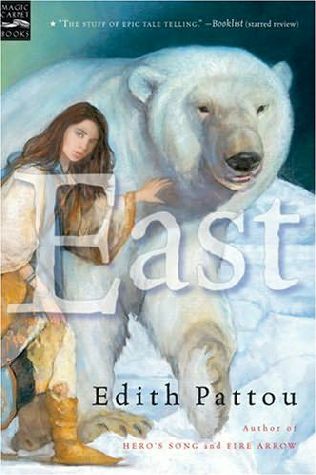
East


Pattou, Edith. 2003. East.

This one is really really really good. A true must-read in the fairy tales novelization genre. Told through many narrators, it retells the fairy tale "East of the Sun and West of the Moon" in a way that just works. I couldn't imagine when I picked it up that I would like it so much. That it would take the place of Beauty by Robin McKinley or Ella Enchanted by Gail Carson Levine. But this one is just oh-so-magical. It's rich in detail and it's just wonderful. If I don't sound quite myself, it's because I'm sick. And I hate being sick. It clouds the mind and makes reviewing difficult. But the book is due back tomorrow...so there was no waiting.

First sentence of prologue: I found the box in the attic of an old farmhouse in Norway. It was large, the size of a footlocker, and there were markings on it; runes, I learned later.

First sentence of chapter one: Ebba Rose was the name of our last-born child. Except it was a lie. Her name should have been Nyamh Rose. But everyone called her Rose rather than Ebba, so the lie didn't matter. At least, that is what I told myself.

494

© Becky Laney of Becky's Book Reviews

Saturday, May 10, 2008

Keeping Score


I have read most of Linda Sue Park's novels, and I've enjoyed all of them. Some more than others, but I've enjoyed them all. (It's just a matter of degree.) I liked--really liked--this one. I didn't know quite what to expect. It is about baseball. Not about playing baseball necessarily, but about being a fan of the sport. About being a fan of the game, the players, the teams. Our narrator, our heroine, is Maggie, or "Maggie-O" as her father likes to call her. She's a Dodger's fan, a Brooklyn Dodgers fan. The novel is set in the early to mid fifties. (1951-1955). Her mother and brother are Dodgers fans as well. But her father is a Yankees fan. (Hence her name "Maggie-O" and his son, Joseph Michael.) Her father was a fireman. But after a serious injury (all occurring before the novel's start) he now has a desk job. Maggie, however, still visits the fire house, the firemen regularly. Not a week goes by when she doesn't go to hang out with her father's friends, her father's coworkers. She loves to listen to the baseball games on the radio with them. One of the men is new. His name is Jim. He's different from the others--he's a Giants fan. But oddly enough, though he's a fan of the wrong team, it's him that Maggie is most drawn to. He teaches her how to keep score, how to follow the game play by play on paper keeping precise records. Their friendship is real though sports-based. So the news that he has been drafted into the army effects her quite deeply.

Maggie has led a sheltered life. But Jim being sent to Korea opens her eyes a bit to the world around her. Not all at once. But slowly and surely, she is growing and changing and coming of age.

Baseball. War. Friendship. Family. This novel has a little bit of everything to offer readers. It is deeper than I thought it would be. The first half of the novel is just a sports novel. But the second half, it's about so much more. Anyway, I think this novel has something for everyone. Even if you're not a big sports fan.

201 pages

© Becky Laney of Becky's Book Reviews

Thursday, May 01, 2008

A Year Down Yonder


Peck, Richard. 2000. A Year Down Yonder.
Review by Becky Laney.

A Year Down Yonder is the sequel to A Long Way From Chicago. However, this is not a novel in stories. Nor is it narrated by Joey Dowdel. No, A Year Down Yonder is the story of Mary Alice, the little sister that is almost-but-not-quite all grown up. The year is 1937. The Depression is making life difficult both in urban and rural areas. It is economic necessity which prompts Mary Alice's parents to send their daughter away. (Joey is sent away also, but not with Mary Alice.) Mary Alice is being sent to live with the vivacious, one-of-a-kind, sometimes embarrassing Grandma Dowdel. How will this "city" girl fit in with these country bumpkins? Will they accept her? welcome her? Not if the Burdicks have their way!

A Year Down Yonder is a treat. It's rich in detail, rich in humor, rich in heart and humanity. The characters, the place all come alive. Richard Peck is a pro when it comes to capturing the good, the bad, the ugly, and the laughable. Mary Alice does have a few adjustments to make, but this book captures her unforgettable journey, her coming-of-age in small town America.

If you haven't read A Long Way From Chicago, this book does stand alone. In case you're wondering. But I would recommend reading both books. Both books are such a joy, a treat, a delight.

© Becky Laney of Becky's Book Reviews

A Long Way From Chicago


Peck, Richard. 1998. A Long Way From Chicago. Review by Becky Laney.

Prologue
It was always August when we spent a week with our grandma. I was Joey then, not Joe: Joey Dowdel, and my sister was Mary Alice. In our first visits we were still just kids, so we could hardly see her town because of Grandma. She was so big, and the town was so small. She was old too, or so we thought--old as the hills. And tough? She was tough as an old boot, or so we thought. As the years went by, though, Mary Alice and I grew up, and though Grandma never changed, we'd seem to see a different woman every summer.
Now I'm older than Grandma was then, quite a bit older. But as the time gets past me, I seem to remember more and more about those hot summer days and nights, and the last house in town, where Grandma lived. And Grandma. Are all my memories true? Every word, and growing truer with the years.


A Long Way From Chicago is a book that is practically perfect in every way. (It did win a Newbery Honor.) It's historical fiction. The book is set during the Depression. The title page calls it a "novel in stories" and that's a fair assessment. The book does consist of loosely connected stories or memories told within a framework of an old man recalling his youth fondly. There are eight 'memories' shared within the book that are the heart and soul of the book. Seven are the consecutive stories of his summer vacations. Each August (starting in 1929 and ending in 1935), Joey and his younger sister Mary Alice leave Chicago to visit their grandmother who lives in a small town in Illinois.

Here is how the first chapter begins, "You wouldn't think we'd have to leave Chicago to see a dead body. We were growing up there back in the bad old days of Al Capone and Bugs Moran. Just the winter before, they'd had the St. Valentine's Day Massacre over on North Clark Street. The city had such an evil reputation that the Thompson submachine gun was better known as the Chicago typewriter. But I'd grown to the age of nine, and my sister Mary Alice was sever, and we'd yet to see a stiff. We guessed that most of them were where you douldn't see them, at the bottom of Lake Michigan, wearing concrete overshoes. No, we had to travel all the way down to our Grandma Dowdel's before we ever set eyes on a corpse."

Joey's voice is of immediate interest to me. He's a great little narrator. The story is rich in detail, rich in character. Every person--man, woman, child--has depth. Peck is just a genius when it comes to writing, to capturing human personalities with wit and humor and heart. The reader becomes intimately acquainted with Joey, Mary Alice, and most importantly Grandma Dowdel. A woman that is one-of-a-kind. A woman that has spirit, gumption, personality, heart, and a mind of her own. A very strong woman who sees the world in her own unique way.

I definitely recommend A Long Way From Chicago!!! It was a fantastic book.

© Becky Laney of Becky's Book Reviews

Sunday, February 04, 2007

The Higher Power of Lucky


Ever wondered what it would be to grow up in a town with a population of 43 people? In THE HIGHER POWER OF LUCKY by Susan Patron, the reader gets a guided tour of life in a small, desert town by our young narrator...Lucky. Lucky isn't lucky. Not in the traditional sense at least. She hasn't hit rock bottom, and in fact, she thinks that might be her biggest problem. She knows from eavesdropping on all the various twelve step programs that you have to hit rock bottom before you find the 'higher power' you need to turn your life around. Lucky has never known her father. He divorced Lucky's mother before she was born. And Lucky's mother? You guessed it, has died tragically after a storm while taking a barefoot stroll when she stepped on a downed power line. Lucky's guardian is her father's ex-wife. His first ex-wife. Brigette was leaving in France--she is a French woman after all--when she got the call that her ex-husband needed her to come to California to raise his daughter from his second marriage. What was supposed to be temporary--just until she could be placed into a traditional foster care--became more long term. Thus the sign 'population 43' still rang true despite her mother's death. Readers are introduced to Lucky, Brigette, and a cast of townspeople...some quite colorful such as Miles who makes cookie runs each morning going from house to house to house--or business to business--begging for cookies. Like most books dealing with orphaned/abandoned children, Lucky spends a great deal of time wondering what will happen. Will Brigette adopt her? Will they stay in Hard Pan, California, despite the snakes and scorpions? Or will Brigette return to France and send Lucky into foster care?

The Higher Power of Lucky is the Newbery Award winner this year (2007). And while you almost hate to criticize an award-winner, I have to say that there are better books, more charming books even, on this topic that were written this past year. Foster care was a HUGE theme in 2006. The Road to Paris by Nikki Grimes and Home and Other Big Fat Lies by Jill Wolfson were excellent. Outstanding even. Just truly beautiful books. Different from each other. But wonderful in their own unique way. And I've read the two Newbery Honor books PENNY FROM HEAVEN by Jennifer L. Holm and HATTIE BIG SKY by Kirby Larson. Both of those books were outstanding. Great books. Books that I hope will become classics. But The Higher Power of Lucky doesn't seem like a classic or a future classic to me. It isn't outstanding. It's good. It's not a bad book by any means. But it's not a book that grabbed me. Of the four other books I've mentioned--The Road to Paris, Home and Other Big Fat Lies, Penny From Heaven, Hattie Big Sky--I've not only loved but I've been recommending to everyone I know. They're just so good that I can't stop talking about them. They're books I would want to read and reread and own. The Higher Power of Lucky was a good read once...but I'm not sure I'll ever have the need to read it again. So in conclusion, it's a fine book. There were enjoyable aspects of the book. But it is--to me at least--a forgettable book.

Tuesday, January 23, 2007

Trouble Don't Last


Pearsall, Shelley. 2002. Trouble Don’t Last.

Trouble has followed Samuel almost his entire life. Born a slave, he is owned by Master Hackler and life on his Kentucky farm is all he’s ever known. Raised not by parents but by fellow slaves, he learned that his mother was sold off the plantation when he was a baby. But Samuel’s luck is about to change. After being punished for breaking a plate, Samuel visits Harrison and is told to expect something big to happen that night. Fearing the worst, he goes to bed with his ‘top eye open’ like Harrison warned. The surprise--Harrison and Samuel are going to start their journey to freedom that night. At first Samuel is afraid. Afraid that they’ll never make it. Afraid of what will happen if they’re caught. When they’re caught. But Harrison reassures him by telling him to put all his fear about the journey into the pack Harrison carries on his back so he could carry it for him. And when us git there safe and sound, say I let it out, and it can float straight up into that free sky and be gone from us forever (23-24). With a few stolen items, a lot of courage, and Harrison’s secret knowledge that he’s obtained about the stops along the Underground railroad, the two begin on an unforgettable journey full of danger but also of hope. Can the pair reach Canada safely? And what kind of new life can they expect there? Are Samuel’s troubles finally over?

http://www.shelleypearsall.com/
Trouble Don't Last page of Pearsall's site

Tuesday, December 26, 2006

Clementine

Pennypacker, Sara. 2006. Clementine.

Clementine by Sara Pennypacker is a fun new chapter book perfect for young readers. (My guess second to fourth graders.) Our young heroine, Clementine is spunky and vibrant leaving a mark wherever she goes. Easily noticed by teachers and principals but not necessarily for the right reasons. But despite some behavior problems, Clementine remains a funny, lovable character.

When called to the principal’s office to explain how and why her friend’s hair got cut in the school bathroom, she answers:

“’I was helping’ . . . and then I told Principal Rice about how I’d helped her, too. ‘I answered the phone while you were gone. I ordered some new school pets, and I told the gym teacher we are never going to play dodgeball again, and I made two appointments for you. The phone kept going dead, so I guess it’s busted. But at least I helped you a little.’ That’s what I thought. There is a look they teach a person to make in principal school that is not very nice” (12-13).

The truth? Clementine always has good intentions, but sometimes her plans backfire or have unforseen-to-her consequences.

Wednesday, December 06, 2006

Dominique Paul

Paul, Dominique. 2006. The Possibility of Fireflies.

2006 seems to be another banner year for troubled teens. I suppose it is the one ‘trend’ in young adult literature that never wavers throughout the decades. Often the ‘trouble’ is the teen rebelling in anger and resentment against parents who are not developed enough to be judged by the reader as worthy or unworthy of such treatment. We don’t know enough to judge if the anger is justified. That is not the case with THE POSSIBILITY OF FIREFLIES. The main character, Ellie Roma, and her sister Gwen are mistreated and abused by a despicable woman who is their mother. She yells. She screams. She hits. She locks her kids out of the house on a regular basis. She neglects them. She doesn’t worry about feeding them. She doesn’t care about them at all. She tells them day in and day out that they ruined her life and she hates them. So it doesn’t come as any surprise when Gwen begins hanging out with the wrong crowd and doing some typical rebelling: smoking, drinking, doing drugs. Ellie’s response may be calmer, but it is equally strong. Silent and angry, Ellie is counting the days until she can make her final escape. THE POSSIBILITY OF FIREFLIES presents two teens, one labeled 'good' and one labeled 'bad', struggling to survive the harshness of their home life. It is an emotionally raw and intense book. I believe the characters are memorable.

Sometimes I think it is okay that my mother doesn’t love me anymore, because she did. And I remember. I only wish I had known it would stop. I would have paid better attention, saved up everything in reserves like when they thought the bomb was coming. But I hadn’t known. I just hadn’t known (91).

Dominique Paul grew up in a Maryland suburb just outside of Washington, D.C., and received her BA in English from the University of Maryland, College Park. Currently she lives in Los Angeles, where she works as a screenwriter. The Possibility of Fireflies is her first novel.

Simon & Schuster: Dominque Paul

Friday, November 10, 2006

Words of Wisdom...

Portman, Frank. 2006. King Dork.

King Dork is by far one of the best young adult books released this year. The books I fall in love with at first sight are few and far between, but I must say that King Dork had me from the very first paragraph:

They call me King Dork. Well, let me put it another way: no one ever actually calls me King Dork. It's how I refer to myself in my head, a silent protest and an acknowledgement of reality at the same time. I don't command a nerd army, or preside over a realm of the socially ill-equipped. I'm small for my age, young for my grade, uncomfortable in most situations, nearsighted, skinny, awkward, and nervous. And no good at sports. So Dork is accurate. The King part is pure sarcasm, though: there's nothing special or ultimate about me. I'm generic. It's more like I'm one of the kings in a pack of crazy, backward playing cards, designed for a game where anyone who gets me automatically loses the hand. I mean, everything beats me, even twos and threes. (5)

And the genius continues throughout...the reader finds phrases that resonate with wisdom, truth, and/or humor.

There's always a bit of suspense about the particular way in which a given school year will get off to a bad start (7).

King Dork is one teen boy's (Tom, aka "Moe" or "Chi-Mo") story of the first semester of his sophomore year (August-December). The characters are memorable and the story unforgettable. A coming-of-age novel that will entertain teens and adults alike.

Recommended books: Looking for Alaska by John Green (reviewed September 11, 2006) and The Astonishing Adventures of Fanboy and Goth Girl by Barry Lyga (reviewed October 20, 2006).

http://www.frankportman.com/
Video trailer for King Dork
Frank Portman's Listmania List for "King Dork"