Showing posts with label 2000. Show all posts

Tuesday, September 23, 2025

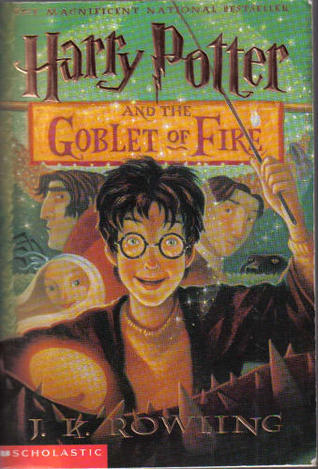
105. Harry Potter and the Goblet of Fire


105. Harry Potter and the Goblet of Fire. J.K. Rowling. 2000. 734 pages. [Source: Library] [3 stars]

First sentence: The villagers of Little Hangleton still called it "the Riddle House," even though it had been many years since the Riddle family had lived there.

ETA: This one isn't my favorite or best. But I did listen to it on audio for my third read through. I love the narration of Stephen Fry. (Except for the elves, but I think any narrator would struggle.) It is certainly important for the series, but again not my favorite or best.

Premise/plot: Harry Potter returns (eventually) to Hogwarts where he and his friends discover several changes for the school year ahead. Before school returns, there is a Quidditch World Cup to be endured. It felt like the sporty Quidditch World Cup took up 800 pages. Once he (and his friends) return to Hogwarts and begin their studies again, the pace picks up a bit. One of the changes this year is the triwizard competition. Hogwarts is one of three schools participating. There is supposed to be one student per school. But someone has entered Harry's name into the goblet of fire and so he ends up being a 'champion' [participant]. Cedric Diggory is the other Hogwarts champion. [I don't remember the names from the other two schools.] This competition is spread out throughout the school year. 

My thoughts: I feel like the first six-hundred pages were mostly dull and ho-hum. I think the last bit of the novel has all the action and suspense. Out of the four novels I've read so far, this has been the dullest all things considered. All things being taking the book as a whole. There were definitely intense, action-packed, emotional scenes/chapters. But does THAT end-portion make up for all the sporty-sport-sport bit at the start???? I'm not sure. This was the first Harry Potter book where I've had to force myself to keep reading to get to the end of it.

 ETA: I had forgotten--almost--how much I disliked this one, OR, at least the start of this one. This one is like THREE different books. There is the EXTREMELY LONG AND BARELY NECESSARY "prologue" of the sporting world championship bit, AND there is the normal, formulaic school semesters bit, and then there is the super compelling, well-paced, ABSOLUTELY absorbing and completely and totally necessary bit that CHANGES EVERYTHING. Like the whole series pivots thanks to the last hundred or so pages of this one. But it takes FOREVER for the good bit to come.


© 2025 Becky Laney of Becky's Book Reviews

Monday, September 16, 2024

72. Harry Potter and the Goblet of Fire

72. Harry Potter and the Goblet of Fire. J.K. Rowling. 2000. 734 pages. [Source: Library] [3 stars]

First sentence: The villagers of Little Hangleton still called it "the Riddle House," even though it had been many years since the Riddle family had lived there. 

Premise/plot: Harry Potter returns (eventually) to Hogwarts where he and his friends discover several changes for the school year ahead. Before school returns, there is a Quidditch World Cup to be endured. It felt like the sporty Quidditch World Cup took up 800 pages. Once he (and his friends) return to Hogwarts and begin their studies again, the pace picks up a bit. One of the changes this year is the triwizard competition. Hogwarts is one of three schools participating. There is supposed to be one student per school. But someone has entered Harry's name into the goblet of fire and so he ends up being a 'champion' [participant]. Cedric Diggory is the other Hogwarts champion. [I don't remember the names from the other two schools.] This competition is spread out throughout the school year. 

My thoughts: I feel like the first six-hundred pages were mostly dull and ho-hum. I think the last bit of the novel has all the action and suspense. Out of the four novels I've read so far, this has been the dullest all things considered. All things being taking the book as a whole. There were definitely intense, action-packed, emotional scenes/chapters. But does THAT end-portion make up for all the sporty-sport-sport bit at the start???? I'm not sure. This was the first Harry Potter book where I've had to force myself to keep reading to get to the end of it.

 ETA: I had forgotten--almost--how much I disliked this one, OR, at least the start of this one. This one is like THREE different books. There is the EXTREMELY LONG AND BARELY NECESSARY "prologue" of the sporting world championship bit, AND there is the normal, formulaic school semesters bit, and then there is the super compelling, well-paced, ABSOLUTELY absorbing and completely and totally necessary bit that CHANGES EVERYTHING. Like the whole series pivots thanks to the last hundred or so pages of this one. But it takes FOREVER for the good bit to come.


© 2024 Becky Laney of Becky's Book Reviews

Monday, March 06, 2023

50. Harry Potter and the Goblet of Fire


Harry Potter and the Goblet of Fire. J.K. Rowling. 2000. 734 pages. [Source: Library]

First sentence: The villagers of Little Hangleton still called it "the Riddle House," even though it had been many years since the Riddle family had lived there. 

Premise/plot: Harry Potter returns (eventually) to Hogwarts where he and his friends discover several changes for the school year ahead. Before school returns, there is a Quidditch World Cup to be endured. It felt like the sporty Quidditch World Cup took up 800 pages. Once he (and his friends) return to Hogwarts and begin their studies again, the pace picks up a bit. One of the changes this year is the triwizard competition. Hogwarts is one of three schools participating. There is supposed to be one student per school. But someone has entered Harry's name into the goblet of fire and so he ends up being a 'champion' [participant]. Cedric Diggory is the other Hogwarts champion. [I don't remember the names from the other two schools.] This competition is spread out throughout the school year. 

My thoughts: I feel like the first six-hundred pages were mostly dull and ho-hum. I think the last bit of the novel has all the action and suspense. Out of the four novels I've read so far, this has been the dullest all things considered. All things being taking the book as a whole. There were definitely intense, action-packed, emotional scenes/chapters. But does THAT end-portion make up for all the sporty-sport-sport bit at the start???? I'm not sure. This was the first Harry Potter book where I've had to force myself to keep reading to get to the end of it.


© 2023 Becky Laney of Becky's Book Reviews

Monday, March 09, 2020

37. Fever 1793

Fever 1793. Laurie Halse Anderson. 2000. 252 pages. [Source: Library][historical fiction; mg historical; mg fiction]

First sentence: I woke to the sound of a mosquito whining in my left ear and my mother screeching in the right.

Premise/plot: Fever 1793 is a historical coming of age novel set in Philadelphia during the devastating yellow fever epidemic. No matter the decade or century an epidemic would be scary, terrifying even. But at a time when doctors were absolutely clueless yet confident that they knew what they were doing, it’s extremely terrifying. Mattie Cook and her family are troubled by the outbreak, yet what is the right course of action?! To flee to the country side and leave the family business untended and boarded up? To separate? Some stay and some go? Who would they stay with in the country? Should they stay open for business? Who should run errands? What places are safe? What places should be avoided? How does one make that determination of what is safe and what is dangerous? After all, one must have food to eat even if one closes the coffee shop. Should one still visit friends? Go to church? Does one trust “the news” as to what is really happening and how many have actually died? Is blaming foreigners and refugees really the best use of time and energy?

My thoughts: I believe this is only the second time I have read this one. I definitely liked it as an adult. I won’t say that every single reader will find it super compelling and impossible to put down. That would be silly. Especially if this one should ever be assigned reading for school. But the historical elements will appeal to those that enjoy and seek out historical fiction. The epidemic should appeal to those that enjoy and seek out the I Survived...book series.

Would I have loved it as a kid? Probably not because of the death toll. This epidemic was deadly and this book is realistic that this epidemic was costly to families and communities. But not all young readers are as sensitive as I once was.


© 2020 Becky Laney of Becky's Book Reviews

Friday, January 24, 2020

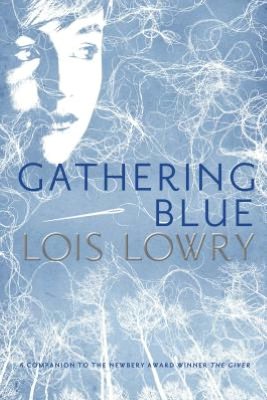
15. Gathering Blue

Gathering Blue. (The Giver #2) Lois Lowry. 2000. 240 pages. [Source: Library] [Speculative Fiction; Dystopia; children's fiction; mg fiction]

First sentence: “Mother?”

Premise/plot: Gathering Blue is a coming of age dystopian novel. It isn’t an in your face dystopia. It’s much more subtle, quiet even. Readers know that this community is a remnant of a civilization. There is one remaining building that has survived the centuries since the collapse. The community has a primitive feel to it—for a futuristic dystopia. The men hunt in packs; the women weave. If you cannot work hunting, gathering, planting, weaving, then you are essentially kicked out and left for the beasts. Kira, our heroine, has a twisted leg—she was born ‘a cripple.’ Some wanted her to be sent away, left for the beasts. But her mother and grandfather fiercely fought to keep her. Kira was being trained by her mother to weave, to dye thread, to embroider when her mother died. Now that she’s on her own the fight to kick her out has resurfaced. One woman demands Kira’s land should be hers. Kira’s fate depends on her defense attorney. Will she be saved? Can she take over her mother’s job?

My thoughts: Is it fair to compare this one to Lois Lowry’s The Giver? Probably not. Especially if you’re supposed to be wearing your book reviewer hat. Though this isn’t a review copy, so I suppose I can be as subjective as I please! I love, love, love The Giver and it gives off deliciously creepy vibes from page one. Something is way, way off and you know it. Gathering Blue has a post-apocalyptic feel to it. Civilization has been set back hundreds if not thousands of years because of a catastrophic collapse. The creepiness creeps up on you in this one. I didn’t see the potential evil in their midst—the secrets, the lies, the crimes. I just got the sense the people were ignorant and ‘uncivilized.’

Readers get a glimpse of one place that might be ‘beyond’ the sophisticated though evil civilization presented in The Giver.


© 2020 Becky Laney of Becky's Book Reviews

Friday, May 05, 2017

Minerva Louise at the Fair

Minerva Louise at the Fair. Janet Morgan Stoeke. 2000. 24 pages. [Source: Library]

First sentence: Minerva Louise loved how peaceful the farm was at night.

Premise/plot: My favorite silly chicken is disturbed by the "stars falling from the sky" and leaves the farm to see what is making all the booms. She finds herself at the fair. She even finds herself on a ride at one point. The world is so new and exciting when seen through the eyes of an inexperienced chicken.

My thoughts: I liked this one. The merry go round as horse barn was probably my favorite bit.

Text: 3.5 out of 5
Illustrations 3.5 out of 5
Total: 7 out of 10

© 2017 Becky Laney of Becky's Book Reviews

Monday, December 26, 2016

Slaves of Obsession

Slaves of Obsession. Anne Perry. 2000. 368 pages. [Source: Library]

First sentence: "We are invited to dine with Mr. and Mrs. Alberton," Hester said in reply to Monk's questioning gaze across the breakfast table.

Premise/plot: William and Hester Monk attend a dinner, and, soon most of the guests will be caught up in a murder case. The victim--one of several--is Mr. Alberton. And it looks like he's been killed by someone he knew, someone he entertained in his own home. Monk isn't directly on the murder case, so to speak, but he's hired by Mrs. Alberton to find her missing daughter and bring her back home, no matter what. And the number one suspect in the case is the daughter's love-interest. So chances are, if you find one you may find the other. So Hester and Monk have their hands full in this one. It takes place on TWO continents. (The daughter has fled to the United States....)

My thoughts: I really am enjoying this series again. I really like seeing Hester and William settle down into married life. I really love seeing these two love and respect and cherish one another! Yet the romance in the book is never in-your-face or time-consuming. Instead it is in the background, subtle. The issue in this book is "slavery" and whether it's right or wrong to sell guns to the South. Does someone who sells guns for a living have a moral obligation to sell guns only to people whom he agrees 100% with? Does he have the right to refuse to sell guns to interested buyers because he finds their cause distasteful? Who is really capable of deciding which causes are good or bad?

© 2016 Becky Laney of Becky's Book Reviews

Monday, December 07, 2015

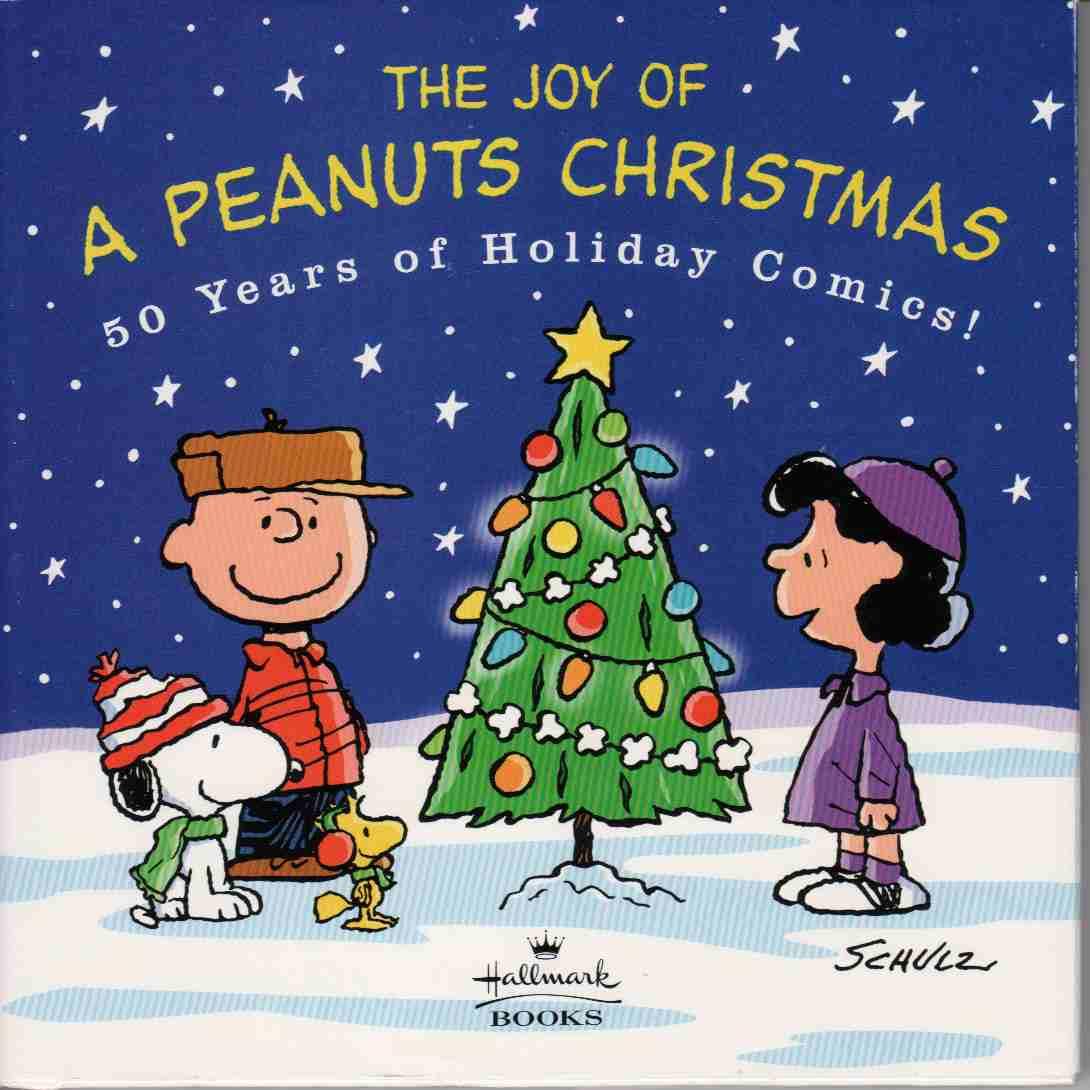
The Joy of a Peanuts Christmas

The Joy of a Peanuts Christmas: 50 Years of Holiday Comics. Charles M. Schulz. Introduction by Don Hall. 2000. Hallmark Books. 119 pages. [Source: Bought]

The Joy of a Peanuts Christmas is a collection of holiday-themed comic strips. Some are black-and-white, some are color. The book is divided into decades: 1950s, 1960s, 1970s, 1980s, and 1990s. The strips themselves are not in chronological order. Though strips that tell a continuing story are in order. Throughout the book, tribute is paid to each character: Charlie Brown, Pig-Pen, Lucy, Linus, Peppermint Patty, Sally, Woodstock, Schroeder, Snoopy, Marcie, Franklin, Spike.

I enjoyed this one very much. It felt very timeless. The characters didn't really change through the years. They remained in spirit very much the same which is one reason why I think it works so well.

Do I have a favorite character? Yes. Of course, I do. It's Linus!!! But I also love, love, love Snoopy.

Do I have a favorite comic strip? That would be harder to answer. There were so many I enjoyed within this collection.  I liked Charlie Brown making so many snowmen in the February 22, 1953, strip. I liked Pig-Pen's dirtiest snowman in the January 6, 1955, strip. Lucy isn't my favorite by any stretch, but the December 21, 1959 strip made me smile. I thought the strip from December 19, 1958, was funny but also a little sad at the same time. In it, Linus suggests addressing Santa as "Dear, O, Mighty One'. Though essentially, anytime Linus is writing Santa or thinking about writing Santa I enjoyed it. And then, of course, there are the strips of Linus preparing to be a shepherd for the play. Loved those! Sally is another favorite, though not perhaps as much as Linus and Snoopy. I loved her hanging up dozens of tiny stockings (1966). In 1978, Sally wrote a report about Santa and his RAIN GEAR. But one of my favorites stars both Snoopy and Sally. It's from November 28, 1995.

Do you have a favorite character?

© 2015 Becky Laney of Becky's Book Reviews

Wednesday, August 05, 2015

Wish You Well

Wish You Well. David Baldacci. 2000/2007. Grand Central Publishing. 432 pages. [Source: Library]

I enjoyed reading David Baldacci's Wish You Well. That is, I "enjoyed" it as much as one can enjoy a book with so much heartache in it. Some of the heartache was completely predictable, I won't lie. But some of it wasn't.

Readers meet Lou (Louisa) and Oz (Oscar). These two undergo a lot in the course of a year. The family is in a car crash. Their father dies at the scene. Their mother is left in a coma, of sorts. She's able to eat and drink, but, not to talk or walk. She's essentially dead to the world, unable to give any sign to anyone that she is still in there. The two go to live with a great-grandmother in Virginia. This great-grandmother raised their father. Her name is Louisa. Life in the country is certainly different than life in New York City, but the two adjust quickly. They enjoy spending time with Diamond, an orphan boy around their age, and Eugene, a black man who lives and works with them on the farm. Their mother lives with them as well. They manage to nurse her and do all the farm work as well. One man, a young lawyer, takes it upon himself to visit the family often. Cotton reads to Alicia (the mother) as often as he can. The children quickly bond with him. So they've experienced loss certainly, but, they've made new friends as well.

Is life perfect? Not really. Oz and Lou would give anything to have their parents back. And Oz especially is still counting on his mom waking up again. Lou secretly wants this just as badly. But she's older, and "wiser," and doesn't want anyone to know that she believes in wishes and happy endings. She can't help herself for wanting and wishing, but, she's ashamed of it at the same time. She hates herself for it in a way.

The book chronicles their adventures and misadventures in the country. The setting is 1940, by the way. I won't spoil the book; yes, a few things are predictable. But not everything in my opinion.

Wish You Well is a coming-of-age story written for adults. Don't be confused by the child narrator, this one really is an adult book.

What I liked best was the characterization and the setting. I liked Lou and Oz and Diamond. I liked Louisa and Cotton. I liked spending time with them. And the historical setting was a nice touch. 


© 2015 Becky Laney of Becky's Book Reviews

Sunday, December 14, 2014

Eight Christmas Books

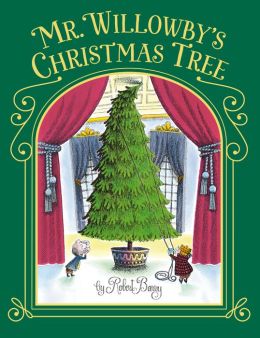
Mr. Willowby's Christmas Tree. Robert E. Barry. 1963. Random House. 32 pages. [Source: Library]

Mr. Willowby's Christmas tree came by special delivery. Full and fresh and glistening green--the biggest tree he had ever seen. He dashed downstairs to open the door--This was the moment he'd waited for.

I loved, loved, loved Mr. Willowby's Christmas Tree. It celebrates giving in a fun and playful way. Mr. Willowby starts off a long chain of giving when he chops off the top of his too-tall Christmas tree. A tree that is splendid in every other way. He gives the tree-top to the upstairs maid. She's delighted. Very delighted. How thoughtful! How cheery! But the tree is too-tall for her small room. The top must go! Chances are you can predict at this point how the story will go. But that doesn't mean it is in any way less delightful. This little tree-top gets passed down and re-trimmed again and again and again and again and again. And it's just WONDERFUL to see how much happiness and cheer it brings to others.

I loved the premise. I loved the writing. The rhyming was delightful. It worked very well for me! I think this one would make a great read-aloud. I also loved how uplifting it is. (After reading Baboushka and the Three Kings, I needed a cheery story!)

Why didn't someone tell me about this wonderful and charming picture book?! Why?! Well, I am glad to have discovered it now!

Which Christmas books would you consider classic? Which would you recommend?

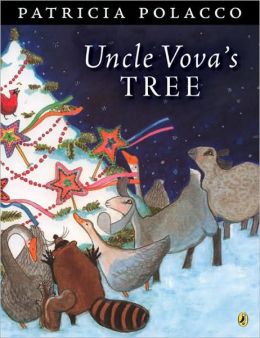
Uncle Vova's Tree. Patricia Polacco. 1989. Penguin. 32 pages. [Source: Library]

Uncle Vova's Tree is rich in detail and tradition. The author, Patricia Polacco, is drawing from her past and recalling some of her childhood Christmases. She writes, "As a child I celebrated Christmas as most American children did, but at Epiphany in January, my brother, my two cousins, my grandparents and I would go to the farm of my Great Uncle Vladimir and Aunt Svetlana to celebrate in the Russian tradition." The book recalls two family gatherings specifically. The first is Uncle Vova's last Christmas. Though of course, most everyone did not *know* it would be his last Christmas. The second is that first Christmas without him. The book definitely has tones of sadness, but, it is ultimately hopeful. Memories, good, strong happy memories, remain.

The book is rich in detail and tradition. It is informative in many ways. Did you know about the tradition of putting hay underneath the tablecloth to remember and honor the stable in Bethlehem where Jesus was born? But in addition to honoring tradition--in this case, Russian tradition--it also celebrates families. Readers meet a family that is close and loving and supportive. Little details make this one work well.

Too Many Tamales. Gary Soto. Illustrated by Ed Martinez. 1993. Penguin. 32 pages. [Source: Library]

Snow drifted through the streets and now that it was dusk, Christmas trees glittered in the windows.

Too Many Tamales is a great family-oriented Christmas story. Maria, our heroine, is helping her mom make tamales. She loves helping her mom, loves being grown-up in the kitchen. But things don't go smoothly with this first batch of tamales. And it is her fault. Mostly. Maria really, really, really wanted to try on her mom's ring. Unfortunately, this-too-big ring falls right into the masa mixture. Hours later, she realizes that she never took the ring off. She doesn't know for sure where the ring is. But she has a strong suspicion that it may very well be in one of the twenty-four tamales. With a little help from her cousins, Maria is in a race to find the ring before her mom--and all the other relatives--realize what has happened. Will she find the ring? Will her mom find out? Will her cousins ever want to eat another tamale?!

I liked this one very much.

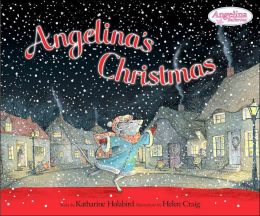
Angelina's Christmas. Katharine Holabird. Illustrated by Helen Craig. 1986. Penguin. 32 pages. [Source: Library]

Christmas was coming, and everyone at Angelina's school was working hard to prepare for the Christmas show.

I enjoyed reading Angelina's Christmas. I enjoyed meeting Angelina and her family. I loved how thoughtful and empathetic Angelina was. She realizes that there is one house in the village that is not decorated. She notices that there is one "old man huddled by a tiny fire." She learns from her parents that this old man is Mr. Bell, a retired postman. She decides that she will do something special for him so he won't be all alone at Christmas time. (And Angelina isn't the only one joining in to help make this Christmas memorable for Mr. Bell.) She makes him cookies, her mom sends along mince pies and fruit, her dad cuts him a Christmas tree. They visit him, Henry, Angelina's brother comes along too. But perhaps even more importantly than showing him kindness through things, they take the time to listen to him, to include him. This one is a lovely book.

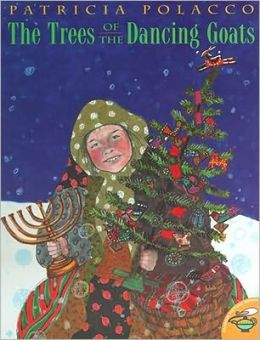
The Trees of the Dancing Goats. Patricia Polacco. 2000. Simon & Schuster. 32 pages. [Source: Library]

At our farm just outside Union City, Michigan, we didn't celebrate the same holidays as most of our neighbors...but we shared their delight and anticipation of them just the same.

I enjoyed reading The Trees of the Dancing Goats by Patricia Polacco. She is sharing yet another holiday memory with young readers in this picture book.

The story focuses on one holiday season when the town is hit by an epidemic, scarlet fever, I believe. The heroine's family is not sick, but, most of their neighbors are. As they are preparing to celebrate Hanukkah, they realize that most of their neighbors are too sick to prepare for and celebrate Christmas. They love their neighbors. They want to do something for them. Working together as a family, they decide to bring Christmas to their neighbors: food, a tree, decorations. Since they don't own any Christmas ornaments, they use animals carved out of wood. One of the animals, as you might have guessed, is a goat. When hung on the tree, it appears to be a dancing goat. Can one family bring Christmas cheer to a community?

I liked this one. I liked the family scenes very much. It is a thoughtful book. I'm glad I finally discovered it!

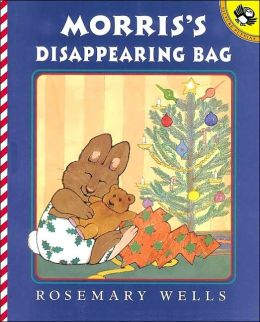
Morris' Disappearing Bag. Rosemary Wells. 1975. Penguin. 40 pages. [Source: Library]

It was Christmas morning. "Wow!" said Morris.

Morris' Disappearing Bag probably isn't my favorite Rosemary Wells, but, this one is enjoyable enough that it's worth reading at least once or twice. Morris stars in this one. He has three older siblings: one big brother, Victor, and two older sisters, Rose and Betty. It is a Christmas book, of course. After all the presents are opened, the three older siblings play with their presents and play with each others presents. Victor got hockey stuff. Betty got a chemistry set. Rose got a beauty kit. They take turns sharing. Much fun is had. But not by all. For Morris has only his present (a teddy bear) to play with. He doesn't get a turn with his siblings' presents. But that changes when Morris discovers a fantastic present under the tree. A bag. A disappearing bag. Whatever is in the bag disappears. His siblings all want a turn, and, he lets them in the bag. While his siblings have disappeared for the day, Morris plays with their stuff before settling into bed with his bear.

Max's Christmas. Rosemary Wells. 1986. Penguin. 32 pages. [Source: Library]

I love watching Max and Ruby. I've seen the adaptation of Max's Christmas plenty of times before I read the book. If you like the show, chances are you'll enjoy reading this book. It is very similar. For those new to these lovable siblings, Ruby is the older sibling. She seems to be raising Max all on her own. (Ruby and Max don't have parents. They have a Grandma, but, she does not live with Max and Ruby.) Max is the younger sibling. He is many things: cute, clever, curious. Yes, he can be mischievous, but, he is also super-observant. I love, love, love them both. I might like Max a tiny bit better than Ruby. But still. I love them both.

In this book, readers join Ruby and Max on Christmas Eve night. Ruby is trying her best to get Max to get ready for bed, to go to sleep. Max is excited, of course. Once he knows that Santa is coming to his house tonight, he wants to see it for himself. So he goes downstairs to wait for Santa....

I liked this one very much.

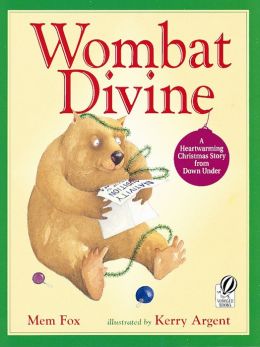
Wombat Divine. Mem Fox. Illustrated by Kerry Argent. 1995/1999. HMH. 32 pages. [Source: Library]

I found Mem Fox's Wombat Divine to be charming. I loved Wombat. He loves, loves, loves Christmas. More than anything, he wants a part in the nativity play. At the auditions, he tries his best. But there are so many parts that he's just not right for. I love the refrain, "Don't lose heart. Why not try for a different part?" which is used throughout the whole auditioning process. He auditions for Archangel Gabriel, Mary, a wise king, Joseph, an innkeeper, and a shepherd. But there's one role that he'd be just perfect playing. Can you guess it?

I liked this one. I thought it was cute and sweet. I liked the writing. I found it unique and oh-so-right.

© 2014 Becky Laney of Becky's Book Reviews

Friday, May 23, 2014

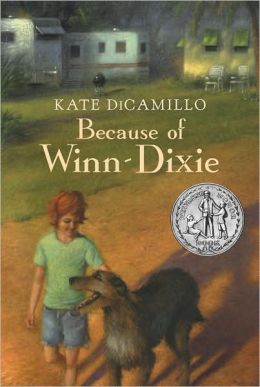
Reread #21 Because of Winn Dixie

Because of Winn Dixie. Kate DiCamillo. 2000. Candlewick. 182 pages. [Source: Book I bought]

Because of Winn Dixie is one of my favorite, favorite, favorite books. I love, love, love this one! Opal Buloni, our young heroine, has recently moved with her father, a preacher, to a small town in Florida. He is the new preacher at a small church, a church held in an old convenient store building, a church with no pews but lawn chairs. The novel, I believe, is set during the summer. Opal, when the novel opens, is still adjusting. She misses her mother tremendously. Her mother's leaving is not recent, but, as Opal grows up, she is beginning to realize more and more how much she misses her mother. Her curiosity and longing has changed. She feels her father ignores her, not because he doesn't love her, not because he doesn't want her or need her, but simply because he's always busy and quiet. Opal needs friends. Find friends she will and all because of Winn Dixie, the dog she finds at the grocery store. Winn Dixie, the dog with an irresistible smile, needs Opal just as much as she needs him. And with a little love from Opal and her Dad, Winn Dixie sets out to charm EVERYONE in town, even people who don't "like" dogs.

I love, love, love the characters in this one. I love Opal. I do. I love her dad. I love that he listens to his daughter and shares with her ten things about her mother. I love Gloria Dump, Miss Franny, Otis, and Sweetie Pie. And, of course, I love Winn Dixie. I also love Opal coming up with a ten things list for Winn Dixie.

I love the writing. This is one of those novels that is just so easy to quote!!!

Favorite quotes:
“Thinking about her was the same as the hole you keep on feeling with your tongue after you lose a tooth. Time after time, my mind kept going to that empty spot, the spot where I felt like she should be.”
“You can't always judge people by the things they done. You got to judge them by what they are doing now.”
“Do you think everybody misses somebody? Like I miss my mama?” “Mmmm-hmmm,” said Gloria. She closed her eyes. “I believe, sometimes, that the whole world has an aching heart.”
© 2014 Becky Laney of Becky's Book Reviews

Friday, April 18, 2014

Reread #16: A Year Down Yonder

A Year Down Yonder. Richard Peck. 2000. Penguin. 144 pages. [Source: Library]

I loved A Year Down Yonder so much more than Richard Peck's A Long Way From Chicago. And I definitely enjoyed A Long Way From Chicago! While A Long Way From Chicago was told from Joey's point of view, A Year Down Yonder is told from Mary Alice's point of view. Because of the Depression, Mary Alice has been sent by her parents to live with Grandma Dowdel. Mary Alice has spent more than a few summers with her Grandma, alongside her brother, but this time she'll be there all year long, and without her brother.

While A Long Way From Chicago is fun, in many ways, it is a bit disjointed as well. Each chapter tells the story of a summer vacation. In A Year Down Yonder, the plot is more traditional. The book follows the course of an entire year. Readers get a better chance to KNOW the characters, to appreciate the characters and the small town setting. And Mary Alice is a great narrator!!! I loved her story. My favorite chapters were "Rich Chicago Girl," "Vittles and Vengeance," "Heart and Flour," and "A Dangerous Man." I loved the slight traces of romance. 


I would definitely recommend both A Long Way From Chicago and A Year Down Yonder. Both books do stand alone, but, they do go together well.

I first reviewed A Year Down Yonder in May 2008.

© 2014 Becky Laney of Becky's Book Reviews

Thursday, October 25, 2012

Gathering Blue (MG)

Gathering Blue. Lois Lowry. 2000/2012. Houghton Mifflin Harcourt. 215 pages.

In anticipation of reading Son, I decided to reread the Giver trilogy by Lois Lowry. Gathering Blue is the second book, it is a companion to The Giver. Readers are introduced to a crippled heroine named Kira whose life is in danger because of her mother's recent death. The village in which she lives has a small tolerance level, I suppose you'd say, for those they deem worthless or less-than. Because of her so-called disability, there are those that food should not be wasted on her, for what good could she ever be to the community. Soon after the novel begins, Kira finds herself on trial. If the court decides in her favor, she'll continue to live in the village, if not, she'll be forced out. Kira lucks out, and she is "rescued" by one of the council. But her life will never be the same, she'll have an honored role in her village, in a way, doing a special job, something that only she can do, but along with the privilege she'll learn some secrets that will perhaps haunt her...

Readers also meet Kira's friend Matt.

I definitely liked this one. I think this is only the second or perhaps third time I've ever read it--I've read The Giver probably six or seven times. I think I appreciated it more this time around.  


Read Gathering Blue
  • If you're a fan of The Giver and want to read on in the series
  • If you're a fan of Lois Lowry
  • If you enjoy middle grade dystopias 
© 2012 Becky Laney of Becky's Book Reviews

Tuesday, March 27, 2012

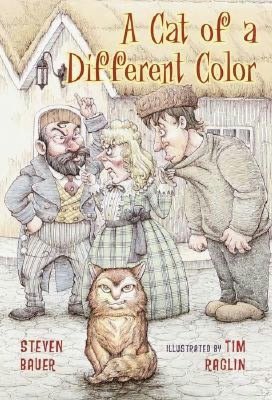
A Cat of a Different Color (MG)

A Cat of a Different Color. Steven Bauer. Illustrated by Tim Raglin. 2000. Random House. 200 pages.

In a village near a silver lake, at the bottom of a range of jagged mountains, three kittens were born in the same litter. Two of them were common enough. They had wide, astonished, watery blue eyes, and gray coats stippled with black, and paws as white as if they'd been dipped in heavy cream, and when the kittens were ten weeks old, those villagers who wanted a pet came round to the house where the kittens had been born and these two were quickly chosen.
Their names were Flumadiddle and Gigamaree, and until they grew to be a year old, they looked so very much alike that sometimes Mr. Mayapple, the man who chose poor Gigamaree, would call, "There you are, you worthless welp!" when he saw Flumadiddle. And sometimes Miss Gagney, who fussed and fiddled over Flumadiddle's feelings, for it was her brother Gigamaree who stalked the streets, while Flumadiddle was a close-to-the-fireside cat, and she knew it was Gigamaree whom Miss Gagney had seen. 
But from the start no one mistook the third cat for anyone but himself. He had fur that seemed to shift in hue in the slightest breeze--fur the color of burning leaves, then fur the color of smoke. His eyes were the palest amber, and the hair on his belly was as whorled as the shapes the villagers' breath made on winter mornings. When he was still a tiny kitten, he'd fallen from a footstool into a large bucket of water, and rather than panicking, he'd seemed quite content to be soaked clear through--which was very odd, for most cats hate even the thought of getting wet. The villagers called him the-cat-who-loves-water, or, in the dialect of that part of the country, Ulwazzer, and because he was so strange, so unlike any cat that anyone had ever seen before, no one would take him home. He was preternaturally calm, they said, and probably possessed, and who wanted a cat who might raise the hair on your neck by yowling in the dark, who might turn on you when least expected, or leap on your face in the night?

I loved this one. I just LOVED, LOVED, LOVED it. It may not be an 'important' book, an 'issue' book, but oh the joy this one brought me!!! It was so charming, so delightful, so funny. It was just the right amount of description too.

A Cat of a Different Color is set in the village of Felicity-by-the-Lake. It is the story of what happens when the town foolishly elects the wrong leader for the job of town mayor. Instead of the most qualified man getting the job, they elect the one who flatters them the most and gives away the tastiest treats. The new mayor is Jeremiah Hoytie. And he's got a wife, Prucilla, and a son, Sam. The couple also has a young distant relation staying with them, Daria Smart. It doesn't take him long for him to start making proclamations and decrees, changing all the rules and lying about it. Some of these proclamations are just over-the-top silly. I don't think I'll ever, ever forget this one:
Proclamation the Fourth: From this day forward, anything which does not belong to you belongs to Prucilla and Jeremiah Hoytie. (116)
The people are not happy about the changes, the new rules, but they're scared to protest, perhaps with good reason. (Who wants to be carried upside down through the town and made to pay a fine?) Fortunately for the town, Ulwazzer, the cat, returns from his roaming...and with a little (human) help is able to save the day...

Read A Cat of a Different Color
  • If you love cats
  • If you love animal fantasies
  • If you love fantasy novels for children
  • If you like funny books (and cats)

© 2012 Becky Laney of Becky's Book Reviews
Monday, March 12, 2012

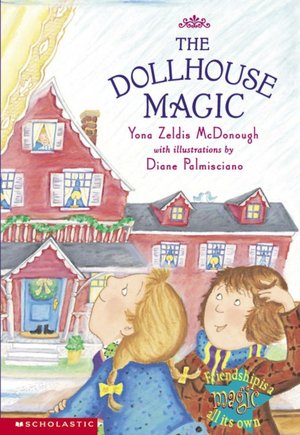
The Dollhouse Magic (MG)

The Dollhouse Magic. Yona Zeldis McDonough. Illustrated by Diane Palmisciano. 2000. Henry Holt. 86 pages.


Of all the streets in town, Lila and Jane Finney like Cheshire the very best. It's not because of the large old oaks whose spreading branches arch and nearly meet in the air, creating, in spring and summer, a most beguiling canopy overhead. Nor is it the well-tended flower beds, though these are filled with an ongoing seasonal display: tulips and daffodils in spring; roses, lilies, and marigolds in summer; asters and mums in the fall. It is not even because of the way the street ends in a lush, grassy circle, in the center of which is a handsomely carved old stone fountain. No, as attractive as all these things are, what Lila and Jane love most is a house on Cheshire Street, a three-story dollhouse with real clapboard siding and a cedar shingle roof that sits in Miss Amanda Whitcomb's front window. 

It all depends on your expectations. On what you want this one to be. Is that fair to a book? Well, I'm not sure it is. But it's one of those things that just happens naturally.

So The Dollhouse Magic is historical fiction for young readers. (I'm thinking second to fourth graders, though that all depends on reading levels of course.) The Dollhouse Magic is set during the Great Depression (1930s). Readers are introduced to two sisters, Lila and Jane, there are other siblings in the family, but Lila and Jane are the stars of this one. The book is about their "adventures" visiting Miss Amanda Whitcomb's dollhouse. It definitely IS an adventure for them. It's quite a thrill to be allowed to play with this dollhouse, to look at all the furniture and dolls. And the dollhouse is perhaps the main attraction at the beginning, but, the two do become very friendly with this old woman. They enjoy the treats she shares. Perhaps they don't realize just how special she is...until...well, you can guess what happens next.

What I didn't quite like about The Dollhouse Magic is how manipulative it is. Yes, I know that people die. I know that is natural. And yes, I know that people even die on Christmas Eve. But. Why oh why oh why does it have to happen in this happy little book...especially without any warning. It's not like we see Miss Whitcomb getting weak or sick. It just didn't seem fair or right.

I would have HATED this ending as a kid. I would have. I'm not all that fond of it as an adult. So my question for you is this... if a character is going to die in a book, do you want some foreshadowing or hinting along the way? Do you want or need time to prepare? Or do you like being surprised? Should sad books come with warnings?

© 2012 Becky Laney of Becky's Book Reviews

Friday, January 27, 2012

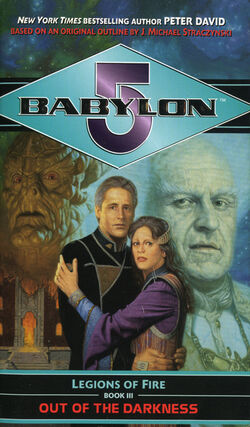
Out of the Darkness

Babylon 5: Legions of Fire: Out of the Darkness. Peter David. 2000. Del Rey. 266 pages.

Prologue: Hiller of the planet Mipas had always been an enthusiast about Earth history.
Chapter one: It is with some degree of shock and personal disappointment that I must conclude that I am losing my mind. I know this because, for the first time in...well...ever, I must admit...I actually felt sorry for Mariel.

Out of the Darkness concludes the Legions of Fire trilogy. And it answers so many questions fans may have about the characters. Including the prophecies and visions of the future hinted at in "War Without End" parts one and two, and "Point of No Return" in season three. Not to mention "Objects at Rest" from season five.

So, Vir has become a strong leader. A behind-the-scenes leader, perhaps, since his movement is oh-so-secretive. If he was known to be the leader of these 'terrorists' sabotaging Centauri's plans, well, he'd pay for it with his life. But the time to act is coming...and soon. And Londo knows this as well. As does G'Kar. All the pieces are coming together for the oh-so-dramatic, oh-so-tragic conclusion. Is it a tragedy with redeeming qualities? Yes. I think so.

It was definitely a compelling read! Very emotional. Especially if you LOVE the characters. This trilogy is definitely a must read. I'm so glad I read it! It made me love certain characters even more. And it gave me a new appreciation for some other characters. Characters that we just barely saw a glimpse of in the series. (Like Londo's wives from "Soul Mates".) And it also fit very nicely (as it should) with In The Beginning.

Read Out of the Darkness
  • If you want to see a more personal, more behind-the-scenes look at the fate of Londo and G'Kar as seen in "War Without End." 
  • If you want to know what happens to your favorite Babylon 5 characters (Londo, G'Kar, John, Delenn, their son, David, Garibaldi, Vir, etc.)
  • If you want to know the fate of Timov and Mariel. (I was definitely surprised by Mariel in the past two novels! I think you might be too.)
  • If you love science fiction with a little drama, a little romance.

© 2012 Becky Laney of Becky's Book Reviews

Thursday, January 26, 2012

Armies of Light and Dark

Babylon 5: Legions of Fire: Armies of Light and Dark. Peter David. 2000. Del Rey. 255 pages.

Prologue: My 'masters' are pleased with me this day.

Chapter one: Vir stood before the giant, crackling energy gate. The ground around him was littered with bodies.

Armies of Light and Dark is the second in the Legions of Fire trilogy. It is definitely a must read! Once you've read The Long Night of Centauri Prime, you're going to want to continue the story. Trust me. So Vir is learning more and more about the darkness surrounding Centauri Prime, learning more about what--or should that be who--the Shadows left behind. He's learning more about the plans--the grand plans--being set in motion. And he's got a little help. True the 'help' is a bit cranky at times, and oh-so-mysterious. (He may NEVER understand technomages.) But Vir is determined--for better or worse--to battle the darkness, the evil forces that no one quite wants to acknowledge just yet.

Read Armies of Light and Dark
  • If you're a fan of Babylon 5, if you just have to know what the future holds for all our characters--well, most of our characters
  • If you're a fan of science fiction with a focus on politics, ethics, good and evil
  • If you're a fan of Vir, if you want to see him transformed into a hero, if you want to see him make tough, tough choices
  • If you're a fan of Londo, if you want to see what happens to him during his reign as emperor
  • If you're a fan of Senna, if you want to see how her character grows and develops 
And now for the quotes,

Vir on the craziness of life:

For the men he passed in the settlement town of K0643, it seemed, the line between truth and fiction, between the easily understood and the incomprehensible, had become blurred. For Vir himself, the line had long ago been completely erased. Anything was capable of happening to him. He felt that this was the only possible mind-set for him to maintain, since anything--more or less-generally did have the habit of happening to him. (14)

Vir and Rem Lamas:

Vir quickly put up his hands and forced a grin. "That's...that's quite all right, I get the idea. I don't really need to know more than you've told me. In fact, I wouldn't have been upset to know less." He cleared his throat, and then said, "So you were going to tell me about..." (16)

Vir being profound:

That was the trouble with knowing what lurks within the shadows, he realized. One can't figure out where to look anymore. If you gaze into the shadows, you blanch at whatever may be in there looking back at you, and you jump as the shadows move. If you look into the light, not only are you blinded by its intensity, but also it serves to remind you that you should be doing everything you can to expunge the darkness. Light does not allow for excuses. (24)

And now a word from Londo:

It is not fit, or meet, or responsible for Centauri to rejoice in the misfortune of others. Throughout our history, we have dealt with other races with compassion, always with compassion. Granted, there have been races that did not see that compassion for what it was, and rebelled. The Narn, naturally, come to mind. In dealing with them, however--in dealing with any who operated in a manner contrary to the interests of the great Centauri Republic--we did exactly what we had to do. No more and no less. (68)

Londo to Senna:

"There are battles that can and should be fought, and there are battles that should not be. In the case of the former, let nothing stop you. In the case of the latter, let nothing start you." (85)

Galen to Vir:

"For every action, however, there is an equal and opposite reaction. That is an immutable rule of the universe. You are to be the opposite reaction." (98)

Londo and G'Kar

"You," Londo said, "are the single most irritating individual I have ever met."
"You see?" G'Kar replied."What could be more proof of friendship than that? Who but a friend could be anywhere near as irritating as I am?" (196)


© 2012 Becky Laney of Becky's Book Reviews

Sunday, June 19, 2011

The Rumpelstiltskin Problem (MG)

The Rumpelstiltskin Problem. Vivian Vande Velde. 2000. Houghton Mifflin. 116 pages.

The Rumpelstiltskin Problem is a collection of short stories. Each short story puts a twist on the fairy tale Rumpelstiltskin. In the author's note, Vivian Vande Velde picks apart all the problems with the original story, alerts readers of all the holes in logic, argues that the story is obviously incomplete! She plays around with this in her stories, proving that there are many sides to a story, many ways to interpret a story. Some are clever. Some are amusing. All are well-crafted, in my opinion.

If I had to choose just one as a favorite, it would be Straw into Gold.

The six short stories are:

A Fairy Tale in Bad Taste
Once upon a time, before pizzerias or Taco Bells, there was a troll named Rumpelstiltskin who began to wonder what a human baby would taste like.
Straw Into Gold
Once upon a time, in the days before Social Security or insurance companies, there lived a miller and his daughter, Della, who were fairly well-off and reasonably happy until the day their mill burned down.
The Domovoi
Once upon a time, before home security systems and trained guard dogs, if you lived in Russia the way to keep your home safe and happy was to have a domovoi living beneath your basement. 
Papa Rumpelstiltskin
Once upon a time, before bread was plastic-wrapped and sold in supermarkets, there lived a miller named Otto and his daughter, Christina.
Ms. Rumpelstiltskin
Once upon a time, before eyelash curlers and lip liner, there lived a very plain girl by the name of Rumpelstiltskin.
As Good As Gold
Once upon a time, before movie stars or rock singers or professional athletes, the people everybody most wanted to meet were kings and queens.

© 2011 Becky Laney of Becky's Book Reviews

Saturday, April 24, 2010

The Queen of Attolia (MG/YA)


The Queen of Attolia by Megan Whalen Turner. 2000. HarperCollins. 288 pages.

He was asleep, but woke at the sound of the key turning in the lock.

Things are not looking so good for Eddis' Thief, Eugenides, for he has been caught by the Queen of Attolia. The queen first met Gen in The Thief. And he didn't exactly make the greatest impression by telling her she was beautiful but not all that kind. It may have been true. (The Queen is not known for her mercy.) But it's not the kind of flattery that will win him royal friends. What will she do now that she has him? What is the best way to hurt him? To hurt his Queen, the uglier-but-kinder Queen he serves?

Queen Eddis is angered when Eugenides is returned. Oh, she's thankful enough that he is still alive. But to see her thief now one-handed, well, it hurts. She's rightfully worried about him. She cares about what this will mean to him. Can Eugenides accept what has happened to him? Can he find the will, the strength he needs? Can he prove just how valuable he is to his Queen, to his country?

The Queen of Attolia is the sequel to The Thief. It is different from The Thief in quite a few ways. It is more focused on politics, on royal intrigues than on adventure-for-the-sake-of-adventure. I am liking this series very much!

© Becky Laney of Becky's Book Reviews
Wednesday, April 14, 2010

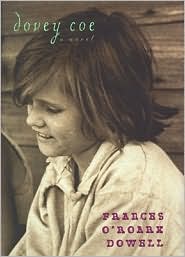
Dovey Coe (MG)


Dovey Coe. Frances O'Roark Dowell. 2000. Simon & Schuster. 192 pages.

My name is Dovey Coe, and I reckon it don't matter if you like me or not. I'm here to lay the record straight, to let you know them folks saying I done a terrible thing are liars. I aim to prove it, too. I hated Parnell Caraway as much as the next person, but I didn't kill him.

Loved this one. Loved the way it started out too! (What do you think?! Would you want to read more after reading that first paragraph?!) Frances O'Roark Dowell has a way with words, a way with characters. And she did a wonderful job in describing the Coe family and the mountain community in which they live.

Dovey Coe does not like Parnell Caraway hanging around her sister, Caroline. Doesn't like the fact that her oh-so-beautiful sister doesn't reject him outright. Doesn't like the fact that her sister might just be reconsidering her plans. You see, Caroline wants to go to college, wants to be a teacher. But Parnell is trying to do anything and everything to make her change her mind. The pretty words he's been saying. The drives they've been taking in his car. The promises of a rich future they could have...together. But not all his words sound so pretty--some are quite ugly. Will Caroline make the right choice? And what will her choice mean for the rest of the Coe family?

This book would be perfect for the Southern Reading Challenge.

© Becky Laney of Becky's Book Reviews