Showing posts with label 1986. Show all posts

Friday, February 13, 2026

18. If You Traveled West in a Covered Wagon


18. If You Traveled West in a Covered Wagon. Ellen Levine. Illustrated by Elroy Freem. 1986. 80 pages. [Source: Bought] [4 stars, children's nonfiction]

First sentence: One hundred and fifty years ago there was no railroad that went all across the country. There were no cars or buses or airplanes. The only was to travel across the country was to ride a horse, or if you went with your family, to travel in a covered wagon. In the 1840s and 1850s, thousands of people traveled West. So if you lived at that time, there was a chance you might have traveled in a covered wagon. This book is about traveling and living in a covered wagon. It tells what it was like to be one of the early pioneers to travel to Oregon.

Premise/plot: What you see is what you get. Each two page spread answers one question. All questions relate to traveling in a covered wagon or traveling west. The questions cover the basics and also goes beyond that a bit to more specific, detailed questions. Will it answer every single possible question? Maybe. Maybe not. But it is a great nonfiction book to pair with fiction titles.

My thoughts: I don't remember all the books in this series, but, I know there were a few at least. I loved these kinds of books as a kid. I was so happy to thrift a copy of this one!

© 2026 Becky Laney of Becky's Book Reviews

Tuesday, May 07, 2019

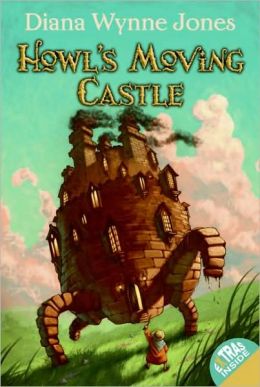
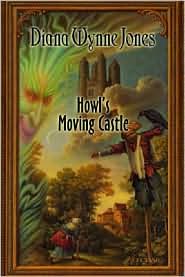
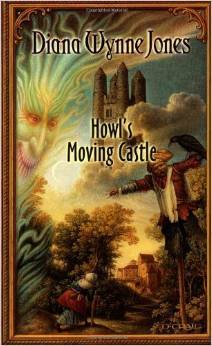
Howl's Moving Castle

Howl's Moving Castle. Diana Wynne Jones. 1986/2001. 329 pages. [Source: Bought]

 First sentence: In the land of Ingary, where such things as seven-league boots and cloaks of invisibility really exist, it is quite a misfortune to be born the eldest of three.

Premise/plot: Sophie Hatter is the oldest of three sisters. (Her sisters are Lettie and Martha). Sophie fears this means she is fated to failure. What fairy tale ever has the oldest daughter succeeding at having a grand adventure and living happily ever after?! She should be thankful that she's not ugly--after all she is a stepsister to the young Martha. When the novel opens, the stepmother, Fanny, has arranged apprenticeships for all three of her children. One will be apprenticed to a local bakery. One will be apprenticed to a witch. And Sophie, the oldest, will remain as apprentice in the family's hat shop. But it isn't Sophie's fate to remain in that hat shop and make hats.

After becoming CURSED by the Witch of the Waste--her curse changes her into an OLD WOMAN-- Sophie finds herself wandering about and in need of refuge. She finds that refuge in Howl's Moving Castle. She joins his household as a cleaning woman. The other residents are Michael, Howl's apprentice, Calcifer, Howl's fire demon, and Wizard Howl himself....

Her quest is to break the curse of Calcifer so that Calcifer can in return break her curse...but neither can discuss their own curse...that's part of the curse. 

My thoughts: I love, love, love, love, love, love this one. It isn't my typical read in many ways. I don't particularly seek out books with wizards, witches, curses, spells, enchantments, etc. But the characterization is super-fun and the writing is delightful. This is the third time I've read the novel, I believe. I think I love it more each time.

Quotes:

  • Sophie Hatter was the eldest of three sisters. She was not even the child of a poor woodcutter, which might have given her some chance of success!
  • Nobody can buy a hat without gossiping.
  • Sophie talked to hats more and more as weeks went by.
  • As a girl, Sophie would have shriveled with embarrassment at the way she was behaving. As an old woman, she did not mind what she did or said. She found that a great relief.
  • “Everyone knows you’re a wizard, young man,” she said severely. “But that doesn’t alter the fact that your castle is the dirtiest place I’ve ever been in.”
  • “If you knew the trouble we’ve had because Howl will keep falling in love like this! We’ve had lawsuits, and suitors with swords, and mothers with rolling pins, and fathers and uncles with cudgels. And aunts. Aunts are terrible. They go for you with hat pins.
  • On the other hand, it is quite a risk to spank a wizard for getting hysterical about his hair.
  • Sophie’s experience told her that tantrums are seldom about the thing they appear to be about.
  • “Did he forget to spend at least an hour in the bathroom this morning?” Michael asked. “He was in there two hours,” said Calcifer, “putting spells on his face. Vain fool!” “There you are, then,” said Michael. “The day Howl forgets to do that will be the day I believe he’s really in love, and not before.”
  • The King was smiling. It was the slightly uncertain smile that went with the person he was, rather than the king he ought to be.
  • “People who are appointed to do something by the King and go courting in the rain instead have only themselves to blame.”
  • Howl’s voice was presently heard shouting weakly, “Help me, someone! I’m dying from neglect up here!”
  • “I’m dying of boredom,” Howl said pathetically. “Or maybe just dying.”
  • “Because there is no cure for a cold,” Howl said dolefully. “Things are going round and round in my head—or maybe my head is going round and round in things.
  • Sophie knew that living happily ever after with Howl would be a good deal more eventful than any story made it sound, though she was determined to try.             

© 2019 Becky Laney of Becky's Book Reviews

Saturday, August 19, 2017

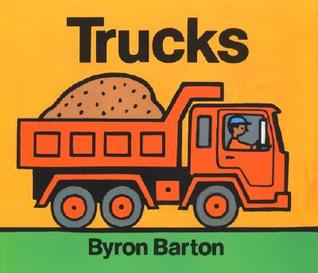
Trucks

Trucks. Byron Barton. 1986. 32 pages. [Source: Library]

First sentence: On the road here come the trucks. They come through tunnels. They go over the bridge.

Premise/plot: Trucks are useful, always working. This is a simple introduction to the working class of trucks. The intended audience is preschoolers or toddlers.

My thoughts: I like this one. The text is super simple. It is not text heavy. As a read aloud it flows well. The illustrations are bold and colorful. I'd recommend this to parents with truck-obsessed little ones. I do think that it could transition to an easy to read on their own book.

Text: 4 out of 5
Illustrations: 3 out of 5
Total: 7 out of 10

© 2017 Becky Laney of Becky's Book Reviews

Sunday, August 06, 2017

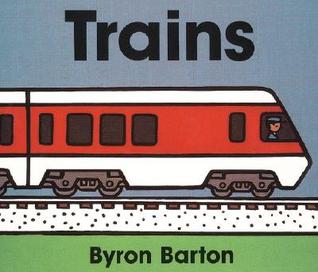
Trains

Trains. Byron Barton. 1986. HarperCollins. 32 pages. [Source: Library]

First sentence: On the track the trains are running. Here is a train with people inside.

Premise/plot: Trains by Byron Barton introduces little ones to multiple types of trains. Passenger, freight, steam, electric. The text is simple, but not as simple as Freight Train.

My thoughts: The very fact that this book is NOT Freight Train might make it appealing to parents who've spent weeks or months reading Freight Train. I did like it. I think it makes a good read aloud. Love the amount of text on each page. The illustrations are very bold, basic colors.

Text: 5 out of 5
Illustrations: 3 out of 5
Total: 8 out of 10

© 2017 Becky Laney of Becky's Book Reviews

Wednesday, December 02, 2015

Complete Tales

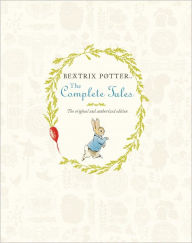
Complete Tales by Beatrix Potter. 1986/2006. 400 pages. [Source: Library]

Would I recommend reading The Complete Tales of Beatrix Potter? Yes, for the most part. Even if I didn't love, love, love each and every story within the collection, I would definitely say that the book is worth having--whether you buy it or borrow it from the library. I love it's completeness. I love that it isn't just a selection of her best-known or best-loved stories. I loved that the book presents her stories in the order of publication. I also love that each story is introduced to readers. Not that this background information would be something you'd need to share with children, but, for adults it's fascinating to learn more about the writing process and the author's personal life.

The book includes:
  • The Tale of Peter Rabbit
  • The Tale of Squirrel Nutkin
  • The Tailor of Gloucester
  • The Tale of Benjamin Bunny
  • The Tale of Two Bad Mice
  • The Tale of Mrs. Tiggy-Winkle
  • The Tale of The Pie and The Patty Pan
  • The Tale of Mr. Jeremy Fisher
  • The Story of A Fierce Bad Rabbit
  • The Story of Miss Moppet
  • The Tale of Tom Kitten
  • The Tale of Jemima Puddle-Duck
  • The Tale of Samuel Whiskers
  • The Tale of the Flopsy Bunnies
  • The Tale of Ginger and Pickles
  • The Tale of Mrs. Tittlemouse
  • The Tale of Timmy Tiptoes
  • The Tale of Mr. Tod
  • The Tale of Pigling Bland
  • Appley Dapply's Nursery Rhymes
  • The Tale of Johnny Town-Mouse
  • Cecily Parsley's Nursery Rhymes
  • The Tale of Little Pig Robinson

The book also features her "other works." These are "Three Little Mice," "The Sly Old Cat," "The Fox and the Stork," and "The Rabbit's Christmas Party." Some of these are works-in-progress. She'd done the illustrations, or drafts of illustrations, but never completed the text.

The book, I think, definitely celebrates her life as a writer, it celebrates the writing and publishing process--the journey. It was great to have such a thorough collection. I did "discover" new-to-me Potter stories that I'd not read before.

My top ten

1) The Tailor of Gloucester
2) The Tale of Peter Rabbit
3) The Tale of Benjamin Bunny
4) The Tale of Two Bad Mice
5) The Story of Miss Moppet
6) The Tale of Little Pig Robinson
7) The Tale of Squirrel Nutkin
8) The Tale of Tom Kitten
9) The Tale of Jemima Puddle-Duck
10) The Tale of Mrs. Tittlemouse

Do you have a favorite story by Beatrix Potter?! I'd love to know what it is!
© 2015 Becky Laney of Becky's Book Reviews

Saturday, November 21, 2015

Seuss on Saturday #47

You're Only Old Once! Dr. Seuss. 1986. Random House. 56 pages. [Source: Library]

 First sentence: One day you will read in the National Geographic of a faraway land with no smelly bad traffic.

Premise/plot: An old man is "stuck" worrying at the doctor's office--or hospital--as various tests and procedures are done for his check up.

My thoughts: You're Only Old Once is definitely a picture book for older readers. Perhaps mainly adult readers. It is clever, in places, and overall I think it's a book worth reading. One example of the cleverness is the eye test or the "eyesight and solvency test" which reads:
HAVE YOU ANY IDEA
HOW MUCH MONEY
THESE TESTS ARE
COSTING
YOU?
Here's another favorite part:
Dietician Von Eiffel controls the Wuff-Whiffer, our Diet-Devising Computerized Sniffer, on which you just simply lie down in repose and sniff at good food as it goes past your nose....And when that guy finds out what you like, you can bet it won't be on your diet. From here on, forget it!
Have you read You're Only Old Once! Did you like it? love it? hate it? I'd love to know what you thought of it!

If you'd like to join me in reading or rereading Dr. Seuss (chronologically) I'd love to have you join me! The next book I'll be reviewing is I Am Not Going To Get Up Today. 

© 2015 Becky Laney of Becky's Book Reviews

Tuesday, August 18, 2015

The Whipping Boy

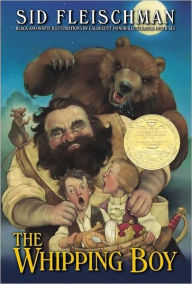
The Whipping Boy. Sid Fleischman. Illustrated by Peter Sis. 1986. 96 pages. [Source: Bought]

First sentence: The young prince was known here and there (and just about everywhere else) as Prince Brat. Not even black cats would cross his path.

Jemmy is "the whipping boy" of Prince Horace (Prince Brat). Every time Prince Brat misbehaves, it is Jemmy who receives his punishment. And does Prince Brat get in trouble often? That would be an understatement. He is ALWAYS getting in trouble, and Jemmy suffers oh-so-bravely for it. Does he cry out, whimper, shed a tear? No, never. And Prince Brat almost hates him for not putting on a show. Doesn't Jemmy know that it would be so much more entertaining if he just would shout or cry out?

The Whipping Boy is the story of what happens when Jemmy and Prince Brat "run away" from the palace. Jemmy is hoping to make his own escape, to sneak away from Prince Brat, and to end his whipping days for good. But before Jemmy can make his second get away, the two are kidnapped...

Beyond that, I will say NOTHING. Except that this is a surprisingly delightful adventure story....

This may be one of the Newbery winners that has surprised me most. I wasn't expecting to like it, to find it so readable, so enjoyable. But I really found myself swept into the story. I liked this one very much. 

Have you read it? Did you like it? love it? hate it? Did you like Jemmy? Did you eventually come to like Prince Brat a tiny bit at least? Do you have a favorite Newbery winner? Which one has surprised you the most?

© 2015 Becky Laney of Becky's Book Reviews

Thursday, July 30, 2015

On My Honor

On My Honor. Marion Dane Bauer. 1986. Houghton Mifflin Harcourt. 96 pages. [Source: Review copy]


The good news is that the jacket copy of this book is so straight forward I would have known to avoid this one as a kid. (Sad books and I did not get along.)

What is the book about? Joel and Tony are close friends, perhaps even best, best friends. But Joel isn't honest with Tony. And Tony isn't honest with Joel. If either boy had been honest, then the book wouldn't exist essentially. The truth is, Joel doesn't want to go with Tony to Starved Rock state park to climb the bluffs. And Tony doesn't want to go swimming at the city pool with Joel. Joel's last hope is that his Dad will say no to the boys biking over to the state park. Is Joel honest with his Dad? Of course not! Don't be silly. His Dad thinks his son wants to go biking with his friend. And though he knows it may be beyond his child's ability to bike eight or nine miles each way, he says yes. Perhaps he wants his son to like him and think he's cool? Joel tries to hide his disappointment that his Dad failed him by setting up good boundaries, and reluctantly Joel sets off on a very long journey. (In the Dad's defense, Joel and Tony are not honest about what they're going to do once they get to the state park.)

At some point, perhaps halfway, perhaps not. The boys take a break on the bridge. Tony decides to change plans. Now Joel had promised his Dad that they wouldn't change plans, that they would go where they were supposed to go, and do what they were supposed to do, but, does Joel have the integrity, the "honor," to stand his ground? Of course not! Not in this book! Tony decides to go swimming in the river, the river that both boys had been warned was dangerous dozens and dozens of times. Tony talks his friend into going swimming in a dangerous river. Joel knew he was making a bad decision, a "wrong" decision, a breaking-all-rules, and going-against-my-parents-decision, but he goes along with Tony anyway. Into the water they go. But Tony has a big secret: he can't swim. And, as you can imagine, swimming in a dangerous river with strong currents and whirlpools is not the best idea if you can't swim. So Tony drowns.

What little regard I have for Joel is completely lost in the next half of this oh-so-short novel. (I was so thankful this one is short!!!) Is Joel honest with anyone after the accident? Does he tell the police? Does he tell Tony's mom? Does he tell his Dad? It's not that he doesn't tell anyone--he tells a stranger, someone near the scene that he gets to look for Tony in the river--but when this stranger wants to do the right thing, the only necessary thing, Joel makes promises he has no intention of keeping. The lying begins. He has no idea what happened to Tony. He left Tony on the road, on his way to the state park. Tony was alive and biking the last time he saw him. He has no idea why he isn't back home yet.

The truth does come out, of course, but not in a way that puts Joel in a good light, an honorable position. The book ends with Joel and his Dad having a heartfelt conversation. But that conversation didn't sit right with me. Joel wants assurance that there is a heaven and that his friend, Tony, is there. And his Dad tells him that no one can be sure that there even is a heaven. But if there is a heaven, then he's sure Tony is there. I'm not sure which annoys me more. The emphasis that "no one can be sure" there is a heaven, or, the assumption that anyone who dies automatically goes to heaven. I'm not suggesting that the book should end with a discussion that heaven is a real place and hell is a real place, and unless you're trusting in Christ as your Savior, you're destined for hell. That's an unlikely book ending for sure.

Who's responsible? Who's to be held accountable? Who's to blame? The book spends some time devoted to this, mostly through showing and not telling. (Though that last conversation with his Dad does bring this up.) The book certainly can bring a reaction out of the reader.

On My Honor was a Newbery Honor book in 1987.

© 2015 Becky Laney of Becky's Book Reviews

Friday, July 24, 2015

Hatchet

Hatchet. Gary Paulsen. 1986. Simon & Schuster. 208 pages. [Source: Library]

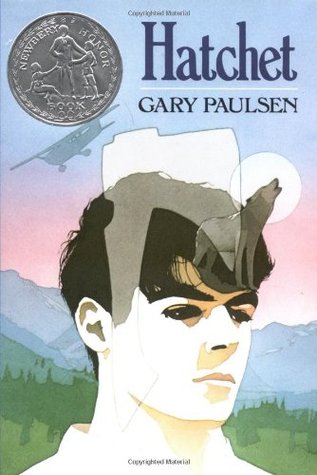
I still can't say that I love this cover of Hatchet, but, avoiding the book because of the cover was a bit silly of me. So did I enjoy reading Hatchet? Yes, for the most part. Hatchet is a survivor story starring Brian Robeson. (It is a Newbery Honor book). Brian is on the way to visit his Dad after the dramatic divorce. (Brian knows something his father doesn't. This SECRET haunts him throughout the book. He's definitely not over the divorce.) But the single engine plane taking him to visit his Dad never arrives. The pilot has a heart attack, and Brian must land/crash the plane himself. He survives the crash, but will he know how to survive in the wild until he is rescued? Fortunately, his mom gave him a hatchet before the trip. And it's a hatchet he wore on the plane, on his belt, I believe? So it's the one thing he has with him that may enable him to survive until help comes...

Brian has adventures and misadventures. He manages to survive, but, never to the point where it becomes fun and amazing. These aren't adventures he'd ever choose to have.

I definitely am glad I read this one. Have you read it? What did you think?

© 2015 Becky Laney of Becky's Book Reviews

Sunday, December 14, 2014

Eight Christmas Books

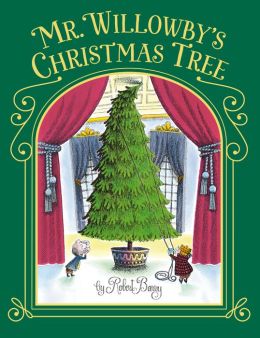
Mr. Willowby's Christmas Tree. Robert E. Barry. 1963. Random House. 32 pages. [Source: Library]

Mr. Willowby's Christmas tree came by special delivery. Full and fresh and glistening green--the biggest tree he had ever seen. He dashed downstairs to open the door--This was the moment he'd waited for.

I loved, loved, loved Mr. Willowby's Christmas Tree. It celebrates giving in a fun and playful way. Mr. Willowby starts off a long chain of giving when he chops off the top of his too-tall Christmas tree. A tree that is splendid in every other way. He gives the tree-top to the upstairs maid. She's delighted. Very delighted. How thoughtful! How cheery! But the tree is too-tall for her small room. The top must go! Chances are you can predict at this point how the story will go. But that doesn't mean it is in any way less delightful. This little tree-top gets passed down and re-trimmed again and again and again and again and again. And it's just WONDERFUL to see how much happiness and cheer it brings to others.

I loved the premise. I loved the writing. The rhyming was delightful. It worked very well for me! I think this one would make a great read-aloud. I also loved how uplifting it is. (After reading Baboushka and the Three Kings, I needed a cheery story!)

Why didn't someone tell me about this wonderful and charming picture book?! Why?! Well, I am glad to have discovered it now!

Which Christmas books would you consider classic? Which would you recommend?

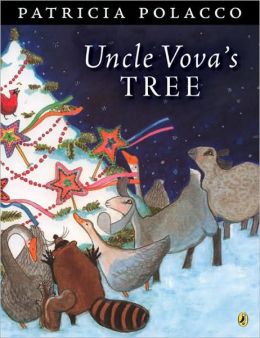
Uncle Vova's Tree. Patricia Polacco. 1989. Penguin. 32 pages. [Source: Library]

Uncle Vova's Tree is rich in detail and tradition. The author, Patricia Polacco, is drawing from her past and recalling some of her childhood Christmases. She writes, "As a child I celebrated Christmas as most American children did, but at Epiphany in January, my brother, my two cousins, my grandparents and I would go to the farm of my Great Uncle Vladimir and Aunt Svetlana to celebrate in the Russian tradition." The book recalls two family gatherings specifically. The first is Uncle Vova's last Christmas. Though of course, most everyone did not *know* it would be his last Christmas. The second is that first Christmas without him. The book definitely has tones of sadness, but, it is ultimately hopeful. Memories, good, strong happy memories, remain.

The book is rich in detail and tradition. It is informative in many ways. Did you know about the tradition of putting hay underneath the tablecloth to remember and honor the stable in Bethlehem where Jesus was born? But in addition to honoring tradition--in this case, Russian tradition--it also celebrates families. Readers meet a family that is close and loving and supportive. Little details make this one work well.

Too Many Tamales. Gary Soto. Illustrated by Ed Martinez. 1993. Penguin. 32 pages. [Source: Library]

Snow drifted through the streets and now that it was dusk, Christmas trees glittered in the windows.

Too Many Tamales is a great family-oriented Christmas story. Maria, our heroine, is helping her mom make tamales. She loves helping her mom, loves being grown-up in the kitchen. But things don't go smoothly with this first batch of tamales. And it is her fault. Mostly. Maria really, really, really wanted to try on her mom's ring. Unfortunately, this-too-big ring falls right into the masa mixture. Hours later, she realizes that she never took the ring off. She doesn't know for sure where the ring is. But she has a strong suspicion that it may very well be in one of the twenty-four tamales. With a little help from her cousins, Maria is in a race to find the ring before her mom--and all the other relatives--realize what has happened. Will she find the ring? Will her mom find out? Will her cousins ever want to eat another tamale?!

I liked this one very much.

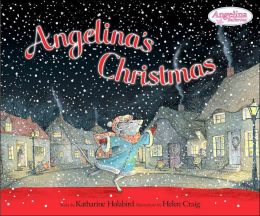
Angelina's Christmas. Katharine Holabird. Illustrated by Helen Craig. 1986. Penguin. 32 pages. [Source: Library]

Christmas was coming, and everyone at Angelina's school was working hard to prepare for the Christmas show.

I enjoyed reading Angelina's Christmas. I enjoyed meeting Angelina and her family. I loved how thoughtful and empathetic Angelina was. She realizes that there is one house in the village that is not decorated. She notices that there is one "old man huddled by a tiny fire." She learns from her parents that this old man is Mr. Bell, a retired postman. She decides that she will do something special for him so he won't be all alone at Christmas time. (And Angelina isn't the only one joining in to help make this Christmas memorable for Mr. Bell.) She makes him cookies, her mom sends along mince pies and fruit, her dad cuts him a Christmas tree. They visit him, Henry, Angelina's brother comes along too. But perhaps even more importantly than showing him kindness through things, they take the time to listen to him, to include him. This one is a lovely book.

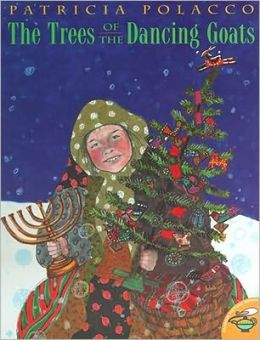
The Trees of the Dancing Goats. Patricia Polacco. 2000. Simon & Schuster. 32 pages. [Source: Library]

At our farm just outside Union City, Michigan, we didn't celebrate the same holidays as most of our neighbors...but we shared their delight and anticipation of them just the same.

I enjoyed reading The Trees of the Dancing Goats by Patricia Polacco. She is sharing yet another holiday memory with young readers in this picture book.

The story focuses on one holiday season when the town is hit by an epidemic, scarlet fever, I believe. The heroine's family is not sick, but, most of their neighbors are. As they are preparing to celebrate Hanukkah, they realize that most of their neighbors are too sick to prepare for and celebrate Christmas. They love their neighbors. They want to do something for them. Working together as a family, they decide to bring Christmas to their neighbors: food, a tree, decorations. Since they don't own any Christmas ornaments, they use animals carved out of wood. One of the animals, as you might have guessed, is a goat. When hung on the tree, it appears to be a dancing goat. Can one family bring Christmas cheer to a community?

I liked this one. I liked the family scenes very much. It is a thoughtful book. I'm glad I finally discovered it!

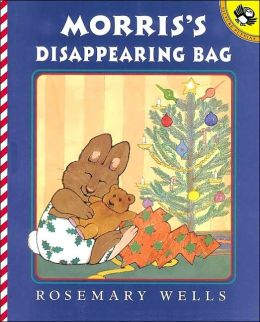
Morris' Disappearing Bag. Rosemary Wells. 1975. Penguin. 40 pages. [Source: Library]

It was Christmas morning. "Wow!" said Morris.

Morris' Disappearing Bag probably isn't my favorite Rosemary Wells, but, this one is enjoyable enough that it's worth reading at least once or twice. Morris stars in this one. He has three older siblings: one big brother, Victor, and two older sisters, Rose and Betty. It is a Christmas book, of course. After all the presents are opened, the three older siblings play with their presents and play with each others presents. Victor got hockey stuff. Betty got a chemistry set. Rose got a beauty kit. They take turns sharing. Much fun is had. But not by all. For Morris has only his present (a teddy bear) to play with. He doesn't get a turn with his siblings' presents. But that changes when Morris discovers a fantastic present under the tree. A bag. A disappearing bag. Whatever is in the bag disappears. His siblings all want a turn, and, he lets them in the bag. While his siblings have disappeared for the day, Morris plays with their stuff before settling into bed with his bear.

Max's Christmas. Rosemary Wells. 1986. Penguin. 32 pages. [Source: Library]

I love watching Max and Ruby. I've seen the adaptation of Max's Christmas plenty of times before I read the book. If you like the show, chances are you'll enjoy reading this book. It is very similar. For those new to these lovable siblings, Ruby is the older sibling. She seems to be raising Max all on her own. (Ruby and Max don't have parents. They have a Grandma, but, she does not live with Max and Ruby.) Max is the younger sibling. He is many things: cute, clever, curious. Yes, he can be mischievous, but, he is also super-observant. I love, love, love them both. I might like Max a tiny bit better than Ruby. But still. I love them both.

In this book, readers join Ruby and Max on Christmas Eve night. Ruby is trying her best to get Max to get ready for bed, to go to sleep. Max is excited, of course. Once he knows that Santa is coming to his house tonight, he wants to see it for himself. So he goes downstairs to wait for Santa....

I liked this one very much.

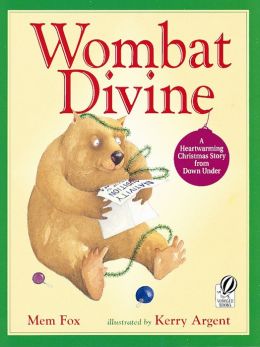
Wombat Divine. Mem Fox. Illustrated by Kerry Argent. 1995/1999. HMH. 32 pages. [Source: Library]

I found Mem Fox's Wombat Divine to be charming. I loved Wombat. He loves, loves, loves Christmas. More than anything, he wants a part in the nativity play. At the auditions, he tries his best. But there are so many parts that he's just not right for. I love the refrain, "Don't lose heart. Why not try for a different part?" which is used throughout the whole auditioning process. He auditions for Archangel Gabriel, Mary, a wise king, Joseph, an innkeeper, and a shepherd. But there's one role that he'd be just perfect playing. Can you guess it?

I liked this one. I thought it was cute and sweet. I liked the writing. I found it unique and oh-so-right.

© 2014 Becky Laney of Becky's Book Reviews

Friday, October 10, 2014

Reread #41 Howl's Moving Castle

Howl's Moving Castle. Diana Wynne Jones. 1986. 336 pages. [Source: Bought]

 I first read and reviewed Howl's Moving Castle in 2009.

After Sophie's father dies, her step-mother sends away two of her sisters. Sophie she keeps on as an apprentice in the family's hat business. Sophie trims hats. While she's trimming hats and arranging them, she finds herself very often talking to the hats, supposing what kind of person will buy the hat, etc. The shop begins to do well--really well. One person--one witch--notices and decides to act. Poor Sophie finds herself under the witch's spell! Sophie leaves her old life behind, without a word, and goes on an adventure of sorts. Life certainly becomes more challenging for Sophie! But she soon finds a new place to belong, a strange place, an odd place, but a place that begins to feel oddly enough like home. Sophie makes friends in unexpected places.

I loved rereading Howl's Moving Castle. From start to finish, this fantasy novel proves delightfully charming. I loved the characters. I especially loved Sophie and Wizard Howl. I loved the world-building. I love the storytelling. I loved Jones' descriptions. It's just a fun, fun adventure story with heart.

Here's how it begins: "In the land of Ingary, where such things as seven-league boots and cloaks of invisibility really exist, it is quite a misfortune to be born the eldest of three. Everyone knows you are the one who will fail first, and worst, if the three of you set out to seek your fortunes. Sophie Hatter was the eldest of three sisters. She was not even the child of a poor woodcutter, which might have given her some chance of success!" It hooks readers from the very beginning. It certainly hooked me!

I would definitely recommend this one! I just love it!
© 2014 Becky Laney of Becky's Book Reviews

Tuesday, June 24, 2014

Behave Yourself, Bethany Brant (1986)

Behave Yourself, Bethany Brant. Patricia Beatty. 1986. HarperCollins. 160 pages. [Source: Bought.] 

I acquired Behave Yourself, Bethany Brant from the library book sale a few years ago. Bethany Brant, the heroine, is a preacher's kid. The book is set near the turn of the twentieth century. And it's set in Texas. It felt like it could be a very good fit for me. Unfortunately, it wasn't quite what I expected it to be.

The book opens with Bethany Brant visiting a fortune teller at a fair or carnival. Her parents are busy listening to live music; her brother, Abel, is off on his own. Bethany knows her parents wouldn't approve of her visiting a fortune teller, of her wasting her money on such a thing, of her giving so much of her time and thought to what the fortune teller says. But. Bethany Brant does, at least on this occasion, exactly what she wants.

The entire book is centered around what the fortune teller said. She was told at least three specific things: something bad was going to happen, there were elephants in her future, and that a one-eyed man would befriend her in her greatest need.

The book chronicles Bethany through all three "prophecies" (for lack of a better word.) It follows her for almost two years. A lot does happen to turn Bethany's world upside down. And in many ways, the book is just your average coming-of-age story.

I liked this one. But I certainly didn't love it.

© 2014 Becky Laney of Becky's Book Reviews

Friday, February 17, 2012

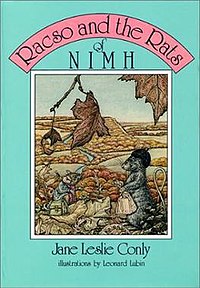
Rasco and the Rats of NIMH (MG)

Rasco and the Rats of NIMH. Jane Leslie Conly. 1986. HarperCollins. 280 pages.

Mrs. Frisby, a brown field mouse, hummed softly to herself as she folded her son Timothy's clothing: a sweater, a jacket, a red scarf. 

I really LOVED Mrs. Frisby and the Rats of NIMH. Which is why I was so excited to discover there was a sequel written by the author's daughter. I'm not sure I loved Rasco and the Rats of NIMH more than the original novel--it's been too many years since I first read it. But I definitely loved it. I just LOVE the world she has created. I loved the community--society--they've built in Thorn Valley.


This book just made me happy. It was purely satisfying. Granted, not everything that happens in this one is happy. There is a problem to be solved, a crisis to be averted. It will take a community working together--thinking together--to save Thorn Valley from a very human threat: progress. But. It was just a great little novel to spend an afternoon with.

Read Rasco and the Rats of NIMH
  • If you love animal fantasies
  • If you love stories starring mice and/or rats
  • If you love Mrs. Frisby and the Rats of NIMH
  • If you want to revisit the 80s--through a rat's perspective!
  • If you love adventure stories

© 2012 Becky Laney of Becky's Book Reviews

Monday, June 13, 2011

The Cat Who Saw Red

The Cat Who Saw Red. Lilian Jackson Braun. 1986. Penguin. 250 pages.

Jim Qwilleran slumped in a chair in the Press Club dining room, his six-feet-two telescoped into a picture of dejection and his morose expression intensified by the droop of his oversized mustache.

Jim Qwilleran has just been designated the paper's food critic. Unfortunately, Jim has just been placed on a diet by his doctor. When he gets the news that the paper is going to be paying him to eat at all the local restaurants, he's reading over his diet sheet.
No potatoes
No bread
No cream soups
No fried foods
No gravy
No sour cream
No desserts
No wonder Jim is feeling down! His first assignment takes him to Maus Haus where he crosses paths with an old girlfriend--now married, now a potter. He also learns that there's an apartment to rent. True, Maus Haus houses some very eccentric people, but there's also a great cook and housekeeper. (I'm not quite sure how to feel about Jim moving in every book!) His two Siamese cats, Koko and Yum Yum seem to like this move. And his two cats especially love all the food he's bringing home--since Qwill is on a diet, since he's restricting himself to three bites per dish.

But it isn't long before Jim and Koko are back at work solving another mystery. His ex, Joy Graham, has gone missing, and though her husband claims she's run off--again--this time to Florida--a state Jim knows she hates--it may take him a while to really discover the truth.

I enjoyed this one. I did. I am just loving the Cat Who mysteries. I love Koko and Jim. (I still don't feel like I "know" Yum Yum.) These books are just very satisfying, very cozy.

Qwilleran tried to entertain the group with tales about Koko and Yum Yum. "They can smell through the refrigerator door," he said. "If there's lobster in there, they won't eat chicken, and if there's chicken, they won't eat beef. Salmon has to be a nationally advertised brand; don't ask me how they know. In the morning Koko rings for his breakfast; he steps on the tabulator key of the typewriter, which jerks the carriage and rings the bell. One of these days I think he'll learn to type." (40-41)


© 2011 Becky Laney of Becky's Book Reviews
Thursday, June 04, 2009

Howl's Moving Castle (MG, YA)


Jones, Diana Wynne. 1986. Howl's Moving Castle. 329 pages.

My new-found love for Diana Wynne Jones became evident only a few pages into Howl's Moving Castle, a wonderful fantasy novel revolving around a moving castle and its inhabitants.

In the land of Ingary, where such things as seven-league boots and cloaks of invisibility really exist, it is quite a misfortune to be born the eldest of three. Everyone knows you are the one who will fail first, and worst, if the three of you set out to seek your fortunes.

Sophie Hatter was the eldest of three sisters. She was not even the child of a poor woodcutter, which might have given her some chance of success. Her parents were well-to-do and kept a ladies' hat shop in the prosperous town of Market Chipping. True, her own mother died when Sophie was too years old and her sister Lettie was one year old, and their father married his youngest shop assistant, a pretty blonde girl called Fanny. Fanny shortly gave birth to the third sister, Martha. This ought to have made Sophie and Lettie into Ugly Sisters, but in fact all three girls grew up very pretty indeed, though Lettie was the one everyone said was most beautiful. Fanny treated all three girls with the same kindness and did not favor Martha in the least.


After the death of Mr. Hatter, the three Hatter sisters are divided up out of necessity--due to debt. One becomes apprentice to a baker/pastry chef. One becomes apprentice to a witch, Mrs. Fairfax. And Sophie, the oldest of the bunch, remains as "apprentice" to Fanny and continues working in the hat shop. Sophie in her people-pleasing, peace-maker role would have been content merely to let life pass her by. If only. If only...she hadn't fallen under the curse of the Witch of the Waste. Cursed to be old (long before her time), Sophie flees the shop (and her village) in shame and frustration. Forced to have an adventure, forced to "seek her fortune" despite being the oldest child, she stumbles across Howl's castle and seeks refuge.

Sophie meets Michael, Howl's apprentice, and Calcifer, Howl's fire demon who resides in the hearth of his castle. Sophie makes an impulsive deal: she'll try to break the contract between the two of them (Howl and Calcifer) if Calcifer will promise to break the curse over her. Sophie's meeting with Howl isn't immediate. And her impressions of him are ever-changing as time goes on.

Who is Wizard Howl? Well, in a way, he is who he chooses to be at that moment. A man of many names certainly. A man who likes having a bad reputation. A man who seems more playful at times than dangerous. A man trying to escape his own curse. Putting aside everything she's heard about him, Sophie begins to like this strange man. She is there to clean and mend for him. And he likes sending Sophie out in the role of his mother.

There are many twists and turns (some expected, some quite unexpected for this reader at least) that unfold throughout the novel. I don't want to go into every little detail and name every character that graces the pages of the book. But I will say this, I really enjoyed this one. It was a book that was fun and playful and delightful. A book that doesn't take itself too seriously.

© Becky Laney of Becky's Book Reviews
Thursday, March 26, 2009

Maus by Art Spiegelman


Spiegelman, Art. 1986. Maus I: A Survivor's Tale: My Father Bleeds History.

This is a true-must-read of a book, well, a graphic novel to be exact. But still, must-read at all accounts. I loved the format of this one. No, not just the graphicness of it. But the framework of the story. How this novel is just as much about a father-son relationship--in all its complications--as it is about Jewishness, about the Holocaust. I also love the exploration of the psychology of it. So often with "Holocaust" books the issue of long-term effects, of psychological and emotional trauma that persists through the decades following such a horrific event, doesn't come up. It's a non-issue. Often memoirs are about a specific period of time. Liberation comes from either the Americans and the Russians. And voila. Horror over. But life isn't that easy.

In this first volume, we meet Artie, an artist, and his father, Vladek, a Holocaust survivor who is grumbling his way through a second marriage to a fellow-survivor, Mala. (Artie's mother, Anja, committed suicide in the late 1960s.) Artie seeks out his father in this volume wanting to hear his story, his past. Seeking answers to questions not only about his father, but his mother as well. Questions about the Nazis, the war, the Holocaust, how these two survived despite the odds. We, as readers, follow two stories, the contemporary setting where a son is asking some hard questions of his father and getting inspired to write about them in graphic novel form, and the historical setting--1930s and 1940s--where we meet his parents and learn their stories and backgrounds.

His father isn't in the best of health, and their relationship is strained. The book addresses the question of if parents ever really understand their children and/or if children can ever truly understand their parents. Can stressful tensions--ongoing issues and conflicts--ever be resolved peacefully? The drama is just as much about healing as it is the Nazis. And I think that is one of the reasons it's so powerful, so resonating. These characters--represented as mice in the novel--feel authentic. They're flawed but lovable. Their stories matter. (By the way, the Nazis are cats. The Polish are pigs. The French are frogs.)

The story is continued in Maus II.


© Becky Laney of Becky's Book Reviews
If you're reading this post on another site, or another feed, the content has been stolen.

Tuesday, January 06, 2009

Veronica


Miner, Jane Claypool. 1986. Veronica. Sunfire Romance.

This particular Sunfire Romance novel is set during World War II. In Hawaii. Our heroine, Veronica, is sixteen. Her father is in the U.S. Navy. He's been stationed there all of her life, she was born and raised there. Veronica portrays the subtle-and-not-so-subtle prejudices of the day. Prejudices against those native Hawaiians; prejudices against the Japanese. Veronica Bennett, unlike her parents, has an open mind. Her best friend, Toshi Nakamura, is of Japanese descent. Her boyfriend, Mike Kokohuilano, is Hawaiian.

When the book opens, she is at a party. A party mostly consisting of those her parents' age. However, there just happens to be one boy there--a very cute boy at that--who is around her age. Two years older, in fact, a Navy man, Phillip Easterwood who's stationed on the U.S.S. Arizona. They meet in the late autumn of 1941.

Before Veronica knows it, she's being wooed by two men: Phillip, a so-called "romantic" man who likes to hear himself talk; and Mike, a guy who's more down-to-earth and all-around-nice-guy. Who will Veronica choose? Or will the Japanese bombers choose for her? Will Phillip survive to the end of the book?

This is from one of Phillip's speeches on their first date:

"The minute I saw you standing in the garden with all these flowers around you, I knew you were right for me. Your hair looked like gold against the blue sky, and then you smiled at me. Do you know how long it's been since someone really smiled at me? Sunny, will you be my girl?"

© Becky Laney of Becky's Book Reviews