Showing posts with label 1995. Show all posts

Saturday, February 04, 2023

20. Running Out of Time


Running Out of Time. Margaret Peterson Haddix. 1995. 184 pages. [Source: Library]

First sentence: The light woke Jessie, though it was just a glimmer downstairs. She eased out of bed, being careful not to disturb her sister Hannah. 

Premise/plot: Jessie Keyser has lived her whole life in a small village, Clifton, where the year is 1840 and a disease is threatening to become an epidemic. But what she doesn’t know can save her...for outside her small village, the year is 1996. In the 1980s, a millionaire had a ‘brilliant’ idea of creating an authentic tourist attraction where volunteers would throw themselves back in time while tourists secretly watched. Jessie’s mother and father were two of the original volunteers. The rules were simple. Anyone was supposed to be able to leave if they changed their mind. While they couldn’t discuss the ‘twentieth-century world’ with just anyone, they could tell their children once they turned twelve. They were supposed to have access to modern medicine in the case of life-threatening illnesses. But what happens when the rulebook is thrown out? Can Jessie save her village from disaster? Full of secrets and surprises, RUNNING OUT OF TIME is an exciting science fiction read.

My thoughts: I've read this one a handful of times. If the summary sounds familiar, it is cut and pasted from an earlier review. I always find myself coming back to this title because the premise is so unique and fun. I love this concept. Jessie--and all the other children--know no other life than frontier life. She honestly believes the year is 1840. This is her world--her only world. When disease threatens, her mom sends her on desperate rescue mission. Escape Clifton. Reach the outside world. Make contact with someone and tell their STORY. Get help. So she's thrown into the 'real world' suddenly. It is a big culture clash. And this one has action, mystery, and great character development.

I am so excited that after so many decades a second book is coming. 

© 2023 Becky Laney of Becky's Book Reviews

Wednesday, January 11, 2023

8. Voices (Babylon 5 #1)


Babylon #5: Voices. John Vornholt. 1995. 246 pages. [Source: Bought]

First sentence: "Welcome to Mars," said the sultry, automated voice. 

Premise/plot: When Talia Winters (Babylon 5's resident telepath) is accused of being a terrorist and bombing a telepath convention being held on the station, it may be up to Michael Garibaldi and Harriman Gray (an unlikely duo to say the best) to track down the real person(s) responsible, clear Talia's name, and restore her reputation. 

Most of the action of this science-fiction novel occurs off the Babylon 5 station. It definitely has plenty of Mr. Bester in it. Though plenty of other telepaths (Psi Corps) enter into the story. 

My thoughts: This was my first time to read Voices. I've read a handful of other Babylon 5 novels (at least three, maybe four). Talia Winters has never been my favorite-or-best character on the show. Either I've mellowed out in my most recent binge-watch, or this novel has helped me like her more.  

The pacing of this one was solid. I definitely wanted to keep reading to figure out just how her name was cleared. I never doubted for a minute that it would be. I knew that no matter the dangers Garibaldi and Winters faced somehow, someway these two would make it back to the Babylon 5 station intact. But there is more than one reason--suspense--to read a novel.


© 2023 Becky Laney of Becky's Book Reviews

Friday, October 13, 2017

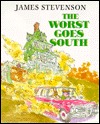
The Worst Goes South

The Worst Goes South. James Stevenson. 1995. 26 pages. [Source: Library]

First sentence: It was a brisk October day. The worst person in the world was taking Daisy for a walk in the woods.

Premise/plot: Readers meet a grumpy, old man "The Worst" in James Stevenson's The Worst Goes South. Why does he choose to go south? To get away from the town's Harvest Festival. His house is right next door to a big empty field. And that big empty field is about to be filled with people, stuff, and NOISE, NOISE, NOISE. The Worst goes to Florida...where he stays in a motel room that is lacking in every way. The owner of the motel thinks he recognizes the Worst?! Could these two be long, lost brothers?!

My thoughts: I enjoyed this one. Mr. Worst is a bit anti-social, a bit rude. Take out the bit, actually. He's very rude, and definitely anti-social. He doesn't want his yard and his porch being used by the people setting up the Harvest Festival. It's bad enough he has to allow people to park in his yard--for free. The book is amusing.
The worst stopped at a toll booth.
"How much?" he said.
"2.50," said the toll taker.
"That's an outrage," said the worst. He handed the man a quarter. "Take this and be glad you got it." Then he drove over the bridge.
We do eventually learn his name: Arvin. 

Text: 4 out of 5
Illustrations: 3 out of 5
Total: 7 out of 10

© 2017 Becky Laney of Becky's Book Reviews

Tuesday, May 10, 2016

Cain His Brother

Cain His Brother. Anne Perry. 1995. 404 pages. [Source: Library]

I found Cain His Brother a bit of a disappointment after The Sins of the Wolf. Especially in the beginning. Readers be warned, you may spend a lot of time YELLING at William Monk. Especially in the first half of this one. William Monk has been somewhat sympathetic even if flawed in earlier books, but, in this one, well, the way he speaks to Hester is just ALL KINDS OF WRONG. I think it stood out more in this one because of how Sins of the Wolf ended. And it wasn't just that. Also he seems to be completely stupid and gullible sometimes where women are concerned. When Druscilla's character was introduced, for example, I started shouting warnings to Monk. He didn't listen. No matter how many times I tried to warn him. I ended up liking this story after all, but, only because Hester COMPLETELY redeems the situation and saves the day. Does he know it?! Of course not. And if he did, he'd probably just yell at Hester and dig a deeper hole for himself as far as I'm concerned. But still I enjoyed this one overall for how Hester, Monk, and Rathbone work together for justice. And the case they're working on is INTERESTING.

Angus Stonefield has been murdered--presumably--by his "evil" twin brother, Caleb Stone. There is no body, just bloody clothes and a missing person case. Some might argue, well, he tired of his wife, he decided to abandon his family, his job, and begin a new life somewhere else. And his clothes might have anyone's blood on them. The widow, Mrs. Stonefield, comes to William Monk desperate. She needs him to find enough proof that he can be declared dead. Sure she'd love justice, but, is realistic about the situation.

Hester and Lady Callandra, meanwhile, are busy nursing typhoid patients on the wrong side of town. The book is very much focused on poverty and the horrible living conditions in 1850s London.

There is plenty of detecting in this one, and, I think this one probably has the biggest twist so far in the series.

© 2016 Becky Laney of Becky's Book Reviews

Wednesday, March 16, 2016

The Sins of the Wolf

The Sins of the Wolf (William Monk #5). Anne Perry. 1995. 436 pages. [Source: Library]

Sins of the Wolf may just be my favorite of the series so far. It is the fifth book in this mystery series.

The novel opens with Hester Latterly, our heroine, on her way to a new job. She's been hired as a private nurse to accompany Mrs. Mary Farraline on a trip to London and back (from Edinburgh). She's never been to Scotland, and, it sounds like an interesting way to spend a week or two. She takes the night train to Edinburgh, meets the family, departs that evening on the train with Mrs. Farraline, who has a heart condition. The start of the trip proves delightful. They talk. They laugh. They share. Hester gives Mrs. Farraline her medicine for the night. Hester settles down to sleep peacefully. That's the last peaceful sleep she'll get unfortunately! The next morning when they arrive in London, Hester sees that Mrs. Farraline has died. That would be sad, of course, but hardly life-changing. Expect that later that day Hester discovers one of Mrs. Farraline's belongings--a piece of jewelry--in her own bag. Fearing the worst she goes to the men she knows best: William Monk and Oliver Rathbone. The advice they give is good, but, too late. She returns to Lady Callandra's home to discover the police are there looking for her. She's arrested, YES, ARRESTED. And William Monk and Oliver Rathbone may never be the same again!!!

Hester is accused of stealing, but, also MURDER. Can William Monk and Oliver Rathbone find the real murderer before Hester is convicted in a Scottish court and hanged?!?!

What a dysfunctional family we meet in this mystery... I hardly have to say this one is compelling from cover to cover. I loved plenty about it!
© 2016 Becky Laney of Becky's Book Reviews

Tuesday, July 07, 2015

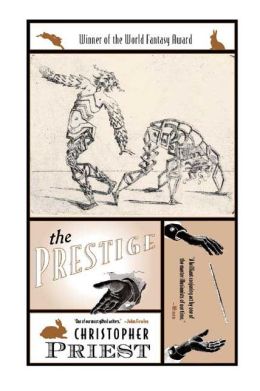
The Prestige

The Prestige. Christopher Priest. 1995/1997. Tor. 360 pages. [Source: Library]

It began on a train, heading north through England, although I was soon to discover that the story had really begun more than a hundred years earlier. 

I saw the movie first. I think there are some benefits to having seen the movie first. It's impossible not to compare the two--the book and the movie--especially since I finished the movie and rushed to put the book on hold at the library. So this "review" will talk about both the book and the movie. I will try my best to keep it spoiler free, especially the opening paragraphs!

The book is different than the movie. The book has a contemporary framework. Andrew Westley, the narrator, has received a magic book from a stranger, the hint being that it was written by one of his ancestors, an Alfred Borden, a Victorian magician. Andrew was adopted, and he knows nothing at all about his Borden relatives. He's manipulated into meeting a woman, Kate Angier. She has much to tell him, for, she believes him to be Nicholas Borden. The two met when he was three, just before he was adopted. He, of course, remembers nothing. And the idea that there is a historic feud between the Borden and Angier families doesn't really intrigue him all that much. But he stays to hear her out.

The book consists of several stories: Andrew's story, Kate's story, Alfred Borden's autobiography, and Rupert Angier's diary. (Andrew's narration opens and closes the novel.) By the end of the book, a fantastic, strange story has been told.

At its simplest here is the plot: Alfred Borden and Rupert (Robert) Angier are rival magicians ever in competition with one another to be the best, to be recognized as being the best. Both the book and the movie convey this. It is HOW it is conveyed that allows for such big differences between the two.

The movie is more dramatic than the book. It makes the rivalry more intense, more personal, more life-and-death. From start to finish the movie is all about REVENGE and LOSS and doing WHATEVER it takes. The book is quite different. For example, in the movie, Angier blames Borden for the death of his wife who drowned during a performance in a water tank. In the book, however, Angier becomes angry with Borden when Borden disrupts his seance and reveals him to be a fake spiritist. Quite a difference! Especially since the "loss of family" angle is huge in the movie. But in the book, Angier has a family: a wife and three children, I believe. That is the only difference I'll mention in the review since I do want it to remain mostly spoiler free.

The Prestige has plenty of twists and turns in the plot. Especially the movie. But also in some ways the novel. Though if you've seen the movie, then, the book will be essentially spoiled. I think you could say the same if you'd read the book first: the movie would be spoiled.

Which did I prefer? I enjoyed both. I did. I really enjoyed the movie. I thought it was great. I watched it twice in one week. I read the novel in one day. There were sections that were quite compelling. My favorite probably being Alfred Borden's autobiography. And then perhaps Angier's diary. I wasn't as drawn to the contemporary story of Kate and Andrew. Though it does intensify the creepy factor greatly. The Prestige would be PERFECT to read for Carl's R.I.P. challenge in the fall.

Have you seen the movie or read the book? Did you like it? love it? hate it? I'd love to know what you thought of it. If you've seen the movie and read the book, which would you recommend first to others?


© 2015 Becky Laney of Becky's Book Reviews

Sunday, December 14, 2014

Eight Christmas Books

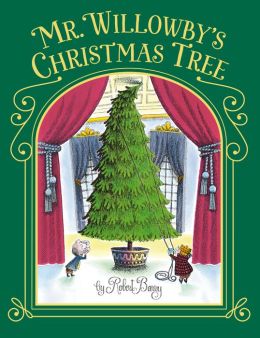
Mr. Willowby's Christmas Tree. Robert E. Barry. 1963. Random House. 32 pages. [Source: Library]

Mr. Willowby's Christmas tree came by special delivery. Full and fresh and glistening green--the biggest tree he had ever seen. He dashed downstairs to open the door--This was the moment he'd waited for.

I loved, loved, loved Mr. Willowby's Christmas Tree. It celebrates giving in a fun and playful way. Mr. Willowby starts off a long chain of giving when he chops off the top of his too-tall Christmas tree. A tree that is splendid in every other way. He gives the tree-top to the upstairs maid. She's delighted. Very delighted. How thoughtful! How cheery! But the tree is too-tall for her small room. The top must go! Chances are you can predict at this point how the story will go. But that doesn't mean it is in any way less delightful. This little tree-top gets passed down and re-trimmed again and again and again and again and again. And it's just WONDERFUL to see how much happiness and cheer it brings to others.

I loved the premise. I loved the writing. The rhyming was delightful. It worked very well for me! I think this one would make a great read-aloud. I also loved how uplifting it is. (After reading Baboushka and the Three Kings, I needed a cheery story!)

Why didn't someone tell me about this wonderful and charming picture book?! Why?! Well, I am glad to have discovered it now!

Which Christmas books would you consider classic? Which would you recommend?

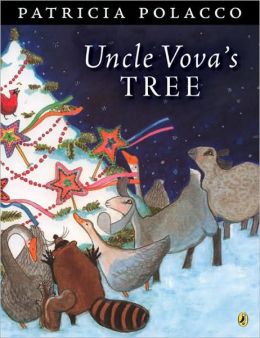
Uncle Vova's Tree. Patricia Polacco. 1989. Penguin. 32 pages. [Source: Library]

Uncle Vova's Tree is rich in detail and tradition. The author, Patricia Polacco, is drawing from her past and recalling some of her childhood Christmases. She writes, "As a child I celebrated Christmas as most American children did, but at Epiphany in January, my brother, my two cousins, my grandparents and I would go to the farm of my Great Uncle Vladimir and Aunt Svetlana to celebrate in the Russian tradition." The book recalls two family gatherings specifically. The first is Uncle Vova's last Christmas. Though of course, most everyone did not *know* it would be his last Christmas. The second is that first Christmas without him. The book definitely has tones of sadness, but, it is ultimately hopeful. Memories, good, strong happy memories, remain.

The book is rich in detail and tradition. It is informative in many ways. Did you know about the tradition of putting hay underneath the tablecloth to remember and honor the stable in Bethlehem where Jesus was born? But in addition to honoring tradition--in this case, Russian tradition--it also celebrates families. Readers meet a family that is close and loving and supportive. Little details make this one work well.

Too Many Tamales. Gary Soto. Illustrated by Ed Martinez. 1993. Penguin. 32 pages. [Source: Library]

Snow drifted through the streets and now that it was dusk, Christmas trees glittered in the windows.

Too Many Tamales is a great family-oriented Christmas story. Maria, our heroine, is helping her mom make tamales. She loves helping her mom, loves being grown-up in the kitchen. But things don't go smoothly with this first batch of tamales. And it is her fault. Mostly. Maria really, really, really wanted to try on her mom's ring. Unfortunately, this-too-big ring falls right into the masa mixture. Hours later, she realizes that she never took the ring off. She doesn't know for sure where the ring is. But she has a strong suspicion that it may very well be in one of the twenty-four tamales. With a little help from her cousins, Maria is in a race to find the ring before her mom--and all the other relatives--realize what has happened. Will she find the ring? Will her mom find out? Will her cousins ever want to eat another tamale?!

I liked this one very much.

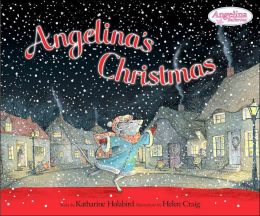
Angelina's Christmas. Katharine Holabird. Illustrated by Helen Craig. 1986. Penguin. 32 pages. [Source: Library]

Christmas was coming, and everyone at Angelina's school was working hard to prepare for the Christmas show.

I enjoyed reading Angelina's Christmas. I enjoyed meeting Angelina and her family. I loved how thoughtful and empathetic Angelina was. She realizes that there is one house in the village that is not decorated. She notices that there is one "old man huddled by a tiny fire." She learns from her parents that this old man is Mr. Bell, a retired postman. She decides that she will do something special for him so he won't be all alone at Christmas time. (And Angelina isn't the only one joining in to help make this Christmas memorable for Mr. Bell.) She makes him cookies, her mom sends along mince pies and fruit, her dad cuts him a Christmas tree. They visit him, Henry, Angelina's brother comes along too. But perhaps even more importantly than showing him kindness through things, they take the time to listen to him, to include him. This one is a lovely book.

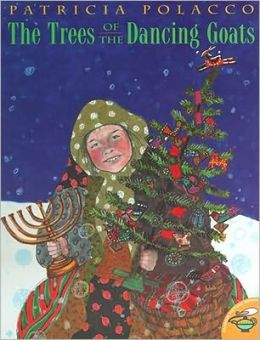
The Trees of the Dancing Goats. Patricia Polacco. 2000. Simon & Schuster. 32 pages. [Source: Library]

At our farm just outside Union City, Michigan, we didn't celebrate the same holidays as most of our neighbors...but we shared their delight and anticipation of them just the same.

I enjoyed reading The Trees of the Dancing Goats by Patricia Polacco. She is sharing yet another holiday memory with young readers in this picture book.

The story focuses on one holiday season when the town is hit by an epidemic, scarlet fever, I believe. The heroine's family is not sick, but, most of their neighbors are. As they are preparing to celebrate Hanukkah, they realize that most of their neighbors are too sick to prepare for and celebrate Christmas. They love their neighbors. They want to do something for them. Working together as a family, they decide to bring Christmas to their neighbors: food, a tree, decorations. Since they don't own any Christmas ornaments, they use animals carved out of wood. One of the animals, as you might have guessed, is a goat. When hung on the tree, it appears to be a dancing goat. Can one family bring Christmas cheer to a community?

I liked this one. I liked the family scenes very much. It is a thoughtful book. I'm glad I finally discovered it!

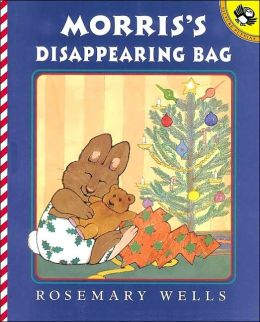
Morris' Disappearing Bag. Rosemary Wells. 1975. Penguin. 40 pages. [Source: Library]

It was Christmas morning. "Wow!" said Morris.

Morris' Disappearing Bag probably isn't my favorite Rosemary Wells, but, this one is enjoyable enough that it's worth reading at least once or twice. Morris stars in this one. He has three older siblings: one big brother, Victor, and two older sisters, Rose and Betty. It is a Christmas book, of course. After all the presents are opened, the three older siblings play with their presents and play with each others presents. Victor got hockey stuff. Betty got a chemistry set. Rose got a beauty kit. They take turns sharing. Much fun is had. But not by all. For Morris has only his present (a teddy bear) to play with. He doesn't get a turn with his siblings' presents. But that changes when Morris discovers a fantastic present under the tree. A bag. A disappearing bag. Whatever is in the bag disappears. His siblings all want a turn, and, he lets them in the bag. While his siblings have disappeared for the day, Morris plays with their stuff before settling into bed with his bear.

Max's Christmas. Rosemary Wells. 1986. Penguin. 32 pages. [Source: Library]

I love watching Max and Ruby. I've seen the adaptation of Max's Christmas plenty of times before I read the book. If you like the show, chances are you'll enjoy reading this book. It is very similar. For those new to these lovable siblings, Ruby is the older sibling. She seems to be raising Max all on her own. (Ruby and Max don't have parents. They have a Grandma, but, she does not live with Max and Ruby.) Max is the younger sibling. He is many things: cute, clever, curious. Yes, he can be mischievous, but, he is also super-observant. I love, love, love them both. I might like Max a tiny bit better than Ruby. But still. I love them both.

In this book, readers join Ruby and Max on Christmas Eve night. Ruby is trying her best to get Max to get ready for bed, to go to sleep. Max is excited, of course. Once he knows that Santa is coming to his house tonight, he wants to see it for himself. So he goes downstairs to wait for Santa....

I liked this one very much.

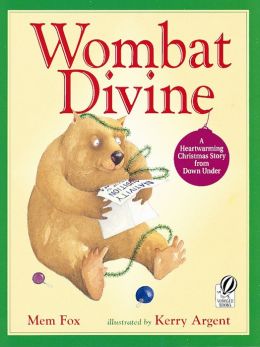
Wombat Divine. Mem Fox. Illustrated by Kerry Argent. 1995/1999. HMH. 32 pages. [Source: Library]

I found Mem Fox's Wombat Divine to be charming. I loved Wombat. He loves, loves, loves Christmas. More than anything, he wants a part in the nativity play. At the auditions, he tries his best. But there are so many parts that he's just not right for. I love the refrain, "Don't lose heart. Why not try for a different part?" which is used throughout the whole auditioning process. He auditions for Archangel Gabriel, Mary, a wise king, Joseph, an innkeeper, and a shepherd. But there's one role that he'd be just perfect playing. Can you guess it?

I liked this one. I thought it was cute and sweet. I liked the writing. I found it unique and oh-so-right.

© 2014 Becky Laney of Becky's Book Reviews

Wednesday, December 10, 2014

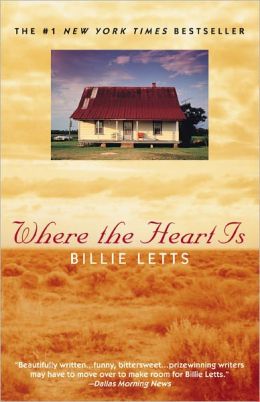
Where The Heart Is (1995)

Where The Heart Is. Billie Letts. 1995. 376 pages. [Source: Bought]

The novel opens circa 1985. Novalee Nation, the heroine, is seven months pregnant. She is with her boyfriend, and they're both heading west. He's a man without integrity, to say the least. He does reluctantly give her a ten dollar bill so she can go buy some shoes when her own shoes are lost through the hole in the floor of his car. But he expects a good bit of change back. Or does he? Was he planning to abandon her at the Walmart all along? Or did he just get tired of waiting? Does it matter? The truth is that Novalee Nation is left at a Walmart in a small town in Oklahoma with only $7.77. She has no family to call, no friends either. So Novalee settles down in Walmart for the rest of her pregnancy, hiding when need be, so no one knows that she is living there. She ventures out during the day and meets people, meets the librarian, for example. By the end of her pregnancy, she's made a few friends. Now these new friends of hers don't know the truth exactly. But they're not the type of people who would care overly much about the truth. Novalee happens to find herself among the least judgmental folks she's ever met. The book spans seven years worth of drama. If the book has a theme it is one of 'home' and 'belonging' and 'family.'

Where the Heart Is was not a good match for me. I wanted a different book, perhaps. A book that kept the "down-to-earth" quirky characters perhaps, but, lost much of the smut. It isn't that Where the Heart Is is your traditional smutty romance--it isn't, far from it. But I thought there were certainly plenty of details that were tasteless. Why did readers need to follow Willy Jack's story at all???? Every chapter that focused on Willy Jack seemed tasteless and pointless. Why do we need to know about his time in prison? If the story had centered exclusively on Novalee Nation, would I have liked it a bit more? I think I would have. At least I wouldn't have hated it. Eliminating Willy Jack wouldn't have solved all the problems, one scene that was too much to take, and rightly so, was the child rape. The scene had every right to be disturbing. It was a horrible awful situation. Still. The details were too much. The profanity--the blasphemy--was also too much. 


© 2014 Becky Laney of Becky's Book Reviews

Tuesday, April 22, 2014

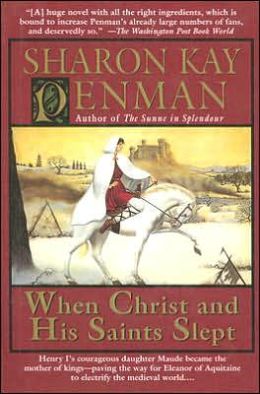
When Christ And His Saints Slept (1994)

When Christ and His Saints Slept by Sharon Kay Penman. 1994. Random House. 746 pages. [Source: Bought]

I've been meaning to read more of Sharon Kay Penman's work for years now. When Christ and His Saints Slept is set in the twelfth century. It begins with the tragic sailing of The White Ship and ends with Henry II ready to be crowned king of England. For readers who like numbers, that would be 1120-1154. It covers the later part of Henry I's reign: his grief and desperation over the loss of his son and heir, his wanting his daughter, Maude, to be his successor; it covers the war--which lasted over ten years--between Stephen and Maude for the crown of England. Readers also get a chance to see Maude's son, Henry, grow up to become "Henry II."

It is a novel with many strengths. One of its greatest strengths, perhaps, is in the wide range of characters or narrators. Stephen and Matilda, on one side, Maude and Geoffrey, on the other. Readers meet the men (and women) who supported Maude, including many of Henry I's illegitimate sons. Readers meet the men (and women) who supported Stephen's claim to the throne. If there is a point to When Christ and His Saints Slept, it is this: war is ugly and cruel and pointless. Readers see Stephen and his supporters--his army--do horribly cruel things in the name of war. Readers see Maude's army do some equally horrid things. One side is not holier than the other. While neither army was as cruel as they possibly could be all the time, without ceasing, year after year, the truth was that England suffered greatly during this tug of war. The truth was very few cared WHO ruled England, so long as England was ruled peaceably and practically. The burning. The stealing and looting. The raping. The killing. The holding of hostages. England was in a BIG BIG mess if this was the best either side could manage.

If the novel has one hero, one "main" character, it would be Ranulf. Ranulf is a fictional illegitimate son of Henry I. It is not a stretch to fit him in historically since Henry I recognized over twenty such sons! Ranulf along with Robert and Gilbert and Miles and Brien, and countless others supported Maude and her claim to the throne. While the novel does focus on the battles, the war, the political mess--it also gives a personal side to the time period. Readers see Ranulf grow up a bit, fall in love, make mistakes, find true love, and settle down to marry and raise his own family.

If the novel is allowed to have more than one hero, well, an obvious choice to me is Henry II. The book covers his teenage years: 14 to 19. The last third of the novel truly focuses on Henry, on his relationship with his parents, with his relationship with Eleanor of Aquitaine. Those last few chapters are far from clean.

I loved how many characters we get to meet and know. I loved that we get to know men AND women from the time period, most of them historical figures, though not all. I loved that readers get introduced to real history. Penman's pacing was wonderful, I felt!

For readers who ENJOY history, When Christ and His Saints Slept is easy to recommend. She gives you enough context so that you're not lost (or at least not lost past all hope!) but it never weighed the text down in my opinion. I admit that "being lost" in a history book is all a subjective matter based on what one does or doesn't know heading into a book, but, I thought she did a good balancing job.


Quotes:
And so began for the wretched people of England, a time of suffering so great that they came to fear "Christ and his saints slept." (171)
If ever there was a woman unable to learn from her mistakes, it was this one for certes. No more than Stephen could. If the Lord God plucked him out of his Bristol prison on the morrow and restored him to power at Westminster, nothing would change. He'd still go on forgiving men he ought to hang, promising more than he could deliver, failing to keep the King's Peace. Maude and Stephen, a match made in Hell. What was it Geoffrey de Mandeville had once said--a lifetime ago? Ah, yes, that Maude would listen to no one and Stephen to anyone. Had there ever, he wondered, been a war like this? Was there a single soul--not related to them by blood or marriage--who truly wanted to see either one of them on England's throne? (281)
"I am truly glad to have you safe, Robert. But tonight I feel as if... as if we'd struggled and panted and clawed our way up a mountain, only to stumble just as we neared the summit and fall all the way down, landing in a bloodied, bruised heap at the bottom. What in God's Name do we do now?"
"I suppose," he said, "we start climbing again."
"How many of our men will have the heart for it?" Rising, she began to pace, "To come so close and then to have it all snatched away like this...it is so unfair, Robert, so damnably unfair!"
"Life is unfair," he said, sounding so stoical, so rational, and so dispassionate that she was suddenly angry, a scalding, seething, impotent rage that spared no one--not herself, not Robert, not God.
"You think I don't know that? When has life ever been fair to women? Just think upon how easy it was for Stephen to steal my crown, and how bitter and bloody has been my struggle to win it back. Even after we'd caged Stephen at Bristol Castle, he was still a rival, still a threat...and why? Because he was so much braver or more clever or capable than me? No...because I was a woman, for it always came back to that. I'll not deny that I made mistakes, but you do not know what it is like, Robert, to be judged so unfairly, to be rejected not for what you've done but for what you are. It is a poison that seeps into the soul, that makes you half crazed with the need to prove yourself..."
She stopped to catch her breath, and only then did she see the look on Robert's face, one of disbelief and then utter and overwhelming fury, burning as hot as her own anger, hotter even, for being so long suppressed.
"I do not know what it is like?" he said incredulously. "I was our father's firstborn son, but was I his heir? No, I was just his bastard. He trusted me and relied upon me and needed me. But none of that mattered, not even after the White Ship sank and he lost his only lawfully begotten son. He was so desperate to have an heir of his body that he dragged you back--unwilling--from Germany, forced you into a marriage that he knew was doomed, and then risked rebellion by ramming you down the throats of his barons. And all the while, he had a son capable of ruling after him--he had me! But I was the son born of his sin, so I was not worthy to be king. As if I could have blundered any worse than you or Stephen!"Maude was stunned. She stared at him, too stricken for words, not knowing what to say even if she'd been capable of speech. Robert seemed equally shattered by his outburst: his face was suddenly ashen. He started to speak, then turned abruptly and walked out. (343-44).
© 2014 Becky Laney of Becky's Book Reviews

Thursday, July 01, 2010

Daughter of Time


The Daughter of Time. Josephine Tey. 1951/1995. Simon & Schuster. 208 pages.

Grant lay on his high white cot and stared at the ceiling. Stared at it with loathing. He knew by heart every last minute crack on its nice clean surface. He had made maps of the ceiling and gone exploring on them; rivers, islands, and continents. He had made guessing games of it and discovered hidden objects; faces, birds, and fishes. He had made mathematical calculations of it and rediscovered his childhood; theorems, angles, and triangles. There was practically nothing else he could do but look at it.

What is a man like Inspector Grant supposed to do in bed all day long? He's got a broken leg. And he's bored, bored, bored...until he becomes interested in Richard III. In the 'mystery' of what happened to Richard's two nephews. Grant reads quite matter-of-factly in the history books about this murder. But something doesn't feel right to Grant. He's looking for answers. He's looking to investigate this case for himself. What really happened to those two young boys? Why did Richard III get the blame? And why has history turned this man--who was quite well liked at the time--into a vicious monster?

I loved this one. I LOVED, LOVED, LOVED this one. Grant is a great narrator. You might think it would be boring since a) Grant never leaves his bed, let alone his room b) the mystery is a historical one, an academic one. But. This book is anything but boring! Hate reading history books? So does Inspector Grant! So whether you love or hate "history" I think you'll find much to appreciate in The Daughter of Time.

One of the reasons I loved The Daughter of Time was I thought it was unique. The book is about a man becoming fascinated with history, with a mystery within history. And how he goes about "solving" the case since he can't very well go about interviewing the witnesses and investigating the crime scene. Most of his research is done by reading. But he doesn't accept everything he reads. No, he questions everything. He thinks, really thinks, about everything closely. And I loved that. I loved how Inspector Grant pulls others in on this investigation. I loved how enthusiastic everyone becomes while 'working' on this case.

I enjoyed Josephine Tey's The Man in the Queue. I enjoyed this one even more. Grant is a great character. (I just love him!) And Tey is a great writer. I love her descriptions, her observations. She has quite a few to share on books, on authors.
Did no one, any more, no one in all this wide world, change their record now and then? Was everyone nowadays thirled to a formula? Authors today wrote so much to a pattern that their public expected it. The public talked about "a new Silas Weekley" or "a new Lavinia Fitch" exactly as they talked about "a new brick" or "a new hairbrush." They never said "a new book by" whoever it might be. Their interest was not in the book but in its newness. They knew quite well what the book would be like. (14)
Here is his description of Silas Weekley's "new" book, The Sweat and the Furrow:
The Sweat and the Furrow was Silas Weekley being earthly and spade-conscious all over seven hundred pages. The situation, to judge from the first paragraph, had not materially changed since Silas's last book: mother lying-in with her eleventh upstairs, father laid-out after his ninth downstairs, eldest son lying to the Government in the cow-shed, eldest daughter lying with her lover in the hayloft, everyone else lying low in the barn. The rain dripped from the thatch, and the manure steamed in the midden. Silas never omitted the manure. It was not Silas's fault that its steam provided the only uprising element in the picture. If Silas could have discovered a brand of steam that steamed downwards, Silas would have introduced it. (13)
You might also be interested in: The White Queen by Philippa Gregory, The Tudor Rose: A Novel of Elizabeth of York by Margaret Campbell Barnes, Richard III by William Shakespeare, The Stolen Crown by Susan Higginbotham, Sent by Margaret Peterson Haddix.

Other reviews of Daughter of Time: Booklust, Things Mean A Lot, Shelf Love, Adventures of An Intrepid Reader, Between the Covers.

© Becky Laney of Becky's Book Reviews

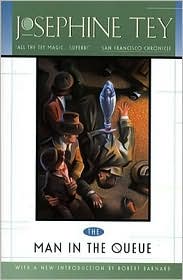
The Man in the Queue


The Man in the Queue. Josephine Tey. 1929/1995. Simon & Schuster. 256 pages.

It was between seven and eight o'clock on a March evening, and all over London the bars were being drawn back from pit and gallery doors.

When a man is murdered in a ticket line for a show, it's up to Inspector Alan Grant and others at Scotland Yard to solve the crime. Many things are a mystery in this one. The man's identity, for one. Who is this man? How could people spend hours in line together and not notice the people around them--the people before and behind them. Who murdered this man? What could the motive be for his murder? Why didn't those behind him notice anything?

I was surprised by how much I liked this one. I have always thought I didn't like mysteries. And yet, I found this detective story so enjoyable. I really liked Inspector Grant. And it was more than just the characters, I liked the narrative style too. I liked the way she told this story.
Eagerly he opened it and eagerly skipped the slightly prosy unimportances with which it opened--Bretherton of the scientific side was inclined to be a pompous dogmatist; if you sent him a Persian cat to report on, he would spend the first sheet of foolscap in deciding that its coat was grey and not fawn--and picked out the salient thing. (39)
Isn't that a great description? I loved the prosy unimportances.

I definitely liked this one. I'm so glad I discovered Josephine Tey.

In the introduction to this edition, Robert Barnard made this observation,
Josephine Tey (1896 or 97-1952) is a writer who lives by her works alone...I would hazard the guess that her readers' attitude toward her is different from their attitude toward other classic crime writers: they regard her with love. They give to their favorite Tey novel what they once gave to their favorite books of childhood, to The Wind in the Willows, Little Women, or whatever: unconditional enthusiasm. (7)

© Becky Laney of Becky's Book Reviews