Showing posts with label 1929. Show all posts

Saturday, October 22, 2022

135. Hitty: Her First Hundred Years


Hitty: Her First Hundred Years. Rachel Field. Illustrated by Dorothy P. Lathrop. 1929. 256 pages. [Source: Library]

First sentence: The antique shop is very still now. Theobold and I have it all to ourselves, for the cuckoo clock was sold day before yesterday and Theobold has been so industrious of late there are no more mice to venture out from behind the woodwork. Theobold is the shop cat--the only thing in it is that is not for sale, which has made him rather overbearing at times. Not that I wish to be critical of him. We all have our little infirmaties and if it had not been for his I might not now be writing my memoirs. Still, infirmities are one thing, and claws are another, as I have reason to know.

Premise/plot: Hitty, Her First Hundred Years won the Newbery award in 1930. Who is Hitty? Hitty is a doll. A wooden doll made from the ever-lucky mountain-ash wood. Her story begins when an Old Peddler--old peddlers are so rarely named in books--takes refuge with a family in Maine. Mrs. Preble is awaiting the return of her husband--who is a whaler--and she has the children to care for. One of her children is a young girl named Phoebe. (The other is a boy named Andy.) The Peddler takes refuge in the storm, but ends up staying quite a while with the family. At some point during his visit, he carves this doll--soon named Mehitabel--for the little girl. Phoebe's told she must sew clothes for the doll before she can be played with--and one of the items Phoebe makes is an undergarment--a chemise--with "Hitty" cross-stitched on it.

Hitty's (mis)adventures span the globe and span generations. Sometimes her change of locale is purposeful--when the Preble family takes her on a ship's voyage to the South Seas--and other times it is quite accidental--when Phoebe drops the doll in India and she is "discovered" by a wandering snake charmer. She has many different owners; she has many different adventures. Throughout it all, she tries to hold on to as much grace and dignity as she can. Which isn't always easy. (Like when she's made an idol in the South Seas.)

My thoughts: Hitty--the doll--is a plaything for children, yet, her various owners through the decades are only rarely children who play with her [and love her as a toy]. Many adults own Hitty. A seamstress sees Hitty as an opportunity to experiment with fashion design and fabrics. Another sees a pincushion. Some see an antique to be displayed and valued. Hitty's purpose changes and fluctuates. 

Much the same, Hitty--the book--may have started out its life as a children's book--a winner of the Newbery, no doubt--yet I venture forth a guess that most often her readers in the past few decades--at least--are adults. And perhaps that is for the best. There is without a doubt much value (or potential value) in vintage antiques. But sometimes antiques lose their suitability for children. Or perhaps the better word may just as well be appeal. I think it's a bit of both with the case of Hitty. 

Not all of Hitty is out of sorts or out of fashion. Plenty remains to charm. But there are definitely episodes--or chapters, or parts of chapters--that just are jarring to modern readers. A little cringe here or there. Injuns, savages, Hindoos...these are just a few of the things that might read a bit off. [One of Hitty's owners has a best friend who is a German immigrant, the German speaks very broken English.] 

As I said, Hitty isn't perfectly-perfect for modern readers. But it isn't without charm. Hitty is a wooden doll who sees, hears, thinks, feels, and sometimes even moves. She observes over a century--give or take a few years--of what we would call history. Imagine how much the world would change from 1829 to 1929! Hitty has "lived" life--the good, the bad, the really ugly. [A low point might be her YEARS buried in a horse-hair sofa.] Her misadventures/adventures have taken a lot out of her physically. Just like some might pass her by as an "ugly" doll, some readers might take a pass on Hitty. But I think she'll find friends here and there that do appreciate her for what she is.

© 2022 Becky Laney of Becky's Book Reviews

134. Beavallet


Beauvallet. Georgette Heyer. 1929. 272 pages. [Source: Library]

First sentence: The deck was in shambles.

Premise/plot: Dona Dominica, the daughter of the former governor of Santiago, Don Manuel de Rada y Sylva, is on her way back to Spain--along with her dying father, when their ship the Santa Maria is boarded by English adventurers (pirates) led by the fearless El Beauvallet (Nicholas Beauvallet). The two are taken captive by Beauvallet and brought aboard his ship, Venture. But he promises--and it's not a promise without risk--to return these two safely to Spain. If anyone can land an English ship safely into a Spanish port during these hostile times it would have to be Beauvallet.

At first Dominica hates her captor. She refuses to admit to herself that he is a little charming, a little handsome. She flirts with the other men to drive him crazy. But. Soon she has to admit that there is an attraction between them. And she's shocked to hear him boast recklessly of his honorable intentions to make her an English woman before the year is out. Since she is his captive, you might think this would be easy. Just set sail for England instead of Spain. The lady seems willing enough. But Beauvallet wants the challenge. So he keeps his promise--his first promise--both father and daughter arrive safely in Spain. Beauvallet returns to England, to his family, to his Queen.

But Dominica has not been forgotten. And a few months later, Beauvallet is ready to pursue his lady. To woo her in Spain. With England and Spain so very, very close to war--how can an Englishman, a pirate, a dreaded pirate, safely enter Spain? He has boasted that he will find a way...

Meanwhile, Dominica's father dies and she is taken into her aunt's family. Her aunt!!! Oh what a character Dona Beatrice is! She's a strong, strong woman with a mind of her own. She has a way of bullying all the men in her life including her son, Don Diego. She has determined that he must marry Dominica.

Beauvallet is an exciting and dramatic historical romance set in the Elizabethan era. Beauvallet is a bold adventurer who will risk it all to win his lady love. With his faithful companion, Joshua Dimmock, by his side, Beauvallet is ready for any challenge. 

My thoughts: The book had action, adventure, drama, and romance. I enjoyed Beauvallet very much! If only Beauvallet had been filmed... Errol Flynn would have been perfect--absolutely perfect--as Heyer's hero, Nicholas Beauvallet. It was easy to imagine, which perhaps helped me enjoy the novel more. Beauvallet would never be among my favorite, favorite Heyer romances. Most of my favorite Heyer novels are set in the Regency. This historical romance is set in the Elizabethan period. But it's good fun and well worth the read. 


© 2022 Becky Laney of Becky's Book Reviews

Monday, October 17, 2022

129. The Jumping-Off Place


The Jumping-Off Place. Marian Hurd McNeely. Illustrated by William Siegel. 1929. 321 pages. [Source: Review copy]

First sentence: Down on their knees, a boy and girl were taking up the kitchen linoleum. It was a queer time to be at that work--half past eight in the evening--and there was an air of strangeness about the house; an unusual silence, a hollowness and a fragrance of crushed flowers in the air. 

Premise/plot: Four kids (Becky, Joan, Phil, and Dick)--doubly orphaned, first by their parents and then their uncle-guardian--set off for Tripp County, South Dakota, in 1910 to homestead on their Uncle's filed claim. And this is to be accomplished almost always on their own. Yes, there are supportive adults who share advice and sometimes an extra pair of hands, but, hundred percent of the blood, sweat, and tears of farming/homesteading will be on these four youngsters. (The oldest is sixteen or seventeen.) The book chronicles about a year's worth of time--give or take a couple of weeks. We definitely go through [late] spring, summer, fall, winter, and the beginning of another spring. Becky, the oldest sibling, I believe, becomes a "teacher" of sorts in a one-room schoolhouse. She isn't certified, but, she's a) willing b) gone through school herself so she's educated enough to teach younger ones c) wanting to go to "normal college" to get her teacher's certificate. There is the almost obligatory chapter where a blizzard strands kids at school. 

My thoughts: This one was published in 1929. It was recognized with a Newbery Honor in 1930. This book was published half a decade (at least) before Laura Ingalls Wilder began writing her children's stories about the homesteading life. (Some of Wilder's books would be set in South Dakota, though decades earlier.) The 1910 setting is interesting. We've got some modern touches--the kids have lived in a city and had city conveniences before--but we've got hints of the older 'pioneer' lifestyle as well. To original readers, 1910 wouldn't have seemed all that "historical" in all likelihood. Today's readers will definitely consider it 'historical' in nature. Perhaps a bit quaint and dated, perhaps outdated. 

Anytime you have an older book, you'll always have people curious about the content and if it is problematic. This one has at least one instance of the n-word--just so you know that up front. It is in relation to working hard and long hours in the field. The children obviously didn't see anything wrong with this word as a descriptor. (Modern readers, if this book has any, may not agree.) There was not really a presence--or notable presence--of Native Americans or "Indians" in this one. You could argue that their absence from the story raises its own issues. But you won't find any scenes like in Little House On the Prairie. So one could definitely look for ways to talk about context and content with children if you're reading this one with children. 


© 2022 Becky Laney of Becky's Book Reviews

Wednesday, October 12, 2022

126. Passing


Passing. Nella Larsen. (Introduced by Emily Bernard). 1929. 160 pages. [Source: Library]

First sentence: It was the last letter in Irene Redfield's little pile of morning mail.

Premise/plot: Irene Redfield, our protagonist, has a love-hate relationship with Clare Kendry, a former friend with whom she grew up. After Clare's father died, the two lost touch if you will. Clare--perhaps slowly and semi-deliberately, perhaps quickly and very deliberately--cut ties with her past (including her whole [racial] community.) Clare, you see, was taken in by her white aunts. Being light-skinned and seeing a world of opportunities ahead of her, made a choice to pass for white full-time even going so far as to marry an out and out racist. Meanwhile, Irene, remained--and married--in the African-American community. 

The story begins with a chance encounter. When these two see each other--quite accidentally--they are both passing for white. [They are in a hotel which prohibits blacks.] Irene does not recognize Clare for the longest time. She's a bit shocked with this reunion. She is hesitant to keep in touch. Especially when she finds out [a few days later] that Clare married such an apologetically racist man. Why would she invite her and another former friend (Gertrude, I believe) into her home only to be insulted. [True, he doesn't know that his wife and her friends are African American, but if he knew, they'd be a big problem.] 

If only the meeting had been oh-so-brief and contained to that one week! 

I mentioned the love-hate relationship, well, the story turns much, much, much darker as it progresses. Leading up to an ambiguous ending (of sorts). But you won't find spoilers here.

My thoughts: The introduction is scholarly, as you'd expect. I suppose there is always a scholarly, academic, intellectual, weighty way to read a book, particularly a classic. But never forget that there are more relaxed ways to just sit back and enjoy a book as well. My approach was not to read in such a way as to produce an essay. My choice--for better or worse, right or wrong--was not to spend time focusing on themes but on the oh-so-human characters. 

This is Irene's story start to finish. I think there might be a temptation to shift the focus solely to Clare. But we see Clare through Irene's eyes. These are Irene's memories and experiences. And the judgments--whether we agree or dare to disagree--are Irene's judgments. Irene sees Clare and both loves and hates what she sees. Clare infuriates and fascinates. (Not that those are Irene's only feelings, mind you, just that she can hold such contrary, conflicted feelings at the exact same time.) 

Clare--or at least Irene's perception of Clare--reminds me, personally, of Scarlett O'Hara or Becky Sharp. 

Irene is NOT a saint. The story being painted--or presented, I guess is the right word--may be biased in a way to present Clare in a negative light. 


© 2022 Becky Laney of Becky's Book Reviews

Tuesday, October 11, 2022

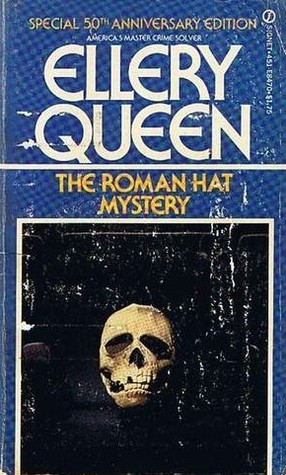
124. The Roman Hat Mystery


The Roman Hat Mystery. Ellery Queen. (aka Frederic Dannay and Manfred Bennington Lee) 1929. 239 pages. [Source: Library]

First sentence: The dramatic season of 192- began in a disconcerting manner. Eugene O'Neill had neglected to write a new play in time to secure the financial encouragement of the intelligentsia; and as for the "low-brows," having attended play after play without enthusiasm, they had deserted the legitimate theatre for the more ingenuous delights of the motion picture palaces.

Premise/plot: The Roman Hat Mystery--the first in the Ellery Queen series--stars a father and son. Inspector Queen is a police inspector. Ellory Queen, the son, is a mystery writer and amateur detective. The crime in this murder mystery takes place during a Broadway show. The only clue they really have to work with--their biggest clue--is that the murder victim's top hat is missing. Since they didn't find the hat on or near the victim, or even at the theatre, someone either wore it out of the theatre or carried it out of the theatre. The theory goes that if you can trace down what happened to the hat, you'll find the murderer.

My thoughts: I found The Roman Hat mystery to be incredibly dull. Perhaps methodical would be the best way to phrase it in polite terms? Perhaps investigations are truly tedious and lack dramatic interest. Perhaps it is just a ton of paperwork and matter of fact, ho-hum questioning. But it was just so much to get through. And the pay off--to me--didn't seem worth it. Dare I say you could read the first two or three chapters and jump straight to the last chapter without missing anything??? You wouldn't miss fleshing out of any characters, that's for sure. And I would even say that the father and son aren't all that fleshed out either. Perhaps they are in later books? Or at least the son?

The book was first published in 1929. Expect the morals and values of 1929. In other words, certain things have not aged well at all. Certain descriptions and plot points are just what most people would call backward. I didn't notice this so much in the dull-as-dirt middle but in the big reveal, it's hard to miss.


© 2022 Becky Laney of Becky's Book Reviews

Monday, October 10, 2022

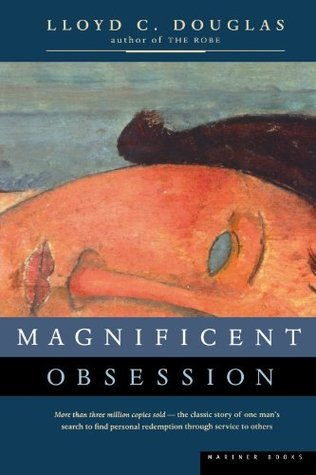
123. Magnificent Obsession


Magnificent Obsession. Lloyd C. Douglas. 1929. 336 pages. [Source: Library]

First sentence: It had lately become common chatter at Brightwood Hospital--better known for three hundred miles around Detroit as Hudson's Clinic--that the chief was all but dead on his feet. The whole place buzzed with it.

Premise/plot: Two men--one supposedly a "saint" and the other a "sinner"--both in dire need of medical equipment to save their lives. The problem? Well, there's only one machine. The so-called "sinner," Robert (Bobby) Merrick is the one whose life is saved. For the record, I don't think a choice was deliberately made at any point by any medical staff to choose one over the other. It's just that the equipment/machine was currently being used to save Bobby's life WHEN Doctor Hudson (the so-called "saint") subsequently needed it. Everyone within three-hundred miles loathes Bobby Merrick for existing. If it wasn't for the likes of him, their precious, dear, beloved, incredibly saintly Dr. Hudson might still be here--working himself to death. The staff doesn't hide it--not even a little--and are downright hostile and cruel. So it's no surprise when Merrick develops a guilt complex and finds himself pledging to be a sinner no more. Off to medical school he'll go. He'll train to become a brain surgeon. He'll do EVERYTHING to fill the doctor's shoes. (No matter how weird or creepy). 

Turns out that the doctor had a gnostic/mystical new-age-y obsessive philosophy about how to live life. He wrote all about it in a journal--in code that would have to be deciphered. For better or worse, Bobby Merrick is able to decipher the code and, you guessed it, Hudson's obsession is transferred completely to Merrick. 

My thoughts: How to describe this one? Weird? Creepy? Odd? Disappointing? Those might be my own descriptions. But they wouldn't be objective descriptions. I am trying to untangle how much of my reaction is tied into the incredibly horrible theology, and how much is tied into the plot and characterization. Because obviously, not every single reader is going to find the religious content objectionable, or, perhaps better phrased as objectionable for the exact same reasons. Two readers could agree that the religious aspects made a mess of this novel, but, disagree as to how and why. 

I'll start with something that I think is more objective and still slightly creepy. In Bobby Merrick's need to "take the place of Dr. Hudson," that includes the need to be a FATHER to his daughter and a HUSBAND to his wife. In other words, in addition to wanting to become a surgeon so he could potentially save the lives Dr. Hudson might have saved had he lived longer, he wants to step in as FATHER and HUSBAND to Hudson's family. The romance didn't feel organic--in my humble opinion. It was predictable, tacky, slightly weird. 

Bobby Merrick, when first introduced, is not in the slightest religious or spiritual. He would never in a million years call himself a Christian. (By the end of the book, he still has hesitations as to the label Christian.) Through reading Hudson's notes, he takes an interest in the New Testament and the Galilean. He realizes that for almost two thousand years, people have been missing the point totally and completely. The New Testament is a methodical, formulaic equation. If you DO a + b + c, then the Major Personality (Merrick refuses to label him God) will follow through with blessing you x + y + z. It isn't so much about the next life, eternal life, or believing and trusting in you-know-who. It is all about what you can get out of this life in the here and now. How a person can "work the system" "stack the deck" do everything just so that everything always, always, always goes your way. Any faith you might have as a result of reading the New Testament, is faith in your faith. He is so excited that he's figured out a way to make religion work for him--and cut the Major Personality almost out altogether--that he's eager to go forth and proselytize. He even convinces a pastor. (To be fair, the pastor at best was an agnostic going through the motions who didn't believe in God all that much but he didn't want to shock the old people in his congregation too much, too fast.) Merrick ridicules the "old time religion" throughout. In particular, he ridicules DEVOTION, adoration, any touch of sentimentality that would have people praising and worshiping God. The Bible to Merrick is just like an algebra book. 

Obviously, as I mentioned, I have personal objections to this type of religious book. I don't expect any other reader to agree. But I do think that so much of this book is taken up in being didactic. And NOT in a way that is clear, logical, reasonable. I found the writing to be vague, mystical, and CONFUSING as all get out. His religious catch-phrases were so foreign to me personally. But he was big into personality implanting and sending out your personality? And something about how your personality is connected with others so that when someone dies part of your personality (soul?????) dies as well? Anyway, I truly think half the book is gibberish at best. I'm labeling it as gnostic/mystic/new-age-y simply because of the whole "I've-got-a-secret" aspect of it. Also it borders on the idea of wealth-prosperity-gospel teaching. But it doesn't fit exactly. 

What you are left with at the end of the day is philosophizing and a sloppily thrown together romance. 

Plus, as a modern reader I am curious about what brain surgeons would have been able to do--the kinds of things they could treat, the surgeries performed, the outcomes of their patients--in the 1920s when this book was both written and set. But the book is about anything but actual medicine or medical practices. I am not sure how long it would have taken for someone to go to medical school and become a brain surgeon, but it takes Bobby Merrick three years to become a brain surgeon and take Doctor Hudson's place at the hospital.


© 2022 Becky Laney of Becky's Book Reviews
Wednesday, January 17, 2018

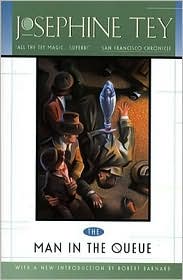
The Man in the Queue

The Man in the Queue (Inspector Alan Grant #1) Josephine Tey. 1929. 255 pages. [Source: Bought]

First sentence: IT was between seven and eight o'clock on a March evening, and all over London the bars were being drawn back from pit and gallery doors. Bang, thud, and clank. Grim sounds to preface an evening's amusement.

Premise/plot: Some murder mysteries make you wait for the murder to occur. That is not the case with Josephine Tey's The Man in the Queue. In the first chapter, the body is discovered. As the line--the queue--moves forward, a man collapses to the ground: he's dead. He was murdered--stabbed--while in line. Inspector Grant faces days of frustration before a few clues come to light. How could a man be murdered in public--with dozens of possible witnesses--and no one notice a thing?!

This mystery introduces the detective Inspector Alan Grant.

My thoughts: The Man in the Queue was the very first mystery novel I ever read. I enjoyed it well enough to become enthusiastic about a new-to-me genre. I have since read all the Inspector Grant books in the series. The Daughter of Time is my favorite and best. Not just my favorite and best Grant novel, but my favorite mystery of all time. (Those that have read it may question the appeal since this mystery takes place while Grant is in the hospital, and the mystery is centuries old. But I stand by my choice.) I would recommend The Man in the Queue.

Favorite quotes:
"Are you hurt?" Grant asked.
"Only my ribs," said Struwwelpeter. "The abnormal excitation of the intercostal muscles has nearly broken them." He struggled to his feet.
"Well, that's twenty minutes wasted," said Grant, "but I had to satisfy myself." He followed the hobbling artist through the dark passage again.
"No time is wasted that earns such a wealth of gratitude as I feel for you," said Struwwelpeter. "I was in the depths when you arrived. I can never paint on Monday mornings. There should be no such thing. Monday mornings should be burnt out of the calendar with prussic acid. And you have made a Monday morning actually memorable! It is a great achievement. Sometime when you are not too busy breaking the law, come back, and I'll paint your portrait. You have a charming head."
A thought occurred to Grant. "I suppose you couldn't draw Sorrell from memory?"
His heart did not jump—that would be doing him an injustice; C.I.D. hearts are guaranteed not to jump, tremble, or otherwise misbehave even when the owner is looking down the uncompromising opening of a gun-barrel—but it certainly was guilty of unauthorized movement. It may have been resentment at his own weakness in being taken aback by a photograph, but Grant's eyes were very hard as he looked at the smiling face—that famous, indeterminate smile. And though his mouth may have curved, he was not smiling as he read the many captions: "Miss Ray Marcable, a studio photograph"; "Miss Marcable as Dodo in Didn't You Know?"; "Miss Marcable in the Row"; and lastly, occupying half the centre page, "Miss Marcable departs from Waterloo en route for Southampton"; and there was Ray, one dainty foot on the step of the Pullman, and her arms full of flowers.
 "Well, Inspector," he said, "how are you getting on? Do you know, you and dentists must be the most unhappy people in the world. No one sees you without remembering unpleasant things."
"Tut, tut, Grant, you've been at the Yard for I don't know how many years, and you're looking at this late stage for reasonable murders. 
© 2018 Becky Laney of Becky's Book Reviews
Saturday, November 26, 2016

Child's Geography of the World

A Child's Geography of the World. V.M. Hillyer. 1929/1951. 472 pages.

First sentence: When I was a boy, my nurse used to take me to the railroad station to see the trains.

Premise/plot: A Child's Geography of the World was first published in 1929. The edition I found was revised and published in 1951. The tone is casual conversation. There are a few black and white illustrations throughout the book. The book is full of information, but what kind?

The truth is some information stays the same no matter the decade. (For example the location of the The Great Lakes, the Empire State Building, the Leaning Tower of Pisa). But plenty of things have changed and changed dramatically! Nations have passed away, governments have been toppled, revolutions have taken place. Also the United States has more than 48 states! Mount Everest has been climbed. Man has gone to the moon and back.

The last war mentioned is World War 2. Communists are mentioned, or perhaps I should say warned against!

Race is definitely an issue if you're reading this with children. (God created black men at night and many black people in Africa eat each other. The narrator makes an offhandedly comment that you will likely never see a real live Indian because there are few left. The narrator later makes an aside that the U.S. does it's best to keep out the Chinese.) I would say adults can throw away the bad and keep the good and have the discernment needed to tell the difference between the two. I would not recommend young children read this on their own for several reasons. One being that unless this text has been updated and revised recently, you'd have more misinformation than correct information.

My thoughts: I find vintage books entertaining. I do. Rare, long out-of-print books call to me. It's a way to capture a glimpse of the past, for better or worse. Not a historical writer's idea of the past. Good Morning, Miss Dove is one of my favorite, favorite books--and movies. This book would have been published at exactly the right time for Miss Dove to use!

The information is dated, true, I won't lie, but it is also a strong narrative. If there weren't problematic sections, I could easily call it charming.

© 2016 Becky Laney of Becky's Book Reviews
Tuesday, August 20, 2013

The Black Dudley Murder (1929)

The Black Dudley Murder. Margery Allingham. 1929. 224 pages. [Source: Bought]

I'm so glad that The Black Dudley Murder was not my first introduction to Margery Allingham or Albert Campion. (The Case of the Late Pig was a fantastic introduction.)

George Abbershaw, our narrator, is a house-guest at a weekend party in a country house. (The "country house" is quite gothic in nature.) He accepted the invitation because he's madly in love with a young woman, Margaret Oliphant, and he'd heard that she was to be in attendance. A whole weekend with her, he might even work up the nerve to propose! Other than Wyatt Petrie, he knows no other guests at all. His narration reveals his first impressions, and some of these first impressions at least are quite correct.

Typically when one goes to a party, one expects to be able to leave when one wants. Even if the host dies of a "heart attack." But that is not the case in The Black Dudley Murder. The guests find themselves held hostage. They have no contact with the world, no way to alert anyone--neighbors, police, etc. of the dangerous situation. (Even if they could manage to get to the garage and their cars without being shot or caught and bound, the cars have all been drained of gasoline.)

Albert Campion is a minor character in this one. He is not the hero of the day--or the hour--and he doesn't exactly steal the scenes he's in. I had a hard time enjoying any of the characters in this one. Or perhaps it's better to say I had a hard time getting to know any of the characters. Perhaps reading Agatha Christie, Georgette Heyer, and Dorothy Sayers has spoiled me.
English detectives are a race apart. They are evident at the first glance. (87)
© 2013 Becky Laney of Becky's Book Reviews

Sunday, June 16, 2013

Sunday Salon: Reading Magic for Marigold (1929)

Magic for Marigold. L.M. Montgomery. 1929. 274 pages.
Once upon a time--which, when you come to think of it, is really the only proper way to begin a story--the only way that really smacks of romance and fairyland--all the Harmony members of the Lesley clan had assembled at Cloud of Spruce to celebrate Old Grandmother's birthday as usual. Also to name Lorraine's baby. It was a crying shame, as Aunt Nina pathetically said, that the little darling had been in the world four whole months without a name. But what could you do, with poor dear Leander dying in that terribly sudden way just two weeks before his daughter was born and poor Lorraine being so desperately ill for weeks and weeks afterwards? Not very strong yet, for that matter. And there was tuberculosis in her family, you know.
I found Magic for Marigold completely charming! I loved the heroine, a young, imaginative girl named Marigold. Our heroine is much younger than previous heroines created by L.M. Montgomery. The focus is on her childhood years, those magical years between six and twelve. I found this to be such a refreshing change! Marigold lives with her mother, her grandmother, and her great-grandmother. When she's not at home or playing in the fields and gardens nearby, she can sometimes be found visiting relations on both sides of her family. While her first visit away from home did not go so well, Marigold comes to love visiting, for the most part. She doesn't always love when young cousins come to visit her, however. Especially when they lead her into TROUBLE. The book shares her adventures and misadventures in friendship! Marigold has a few lessons to learn about friendship, about family, about her own emotions, about life itself! And I loved reading about them!

Have you read Magic for Marigold? What did you think?

Favorite quotes:
Lucifer was Old Grandmother's favourite. A remote, subtle cat. An inscrutable cat so full of mystery that it fairly oozed out of him. 
Marigold looked rather scornfully at Grandmother. Didn't Grandmother understand that when you went through The Magic Door you stepped straight into fairyland, where there was no such thing as time? 
Gwen suddenly discovered that it was not such an easy thing to invent a prayer. "Dear God," she said slowly, "please--please--oh, please never let me have moles like Tabby Derusha's. And never mind about the daily bread--I'm sure to have lots of that--but please give me lots of pudding and cake and jam. And please bless all the folks who deserve it." 
Mrs. Lawrence was very proud of her resemblance to Queen Victoria and dressed up to it. She had three chins, a bosom like a sheep and a harmless, if irritating, habit of shedding hairpins wherever she went. Her favourite adjective was "Christian," and she had a very decided dislike to being reminded that she was either fat or old. She constantly wore a brooch with Clementine's hair in it and when she talked of her daughter--as she did very often--she snuffled. In spite of this, Mrs. Lawrence had many good qualities and was a decent old soul enough, as Uncle Klon said.

© 2013 Becky Laney of Becky's Book Reviews

Saturday, January 26, 2013

Beauvallet (1929)

Beauvallet. Georgette Heyer. 1929. Arrow Books. 264 pages.

The deck was in shambles.

If only Beauvallet had been filmed... Errol Flynn would have been perfect--absolutely perfect--as Heyer's hero, Nicholas Beauvallet. It was easy to imagine, which perhaps helped me enjoy the novel more. Beauvallet is the heroic pirate who agrees to take Dona Dominica and her father Don Manuel de Rada y Sylva directly to Spain--at the risk of his own life, he is a wanted man after all--after their capture. (The ship they were sailing on, the Santa Maria, attacked Beauvallet's ship.) Beauvallet treats the Spanish lady well--very well. Though he could take her to England and marry her, his intentions are completely honorable, he chooses to keep his word and take her to Spain. He will come for her--fight for her--in Spain. There are essentially three sections in this romance: the initial pirating chapters where Beauvallet is wooing Dona Dominica on his ship; Beauvallet's return to England afterwards which allows readers to meet the family; Beavallet's dangerous journey to win Dona Dominica which sees him traveling through France and Spain.

I enjoyed this one. You can read my initial review from several years ago to learn more. But I enjoyed it. Beauvallet would never be among my favorite, favorite Heyer romances. Most of my favorite Heyer novels are set in the Regency. This historical romance is set in the Elizabethan period. But it's good fun and well worth the read. 

Read Beauvallet
  • If you love Errol Flynn, 
  • If you enjoy pirate-adventure love stories,
  • If you enjoy historical novels set in the Elizabethan period
  • If you enjoy Georgette Heyer
© 2013 Becky Laney of Becky's Book Reviews

Wednesday, June 06, 2012

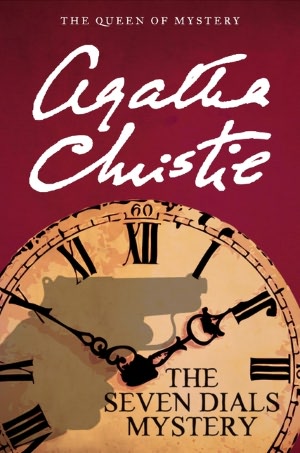
The Seven Dials Mystery

The Seven Dials Mystery. Agatha Christie. 1929/2012. HarperCollins. 304 pages.

That amiable youth, Jimmy Thesiger, came racing down the big staircase at Chimneys two steps at a time. So precipitate was his descent that he collided with Tredwell, the stately butler, just as the latter was crossing the hall bearing a fresh supply of hot coffee. Owing to the marvelous presence of mind and masterly agility of Tredwell, no casualty occurred.

 Oh, how I LOVED The Seven Dials Mystery!!!! It was such a great book. I loved the tone of this one--the tongue-in-cheek-ness of it. It was just one of those books where you could almost open it to any page and find something to smile about. The characters. The characters' names. The dialogue. Some of the situations. The Seven Dials Mystery is one of those rare books that combines comedy or humor with drama and suspense. There is danger and suspense. There are murder victims. The murderer does manage to avoid detection, for most of the novel. And the reader knows that the murderer could strike again. So the threat is real, but, at the same time The Seven Dials Mystery does not read like a horror novel. It's not weird enough, creepy enough, scary enough. I don't think the point of this one is to scare you, I think it is all about entertaining you.

This Agatha Christie novel features several characters that I loved. The inspector from Scotland Yard is Superintendent Battle. And I definitely enjoyed him. Not quite as much as I enjoyed Eileen "Bundle" Brent. But still, I was glad to meet him. Bundle was one of a handful of young people who involve themselves in this case. They are working with Battle to solve the case. And there is a tiny bit of romance going on behind the scenes in this one.

The setting of this one, for the most part, is Chimneys. The novel opens with a houseguest being murdered. Well, that's not exactly true. The novel begins with all the other houseguests making fun of the would-be-victim's bad habit of sleeping way too late. Their teasing even takes it the next level--a big practical joke is planned and plotted for the next day. But the victim of the joke becomes the victim of a murderer. Who killed Gerry Wade? Was it one of the other houseguests?

Read The Seven Dials Mystery
  • If you're a fan of Agatha Christie
  • If you're interested in reading Christie's earlier works
  • If you enjoy mystery/suspense novels
  • If you enjoy a little comedy with your mystery/thriller
  • If you want to smile 
© 2012 Becky Laney of Becky's Book Reviews

Wednesday, August 11, 2010

Beauvallet


Beauvallet. Georgette Heyer. 1929/2010. Sourcebooks. 301 pages.

The deck was in shambles.

Dona Dominica, the daughter of the former governor of Santiago, Don Manuel de Rada y Sylva, is on her way back to Spain--along with her dying father, when their ship the Santa Maria is boarded by English adventurers (pirates) led by the fearless El Beauvallet (Nicholas Beauvallet). The two are taken captive by Beauvallet and brought aboard his ship, Venture. But he promises--and it's not a promise without risk--to return these two safely to Spain. If anyone can land an English ship safely into a Spanish port during these hostile times it would have to be Beauvallet.

At first Dominica hates her captor. She refuses to admit to herself that he is a little charming, a little handsome. She flirts with the other men to drive him crazy. But. Soon she has to admit that there is an attraction between them. And she's shocked to hear him boast recklessly of his honorable intentions to make her an English woman before the year is out. Since she is his captive, you might think this would be easy. Just set sail for England instead of Spain. The lady seems willing enough. But Beauvallet wants the challenge. So he keeps his promise--his first promise--both father and daughter arrive safely in Spain. Beauvallet returns to England, to his family, to his Queen.

But Dominica has not been forgotten. And a few months later, Beauvallet is ready to pursue his lady. To woo her in Spain. With England and Spain so very, very close to war--how can an Englishman, a pirate, a dreaded pirate, safely enter Spain? He has boasted that he will find a way...

Meanwhile, Dominica's father dies and she is taken into her aunt's family. Her aunt!!! Oh what a character Dona Beatrice is! She's a strong, strong woman with a mind of her own. She has a way of bullying all the men in her life including her son, Don Diego. She has determined that he must marry Dominica.

Beauvallet is an exciting and dramatic historical romance set in the Elizabethan era. Beauvallet is a bold adventurer who will risk it all to win his lady love. With his faithful companion, Joshua Dimmock, by his side, Beauvallet is ready for any challenge. The book had action, adventure, drama, and romance. I enjoyed Beauvallet very much!

The opening chapters of Beauvallet definitely reminded me of The Sea Hawk, a 1940 film starring Errol Flynn.

© Becky Laney of Becky's Book Reviews

Thursday, July 01, 2010

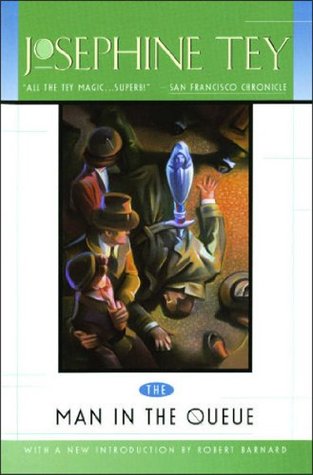
The Man in the Queue


The Man in the Queue. Josephine Tey. 1929/1995. Simon & Schuster. 256 pages.

It was between seven and eight o'clock on a March evening, and all over London the bars were being drawn back from pit and gallery doors.

When a man is murdered in a ticket line for a show, it's up to Inspector Alan Grant and others at Scotland Yard to solve the crime. Many things are a mystery in this one. The man's identity, for one. Who is this man? How could people spend hours in line together and not notice the people around them--the people before and behind them. Who murdered this man? What could the motive be for his murder? Why didn't those behind him notice anything?

I was surprised by how much I liked this one. I have always thought I didn't like mysteries. And yet, I found this detective story so enjoyable. I really liked Inspector Grant. And it was more than just the characters, I liked the narrative style too. I liked the way she told this story.
Eagerly he opened it and eagerly skipped the slightly prosy unimportances with which it opened--Bretherton of the scientific side was inclined to be a pompous dogmatist; if you sent him a Persian cat to report on, he would spend the first sheet of foolscap in deciding that its coat was grey and not fawn--and picked out the salient thing. (39)
Isn't that a great description? I loved the prosy unimportances.

I definitely liked this one. I'm so glad I discovered Josephine Tey.

In the introduction to this edition, Robert Barnard made this observation,
Josephine Tey (1896 or 97-1952) is a writer who lives by her works alone...I would hazard the guess that her readers' attitude toward her is different from their attitude toward other classic crime writers: they regard her with love. They give to their favorite Tey novel what they once gave to their favorite books of childhood, to The Wind in the Willows, Little Women, or whatever: unconditional enthusiasm. (7)

© Becky Laney of Becky's Book Reviews