Showing posts with label vintage mystery. Show all posts

Tuesday, December 26, 2023

194. The Mysterious Mr. Badman


The Mysterious Mr. Badman. W.F. Harvey. 1934. 204 pages. [Source: Library]

First sentence: When at two o'clock on a sultry July afternoon Athelstan Digby undertook to keep an eye on the contents of the old bookshop in Keldstone High Street, he deliberately forgot to mind his own business. 

Premise/plot: This one is a vintage mystery from the 1930s. Athelstan Digby, one of our protagonists, is on holiday. He's temporarily minding a bookshop--while the owners are away for a day (possibly one day and one night). He has THREE people come in and all ask for the same book--The Life and Death of Mr. Badman by John Bunyan. He finds this strange, strange, super-strange. Events in the small village soon reflect this, Athelstan and his nephew, Jim, soon find themselves amateur detectives trying to solve multiple crimes--including murder. 

My thoughts: I LOVED, LOVED, LOVED this one. It reminded me of all the reasons I love vintage mysteries, particularly British mysteries. I enjoyed getting to know the characters. I loved the bookish plot. I loved finding a new-to-me author. Definitely recommended.


© 2023 Becky Laney of Becky's Book Reviews

Tuesday, October 11, 2022

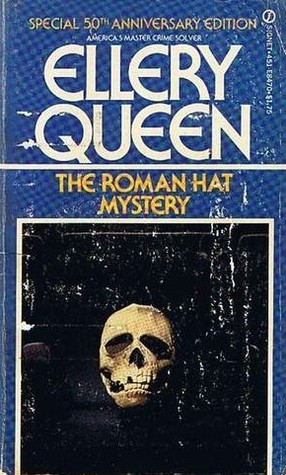
124. The Roman Hat Mystery


The Roman Hat Mystery. Ellery Queen. (aka Frederic Dannay and Manfred Bennington Lee) 1929. 239 pages. [Source: Library]

First sentence: The dramatic season of 192- began in a disconcerting manner. Eugene O'Neill had neglected to write a new play in time to secure the financial encouragement of the intelligentsia; and as for the "low-brows," having attended play after play without enthusiasm, they had deserted the legitimate theatre for the more ingenuous delights of the motion picture palaces.

Premise/plot: The Roman Hat Mystery--the first in the Ellery Queen series--stars a father and son. Inspector Queen is a police inspector. Ellory Queen, the son, is a mystery writer and amateur detective. The crime in this murder mystery takes place during a Broadway show. The only clue they really have to work with--their biggest clue--is that the murder victim's top hat is missing. Since they didn't find the hat on or near the victim, or even at the theatre, someone either wore it out of the theatre or carried it out of the theatre. The theory goes that if you can trace down what happened to the hat, you'll find the murderer.

My thoughts: I found The Roman Hat mystery to be incredibly dull. Perhaps methodical would be the best way to phrase it in polite terms? Perhaps investigations are truly tedious and lack dramatic interest. Perhaps it is just a ton of paperwork and matter of fact, ho-hum questioning. But it was just so much to get through. And the pay off--to me--didn't seem worth it. Dare I say you could read the first two or three chapters and jump straight to the last chapter without missing anything??? You wouldn't miss fleshing out of any characters, that's for sure. And I would even say that the father and son aren't all that fleshed out either. Perhaps they are in later books? Or at least the son?

The book was first published in 1929. Expect the morals and values of 1929. In other words, certain things have not aged well at all. Certain descriptions and plot points are just what most people would call backward. I didn't notice this so much in the dull-as-dirt middle but in the big reveal, it's hard to miss.


© 2022 Becky Laney of Becky's Book Reviews

Saturday, September 10, 2022

108. Death on the Nile


Death on the Nile. Agatha Christie. 1937/2007. Black Dog & Leventhal. 352 pages. [Source: Bought]

First sentence: "Linnet Ridgeway!" "That's her!" said Mr. Burnaby, the landlord of the Three Crowns. He nudged his companion.

Premise/plot: All is not fair in love or war. This Hercule Poirot mystery is set on a cruise of the Nile river. It is the honeymoon trip for one happy couple--or should I say one "happy" couple. For this happy couple is being stalked/followed by a disgruntled (and dramatic) ex. She is not happy to see HER former fiance marry a now former friend. She even introduced them! These three aren't the only travelers with struggles, traumas, and dramas of their own. Poirot picked quite a bunch to travel with. (Not that he had much say in the matter.) But when bodies start to fall, well, he has his work to do.

My thoughts: I LOVED, LOVED, LOVED Agatha Christie's Death on the Nile. It is such a great mystery, very complex! Hercule Poirot and Colonel Race find themselves on board a ship on the Nile, they are in interesting company. Poirot notices the tension between some of his fellow travelers from the very start. And as he takes the time to get to know everyone, to have personal chats with almost every one, his unease only increases. He fears that before the trip is over, murder will have been committed. But who shall the victim be? And who the murderer? Meanwhile, Race is on a mission of his own before a body is even found. He is on the trail of a killer, a radical. He's not sure WHO his man is, just knows that he is almost certainly on board, that is where his clues have led him. When the oh-so-wealthy heiress, Linnet Ridgeway, is murdered on her honeymoon with Simon Doyle, there are plenty of suspects. For not all of the passengers on board are exactly strangers to her....

The first part of this one is set in England, but the rest is all set in Egypt.

This one had me from the start. It was so thrilling! Not only was the plot interesting and surprising and wonderful, the characterization was so well done!!!


© 2022 Becky Laney of Becky's Book Reviews

Thursday, March 03, 2022

33. The Naked Sun


The Naked Sun. (Robot #2) Isaac Asimov. 1958. 271 pages. [Source: Library]

First sentence: Stubbornly Elijah Baley fought panic. For two weeks it had been building up. Longer than that, even. It had been building up ever since they had called him to Washington and there calmly told him he was being reassigned.

Premise/plot: The Naked Sun is the second Robot novel starring detectives Elijah Baley and R. Daneel Olivaw. The Caves of Steel was a mystery detective novel set on a futuristic Earth. The Naked Sun has this pair traveling to the planet Solaria. The pair have been requested to come solve a murder.

My thoughts: I LOVED, LOVED, LOVED, LOVED this one. It is science fiction AND a murder mystery. I appreciated the world-building of the Outer Colony Solaria. Though the original colonists were from Earth--way, way, way, way, way back when--the culture and society is night and day different. And it isn't only because the proportion of humans to robots is so large...

You see, the Solarians have evolved into a culture where you never actually SEE or interact (physically) with another human being. Marriages are arranged, but duty-driven, somewhat distasteful, practically repulsive. A husband and wife may live on the same estate, but never actually see each other face-to-face for weeks or even months at a time. All Solarians find SEEING distasteful and "wrong." Solarians, well, they've evolved into a culture that VIEWS. One uses technology to VIEW one another. All relationships are maintained through viewing. Viewing has COMPLETELY different rules (or protocols) than seeing.

If humans absolutely *have* to be in the same physical room, then it's polite to stand twenty feet (or so) away.

Quotes:

Gruer said, "No, I cannot say the murderer is completely unknown. In fact, there is only one person that can possibly have done the deed." "Are you sure you don't mean only one person who is likely to have done the deed?" Baley distrusted overstatement and had no liking for the armchair deducer who discovered certainty rather than probability in the workings of logic. But Gruer shook his bald head. "No. Only one possible person. Anyone else is impossible. Completely impossible." "Completely?" "I assure you." "Then you have no problem." "On the contrary. We do have a problem. That one person couldn't have done it either." Baley said calmly, "Then no one did it." "Yet the deed was done. Rikaine Delmarre is dead." 

"You said something about interviewing people face to -----" He shook his head, his tongue dabbing quickly at his lips. "I would rather not say it. I think you know what I mean. The phrase conjured up the most striking picture of the two of us breathing--breathing one another's breath." The Solarian shuddered. "Don't you find that repulsive?" "I don't know that I've thought it so." "It seems so filthy a habit. And as you said it and the picture rose in my mind, I realized that after all we were in the same room and even though I was not facing you, puffs of air that had been in your lungs must be reaching me and entering mine. With my sensitive frame of mind---"

Anything could be found in figures if the search were long enough and hard enough and if the proper pieces of information wre ignored or overlooked.


© 2022 Becky Laney of Becky's Book Reviews

Monday, June 01, 2020

77. The Rat Began to Gnaw the Rope

The Rat Began to Gnaw the Rope. C.W. Grafton. 2020. Poisoned Pen Press. 304 pages. [Source: Review copy]

First sentence: My secretary said that there was a Miss Ruth McClure to see me and I said that she could come on in. The girl who stood in the doorway a moment later was small and lovely but she was obviously very unhappy and looked as if she were not sure she wanted to come in after all.

Premise/plot: As adults we don't really have D.E.A.R scheduled into our days, well, most don't. D.E.A.R. if you don't know means Drop Everything And Read. But this vintage mystery should be a must-must-must read for all mystery lovers.

Originally published in 1943, it stars an amateur detective, Gilmore "Gil" Henry, a lawyer. A young woman, Ruth McClure, comes to him--as a lawyer--seeking his services. She has a couple of questions about some stock she has inherited after her father's death. Henry takes the case, and, well a lot more comes with that--than he was expecting! His close encounters with death start piling up!!!! Somebody does not want him helping out Miss McClure. But why?!?!

My thoughts: I loved, loved, loved, loved, LOVED this vintage mystery. It perhaps isn't perfectly perfect. It is very much a product of its time. It was written and published during the second world war. But for adult readers with an appreciation for context that don't find offense at the drop of a hat, I think it would prove a delightful escape.

I love the narrative! I love Gil Henry. It's not often you get pudgy, chubby detectives that are way out of their element but super stubborn. I love the description as well.

As I reached the city limits I turned on the radio and caught a hot swing band with one of these women crooners who sounds as if she has gallstones. It was starting to rain a little and the black-top road was shiny like seals in the circus.


I was about halfway down the steep hill when there was a sharp explosion and the car jumped and twisted under me like a hula dancer. I went down that hill in a wild zigzag, keeping to the road for fifty or seventy-five yards by pressing my hundred and eighty pounds against the wheel and trying to anticipate each move. Then I went into a spin and the last thing I heard was the high whine of the tires skidding sidewise. I ought to be dead. How many times the car turned over I don’t know but when I came to, I was hanging halfway out of the door by the driver’s seat and the car was upright some thirty feet off the road down a slight incline.


I began to get a pretty good idea of what Tim McClure might look like when I tried to put on the suit I found on the bed. It may not have been a zoot suit6 but the way I wore it, it certainly had a drape shape. I rolled up probably eight inches around my ankles and the overlap at my waistline was something to look at. The shoulders of the coat hung down almost to my elbows and, of course, my hands were clear out of sight up the sleeves. No wonder Miss Ruth McClure laughed when she saw me. I was a dead ringer for the smallest of the seven dwarfs and sure enough she called me Dopey.


Every person has some cross to bear. Mine is that I am not shaped like people who are intended to get their clothes in ready-to-wear shops. If clothes are to fit me in the middle, they have to be too long at the ends and if they are to fit me at the ends, they hurt me in the middle.


I didn’t want to take the time to wait while alterations were made so I took a suit which hurt when I buttoned it at the waist. Mr. Silverstein had on a black skull cap and a measuring tape hung around his neck. He patted and smoothed and pulled at things to make them hang right and appeared to approve in every particular although he finally said that maybe it was a little snug. I thought snug was hardly the appropriate word since my belt was almost out of sight and I could tell that I would not want to sit down very often.


I regretted my decision when I crawled in under the wheel of the car. They say when you cut earthworms in two, the halves go about their own business and supply whatever it takes to carry on, but I am no earthworm and I had no faith in my ability to do the same.


I wondered if there was any way to grow a new tooth, remove bruises, reduce thirty pounds or grow eight inches taller in a few minutes, but decided there wasn’t. I thought about buying a new suit and incidentally giving my tortured stomach a rest, but with the other details so accurately reported, I thought it would be a waste of time and money. There wasn’t any water at the newsstand so I took two tablets out of the box and munched them disagreeably as I walked down the street wondering how long it would be before I was on the inside looking out.


People who fix things to eat like to see other people eat them, especially when they are hungry and say so, and I was so hungry it must have been shining out of my eyes for anybody to see.


Well, you can’t stand in one spot forever. Acorns do it and get to be oak trees and leaves grow all over them and by and by they can’t move at all.


© 2020 Becky Laney of Becky's Book Reviews

Wednesday, January 01, 2020

1. Christmas Card Crime and Other Stories

Christmas Card Crime and Other Stories. Compiled by Martin Edwards. 2018. The British Library/Poisoned Pen Press. 256 pages. [Source: Review copy] [Genres: Short Stories; Mystery; Classics]

The Christmas Card Crime and Other Stories is a holiday-themed short story collection featuring eleven vintage mystery stories.

A Christmas Tragedy by Baroness Orczy 
First sentence: It was a fairly merry Christmas party, although the surliness of our host somewhat marred the festivities. But imagine two such beautiful young women as my own dear lady and Margaret Ceely, and a Christmas Eve Cinderella in the beautiful ball-room at Clevere Hall, and you will understand that even Major Ceely’s well-known cantankerous temper could not altogether spoil the merriment of a good, old-fashioned festive gathering.

Premise/plot: A holiday gathering at a country home goes awry when a murder is committed on Christmas Eve. It is up to Lady Molly to find the real murderer and free the man who has been set up to take the fall.

My thoughts: I'd give this one three stars. It was just okay.

By the Sword by Swelwyn Jepson
First sentence: Alfred Caithness stayed on for Christmas for two reasons, quite apart from the cold weather, which he found easier to support at Dingle House than alone in his Baker Street flat.

Premise/plot: A family holiday gathering goes horribly wrong when a murder is committed...it has to have been a family member...but who and why?!

My thoughts: I'd give this one two stars. I liked it even less than the first one in the story.

The Christmas Card Crime by Donald Stuart
First sentence: With a long hiss of escaping steam that sounded like light relief the Western Express came to a halt beside the platform at Bodmin Station. From a first class compartment a tall, thin man alighted, and turned to assist a middle-aged lady, whose ample proportions were enveloped in a voluminous coat of some mysterious black, furry material. “I hope there’s a waiting room,” she remarked, shivering violently as a blast of icy wind came whistling along the platform. “This weather is bad for them what’s got rheumatics.”

Premise/plot: When a train is stalled by the weather, the travelers set out on foot to search for a warm place to stay the night...but someone on the train has less than pure motives...will all the travelers reach their destination alive?!

My thoughts: I LOVED this story. I'd give it 5 stars.

The Motive by Ronald Knox
First sentence: “A certain amount of dust is good for a juryman’s eyes. It prevents him going to sleep.” Sir Leonard Huntercombe is probably responsible for more scoundrels being at large than any other man in England.

Premise/plot: The narrator is weaving quite a story...but is it a true story or the work of his imagination?

My thoughts: I liked this one. I'd give it three stars.

Blind Man's Hood by Carter Dickson (aka John Dickson Carr)
First sentence: Although one snowflake had already sifted past the lights, the great doors of the house stood open. It seemed less a snowflake than a shadow; for a bitter wind whipped after it, and the doors creaked.


Premise/plot: I wish I could tell you about what makes this atmospheric story so delightful....but the less you know the better. But think Twilight Zone.

My thoughts: I LOVED this one. I'd give it 5 stars.

Paul Temple's White Christmas by Francis Durbridge
First sentence: Steve stopped talking about Switzerland, tore up the Winter Sports brochure, and went out shopping. She said that she would meet Temple at the Penguin Club at a quarter past four. “I shan’t be a minute later than four-fifteen,” she said gaily. That was two hours ago.


Premise/plot: Paul Temple is married to a woman named Steve...and they have an unexpected white Christmas.

My thoughts: This is the most disappointing of the bunch. It was so SHORT that it was confusing and pointless. Like why even include it if the characterization, the plot, the story was so short it was stunted?! I'd give it one star.

Sister Bessie Or Your Old Leech
First sentence: Hilda Trent turned the Christmas card over with her carefully manicured fingers as she read the idiotic lines aloud. “Did you ever hear anything so completely palsied?” she asked her husband. “I wonder who on earth they can get to write the stuff. Timothy, do you know anybody called Leech?” “Leech?” “Yes—that’s what it says: ‘From your old Leech.’ Must be a friend of yours. The only Leach I ever knew spelt her name with an a and this one has two e’s.”

Premise/plot: Timothy, the narrator, is trying desperately to figure out which family member is blackmailing him...and he'll do anything to stop it...

My thoughts: I did NOT like this one. Though I suppose I liked it more than Paul Temple's White Christmas. I'd give this one two stars.

A Bit of Wire Pulling by E.C.R. Lorac.
First sentence: “It’s a very rare thing for a murder to be committed actually in the presence of a police officer,” said Inspector Lang, the old C.I.D. man. “I should think it’s unique,” growled Dr Walton, and Harland (a rising young barrister) put in: “Tell us the yarn, Inspector. We’re a safe audience, and it’s just the night for a yarn.”

Premise/plot: An Inspector tells an eager audience a story...

My thoughts: I definitely liked this one. Three stars.

Pattern of Revenge by John Bude
First sentence: Thord Jensen was the finest man on skis in Levendal. Englishmen of the pre-war era, holidaying in our Norwegian mountains, may remember Thord—for after the tragedy he set up as a ski-ing instructor and did exceeding well for himself. So well, in fact, that when he died in 1945 as the result of an accident, Thord was in a position to leave over three thousand pounds to his hated rival, Olaf Kinck. That, of course, was by way of compensation for what he’d done to Olaf—for when the poor fellow was released from an Oslo jail, three months after Thord’s confession, it was not only his heart that was broken but his faith in his fellow-men.


Premise/plot: A dying man regrets taking revenge on a rival....

My thoughts: It was short but thought-provoking. 4 stars.

Crime at Lark Cottage by John Bingham
First sentence: The weather was foul. It had been snowing, off and on, for some days, but during the last few hours the temperature had suddenly risen, and with the departure of the cold had come the rain, pitting the smooth snow, causing it to fall with soft rustles and sighs from the branches in the coppice which surrounded the cottage on three sides.
Premise/plot: This is a great example of a case where the LESS you know going in...the better the story reads. 
My thoughts: I LOVED this one. 5 stars.
 'Twixt the Cup and the Lip by Julian Symons
First sentence: “A beautiful morning, Miss Oliphant. I shall take a short constitutional.” “Very well, Mr Payne.” Mr Rossiter Payne put on his good thick Melton overcoat, took his bowler hat off its peg, carefully brushed it, and put it on. He looked at himself in a small glass and nodded approvingly at what he saw. 
Premise/plot: Appearances can be deceiving...
My thoughts: I don't know how to talk about this one without spoiling it. I really enjoyed how it was written...and it was quite satisfying...even if it was a bit predictable after the initial surprise. 5 stars.
Overall thoughts: I enjoyed these stories. The earliest appeared in 1909 and the latest circa 1965. I didn't love, love, love all the stories--at least not equally. But the week I spent reading this one--several stories each day--it was enjoyable, satisfying, FUN picking this one up to see what was next.
I would recommend this one. 


© 2020 Becky Laney of Becky's Book Reviews

Friday, April 26, 2019

Duplicate Death

Duplicate Death. (Inspectors Hannasyde and Hemingway #7) Georgette Heyer. 1951/2019. Sourcebooks. 400 pages. [Source: Review copy]

First sentence: There were several promising-looking letters in the pile laid on Mrs. James Kane's virgin breakfast-plate on Monday morning, but, having sorted all the envelopes with the air of one expectant of discovering treasure-trove, she extracted two addressed to her in hands indicative either of illiteracy or of extreme youth.

Premise/plot: Duplicate Death should never, ever, ever be read before They Found Him Dead. Trust me--please. The novel opens and closes with the stars of They Found Him Dead now happily married and the parents of four children. (Patricia Allison and James "Jim" Kane). Why the novel opens and closes with them remains a mystery to me.

Timothy HARTE is madly in love with a young woman, Miss Beulah Birtley. Miss Birtley is working for a difficult woman, Mrs. Haddington; Mrs. Haddington has a beautiful daughter, Cynthia. If it was up to Mrs. Haddington--which it isn't--Cynthia and Timothy would make a match of it. Both young people are at a bridge party at the Haddington house--though I don't quite remember if Miss Birtley is a "guest" or "staff" at the time--when a murder occurs. The investigators from the case are Hannasyde and Hemingway. Both remember Timothy Harte from their previous acquaintance. Both are listed among the suspects, though neither tops the list of SUSPECTS. A second murder throws the investigation off--for a while.

My thoughts: It annoys me that the jacket copy is INACCURATE for this one. Is it really so terribly hard to get a name right? Timothy KANE is not a character in the book. He doesn't exist. Not existing, he doesn't have a fiancee who's a prime suspect. However, Timothy HARTE does exist and does have a fiancee, though she's not really a prime suspect. Also the book stresses the friendship between Timothy KANE and the inspectors; I would say that is misleading as well. Fourteen years--give or take--have gone by without them speaking to each other or "hanging out." I doubt that the Inspectors were thinking of or missing Timothy in all those years. And probably the same could be said for Timothy. They were acquaintances that were on friendly terms--nothing more, nothing less.

All that being said, I liked this one well enough.

'Look here, I--the thing is--there are things in my life you don't know anything about!'
'Good God, I should hope there were!' retorted Timothy. "I've only known you a month!'
'And some of them you wouldn't like!'
'I daresay. Come to think of it, I can tell you of one thing in your young life I don't like right now, and that's Mr. Daniel Seaton-Carew.'

'I have no wish to appear boastful,' returned young Mr. Harte, 'but from my earliest days it has been said of me by all who know me best that I talk enough for two, or even more.'

'Seaton-Carew is considered to be rather an attractive type.'
'What does he attract? Pond-life?'

'Wireless programmes are neither primarily or secondarily intended for cultured persons,' replied Timothy, quite unruffled. 'Too often they appear to be intended either for the entirely witless, or for those desirous of acquiring without effort a little easy knowledge. I remember that someone once gave a fifteen minute talk on the Battle of Waterloo. A sobering thought.'

The Chief Inspector groaned. 'Any line on it at all?'
'Might be, might not. Doesn't sound like a cinch, from the first report. There were forty-nine people in the house at the time--'
'What?'
'Fifty-five, counting the servants,' said the Superintendent.

'What you [Pershore] want to do is to hire a hall, and give a series of lectures on police work,' interposed Hemingway. 'You'll probably make a lot of money: people will pay to listen to anything! I wouldn't, of course, but that's because I have to listen to you, and even the Department wouldn't expect me to pay for doing what I can't help. Now you stop trying to annoy me, and tell me what's been happening here without any trimmings!'

'Good God!' said Mr. Harte, staring at him between narrowed eyelids. 'You're the Sergeant!'
'Well, I was once, but I've been promoted,' he replied. 'Did you happen to know me when I was a Sergeant, sir?'
'Of course I did!' said Timothy, rising, and going towards him, with his hand held out. 'You probably don't remember me, but don't you remember the Kane case?'

'Perhaps you are confusing popularity with usefulness. Unattached men, Chief Inspector, are greatly in demand amongst hostesses.'

If you were to have given Mr. Godfrey Poulton the choice between having a sewer-rat loose in his house or the late Seaton-Carew, it's my belief he'd have chosen the rat.

The only thing that would surprise me about his case would be if I was able to get a real lead.

Ever add two and two together and get five for an answer? No, you wouldn't because you've got no imagination, but it's what I can see myself doing. All the same, taking your bit of dirt with what I gathered from Lady Nest's way of carrying on, I think this'll bear looking into.

'Look here, I don't mind you making two and two five, but when you start making it six, your'e going too far, Sandy!' expostulated Hemingway.


© 2019 Becky Laney of Becky's Book Reviews

Friday, January 18, 2019

4:50 From Paddington

4:50 From Paddington. (Miss Marple #8) Agatha Christie. 1957/2007. 288 pages. [Source: Bought]

First sentence: Mrs. McGillicuddy panted along the platform in the wake of the porter carrying her suitcase.

Premise/plot: Poor Mrs. McGillicuddy! She witnesses a crime when she's on a train--the crime takes place on a passing train--and NO ONE believes her. No one but Miss Marple that is! Miss Marple knows her friend did not imagine a man strangling a woman. Since the police aren't going to bother with an investigation, it's up to her and her friends. Miss Marple hires a woman--Lucy Eyelesbarrow--to do the job. Lucy gets hired on at an estate--the nearest estate to where Miss Marple thinks the body might have been thrown off the train--and in her spire time Lucy will hunt for the body. It doesn't take her long--not really, not all things considered. What takes time is identifying the woman. Who was she? What was she doing in England? Is she in any way connected to the family or the estate? Could Lucy be living with a murderer?

My thoughts: I love, love, love this murder mystery. The murder occurs BEFORE Christmas but most of the book occurs in January or thereabouts. Lucy is working for a very eccentric, quirky family. Some of these family members are quite memorable, almost delightful. Miss Marple is staying nearby and posing as Lucy's aunt.

This is a well-written mystery novel that is fun to read and reread. (Though to be honest you should let a few years go by so that the details get a bit fuzzy in between readings.)

Quotes: 
"Well," she said, "it looks as though you were right." She produced her findings and gave the details of their discovery. "Perhaps one ought not to feel so," she said, "but it is rather gratifying to form a theory and get proof that it is correct!" (39)
"At a certain stage one is inclined to think everyone knows a little more than they are willing to tell you." (81)
"If you have not committed a murder, it naturally annoys you if it seems someone thinks that you have," said Inspector Craddock mildly. (129)
"The truth is people are an extraordinary mixture of heroism and cowardice." (144)


© 2019 Becky Laney of Becky's Book Reviews
Thursday, December 13, 2018

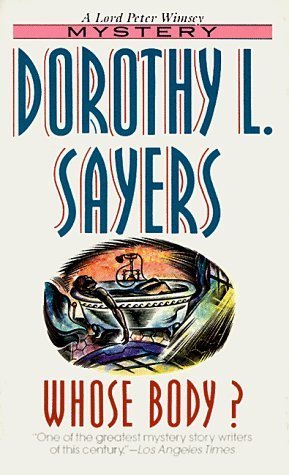
Whose Body?

Whose Body? Dorothy L. Sayers. 1923/1995. HarperTorch. 224 pages. [Source: Bought]

First sentence: "Oh damn!" said Lord Peter Wimsey at Piccadilly Circus.

Premise/plot: Whose Body? is the first novel in a mystery series starring Lord Peter Wimsey as an amateur detective. (He solves crimes with a little help from his butler/valet, Bunter, and in later mysteries with his girlfriend/wife.) In the opening pages of the novel, Lord Peter receives a phone call--or 'phone call--from his mother the Dowager Duchess. A murder has been committed. A naked man has been found in a bath tub of an acquaintance of hers. Is he interested in solving the case and working with Scotland Yard?

My thoughts: As a whole, I love, love, love the series by Dorothy Sayers. That being said, I don't love each and every book in the series equally. I enjoyed this one very much. I found it to be witty and delightful. It was super quotable. I would recommend it as a starting point for reading the series.

Quotes:
  • Exit the amateur of first editions; new motive introduced by solo bassoon; enter Sherlock Holmes, disguised as a walking gentleman. There goes Bunter. Invaluable fellow--never offers to do his job when you've told him to do somethin' else. (5)
  • "Sugg's a beautiful, braying ass," said Lord Peter. "He's like a detective in a novel." (18)
  • "I love trifling circumstances," said Lord Peter. "so many men have been hanged by trifling circumstances." (20)
  •  "Parker, acushla, you're an honour to Scotland Yard. I look at you, and Sugg appears a myth, a fable, an idiot-boy, spawned in a moonlight hour by some fantastic poet's brain. Sugg is too perfect to be possible." (23)
  • "Look here, Wimsey--you've been reading detective stories; you're talking nonsense." (29)
  • Of course, if this were a detective story, there'd have been a convenient shower exactly an hour before the crime and a beautiful set of marks which could only have come between two and three in the morning, but this being real life in a London November, you might as well expect footprints in Niagra. (44)
  • "It's a hard life, valeting by day and developing by night--morning tea at any time from 6:30 to 11, and criminal investigation at all hours. It's wonderful, the ideas these rich men with nothing to do get into their heads." (49)
  • "Have you any Scotch blood in you, Parker?" inquired his colleague, bitterly.
    "Not that I know of," replied Parker. "Why?"
    "Because of all the cautious, ungenerous, deliberate and cold-blooded devils I know," said Lord Peter, "you are the most cautious, ungenerous, deliberate and cold-blooded. Here I am, sweating my brains out to introduce a really sensational incident into your dull and disreputable little police investigation, and you refuse to show a single spark of enthusiasm."
    "Well, it's no good jumping at conclusions."
    "Jump? You don't even crawl distantly within sight of a conclusion. I believe if you caught the cat with her head in the cream-jug you'd say it was conceivable that the jug was empty when she got there."
    "Well, it would be conceivable, wouldn't it?" (51)
  • "There's nothing you can't prove if your outlook is only sufficiently limited. Look at Sugg." (69)
  • Assigning a motive for the murder of a person without relations or antecedents or even clothes is like trying to visualize the fourth dimension--admirable exercise for the imagination, but arduous and inconclusive. (82)
  • "One demands a little originality in these days, even from murderers," said Lady Swaffham. "Like dramatists, you know--so much easier in Shakespeare's time, wasn't it? Always the same girl dressed up as a man, and even that borrowed from Boccaccio or Dante or somebody. I'm sure if I'd been a Shakespeare hero, the very minute I saw a slim-legged young page-boy I'd have said: "Odsbodikins! There's that girl again!" (123)
  • "And in short stories," said Lord Peter, "it has to be put in statement form, because the real conversation would be so long and twaddly and tedious, and nobody would have the patience to read it. Writers have to consider their readers, you see." (158)


© 2018 Becky Laney of Becky's Book Reviews

Thursday, August 30, 2018

The Boomerang Clue

The Boomerang Clue. Agatha Christie. 1934. 224 pages. [Source: Bought]

First sentence: Bobby Jones teed up his ball, gave a short preliminary waggle, took the club back slowly, then brought it down and through with the rapidity of lightning.

Premise/plot: Bobby Jones, the vicar's son, is playing a round of golf with a friend when they discover a dying man. Did he fall to his death quite by accident, or was he pushed off the cliff? His death is ruled an accident, but Bobby and his friend, Lady Frances (aka Frankie) disagree. Primarily they disagree because soon after this incident an attempt is made on Bobby's life. There is a murderer about who seems to think that Bobby knows more than he actually does--that Bobby is a threat to him. Frankie and Bobby team up to find the murderer, but the clues are few and far between. They have so little to go on and the man--or woman--they're searching for is DANGEROUS. Will they discover the truth of his identity in time? And will he--or she--be brought to justice?

My thoughts: This one is also titled Why Didn't They Ask Evans? That phrase was the last thing uttered by the victim. Bobby the only one who heard it. (His friend had gone for help already). Who is Evans? What question should they have asked Evans? And for that matter WHO is this dead man? Bobby and Frankie are amateurs at best. This is, as far as I know, their only case.

I will say that this one kept me guessing until the very, very end. I don't know why I was so horrible at solving this one. Well, that's not true. The clues are so teeny tiny and there really isn't much to go on except instincts. And readers' impressions are formed largely from the impressions of the characters themselves. Have you read this one? Did you guess who did it?


© 2018 Becky Laney of Becky's Book Reviews

Tuesday, July 24, 2018

Singing in the Shrouds

Singing in the Shrouds. Ngaio Marsh. 1958. 240 pages. [Source: Bought]

First sentence: In the Pool of London and farther east all through the dockyards the fog lay heavy. Lights swam like moons in their own halos. Insignificant buildings, being simplified, became dramatic.

Premise/plot: Singing in the Shrouds is the twentieth novel in Ngaio Marsh's Inspector Alleyn mystery series. Cape Farewell is about to steam out to sea when a body is discovered near the docks. It is believed that the murderer is a passenger on the ship. Inspector Alleyn joins the ship--in disguise--the next day. He not only wants to find the murderer--who has already struck three times--but to prevent another murder from occurring. This serial killer is striking every ten days. And the voyage is much longer than ten days! Can Alleyn discover the murderer among the passengers without being discovered himself?

My thoughts: I am loving Ngaio Marsh. I am. I can't believe it's taken me so long to get to her mystery novels. I enjoyed getting to know the passengers. There were some interesting characters among them--some prove Alleyn's great allies. One of the passengers was a 1950s version of Jerry Springer--a television personality of a reality talk show where guests bring him their personal troubles. 
When it comes to separating the easygoing from the exacting passenger, stewards are not easily deceived. But Dennis had been taken in by Mr. Merryman. The spectacles, the rumpled hair and cherubic countenance had led him to diagnose absence of mind, benevolence and timidity. He was bitterly disappointed when Mr. Merryman now gave unmistakable signs of being a Holy Terror. (24)
It's the greatest mistake to think that jealousy is necessarily a fault. On the contrary, it may very well sharpen the perception. (54)
'Alibis,' Mr. Merryman said grandly, 'are in the same category as statistics: in the last analysis they prove nothing.' (85)
© 2018 Becky Laney of Becky's Book Reviews

Friday, June 29, 2018

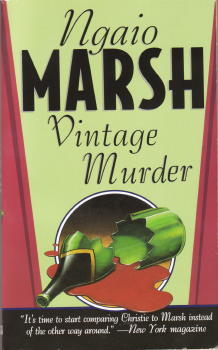
Vintage Murder

Vintage Murder. Ngaio Marsh. 1937. 256 pages. [Source: Bought]

First sentence: The clop and roar of the train was an uneasy element somewhere at the back of the tall man's dreams.

Premise/plot: Inspector Alleyn can't escape work on his vacation to New Zealand. He finds himself in company with a company--a touring theatre company. He socializes with them on the train to their shared destination. He keeps on socializing with them once they arrive. A few are aware of who he is--the famous Inspector--but many are not. At a big party after their opening show, a planned surprise turns deadly. Inspector Alleyn witnesses the 'surprise' along with most of the cast, crew, and invited guests. Will he be able to solve the crime and determine the motive?

My thoughts: This mystery novel is set in New Zealand, in a theatre in New Zealand. For mystery lovers looking for a more 'exotic' setting than the English countryside, this one may prove quite satisfying. Its peopled with quirky characters and I must admit it kept me guessing up until the end. I found it a quick and enjoyable read.
"It's human nature," he said. "Wondering! People spend half their time wondering about each other. That's what sells this detective fiction, I reckon." (97)
© 2018 Becky Laney of Becky's Book Reviews

Wednesday, May 23, 2018

Thirteen at Dinner

Thirteen at Dinner. Agatha Christie. 1933. 228 pages. [Source: Bought]

First sentence: The memory of the public is short. Already the intense interest and excitement aroused by the murder of George Alfred St. Vincent Marsh, fourth Baron Edgware, is a thing past and forgotten. Newer sensations have taken its place. My friend, Hercule Poirot, was never openly mentioned in connection with the case. This, I may say, was entirely in accordance with his own wishes.

Premise/plot: Thirteen at Dinner is the ninth novel in the Hercule Poirot mystery series by Agatha Christie. It is narrated by Poirot's good friend Captain Hastings. He is recounting for readers a case that Poirot himself was a bit ashamed of being involved in.

It begins with a performance: Hastings and Poirot witness a one-woman show, Carlotta Adams. One of the imitations she does is of actress Jane Wilkinson. Wilkinson has married into the nobility, Lord Edgware, but it has not been a successful match--at all.

Later that evening, Poirot meets Jane Wilkinson for himself. She has come to him--pleading with him. Will he be willing to go to Lord Edgware and ask him to grant her a divorce so she can remarry? If not she doesn't know what she'll do. Poirot agrees to go. Lord Edgware agrees to a divorce promptly. In fact, he claims that he agreed over six months ago letting her know by letter!

The next day Lord Edgware is DEAD. Who murdered him and why?!

My thoughts: If you've read Lord Edgware Dies, you've read Thirteen at Dinner. But. If you're like me, you won't mind a bit rereading this Christie mystery. It is one of my favorites. Why? Not because of the details of the mystery. But because of the WRITING. I love Hastings' narration. I love the banter between Hastings and Poirot. Poirot can be such a hoot! It was a TREAT to reread this one.

Quotes:
"Do you not know, my friend, that each one of us is a dark mystery, a maze of conflicting passions and desires and aptitudes? Mais oui, c'est vrai. One makes one's little judgments--but nine times out of ten, one is wrong."
"Not Hercule Poirot," I said smiling.
"Even Hercule Poirot! Oh! I know very well that you have always a little idea that I am conceited, but indeed, I assure you, I am really a very humble person."
I laughed.
"You--humble!"
"It is so. Except--I confess it--that I am a little proud of my moustaches. Nowhere in London have I observed anything to compare with them. (5-6)
"Stop Poirot!" I cried. "You are making my head spin. "
"No, no, my friend. We are only considering possibilities. It is like trying on the clothes. Does this fit? No, it wrinkles on the shoulder? This one? Yes, that is better--but not quite large enough. This other one is too small. So on and so on, until we reach the perfect fit--the truth." (65)
"I always find alibis very enjoyable," he remarked. "Whenever I happen to be reading a detective story I sit up and take notice when the alibi comes along." (101)
"Between the deliberate falsehood and the disinterested inaccuracy it is very hard to distinguish sometimes.."
"What do you mean?"
"To deceive deliberately--that is one thing. But to be so sure of your facts, of your ideas and of their essential truth that the details do not matter--that, my friend, is a special characteristic of particularly honest persons." (107)
"The positive witness should always be treated with suspicion, my friend. The uncertain witness who doesn't remember, isn't sure, will think a minute--ah! yes, that's how it was--is infinitely more to be depended upon!"
"Dear me, Poirot," I said. "You upset all my preconceived ideas about witnesses." (107-8)
"My good friend," he said. "I depend upon you more than you know."
I was confused and delighted by these unexpected words. He had never said anything of the kind to me before. Sometimes, secretly, I had felt slightly hurt. He seemed almost to go out of his way to disparage my mental powers.
Although I did not think his own powers were flagging, I did realize suddenly that perhaps he had come to depend on my aid more than he knew.
"Yes," he said dreamily. "You may not always comprehend just how it is so--but you do often, and often point the way."
I could hardly believe my ears.
"Really, Poirot," I stammered. "I'm awfully glad, I suppose I've learnt a good deal from you one way or another--"
He shook his head.
"Mais non, ce n'est pas ca. You have learnt nothing."
"Oh!" I said, rather taken aback.
"That is as it should be. No human being should learn from another. Each individual should develop his own powers to the uttermost, not try to imitate those of someone else. I do not wish you to be a second and inferior Poirot. I wish you to be the supreme Hastings. In you, Hastings, I find the normal mind almost perfectly illustrated." (111)
"You are like someone who reads the detective story and who starts guessing each of the characters in turn without rhyme or reason." (112)
"You have a theory, then?"
"A detective, M. Martin, always has a theory. It is expected of him. I do not call it a theory myself. I say that I have a little idea. That is the first stage."
"And the second stage?"
"If the little idea turns out to be right, then I know! It is quite simple, you see." (129)
"Do not antagonize your son! He is of an age to choose for himself. Because his choice is not your choice, do not assume that you must be right. If it is a misfortune, then accept misfortune. Be at hand to aid him when he needs aid. But do not turn him against you." (145)

© 2018 Becky Laney of Becky's Book Reviews

Wednesday, May 02, 2018

A Wreath for Rivera

A Wreath for Rivera (Roderick Alleyn #15) Ngaio Marsh. 1949. 336 pages. [Source: Bought]

First sentence:  From Lady Pastern and Bagott to her niece by marriage, Miss Carlisle Wayne...

Premise/plot: Carlisle Wayne has been invited to visit by her aunt and uncle, Lord and Lady Pastern and Bagott. Her eccentric uncle will be performing in a band, a jazz band, and it will be an experience. Whether it will be fun or a disaster remains to be seen. Also coming to witness the spectacle is Edward Manx, a family cousin. Lord and Lady Pastern would love for their daughter, Felicite, to marry Edward. Anyone would be preferable to her current love interest, Carlos Rivera. That love affair is a bit rocky. Or else Felicite wouldn't be writing the advice column of a local newspaper!

Lord Pastern's BIG debut does not quite go according to plan. The plan includes the firing of a gun and playacting. In actuality, a murder is committed in front of an audience. Will Roderick Alleyn and his team be able to solve the crime?

My thoughts: I definitely enjoyed this one! (It is the third I've read in the series. I've also read A Man Lay Dead and The Final Curtain.) I couldn't help wanting a little more however. I was intrigued by Carlisle. I felt teased by Marsh. Was Carlisle in love with Edward? Was Edward in love with Carlisle? Had they been seeing each other? How close had they gotten? Was she jealous when her cousin started flirting with Edward seemingly out of the blue? Did they work out their misunderstanding? Did they end up together? I NEED TO KNOW. As for the solving of the crime, I had two suspects in mind. I don't know that the clues definitely led to just one firm suspect. In fact, most of the clues were only given to readers AFTER the case had been solved. The detectives had an excuse for that--but it was mighty convenient for the author.


© 2018 Becky Laney of Becky's Book Reviews

Tuesday, April 03, 2018

Uneasy Terms

Uneasy Terms. (Slim Callaghan #7) Peter Cheyney. 1947. 240 pages. [Source: Bought]
 
First sentence: The wind came in from the sea, driving the rain before it. It descended in sheets beating down on the rolling Sussex Downs, forming little rivulets that ran swiftly down the gutters of the winding roads about Alfriston. The wind howled dismally through the woods that topped the long rise of downland behind the village.

Premise/plot: If only the mother could have foreseen that her will would lead to murder...

Viola Alardyse is the oldest daughter. Her inheritance will be lost IF she is married at the time of her mother's death or if she gets married.
Corinne Alardyse is the middle daughter. She gets the inheritance if her older sister marries, but only so long as she remains unmarried herself.
Patricia Alardyse is the youngest daughter. Again, she gets the inheritance if and only if both of her sisters have married and if she herself remains unmarried.

If all three sisters marry, then everything goes to charity.

The book begins with an argument over dinner. The sisters live with their maternal aunt--their mother's sister--and their stepfather--their mother's second husband. The sisters are fighting with each other but also with their stepfather. He shares a startling bit of news: he has heard some rumors and he's going to hire a private investigator to get to the bottom of it.

Enter Slim Callaghan, a private investigator. What will he make of Viola? of Corinne? of Patricia? He won't have a chance to form an opinion of the stepfather--Colonel Stenhurst. Before they can meet, his body is found.

My thoughts: Peter Cheyney is a new-to-me author. This was my first introduction to the British private investigator, Slim Callaghan. He seems to love women and booze. But he stays on task--mainly. Even if he's led in part by his lusty intuition.

I saw a few of the twists coming early on. But I didn't mind because it can be quite satisfying to guess right in a mystery.

Quotes:
'I never take advice, Miss Alardyse,' he said. 'I've found that other people's advice doesn't often interest me. I prefer to make my own mistakes.' He grinned at her, almost insolently. (57)
'I've always believed that as between a client and a private detective there is nothing like the truth, the whole truth, and nothing but the truth.' (101)
'I have broad shoulders and I like a lot of clients.' (193)

© 2018 Becky Laney of Becky's Book Reviews
Monday, March 05, 2018

Daughter of Time

The Daughter of Time. Josephine Tey. 1951/1995. Simon & Schuster. 208 pages. [Source: Bought]

First sentence: Grant lay on his high white cot and stared at the ceiling. Stared at it with loathing. He knew by heart every last minute crack on its nice clean surface. He had made maps of the ceiling and gone exploring on them; rivers, islands, and continents. He had made guessing games of it and discovered hidden objects; faces, birds, and fishes. He had made mathematical calculations of it and rediscovered his childhood; theorems, angles, and triangles. There was practically nothing else he could do but look at it.

Premise/plot: What is a police inspector to do when he's stuck in a hospital bed with a broken leg? Uninterested in solving any recent cold cases, he turns to the past for inspiration. He sets out to solve the mystery of who killed the two princes in the tower. He begins his investigation by looking at the so-called prime suspect: King Richard III. But he's troubled by what he's discovered. All the evidence "against" Richard is faulty, weak, unsubstantiated; in short in a modern case, everything would be inadmissible. The evidence feels contrived--pieced together decades after the boys disappeared. More importantly, it feels politically motivated all being written during the Tudor dynasty--in the reigns of Henry VII and Henry VIII. But if Alan Grant has pardoned Richard III--eliminated him as a suspect--who does he think committed the crime? And did the crime occur when everyone thinks it did? Could the boys have been alive when Henry VII defeated Richard III at Bosworth Field?!

My thoughts: I love, love, love, LOVE this mystery novel by Josephine Tey. It was the first mystery novel that I LOVED. (My very first mystery novel was also by Tey. But I didn't "love" it.) I found the writing to be enjoyable and quite quotable!!! That is rarely the case in a mystery novel where it is all about who did it.

Alan Grant on popular fiction authors:

The Sweat and the Furrow was Silas Weekley being earthly and spade-conscious all over seven hundred pages. The situation, to judge from the first paragraph, had not materially changed since Silas's last book: mother lying-in with her eleventh upstairs, father laid-out after his ninth downstairs, eldest son lying to the Government in the cow-shed, eldest daughter lying with her lover in the the hayloft, everyone else lying low in the barn. The rain dripped from the thatch, and the manure steamed in the midden. Silas never omitted the manure. It was not Silas's fault that its steam provided the only uprising element in the picture. If Silas could have discovered a brand of steam that steamed downwards, Silas would have introduced it. (13)
Did no one, any more, no one in all this wide world, change their record now and then? Was everyone nowadays thirled to a formula? Authors today wrote so much to a pattern that their public expected it. The public talked about "a new Silas Weekley" or "a new Lavinia Fitch" exactly as they talked about "a new brick" or a "new hairbrush." They never said "a new book by" whoever it might be. Their interest was not in the book but in its newness. They knew quite well what the book would be like. (14)
The Rose of Raby proved to be fiction, but at least easier to hold than Tanner's Constitutional History of England. It was, moreover, the almost-respectable form of historical fiction which is merely history-with-conversation, so to speak. An imaginative biography rather than an imagined story. Evelyn Payne-Ellis, whoever she might be, had provided portraits and a family tree, and had made no attempt, it seemed, to what he and his cousin Laura used to call in their childhood "write forsoothly." There were no "by our Ladys," no "nathelesses" or "varlets." It was an honest affair according to its lights. And its lights were more illuminating than Mr. Tanner. Much more illuminating. It was Grant's belief that if you could not find out about a man, the next best way to arrive at an estimate of him was to find out about his mother. (59)
Alan Grant on Sir Thomas More
He came to the surface an hour later, vaguely puzzled and ill at ease. It was not that the matter surprised him, the facts were very much what he had expected them to be. It was that this was not how he had expected Sir Thomas to write. "He took ill rest at nights, lay long waking and musing; sore wearied with care and watch, he slumbered rather than slept. So was his restless heart continually tossed and tumbled with the tedious impression and stormy remembrance of his most abominable deeds." That was all right. But when he added that "this he had from such as were secret with his chamberers" one was suddenly repelled. An aroma of back-stair gossip and servants' spying came off the page. So that one's sympathy tilted before one was aware of it from the smug commentator to the tortured creature sleeping on his bed. The murderer seemed of greater stature than the man who was writing of him. Which was all wrong. Grant was conscious too of the same unease that filled him when he listened to a witness telling a perfect story that he knew to be flawed somewhere... (71)
He was five. When that dramatic council scene had taken place at the Tower, Thomas More had been five years old. He had been only eight when Richard died at Bosworth. Everything in that history had been hearsay. And if there was one word that a policeman loathed more than another it was hearsay. Especially when applied to evidence. He was so disgusted that he flung the precious book on to the floor before he remembered that it was the property of a Public Library and his only by grace and for fourteen days. More had never known Richard III at all. He had indeed grown up under a Tudor administration. That book was the Bible of the whole historical world on the subject of Richard III--and it was from that account that Holinshed had taken his material, and from that Shakespeare had written his--and except that More believed what he wrote to be true it was of no more value than what the soldier said.... Grant had dealt too long with the human intelligence to accept as truth someone's report of someone's report of what that someone remembered to have seen or been told. (81)
Other favorite quotes:
"One would expect boredom to be a great yawning emotion, but it isn't, of course. It's a small niggling thing." (16)
"I'm feeling like a policeman. I'm thinking like a policeman. I'm asking myself the question that every policeman asks in every case of murder: Who benefits? And for the first time it occurs to me that the glib theory that Richard got rid of the boys to make himself safer on the throne is so much nonsense. Supposing that he had got rid of the boys. There were still the boys' five sisters between him and the throne. To say nothing of George's toy: the boy and girl. George's son and daughter were barred by their father's attainder; but I take it that an attainder can be reversed, or annulled, or something. If Richard's claim was shaky, all those lives stood between him and safety."
"And did they all survive him?"
"I don't know. But I shall make it my business to find out. The boys' eldest sister certainly did because she became Queen of England as Henry's wife." (105)
It was brought home to him for the first time not only what a useless thing the murder of the boys would have been, but what a silly thing. And if there was anything that Richard of Gloucester was not, beyond a shadow of a doubt, it was silly. (137)
"Of course I'm only a policeman," Grant said. "Perhaps I never moved in the right circles. It may be that I've met only nice people. Where would one have to go to meet a woman who became matey with the murderer of her two boys?"
"Greece, I should think," Marta said. "Ancient Greece."
"I can't remember a sample even there."
"Or a lunatic asylum, perhaps. Was there any sign of idiocy about Elizabeth Woodville?"
"Not that anyone ever noticed. And she was Queen for twenty years or so."
...
"Yes of course. It's the height of absurdity. It belongs to Ruthless Rhymes, not to sober history. That is why historians surprise me. They seem to have no talent for the likeliness of any situation. They see history like a peepshow; with two-dimensional figures against a distant background."
"Perhaps when you are grubbing about with tattered records you haven't time to learn about people. I don't mean about the people in the records, but just about People. Flesh and blood. And how they react to circumstances." (151)
The spectacle of Dr. Gairdner trying to make his facts fit his theory was the most entertaining thing in gymnastics that Grant had witnessed for some time... As a contortionist Dr. Gairdner was the original boneless wonder. More than ever Grant wondered with what part of their brains historians reasoned. It was certainly by no process of reasoning known to ordinary mortals that they arrived at their conclusions. (173)
 Historians should be compelled to take a course in psychology before they are allowed to write. (201) 

© 2018 Becky Laney of Becky's Book Reviews

Wednesday, September 20, 2017

Verdict of Twelve

Verdict of Twelve. Raymond Postgate. 1940/2017. 208 pages. [Source: Review copy]

First sentence: The Clerk of Assize had to have some way of relieving the tedium of administering the same oath year after year.

Premise/plot: Verdict of Twelve is a classic mystery originally published in 1940 in Britain. This mystery has four parts. In the first part, readers meet the twelve jurors. Backstories--some quite detailed--are given for all members of the jury. In the second part, the crime is laid out for readers. This isn't the trial itself. This is a behind-the-scenes glimpse just for readers. In the third part, I believe, the trial occurs and the jury deliberates. The fourth and final part is an epilogue revealing if the jury got it right or wrong.

A young boy dies of poisoning. His aunt stands accused of the crime. Is there enough reasonable doubt to rule her not guilty? That is the question. The defense will argue that four people equally had motive, means, and opportunity. The aunt, the two servants, the boy himself. (The aunt and two servants would inherit a good bit of money if he died. All of the people in the house had access to ivy dust from the ivy plants. All had opportunity to mix ivy dust into the salad dressing.) The defense targets the boy himself--the victim. They argue the boy was trying to murder his aunt, but wasn't smart enough, clever enough to pull it off successfully.

My thoughts: This one was a fascinating yet troubling read. There are scenes from this mystery that may haunt me for years to come. I definitely liked it and would recommend it. While the focus is closely on the twelve jurors, it is a very different type of read than Twelve Angry Men by Reginald Rose.
© 2017 Becky Laney of Becky's Book Reviews

Tuesday, October 04, 2016

Mystery in White

Mystery in White. J. Jefferson Farjeon. 1937/2014. 211 pages. [Source: Review copy]

First sentence: The Great Snow began on the evening of December 19th. Shoppers smiled as they hurried home, speculating on the chance of a white Christmas.

Premise/plot: Mystery in White may start out on a train, but, it soon turns into a country house murder mystery with hints of ghosts of Christmas past. A handful of strangers sharing a compartment in a train decide to see if they can walk to the next station instead of waiting out the storm on board the train. Two of these strangers are related--a brother and sister, David and Lydia. Not everyone thinks it's a good idea--in fact some think it's horribly foolish. But soon the company finds themselves seeking shelter at a seemingly abandoned house. The tea is hot, there is evidence that someone was there just minutes before, but now no one. The strength of the storm leaves them with little choice but to stay there for the duration. One of their company has already fallen sick--a fever--and a second has injured an ankle.

My thoughts: The book is a very atmospheric mystery. It is just a satisfying read from beginning to end. The characters are interesting and flawed but a delight to spend time with.

This compelling mystery is now back in print. I definitely recommend it!


© 2016 Becky Laney of Becky's Book Reviews
Tuesday, April 26, 2016

Murder in the Museum

Murder in the Museum. John Rowland. 1938. Poisoned Pen Press. 250 pages. [Source: Review copy]

I really loved reading John Rowland's Murder in the Museum. It was a quick, entertaining read with filled with characters that you can't help wanting to spend time with.

The book opens with Henry Fairhurst happening upon a dead body at the British Museum--in the reading room. He speaks, of course, to the police inspectors--Inspector Shelley and (Constable) Cunningham--and they let slip that it was murder--poison, cyanide. While a bit shocked, perhaps, by the discovery, he's a bit thrilled underneath it all. Nothing like this has ever happened to him before--and the excitement of it, well, he doesn't want to let it go. He wants to help solve the case. They don't agree to this, not right away, of course. But as his volunteered tips prove useful on more than one occasion, soon, he's unofficially taking part.

The victim is a professor of Elizabethan literature, named Julius Arnell. His love of almonds--sugared almonds, I believe--did him in. That is where the poison was.

As I said I loved this one. I loved the mystery of it, the unfolding of clues and suspects. It was also a tension-filled read in many ways. There is more than one crime, for one thing, and readers see one crime in progress. It's a suspenseful read to be sure!!!

© 2016 Becky Laney of Becky's Book Reviews

Wednesday, April 22, 2015

Green for Danger (1944)

Green for Danger. Christianna Brand. 1944. 256 pages. [Source: Bought]

Reading Green for Danger was like watching a soap opera--for better or worse. It definitely had its enjoyable moments now and then. But I can't say it was really a great fit for my reading taste. (Not that it was smutty. Just a lot of messy, oh-so-dramatic twists and turns, some of which related to their love lives.)

I wanted to read Green for Danger because it's a vintage mystery published during World War II. It is also set during the war and focused on the war. All of the characters--all of the suspects--work in a hospital. Readers get a behind the scenes look at war-time England. It had the potential to be quite good: fascinating even.

Was I disappointed? Yes and no. I would have liked more depth to the characterization with perhaps a tiny bit less drama. That being said, there was plenty of suspense and mystery. And looking back, there were plenty of clues throughout the book. It wasn't a great read for me, but, it wasn't all that bad either.

I also watched the movie adaptation of Green For Danger (1946). I found myself enjoying it more than the book. The plot is different from the book in some ways, but I thought it worked well. If you like watching mysteries, I'd definitely recommend it.

© 2015 Becky Laney of Becky's Book Reviews