Showing posts with label 1944. Show all posts

Tuesday, February 26, 2019

The First Woman Doctor

The First Woman Doctor: The Story of Elizabeth Blackwell, M.D. Rachel Baker. 1944/1972. Scholastic. 188 pages. [Source: Bought]

First sentence: Three little girls in long, gray Quaker-like gowns, and white dimity bonnets, were walking with their governess and talking quite seriously.

Premise/plot: The First Woman Doctor is a biography of Elizabeth Blackwell, M.D. Over half of the book focuses on her struggle to get higher education. At the time no college or university were accepting women into their programs. A woman doctor?! a woman surgeon?! The idea was laughable, right?! Sure women can be nurses--but nursing isn't a skilled profession! Blackwell is confident, bold, determined, stubborn, diligent. She will be a doctor. She will get an education. Some way, some how she will prove herself. The other half of the book focuses on her life as a doctor. She was determined to help other women become doctors and nurses. She was also determined to help those in the poorest community, the ones who needed medical care the most and were unable to get it.

My thoughts: I enjoyed this one for the most part. The last few chapters were VERY rushed. Most of the biography focuses on four or five years of her life. But the last few chapters speeds through DECADES at a pace that is dizzying and slightly confusing. One gets a good idea of who she was as a person. I do wish that some of the relationships were better explored. This one does a LOT of name-dropping but no 'characterization.'

This biography was originally written in 1944. I wonder if any young girls read this and were inspired to become doctors? It would be nice to think so. 


© 2019 Becky Laney of Becky's Book Reviews

Monday, October 08, 2018

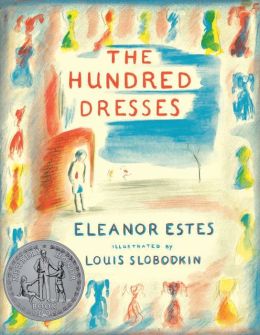
The Hundred Dresses

The Hundred Dresses. Eleanor Estes. Illustrated by Louis Slobodkin. 1944/2004. Houghton Mifflin Harcourt. 96 pages. [Source: Library]

First sentence: Today, Monday, Wanda Petronski was not in her seat. But nobody, not even Peggy and Madeline, the girls who started all the fun, noticed her absence. Usually Wanda sat in the next to the last seat in the last row in Room 13. She sat in the corner of the room where the rough boys who did not make good marks on their report cards sat; the corner of the room where there was more scuffling of feet, most roars of laughter when anything funny was said, and most mud and dirt on the floor.

Premise/plot: The heroine of Eleanor Estes' The Hundred Dresses is a young girl named Maddie. The book chronicles her awakening of conscience. Peggy and Maddie began "having fun" with Wanda Petronski several months before this chapter book opens. Fun. That's how Peggy sees it. And perhaps that's how Maddie viewed it the first few times. But lately Maddie has been thinking the "fun" they're having is wrong--is in fact unkind. But if she spoke up to Peggy, would Peggy listen to her and stop? Or would Peggy turn her back on her? Would Maddie lose her best friend?

"The fun" started when Wanda said she had a hundred dresses in her closet. Wanda--the girl who has worn the same dress every single day of the school year. Wanda--the girl with the funny last name. Wanda--the girl who lives on the wrong side of town. How could that Wanda really, truly have hundred dresses in her closet. She has to be lying, right?! If she's going to tell such a bold lie as that, is teasing her all that wrong?

Maddie comes to think it is. But her change of heart may be too late. Will Wanda ever know that Maddie is sorry for the way she's behaved?

My thoughts: I first read this one a few years ago. I think I love it even more now upon second reading. The book has a gentleness to it, but don't underestimate the power of meekness. This book has a message for young readers.

Wanda. By the time the book opens, Wanda has essentially already left school. We see her through Maddie's eyes--in a flashback of sorts. We see her through her artwork. We see her through her letter to the teacher. The impression I get of Wanda is that she's incredible, a girl worth knowing and befriending. For it seems that despite the teasing, she is willing to forgive. She's not angry. She's not bitter. She's not hateful. She's kind. Turning the other cheek, kind. The embodiment of the golden rule: "do unto others."

Maddie. This is a coming-of-age for Maddie. It is her character growth the book chronicles. Maddie was not "the instigator" of the bullying. She was a follower--a somewhat reluctant participant. But by the end of the book Maddie realizes that even observing "the fun" and standing by and doing nothing--saying nothing--is a wrongful act. Maddie realizes her own cowardice, her own weakness. She makes a resolution to change, to be a better person, to make amends, to never follow the crowd again, to always do what is right no matter what.

Peggy. This is the girl we know the least about. We know that she is one who first started teasing Wanda. But we don't know her heart--just her actions. Did she know it was wrong? Did she stop "the fun" only because Wanda moved away, or did she too experience a change of heart? I get the impression that she feels guilty, but not the impression that she's genuinely repentant and wanting to make amends. If Maddie wasn't so eager to make amends, would Peggy's guilty feeling last all that long? We just don't know. We can guess. But we can't know.

Have you read the Hundred Dresses? What did you think of it?!

© 2018 Becky Laney of Becky's Book Reviews

Wednesday, September 26, 2018

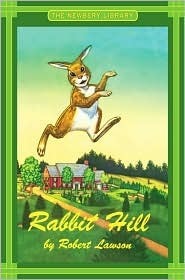
Rabbit Hill

Rabbit Hill. Robert Lawson. 1944. 127 pages. [Source: Library]

First sentence: All the Hill was boiling with excitement. On every side there rose a continual chattering and squeaking, whispering and whistling, as the Animals discussed the great news. Through it all could be heard again and again the words, "New Folks coming."

Premise/plot: Rabbit Hill is an animal fantasy novel that won the Newbery Medal in 1945. Little Georgie, one of the characters, is bringing news with him: NEW folks are moving in. Will the NEW folks be good or bad for the Hill? Will the animals lives be better for the change or worse? No doubt about it, times have been hard the past few years. But are good days ahead of them again? Little Georgie, unlike his mother, is prone to hope instead of worry.

The animal community is unbalanced. They depend on the humans--for gardens, for scraps, etc. But they also dread the humans--guns, traps, dogs. The animals are starving because there aren't any humans there to care for the land. But are humans the answer? 

My thoughts: It was a quick read. I will give it that. I'm not sure if I liked it. I didn't dislike it, mind you; my reaction wasn't that strong. The book introduces us to many characters. (My favorite character was Little Georgie. I felt no connection to the others, not really.) 

Overall, I found the book a bit on the boring side. I didn't want to find it boring. I wanted it to be a fabulous animal fantasy like Charlotte's Web. But at the very least it wasn't a Stuart Little!


© 2018 Becky Laney of Becky's Book Reviews

Wednesday, April 22, 2015

Green for Danger (1944)

Green for Danger. Christianna Brand. 1944. 256 pages. [Source: Bought]

Reading Green for Danger was like watching a soap opera--for better or worse. It definitely had its enjoyable moments now and then. But I can't say it was really a great fit for my reading taste. (Not that it was smutty. Just a lot of messy, oh-so-dramatic twists and turns, some of which related to their love lives.)

I wanted to read Green for Danger because it's a vintage mystery published during World War II. It is also set during the war and focused on the war. All of the characters--all of the suspects--work in a hospital. Readers get a behind the scenes look at war-time England. It had the potential to be quite good: fascinating even.

Was I disappointed? Yes and no. I would have liked more depth to the characterization with perhaps a tiny bit less drama. That being said, there was plenty of suspense and mystery. And looking back, there were plenty of clues throughout the book. It wasn't a great read for me, but, it wasn't all that bad either.

I also watched the movie adaptation of Green For Danger (1946). I found myself enjoying it more than the book. The plot is different from the book in some ways, but I thought it worked well. If you like watching mysteries, I'd definitely recommend it.

© 2015 Becky Laney of Becky's Book Reviews

Wednesday, March 25, 2015

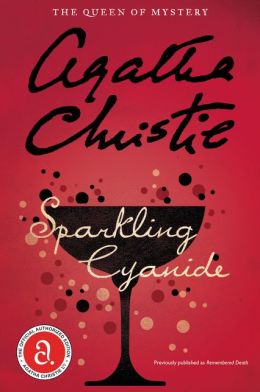
Sparkling Cyanide (1944)

Sparkling Cyanide. (Colonel Race #4) Agatha Christie. 1944/2002. HarperCollins. 288 pages. [Source: Bought]

It's been a while since I've last read Agatha Christie. Though this one did not star Hercule Poirot or Miss Marple, I ended up LOVING it. Though I should add that my 'favorite' Christie mystery is usually--though not always--one of the ones I've most recently read. It's not unusual for my 'favorite' to change frequently.

Rosemary Barton is the victim. That isn't a spoiler. She's been dead almost a whole year when the novel opens. Sparkling Cyanide is written from multiple perspectives: six, I believe. Readers know that one of the six could in fact be the murderer, or at the very least know the murderer and are keeping quiet.

One other thing. Rosemary Barton's death is officially a suicide. It was never taken on as a murder case. Until....

There is so much I CAN'T say about Sparkling Cyanide. I love reading mysteries. I do. Vintage mysteries especially. And Agatha Christie is one of my favorite authors to read. But I can't say I love reviewing mysteries. It's such a tricky thing to attempt. Because spoilers ruin mysteries more often than not. So, I'd definitely recommend Sparkling Cyanide. (It was originally titled Remembered Death in America.)


© 2015 Becky Laney of Becky's Book Reviews

Sunday, March 08, 2015

The 100 Dresses (1944)

The 100 Dresses. Eleanor Estes. Illustrated by Louis Slobodkin. 1944/2004. Houghton Mifflin Harcourt. 96 pages. [Source: Library]

Two girls learn a little bit about empathy in Eleanor Estes' classic story The 100 Dresses. Wanda Petronski wears the same dress day after day. For the record, it is always clean. But still the other kids in her class--particularly the girls--can't help teasing or bullying her. She has a "weird" last name; she always wears the same clothes; she talks about having a 100 dresses at home. Peggy and her good friend, Maddie, the heroine, started the "game" of teasing her. But Maddie and Peggy both realize the error of their way, Maddie especially. But will their change of heart come too late? Will they be able to tell Wanda how very sorry they are for how they've treated her? Will she forgive them?

I liked this one very much. I'd definitely recommend it. I enjoyed both the text and the illustrations.

Have you read The Hundred Dresses? What did you think?

© 2015 Becky Laney of Becky's Book Reviews

Wednesday, June 05, 2013

Detection Unlimited (1944)

Detection Unlimited. Georgette Heyer. 1944/2010. Sourcebooks. 378 pages.

This is the fourth Georgette Heyer mystery I've read. I really loved the first two I read: Why Shoot a Butler and Envious Casca. I had a few issues with Duplicate Death, though it wasn't awful. I enjoyed Detection Unlimited much more than Duplicate Death. But I still can't say that I loved it as much as Envious Casca and Why Shoot a Butler.

Inspector Hemingway is called to solve a murder case. The victim was VERY unpopular in his neighborhood. And there are plenty of likely suspects from all sorts of backgrounds. The neighborhood has more secrets than one might expect. Each suspect has a theory of who did it. And they're all most cooperative to point out why everyone else has a better motive and/or better opportunity. But the Inspector doesn't need each suspect to play detective as well!

Many scenarios are presented in this one, but the solving of the mystery is so sudden and rushed that I didn't find it satisfying.

© 2013 Becky Laney of Becky's Book Reviews

Friday, May 24, 2013

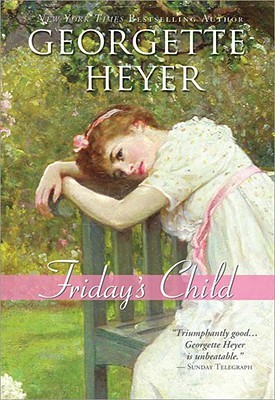
Friday's Child (1944)

Friday's Child. Georgette Heyer. 1944/2008. Sourcebooks. 425 pages.

When we first meet Lord Sherington* he is proposing to Miss Isabella Milborne. He marries a few chapters later, but, his wife is NOT Miss Milborne. After a brutal rejection, he decides to marry the first woman he sees. He happens across an old friend from childhood days, a Miss Hero Wantage. She is much younger than he is--just seventeen! But she's willing, more than willing, to be his wife. How did these two happen to meet? Well, she's running away from home! So Sherry and Hero set off together to London to arrange their marriage. He settles her into a hotel room, and, then begins to go about the necessary details of arranging a super-quick wedding!

Sherry wanted to marry so he could inherit now instead of later. At first he thinks his marriage won't really change anything at all in his daily life. But, of course, he was mistaken! Hero is completely clueless about how a proper young wife should behave, what things are socially acceptable and socially encouraged, and what things are NOT to be done. Hero absorbs everything, she's very observant but not exactly discerning. She's impulsive too! So if she wants to try something, she does!

Hero's closest friends are her husband's closest friends: Gil, Ferdy, and George. And they all adore "Kitten." In fact, sometimes they understand her better than her own husband. They are quicker to perceive things! They can "read" her better and sometimes they interfere in the marriage to help things run smoother. They often explain things to Sherry in such a way that he finally gets it. Sherry, however, feels that they interfere too much!

While Hero is aware of her feelings for Sherry, will her husband ever realize how he truly feels about his young wife?!

I enjoyed Friday's Child. It is not my absolute favorite Georgette Heyer regency, but, it is quite enjoyable!!! 

*Throughout the novel, he's simply "Viscount" or "Sherry"  or "Anthony"


© 2013 Becky Laney of Becky's Book Reviews

Wednesday, July 27, 2011

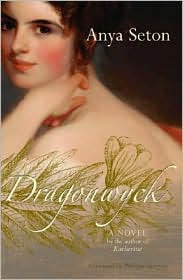
Dragonwyck

Dragonwyck. Anya Seton. 1944/2005. Chicago Review Press. 352 pages.

It was on an afternoon in May of 1844 that the letter came from Dragonwyck. 

Miranda Wells is the foolish heroine of Anya Seton's Dragonwyck. This farm girl has much to learn, and her trusting nature combined with her restlessness is just asking for trouble. The novel opens with Miranda being invited to visit her cousin, Nicholas, and his wife, Johanna, and their daughter, Katrine, in their home, Dragonwyck. Though cousins, the two have never met. For the Van Ryn's are quite wealthy, and the Wells are at best poor relations. But the couple appears--at first--to be looking for a companion for their daughter. Someone not quite a servant, but not quite a real guest either. The wealth and luxury of their lifestyle--especially in comparison to the only lifestyle she's ever known--life on a farm has Miranda thoroughly charmed. Everything that Nicholas says and does just wows her. He seems to be so perfectly, perfect. She just can't help herself, she finds herself falling for him. On her part, I do feel it's just silliness, with more innocence to it than real intent to break up a marriage. But the wife, well, she is unhappy and uncomfortable with Miranda being there. She didn't expect her to be so young, so beautiful, so ready to be charmed by her husband.

How does Nicholas feel about Miranda? How does Nicholas feel about his wife? his daughter? How does Nicholas feel about anyone else? Well. Readers can draw their own conclusions, perhaps. But needless to say, this reader was NOT charmed by Nicholas. He didn't seem all that swoon-worthy to me. And AFTER his wife's oh-so-convenient-death, well, my impressions changed even more--but not in his favor. A true romantic hero, in my opinion, would NEVER EVER propose marriage to a young woman while his dead wife was still in the room.

So do you think Miranda lives happily ever after with Nicholas?!

It's true I was never bored with Dragonwyck. But I also never found true satisfaction with it. Miranda was a frustrating heroine, to me, because she was just too stupid immature. She wasn't all that smart, and she wasn't all that good. (With goodness being a virtue.) There was very little to love in Miranda. That being said, I definitely felt something for her. I pitied her. Miranda's choices weren't all that smart. But NO WOMAN deserves to be treated the way she was treated. And I definitely wanted Miranda to be saved--to either save herself or to be rescued by some good soul. Nicholas. Well, what can I really say about him?! I didn't find him appealing at all. It was just so easy for me to hate him. His flaws are too many to even begin to list. And his strengths? Well, I can't think of any!

Have you read Dragonwyck? What did you think of it? Did you like it? love it? hate it? Do you think it's fair to compare it to Jane Eyre and Rebecca? I definitely see how Dragonwyck is a gothic romance.

Here's how Philippa Gregory's afterword begins, "At the very opening of this far-fetched, romantic novel, Anya Seton takes a great risk with her readers: she shows a foolish young woman reading a far-fetched, romantic novel and gently mocks both the genre and the readers."

Here's the part where I disagree with her:
Johanna is a wonderful thumbnail portrait of a woman whose death we are not going to mourn. Her greed, illustrated in the first moment we meet her when she demands to know if her husband has brought her pastries from town, is wonderfully described. Seeing Johanna, with crumbs on her gown and half-eaten dishes in her room, puts us neatly on the side of Nicholas and the guilty lovers. We are prepared for Johanna's death, and we don't mind when it happens.
By the time Nicholas comes to marry Miranda, Seton has so arranged our sympathies that we are as keen for the marriage to proceed as is Miranda. And so we forgive Nicholas for our suspicion of murder and Miranda for her desire for Nicholas and cupidity for his life. In addition, we agree with Miranda that the farm is a poor place. We forgive both Nicholas and Miranda because we are as bad as they. We don't mind that Johanna is dead, and we want to see Miranda live the high life. (339-340)
It is Nicholas who dominates the book, of course, and it is he who lingers in the mind after the book is finished. What a wonderfully gothic, nightmarish hero-villain he is! He is handsome and beautifully dressed; he is stylish and wealthy. He is absolutely exceptional, and we know this before he even enters the pages of the novel because Seton has the crowd murmur his name before he arrives. He delights us at once. He circumvents Miranda's father, which pleases us since we want to see her freed. He sweeps her away to his home, and his home is a wonder. We think, like Miranda, that he could be saved by true love. We despise his fat wife; we have hopes for his future. (341)
I don't only disagree with her a little, I disagree a LOT. (I might have exchanged a few words with the book.)

© 2011 Becky Laney of Becky's Book Reviews

Tuesday, March 23, 2010

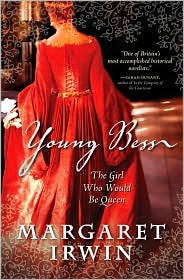
Young Bess


Young Bess by Margaret Irwin. 1944/2010. [March 2010] SourceBooks. 400 pages.

She had been allowed to come out to the royal flagship, and had been eating cherries and strawberries dipped in wine.

Young Bess follows the adventures and misadventures of the Tudor family. The title leads you to believe the focus is on Elizabeth and Elizabeth alone. But that isn't quite the case. It is the story of some rather turbulent years (well, most years were turbulent with the Tudors I've found!) in English history.

This book will see the death of King Henry VIII, Catherine Parr (the former Queen), Tom and Edward Seymour, and Edward VI. It stars the two Seymour brothers battling for power, a young Jane Grey, a young Elizabeth (of course), and a not-so-young Mary. Edward VI does enter into it a tiny bit. But not all that often, whether that's because he had little to do with his sisters and cousins or if he just didn't do much of anything, I don't know.

Did I like this one? Mostly. There were places where it was cleverly and amusingly written. Where it was just fun to read. There were also a few places where it was a bit boring. I did think it was well-written. And I do think fans of historical fiction will probably like it. Especially those who love to read anything and everything written about the Tudors.

There will be two others in this series.

© Becky Laney of Becky's Book Reviews