Showing posts with label 1958. Show all posts

Sunday, March 01, 2026

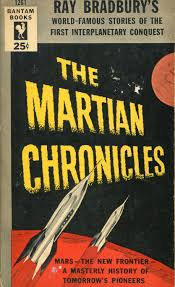
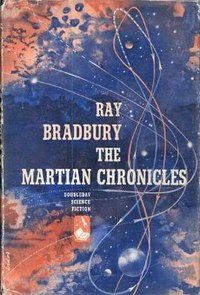
26. The Martian Chronicles


26. Martian Chronicles. Ray Bradbury. HarperCollins. 1958/2006 edition. 268 pages. [Source: Library] [5 stars, science fiction; short stories; classic; audiobook]

One minute it was Ohio winter, with doors closed, windows locked, the panes blind with frost, icicles fringing every roof, children skiing on slopes, housewives lumbering like great black bears in their furs, along the icy streets.
And then a long wave of warmth crossed the small town. A flooding sea of hart air; it seemed as if someone had left a bakery door open. The heat pulsed among the cottages and bushes and children. The icicles dropped, shattering, to melt. The doors flew open. The windows flew up. The children worked off their wool clothes. The housewives shed their bear disguises. The snow dissolved and showed last summer's ancient green lawns.
Rocket summer. The words passed among the people in the open, airing houses. Rocket summer. The warm desert air changing the frost patterns on the windows, erasing the art work. The skis and sleds suddenly useless. The snow, falling from the cold sky upon the town, turned to a hot rain before it touched the ground. Rocket summer. People leaned from their dripping porches and watched the reddening sky. (1)
ETA: I listened to The Martian Chronicles on audiobook. It is narrated by Scott Brick. It was an awesome audio book. I'm not surprised that Ray Bradbury's book makes such an excellent listen. His writing is SO good. AND his characters, plots, story twists, everything grabs your attention.


I LOVE, LOVE, LOVE Ray Bradbury's The Martian Chronicles. This is the second or third time (probably fourth) I've read this one. And each time I read it, I end up loving it even more. It's like each time I'm surprised by how much I love it. Like in between readings I forget how engaging and compelling it is. I settle into thinking that it was just me exaggerating things (again). That it couldn't possibly be that good. But no. It is that good.

The edition I read this time had twenty-seven stories; some of these 'stories' are just vignettes, or short preludes, transition pieces of a paragraph or two. But many are full-length stories. There are some great stories in this one.
  • January 2030 Rocket Summer
  • February 2030 Ylla
  • August 2030 The Summer Night
  • August 2030 The Earth Men
  • March 2031 The Taxpayer
  • April 2031 The Third Expedition
  • June 2032 --And the Moon Be Still as Bright
  • August 2032 The Settlers
  • December 2032 The Green Morning
  • February 2033 The Locusts
  • August 2033 Night Meeting
  • October 2033 The Shore
  • November 2033 The Fire Balloons
  • February 2034 Interim
  • April 2034 The Musicians
  • May 2034 The Wilderness
  • 2035-2036 The Naming of Names
  • April 2036 Usher II
  • August 2030 The Old Ones
  • September 2036 The Martian
  • November 2036 The Luggage Store
  • November 2036 The Off Season
  • November 2036 The Watchers
  • December 2036 The Silent Towns
  • April 2057 The Long Years
  • August 2057 There Will Come Soft Rains
  • October 2057 The Million Year Picnic
I wasn't aware that there were different editions of this one, and that the stories could vary depending on the edition. Also the dates have been modified (by thirty years) in some editions, like the edition I read this time around. The very, very newest edition has the original dates, 1999-2026. This newest edition does not have "The Fire Balloons." Also, instead of "The Wilderness" it has "Way in the Middle of the Air."

My thoughts on individual stories, and, first sentences from the stories

"Ylla"
They had a house of crystal pillars on the planet Mars by the edge of an empty sea, and every morning you could see Mrs. K eating the golden fruits that grew from the crystal walls, or cleaning the house with handfuls of magnetic dust which, taking all dirt with it, blew away on the hot wind.
A story told solely from the perspective of the Martians, in this case, a husband and wife. A husband has a very definite reaction to his wife's strange dreams. She dreams of a man, Nathaniel York, coming in a ship, in a rocket, and landing. The dream even tells her where and when. But her controlling and perhaps jealous husband has a way of dealing--for once and for all--with his wife's dreams.

"The Earth Men"
Whoever was knocking at the door didn't want to stop. Mrs. Ttt threw the door open. "Well?"
The story of the second expedition. Let's just say that the welcoming committee wasn't quite what they expected! First, NO ONE wanted to bother with them, then they were greeted by a strange assortment of Martians all claiming to be from Earth. And then....well, that wouldn't be polite of me to spoil it!
"The Third Expedition" (aka Mars is Heaven)
The ship came down from space. It came from the stars and the black velocities, and the shining movements, and the silent gulfs of space. It was a new ship; it had fire in its body and men in its metal cells, and it moved with a clean silence, fiery and warm. In it were seventeen men, including a captain. 
This one is a classic short story that you may have stumbled across in another context from The Martian Chronicles. (I've heard two radio adaptations, for example.) And the title is self-explanatory. It is the story of what happens when the third expedition lands. It is the story of what they see and  WHO they see. It is a story that stretches you, perhaps. But it's a good one!

"--And the Moon Be Still As Bright"
It was so cold when they first came from the rocket into the night that Spender began to gather the dry Martian wood and build a small fire. He didn't say anything about a celebration; he merely gathered the wood, set fire to it, and watched it burn.
And now we're on to the fourth expedition, the fourth rocket ship to successfully land on Mars. This time they manage to stay alive past the initial day or two or three. This is the story of what happens when one of the crew members, Spender, goes off on his own to learn the Martian culture, to explore the ruins, to explore the cities, to examine the artifacts and remnants of a culture that is gone with the wind. What happens next...well....there are a million reasons why readers shouldn't sympathize with Spender, but, like Captain Wilder, they may feel the pull all the same.


"The Settlers"
The men of Earth came to Mars. They came because they were afraid or unafraid, because they were happy or unhappy, because they felt like Pilgrims or did not feel like Pilgrims. There was a reason for each man. They were leaving bad wives or bad jobs or bad towns; they were coming to find something or leave something or get something, to dig up something or bury something or leave something alone. They were coming with small dreams or large dreams or none at all.
One of my favorite vignettes. For some reason it reminds me of John Steinbeck.

"Night Meeting"
Before going on up into the blue hills, Tomas Gomez stopped for gasoline at the lonely station.
There is something haunting and fantastical about this short story of a human and Martian meeting and not exactly seeing the same reality.

"The Fire Balloons"
Fire exploded over summer night lawns. 

 I first read "The Fire Balloons" in another collection of Ray Bradbury stories. I didn't, at the time, see it as being part of The Martian Chronicles. (And, in fact, it wasn't part of the edition I first read.) But now it is one of my favorite stories! In it two priests go to Mars as missionaries. One at least was expecting, was hoping, to meet Martians, to actually BE a missionary TO Martians, to an alien species. So when given the opportunity of going out into the hills and trying to communicate with blue balloon-like hovering creatures OR ministering to humans who have migrated to Mars, the answer is clear to Father Peregrine. But do the Martians need his church? This story has one of my favorite quotes:
"Father Peregrine, won't you ever be serious?"
"Not until the good Lord is. Oh, don't look so terribly shocked, please. The Lord is not serious. In fact, it is a little hard to know just what else He is except loving. And love has to do with humor, doesn't it? For you cannot love someone unless you put up with him, can you? And you cannot put up with someone constantly unless you can laugh at him. Isn't that true? And certainly we are ridiculous little animals wallowing in the fudge bowl, and God must love us all the more because we appeal to His humor."
 "The Wilderness"
Oh, the Good Time has come at last--
It was twilight and Janice and Leonora packed steadily in their summer house, singing songs, eating little, and holding to each other when necessary. But they never glanced at the window where the night gathered deep and the stars came out bright and cold.

This is another story that I ended up loving. And it was new-to-me too, it not being part of the original. But in this story we meet two women who are about to travel to Mars to get married and settle down. (The men having gone first.) The story likens exploring and settling Mars to exploring and settling the Old West (places like Wyoming, California, Oregon, etc.) It is about how the two handle their last night on Earth.
Is this how it was over a century ago, she wondered, when the women, the night before, lay ready for sleep, or not ready, in the small towns of the East, and heard the sound of horses in the night and the creak of the Conestoga wagons ready to go, and the brooding of oxen under the trees, and the cry of children already lonely before their time?...Is this then how it was so long ago? On the rim of the precipice, on the edge of the cliff of stars. In their time the smell of buffalo, and in our time the smell of the Rocket. Is then then how it was? And she decided, as sleep assumed the dreaming for her, that yes, yes indeed, very much so, irrevocably, this was as it had always been and would forever continue to be. 
"Usher II" (aka Carnival of Madness)
"During the whole of a dull, dark and soundless day in the autumn of the year, when the clouds hung oppressively low in the heavens, I had been passing alone on horseback, through a singularly dreary tract of country, and at length found myself, as the shades of evening drew on, within view of the melancholy House of Usher..." Mr. William Stendahl paused in his quotation. There, upon a low black hill, stood the house, its cornerstone bearing the inscription: 2036 A.D.

I remembered this as being one of the stories in A PLEASURE TO BURN, a Ray Bradbury collection celebrating the creative stories leading up to the writing/publishing of Fahrenheit 451. And it was first published as "Carnival of Madness." But it was also part of Ray Bradbury's book, The Martian Chronicles. And it is perhaps one of the most memorable of the collection. It is a true must read for anyone who loves Fahrenheit 451, for it continues on some of the same themes. I don't want to say too much about it really, because it shouldn't be spoiled at all if you want to get the full enjoyment of it!

"The Martian"
The blue mountains lifted into the rain and the rain fell down into the long canals and old LaFarge and his wife came out of their house to watch. 
An elderly couple have come to Mars and one night they are surprised by the appearance of their "son" (who died and was buried back on Earth). Their "son" doesn't want to leave the house, and is enjoying his family too much to risk getting "trapped" by going into the city and interacting with others. This story is creepy.


"The Luggage Store," "The Off Season," "The Watchers," "The Silent Towns," "The Long Years," "There Will Come Soft Rains," and "The Million Year Picnic."

These stories, I feel, work best as a sequence showing what happens both on Earth and Mars when the worst happens--atomic war on Earth. In "The Luggage Store," one speculates that his business will improve greatly if the war happens, if the worst happens. He feels that everyone will want to go back home to Earth to be with their loved ones, to find out if their loved ones are okay, to try to piece their society and civilization back together. In "The Off Season" readers learn that the war has started and the destruction has begun. There is nothing truly comical about it, but, it does happen to be told from the point of view of a man who has just opened a hot dog stand. "The Watchers" shows the people leaving Mars to return to Earth--for better or worse. "The Silent Towns" and "The Long Years" are two stories set on Mars. The first, "The Silent Towns" is told from the point of view of a man who chose to stay behind. He's lonely, but not THAT lonely it turns out. He does meet one woman who stayed behind, but, he decides that his own company is enough after all. "The Long Years" sees the return of Captain Wilder, I believe, who discovers a man and his family. There is a twist, however, which prevents this one from being a happy story. "There Will Come Soft Rains" is a very, very, very lonely story where we get a glimpse--just a small glimpse perhaps--of the desolation and destruction of life as we know it in at least one human city. We see the ending of an era, perhaps. There are no human characters in this one. "The Million Year Picnic" resonates even more when seen back-to-back with "There Will Come Soft Rains." In this story, readers meet a family: parents and sons who have come to Mars on their own private Rocket--a rocket that has been hidden away for many years, a rocket that has been saved for a true emergency. We meet a father who has prepared for THE END in a big, big way.

Read The Martian Chronicles
  • If you love science fiction
  • If you like science fiction
  • If you enjoy short stories; if you don't enjoy short stories
  • If you are a fan of Ray Bradbury
  • If you are a fan of the Twilight Zone


© 2026 Becky Laney of Becky's Book Reviews

Wednesday, June 05, 2024

51. Danny and the Homework Machine


Danny Dunn and the Homework Machine. Jay Williams and Raymond Abrashkin. 1958. 141 pages. [Source: Library]

First sentence: Danny Dunn bent over a strange device that hung from the ceiling of his bedroom, directly over his desk.

Premise/plot: Danny Dunn loves to learn, experiment, invent. He's driven by curiosity. However Danny Dunn and his friends--new and old--don't like doing homework. In this "vintage" children's book Danny programs the Professor's computer [large, bulky, not user-friendly computer] to do their homework. This requires a LOT of programming, a LOT of extra work. He first has to teach the computer and then has to teach himself and his friends how to use the computer. Danny is under the belief that he is saving time by using a computer. The adults may be getting amusement out of this realizing that extra homework is what it really is.

My thoughts: This book does not age well....for better or worse. On the one hand, I do think vintage books can give you a glimpse into the past, a time capsule if you will. In this book and in the previous Danny Dunn book I've read, it's a glimpse into how THEY in the 1950s thought the future would look like. The first book I read Danny Dunn was about space and space travel. This one was about computers. It can be amusing to see how those living in the past imagined the future playing out. On the other hand, Danny Dunn's life is so out of place--so dated. I have a hard time imagining kids today reading about this super-ancient "advanced" computer that is "oh so miraculous" and "amazing." The story, the dialogue, the characters don't really age well. As an adult I was amused yet not particularly entertained. 


© 2024 Becky Laney of Becky's Book Reviews

Tuesday, January 16, 2024

5. A Bear Called Paddington


A Bear Called Paddington. Michael Bond. 1958. 159 pages. [Source: Bought] [Children's classic; animal fantasy]

First sentence: Mr and Mrs Brown first met Paddington on a railway platform.

Premise/plot: Paddington Bear has travelled all the way from darkest Peru (with the blessing of his Aunt Lucy) as a stowaway. This adorable, homeless bear is adopted by the Brown family. Judy and Jonathan are the Brown children; Mrs Bird is the housekeeper. Adventures and misadventures are had: all the time, everywhere he goes. I would say he’s less mischievous than Curious George.

My thoughts: This one was first published in 1958. It easily could have been a part of my mom’s childhood—and its sequels. Mom recently rediscovered this first book at the library. She said I HAD to read it because it’s awesome. She regretted never reading it aloud to us when we were kids. It is a great book. Perhaps not quite as quotable as Pooh, but still quotable. I will definitely be recommending this one.

“It wasn’t so much that he didn’t like baths; he really didn’t mind being covered with jam and cream. It seemed a pity to wash it all off quite so soon.” (27)

“After a few seconds he decided quite definitely that he preferred riding on an escalator. They were nice and smooth. But lifts! To start with, it was full of people carrying parcels and all so busy they had not time to notice a small bear—one woman even rested her shopping bag on his head and seemed quite surprised when Paddington pushed it off. Then suddenly half of him seemed to fall away while the other half stayed where it was. Just as he had got used to that feeling the second half of him caught up again and even overtook the first half before the doors opened. It did that four times on the way down and Paddington was glad when the man in charge said it was the ground floor and Mrs Brown led him out.” (67-8)


© 2024 Becky Laney of Becky's Book Reviews

Friday, November 18, 2022

154. Mrs. Harris Goes to Paris (and Mrs. Harris Goes to New York)


Mrs. Harris Goes to Paris & Mrs. Harris Goes to New York. 1958/1959. Omnibus edition 2022. 320 pages. [Source: Library]

First sentence from Mrs. Harris Goes to Paris: The small, slender woman with apple-red cheeks, greying hair, and shrewd, almost naughty little eyes sat with her face pressed against the cabin window of the BEA Viscount on the morning flight from London to Paris.

First sentence from Mrs. Harris Goes to New York: Mrs Ada Harris and Mrs Violet Butterfield, of Numbers 5 and 9 Willis Gardens, Battersea, London, respectively, were having their nightly cup of tea in Mrs Harris's neat and flower-decorated little flat in the basement of number five.

Premise/plot: This is an omnibus edition of the first two Mrs. Harris novels by Paul Gallico. In the first book, Mrs Ada Harris (or Ada 'Arris) fixates on the dream of buying/owning a Dior dress. She saves for three years to earn enough money to travel to Paris and buy the dress. While she's spent years dreaming about this experience, she finds that she doesn't necessarily daydream about actually wearing the dress [herself.] In the second book, Mrs. Ada Harris and her friend Mrs Violet Butterfield travel to New York with Mr and Mrs Schreiber. She uses this opportunity to look for the [American] father of Henry Brown. She's convinced he'd be better off with his biological father instead of his foster [or adopted] parents the Gussets who are abusive. How hard could it be to find a man named George Brown living someone in the United States? So, naturally, of course, she kidnaps the child and sneaks him aboard the ship they're traveling on.

My thoughts: I watched two adaptations of the first book Mrs Harris Goes to Paris. It is a charming SHORT novel [or novella]. Mrs Harris is a super-lovable busy-body. She's like everyone's fairy godmother--of sorts. Just by being her lovable, caring self, she improves the lives of those around her. Her beauty comes from within, and she brightens up the lives of those she knows [and interacts with]. The novel does differ from both adaptations of the novel. Neither movie has the book ending. 

The second novel is quite a bit longer than the first one. The focus is on Mrs Harris' search for the young Henry's father. She has better luck finding and buying the perfect dress [named Temptation] than she does tracking down the boy's biological father. And when the boy's father is found--no thanks to Mrs Harris' meddling or searching, it's an absolute disaster. The happy-ish ending is no thanks to Mrs Harris, not really. Mr. Schreiber is the one who saves the day. For me, the book was entirely MEH.


© 2022 Becky Laney of Becky's Book Reviews

Thursday, March 03, 2022

33. The Naked Sun


The Naked Sun. (Robot #2) Isaac Asimov. 1958. 271 pages. [Source: Library]

First sentence: Stubbornly Elijah Baley fought panic. For two weeks it had been building up. Longer than that, even. It had been building up ever since they had called him to Washington and there calmly told him he was being reassigned.

Premise/plot: The Naked Sun is the second Robot novel starring detectives Elijah Baley and R. Daneel Olivaw. The Caves of Steel was a mystery detective novel set on a futuristic Earth. The Naked Sun has this pair traveling to the planet Solaria. The pair have been requested to come solve a murder.

My thoughts: I LOVED, LOVED, LOVED, LOVED this one. It is science fiction AND a murder mystery. I appreciated the world-building of the Outer Colony Solaria. Though the original colonists were from Earth--way, way, way, way, way back when--the culture and society is night and day different. And it isn't only because the proportion of humans to robots is so large...

You see, the Solarians have evolved into a culture where you never actually SEE or interact (physically) with another human being. Marriages are arranged, but duty-driven, somewhat distasteful, practically repulsive. A husband and wife may live on the same estate, but never actually see each other face-to-face for weeks or even months at a time. All Solarians find SEEING distasteful and "wrong." Solarians, well, they've evolved into a culture that VIEWS. One uses technology to VIEW one another. All relationships are maintained through viewing. Viewing has COMPLETELY different rules (or protocols) than seeing.

If humans absolutely *have* to be in the same physical room, then it's polite to stand twenty feet (or so) away.

Quotes:

Gruer said, "No, I cannot say the murderer is completely unknown. In fact, there is only one person that can possibly have done the deed." "Are you sure you don't mean only one person who is likely to have done the deed?" Baley distrusted overstatement and had no liking for the armchair deducer who discovered certainty rather than probability in the workings of logic. But Gruer shook his bald head. "No. Only one possible person. Anyone else is impossible. Completely impossible." "Completely?" "I assure you." "Then you have no problem." "On the contrary. We do have a problem. That one person couldn't have done it either." Baley said calmly, "Then no one did it." "Yet the deed was done. Rikaine Delmarre is dead." 

"You said something about interviewing people face to -----" He shook his head, his tongue dabbing quickly at his lips. "I would rather not say it. I think you know what I mean. The phrase conjured up the most striking picture of the two of us breathing--breathing one another's breath." The Solarian shuddered. "Don't you find that repulsive?" "I don't know that I've thought it so." "It seems so filthy a habit. And as you said it and the picture rose in my mind, I realized that after all we were in the same room and even though I was not facing you, puffs of air that had been in your lungs must be reaching me and entering mine. With my sensitive frame of mind---"

Anything could be found in figures if the search were long enough and hard enough and if the proper pieces of information wre ignored or overlooked.


© 2022 Becky Laney of Becky's Book Reviews

Tuesday, February 01, 2022

17. Exodus


Exodus. Leon Uris. 1958. 610 pages. [Source: Library]

First sentence: The airplane plip-plopped down the runway to a halt before the big sign: WELCOME TO CYPRUS.

Don't read Exodus expecting a grand, sweeping love story between a man and a woman. It is not a romance. I didn't go into it thinking it was a romance, but, at the same time you could isolate a few chapters here and there and get the wrong impression. I have--as of the writing of this review--not seen the film adaptation. I don't know if the movie portrays it as a great romance or not. 

The novel focuses on the birth of the nation of Israel in the twentieth century. While there are plenty of flashbacks (and more flashbacks) most of the action occurs 1946-1948. The nation of Israel is without a doubt the main character. Probably. I suppose one could argue that the main character is collectively speaking the Jewish people. This novel is ALL ABOUT the conflict. The opposing views, the ongoing struggles that surround the 'birth' of Israel. We get glimpses from all viewpoints.

Of course, there are a few (human) main characters. Kitty Fremont, an American nurse who only reluctantly goes to Palestine, is one of the main characters. At the beginning, she is a bit clueless. Why would any Jewish person--she wonders--choose to go to Palestine and 'rough it' in that country where they are not wanted when they could settle in America (for example) and have an 'easy' time of it. Why struggle in a harsh land where you both men and women will have to fight, fight, fight, fight, and fight some more to stay? She doesn't get the appeal of Palestine for the Jews. Of course, at the beginning, she still sees Jews as "other" or odd. She feels saddened and sympathetic to the plight of Jews after learning of the Holocaust, but she doesn't particularly like or understand. I'd describe her as sympathetic from a distance. But she finds herself thrown right in the middle. She meets a young Jewish teen, Karen, and there is an instant bond (at least on her side). Karen becomes her family--unofficially. She dreams of wooing Karen away from her hopes and dreams of settling in Palestine and settling down with Karen back in America. She only goes (or mainly goes) to Palestine because she is following Karen.

Of course, that's only half the equation. Kitty Fremont is also oddly enamored with Ari Ben Canaan. She would never in a hundred million years say "I have a crush on Ari Ben Canaan." But she finds him mesmerizing to a certain degree. And it is mutual. She isn't his ideal either--far from it. She's an American woman whose values, beliefs, and culture are so removed from his own. But they find themselves circling each other, reluctant to admit perhaps that there is something going on...

But this is not a romance. I repeat, not a romance. Don't pick this one up thinking Kitty and Ari have this GREAT love affair. It is politics and war; war and politics.

It is about a nation and the people who are willing to give their all--even their very lives--to see her come into being and thrive.


© 2022 Becky Laney of Becky's Book Reviews

Friday, May 01, 2020

62. The Martian Chronicles

Martian Chronicles. Ray Bradbury. HarperCollins. 1958/2006 edition. 268 pages. [Source: Library] [science fiction; short stories; classic]

One minute it was Ohio winter, with doors closed, windows locked, the panes blind with frost, icicles fringing every roof, children skiing on slopes, housewives lumbering like great black bears in their furs, along the icy streets.
And then a long wave of warmth crossed the small town. A flooding sea of hart air; it seemed as if someone had left a bakery door open. The heat pulsed among the cottages and bushes and children. The icicles dropped, shattering, to melt. The doors flew open. The windows flew up. The children worked off their wool clothes. The housewives shed their bear disguises. The snow dissolved and showed last summer's ancient green lawns.
Rocket summer. The words passed among the people in the open, airing houses. Rocket summer. The warm desert air changing the frost patterns on the windows, erasing the art work. The skis and sleds suddenly useless. The snow, falling from the cold sky upon the town, turned to a hot rain before it touched the ground. Rocket summer. People leaned from their dripping porches and watched the reddening sky. (1)
I LOVE, LOVE, LOVE Ray Bradbury's The Martian Chronicles. This is the second or third time (probably fourth) I've read this one. And each time I read it, I end up loving it even more. It's like each time I'm surprised by how much I love it. Like in between readings I forget how engaging and compelling it is. I settle into thinking that it was just me exaggerating things (again). That it couldn't possibly be that good. But no. It is that good.

The edition I read this time had twenty-seven stories; some of these 'stories' are just vignettes, or short preludes, transition pieces of a paragraph or two. But many are full-length stories. There are some great stories in this one.
  • January 2030 Rocket Summer
  • February 2030 Ylla
  • August 2030 The Summer Night
  • August 2030 The Earth Men
  • March 2031 The Taxpayer
  • April 2031 The Third Expedition
  • June 2032 --And the Moon Be Still as Bright
  • August 2032 The Settlers
  • December 2032 The Green Morning
  • February 2033 The Locusts
  • August 2033 Night Meeting
  • October 2033 The Shore
  • November 2033 The Fire Balloons
  • February 2034 Interim
  • April 2034 The Musicians
  • May 2034 The Wilderness
  • 2035-2036 The Naming of Names
  • April 2036 Usher II
  • August 2030 The Old Ones
  • September 2036 The Martian
  • November 2036 The Luggage Store
  • November 2036 The Off Season
  • November 2036 The Watchers
  • December 2036 The Silent Towns
  • April 2057 The Long Years
  • August 2057 There Will Come Soft Rains
  • October 2057 The Million Year Picnic
1950 edition of The Martian Chronicles
I wasn't aware that there were different editions of this one, and that the stories could vary depending on the edition. Also the dates have been modified (by thirty years) in some editions, like the edition I read this time around. The very, very newest edition has the original dates, 1999-2026. This newest edition does not have "The Fire Balloons." Also, instead of "The Wilderness" it has "Way in the Middle of the Air."

My thoughts on individual stories, and, first sentences from the stories

"Ylla"
They had a house of crystal pillars on the planet Mars by the edge of an empty sea, and every morning you could see Mrs. K eating the golden fruits that grew from the crystal walls, or cleaning the house with handfuls of magnetic dust which, taking all dirt with it, blew away on the hot wind.
A story told solely from the perspective of the Martians, in this case, a husband and wife. A husband has a very definite reaction to his wife's strange dreams. She dreams of a man, Nathaniel York, coming in a ship, in a rocket, and landing. The dream even tells her where and when. But her controlling and perhaps jealous husband has a way of dealing--for once and for all--with his wife's dreams.

"The Earth Men"
Whoever was knocking at the door didn't want to stop. Mrs. Ttt threw the door open. "Well?"
The story of the second expedition. Let's just say that the welcoming committee wasn't quite what they expected! First, NO ONE wanted to bother with them, then they were greeted by a strange assortment of Martians all claiming to be from Earth. And then....well, that wouldn't be polite of me to spoil it!


"The Third Expedition" (aka Mars is Heaven)
The ship came down from space. It came from the stars and the black velocities, and the shining movements, and the silent gulfs of space. It was a new ship; it had fire in its body and men in its metal cells, and it moved with a clean silence, fiery and warm. In it were seventeen men, including a captain. 
This one is a classic short story that you may have stumbled across in another context from The Martian Chronicles. (I've heard two radio adaptations, for example.) And the title is self-explanatory. It is the story of what happens when the third expedition lands. It is the story of what they see and  WHO they see. It is a story that stretches you, perhaps. But it's a good one!

"--And the Moon Be Still As Bright"
It was so cold when they first came from the rocket into the night that Spender began to gather the dry Martian wood and build a small fire. He didn't say anything about a celebration; he merely gathered the wood, set fire to it, and watched it burn.
And now we're on to the fourth expedition, the fourth rocket ship to successfully land on Mars. This time they manage to stay alive past the initial day or two or three. This is the story of what happens when one of the crew members, Spender, goes off on his own to learn the Martian culture, to explore the ruins, to explore the cities, to examine the artifacts and remnants of a culture that is gone with the wind. What happens next...well....there are a million reasons why readers shouldn't sympathize with Spender, but, like Captain Wilder, they may feel the pull all the same.

"The Settlers"
The men of Earth came to Mars. They came because they were afraid or unafraid, because they were happy or unhappy, because they felt like Pilgrims or did not feel like Pilgrims. There was a reason for each man. They were leaving bad wives or bad jobs or bad towns; they were coming to find something or leave something or get something, to dig up something or bury something or leave something alone. They were coming with small dreams or large dreams or none at all.
One of my favorite vignettes. For some reason it reminds me of John Steinbeck.

"Night Meeting"
Before going on up into the blue hills, Tomas Gomez stopped for gasoline at the lonely station.
There is something haunting and fantastical about this short story of a human and Martian meeting and not exactly seeing the same reality.

"The Fire Balloons"
Fire exploded over summer night lawns. 
 I first read "The Fire Balloons" in another collection of Ray Bradbury stories. I didn't, at the time, see it as being part of The Martian Chronicles. (And, in fact, it wasn't part of the edition I first read.) But now it is one of my favorite stories! In it two priests go to Mars as missionaries. One at least was expecting, was hoping, to meet Martians, to actually BE a missionary TO Martians, to an alien species. So when given the opportunity of going out into the hills and trying to communicate with blue balloon-like hovering creatures OR ministering to humans who have migrated to Mars, the answer is clear to Father Peregrine. But do the Martians need his church? This story has one of my favorite quotes:
"Father Peregrine, won't you ever be serious?"
"Not until the good Lord is. Oh, don't look so terribly shocked, please. The Lord is not serious. In fact, it is a little hard to know just what else He is except loving. And love has to do with humor, doesn't it? For you cannot love someone unless you put up with him, can you? And you cannot put up with someone constantly unless you can laugh at him. Isn't that true? And certainly we are ridiculous little animals wallowing in the fudge bowl, and God must love us all the more because we appeal to His humor."
 "The Wilderness"
Oh, the Good Time has come at last--
It was twilight and Janice and Leonora packed steadily in their summer house, singing songs, eating little, and holding to each other when necessary. But they never glanced at the window where the night gathered deep and the stars came out bright and cold.
This is another story that I ended up loving. And it was new-to-me too, it not being part of the original. But in this story we meet two women who are about to travel to Mars to get married and settle down. (The men having gone first.) The story likens exploring and settling Mars to exploring and settling the Old West (places like Wyoming, California, Oregon, etc.) It is about how the two handle their last night on Earth.
Is this how it was over a century ago, she wondered, when the women, the night before, lay ready for sleep, or not ready, in the small towns of the East, and heard the sound of horses in the night and the creak of the Conestoga wagons ready to go, and the brooding of oxen under the trees, and the cry of children already lonely before their time?...Is this then how it was so long ago? On the rim of the precipice, on the edge of the cliff of stars. In their time the smell of buffalo, and in our time the smell of the Rocket. Is then then how it was? And she decided, as sleep assumed the dreaming for her, that yes, yes indeed, very much so, irrevocably, this was as it had always been and would forever continue to be. 
"Usher II" (aka Carnival of Madness)
"During the whole of a dull, dark and soundless day in the autumn of the year, when the clouds hung oppressively low in the heavens, I had been passing alone on horseback, through a singularly dreary tract of country, and at length found myself, as the shades of evening drew on, within view of the melancholy House of Usher..." Mr. William Stendahl paused in his quotation. There, upon a low black hill, stood the house, its cornerstone bearing the inscription: 2036 A.D.
I remembered this as being one of the stories in A PLEASURE TO BURN, a Ray Bradbury collection celebrating the creative stories leading up to the writing/publishing of Fahrenheit 451. And it was first published as "Carnival of Madness." But it was also part of Ray Bradbury's book, The Martian Chronicles. And it is perhaps one of the most memorable of the collection. It is a true must read for anyone who loves Fahrenheit 451, for it continues on some of the same themes. I don't want to say too much about it really, because it shouldn't be spoiled at all if you want to get the full enjoyment of it!

"The Martian"
The blue mountains lifted into the rain and the rain fell down into the long canals and old LaFarge and his wife came out of their house to watch. 
An elderly couple have come to Mars and one night they are surprised by the appearance of their "son" (who died and was buried back on Earth). Their "son" doesn't want to leave the house, and is enjoying his family too much to risk getting "trapped" by going into the city and interacting with others. This story is creepy.

"The Luggage Store," "The Off Season," "The Watchers," "The Silent Towns," "The Long Years," "There Will Come Soft Rains," and "The Million Year Picnic."

These stories, I feel, work best as a sequence showing what happens both on Earth and Mars when the worst happens--atomic war on Earth. In "The Luggage Store," one speculates that his business will improve greatly if the war happens, if the worst happens. He feels that everyone will want to go back home to Earth to be with their loved ones, to find out if their loved ones are okay, to try to piece their society and civilization back together. In "The Off Season" readers learn that the war has started and the destruction has begun. There is nothing truly comical about it, but, it does happen to be told from the point of view of a man who has just opened a hot dog stand. "The Watchers" shows the people leaving Mars to return to Earth--for better or worse. "The Silent Towns" and "The Long Years" are two stories set on Mars. The first, "The Silent Towns" is told from the point of view of a man who chose to stay behind. He's lonely, but not THAT lonely it turns out. He does meet one woman who stayed behind, but, he decides that his own company is enough after all. "The Long Years" sees the return of Captain Wilder, I believe, who discovers a man and his family. There is a twist, however, which prevents this one from being a happy story. "There Will Come Soft Rains" is a very, very, very lonely story where we get a glimpse--just a small glimpse perhaps--of the desolation and destruction of life as we know it in at least one human city. We see the ending of an era, perhaps. There are no human characters in this one. "The Million Year Picnic" resonates even more when seen back-to-back with "There Will Come Soft Rains." In this story, readers meet a family: parents and sons who have come to Mars on their own private Rocket--a rocket that has been hidden away for many years, a rocket that has been saved for a true emergency. We meet a father who has prepared for THE END in a big, big way.

Read The Martian Chronicles
  • If you love science fiction
  • If you like science fiction
  • If you enjoy short stories; if you don't enjoy short stories
  • If you are a fan of Ray Bradbury
  • If you are a fan of the Twilight Zone


© 2020 Becky Laney of Becky's Book Reviews

Monday, February 25, 2019

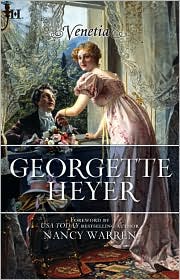
Venetia

Venetia. Georgette Heyer. 1958/2009. Harlequin. 368 pages. [Source: Gift]

First sentence: "A fox got in amongst the hens last night, and ravished our best layer," remarked Miss Lanyon. "A great-grandmother, too! You'd think he would be ashamed!" Receiving no answer, she continued in an altered voice: "Indeed, you would! It is a great deal too bad. What is to be done?"

Premise/plot: Venetia is a woman (25) living with her younger brother, Aubrey (17), and being courted by two equally unsatisfying gentlemen of the neighborhood, Edward Yardley and Oswald Denny. The Lanyon siblings do have an older brother, Conway. But he is in the army, and he hasn't been at Undershaw in years. Venetia and Aubrey do not miss him at all. Life is fairly routine for the two. Until. Lord Damerel ("The Wicked Baron") returns to his estate.

The two meet when she is trespassing on his land. He has no idea who she is. But she has a fairly good idea who he is. Especially after he kisses her! Yes, he kisses her.
"Who are you?" he demanded abruptly. "I took you for a village maiden--probably one of my tenants."
"Did you indeed? Well, if that is the way you mean to conduct yourself amongst the village maidens you won't win much liking here!"
"No, no, the danger is that I might win too much!" he retorted. "Who are you? Or should I first present myself to you? I'm Damerel, you know."
"Yes, so I supposed, at the outset of our delightful acquaintance. Later, of course, I was sure of it."
"Oh, oh--! My reputation, Iago, my reputation!" he exclaimed laughing again. "Fair Fatality, you are the most unusual female I have encountered in all my thirty-eight years!"
"You can't think how deeply flattered I am!" she assured him. "I daresay my head would be quite turned if I didn't suspect that amongst so many a dozen or so may have slipped from your memory."
"More like a hundred! Am I never to learn your name? I shall, you know, whether you tell me or no!" (33)
He intends to know her better while he's in the neighborhood. Venetia doesn't need a Lady Denny to tell her that would be unwise. But. When her brother, Aubrey, has a riding accident and is saved by none other than Damerel...well, she can't help getting to know him much, much better. And soon they become great friends. Of course, it's a friendship with always a hint of something more...

Lord Damerel isn't the only newcomer to the neighborhood. Soon Venetia and Aubrey welcome TWO very unexpected house guests. Conway has gotten married--her name is Charlotte. And Charlotte and her mother have come to stay at Undershaw. And the mother is quite the character. How long can Venetia stand to share a home with such a woman? Venetia begins to think about her options...and wishing it was more socially acceptable for her to set up her own home.

My thoughts: I love, love, LOVE Venetia. It is without a doubt my favorite Georgette Heyer novel--at least until I read my next. There are a handful that I do love and adore. But I can never quite forget how magical Venetia is. I love all the characters in this one--the major characters (Lord Damerel, Venetia), the minor characters (Aubrey, Edward Yardley, Oswald Denny, Charlotte, Mrs. Scorrier, etc.) I love the dialogue. I love the story. Venetia IS not your typical heroine--is not Heyer's typical heroine. Lord Damerel may be a somewhat typical rake in the romance genre BUT Venetia keeps him on his toes. They are well paired, well matched. 

He laughed out at that, flinging back his head in wholehearted enjoyment, gasping, "why, oh why did I never know you until now?"
"It does seem a pity," she agreed. "I have been thinking so myself, for I always wished for a friend to laugh with."
"To laugh with!" he repeated slowly.
"Perhaps you have friends already who laugh when you do," she said diffidently. "I haven't, and it's important, I think--more important than sympathy in affliction, which you might easily find in someone you positively disliked."
"But to share a sense of the ridiculous prohibits dislike--yes, that's true. And rare! My God, how rare! Do they stare at you, our worthy neighbors, when you laugh?"
"Yes! Or ask me what I mean when I'm joking!" She glanced at the clock above the empty fireplace. "I must go." (64)
"Oh, no, nothing of that nature!" she replied, getting up.
"I allow you all the vices you choose to claim--indeed, I know you for a gamester, and a shocking rake, and a man of sadly unsteady character!--but I'm not so green that I don't recognize in you one virtue at least, and one quality."
"What is that all? How disappointing! What are they?"
"A well-informed mind, and a great deal of kindness," she said, laying her hand on his arm, and beginning to stroll with him back to the house. (99)


© 2019 Becky Laney of Becky's Book Reviews

Tuesday, July 24, 2018

Singing in the Shrouds

Singing in the Shrouds. Ngaio Marsh. 1958. 240 pages. [Source: Bought]

First sentence: In the Pool of London and farther east all through the dockyards the fog lay heavy. Lights swam like moons in their own halos. Insignificant buildings, being simplified, became dramatic.

Premise/plot: Singing in the Shrouds is the twentieth novel in Ngaio Marsh's Inspector Alleyn mystery series. Cape Farewell is about to steam out to sea when a body is discovered near the docks. It is believed that the murderer is a passenger on the ship. Inspector Alleyn joins the ship--in disguise--the next day. He not only wants to find the murderer--who has already struck three times--but to prevent another murder from occurring. This serial killer is striking every ten days. And the voyage is much longer than ten days! Can Alleyn discover the murderer among the passengers without being discovered himself?

My thoughts: I am loving Ngaio Marsh. I am. I can't believe it's taken me so long to get to her mystery novels. I enjoyed getting to know the passengers. There were some interesting characters among them--some prove Alleyn's great allies. One of the passengers was a 1950s version of Jerry Springer--a television personality of a reality talk show where guests bring him their personal troubles. 
When it comes to separating the easygoing from the exacting passenger, stewards are not easily deceived. But Dennis had been taken in by Mr. Merryman. The spectacles, the rumpled hair and cherubic countenance had led him to diagnose absence of mind, benevolence and timidity. He was bitterly disappointed when Mr. Merryman now gave unmistakable signs of being a Holy Terror. (24)
It's the greatest mistake to think that jealousy is necessarily a fault. On the contrary, it may very well sharpen the perception. (54)
'Alibis,' Mr. Merryman said grandly, 'are in the same category as statistics: in the last analysis they prove nothing.' (85)
© 2018 Becky Laney of Becky's Book Reviews

Thursday, May 24, 2018

The Three Edwards

The Three Edwards (The Plantagenets #3) Thomas B. Costain. 1958. 480 pages. [Source: Library]
First sentence: The Crusades were running down like an unwound clock.

Premise/plot: The Three Edwards is the third volume in the nonfiction series by Thomas B. Costain on the Plantagenets. It covers the reigns of Edward I, Edward II, and Edward III. It covers the politics, the wars, and the personal dramas. It highlights various men and women who were influential during these years. 

Except perhaps for the reign of Edward II--that had its own dramas and conflicts--much of the book is spent on wars at home and abroad. Wars with Scotland and Wales. Wars with France.

My thoughts: I enjoyed this one--for the most part. My interest in specific battles is low I admit. I have no interest in battle tactics, etc. But there was also plenty of personal drama: wives and husbands, fathers and sons, and daughters being used as bargaining tools. Costain does a good job of presenting the strengths and weaknesses of each Edward. No person is solely good or evil. Holding onto power can be tricky, and power can go to one's head and corrupt.  

Other books in the series: The first volume is The Conquering Family. The second volume is The Magnificent Century.

© 2018 Becky Laney of Becky's Book Reviews

Monday, June 05, 2017

Champagne for One

Champagne for One. Rex Stout. 1958. 205 pages. [Source: Bought]

First sentence: If it hadn't been raining and blowing that raw Tuesday morning in March I would have been out, walking to the bank to deposit a couple of checks, when Austin Byne phoned me, and he might have tried somebody else. But more likely not. He would probably have rung again later, so I can't blame all this on the weather.

Premise/plot: When Austin Byne calls Archie Goodwin asking him for a favor, to fill in for him at a charity event, Archie says yes. As a consequence, when a young woman, Faith Usher, dies at the event, Goodwin was there to testify to one thing with all certainty--it was not suicide, but murder. He had been warned that she had cyanide in her purse, so he was watching her and her purse all evening long. The police are unconvinced, especially at first, but they've learned not to rush things when Nero Wolfe is involved. Can Nero Wolfe and company (Archie, Saul, etc.) solve the case?! Who killed Faith and why?!

My thoughts: I ADORE Nero Wolfe and Archie Goodwin. This was a reread for me. And before I reread it, I watched the adaptation of it. But even knowing all the details before picking it up, I have to say it is a fabulous read still.

"Archie." "Yes, sir." "Do I ever intrude in your private affairs?" "Yes, sir. Frequently. But you think you don't, so go right ahead." (11)
I'll try to be fair to him, and I know there is no law against a man having plucked eyebrows and a thin mustache and long polished nails, and my suspicion that he wore a girdle was merely a suspicion, and if he had married Mrs. Albert Grantham for her money I freely admit that no man marries without a reason and with her it would have been next to impossible to think up another one, and I concede that he may have had hidden virtues which I had missed. (18)
"I must apologize for that crack about salary. I forgot you were listening." He grunted. "Your memory is excellent and you shouldn't disparage it. What does that man want of me?" I covered a yawn. "Search me. If I had had some sleep I might risk a guess, but it's all I can do to get enough oxygen for my lungs so my brain's doing without... (60)
"You don't make it any easier, Wolfe." "I don't pretend to make things easier. I only make them manageable--when I can." (63)
 As I entered, my wristwatch said 4:12. Between then and a quarter past six, slightly over two hours, I ate five pieces of pie, two rhubarb and one each of apple, green tomato, and chocolate, and drank four glasses of milk and two cups of coffee, while seated at a table by the front window, from which I could see the entrance to 87, across the street and up a few doors. To keep from arousing curiosity by either my tenure or my diet, I had my notebook and pencil out and made sketches of a cat sleeping on a chair. In the Village that accounts for anything. (155)
"Do you know what a genius is? A genius is a guy who makes things happen without his having any idea that they are going to happen. It's quite a trick." (159)


© 2017 Becky Laney of Becky's Book Reviews

Sunday, February 05, 2017

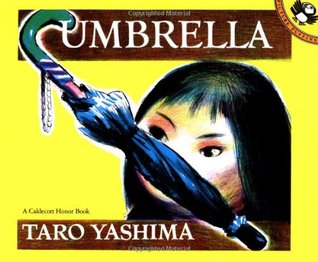
Umbrella

Umbrella. Taro Yashima. 1958/1977. 40 pages. [Source: Bought]

First sentence: Momo is the name of a little girl who was born in New York.

Premise/plot: Momo received two gifts for her third birthday: red rubber boots and an umbrella. She loves, loves, loves her presents and she wants to use them right away! But of course it is not raining! Momo reluctantly waits and waits for the rain to come. One day it does!

Favorite quotes:
On the umbrella, raindrops made a wonderful music she never had heard before--
Bon polo
Bon polo
Ponpolo ponpolo
Ponpolo ponpolo
Bolo bolo ponpolo
Bolo bolo ponpolo
Boto boto ponpolo
Boto boto ponpolo
My thoughts: Whenever I'm asked what my favorite picture book from childhood is, I know exactly how to answer! Umbrella! I love, love, love the rhythm of it. The illustrations are amazing! I think I judge all other books by this one!

Text: 5 out of 5
Illustrations: 5 out of 5
Total: 10 out of 10

© 2017 Becky Laney of Becky's Book Reviews

Saturday, June 11, 2016

Best In Children's Books, Volume 6

Best In Children's Books. Volume 6. 1958. Nelson Doubleday. 160 pages. [Source: Bought]

Let's go vintage! This title is the sixth volume in a long series of books called Best in Children's Books. It was published in 1958 by Nelson Doubleday. It blends fiction and nonfiction, prose and poetry. It has many contributing authors and illustrators.

The Story of Early America by Donald Culross Peattie, illustrated by Leonard Weisgard. This is an excerpt from A Child's Story of the World (1937). Honestly, I think I enjoyed the illustrations more than the text. Readers should know two things 1) These two chapters do not hold up to the test of time. They didn't age gracefully, in other words. 2) They contain passages with the potential to offend in varying degrees.

When Columbus landed, some naked red men on the shore ran away. After a while their childish curiosity got the better of them, and they came stealing out to meet the newcomers. (10)
He saw that these people were much more simple-minded than criminals from the jails of Spain. (11)
They were so evidently savages, and not the rich, civilized people that he expected to meet in India. So he called these men Indians, and so they have been called ever since, though of course our redskins have nothing to do with the real people of India. (11)
So the Spanish, Portuguese, and English sent ships to Africa to capture the jungle Negroes. They were thrown into boats and brought to America. The Negroes had powerful bodies. They did not mind the intense heat. They were afraid of the white men, and knew that they could never escape back across the sea. So they bent their backs to the hard labor and tried to be cheerful. They made good slaves. (23)
In the northern states slavery soon died out. One reason for this was that, in the North, factories and not farming were the important way of making money. Intelligent men were needed to work in factories. The Negroes, fresh from jungle life, were not ready for such work. But in the South, where tobacco, cotton, and rice were rich crops which all the world was clamoring to buy, the Negro slave could work better than the free white man. He did not have to use his head, but only his muscles. (31-2)
The Very Little Girl (1953) is by Phyllis Krasilovsky and illustrated by Ninon. This is a charming, delightful, very unoffensive little piece about a little girl who slowly but surely finds herself growing up.

The Elephant's Child (1900) by Rudyard Kipling. Illustrated by Henry C. Pitz. I LOVE, LOVE, LOVE, LOVE, LOVE, LOVE, LOVE this one. This is probably one of the main reasons I bought this book. In this story, readers learn about how the elephant got his trunk. A lot of spanking is involved! And the Elephant's Child isn't only the recipient of the spanking. This one makes a GREAT read aloud. While I would never, ever, ever read aloud The Story of Early America, I would share The Elephant's Child. Kipling has a way with words. "Great, grey-green, greasy Limpopo River." I enjoy the characters. Especially the elephant, the crocodile, and the snake.

Poems of the City (1924) by Rachel Field, illustrated by Harvey Weiss. A selection of eleven poems by Rachel Field. Poems include "Skyscrapers," "Good Green Bus," "The Pretzel Man," "The Ice-Cream Man," "The Stay-Ashores," "The Animal Store," "City Rain, "Pushcart Row," "Chestnut Stands," "Taxis," and "At the Bank." My favorite was "The Ice-Cream Man."

The next story is The Shoemaker and The Elves by Jakob and Wilhelm Grimm illustrated by Fritz Kredel. This is the traditional story. The illustrations are something. And it is an illustration from this story that is on the cover of this book.

A Child's World in ABC by Mary Warner Eaton, illustrated by Charlotte Steiner. This piece was written specifically for this book. I liked this one well enough. I liked the illustrations especially. But that doesn't mean it aged well.

Your Breakfast Egg is by Benjamin C. Gruenberg and Leone Adelson. Illustrated by Leonard Kessler. This was first published in 1954. It is an excerpt from YOUR BREAKFAST AND THE PEOPLE WHO MADE IT. Essentially it is a nonfiction piece celebrating "modern" and "scientific" advances in how chickens are kept, raised, etc. Celebrate the fact that your hens no longer have to go outside and find their own food to eat! Rejoice that now--day and night--they are kept inside cages and are fed with "all kinds of grains and other foods that are good for them." This chapter made me shudder. I had read about this in The Dorito Effect, of course, as one of the many illustrations of what is wrong with food. But this is a period-piece, if you will, showing how silly we can be.

Life in the Arctic and This is Italy are short nonfiction pieces with no given author. Both include a few photographs.

The Saddler's Horse by Margery Williams Bianco, illustrated by Grace Paull, is a short story about a saddler's horse and a cigar-store wooden Indian having a runaway adventure together.

Dick Whittington and His Cat is adapted from James Baldwin and illustrated by Peter Spier. I read a picture book by Marcia Brown (1950) last year and really enjoyed it. This story is nice, nothing unexpected, but nice.

Concluding Thoughts: The book is "flawed" in some ways in that a few of the pieces in this one reveal an America with a very different value system. But it's an opportunity to celebrate how far we've come in understanding one another as well. Some pieces sit "heavy" and others are just very light delights.


© 2016 Becky Laney of Becky's Book Reviews

Sunday, December 13, 2015

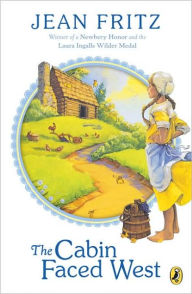
The Cabin Faced West

The Cabin Faced West. Jean Fritz. Illustrated by Feodor Rojankovsky. 1958. 124 pages. [Source: Bought]

Ann Hamilton swept the last of the day's dust out of the door into the sunset. Even the cabin faced west, Ann thought as she jerked the broom across the flat path the daylight made as it fell through the open doorway. It was the only place the daylight had a chance to come in. The cabin was solid logs all the way around without another opening anywhere. Its back was turned squarely against the East just as her father had turned his back. Just as her older brothers, David and Daniel, had.

Did I enjoy reading Jean Fritz's The Cabin Faced West? YES!!! I loved, loved, LOVED it. It is the book that I probably would have read a dozen times or more if I'd read it as a kid. Honestly I probably would have worn the cover off of a copy! But I didn't "discover" this until I saw a copy on clearance for fifty cents at a used book store a few years ago decade ago. I do wish I'd taken the time to read it when I bought it! I probably would have read it a couple of times more at least. I am an again-again reader.

The Cabin Faced West is a children's historical novel. It is set in the days after the American Revolution. Ann Hamilton is the ten-year-old heroine. She has not decidedly "turned HER back" to the East as her father and brothers. She really, really misses Gettysburg: her old home, her friends, the family she left behind. She misses having a community close by--a community of girls her own age. There are a handful of neighbors about, but, do those neighbors have girls anywhere near her own age--NO, they do not. Just boys and babies, boys and babies. The boy closest her own age is named Andy. And he's "the worst of them all" at least sometimes.

I liked this one start to finish. I did. I loved the characters. Loved Ann's meeting with Arthur Scott, and, then, of course her meeting with GEORGE WASHINGTON. And I loved learning that elements of this one are true, and, that the story is based--perhaps loosely--on the author's family history.

© 2015 Becky Laney of Becky's Book Reviews

Thursday, November 26, 2015

Harold at the North Pole

Harold at the North Pole. Crockett Johnson. 1958. HarperCollins. 48 pages. [Source: Library]

First sentence: It was Christmas Eve, and Harold had to have a Christmas tree before Santa Claus arrived.

Premise/plot: It's Christmas Eve and Harold needs a Christmas tree. With his purple crayon in hand, Harold's adventure begins. He's in search of a tree, so he must draw stars and woods and SNOW. Because he was a little TOO enthusiastic about the snow, Harold finds himself at the North Pole, and, Santa is snowed in. Can Harold draw Santa out of trouble?

My thoughts: This one is so cute and charming. I loved the text. I loved the illustrations. I loved the scene where Harold draws the reindeer and harnesses them up to Santa's sleigh. Have you read this one? What did you think?

Text: 4.5 out of 5
Illustrations: 4.5 out of 5
Total: 9 out of 10

© 2015 Becky Laney of Becky's Book Reviews

Sunday, April 12, 2015

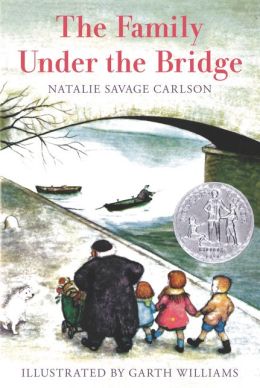
The Family Under the Bridge (1958)

The Family Under the Bridge. Natalie Savage Carlson. Illustrated by Garth Williams. 1958/1989. HarperCollins. 123 pages.

Once there was an old hobo named Armand who wouldn't have lived anywhere but in Paris. So that is where he lived. Everything that he owned could be pushed around in an old baby buggy without any hood, so he had no worries about rents or burglars. All the ragged clothing he owned was on his back, so he didn't need to bother with trunks or dry-cleaners. It was easy for him to move from  one hidey-hole to another so that is what he was doing one late member in December.

Have you read The Family Under the Bridge?! Why did no one tell me how WONDERFUL it was? I read it and absolutely loved it.

The Family Under the Bridge is set in Paris in December. (So it would be perfect to read around Christmas or New Year's Day). Armand is the hero. As he prepares for winter, he makes plans to go and live under "his" bridge. When he arrives, he discovers that there is a family already living there. At first, he thought he would leave immediately and go find another bridge to live under. But. He lets himself be talked into staying. The family includes two little girls and a little boy and their mother.
"It looks to me like you've already found a new place," said Armand, "and it's my old place. You've put me out of my home just like that landlady did to you."
Suzy was apologetic. She moved the pushcart over and measured Armand with one eye closed. Then she carefully drew a long rectangle on the concrete with a piece of soft coal.
"That's your room," she said. "You can live with us." On second thought, she scrawled a small checkered square at the foot of the rectangle. "There's a window," she said gravely, "so you can look out and see the river."
Armand grumbled to himself and pulled his coat tighter across his chest as if to hide his heart. Oh, this starling was a dangerous one. He'd better move on. Paris was full of bridges, the way the Seine meandered through it. No trouble finding another one. But as he started away, the girl ran over and clutched him by his torn sleeve.
"Please stay," she begged. "We'll pretend you're our grandfather."
Armand snorted. "Little one," he said, "next to a millionaire a grandfather is the last thing I hope to be." But even as he grumbled, he began unpacking his belongings. (11-12)
He claims he doesn't have a heart, and doesn't want a family. But a family is soon what they become...especially when the authorities learn about the children living under the bridge... Can Armand save them all and prevent the family from being split up?!

As I said, I loved, loved, loved this one.

© 2015 Becky Laney of Becky's Book Reviews

Saturday, April 11, 2015

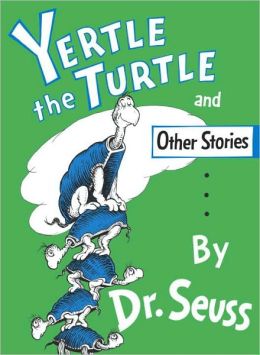
Seuss on Saturday #15

Yertle the Turtle and Other Stories. Dr. Seuss. 1958/2008. Random House. 96 pages. [Source: Review copy]

First sentence of Yertle the Turtle:
 On the far-away island of Sala-ma-Sond, Yertle the Turtle was king of the pond. A nice little pond. It was clean. It was neat. The water was warm. There was plenty to eat. The turtles had everything turtles might need. And they were all happy. Quite happy indeed.
First sentence of Gertrude McFuzz:
There once was a girl-bird named Gertrude McFuzz and she had the smallest plain tail ever was. One droopy-droop feather. That's all she had. And, oh! That one feather made Gertrude so sad. 
First sentence of The Big Brag:
The rabbit felt mighty important that day on top of the hill in the sun where he lay. He felt SO important up there on that hill that he started in bragging, as animals will and he boasted out loud, as he threw out his chest, 'Of all the beasts in the world, I'm the best! On land, and on sea...even up in the sky no animal lives who is better than I!'
Premise/plot of Yertle the Turtle: Yertle the Turtle is king, but, he doesn't want to rule supreme over a small pond, so, he starts turtle-stacking to expand his kingdom. After all he "rules" over everything he can see, so the higher the better, right?! But what happens when the turtles below him start to grumble and complain?!

Premise/plot of Gertrude McFuzz: Gertrude McFuzz is jealous and foolish. She wants MORE feathers, beautiful feathers so she can be the most beautiful bird. Her uncle doctor gives her some advice--reluctantly perhaps knowing that she will go too far with her vanity. She starts eating a berry to make her grow tail feathers, and, well, she should have been wiser. Will all end well?

Premise/plot of The Big Brag: A rabbit and bear get into a bragging contest until a worm intervenes.

My thoughts on Yertle the Turtle: I liked Yertle the Turtle. I did. I wouldn't say it's my favorite or best. But it is a good story on selfishness and tyranny. I'm glad the turtles started speaking up and gained their independence!

My thoughts on Gertrude McFuzz: I liked Gertrude McFuzz too. I thought the story was a great lesson in being careful what you wish for and being content with what you have!

My thoughts on The Big Brag: Of the three stories in this collection, this is probably my least favorite. The bear and the rabbit are quite annoying. Of course, that is the point. Bragging won't win you friends and will just make you look foolish.

Have you read Yertle the Turtle and Other Stories? What did you think of it? Of the three stories, which is your favorite?

If you'd like to join me in reading or rereading Dr. Seuss (chronologically) I'd love to have you join me! The next book I'll be reviewing is Happy Birthday to You.

© 2015 Becky Laney of Becky's Book Reviews

Saturday, April 04, 2015

Seuss on Saturday #14

The Cat In the Hat Comes Back. Dr. Seuss. 1958. Random House. 63 pages. [Source: Library]

First sentence:
This was no time for play.
This was no time for fun.
This was no time for games.
There was work to be done.
All that deep,
deep, deep snow,
All that snow had to go.
When our mother went
Down to the town for the day,
She said, "Somebody has to
Clean all this away.
Somebody, SOMEBODY
has to, you see."
Then she picked out two Somebodies.
Sally and me. 
Premise/plot: It's a sequel to The Cat in the Hat. The two children have learned a lesson or two since the previous book. Do they invite him in? Do they take joy in his arrival? Hardly!!! They are anxious to be rid of him. While they're HARD at work shoveling snow, the cat arrives and enters their house. They don't want him IN the house, they're afraid of what he might do. But despite their good intentions, they might be a little too late. For the Cat in the Hat takes a bath in their tub--while eating cake--and when the water is drained, they notice something awful: A BIG, LONG PINK CAT RING! How will they get rid of this mess that looks like PINK INK?! They know--though the cat obviously doesn't--that it shouldn't involve ANYTHING that belongs to their mother or father. From cover to cover, this one just SATISFIES.

My thoughts: The Cat in the Hat Comes Back is probably my favorite and best book by Dr. Seuss. I LOVE, LOVE, LOVE it. It's just so enjoyable, so satisfying, so funny. And it's also so very quotable!!!

Have you read The Cat in the Hat Comes Back? Did you like it? love it? hate it? I'd love to know what you think of it! Also, how do you think it compares to The Cat in the Hat? Which of the two is your favorite?

If you'd like to join me in reading or rereading Dr. Seuss (chronologically) I'd love to have you join me! The next book I'll be reviewing is Yertle the Turtle and Other Stories. 

© 2015 Becky Laney of Becky's Book Reviews

Wednesday, October 16, 2013

Rereading Venetia Again

Venetia. Georgette Heyer. 1958/2009. Harlequin. 368 pages. [Source: Gift] 

This is my third review of Venetia. (I've read the book three times and listened to the audio book once. It was narrated by Richard Armitage.)

It is my FAVORITE Georgette Heyer novel. There are many I'd place in my top five, but, really no other book comes close to being consistently in the top slot.

Venetia is our heroine. I love her. I do. She is twenty-five and managing the estate in her older brother's absence. She is also looking out for her younger brother, Aubrey, who is just seventeen. There is something very practical and matter-of-fact about Venetia. For example, she's very honest about herself, about her family, about life as she sees it. She says things that maybe would shock others in society. She has never been "in society." She's lived an extremely sheltered life in some ways. But she'll be having a grand adventure soon enough!

Venetia is out for one of her daily walks when she is surprised by the....Wicked Baron....Lord Damerel himself. Their first meeting is interesting and dramatic...

The two meet when she is trespassing on his land. He has no idea who she is. But she has a fairly good idea who he is. Especially after he kisses her! Yes, he kisses her.
"Who are you?" he demanded abruptly. "I took you for a village maiden--probably one of my tenants."
"Did you indeed? Well, if that is the way you mean to conduct yourself amongst the village maidens you won't win much liking here!"
"No, no, the danger is that I might win too much!" he retorted. "Who are you? Or should I first present myself to you? I'm Damerel, you know."
"Yes, so I supposed, at the outset of our delightful acquaintance. Later, of course, I was sure of it."
"Oh, oh--! My reputation, Iago, my reputation!" he exclaimed laughing again. "Fair Fatality, you are the most unusual female I have encountered in all my thirty-eight years!"
"You can't think how deeply flattered I am!" she assured him. "I daresay my head would be quite turned if I didn't suspect that amongst so many a dozen or so may have slipped from your memory."
"More like a hundred! Am I never to learn your name? I shall, you know, whether you tell me or no!" (33)
He intends to know her better while he's in the neighborhood. When her brother, Aubrey, has a riding accident and is saved by none other than Damerel...well, she can't help getting to know him much, much better. And soon they become great friends.

Lord Damerel isn't the only newcomer to the neighborhood. Soon Venetia and Aubrey welcome TWO very unexpected house guests. Conway has gotten married--her name is Charlotte. And Charlotte and her mother have come to stay at Undershaw. And the mother is quite the character. How long can Venetia stand to share a home with such a woman? Venetia begins to think about her options...and wishing it was more socially acceptable for her to set up her own home.

I love this one so much. I love Venetia. I love Lord Damerel. I love Aubrey. I love picking on Edward Yardley and Oswald Denny. It's such a fun and satisfying romance!!! 

Quotes:
Startled, she turned her head, and found that she was being observed by a tall man mounted on a handsome gray horse. He was a stranger, but his voice and his habit proclaimed his condition, and it did not take her more than a few moments to guess that she must be confronting the Wicked Baron. She regarded him with candid interest, unconsciously affording him an excellent view of her enchanting countenance. His brows rose, and he swung himself out of the saddle, and came towards her with long, easy strides. She was unacquainted with any men of mode, but although he was dressed like any country gentleman a subtle difference hung about his buckskins and his coat of dandy gray russet. No provincial tailor had fashioned them, and no country beau could have worn them with such careless elegance. He was taller than Venetia had at first supposed, rather loose-limbed, and he bore himself with a faint suggestion of swashbuckling arrogance. (30)
He laughed out at that, flinging back his head in wholehearted enjoyment, gasping, "why, oh why did I never know you until now?"
"It does seem a pity," she agreed. "I have been thinking so myself, for I always wished for a friend to laugh with."
"To laugh with!" he repeated slowly.
"Perhaps you have friends already who laugh when you do," she said diffidently. "I haven't, and it's important, I think--more important than sympathy in affliction, which you might easily find in someone you positively disliked."
"But to share a sense of the ridiculous prohibits dislike--yes, that's true. And rare! My God, how rare! Do they stare at you, our worthy neighbors, when you laugh?"
"Yes! Or ask me what I mean when I'm joking!" She glanced at the clock above the empty fireplace. "I must go." (64)
"Oh, no, nothing of that nature!" she replied, getting up.
"I allow you all the vices you choose to claim--indeed, I know you for a gamester, and a shocking rake, and a man of sadly unsteady character!--but I'm not so green that I don't recognize in you one virtue at least, and one quality."
"What is that all? How disappointing! What are they?"
"A well-informed mind, and a great deal of kindness," she said, laying her hand on his arm, and beginning to stroll with him back to the house. (99)
© 2013 Becky Laney of Becky's Book Reviews
Friday, September 20, 2013

Light on Lucrezia (1958)

Light on Lucrezia: A Novel of the Borgias. Jean Plaidy. 1958/2011. Crown. 384 pages. [Source: Bought]

Light on Lucrezia is the sequel to Madonna on the Seven Hills. The novel opens with the moody Lucrezia preparing for her second marriage. The marriage has been arranged for her by her father, the Pope. She happens to be marrying Sanchia's brother, Alfonso. (Sanchia is her sister-in-law.) The two are a great couple; however, Lucrezia isn't to be allowed her happily ever after for politics and family interfere once again. After her husband's murder, Lucrezia's life is a bit of a mess. A third marriage is arranged after a time, but, it's less than ideal. At least as depicted by Plaidy! But though Lucrezia's fate is the happiest of the Borgia family, that really is not saying much considering what happens...

Reading Light On Lucrezia is like suffering through the last half of Gone With The Wind. There are highlights, of course, but overall it just gets more depressing and hopeless with every single chapter until the dreariest of endings. Is the ending inevitable? Sure. It is (very loosely) based on history. Cesare's fate is set in stone. And Lucrezia's childbearing misfortunes are realistic enough, but it was so very sad to read of all the miscarriages and the babies that died so very young. 

Madonna of the Seven Hills and Light on Lucrezia have recently been published as one novel. Plaidy's depiction of the Borgias is interesting. They have their fascinating-but-troubling moments to shine. And the first novel, at least, had some lightness and frivolity to it. I think Plaidy's characterization is better than say, The Borgia Bride, but not as wonderful as Blood and Beauty.  I really want Sarah Dunant to write another Borgia novel!!!

© 2013 Becky Laney of Becky's Book Reviews