Wednesday, August 05, 2026
54. The Good Fortune of Miss Robbins
54. The Good Fortune of Miss Robbins. Melanie Dickerson. 320 pages. [Source: Library] [3 stars, clean romance, historical romance, Jane Eyre wannabe]
First sentence: "Charlotte! A letter came for you!" Hattie Jacobs emerged from the back entrance of Mrs. Southey's School for Young Ladies, waving something over her head.
Premise/plot: Charlotte Robbins, our protagonist, is incredibly excited to start a new chapter of her life as a governess to an earl's niece and nephew. Lord Brookhaven is extremely friendly and sociable from their first meeting. Charlotte was hoping to find love in this new chapter as well though she knows that it couldn't possibly be with the earl himself. But surely there's someone about with whom she could find a happily ever after. BUT when Charlotte is included in Lord Brookhaven's social calendar--a house party--she begins to realize she is in fact falling for the earl. AT the same time, he begins to realize he is falling in love with her. But, dear readers, we are barely a fifth of the way through the novel. Readers still have a couple hundred pages to go before the incredibly obvious and tedious misunderstandings can be cleared up in three or four minutes of conversation.
My thoughts: The book wants to be Jane Eyre without being Jane Eyre. They've upgraded Mr. Rochester to an EARL. They've removed the hidden wife in the attic. Simply not acceptable to have a MARRIED MAN falling in love with another woman, proposing, or trying to marry again unlawfully. They have tried to make the story a little more Charles Dickens...introducing TWO ORPHAN CHILDREN that must be saved and rescued. Charlotte does "inherit" but not from an uncle she's never met--but from an imaginary uncle created by the earl as a guise. This money from an "uncle" (wink, wink) sets her up in London, brings two street orphans into her life, and makes her the catch of the season. As marriage proposals abound, Charlotte is unhappy because Lord Brookhaven is keeping his distance. The truth comes out...and she's livid. And then the nonsense continues because of course it does. Eventually these two have an honest conversation and when he proposes she accepts.
It is published by a CHRISTIAN publisher. There is little to no Christian content. There is 800% more Christian content in the original novel Jane Eyre than in this book. The "improvements" to the story are not really improvements in my opinion.
© 2026 Becky Laney of Becky's Book Reviews
Monday, June 29, 2026
45. The Other Bennet Sister

45. The Other Bennet Sister. Janice Hadlow. 2020. 463 pages. [Source: Review copy] [adult fiction, historical fiction, historical romance, Austen adaptation, 5 stars]
First sentence: It is a sad fact of life that if a young woman is unlucky enough to come into the world without expectations, she had better do all she can to ensure she is born beautiful. To be poor and handsome is misfortune enough; but to be penniless and plain is a hard fate indeed.
Premise/plot: The Other Bennet Sister is a spin-off of Jane Austen's Pride and Prejudice. The first bit of the book is a prequel. Readers meet Mary Bennet as a young girl. Before Mary overheard her mother talking about her unfortunate looks, her ugly plainness, she was content and happy enough to hang out with her older sisters, Jane and Elizabeth. The more self-conscious she becomes of everyone thinking she is 'different' (and really this is more her parents fault--her father ignores EVERYONE except Lizzy and her mother has no use for her at all), the more distance is created between her and her sisters. She soon finds herself seeking ONLY the companionship of books. Books--religious texts included--become her refuge. She seeks religion and philosophy and other more nonfiction-y books. Perhaps if she'd read novels she'd have still 'fit in' with her sisters.
The second bit of the novel is the first part of Pride and Prejudice seen through the eyes of Mary Bennet. Not the whole novel, mind you, but the part Mary witnessed at the start. Mary is also friends with Charlotte Lucas which does make sense. Here we see Mr. Collins through her eyes. And the DISASTROUS party where Mary is humiliated.
The third bit of the novel is by far the largest part. Readers see what happens next--a year or two after the conclusion of Pride and Prejudice. We see what happens after the death of her father, Mr. Bennet, and how she tries and tries to find a place to settle. This was the coming of age bit of the novel. Will Mary Bennet find her happily ever after????
My thoughts: I loved, loved, loved this one!!!! It was SO good. I loved her character throughout. Mary Bennet has always been misunderstood. And I loved seeing these familiar characters THROUGH her eyes. A reminder that there's more than one side to any story.
© 2026 Becky Laney of Becky's Book Reviews
Wednesday, May 07, 2025
46. The Tides of Time
46. The Tides of Time. Sarah M. Eden. 2025. 368 pages. [Source: Library] [5 stars, time travel, adult romance, historical fiction]
First sentence: Lili Minet had a price on her head. She stood in the shadows inside Saint Catherine's Church alongside a family she'd known for only a few days, hopeful that the reward for her capture would increase before the day's end. As far as she knew, no one had facilitated the escape of more people from the clutches of the Tribunal revolutionnaire than she. Four more individuals would, that evening, be added to the seventy-two already rightly credited to her.
Premise/plot: The Tides of Time is a TIME TRAVEL ROMANCE. Those three words may be enough of a hook for some readers. (It was for me). Lili Minet, our heroine, is on the run for her life in 1793 during the French Revolution. She's been helping people escape, but, her luck may have just run out. One of those searching desperately for her--for her harm--is her brother who is in full support of the revolution and the guillotine. When stormy seas lead to her being tossed overboard, she finds herself rescued by a lightkeeper, Armitage Pierce, off the coast of Loftstone Island....in 1873. As the weeks go by she adjusts to the strangeness of her situation. She loves Armitage and his grandfather. She loves the community on the island. She loves her new found-family. She can't quite forget her own brother--for good reason--nor the France she left behind. The Tides of Time can be cruel or kind--or both.
My thoughts: I LOVE this one. I do. Time travel is going to always have great potential for me. This publisher is known for clean romance, another win for me.
There are TWO things that might be off-putting to potential readers. (They weren't at all for me.) One, Lili speaks a mixture of English and French. There is a strong sprinkling of French phrases and sentences. It makes sense for the story. She is a French woman--obviously French is going to be her primary language, her first language, the language that she would speak especially when stressed or out of sorts. Two, the DIALECT of the island could be offputting. "She/her" "He/Him" "We/Us" essentially all the pronouns have vastly different usage. For example, "Her isn't hostile to me." "A calculated decision, that. I watched she make it."
© 2025 Becky Laney of Becky's Book Reviews
Monday, March 06, 2023
49. Miss Newbury's List
Miss Newbury's List (Proper Romance) Megan Walker. 2023. 280 pages. [Source: Review copy]
First sentence: I leaned over the trunk at the foot of my bed in a desperate, frantic search.
Premise/plot: Miss Newbury's List is a Regency romance novel by Megan Walker. It is in the Proper Romance (clean) line of books published by Shadow Mountain. Our heroine, Rosalind Newbury, is engaged to marry the Duke of Marlow. It's not a love match--for either of them. They've only met twice. Her parents are incredibly excited--beyond thrilled--with the match. Marrying nobility is a dream that has been passed down for generations. Their daughter is the one who will make her parents dreams come true. That's good, right? Well, maybe.
Rosalind Newbury has a best friend, Liza, and Liza has a visiting cousin, Charlie. Charlie and Rosalind (or Ros) grow closer as her wedding draws near. You see, Miss Newbury has....a [bucket] list. When she was a child--perhaps ten?--she wrote a list of things [about ten???] she wanted to accomplish before she got married. Her bucket list is probably unusual for the times. First, I'm not sure anyone--male or female--wrote out "bucket lists" (not that it is ever in any way called a bucket list) of things to accomplish before marriage [or while they were young]. Second, even if men did have a "bucket" list of things they wanted to accomplish...I'm not sure young women would have. Third, the items on the list are unusual. In that almost all of the items on the list challenge the norms.
My thoughts: In all honesty, I thought all of the items on Rosalind's list were out of place, out of time, a bit off. Like is Rosalind really a young woman born circa 1800??? Or is she a twenty-first century woman wearing bonnets and petticoats? Perhaps "all" is too strong. I thought most of them were ridiculous. By extension, I then began thinking of Rosalind as ridiculous. [For example, when Rosalind decides to "learn to swim" by sneaking out early in the morning, going off by herself, and jumping into a pond having no plan, no idea, no help if things go wrong. That just seems high risk for little reward. Of course, she almost drowns and ends this whole list business.]
As for Charlie, I do like Charlie for the most part. I don't like his interest in boxing. (Though I'm guessing that aspect of sport/hobby is historically accurate). But he's a good guy.
The book is super-predictable. I typically do not mind in any way a predictable romance. I don't. The more I love the couple, the more predictability I want, expect, need.
For readers who embrace this notion of a bucket list and a free-spirited, quirky young heroine, this one offers a sweet, clean romance.
© 2023 Becky Laney of Becky's Book Reviews
Friday, January 27, 2023
17. The Little Wartime Library
The Little Wartime Library. Kate Thompson. 2022. 496 pages. [Source: Review copy]
First sentence: An old woman walks up the westbound platform of Bethnal Green Underground Station, moving painfully slowly on account of her arthritis.
Premise/plot: A book about libraries and books set during the Second World War??? YES please. That was my initial first impression.
The novel has a framework--for better or worse. The opening and closing chapters readers meet an elderly woman and her two daughters. The rest of the novel is set in London's East End during the Second World War. It alternates between two librarians (or one librarian and one librarian assistant). Clara Button is a widow who before the war was a children's librarian. During the war she is managing an underground--literally--library. Bethnal Green tube station is serving many functions these days--including a temporary library structure. She works closely with all classes, all ages. Ruby Monroe, her assistant, is a fiery/feisty vixen who loves living life big--living for today, throwing all caution [and morals] to the wind. She is carrying a burden, though she hates to let it show to just anyone. She encourages Clara, always, to take chances.
Ruby meets an American soldier, Eddie, with whom she has a whirlwind romance. He is smitten. She's less so, but, wouldn't it be lovely to dream of flying away to America after the war and starting over.
Clara meets an ambulance driver, Billy, who is hot and cold. She sometimes gets the strongest impressions that he loves her truly and deeply, that this relationship is going somewhere. Other times, he acts like a complete stranger who couldn't care less if he ever sees her again.
These two meet plenty of people--all ages, all socioeconomic classes, different races. But Clara becomes especially fond of a handful of children. Sparrow, a young boy, whom she is teaching to read. Beatty and Maria, two Jewish refugees from Jersey.
My thoughts: My first impression was YES PLEASE. It just sounds like it would be an amazing fit for me. Set during the Second World War. A Book about librarians making a difference. BOOKS changing lives. Books as a way to make connections.
But....this one, sadly, wasn't for me after all. I didn't enjoy the framework, not really. I almost wish we'd had Beatty's perspective in the past too. It was an odd switch, for me, to spend 95% of the book with Clara and Ruby's perspective--all very adult and adult-oriented. And then throw in the bits at the beginning and the end that are from Beatty's perspective seventy plus years later. The past flashbacks contain things that Beatty could not have actually known.
I felt that the novel was TOO busy. There are a million story threads. A story thread might sit vacant for a hundred plus pages only to suddenly make a reappearance. There is so much telling and not showing. And there were literally pages--sometimes whole chapters--that were just info dumps.
The characters. It makes sense that there would be personal tensions. But why did this story need SO many villains???? So many characters that are one-dimensional and "evil" "mean" "cruel" "vindictive" "callous" "despicable" for literally no reason whatsoever. Two people can disagree on something--even strongly--and not have to be downright EVIL.
For example, the EVIL man who is out to get Clara Button fired. I can see two librarians--especially at the time--having differing opinions. She wants to serve EVERYONE in the community. She wants the library to be a safe place regardless of age, gender, race/ethnicity, social class, education, etc. He doesn't. Libraries are for refined folks of a certain class or distinction. She wants the library to have ALL the books, and offer information freely. He wants the librarian to be a gatekeeper of morals and virtues. She believes that knowledge is power and that the more you know, the better informed you'll be when it comes to making decisions--big or small. He believes in withholding knowledge/information to maintain the status quo. They have completely different philosophies on HOW a library should operate. His ideas alone would make him a despicable character with modern readers. [I'm not arguing that]. But why did he have to be portrayed as extra-super-exceedingly evil on top of that????
The undercurrent of this one is that Ruby and Clara are fighting against the system, a system that wants to hold women down and deny them. A system that protects rapists and wife-beaters and blames women for daring to speak up. A system that thinks women shouldn't be allowed to read, encouraged to read.
So much of this one was just ugly. I may not have liked the super-villain-y-villains, but I didn't really like Clara and Ruby either. The writing style just felt hammer-like; let's hit readers over the head for the entire novel to make sure they understand that anyone who would limit access to books is evil.
© 2023 Becky Laney of Becky's Book Reviews
Sunday, November 27, 2022
160. A Holiday by Gaslight
A Holiday by Gaslight by Mimi Matthews. 2018. 175 pages. [Source: Bought]
First sentence: An icy late November breeze rustled the bare branches of the trees along the Serpentine.
Premise/plot: Sophie Appersett has been following her parents' lead when it comes to "romance". They are hoping the [semi-arranged] match between Sophie and Mr. Edward Sharpe, London merchant will be just the thing. To be fair, they see Mr. Sharpe and see moneybags. Sophie, well, she is hoping to see more than that. But seeing the real deal, getting to know the real person, takes a bit of effort. Both Sophie and Edward, well, they're not the best at letting down their guards with one another and being real, true, genuine.
Sophie's father has spent all her dowry on getting their country home fitted for gaslight. And his plans may just extend beyond that...
He has been invited [along with his parents and a friend] to spend Christmas with them in the country...
My thoughts: It was playful and fun. It was sweet. It was clean--nothing to my recollection beyond a kiss or two. If holiday romances are your thing, then this one may just be all delight.
I definitely enjoyed this one. I have read Mimi Matthews in the past. This one didn't quite live up to my full-length-novel expectations. I think if my expectations had been lowered to begin with--it is more of a novella--it would have satisfied.
© 2022 Becky Laney of Becky's Book Reviews
Friday, May 27, 2022
65. The Belle of Belgrave Square
The Belle of Belgrave Square. (Belles of London #2) Mimi Matthews. 2022. 432 pages. [Source: Review copy]
First sentence: Julia Wychwood was alone in Rotten Row, and that was exactly the way she liked it.
Premise/plot: Julia Wychwood is the heroine of Mimi Matthews' The Belle of Belgrave Square. What can I say about Julia? Well, she's socially anxious, prefers books to people, and she happens to be an heiress. Her parents play up (or perhaps that was just my perception???) their illnesses. And they are just as convinced that their daughter, Julia, is weak, fragile, and "poorly." Julia sometimes doesn't fight against this notion--if being "ill" equals more time in her room reading the latest book. But there comes a time when enough is enough is enough.
Captain Jasper Blunt, a war hero (and the hero of this romance novel), doesn't love town life--or should that be TON life. London life isn't exactly his cup of tea; he much prefers life in YORKSHIRE on his estate (run down though it may be). He is in town looking for an heiress to marry. Why an heiress? Well, his estate is in shambles--literally and figuratively. It isn't just that the estate isn't profitable. The situation is dire. He is thinking of his three children--illegitimate though they may be in the eyes of society and the law. Julia is his first choice. For many, many, many reasons.
Julia is drawn to Jasper--deeply. But there are obstacles on the way to this match from both. One thing the two share is a LOVE for reading. In fact, these two love to talk about their favorite authors and favorite books. The discussion is real, and goes beyond the surface.
My thoughts: I love, love, love, love, LOVE, LOVE, crazy love this book. I had no idea it was the second in a series when I chose it for review. I will definitely be going back to read the first book in the series. This book gave off BEAUTY AND THE BEAST vibes, and I was all for it. However, as the novel progressed, I soon picked up on something that thrilled me even more....the book was reminding me of The Blue Castle by L.M. Montgomery. The Blue Castle is without a doubt one of my favorite, favorite, favorite romances by Montgomery. Perhaps because I identify with the heroine so much.
I loved Julia. I could identify with her. It is so refreshing to identify with heroines in romance novels. Not usual or typical for me. Give me a socially awkward or socially anxious heroine that panics with small talk, and you'll have me at hello.
I loved Jasper. His story isn't necessarily straightforward, plenty of twists and turns. I definitely was cheering for him throughout. There were so many scenes--so many--that just made me giddy.
Is the romance novel clean? Maybe. I'll clarify. If your objection with certain scenes is premarital or extramarital, then yes, this one is "clean" enough. Nothing improper happens before vows are exchanged. Mostly. It depends on if one little kiss counts as improper. But from the start, she knows his intentions are marriage. There's never a creepy-creeper vibe that he is trying to take advantage of her. There are romantic, sensual scenes (a handful) in the novel after they are married. I found them in the tasteful (mostly) range. These scenes are not front and center and written without excessive detail. The scenes don't go on for pages and pages and pages. These scenes do not steal the show or distract from the actual story.
Quotes:
In a novel, she was safe. Her throat didn't close up and her palms didn't grow damp. She could experience things in a way that didn't overwhelm her.
This was how he could help her. Not by holding her. Not by carrying her off to safety somewhere. But by talking to her. By engaging her on the subject she loved most.
© 2022 Becky Laney of Becky's Book Reviews
Friday, April 01, 2022
41. Yours Cheerfully
Yours Cheerfully. (The Emmy Lake Chronicles #2) A.J. Pearce. 2021. 304 pages. [Source: Review copy]
First sentence: As Mr. Collins called a start to the Woman's Friend editorial meeting, to anyone watching, it was a perfectly normal Monday-morning affair.
Premise/plot: Yours Cheerfully is the sequel to Dear Mrs. Bird. Both books are set in London (for the most part) during the Second World War. This book is set in the fall/winter of 1941. Emmy Lake, our heroine, managed to keep her job at the magazine Woman's Friend despite some issues that came to light in the previous book. She spends most of this second book not as an advice columnist (if she still does the advice column, she never once shares the letters) but as a journalist writing a series of stories on women factory workers. She makes friends with a handful of workers. Not just smile and nod acquaintances but get up all in your business friendships. She takes it upon herself to agitate (stir things up) the workers and convince them to risk it all for the chance of better working conditions. This isn't just a story to cover. This becomes a dear and precious cause to her. She even risks missing her own wedding (to a soldier) to cover this story.
My thoughts: I really did enjoy Dear Mrs. Bird. I did not enjoy Yours Cheerfully nearly as much. I did not feel that there was much further character development. And the relationship development was practically non-existent. True, I think it's the readers who are left behind on this one--not Emmy Lake. She's 100% in love with Charles Collins. Not a doubt in her mind about that. But this reader at least, felt that Emmy and Charles' relationship was a little lacking in development. I never really felt like I got to know Charles. Perhaps the romance is inconsequential. Maybe the book exists not as historical romance per se but as historical fiction with the focus almost exclusively on friendships between the women. That is a distinct possibility. If so, I found these friendships to be a little too insta(nt) for me. Like you take public transit and suddenly become near instant besties with a couple of women sitting near you. Granted, maybe some people do make best friends like that--and accumulate dozens if not hundreds of friends--just that quickly.
I did get some North and South vibes--not in terms of romance--but in terms of an opinionated woman so confident and sure that she had all the answers on how to better run (or manage) a factory.
Maybe Emmy Lake was supposed to come across as fierce and strong and independent. I just thought her pushiness might get the other women into serious trouble. Her "helpfulness" might lead to true destitution for women already living in poverty if she wasn't extremely lucky.
© 2022 Becky Laney of Becky's Book Reviews
Thursday, April 15, 2021
39. The Talisman Ring
The Talisman Ring. Georgette Heyer. 1936/2009. Sourcebooks. 303 pages. [Source: Review copy]
First sentence: Sir Tristram Shield, arriving at Lavenham Court in the wintry dusk, was informed at the door that his great-uncle was very weak, not expected to live many more days out.
Premise/plot: How to introduce this one? Think, think, think. I could mention that it
has a heroine that reminds me of Catherine Morland of Northanger Abbey,
Jane Austen fame. Because it does. Eustacie de Vauban is silly and
impulsive and much too much into romantic novels with daring adventures
and dashing, swoon-worthy heroes. She, like Catherine, has an
over-active imagination. But, this book isn't her story alone. So maybe
that wouldn't quite be fair.
The book opens with a dying old man, the family patriarch, Sylvester,
calling his family together. He wants his granddaughter, Eustacie, whom
he rescued from France before the revolution got started with all the
guillotining, to be safely married. He wants his great-nephew (Sylvester
is Tristam's great-uncle), Tristram Shield, to marry her. He decidedly
does not want Basil "The Beau" Lavenham to be the man for the job.
Though since Ludovic Lavenham's "death" there is really no one closer in
the line to inherit his title and his lands. But is Ludovic really
dead?
The more time Eustacie spends with Tristram, the more she knows that he
is not the one for her. He is not adventurous. He is not romantic. He is
not impressed with her storytelling and imagining. He is much too
grounded in reality to ever be dashing and heroic. He's simply put not
hero material. So Eustacie makes up her mind to run away. In the middle
of the night. On horseback. What could be wrong with that?
Well, maybe just maybe as she's running away...she runs right into the
middle of a pack of smugglers. Instead of being scared silly. She's in
love with the notion. An adventure worthy of any real heroine!
Fortunately for her, her kidnapper is none-other than her cousin
Ludovic. He's a man already on the outs with the law--charged with a
murder several years previous. But is he guilty of that crime?
Can Eustacie (and company) prove Ludovic's innocent of murder? Can they
redeem his name, enable him to come out of hiding, and claim what is
rightfully his? It will be a massive undertaking and require some help! (Enter Sarah Thane and company).
My thoughts: It can be easy to forget just how much you enjoyed a particular Heyer
romance when you've read so many. The Talisman Ring is certainly
enjoyable and quite satisfying...even if it doesn't necessarily stay as
fresh in one's memory as being a favorite-favorite. I enjoyed the two
romances in this one. But above all, I enjoyed the dramatic, suspenseful
mystery! It reminded me a bit of the promise of Northanger Abbey,
except in this case, there was actually plenty of adventure and danger
and mystery!
A scene between Eustacie and Tristram:
“You would more probably have gone to the guillotine,' replied Sir Tristram, depressingly matter of fact.
'Yes, that is quite true,' agreed Eustacie. 'We used to talk of it, my cousin Henriette and I. We made up our minds we should be entirely brave, not crying, of course, but perhaps a little pale, in a proud way. Henriette wished to go to the guillotine en grande tenue, but that was only because she had a court dress of yellow satin which she thought became her much better than it did really. For me, I think one should wear white to the guillotine if one is quite young, and not carry anything except perhaps a handkerchief. Do you not agree?'
'I don't think it signifies what you wear if you are on your way to the scaffold,' replied Sir Tristram, quite unappreciative of the picture his cousin was dwelling on with such evident admiration.
She looked at him in surprise. 'Don't you? But consider! You would be very sorry for a young girl in a tumbril, dressed all in white, pale, but quite unafraid, and not attending to the canaille at all, but--'
'I should be very sorry for anyone in a tumbril, whatever their age or sex or apparel,' interrupted Sir Tristram.
'You would be more sorry for a young girl--all alone, and perhaps bound,' said Eustacie positively.
'You wouldn't be all alone. There would be a great many other people in the tumbril with you,' said Sir Tristram.
Eustacie eyed him with considerable displeasure. 'In my tumbril there would not have been a great many other people,' she said.”
© 2021 Becky Laney of Becky's Book Reviews
Monday, March 01, 2021
21. A Captain for Caroline Gray
A Captain for Caroline Gray. Julie Wright. 2021. [March] 336 pages. [Source: Review copy]
First sentence: The ball had been a disaster. Certainly, Caroline Gray’s dance card had been filled respectably, if not entirely, and the conversation had not been dull. And the food—oh, the food. Caroline had loved every creamy morsel. The entire neighborhood admired the Prescotts’ cook. In truth, Caroline hadn’t even realized how disastrous the ball had actually been until the next morning when her mother entered her bedchamber before the maid had even arrived to light the fire. “Get up,” her mother said, pulling down the coverlet that Caroline had embroidered herself.
Premise/plot: Bluestocking Caroline Gray is finding it difficult to find a husband in England. She does truly want to marry and have children. She just wants a husband who wants a wife who has thoughts and opinions of her own, who wants a wife who is curious and eager to learn and mature. She doesn't think it's too much to ask for...but luck hasn't been on her side. Now her time is running out, she has one last opportunity but it comes with RISK: to set sail to India to meet a young man. She's not alone in her mission, there's literally a half dozen to dozen women voyaging to India to husband hunt.
Caroline Gray's passage is being sponsored by her potential mother-in-law. Mrs. Barritt has been keeping an eye out for a suitable young lady to send to her son for approval...he is a captain.
But is he THE CAPTAIN in the title?!?!?! Or could the Captain of the PERSISTENCE be 'the one?'
My thoughts: 2021 apparently has been the year for me reading books set on ships! (Fortunately this one doesn't involve a ship wreck!)
I enjoyed this clean historical romance. It is told from the perspective of the Captain AND from the perspective of Caroline. I liked both perspectives. I liked the development of the relationship--there was nothing instant about it. The obstacles came both from within and without. Communication was key and it wasn't always easy. One of the themes was forgiveness.
© 2021 Becky Laney of Becky's Book Reviews
Monday, May 27, 2019
The Convenient Marriage
First sentence: Lady Winwood being denied, the morning caller inquired with some anxiety for Miss Winwood, or, in fact, for any of the young ladies.
Premise/plot: Lord Rule has offered for the eldest Winwood daughter little knowing that Elizabeth's heart belongs to a soldier. Elizabeth Winwood being a dutiful daughter has determined to break off the love match and please her mother. After all the Winwoods desperately needs Rule's money in order to satisfy their brother's debts. Horatia, the youngest, won't have it. Everyone knows she's fierce and a bit reckless. But no one suspects that she--accompanied by a maid--will go to Rule's house, request to see him, and bluntly tell him to marry HER and NOT ELIZABETH. This makes for the BEST SECOND CHAPTER IN A BOOK OF ALL TIME. He agrees despite her stammer and eyebrows or perhaps because of them. There is something fiery and unique about Horry. Readers can tell that this will be everything but a marriage of convenience.
My thoughts: Georgette Heyer's The Convenient Marriage is a historical romance novel that I love and adore. It may just be my all-time favorite Heyer romance. It is without a doubt in my top two. I love everything about it and would change nothing.
I love the setting. It is set in the GEORGIAN period. The American Revolution is going on in the background. Elizabeth's soldier has been to America and back--he was injured in the fighting. The main character, Horatia, is named after her godfather, Horatio (Horace) Walpole. The book immerses you in the times--fashion and etiquette for men and women.
I love the humor and wit. It isn't just that there's great chemistry in the dialogue of Horry and Marcus (Lord Rule). That I would expect from any and every romance novel--especially those of Heyer. No, it seems the dialogue sparkles for ALL the characters. In particular I love, love, love Horry's brother, whom we mostly see as VISCOUNT or PEL.
I love the characterization. Usually romance novels have two well-developed characters--the hero and the heroine. The whole point of the novel usually building up their relationship and leading to a happily ever after. Horry and Marcus enter the novel fully developed. They had me at hello--nearly. Again, a great second chapter that HOOKS you. But The Convenient Marriage is peopled with characters that I either love, love, love or love to hate. (Caroline Massey, Crosby Drelincourt and Robert Lethbridge).
I love the pacing. This story never once drags. There is not even one unnecessary scene. Everything is building to a GIDDY-MAKING conclusion. The journey is just as enjoyable as that ultimately satisfying conclusion you know is coming.
I love the action. Now, the action isn't the first thing that comes to mind. It does require a bit of imagination. But this one has sword-fighting and duels. It has highway men. I think it would make an absolutely thrilling film. Everything about this romance novel begs for a film adaptation. It is funny. It is romantic. It is dashing.
I also love the action you don't see--this is clean romance. I wish clean romances were more common.
I mentioned this already but the writing is wonderful. All these quotes come from the second chapter.
‘Are you L-Lord Rule?’ demanded the lady. He was amused. ‘I have always believed so,’ he replied. ‘Why, I th-thought you were quite old!’ she informed him ingenuously. Did you come to see me in order to–er–satisfy yourself as to my appearance?’ She blushed fierily. ‘P-please forgive m-me!’ she begged, stammering dreadfully. ‘It w-was very r-rude of m-me, only you s-see I was surprised just for the m-moment.’‘If you were surprised, ma’am, what can I be but deeply flattered?’ said the Earl. ‘But if you did not come to look me over, do you think you could tell me what it is I am to have the honour of doing for you?’
‘It is because of L-Lizzie–my sister. You have offered for her, haven’t you?’
Slightly taken aback, the Earl bowed. Horatia said in a rush: ‘C-could you–would you m-mind very much–having m-me instead?’
‘Of c-course I know it ought to be Charlotte, for she is the elder, but she said nothing would induce her to m-marry you.’
His lips quivered. ‘In that case,’ he said, ‘it is fortunate that I did not solicit the honour of Miss Charlotte’s hand in marriage.’
‘But may I know whether I appear to all the members of your family in this disagreeable light?’ ‘Oh no!’ said Horatia earnestly. ‘M-mama is excessively pleased with you, and I myself d-don’t find you disagreeable in the least. And if only you would be so v-very obliging as to offer for m-me instead of Lizzie I should like you very well.’ ‘But why,’ asked Rule, ‘do you want me to offer for you?’
Horatia said eagerly: ‘Oh, you will take m-me instead?’ ‘No,’ said Rule, with a faint smile. ‘I won’t do that. But I will engage not to marry your sister. It’s not necessary to offer me an exchange, my poor child.’
‘B-but it is!’ said Horatia vigorously. ‘One of us m-must marry you!’ The Earl looked at her for a moment.
‘I think you must explain it all to me,’ he said. ‘I seem to be more than ordinarily dull this morning.’
Horatia knit her brows. ‘Well, I’ll t-try,’ she said. ‘You see, we’re so shockingly poor. Charlotte says it is all P-Pelham’s fault, and I dare say it may be, but it is no use blaming him, b-because he cannot help it. G-gambling, you know. Do you gamble?’
‘Sometimes,’ answered his lordship. The grey eyes sparkled. ‘So do I,’ declared Horatia unexpectedly. ‘N-not really, of course, but with Pelham. He taught me.
‘It’s v-vulgar to care about Settlements, but you are very rich, are you not?’ ‘Very,’ said his lordship, preserving his calm.
Horatia seemed determined to make a clean breast of her blemishes.
‘And p-perhaps you could become used to my eyebrows?’ The smile lurked at the back of Rule’s eyes. ‘I think, quite easily.’
She said sadly: ‘They won’t arch, you know. And I ought to t-tell you that we have quite given up hope of my g-growing any taller.’ ‘It would certainly be a pity if you did,’ said his lordship.
‘You m-may have n-noticed that I have a–a stammer.’ ‘Yes, I had noticed,’ the Earl answered gently.
‘If you f-feel you c-can’t bear it, sir, I shall quite understand,’ Horatia said in a small, anxious voice. ‘I like it,’ said the Earl.
‘It is very odd of you,’ marvelled Horatia. ‘But p-perhaps you said that to p-put me at my ease?’ ‘No,’ said the Earl. ‘I said it because it was true. Will you tell me how old you are?’
‘D-does it matter?’ Horatia inquired forebodingly. ‘Yes, I think it does,’ said his lordship. ‘I was afraid it m-might,’ she said. ‘I am t-turned seventeen.’
‘Turned seventeen!’ repeated his lordship. ‘My dear, I couldn’t do it.’ ‘I’m too young?’ ‘Much too young, child.’
Horatia swallowed valiantly. ‘I shall grow older,’ she ventured. ‘I d-don’t want to p-press you, but I am thought to be quite sensible.’
‘But I think that thirty-five makes a poor husband for seventeen.’ ‘P-pray do not give that a thought, sir!’ said Horatia earnestly. ‘I assure you, for my p-part I do not regard it at all.
In f-fact, I think I should quite like to marry you.’ ‘Would you?’ he said. ‘You do me great honour, ma’am.’ He came towards her, and she got up.
‘Well, to tell you the truth, Lizzie, I would like to m-marry him. But I c-can’t help wondering whether you are quite sure you d-don’t want to?’
‘I thought of that myself,’ admitted Horatia. ‘He s-says he thinks he will grow used to my horrid eyebrows quite easily. And I will t-tell you something, Charlotte! He said it would be a p-pity if I became any taller.’
‘My lord, let my treasured child answer you with her own lips. Horatia love, Lord Rule has done you the honour to request your hand in marriage.’
‘I t-told you he was going to, M-mama!’ said Horatia incorrigibly. ‘Horatia–I beg of you!’ implored the long-suffering lady. ‘Your curtsy, my love!’ Horatia sank obediently into a curtsy.
Mr Walpole’s face wore an approving smile, though he regretted that his god-daughter should be marrying a Tory. But then Mr Walpole was so very earnest a Whig, and even he seemed to think that Lady Winwood was right to disregard Rule’s political opinions.
The Macaroni, Mr Crosby Drelincourt, mechanically straightened the preposterous bow he wore in place of a cravat.
You do not look at all the thing, my dear fellow. In fact, I should almost feel inclined to recommend another hairpowder than this blue you affect. A charming tint, Crosby: you must not think I don’t admire it, but its reflected pallor upon your countenance.
But how in the world came they to put “Horatia” for “Elizabeth”?’ ‘You see,’ said Rule apologetically, ‘Arnold sent the advertisement to the Gazette.’
‘Well, I never would have believed Mr Gisborne to be so big a fool!’ declared her ladyship. ‘But perhaps I ought to explain, my dear Louisa, that he had my authority,’ said Rule still more apologetically.
‘Lord, Rule, what can you possibly mean?’ she demanded. ‘You’re not going to marry Horatia Winwood!’ ‘But I am,’ said his lordship calmly.
‘I don’t know what you’re talking about, and how you can mean to marry Horatia, who must be still in the schoolroom, for I’m sure I have never clapped eyes on her–in place of that divinely beautiful Elizabeth–’
‘Ah, but I am going to grow used to the eyebrows,’ interrupted Rule. ‘And she has the Nose.’
‘When did you have this notion of marrying her?’ she asked. ‘Oh, I didn’t,’ replied the Earl. ‘It was not my notion at all.’ ‘Whose, then?’
‘Horatia’s, my dear. I thought I had explained.’ ‘Do you tell me, Marcus, the girl asked you to marry her?’ said Lady Louisa sarcastically.
‘Marcus, is the girl a minx?’ she asked. ‘No,’ he answered. ‘She is not, Louisa. I am not at all sure that she is not a heroine.’
The Earl’s eyes gleamed. ‘Well, I am rather old, you know, though no one would think it to look at me. But she assures me she would quite like to marry me. If my memory serves me, she prophesied that we should deal famously together.’
‘But for all that you are at my feet, Marcus, you have offered for another woman.’
‘Marriage,’ said his lordship pensively, ‘is such a very dull affair, you know.’ ‘Is it, my lord? Even marriage with the noble Earl of Rule?’
‘Even with me,’ agreed Rule. He looked down at her, a curious expression that was not quite a smile in his eyes. ‘You see, my dear, to use your own words, you would have to love me–only me.’
‘That would certainly be very dull,’ she said. She glanced sideways at him. ‘Are you perhaps jealous, my lord?’ ‘Not in the least,’ said the Earl placidly.
‘Not that I’m in the habit of borrowing from my friends, y’know, but I count you one of the family, Rule.’ ‘And admit me to its privileges,’ said the Earl gravely. ‘Admit me still further and let me have a list of your debts.’
The Viscount was momentarily startled. ‘Hey? What, all of ’em?’ He shook his head. ‘Devilish handsome of you, Rule, but can’t be done.’ ‘You alarm me,’ said Rule. ‘Are they beyond my resources?’ ‘The trouble is,’ said the Viscount confidentially, ‘I don’t know what they are.’
‘My resources, or your debts?’
‘I wanted her to lead you a dance,’ she [Louisa] said candidly. ‘I thought it would be very good for you. But I never dreamed she would make herself the talk of the town while you stood by and watched.’
‘You see, I hardly ever dance,’ Rule excused himself.
‘C-Crosby, your wig is l-like the last verse of the song. You know, it runs like this: Five pounds of hair they wear behind, the ladies to delight, O!–only it doesn’t delight us at all.’
‘Oh, and you c-carry a fan! Lady Amelia, only see! Mr Drelincourt has a fan m-much prettier than mine!’
‘Do you find me a sore trial, Arnold? I am sure you must. It is time I made amends.’ ‘Does that mean you will look over the accounts, sir?’ asked Mr Gisborne hopefully.
‘No, my dear boy, it does not. But you may–ah–use your own discretion in the matter of Mr Drelincourt’s embarrassments.’
Mr Gisborne gave a short laugh. ‘If I were to use my own discretion, sir, Mr Drelincourt’s ceaseless demands on your generosity would find their way into the fire!’ he said roundly. ‘Precisely,’ nodded the Earl, and went on up the stairs.
Attracted by Lethbridge she might be, but there was a very cogent reason why she should not be in the least in love with him. The reason stood well over six foot in height, and was going to be shown, in vulgar parlance, that what was sauce for the goose could be sauce for the gander as well.
Glamour might still have clung to a rakehell who abducted noble damsels, but no glamour remained about a man who had been pushed into a pond in full ball-dress.
‘If a man gives a party, he ought to know what kind of party it is,’ argued the Viscount. ‘If you don’t know, how are we to know? It might be a damned soirée, in which case we wouldn’t have come. Let’s go home, Pom.’
‘Rid yourself of the notion that any of you are here by my invitation,’ said Lethbridge unpleasantly, and moved across to the table.
‘If your object was to drag my name in the mud, why, certainly!’ said Rule. ‘My wife remains my wife. Presently you shall tell me by what means you forced her to enter your house.’
Lethbridge raised his brows. ‘And what makes you so sure that I had any need to employ force, my lord?’
‘Merely my knowledge of her,’ replied the Earl. ‘You have a vast deal of explaining to do, you see.’
‘Oh, make no mistake! I am all the villain you think me. She saved herself.’
‘When I married you there was another woman in my life. She is not there now, my darling, and in my heart she never had a place.’
‘Oh, M-Marcus, put m-me there!’ Horatia said on a sob. ‘You are there,’ he answered, and caught her up in his arms and kissed her, not gently at all, but ruthlessly, crushing all the breath out of her body. ‘Oh!’ gasped Horatia. ‘Oh, I n-never knew you could k-kiss like that!’
‘But I can, you see,’ said his lordship. ‘And–I am sorry if you do not like it, Horry–I am going to do it again.’
‘But I d-do like it!’ said Horatia. ‘I l-like it very m-much!’
Monday, February 25, 2019
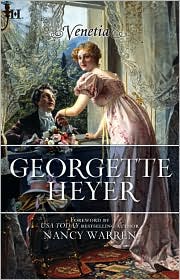
Venetia
First sentence: "A fox got in amongst the hens last night, and ravished our best layer," remarked Miss Lanyon. "A great-grandmother, too! You'd think he would be ashamed!" Receiving no answer, she continued in an altered voice: "Indeed, you would! It is a great deal too bad. What is to be done?"
Premise/plot: Venetia is a woman (25) living with her younger brother, Aubrey (17), and being courted by two equally unsatisfying gentlemen of the neighborhood, Edward Yardley and Oswald Denny. The Lanyon siblings do have an older brother, Conway. But he is in the army, and he hasn't been at Undershaw in years. Venetia and Aubrey do not miss him at all. Life is fairly routine for the two. Until. Lord Damerel ("The Wicked Baron") returns to his estate.
The two meet when she is trespassing on his land. He has no idea who she is. But she has a fairly good idea who he is. Especially after he kisses her! Yes, he kisses her.
"Who are you?" he demanded abruptly. "I took you for a village maiden--probably one of my tenants."He intends to know her better while he's in the neighborhood. Venetia doesn't need a Lady Denny to tell her that would be unwise. But. When her brother, Aubrey, has a riding accident and is saved by none other than Damerel...well, she can't help getting to know him much, much better. And soon they become great friends. Of course, it's a friendship with always a hint of something more...
"Did you indeed? Well, if that is the way you mean to conduct yourself amongst the village maidens you won't win much liking here!"
"No, no, the danger is that I might win too much!" he retorted. "Who are you? Or should I first present myself to you? I'm Damerel, you know."
"Yes, so I supposed, at the outset of our delightful acquaintance. Later, of course, I was sure of it."
"Oh, oh--! My reputation, Iago, my reputation!" he exclaimed laughing again. "Fair Fatality, you are the most unusual female I have encountered in all my thirty-eight years!"
"You can't think how deeply flattered I am!" she assured him. "I daresay my head would be quite turned if I didn't suspect that amongst so many a dozen or so may have slipped from your memory."
"More like a hundred! Am I never to learn your name? I shall, you know, whether you tell me or no!" (33)
Lord Damerel isn't the only newcomer to the neighborhood. Soon Venetia and Aubrey welcome TWO very unexpected house guests. Conway has gotten married--her name is Charlotte. And Charlotte and her mother have come to stay at Undershaw. And the mother is quite the character. How long can Venetia stand to share a home with such a woman? Venetia begins to think about her options...and wishing it was more socially acceptable for her to set up her own home.
My thoughts: I love, love, LOVE Venetia. It is without a doubt my favorite Georgette Heyer novel--at least until I read my next. There are a handful that I do love and adore. But I can never quite forget how magical Venetia is. I love all the characters in this one--the major characters (Lord Damerel, Venetia), the minor characters (Aubrey, Edward Yardley, Oswald Denny, Charlotte, Mrs. Scorrier, etc.) I love the dialogue. I love the story. Venetia IS not your typical heroine--is not Heyer's typical heroine. Lord Damerel may be a somewhat typical rake in the romance genre BUT Venetia keeps him on his toes. They are well paired, well matched.
He laughed out at that, flinging back his head in wholehearted enjoyment, gasping, "why, oh why did I never know you until now?"
"It does seem a pity," she agreed. "I have been thinking so myself, for I always wished for a friend to laugh with."
"To laugh with!" he repeated slowly.
"Perhaps you have friends already who laugh when you do," she said diffidently. "I haven't, and it's important, I think--more important than sympathy in affliction, which you might easily find in someone you positively disliked."
"But to share a sense of the ridiculous prohibits dislike--yes, that's true. And rare! My God, how rare! Do they stare at you, our worthy neighbors, when you laugh?"
"Yes! Or ask me what I mean when I'm joking!" She glanced at the clock above the empty fireplace. "I must go." (64)
"Oh, no, nothing of that nature!" she replied, getting up.
"I allow you all the vices you choose to claim--indeed, I know you for a gamester, and a shocking rake, and a man of sadly unsteady character!--but I'm not so green that I don't recognize in you one virtue at least, and one quality."
"What is that all? How disappointing! What are they?"
"A well-informed mind, and a great deal of kindness," she said, laying her hand on his arm, and beginning to stroll with him back to the house. (99)
© 2019 Becky Laney of Becky's Book Reviews
Wednesday, February 20, 2019
Healing Hearts
First sentence: Miriam Bricks sat in the cramped and rancid interior of a rickety stagecoach and contemplated for the hundredth time how fortunate she was to be there.
Premise/plot: The hero of Healing Hearts, Dr. Gideon MacNamara needs a wife and a nurse. Neither are easy to come by in Savage Wells, Wyoming. He's sent away--mail order--for a woman who's willing to be both. Miriam Bricks is a qualified, experienced nurse. She's more than willing to be his nurse--even to cook his meals--but she's not prepared to marry him--or anyone. Will Dr. MacNamara make the best of a bad situation? YES, yes he will. What he learns about Miriam is that she's a FANTASTIC nurse. She's just as skilled treating patients as she evading questions about her past. What is she hiding from him? from everyone? Will her past come back to threaten her?
My thoughts: I really LOVED this one. It is set in Wyoming in 1876. It definitely has an Old West vibe to it--which I adored. I loved the getting-to-know-one-another aspect of their relationship. As much fun as it would be to have a marriage of convenience turn into the real deal story...this one was oh-so-satisfying. This pacing makes complete sense for Miriam. And it just felt completely right. I also enjoyed meeting the other residents of Savage Wells. And some of the visitors as well! (I know this is book two in a series, but I never once felt lost.)
I would definitely recommend this one. I was thrilled to be a part of the blog tour for this one!
© 2019 Becky Laney of Becky's Book Reviews