Showing posts with label 1936. Show all posts

Tuesday, February 24, 2026

24. Gone With The Wind


24. Gone With The Wind. Margaret Mitchell. 1936. 1037 pages. [Source: Library] [5 stars, audio book, classic fiction, historical fiction, adult romance]

First sentence: Scarlett O’Hara was not beautiful, but men seldom realized it when caught by her charm as the Tarleton twins were.

ETA: I listened on audio this one. It was WONDERFUL on audio. Because it was audio, it slowed me down in the 'reading' and it helped me notice details that perhaps I might have skimmed over in a forgetting way. Then again, it has been a few years since I sat down and read this one.

Premise/plot: Scarlett’s “love” for her brainy neighbor, Ashley Wilkes, prevents her from living happily ever after with Charleston-born bad-boy, Rhett Butler. Set during the war between the states and reconstruction, Gone With The Wind showcases the good, the bad, the ugly—and everything in between—of the American south. An example of the good would be Melanie Hamilton Wilkes. An example of the bad would be Scarlett O’Hara Hamilton Kennedy Butler, our “heroine” who excels at math and manipulation. (But fails completely in being a good human.) An example of the ugly...should I pick the racism, the sexism, or both?! 

Even if you've never read the book, I would imagine you've got a fairly good notion of what Gone With The Wind is about. At least on the surface. It's the story of the spoiled-rotten Scarlett O'Hara and her quest to win her heart's desire through any means possible. Scarlett is one that doesn't ask if it's wrong or right. She only lives by this question--does it get me one step closer to what I want? If it does--then look out!

Scarlett. Rhett. Ashley. You probably know the basics. A woman wants what she can't have. She wants it until she can have it. The moment she has it. She doesn't want it anymore. Scarlett is in a perpetual state of frustration. The man in her bed doing her bidding is rarely the man in her heart.

The book is about much more than Scarlett and her quest for love, however. It's a love story, I won't deny it. But there is much more than love at stake in the novel. War. Reconstruction. Civilization. Society. Culture. Class. Race. Money. Politics. Survival. It's a novel of contrasts. The Old South vs. The New South. Conformity vs. Individuality. The haves vs. the have-nots. If asked to sum up Gone With The Wind in one word, most would probably say "Love." I'd say gumption. People who have it; people who don't. What do I mean by gumption? Partly spirit. Partly courage. Partly determination. Partly ambition. People with gumption act. They do what they must when they must.

One of my favorite non-love scenes from the book is Scarlett's conversation with Grandma Fontaine. A wonderful, wonderful character by the way. The setting is after Gerald's funeral. Scarlett is pregnant with Frank Kennedy's baby. (Yes, the movie killed Gerald, her father, off too soon.)
"We bow to the inevitable. We’re not wheat, we’re buckwheat! When a storm comes along it flattens ripe wheat because it’s dry and can’t bend with the wind. But ripe buckwheat’s got sap in it and it bends. And when the wind has passed, it springs up almost as straight and strong as before. We aren’t a stiff-necked tribe. We’re mighty limber when a hard wind’s blowing, because we know it pays to be limber. When trouble comes we bow to the inevitable without any mouthing, and we work and we smile and we bide our time. And we play along with lesser folks and we take what we can get from them. And when we’re strong enough, we kick the folks whose necks we’ve climbed over. That, my child, is the secret of the survival.” And after a pause, she added: “I pass it on to you.”

The old lady cackled, as if she were amused by her words, despite the venom in them. She looked as if she expected some comment from Scarlett but the words had made little sense to her and she could think of nothing to say. (709-710)

It's a novel that goes above and beyond the central character of Scarlett. Even if you hate Scarlett, I'd imagine you'd find some character to love. Be it Melanie. Rhett. Mammy. Uncle Peter. Grandma Fontaine. How could you not? There are so many characters, so many individual stories. Stories of triumph. Stories of loss. Stories of hope. Stories of disappointment. Stories of survival. Stories of failure. There is depth and meaning that the movie doesn't even try to accommodate. Depth and meaning that even diehard fans can't help but learn something new with each rereading.

My thoughts: I have read this one dozens of times. It is nothing like the movie. You probably doubt me on this. The movie is so iconic, so classic, so beloved that surely it does a good to great job adapting the book to the big screen. But no. Scarlett’s character is definitely more complex and many of the events that shape and mold her most are just not to be found on screen. Several relationships that shed light on Scarlett are never developed because the characters never appear on screen at all. True not every character in Mitchell’s novel can make it to the screen. But some exclusions make no sense. For example, Scarlett having Charles’ baby, Wade, and Frank’s baby, Ella. Or take the existence of Will, a Confederate soldier who stays at Tara after the war and ultimately marries Suellen. Or Archie, a prisoner—murderer—freed close to the end of the war to fight for the Confederacy. He is taken in by the kind-hearted open-minded Melanie. But probably my favorite character that is excluded from the movie is Grandma Fontaine. Her scenes with Scarlett (mainly after the war but before her marriage to Rhett) are among my absolute favorites in the entire book. Her observations on Scarlett are spot-on. Her advice, though not taken or understood, is excellent. But it isn’t just an absence of characters, but scenes or events as well. The tones and themes differ as well.

There were so many transformative moments in the book that fundamentally shape and change Scarlett. PIVOTAL moments that forever leave an impact that the movie simply ignores. So the character in the movie lacks ALL THE LAYERS. This time I read it through the lens of Scarlet's MENTAL HEALTH. How did the trauma impact and change her. HOW does she cope with trauma. DOES she ever process her trauma, her grief, her losses. We know that she copes by avoidance AND drinking alcohol, for example, but we also know those aren't working for her.

Hollywood’s “South” does not resemble Mitchell’s South. One could go ahead and argue that Mitchell’s South bares little resemblance to the actual South. But perhaps that is just its limited perspective. Scarlett, the heroine, does a poor job observing and understanding the world around her. She doesn’t bother with anything requiring deep thought or analysis. She also takes selfishness to an extreme. But the novel isn’t told merely or exclusively through her eyes, it includes other perspectives—both of specific characters and a general omniscient narrator. These would be limited as well. It is set during the war and reconstruction and reflect that mindset. It was written by an author who grew up listening to family stories from those who lived through that time. Her growing up years would have not only been shaped by her personal family but through her community, her culture. It was written over a series of years—late twenties to mid-thirties. Would Mitchell’s text have been viewed as (overly) racist when it was published? Would it have been fitting given the time the novel was set historically and the time it was published? That being said, reading the book today begs for discussion. And not just about race, by the way. By all means talk about the problems in the text. But try to keep context in mind. 

My rule is context, context, context. My second rule is that it is better to discuss and employ critical thinking skills than it is to deny, hide, or censor. There are two contexts for reading Gone With The Wind. The first is that of the author. Margaret Mitchell. A Southern woman growing up in turn-of-the-century America. The 1920s and the 1930s. These were the years that Margaret Mitchell was living and working on her novel. This is the culture and mindset of the author and of the original audience. Gone With The Wind is not alone. It doesn't stand out from the crowd. Many books, many authors used the n-word without batting an eye. Many wrote with the mindset that whites are superior--intellectually at least--to blacks. It doesn't make it true then or now. But that is the mindset. The second is that of the setting of the novel. 1860s-1870s America's South. You can't be true to history without going there. It's a fact in America's history. There's no disputing or denying it. It's not pleasant; it's often ugly. But there you have it. You've got to know where you've been so you can measure how far you've come. And so you can measure how far you've still got to go. America--both as a nation and as a people--has never been perfect. Will probably never be perfect.

As a reader, I can enjoy the story without being brainwashed. I can see. I can question. I can realize when I'm being fed bull. Lines where the former slaves still faithful servants are talking about how they've never wanted freedom??? about how they've never wanted money or independence??? I think I know that Mitchell was full of it. I think most readers can make that division. I hope.


The last chapter was written first. Rhett’s leaving Scarlett was set in stone—inevitable. What does this mean for interpreting the novel? Mitchell never intended a sequel. Didn’t want one. Nothing ambiguous as far as she was concerned. Scarlett had lost Rhett. Rhett’s love for Scarlett was gone with the wind. Her happy ending just as much a lost cause as the Confederacy. But readers like ambiguity. Scarlett is not to be discounted just yet. She will live to fight another day. She will not let go easily. But who will prove more stubborn? Can Rhett withstand Scarlett’s manipulations? Is he really ready to walk away from her forever?

I think Scarlett is at a crossroad. I have no doubt she’ll come out standing, stronger than before. I have no doubt that she’ll prove resilient. But will she get him back?! Much tougher. Because what she needs is a complete, total, radical transformation or change of tactics. Aggressive will not win Rhett back. I’m not sure passive-aggressive will win him back. But perhaps passive, passive, passive, aggressive, passive passive will. Her pursuit of him needs to be so subtle, so layered-ly subtle that no one can even suspects she still wants him back. Can Scarlett pull that off? She’s not good at subtle. Another tactic might be to attract him back by being a better mother. It won’t take much for Scarlett to be better than previously. She’s horrible, absolutely horrible. But if she can learn to treat Wade and Ella with kindness, give them affection and attention, spend time getting to know and understand them. Perhaps Rhett will see her as capable of change, of maturity. Perhaps he can see that she is capable of putting others first, of empathy, of being human. Even if that should fail to get him back, she won’t be alone-alone. Maybe she’ll be a super strong single mother who has healthy relationships with her kids. But is Scarlett capable of this? Does Mitchell write her that way? Does it matter what her intentions are? I hate to think of Scarlett staying the same, of her misery and desperation increasing day by day, week by week, etc. 

 What Scarlett needs though she does not know it—more than a return trip to Tara, more than winning Rhett back—is Jesus Christ. She has a god-shaped hole that can’t be filled with alcohol, with money, with power, with lust, with love.


© 2026 Becky Laney of Becky's Book Reviews

Monday, December 08, 2025

122. Anne of Windy Poplars


Anne of Windy Poplars. L.M. Montgomery. 1936. 288 pages. [Source: Bought]

First sentence:  DEAREST: Isn't that an address! Did you ever hear anything so delicious? Windy Poplars is the name of my new home and I love it. I also love Spook's Lane, which has no legal existence. It should be Trent Street but it is never called Trent Street except on the rare occasions when it is mentioned in the Weekly Courier . . . and then people look at each other and say, 'Where on earth is that?' Spook's Lane it is . . . although for what reason I cannot tell you. I have already asked Rebecca Dew about it, but all she can say is that it has always been Spook's Lane and there was some old yarn years ago of its being haunted. But she has never seen anything worse-looking than herself in it. 

Premise/plot: Anne and Gilbert are engaged at last! But Gilbert still has three years of school to go, and, so Anne finds herself a job as principal of a school in Summerside. Anne of Windy Poplars gives us an intimate look at those three years. Much of the book provides glimpses into the letters Anne writes Gilbert. But there are some traditional chapters as well.

My thoughts: Anne of Windy Poplars is such a delightful (late) addition to the Anne series by L.M. Montgomery. I love, love, love it. Even if Gilbert himself is absent. (We only see her letters to him, never his letters to her.)

This book showcases what Montgomery does BEST: bring her characters to life. It doesn't seem to matter if we spend two paragraphs with a character or two chapters. I CARE about every character she introduces.

Some of the characters we meet in this one: Aunt Kate, Aunt Chatty, Rebecca Dew, Dusty Miller (cats count as characters, right?!), Little Elizabeth, Nora Nelson, Jim Wilcox, Esme Taylor, Dr. Lennox Carter, Cyrus Taylor, Teddy Armstrong, Lewis Allen, Katherine Brooke, Mrs. Adoniram Gibson and Pauline, Cousin Ernestine Bugle, Jarvis Morrow, Dovie Westcott, Frank Westcott.
 

Favorite quotes:

I have a scratchy pen and I can't write love-letters with a scratchy pen...or a sharp pen...or a stub pen. So you'll only get that kind of letter from me when I have exactly the right kind of pen. 
You know I've always been one to whom adventures come unsought. I just seem to attract them, as it were.  
School begins tomorrow. I shall have to teach geometry! Surely that can't be any worse than learning it. 
Isn't it queer that the things we writhe over at night are seldom wicked things? Just humiliating ones.
I don't like reading about martyrs because they always make me feel petty and ashamed...ashamed to admit I hate to get out of bed on frosty mornings and shrink from a visit to the dentist!
Nobody is ever too old to dream. And dreams never grow old.
I said drenched and I mean drenched.
Oh, no, babies are never common," said Anne, bringing a bowl of water for Mrs. Gibson's roses. "Every one is a miracle."
It seems so strange to read over the stories of those old wars...things that can never happen again. I don't suppose any of us will ever have more than an academic interest in 'battles long ago.' It's impossible to think of Canada ever being at war again. I am so thankful that phase of history is over. 
Nobody is ever too old to wear just what she wants to wear. You wouldn't want to wear it if you were too old.


© 2025 Becky Laney of Becky's Book Reviews

Thursday, April 15, 2021

39. The Talisman Ring


The Talisman Ring. Georgette Heyer. 1936/2009. Sourcebooks. 303 pages. [Source: Review copy]

First sentence: Sir Tristram Shield, arriving at Lavenham Court in the wintry dusk, was informed at the door that his great-uncle was very weak, not expected to live many more days out.

Premise/plot: How to introduce this one? Think, think, think. I could mention that it has a heroine that reminds me of Catherine Morland of Northanger Abbey, Jane Austen fame. Because it does. Eustacie de Vauban is silly and impulsive and much too much into romantic novels with daring adventures and dashing, swoon-worthy heroes. She, like Catherine, has an over-active imagination. But, this book isn't her story alone. So maybe that wouldn't quite be fair.

The book opens with a dying old man, the family patriarch, Sylvester, calling his family together. He wants his granddaughter, Eustacie, whom he rescued from France before the revolution got started with all the guillotining, to be safely married. He wants his great-nephew (Sylvester is Tristam's great-uncle), Tristram Shield, to marry her. He decidedly does not want Basil "The Beau" Lavenham to be the man for the job. Though since Ludovic Lavenham's "death" there is really no one closer in the line to inherit his title and his lands. But is Ludovic really dead?

The more time Eustacie spends with Tristram, the more she knows that he is not the one for her. He is not adventurous. He is not romantic. He is not impressed with her storytelling and imagining. He is much too grounded in reality to ever be dashing and heroic. He's simply put not hero material. So Eustacie makes up her mind to run away. In the middle of the night. On horseback. What could be wrong with that?

Well, maybe just maybe as she's running away...she runs right into the middle of a pack of smugglers. Instead of being scared silly. She's in love with the notion. An adventure worthy of any real heroine! Fortunately for her, her kidnapper is none-other than her cousin Ludovic. He's a man already on the outs with the law--charged with a murder several years previous. But is he guilty of that crime?

Can Eustacie (and company) prove Ludovic's innocent of murder? Can they redeem his name, enable him to come out of hiding, and claim what is rightfully his? It will be a massive undertaking and require some help! (Enter Sarah Thane and company).

My thoughts: It can be easy to forget just how much you enjoyed a particular Heyer romance when you've read so many. The Talisman Ring is certainly enjoyable and quite satisfying...even if it doesn't necessarily stay as fresh in one's memory as being a favorite-favorite. I enjoyed the two romances in this one. But above all, I enjoyed the dramatic, suspenseful mystery! It reminded me a bit of the promise of Northanger Abbey, except in this case, there was actually plenty of adventure and danger and mystery!

 A scene between Eustacie and Tristram:

“You would more probably have gone to the guillotine,' replied Sir Tristram, depressingly matter of fact.
'Yes, that is quite true,' agreed Eustacie. 'We used to talk of it, my cousin Henriette and I. We made up our minds we should be entirely brave, not crying, of course, but perhaps a little pale, in a proud way. Henriette wished to go to the guillotine en grande tenue, but that was only because she had a court dress of yellow satin which she thought became her much better than it did really. For me, I think one should wear white to the guillotine if one is quite young, and not carry anything except perhaps a handkerchief. Do you not agree?'
'I don't think it signifies what you wear if you are on your way to the scaffold,' replied Sir Tristram, quite unappreciative of the picture his cousin was dwelling on with such evident admiration.
She looked at him in surprise. 'Don't you? But consider! You would be very sorry for a young girl in a tumbril, dressed all in white, pale, but quite unafraid, and not attending to the canaille at all, but--'
'I should be very sorry for anyone in a tumbril, whatever their age or sex or apparel,' interrupted Sir Tristram.
'You would be more sorry for a young girl--all alone, and perhaps bound,' said Eustacie positively.
'You wouldn't be all alone. There would be a great many other people in the tumbril with you,' said Sir Tristram.
Eustacie eyed him with considerable displeasure. 'In my tumbril there would not have been a great many other people,' she said.” 

© 2021 Becky Laney of Becky's Book Reviews

Thursday, April 01, 2021

31. Ordeal by Hunger


Ordeal by Hunger: The Story of the Donner Party. George R. Stewart. 1936. 392 pages. [Source: Online]

First sentence from the preface: The misadventure of the Donner Party constitutes one of the most amazing stories of that land of amazing stories, the American West. It is worthy of record as a historical document upon what human beings may achieve, endure, and perpetrate, in the final press of circumstance. This account is intended for a full and critical history of that ill-fated band of pioneers, and has been made possible by the remarkable preservation of detailed records. It is strictly factual, based upon the evidence of the sources and upon reasonable deduction from that evidence; it is not fiction.

It almost goes without saying that the Ordeal by Hunger: The Story of the Donner Party won't be for every reader. It is a nonfiction account written in 1936 by George R. Stewart. 

To put the book into a little context, there were two survivors of the Donner Party still living--Naomi Pike and Isabella Breen--when he began his first draft of this nonfiction narrative. Both died before the book's publication--one in the spring of 1934 and the other in the spring of 1935. 

Stewart stresses that this book is nonfiction and not a fictional treatment of the Donner Party. That his narrative is derived from factual accounts. He drew from contemporary letters and journals, works written and published soon after 1847 (including oral testimonies), and works written and published after 1870 (including autobiographies and memoirs). 

The book opens with a decision--a decision to take a shortcut recommended by a fellow named Hastings--that would increasingly prove fatal. It is here with this decision that "the Donner Party" came into existence. These were the wagons that broke away from the main wagon train--who were also going to California but by a different route. 

His narrative provides an overview of the tragic events in 1846/1847. Sometimes his narrative focuses on specific individuals and perhaps may be said to reflect a more personal account of those events. But overall I wouldn't say his narrative style is personal or intimate. His account doesn't so much focus on feelings and emotions--trying to put the reader inside the minds of those who lived and/or died that winter--but on the actions and deeds. 

Contemporary readers may fault Stewart a couple of things. One that his narrative focuses almost exclusively on men (and boys). The narrative doesn't ask if the women were equally heroic, brave, determined, hard-working, and/or strong as the men. Occasionally, he does shift his focus to the women--briefly, very briefly. But honestly the women, for the most part, weren't the decision makers on this trip (or any trip). What choice did a woman have if she disagreed with the decisions? It's not like she could abandon the wagon train, her family, her supplies and set off cross country on her own to try to find a better way to California. 

In the case of the Donner Party, it wouldn't be completely unfair to say it was like the blind leading the blind. They didn't have an actual, physical guide guiding them along the route. They were following some pretty sketchy written guides that didn't exactly prove all that accurate. The decision makers were making best guesses or not-best guesses as the case may be. But they had no way of knowing--after that one big decision coming at the beginning of the book--if their decision would be WISE or FOOLISH. They had no way of knowing/predicting the future.

Another thing that may prove difficult for modern readers in Stewart's text, is his treatment of other races--specifically Native Americans and Mexicans. This mindset when you think about it isn't all that unexpected. He is writing an account of settlers and pioneers traveling in 1846/1847. Manifest Destiny. The West is yours for the taking. It is yours if you want it, if you work for it. COME, COME, COME. That the settlers themselves felt entitled to it, well, it shouldn't be surprising. Many of his sources would have had this perspective or bias. Stewart was also writing in the 1930s. Perhaps western films and shows weren't in their golden era just yet--but if not yet, it was still coming. Now his descriptions of events--the way he phrases things beyond telling the bare facts (which can't be changed, can't be erased, can't be cancelled)--is cringe-worthy and offensive.

Quotes:

If in the story I have told much which is unpleasant and much which the actors themselves would have been glad to let be forgotten, I may at least plead that I have told all in charity. I blame none of the emigrants for their acts during that winter, any more than I should blame a man for his acts during a  delirium. Upon controversial points I have honestly considered  both sides, and have given each a chance to speak, in the notes if not always in the text. 

A microcosm of humanity, to be tested with a severity to which few groups of human beings in recorded history have been subjected, destined to reveal the extremes of which the human body and mind are capable — and yet to the eye of the trapper or wandering Indian merely one more emigrant train going west.  

From the very journey which they made they must indeed be called pioneers, but they cannot be called frontiersmen. They were merely country-folk and townspeople of the middle-west, not mountain-men...By now they had adapted themselves to the routine. To the mere hardships of the life they were inured, used as they were at best to but few of the comforts of civilization. But this was not the life to which they were accustomed. 

Worst of all, they were playing — and they knew it — against Time, and they had lost the first game. 

Hatred and inhumanity walked beside the wagons. 

But in the game which the emigrants were playing against Time, the score could not be evened by a rifle bullet, and it stood heavily against them. During those last days of October snow fell as they moved along. The cattle had to nose through it for grass. On the distant mountains it lay white upon the pine-branches. Winter was in the air; it was bitter cold, and the sky was bleak. 

Sensing the crisis, some of the emigrants urged a bold push forward, but most of them were too exhausted to make a further effort. So they prepared to spend the night as best they could upon the snow. They gathered about the fire, and had something to eat. Then they laid blankets and buffalo-robes on the snow, put the children to bed bundled up as well as possible. The men and women huddled about, some making themselves beds, and some sitting crouched by the fire. They were too weary now; they would cross in the morning. Then it began to snow. 

Back across the lake, as they looked through the darkening atmosphere of the short winter afternoon, they could see the solid rampart of the pass, a mass of snow unbroken except where bare precipices stood darkly out. It was November 4th. The trap which had clicked behind them at Fort Bridget had closed in front. 

Every week now was making a perceptible difference in the emigrants. Beaten upon by blizzards, half starved, they now had more and more difficulty in cutting and dragging firewood through the deep snows. They began to suffer from the cold. About this time they must have begun to notice what afterwards seemed to them so astonishing. The women stood the strain better than the men did. Whether food was apportioned by individuals rather than by size, whether the men did more physical work and therefore expended more energy, whether the constitution of a woman is more enduring than that of a man, whether merely in these individual cases the women were hardier — these questions cannot be surely answered. Most likely several of these factors were at work, but certainly, with some exceptions, the men failed sooner. 

When men abandon a sinking ship, so the stories go, they at first conduct themselves with some degree of steadiness and order. But as the ship lurches more heavily, they feel the tension, and the rhythm quickens until the last moments are a wild running about the decks. Then the boats go down with a run; men leap overboard; and the vessel dips to the final plunge. So the rhythm seems to quicken in the rescue of the Donner Party. Glover’s men had doggedly pushed ahead in a spirit of calculated audacity; Reed’s party had been more hurried; and now Eddy and Foster with their two aids seen by comparison to run, as if they felt the ship settling beneath them.

A little after midday they came to the cabins. They found no one alive. Around them lay a scene of filth and mutilated corpses, even worse than that which earlier relief-parties had been forced to witness. The seven men stood speechless and awestruck, and as the intense silence of the forest seemed to sweep in upon them, even Fallon, the mountain-man, felt the creeping horror. 

Probably the best way to feel the actuality of the story is to travel through its setting. For the country is tangible and solid, now as then. And for this reason, I have in the telling often stressed the scene until the reader has, I hope, come to feel the land itself as one of the chief characters of the tale. 

The very fact that it may be called spectacular should warn us, however, against the fallacy of considering it typical. It is no more typical of the wagon-journey to California than the last voyages of the Titanic and the Lusitania are typical of the trans- Atlantic passage. Emigrants ordinarily suffered hardships along the Humboldt, and had a difficult struggle in getting over the Sierra, but they also had some good times upon the road, and often got through to California in good enough health and spirits.

One turns naturally to the question of what caused the disaster of the Donner Party. It was of course the direct result of their taking the so-called cut-off advocated by Hastings. But who was responsible? I have found widely spread a tendency to blame the emigrants themselves, to consider that they, or at least their leaders, were a pig-headed, ignorant lot who thought they knew more about matters than other people did and who by blundering ahead brought upon themselves pretty much what they deserved. As I have tried to show in the first chapters of this book, such an attitude is not well based.

I do not maintain that the men, or even the women, of the Donner Party were faultless, that they always made the right decisions, or that they were immune from the ordinary human shortcomings, including that of common stupidity. I do not believe, however, that they had more than their share of such weaknesses. And I object strongly to the smug conviction that because they starved to death we of a later day knowing only very different conditions can conclude that it was all their own fault. 

Nevertheless, the cannibalism, although it might almost be called a minor episode, had become in the popular mind the chief fact to be remembered about the Donner Party. For a taboo always allures with as great strength as it repels. 

The story of their ordeal is not pleasant. Few, I fear, will find it always easy reading. But after all, the merely pleasant It is thin and bloodless; a picnic in the park scarcely gives humanity a chance to show of what it is capable. Not of that sort, all will agree, is this adventure in the snow. Here, if anywhere, we see men and women and children put to the final strain of body and spirit. Yet suicide finds no place in the story. And since these too in great part endured, others in evil circumstance may be encouraged to fight boldly. By this, their story may even be said to meet the demands of some that literature should serve an extraneous social purpose. For though despair is often close at hand, it never triumphs, and through all the story runs, a sustaining bond, the primal force which humanity shares with all earthly creatures, the sheer will to live.


© 2021 Becky Laney of Becky's Book Reviews

Friday, November 29, 2019

Gone With The Wind

Gone With The Wind. Margaret Mitchell. 1936. 1037 pages. [Source: Book I Bought]


First sentence: Scarlett O’Hara was not beautiful, but men seldom realized it when caught by her charm as the Tarleton twins were.

Premise/plot: Scarlett’s “love” for her brainy neighbor, Ashley Wilkes, prevents her from living happily ever after with Charleston-born bad-boy, Rhett Butler. Set during the war between the states and reconstruction, Gone With The Wind showcases the good, the bad, the ugly—and everything in between—of the American south. An example of the good would be Melanie Hamilton Wilkes. An example of the bad would be Scarlett O’Hara Hamilton Kennedy Butler, our “heroine” who excels at math and manipulation. (But fails completely in being a good human.) An example of the ugly...should I pick the racism, the sexism, or both?!

My thoughts: I have read this one dozens of times. It is nothing like the movie. You probably doubt me on this. The movie is so iconic, so classic, so beloved that surely it does a good to great job adapting the book to the big screen. But no. Scarlett’s character is definitely more complex and many of the events that shape and mold her most are just not to be found on screen. Several relationships that shed light on Scarlett are never developed because the characters never appear on screen at all. True not every character in Mitchell’s novel can make it to the screen. But some exclusions make no sense. For example, Scarlett having Charles’ baby, Wade, and Frank’s baby, Ella. Or take the existence of Will, a Confederate soldier who stays at Tara after the war and ultimately marries Suellen. Or Archie, a prisoner—murderer—freed close to the end of the war to fight for the Confederacy. He is taken in by the kind-hearted open-minded Melanie. But probably my favorite character that is excluded from the movie is Grandma Fontaine. Her scenes with Scarlett (mainly after the war but before her marriage to Rhett) are among my absolute favorites in the entire book. Her observations on Scarlett are spot-on. Her advice, though not taken or understood, is excellent. But it isn’t just an absence of characters, but scenes or events as well. The tones and themes differ as well.

Hollywood’s “South” does not resemble Mitchell’s South. One could go ahead and argue that Mitchell’s South bares little resemblance to the actual South. But perhaps that is just its limited perspective. Scarlett, the heroine, does a poor job observing and understanding the world around her. She doesn’t bother with anything requiring deep thought or analysis. She also takes selfishness to an extreme. But the novel isn’t told merely or exclusively through her eyes, it includes other perspectives—both of specific characters and a general omniscient narrator. These would be limited as well. It is set during the war and reconstruction and reflect that mindset. It was written by an author who grew up listening to family stories from those who lived through that time. Her growing up years would have not only been shaped by her personal family but through her community, her culture. It was written over a series of years—late twenties to mid-thirties. Would Mitchell’s text have been viewed as (overly) racist when it was published? Would it have been fitting given the time the novel was set historically and the time it was published? That being said, reading the book today begs for discussion. And not just about race, by the way. By all means talk about the problems in the text. But try to keep context in mind.

I mentioned sexism earlier. I don’t typically read books—classics through a feminist lens. But in light of #metoo...it’s hard not to see that the novel has some issues, some examples. The characters are very judgmental, extremely so. If a woman is assaulted outside her home, she’s to blame for leaving it. Many, many actions are seen as being forward, asking for it, unladylike. Different situations prove “compromising.” Here we have a whole other mindset of sexuality. But the issue of Rhett can’t be ignored. He is aggressive, in some cases, assaulting. It’s all written off with a grin because Scarlett gets “swept up” and ends up reciprocating his passion. But to Rhett, no doesn’t mean no. Scarlett is his to possess or to reject. No locked doors could keep him out of her room, out of her bed...if....he wanted her. Rhett has all the power. And for Scarlett to admit to herself or to anyone else that she actually enjoys sex...it’s not going to happen. The situations are definitely complex and perhaps worth discussing. Perhaps in light of how rape has historically been depicted in women’s fiction and romance novels. Many by women authors. Heroes must be strong, bold, aggressive, assertive, take what they want. What kind of sense does it make for women to fall in love and stay in love with their rapists? What kind of sense does it make for readers to love such literature? To accept, even expect, such “love” scenes. I am thinking beyond Gone With The Wind. Everything is subtle or mostly subtle in this one. Nothing overly graphic or smutty. Nothing that would obviously need censoring.

Then there are Scarlett’s lack of choices at the time she lived....

The last chapter was written first. Rhett’s leaving Scarlett was set in stone—inevitable. What does this mean for interpreting the novel? Mitchell never intended a sequel. Didn’t want one. Nothing ambiguous as far as she was concerned. Scarlett had lost Rhett. Rhett’s love for Scarlett was gone with the wind. Her happy ending just as much a lost cause as the Confederacy. But readers like ambiguity. Scarlett is not to be discounted just yet. She will live to fight another day. She will not let go easily. But who will prove more stubborn? Can Rhett withstand Scarlett’s manipulations? Is he really ready to walk away from her forever?

I think Scarlett is at a crossroad. I have no doubt she’ll come out standing, stronger than before. I have no doubt that she’ll prove resilient. But will she get him back?! Much tougher. Because what she needs is a complete, total, radical transformation or change of tactics. Aggressive will not win Rhett back. I’m not sure passive-aggressive will win him back. But perhaps passive, passive, passive, aggressive, passive passive will. Her pursuit of him needs to be so subtle, so layered-ly subtle that no one can even suspects she still wants him back. Can Scarlett pull that off? She’s not good at subtle. Another tactic might be to attract him back by being a better mother. It won’t take much for Scarlett to be better than previously. She’s horrible, absolutely horrible. But if she can learn to treat Wade and Ella with kindness, give them affection and attention, spend time getting to know and understand them. Perhaps Rhett will see her as capable of change, of maturity. Perhaps he can see that she is capable of putting others first, of empathy, of being human. Even if that should fail to get him back, she won’t be alone-alone. Maybe she’ll be a super strong single mother who has healthy relationships with her kids. But is Scarlett capable of this? Does Mitchell write her that way? Does it matter what her intentions are? I hate to think of Scarlett staying the same, of her misery and desperation increasing day by day, week by week, etc. What Scarlett needs though she does not know it—more than a return trip to Tara, more than winning Rhett back—is Jesus Christ. She has a god-shaped hole that can’t be filled with alcohol, with money, with power, with lust, with love.
© 2019 Becky Laney of Becky's Book Reviews

Monday, April 22, 2019

Miss Buncle Married

Miss Buncle Married. (Miss Buncle #2) D.E. Stevenson. 1936. 352 pages. [Source: Library]

First sentence: "We had better move," said Mr. Abbott casually.

Premise/plot: If you haven't read Miss Buncle's Book, then you should--you really should. This is the second book in the series. Miss Buncle has given up writing--or has she?--and she's settled down with her publisher, Arthur Abbott. The two are newlyweds looking for their dream home. Well, she is the one mostly doing all the hard work. He's left it up to her--mostly. And does she find her dream home? YES. Though it doesn't appear perfectly dreamy and wonderful at first or second glance. Far from it. They are settling in the village of Wandlebury.

Most of the book is about them settling down into the neighborhood and making friends. Sam, Mr. Abbot's nephew, visits a great deal. Could he be falling madly in love with one of the country girls?! Could Miss Buncle be playing matchmaker?!

At one point, Miss Buncle does write again....but will there be a third book published?!

My thoughts: I loved, loved, loved, LOVED the first book. I really liked the second book. I found the first book to be more entertaining. Miss Buncle had written one book and had it published and was in the process of writing a second book. The village was REACTING to the first book. And it provided hilariously entertaining moments. All of this is missing in the second book. Miss Buncle is still Miss Buncle. But it's mainly just the two meeting their neighbors, socializing, trying to get out of socializing, enjoying cozy evenings together. Sam and Jerry's courtship provides most of the action and even then it isn't a thrilling read. But do books have to be thrilling to be enjoyable? I don't think they do.

Quotes:
  • She might or might not have "an imagination" (Arthur could not be sure of that), but she certainly had an extraordinary power of getting underneath people's skins. Without being conscious of it herself she was able to sum up a person or situation in a few minutes. People's very bones were bare to her--and she had no idea of it. (75)
  • In a new friend we start life anew, for we create a new edition of ourselves and so become, for the time being, a new creature. (152)
  • An author does not consciously create his characters, they come to him readymade with all their characteristics firmly fixed, and the author can do nothing with his character but accept or reject him. He cannot change or modify the personality that has arisen without making him unreal. (236)

S
P
O
I
L
E
R

Some reviewers seem to be quite disappointed that Miss Buncle is no longer writing. They are upset that she's "given up her career" now that she's married. I am not one of them. I think Barbara writes when she's inspired. I think if she gets inspired, she'll write. But the joy comes for her not in the publication but in the act of writing. She doesn't care if John Smith has another bestseller. She has witnessed the harm that the blunt truth can do to a community. She has no desire to move every single time she publishes a new book. She has found a place to belong, to call home, a place she wants to LIVE. She didn't have that before. But now she has. She doesn't want to disrupt things. She's choosing her personal happiness over "fame" for John Smith. Here's the thing...John Smith isn't real. He was necessary for a time. But now he's not.

© 2019 Becky Laney of Becky's Book Reviews

Monday, January 28, 2019

Ballet Shoes

Ballet Shoes. (Shoes #1) Noel Streatfeild. 1936/2018. Random House. 256 pages. [Source: Library]

 First sentence: The Fossil sisters lived in the Cromwell Road.

Premise/plot: Pauline, Petrova, and Posy are the Fossil sisters--not related by blood, perhaps--but sisters all the same. Each was adopted by gum--Great Uncle Matthew. He is an ADVENTURER. And on three of his trips he brought home children--babies--instead of just fossils. While he is away, the children are being raised by Sylvia (Matthew's great-niece), Nana, and Cook. When money runs low, it's decided that they will take boarders. As the children grow they enter a special school that teaches acting, singing, dancing, performing. The children can begin earning money when they're twelve by performing...

The children have vowed repeatedly throughout the book to make the name of FOSSIL famous....will they?

My thoughts: I enjoyed rereading Ballet Shoes. It's been nine years since I've last read it! I definitely appreciated it more this time. That is one reason why I love to reread books. Sometimes once isn't enough.

Quotes:
They went to church--even Posy--and sang, "Hark, the Herald Angels," "O Come, All Ye Faithful," and "The First Noel." They had been afraid that perhaps they would only get one that they knew and the rest some dull tune that was supposed to belong to Christmas and did not really. (69)
Original audience born circa 1924 to 1928.

© 2019 Becky Laney of Becky's Book Reviews

Wednesday, July 18, 2018

Roller Skates

Roller Skates. Ruth Sawyer. 1936. 186 pages. [Source: Bought]

First sentence: Spring has come; windows are open.

Premise/plot: Roller Skates is set in New York City in the 1890s. Lucinda Wyman, our roller-skating heroine, will be staying with the Misses Peters (Miss Peters, Miss Nettie) while her parents go abroad for a year. She'll still have to visit her prim and proper relatives once a week, but, most of her time is her own...and she'll use it to make friends with anyone and everyone regardless of their age, gender, and/or social class.

My thoughts: If I'd read this book in one or two days instead of three or four weeks, would I have liked it better? Probably. Reading one or two chapters per week killed the enjoyment I might have gotten from the story.

To be honest the introduction also unsettled me a bit. Who is narrating the introduction? Who is the unnamed old friend Lucinda is visiting? How many years have passed? Were they children together? Or is the unnamed old friend one of the adult friends she made? Is the unnamed friend a man or a woman? Why did Lucinda give this person her diary? And why didn't the book END with her giving someone her diary? Why did the end absolutely not tie back to the introduction at all?

I will need to reread this at some point to give it a better chance to charm me.


© 2018 Becky Laney of Becky's Book Reviews

Sunday, October 16, 2016

Anne of Windy Poplars

Anne of Windy Poplars. L.M. Montgomery. 1936. 288 pages. [Source: Bought]

First sentence:  DEAREST: Isn't that an address! Did you ever hear anything so delicious? Windy Poplars is the name of my new home and I love it. I also love Spook's Lane, which has no legal existence. It should be Trent Street but it is never called Trent Street except on the rare occasions when it is mentioned in the Weekly Courier . . . and then people look at each other and say, 'Where on earth is that?' Spook's Lane it is . . . although for what reason I cannot tell you. I have already asked Rebecca Dew about it, but all she can say is that it has always been Spook's Lane and there was some old yarn years ago of its being haunted. But she has never seen anything worse-looking than herself in it. 

Premise/plot: Anne and Gilbert are engaged at last! But Gilbert still has three years of school to go, and, so Anne finds herself a job as principal of a school in Summerside. Anne of Windy Poplars gives us an intimate look at those three years. Much of the book provides glimpses into the letters Anne writes Gilbert. But there are some traditional chapters as well.

My thoughts: Anne of Windy Poplars is such a delightful (late) addition to the Anne series by L.M. Montgomery. I love, love, love it. Even if Gilbert himself is absent. (We only see her letters to him, never his letters to her.)

This book showcases what Montgomery does BEST: bring her characters to life. It doesn't seem to matter if we spend two paragraphs with a character or two chapters. I CARE about every character she introduces.

Some of the characters we meet in this one: Aunt Kate, Aunt Chatty, Rebecca Dew, Dusty Miller (cats count as characters, right?!), Little Elizabeth, Nora Nelson, Jim Wilcox, Esme Taylor, Dr. Lennox Carter, Cyrus Taylor, Teddy Armstrong, Lewis Allen, Katherine Brooke, Mrs. Adoniram Gibson and Pauline, Cousin Ernestine Bugle, Jarvis Morrow, Dovie Westcott, Frank Westcott.


© 2016 Becky Laney of Becky's Book Reviews

Thursday, April 21, 2016

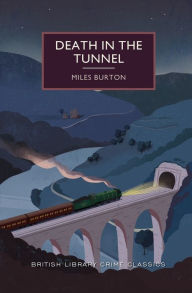
Death in the Tunnel

Death in the Tunnel. Miles Burton. 1936/2016. Poisoned Pen Press. 232 pages. [Source: Review copy]

Though I may not have loved, loved, loved Death in the Tunnel by Miles Burton, I did find it a thoroughly enjoyable read. The murder in this murder mystery happens early on--in the first few page. And this murder occurs on a train--in a train tunnel. Two men set about solving this mystery, Desmond Merrion (who has his own series, this is #13) and Inspector Arnold (from Scotland Yard). The victim is a businessman, Sir Wilfred Saxonby. The murder was made to look like a suicide--a gun with the victim's initials are found in his compartment. Nothing was stolen from his body, from his wallet. His compartment was locked. But there are several reasons why this suicide theory doesn't sit right with Merrion and Arnold. Can they sift through the dozens of clues to find the murderer? Can they agree upon a believable motive for the crime?

Death in the Tunnel is certainly not a character-driven novel. I would say that character development is kept to a bare minimum. But the abundance of clues and the way that they are shared with readers, keeps one reading to see who did it.

The novel was first published in 1936. It has recently been republished. I am glad to see more golden-age mystery novels being brought back into print. This is one of my favorite genres.

© 2016 Becky Laney of Becky's Book Reviews

Wednesday, February 25, 2015

Case of the Stuttering Bishop

The Case of the Stuttering Bishop. (Perry Mason #9) Erle Stanley Gardner. 1936. 189 pages. [Source: Bought]

I love watching Perry Mason. I do. It's one of my favorite shows. Do I love reading about Perry Mason as much as watching Perry Mason? Maybe not quite as much. But I certainly enjoy it. I find them easy and satisfying. The Case of the Stuttering Bishop is one of the better ones I've read. It was adapted for the show's second season--which explains why it felt so very familiar while I was reading it.

The book opens with a bishop going to Perry Mason for advice. What Perry and Della find most disturbing about this visit is the fact that this bishop from Australia stutters. His stuttering leads them to believe that he may not be who he claims to be, that the whole case he's presented them with may be filled with lies. Curious they are, no doubt, which is why they get Paul Drake on the case.

Clues come out with each chapter, the story unfolds bit by bit. Perry Mason, Della, and Paul work together to try to find out the real story, to determine who is lying and who is telling the truth. I won't go into any of the details or specifics here. Details in reviews spoil mysteries often.

If you enjoy watching Perry Mason, chances are you'll enjoy reading this one.


© 2015 Becky Laney of Becky's Book Reviews

Friday, February 20, 2015

Winterbound (1936)

Winterbound. Margery Williams Bianco. 1936/2014. Dover. 234 pages. [Source: Bought]

Did I love Winterbound the same way I loved Margery Williams' Velveteen Rabbit. NO! I want to be honest about that from the start. Winterbound is not nearly as charming and lovely and wonderful as The Velveteen Rabbit. But with the right expectations, Winterbound could work for some readers.

Winterbound is about four siblings living on their own in a rented house in rural New England with both parents away. The father is an archaeologist,  if I'm remembering correctly. He'll be gone for a year or two. The mother's absence is more sudden. She goes to take care of a sick relative in New Mexico.  The family--three girls, one boy--were raised in the city. This is their first time 'experiencing' country life. This is also their first time being independent. The two oldest are nearly-grown--upper teens. Kay. Garry (short for Margaret). Caroline. Martin.

Is the book about anything? Yes and no.

It is a coming-of-age story for both Kay and Garry, in a way. Both are learning who they are as individuals: what they like, love, want, need, etc. Both are thinking ahead, thinking about the future: who they want to be, what they want their lives to look like, how they plan to earn money, etc. I think it's good to approach this one as an "Am I ready to be an adult?" book.

It is a book about family and friendship. All of the siblings make friends within the community. And, of course, there's always their relationships with each other. The sections when they're spending time with their best friends are always enjoyable. Plenty of storytelling.

It is a book about rural life, seasons, and nature. When you see the title don't think LONG WINTER, that isn't fair to this book at all. This book isn't so much about winter, as it is about all the seasons. Yes, the four face a difficult week or two when they're isolated because of too much snowfall, a blizzard perhaps. But that's just a tiny part of the book as a whole. It's just as much about all four seasons.

It is a slower-paced book, I admit. Not every book has to be action-packed and full of adventure and drama. But I wouldn't say that nothing happens. The focus is on the ordinary.

© 2015 Becky Laney of Becky's Book Reviews

Sunday, November 24, 2013

Sunday Salon: Reading Anne of Windy Poplars

Anne of Windy Poplars. L.M. Montgomery. 1936. 288 pages. [Source: Bought]

Anne of Windy Poplars is such a lovely little epistolary novel. Readers are privileged to share in some of Anne's letters to her beloved Gilbert. In these letters there are hundreds (if not thousands) of character sketches sharing details about Anne's life and new experiences as she teaches at a high school in Summerside, Prince Edward Island. (Highlights include Rebecca Dew, "Little Elizabeth" (Grayson), Katherine Brooke, Aunt Chatty and Aunt Kate, Jen Pringle, Mrs. Gibson, Lewis Allen, Teddy Armstrong (Little Fellow), Gerald and Geraldine (the twins she babysits...once), Jarvis Morrow, Dovie Westcott, Miss Minerva Tomgallon, etc.) Some people just get a brief sentence or two, but oh what Montgomery can do with just a few sentences or even a few words! Montgomery, at her very best, can bring more life and humanity to a character than a good many contemporary writers do in an entire novel. Other characters have whole episodes about them. For example, readers really get to spend some time with Katherine Brooke! One of my favorite episodes--if episode is the right word--is Anne and Lewis out canvassing for subscriptions to the drama club. They meet a "little fellow" named Teddy Armstrong. That story just gets me every single time! Montgomery can bring me to near tears and yet not feel manipulative. How does she do that?!

Have you read Anne of Windy Poplars? How do you think it fits in with the rest of the series? Do you have a favorite character?

Favorite quotes:
I have a scratchy pen and I can't write love-letters with a scratchy pen...or a sharp pen...or a stub pen. So you'll only get that kind of letter from me when I have exactly the right kind of pen. 
You know I've always been one to whom adventures come unsought. I just seem to attract them, as it were.  
School begins tomorrow. I shall have to teach geometry! Surely that can't be any worse than learning it. 
Isn't it queer that the things we writhe over at night are seldom wicked things? Just humiliating ones.
I don't like reading about martyrs because they always make me feel petty and ashamed...ashamed to admit I hate to get out of bed on frosty mornings and shrink from a visit to the dentist!
Nobody is ever too old to dream. And dreams never grow old.
I said drenched and I mean drenched.
Oh, no, babies are never common," said Anne, bringing a bowl of water for Mrs. Gibson's roses. "Every one is a miracle."
It seems so strange to read over the stories of those old wars...things that can never happen again. I don't suppose any of us will ever have more than an academic interest in 'battles long ago.' It's impossible to think of Canada ever being at war again. I am so thankful that phase of history is over. 
Nobody is ever too old to wear just what she wants to wear. You wouldn't want to wear it if you were too old. 

© 2013 Becky Laney of Becky's Book Reviews

Wednesday, June 19, 2013

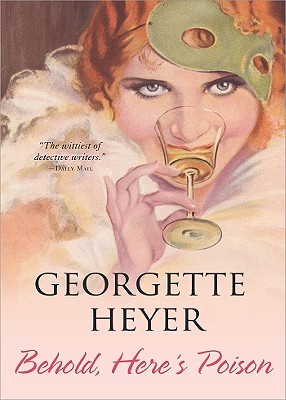
Behold, Here's Poison (1936)

Behold, Here's Poison. Georgette Heyer. 1936/2009. Sourcebooks. 330 pages.

I definitely LOVED this mystery by Georgette Heyer. Gregory Matthews has been poisoned. At first, the family assumed his death was of natural causes, but one insistent aunt sees differently. The aunt's instincts proved correct: he was poisoned by nicotine! Inspector Hannasyde and Inspector Hemingway are assigned the case. I have come to appreciate Inspector Hannasyde very much! (I also LOVED seeing Giles Carrington again!)

The entire family is on the list of suspects. And to be honest, the family is that dysfunctional so it would make sense that the suspect list would be a long one.

I enjoyed this one for the characters. (I loved Stella, and Randall definitely grew on me!!!) I found this one oh-so-satisfying.

© 2013 Becky Laney of Becky's Book Reviews

Thursday, June 06, 2013

The Red Box (1936)

The Red Box. Nero Wolfe. (Nero Wolfe #4) 1936. 266 pages.

I really enjoyed The Red Box by Rex Stout. It is the fourth mystery in the Nero Wolfe series. In this one, Archie Goodwin and Nero Wolfe are trying to solve a murder. A young woman has been murdered--death by chocolate; the almond candy in a box of luxurious candy was poisoned. No one is admitting knowledge of where the box of candies came from. So was this young woman, Molly Lauck, the intended victim? Wolfe doesn't think so. He's convinced the killer will make another attempt. Can he solve the crime in time to prevent a second death?

I really love Rex Stout's Nero Wolfe series. I love Archie Goodwin and Nero Wolfe. The series is very enjoyable. I would definitely recommend! 

Others in the series include: The Doorbell RangThe League of Frightened Men, The Rubber Band, Black Orchids. Silent Speaker. Some Buried Caesar. The Golden Spiders. Death of a Doxy. Three at Wolfe's Door. Too Many Cooks. Fer-de-lance. Too Many Women. Champagne for One.

© 2013 Becky Laney of Becky's Book Reviews

Tuesday, May 28, 2013

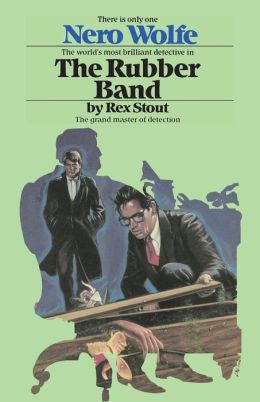
The Rubber Band (1936)

The Rubber Band. (Nero Wolfe #3) Rex Stout. 190 pages.

I threw down the magazine section of the Sunday Times and yawned. I looked at Nero Wolfe and yawned again. 

 I was slightly disappointed in my most recent Nero Wolfe read, The League of Frightened Men. But I just LOVED, LOVED, LOVED The Rubber Band. It reminded me of why I enjoy the Nero Wolfe stories so much. It had plenty of Nero Wolfe and Archie Goodwin! It also featured plenty of interaction with Inspector Cramer.

Nero Wolfe has plenty of potential clients in this one because several people have come to him with their problems. But which client will he accept, and why?!

This murder mystery has multiple victims. I could try to summarize the mystery, but why spoil the fun?!

Favorite quotes:
There's just as many honest men here as the other side of the mountain. And just as few. I'm one. I'm so damn honest I often double-cross myself. Nero Wolfe is almost as bad. (19)
It is not always practicable to sneer at mud; there's too much of it. (31)
The avoidance of idiocy should be the primary and constant concern of every intelligent person. It is mine. I am sometimes successful. (44)
Okay. I'll gargle my milk. It'll probably be my last chance for that innocent amusement before they toss us in the hoosegow. I remember you told me once that there is no moment in any man's life too empty to be dramatized. (76) 
No guy who knows he's right because he's too conceited to be wrong can be expected to go into conference about it. (167)
© 2013 Becky Laney of Becky's Book Reviews

Tuesday, March 05, 2013

The Talisman Ring (1936)

The Talisman Ring. Georgette Heyer. 1936/2009. Sourcebooks. 316 pages.

It can be easy to forget just how much you enjoyed a particular Heyer romance when you've read so many. The Talisman Ring is certainly enjoyable and quite satisfying...even if it doesn't necessarily stay as fresh in one's memory as being a favorite-favorite. I enjoyed the two romances in this one. But above all, I enjoyed the dramatic, suspenseful mystery! It reminded me a bit of the promise of Northanger Abbey, except in this case, there was actually plenty of adventure and danger and mystery!

One of the heroines, Eustacie, is quite fun because she is so over-the-top silly and dramatic. She CRAVES romantic adventures and dangers--the stuff of novels. While she's willing to settle, to a certain degree, for a marriage of convenience, she really, truly wants a soul mate just as imaginative and expressive as she is. She wants to be made much of, she wants to be adored, she wants to be rescued, she wants to feel like life is one thrill after another. Her grandfather wants her to marry one cousin, Tristam Shield, one of the heroes of the novel; but these two just do not suit one another! They would drive each other crazy if the marriage actually took place! But Eustacie is determined to run away--in the middle of the night. And oh the adventure she stumbles into that night, SMUGGLERS. How perfect, how romantic. One of the smugglers turns out to be another cousin, Ludovic, a man who had to flee England several years earlier because he's suspected of murder....

And that's just the start!

A scene between Eustacie and Tristam:
“You would more probably have gone to the guillotine,' replied Sir Tristram, depressingly matter of fact.
'Yes, that is quite true,' agreed Eustacie. 'We used to talk of it, my cousin Henriette and I. We made up our minds we should be entirely brave, not crying, of course, but perhaps a little pale, in a proud way. Henriette wished to go to the guillotine en grande tenue, but that was only because she had a court dress of yellow satin which she thought became her much better than it did really. For me, I think one should wear white to the guillotine if one is quite young, and not carry anything except perhaps a handkerchief. Do you not agree?'
'I don't think it signifies what you wear if you are on your way to the scaffold,' replied Sir Tristram, quite unappreciative of the picture his cousin was dwelling on with such evident admiration.
She looked at him in surprise. 'Don't you? But consider! You would be very sorry for a young girl in a tumbril, dressed all in white, pale, but quite unafraid, and not attending to the canaille at all, but--'
'I should be very sorry for anyone in a tumbril, whatever their age or sex or apparel,' interrupted Sir Tristram.
'You would be more sorry for a young girl--all alone, and perhaps bound,' said Eustacie positively.
'You wouldn't be all alone. There would be a great many other people in the tumbril with you,' said Sir Tristram.
Eustacie eyed him with considerable displeasure. 'In my tumbril there would not have been a great many other people,' she said.” 
I loved this one; I just LOVED it. It's so delightful and fun! I am just loving my 2013 project of reading and rereading all of Georgette Heyer's romances in chronological order!

Read The Talisman Ring
  • If you enjoyed Northanger Abbey
  • If you enjoy historical romance with a good bit of mystery
  • If you like drama, romance, mystery, adventure set in the 1790s
  • If you enjoy Georgette Heyer

© 2013 Becky Laney of Becky's Book Reviews
Saturday, December 03, 2011

A Shilling for Candles

A Shilling for Candles. Josephine Tey. 1936. 240 pages.

First sentence: It was a little after seven on a summer morning, and William Potticary was taking his accustomed way over the short down grass of the cliff-top. Beyond his elbow, two hundred feet below, lay the Channel, very still and shining, like a milky opal.
A man discovers the body of an actress...and it is up to Inspector Grant to find her murderer.

This is the third Josephine Tey mystery novel I've read, and, it happens to be my least favorite. And I'm not even sure why I found it so disappointing. Inspector Grant has charmed me in the past, and I've appreciated the way he's gone about solving mysteries or crimes. In this one, he didn't seem to shine. In fact he seemed to disappear for chapters a time.  I don't know if I was just imagining that or if it  was really the case. There was just a great  disconnect in this one. I didn't find it satisfying at all.

I did love Daughter of Time. And I enjoyed The Man in the Queue.


© 2011 Becky Laney of Becky's Book Reviews

Saturday, January 22, 2011

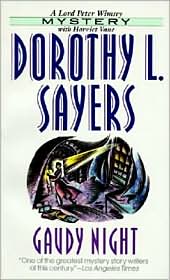
Gaudy Night

Gaudy Night. Dorothy L. Sayers. 1936/1995. HarperCollins. 512 pages.

Harriet Vane sat at her writing-table and stared out into Mecklenburg Square. The late tulips made a brave show in the Square garden, and a quartet of early tennis-players were energetically calling the score of a rather erratic and unpracticed game. But Harriet saw neither tulips nor tennis-players.

This is the third novel starring Lord Peter Wimsey and Harriet Vane. The first two being Strong Poison and Have His Carcase. Both featured Lord Peter prominently. In the first, he "rescued" an accused murderess, Harriet Vane, she stood accused of poisoning her former lover. In a little under a month, he proved his love by proving her innocence. Upon their first meeting, he proposed. It was--for him--love at first sight. In the second, Lord Peter proves helpful once again when Harriet discovers a dead body on the beach. He doesn't even wait for there to be a sign of trouble, he's there on the spot to do what he does best.

In the third novel, Lord Peter is strangely absent for the first half of the novel. At first, this irritated me. I mean, I want LORD PETER to be appearing in every chapter--if not on every page. I mean, I just can't get enough of him. I LOVE AND ADORE him. But. I think his absence serves at least two purposes. First, I think it reflects the times surprisingly well. Sayers has Lord Peter working for the Foreign Office; she has Lord Peter off in Europe trying to be a peacemaker. There are a few conversations that reflect that all is not as it should be in Europe, in the world, that there are tremors of political turmoil and uprising. That another war may be coming. Second, I think it's for Harriet's benefit. With Peter gone, she realizes--perhaps a little too slowly for this reader--just how much she needs him. Needs him not to "rescue" her perhaps though he has a way of doing just that. But needs him--as in needs his company, his humor, his wit, his strength, his intelligence. She almost aches for him. If that makes sense. So Harriet and I were both in the same place (for a change), we were both wanting Lord Peter, longing to hear his voice again.

So what is Gaudy Night about? Well, Harriet Vane has returned to Oxford, to her college (Shrewsbury College). At first this return is just for the "Gaudy" reunion. But. After the women's college experiences a series of pranks and other (small) crimes, she's called back to lend a hand in the investigation. They don't want to go to the police. They don't want outsiders to know that there is someone writing obscene letters and destroying college property. Since these letters are anti-feminist--the person writing them obviously feels that women should not be educated or work outside the home. A large part of this one is set in an academic environment. It features a handful of women discussing big issues of the day. It was hard, for me, to keep track of all the new characters introduced. All the women professors, tutors, dons, and students. But there was one new character that was unforgettable: Lord Peter's nephew, Lord St. George! (I really, really liked him!) As the months go by, the crimes start to change. The case may prove a little too challenging to solve all on her own, but Lord Peter can't stay away forever. And together, they may just do more than solve the case...

I enjoyed the romance in Gaudy Night. I enjoyed seeing Lord Peter through different eyes. (For example, Wimsey is discussed by a good many women at the college. Sometimes in a flattering way, sometimes not. But it is interesting to see Harriet's reaction to other people's opinion of Lord Peter. When she sees that Lord Peter is a desirable man in other women's eyes, well, it doesn't hurt the situation any!) I loved the characterization too. I loved Lord St. George and Reggie Pomfret, for example.  I wasn't such a big fan of the mystery plot in this one--it wasn't much of a surprise to me who was at fault. But overall, the writing still worked well for me.

Favorite quotes:

"How all occasions do inform against me!" muttered Harriet to herself. One would have thought that Oxford at least would offer a respite from Peter Wimsey and the marriage question. But although she herself was a notoriety, if not precisely a celebrity, it was an annoying fact that Peter was a still more spectacular celebrity, and that, of the two, people would rather know about him than about her. As regards marriage--well, here one certainly had a chance to find out whether it worked or not. Was it worse to be a Mary Atwood (nee Stokes) or a Miss Schuster-Slatt? Was it better to be a Phoebe Bancroft (nee Tucker) or a Miss Lydgate? And would all these people have turned out exactly the same, married or single? (46)

"Do you know any man who sincerely admires a woman for her brains?"
"Well, said Harriet, "certainly not many."
"You may think you know one," said Miss Hillyard, with a bitter emphasis. "Most of us think at some time or other that we know one. But the man usually has some other little axe to grind." (55)

"Peter" said Harriet. And with the sound of her own voice she came drowsing and floating up out of the strong circle of his arms, through a green sea of sun-dappled beechleaves into darkness. "Oh damn," said Harriet softly to herself. "Oh, damn, I didn't want to wake up." The clock in the New Quad struck three musically. "This won't do," said Harriet. "This really will not do. My sub-conscious has a most treacherous imagination." She groped for the switch of her bedside lamp, "It's disquieting to reflect that one's dreams never symbolize one's real wishes, but always something Much Worse." She turned the light on and sat up. "If I really wanted to be passionately embraced by Peter,  I should dream of something like dentists or gardening." (113)

If you learn how to tackle one subject--any subject--you've learnt how to tackle all subjects. (171)

"But what's Mock Turtle about?" inquired Harriet? On this point the authors were for the most part vague; but a young man who wrote humorous magazine stories, and could therefore afford to be wide-minded about novels, said he had read it and thought it rather interesting, only a bit long. It was about a swimming instructor at a watering place, who had contracted such an unfortunate anti-nudity complex through watching so many bathing-beauties that it completely inhibited all his natural emotions. So he got a job on a whaler and fell in love at first sight with an Eskimo, because she was such a beautiful bundle of garments. So he married her and brought her back to live in a suburb, where she fell in love with a vegetarian nudist. So then the husband went slightly mad and contracted a complex about giant turtles, and spent all his spare time staring into the turtle tank at the Aquarium, and watching the strange, slow monsters swimming significantly round in their encasing shells. But of course a lot of things into it--it was one of those books that reflect the author's reaction to Things in General. Altogether, significant was, he thought, the word to describe it. (233)

"He's a precocious little monkey," said his uncle, without enthusiasm. "Though I can't blame him for that; it runs in the blood. But it's characteristic of his impudence that he should have gate-crashed your acquaintance, after you had firmly refused to meet any of my people."
"I found him for myself, you see, Peter."
"Literally, or so he says. I gather that he nearly knocked you down, damaged your property and generally made a nuisance of himself, and that you instantly concluded he must be some relation to me."
"That's--If he said that, you know better than to believe it. But I couldn't very well miss the likeness."
"Yet people have been known to speak slightingly of my personal appearance! I congratulate you on a perception worthy of Sherlock Holmes at his keenest." (308)

How fleeting are all human passions compared with the massive continuity of ducks... (325)

"Do you find it easy to get drunk on words?"
"So easy that, to tell you the truth, I am seldom perfectly sober. Which accounts for my talking so much." (330)

"Something worried you about this room. What was it?"
"You don't need to be told."
"No, I am convinced that our two hearts beat as one. But tell Miss Martin." (345)

"Just exercise your devastating talent for keeping to the point and speaking the truth."
"That sounds easy."
"It is--for you. That's what I love you for. Didn't you know?" (365)

"I don't know. I have a reputation for flippant insincerity. You think I'm honest?"
"I know you are. I couldn't imagine your being anything else." (382)

It is said that love and a cough cannot be hid. (427)

© 2011 Becky Laney of Becky's Book Reviews

Friday, May 29, 2009

The Talisman Ring


Heyer, Georgette. 1936/2009. The Talisman Ring. Sourcebooks. 303 pages.

How to introduce this one? Think, think, think. I could mention that it has a heroine that reminds me of Catherine Morland of Northanger Abbey, Jane Austen fame. Because it does. Eustacie de Vauban is silly and impulsive and much too much into romantic novels with daring adventures and dashing, swoon-worthy heroes. She, like Catherine, has an over-active imagination. But, this book isn't her story alone. So maybe that wouldn't quite be fair.

The book opens with a dying old man, the family patriarch, Sylvester, calling his family together. He wants his granddaughter, Eustacie, whom he rescued from France before the revolution got started with all the guillotining, to be safely married. He wants his great-nephew (Sylvester is Tristam's great-uncle), Tristam Shield, to marry her. He decidedly does not want Basil "The Beau" Lavenham to be the man for the job. Though since Ludovic Lavenham's "death" there is really no one closer in the line to inherit his title and his lands. But is Ludovic really dead?

The more time Eustacie spends with Tristam, the more she knows that he is not the one for her. He is not adventurous. He is not romantic. He is not impressed with her storytelling and imagining. He is much too grounded in reality to ever be dashing and heroic. He's simply put not hero material. So Eustacie makes up her mind to run away. In the middle of the night. On horseback. What could be wrong with that?

Well, maybe just maybe as she's running away...she runs right into the middle of a pack of smugglers. Instead of being scared silly. She's in love with the notion. An adventure worthy of any real heroine! Fortunately for her, her kidnapper is none-other than her cousin Ludovic. He's a man already on the outs with the law--charged with a murder several years previous. But is he guilty of that crime?

Can Eustacie (and company) prove Ludovic's innocent of murder? Can they redeem his name, enable him to come out of hiding, and claim what is rightfully his?

This one is silly and fun. A pure delight. It's just comical.

© Becky Laney of Becky's Book Reviews