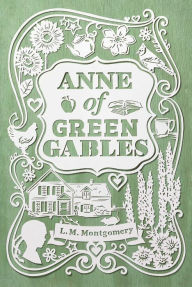
Anne of Green Gables. L.M. Montgomery. 1908. 448 pages. [Source: Bought]
I plan on rereading all the Anne books this year. [Maybe] It is such a dear favorite of mine. I couldn't begin to give an
accurate accounting of just how many times I've read it. Out of all the
Anne books, I think I love the first and last best of all. I think it
only right that you begin and end the series in tears. [Very true].
Anne of Green Gables introduces readers to Anne Shirley, Marilla and
Matthew Cuthbert, Rachel Lynde, Diana Barry, and Gilbert Blythe. And
that's just naming a few. By the time you've read and reread this one a
couple of times, the whole community seems to come alive.
The absolute basics: Anne Shirley is an eleven year old orphan who
arrives in Avonlea on Prince Edward Island. Marilla and Matthew are a
brother-and-sister looking to adopt...a boy. Earlier miscommunication
ultimately leads our heroine, young Ann-with-an-e, to the depths of
despair. But Matthew, even before he arrives back at Green Gables with
Anne, has decided HE WANTS TO KEEP HER FOREVER AND EVER. Marilla is not
ready to say "yes" that quickly. Though as you might predict, she does
end up keeping her...and loving her dearly.
The book relates to readers her adventures and misadventures. There is
never a dull moment because our heroine never makes the same mistake
twice. Here are a few additional characters you should know:
Diana Barry is Anne's bosom friend. These two are inseparable from their
first meeting on. The two are not all that alike, but, they get along
so splendidly. Anne forgives Diana her lack of imagination as I would
imagine most readers do as well.
Gilbert Blythe is swoon-worthy. Wait, that's me talking. Gilbert is
technically the cutest boy in Avonlea. When he first sees Anne, he calls
her "Carrots." He desperately wants her attention. But he ends up
making an enemy. Anne may forgive Diana her lack of imagination, but,
she won't forgive the oh-so-cute boy who called her CARROTS. For most of
the book, these two are academic rivals.
Rachel Lynde is Marilla's best friend, for better or worse, and without a
doubt the town's biggest gossip. Her first impression of Anne is
quickly replaced with a much nicer one after Anne apologizes
beautifully. Rachel has a 'soft spot' for Anne, and is, in fact, the one
who sews up Anne's first dress with puffed sleeves.
The book is written from multiple points of view. Readers get to know
Anne, of course, but also Matthew and Marilla. (The first chapter is
told from Rachel Lynde's point of view.) I didn't really pay much
attention to how much Marilla we get in this first book in the series
until I was an adult. But in many ways, this is Marilla's "coming of
age" story just as much as it is Anne's.
Quotes:
The long platform was almost deserted; the only living creature in sight
being a girl who was sitting on a pile of shingles at the extreme end.
Matthew, barely noting that it WAS a girl, sidled past her as quickly as
possible without looking at her. Had he looked he could hardly have
failed to notice the tense rigidity and expectation of her attitude and
expression. She was sitting there waiting for something or somebody and,
since sitting and waiting was the only thing to do just then, she sat
and waited with all her might and main.
A child of about eleven, garbed in a very short, very tight, very ugly
dress of yellowish-gray wincey. She wore a faded brown sailor hat and
beneath the hat, extending down her back, were two braids of very thick,
decidedly red hair. Her face was small, white and thin, also much
freckled; her mouth was large and so were her eyes, which looked green
in some lights and moods and gray in others.
"Would you rather I didn’t talk? If you say so I’ll stop. I can STOP when I make up my mind to it, although it’s difficult.”
But if you call me Anne please call me Anne spelled with an E.” “What
difference does it make how it’s spelled?” asked Marilla with another
rusty smile as she picked up the teapot. “Oh, it makes SUCH a
difference. It LOOKS so much nicer. When you hear a name pronounced
can’t you always see it in your mind, just as if it was printed out? I
can; and A-n-n looks dreadful, but A-n-n-e looks so much more
distinguished.
It’s all very well to read about sorrows and imagine yourself living
through them heroically, but it’s not so nice when you really come to
have them, is it?
“Do you never imagine things different from what they really are?” asked
Anne wide-eyed. “No.” “Oh!” Anne drew a long breath. “Oh, Miss —
Marilla, how much you miss!”
Somehow, things never are so good when they’re thought out a second time.
“Saying one’s prayers isn’t exactly the same thing as praying,” said Anne meditatively.
Boiled pork and greens are so unromantic when one is in affliction.
Isn’t it good just to be alive on a day like this? I pity the people who
aren’t born yet for missing it. They may have good days, of course, but
they can never have this one.
“I think your Gilbert Blythe IS handsome,” confided Anne to Diana, “but I
think he’s very bold. It isn’t good manners to wink at a strange girl.”
But it was not until the afternoon that things really began to happen.
Gilbert Blythe wasn’t used to putting himself out to make a girl look at
him and meeting with failure. She SHOULD look at him, that red-haired
Shirley girl with the little pointed chin and the big eyes that weren’t
like the eyes of any other girl in Avonlea school. Gilbert reached
across the aisle, picked up the end of Anne’s long red braid, held it
out at arm’s length and said in a piercing whisper: “Carrots! Carrots!”
Then Anne looked at him with a vengeance! She did more than look. She
sprang to her feet, her bright fancies fallen into cureless ruin. She
flashed one indignant glance at Gilbert from eyes whose angry sparkle
was swiftly quenched in equally angry tears. “You mean, hateful boy!”
she exclaimed passionately. “How dare you!”
“I’m so glad I live in a world where there are Octobers. It would be
terrible if we just skipped from September to November, wouldn’t it?
Look at these maple branches. Don’t they give you a thrill — several
thrills? I’m going to decorate my room with them.”
I love bright red drinks, don’t you? They taste twice as good as any other color.
Well, I suppose I must finish up my lessons. I won’t allow myself to
open that new book Jane lent me until I’m through. But it’s a terrible
temptation, Matthew. Even when I turn my back on it I can see it there
just as plain. Jane said she cried herself sick over it. I love a book
that makes me cry. But I think I’ll carry that book into the sitting
room and lock it in the jam closet and give you the key. And you must
NOT give it to me, Matthew, until my lessons are done, not even if I
implore you on my bended knees. It’s all very well to say resist
temptation, but it’s ever so much easier to resist it if you can’t get
the key.
You didn’t know just how I felt about it, but you see Matthew did.
Matthew understands me, and it’s so nice to be understood, Marilla.
“It’s because you’re too heedless and impulsive, child, that’s what. You
never stop to think — whatever comes into your head to say or do you
say or do it without a moment’s reflection.” “Oh, but that’s the best of
it,” protested Anne. “Something just flashes into your mind, so
exciting, and you must out with it. If you stop to think it over you
spoil it all. Haven’t you never felt that yourself, Mrs. Lynde?”
When Miss Barry went away she said: “Remember, you Anne-girl, when you
come to town you’re to visit me and I’ll put you in my very sparest
spare-room bed to sleep.” “Miss Barry was a kindred spirit, after all,”
Anne confided to Marilla. “You wouldn’t think so to look at her, but she
is. You don’t find it right out at first, as in Matthew’s case, but
after a while you come to see it. Kindred spirits are not so scarce as I
used to think. It’s splendid to find out there are so many of them in
the world.”
There’s such a lot of different Annes in me. I sometimes think that is
why I’m such a troublesome person. If I was just the one Anne it would
be ever so much more comfortable, but then it wouldn’t be half so
interesting.
“Yes; but cakes have such a terrible habit of turning out bad just when you especially want them to be good,” sighed Anne.
“Marilla, isn’t it nice to think that tomorrow is a new day with no
mistakes in it yet?” “I’ll warrant you’ll make plenty in it,” said
Marilla.
Mrs. Lynde says I’m full of original sin. No matter how hard I try to be
good I can never make such a success of it as those who are naturally
good. It’s a good deal like geometry, I expect. But don’t you think the
trying so hard ought to count for something?
It isn’t very pleasant to be laid up; but there is a bright side to it, Marilla. You find out how many friends you have.
Mrs. Allan says we should never make uncharitable speeches; but they do
slip out so often before you think, don’t they? I simply can’t talk
about Josie Pye without making an uncharitable speech, so I never
mention her at all. You may have noticed that. I’m trying to be as much
like Mrs. Allan as I possibly can, for I think she’s perfect.
“Isn’t this evening just like a purple dream, Diana? It makes me so glad
to be alive. In the mornings I always think the mornings are best; but
when evening comes I think it’s lovelier still.”
Mr. Allan says everybody should have a purpose in life and pursue it
faithfully. Only he says we must first make sure that it is a worthy
purpose. I would call it a worthy purpose to want to be a teacher like
Miss Stacy, wouldn’t you, Marilla? I think it’s a very noble profession.
Why can’t women be ministers, Marilla? I asked Mrs. Lynde that and she
was shocked and said it would be a scandalous thing. She said there
might be female ministers in the States and she believed there was, but
thank goodness we hadn’t got to that stage in Canada yet and she hoped
we never would. But I don’t see why. I think women would make splendid
ministers. When there is a social to be got up or a church tea or
anything else to raise money the women have to turn to and do the work.
I’m sure Mrs. Lynde can pray every bit as well as Superintendent Bell
and I’ve no doubt she could preach too with a little practice.” “Yes, I
believe she could,” said Marilla dryly. “She does plenty of unofficial
preaching as it is. Nobody has much of a chance to go wrong in Avonlea
with Rachel to oversee them.”
There are so many things to be thought over and decided when you’re
beginning to grow up. It keeps me busy all the time thinking them over
and deciding what is right. It’s a serious thing to grow up, isn’t it,
Marilla? But when I have such good friends as you and Matthew and Mrs.
Allan and Miss Stacy I ought to grow up successfully, and I’m sure it
will be my own fault if I don’t.
As Mrs. Lynde says, ‘If you can’t be cheerful, be as cheerful as you can.’
It’s good advice, but I expect it will be hard to follow; good advice is apt to be, I think.
“No, I wasn’t crying over your piece,” said Marilla, who would have
scorned to be betrayed into such weakness by any poetry stuff. “I just
couldn’t help thinking of the little girl you used to be, Anne. And I
was wishing you could have stayed a little girl, even with all your
queer ways. You’ve grown up now and you’re going away; and you look so
tall and stylish and so — so — different altogether in that dress — as
if you didn’t belong in Avonlea at all — and I just got lonesome
thinking it all over.”
It won’t make a bit of difference where I go or how much I change
outwardly; at heart I shall always be your little Anne, who will love
you and Matthew and dear Green Gables more and better every day of her
life.
“Wouldn’t Matthew be proud if I got to be a B.A.? Oh, it’s delightful to
have ambitions. I’m so glad I have such a lot. And there never seems to
be any end to them — that’s the best of it. Just as soon as you attain
to one ambition you see another one glittering higher up still. It does
make life so interesting.”
“That Anne-girl improves all the time,” she said. “I get tired of other
girls — there is such a provoking and eternal sameness about them. Anne
has as many shades as a rainbow and every shade is the prettiest while
it lasts. I don’t know that she is as amusing as she was when she was a
child, but she makes me love her and I like people who make me love
them. It saves me so much trouble in making myself love them.”
For we pay a price for everything we get or take in this world; and
although ambitions are well worth having, they are not to be cheaply
won, but exact their dues of work and self-denial, anxiety and
discouragement.
“Well now, I’d rather have you than a dozen boys, Anne,” said Matthew
patting her hand. “Just mind you that — rather than a dozen boys. Well
now, I guess it wasn’t a boy that took the Avery scholarship, was it? It
was a girl — my girl — my girl that I’m proud of.” He smiled his shy
smile at her as he went into the yard. Anne took the memory of it with
her when she went to her room that night and sat for a long while at her
open window, thinking of the past and dreaming of the future.
It was the last night before sorrow touched her life; and no life is
ever quite the same again when once that cold, sanctifying touch has
been laid upon it.
Marilla, I’ve almost decided to give up trying to like Josie Pye. I’ve
made what I would once have called a heroic effort to like her, but
Josie Pye won’t BE liked.
When I left Queen’s my future seemed to stretch out before me like a
straight road. I thought I could see along it for many a milestone. Now
there is a bend in it. I don’t know what lies around the bend, but I’m
going to believe that the best does. It has a fascination of its own,
that bend, Marilla. I wonder how the road beyond it goes — what there is
of green glory and soft, checkered light and shadows — what new
landscapes — what new beauties — what curves and hills and valleys
further on.
“Dear old world,” she murmured, “you are very lovely, and I am glad to be alive in you.”
“‘God’s in his heaven, all’s right with the world,’” whispered Anne softly. softly.
© 2023 Becky Laney of Becky's Book Reviews