Eight books by Asian and/or Asian-American authors
1. Revolution is not a Dinner Party by Ying Chang Compestine
2. The Girl with the White Flag by Tomiko Higa
3. Yellow Umbrella by Jae soo Liu
4. Year of the Rat by Grace Lin
5. The Fold by An Na
6. The Mats by Francisco Arcellana
7. Guji, Guji by Chih-Yuan Chen
8. The Dragon's Child by Laurence Yep
For a list of potential books please see this post.
Eight audio books.
I thought long and hard about this category. A challenge is supposed to be challenging. And since I rarely listen to audio books, I thought this might be a good chance to expand my comfort zones and grow as a listener :)
1. Little Town on the Prairie by Laura Ingalls Wilder
2. These Happy Golden Years by Laura Ingalls Wilder
3. Speak by Laurie Halse Anderson
4. Silver Chair by C.S. Lewis
5. The Dead and the Gone by Susan Beth Pfeffer
6. The Horse and His Boy by C.S. Lewis
7. The Composer is Dead by Lemony Snicket
8. Moxy Maxwell Does Not Love Writing Thank You Notes by Peggy Gifford
I own a few titles--the Little House books and the Chronicles of Narnia and both Ender's Game and Ender's Shadow. But the library may prove invaluable here as well as iTunes podcasts of classics. For example, almost all of Jane Austen's books are available as podcasts one chapter at a time.
8 classics by women writers (any time period pre-1950)
1. Gone With the Wind by Margaret Mitchell
2. Persuasion by Jane Austen
3. Northanger Abbey by Jane Austen
4. Wives and Daughters by Elizabeth Gaskell
5. Their Eyes Were Watching God by Zora Neale Hurston
6. Sense and Sensibility by Jane Austen
7. Camilla by Fanny Burney
8. The Mysteries of Udolpho by Ann Radcliffe
Right now, I'm thinking Zora Neale Hurston, Jane Austen, Kate Chopin, etc. I'm sure my list will change as I explore. But I know this is something I'd like to do for 2008.
8 Award-Winning Children's Books (Caldecott, Newbery, Printz, etc.)
1. Hitty, Her First Hundred Years by Rachel Field (Newbery, 1930)
2. On the Banks of Plum Creek by Laura Ingalls Wilder (Newbery Honor, 1938)
3. By the Shores of Silver Lake by Laura Ingalls Wilder (Newbery Honor, 1940)
4. The Long Winter by Laura Ingalls Wilder (Newbery Honor, 1941)
5. Adam of the Road by Elizabeth Janet Gray (Newbery, 1943)
6. Mrs. Frisby and the Rats of NIMH by Robert O'Brian (Newbery, 1972)
7. The Entertainer and the Dybbuk by Sid Fleischman (Sidney Taylor Book Award, 2008)
8. My Father's Dragon by Ruth Stiles Gannett (Newbery Honor, 1949)
Extras: Out of the Dust by Karen Hesse (Newbery Winner, 1998) A Long Way From Chicago by Richard Peck, (Newbery Honor, 1999), A Year Down Yonder by Richard Peck, (Newbery Winner, 2001)
For the record, honor books count as well in my book.
8 Nonfiction Books
1. The Diary of A Young Girl by Anne Frank
2. I Have Lived A Thousand Years by Livia Bitton-Jackson
3. The Cage by Ruth Minsky Sender
4. Painting the Wild Frontier by Susanna Reich
5. Wanda Gag: The Girl Who Loved To Draw by Deborah Kogan Ray
6. My Bridges of Hope by Livia Bitton-Jackson
7. I Will Plant You A Lilac Tree by Laura Hillman
8. The Year We Disappeared by Cylin and John Busby
My list may change, but this is what I'm planning at the moment. No promises though. :)
8 Childhood Favorites
1. Winnie the Pooh by A.A. Milne
2. Little House in the Big Woods by Laura Ingalls Wilder
3. Little House on the Prairie by Laura Ingalls Wilder
4. Alice in Wonderland by Lewis Carroll
5. Prince Caspian by C.S. Lewis
6. The Lion The Witch and the Wardrobe by C.S. Lewis
7. The Voyage of the Dawn Treader by C.S. Lewis
8. Mandy by Julie Edwards
Alternates:
8 by Beverly Cleary
1. Beezus and Ramona
2. Ramona the Pest
3. Ramona the Brave
4. Ramona and her Father
5. Ramona and her Mother
6. Ramona Quimby Age 8
7. Ramona Forever
8. Ramona's World
8 by L.M. Montgomery
1. Anne of Green Gables
2. Anne of Avonlea
3. Anne of the Island
4. Anne of Windy Poplars
5. Anne's House of Dreams
6. Anne of Ingleside
7. Rainbow Valley
8. Rilla of Ingleside
© Becky Laney of Becky's Book Reviews

Showing posts with label 888 Challenge. Show all posts
Showing posts with label 888 Challenge. Show all posts
Friday, October 24, 2008


Rilla of Ingleside

Montgomery, L.M. 1921. Rilla of Ingleside.
I will try to dry my eyes long enough to type out a review that couldn't hope to do this book justice. Rilla of Ingleside is the final book in the series of Anne books. The novel is set during World War I. For those that think Anne's life was so rosy and so perfect...just consider that her children came of age just in time for the declaration of war. The novel opens in July of 1914. Within the first few chapters, Anne has seen her firstborn son, Jem, off to war. Before the novel closes, she'll send off two more of her sons: Walter and Shirley.
Rilla of Ingleside isn't Anne's story--though we do get glimpse of the fiftyish year old mother and wife--it is Rilla's through and through. Her youngest child is just a few weeks (or is it a few months?) shy of her fifteenth birthday. Her teen years will be impacted greatly by the war. She'll have to say goodbye to her three brothers, two of her childhood chums (Jerry and Carl) and her almost-sweetheart Kenneth Ford. (Kenneth Ford is the son of Leslie Moore and Owen Ford whose story we were swept away with in Anne's House of Dreams.)
What does Rilla do with her time? She doesn't go away to school (high school and college) like her sisters Nan and Di. No, she'll start a Junior Red Cross society for the younger crowd in the village. But perhaps what changes her as a person (as a soul) is when she adopts a war baby. She quite inadvertently discovers a tragic baby--just a month or so old--whose father is a soldier overseas and whose mother has just died. Too compassionate to send to an orphanage, she takes him home--and does so in style. This baby is carried home in a soup tureen. For four long years, Rilla plays the role of mother. And it does change her...and for the better.
Life on the home front worrying about loved ones far far away is hard. Waiting to hear if they're dead or alive or if they're coming home...is difficult, is life changing. War brings hardship and worry and sorrow and grief and new perspectives on life as well.
The heart and soul of this book--the sentimental details that will pull at your heartstrings is Dog Monday. Jem's dog that stays at the train station all the years while his master is away. The dog that can't be tempted or swayed to leave the spot where he lost saw his Jem. The dog's loyalty...to both Jem....and to Walter...is not easily forgotten.
Rilla of Ingleside is a fitting end to a wonderful series. Like Anne of Green Gables, it has its bittersweet moments. It's about life--the good, the bad, the ugly, the joyous, the heartbreaking. I think it's only right that both books can bring both tears and smiles.
© Becky Laney of Becky's Book Reviews
Thursday, October 23, 2008
Rainbow Valley

Montgomery, L.M. 1919. Rainbow Valley.
This book in the series has very little to do with Anne and very much to do with a set of imaginative children. The Blythe children: Jem, Walter, Nan, Di, Shirley, and Rilla. The Meredith children: Jerry, Faith, Carl, Una. And the prone-to-trouble Mary Vance whom Mrs. Marshall Elliot (a.k.a. Miss Cornelia) adopts. The children spend their time (when they're not in school or church) playing together in Rainbow Valley. The focus on this one, however, is not on the Blythe children. No, the stars of this book are the Meredith children. Their father is the preacher. He's a widower. And the kids have a bit of time behaving themselves. For one thing, their father doesn't have any inclination what his children are up to. There is no structure. There are no clear rules. He's a bit of a lost soul...and very unobservant. If it wasn't for good old "Aunt Martha" then the children would be quite alone. (Unfortunately, Aunt Martha isn't that great a cook...or a housekeeper...or a nanny.)
There is a bit of romance in Rainbow Valley. A concerned citizen (any guesses who???) tells the preacher he needs to find a wife, a good woman who can raise his children because someone needs to do it. He finds the perfect woman too...Rosemary West...unfortunately their courtship isn't a sure thing because of a long-ago-promise between siblings.
Full of humor and heart, this one is an enjoyable read.
© Becky Laney of Becky's Book Reviews
Wednesday, October 22, 2008
Travel the World: Canada: Anne of Ingleside

Montgomery, L.M. 1939. Anne of Ingleside.
Out of all of the Anne books--Anne of Green Gables, Anne of Avonlea, Anne of the Island, Anne of Windy Poplars, Anne's House of Dreams, Anne of Ingleside, Rainbow Valley, and Rilla of Ingleside--this one is actually my least favorite of the bunch. Perhaps it is the fact that it was written so many years after the others. Rainbow Valley, the one which chronologically is the sequel to Anne of Ingleside, was published in 1919. This one always seemed a bit tacked on to the others.
Anne is all grown up with children of her own: Jem, Walter, Nan and Di (the Blythe twins), Shirley (boy with a bit of a girly name), and Rilla, the baby of the family. Anne and Gilbert are still happily wed though we don't see too closely or intimately into their relationship. Susan Baker is their live-in helper. Part nanny. Part cook. Full-time storyteller.
The book is episodic. There isn't one narrator. The role of narrator shifts between Anne and each of her children. (I can't remember if Susan ever gets her own chapters or not.) Each child seems to get a turn in the spotlight. From baby-Rilla being frightened to walk through town carrying a cake to Jem's heartbreaking loss of his first dog. The stories are about family and friendship and at times some of the harder things in life.
My favorite sequence in Anne of Ingleside is the visit of Aunt Mary Maria, Gilbert's aunt who invites herself to stay. No one has the gumption to even hint that it's time for her to go back to her own home. But an accidental surprise birthday party does the trick just fine.
I'm not suggesting it isn't worth reading, but it doesn't have that satisfying grinning ear-to-ear something special feeling about it.
© Becky Laney of Becky's Book Reviews
Saturday, October 18, 2008
Anne's House of Dreams

Montgomery, L.M. 1922. Anne's House of Dreams.
Anne's House of Dreams is the perfect blend of bittersweet and happily ever aftering. Anne Shirley has married Gilbert Blythe. She's Anne Blythe now. (Later on she's "Mrs. Dr. Dear" but that won't be until Anne of Ingleside.) The Blythes are moving away from Avonlea and settling down in Glen St. Mary/Four Winds Point. They've got a little cottage by the sea. (There is a brook nearby so Anne is happy.) The book tells of the first few years of wedded bliss for the two. (Though the couple is not without its heartaches as they lose their first baby, Joy, the very day its born.)
Anne's House of Dreams introduces many new characters--some of my favorites I admit--Captain Jim, Miss Cornelia, Leslie Moore, Owen Ford. Marshall Elliot. Susan Baker. Who would ever want to forget their stories? Captain Jim's life-book. Leslie Moore's tragic past but enduring spirit. Miss Cornelia. She's got to be one-of-a-kind. Just a truly spirited character with so much heart and full of gumption. Practically everything out of her mouth is quotable. She sure is great at banter :)
I love this book. I do.
© Becky Laney of Becky's Book Reviews
Thursday, October 16, 2008
Anne of Windy Poplars

Montgomery, L.M. 1936. Anne of Windy Poplars.
If one were to make assumptions, one might assume that I couldn't possibly love Anne of Windy Poplars as much as the other books in the series because of the lack of Gilbert. The book is comprised of just Anne's letters after all. And on top of that, the reader is left out of the romantic correspondence between the two. When Anne has a certain kind of pen...the reader is shut out of her world. But strangely enough, surprising even to me, I just adore Anne of Windy Poplars.
I think Anne of Windy Poplars is marvelous because it introduces dozens of new characters. All original. All full of heart. All human. L.M. Montgomery is great at characterization. She got that humans have a bit of it all...a bit good...a bit bad...a bit crazy too. And her characters are lovable. Especially the flawed ones.
This book is perhaps even more episodic than the previous Anne books. We've got Anne living in Summerside on Prince Edward Island. She's boarding with Aunt Chatty, Aunt Kate, and Rebecca Dew. (And who could forget the cat Dusty Miller?) She's still teaching, and she's got a job as principal at a high school.
I think what makes L.M. Montgomery so unique as a writer is that I care. If she writes about it, when she's storytelling, she's got a knack (that should be she had a knack because I *know* she's dead) for making me care. A knack for making me want to know more. She's got me thoroughly under her spell.
I've got many favorite "side" stories--including the story of little Elizabeth (with a dozen or so different nicknames for each mood but never Lizzie)--but I think one of my favorites is the story of Nora Nelson and Jim Wilcox. That and I love the story of Esme Taylor, Dr. Lennox Carter, and Cyrus Taylor. And then there's that one about Teddy Armstrong and his father. I get veclemped just thinking about it.
This book really is a treasure of good storytelling. My head knows that it doesn't particularly advance the story of Anne and Gilbert along very much. But my heart just knows that it has so many touching little moments of life that I really can't imagine reading the series and skipping it.
© Becky Laney of Becky's Book Reviews
Anne of the Island
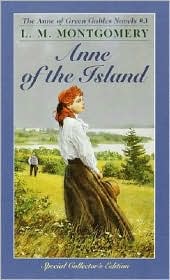
Montgomery, L.M. 1915. Anne of the Island.
"Harvest is ended and summer is gone," quoted Anne Shirley, gazing across the shorn fields dreamily.
I don't know if there are enough words to describe how I feel about Anne of the Island. It is one of the most magically, wonderful, giddy-making, purely-delightful, satisfying books I've ever read...and reread...and reread. Reading this book makes all the world seem right. (At least during the reading process.) It picks up shortly after where Anne of Avonlea leaves off. Anne Shirley and Gilbert Blythe are preparing to go off to Redmond college. (Along with Charlie Sloane and Priscilla Grant who you may or may not remember.) Diana Barry is engaged to Fred Wright. And there is a hint of love in the air.
This is the story of Anne's college years; it spans four years. The books focus on her friendships with Priscilla Grant, Philippa Gordon, and Stella Maynard, her roommates. And of course the book focuses on her romantic-and-not-so-romantic dealings with men. Many men propose to Anne during the course of the book including Billy Andrews--who sends his sister in his place--and Sam Toliver with his bumbling, "Will yeh heve me?" (Charlie Sloane, Gilbert Blythe, and Royal Gardner are others.)
There are many side stories in Anne of The Island. And while these little asides and tangents are not employed much in modern fiction, within the works of L.M. Montgomery, they are so thoroughly charming that they just work well. Really really well.
I loved this one. Loved the romance. Loved the characters. Loved everything.
Here's my favorite bit of the book:
There is a book of Revelation in every one's life, as there is in the Bible. Anne read hers that bitter night, as she kept her agonized vigil through the hours of storm and darkness. She loved Gilbert—had always loved him! She knew that now. She knew that she could no more cast him out of her life without agony than she could have cut off her right hand and cast it from her. And the knowledge had come too late—too late even for the bitter solace of being with him at the last. If she had not been so blind—so foolish—she would have had the right to go to him now. But he would never know that she loved him—he would go away from this life thinking that she did not care. Oh, the black years of emptiness stretching before her! She could not live through them—she could not! She cowered down by her window and wished, for the first time in her gay young life, that she could die, too. If Gilbert went away from her, without one word or sign or message, she could not live. Nothing was of any value without him. She belonged to him and he to her. In her hour of supreme agony she had no doubt of that. He did not love Christine Stuart—never had loved Christine Stuart. Oh, what a fool she had been not to realize what the bond was that had held her to Gilbert—to think that the flattered fancy she had felt for Roy Gardner had been love. And now she must pay for her folly as for a crime. (237)
© Becky Laney of Becky's Book Reviews
Wednesday, October 15, 2008
Travel the World: Canada: Anne of Avonlea

Montgomery, L.M. 1909. Anne of Avonlea.
Anne of Avonlea is the second book in the Anne series by L.M. Montgomery. Anne has graduated from Queens now, and is ready to begin her teaching career. She'll be teaching at the Avonlea school. She is still quite chummy with Diana Barry and Gilbert Blythe. And she is almost (but not quite) just as prone to getting into trouble as she ever was.
This second book adds some great characters: Mr. Harrison, the cranky neighbor with a parrot; Davy and Dora, the twins Marilla adopts; Paul Irving, the boy-from-the-States with a big imagination and a way with words; and Miss Lavendar, the "old" maid that has spent most of her years in seclusion but who is a true kindred spirit. And it has some great adventures or "incidents" that I love. Painting the debate hall that horrid shade of blue. Prophesying Uncle Abe's "big storm." The charming love story of Miss Lavendar and Mr. Irving...in which it is shown that it is never too late for one's Prince to return and for love to take hold.
I love Anne Shirley. I love her world. I love her friends. These books are just magical.
© Becky Laney of Becky's Book Reviews
Thursday, September 18, 2008
The Mysteries of Udolpho

 Radcliffe, Ann. 1794. The Mysteries of Udolpho: A Romance Interspersed with Some Pieces of Poetry.
On the pleasant banks of the Garonne, in the province of Gascony, stood, in the year 1584, the chateau of Monsieur St Aubert.
Emily St Aubert is our heroine in Ann Radcliffe's gothic classic, The Mysteries of Udolpho. When we first meet Emily, she is quite happy and living with her mother and father. Everything is as it should be. But this blissful existence won't last long. The beginning of the end comes with the death of her mother. Grief-stricken but brave, this father-daughter team decide (after some time) a vacation would be ideal for his health. He hasn't been the same since his wife's death. And the truth of the matter is, he is slipping away as well. Of course, Emily, dear that she is, isn't aware of how desperate her situation is. How close she is to becoming an orphan. But she senses that all isn't right with the world, with her father.

 On this journey together the two meet a young man, a Monsieur Valancourt. (He joins them and they journey all three together here and there and everywhere. But he can't stay with them forever. He can't just invite himself along wherever they go. So they do eventually part ways. Their destination is Provence and the Mediterranean.) The sights are exquisite. And a good time is had by all. But as they arrive at their final destination, little do they know that St Aubert is about to arrive at his. While staying with some kind strangers in a small cottage, her father takes a turn for the worse. And after confessing to a local priest (or clergy of some sort), he dies. This locale is situated by an abandoned castle whom legend has is haunted. The home of a former Marchioness, Villefort I believe is the name. Besides this strange wonder, there is a convent of nuns nearby as well. And Emily does have some interaction with the abbess and a few of these nuns. They do provide some relief for her grief.
 Charged with an important mission, Emily--weeping all the way--makes her way back home. Her father's dying wish was for her to burn some of his papers hidden away in his office. And to do so without reading them. She's a bit stunned that her father would have that big a secret from her. But she's a good girl, and does as told. She also finds a mysterious picture (or portrait) of a woman that she witnessed her father weeping over the night before they home for their mountain journey. She keeps this with her. And it's a good thing she does--it makes a great plot device later on.
But while Emily would love to remain in her own little home going about in her own little way. Sad, yes. But in familiar surroundings and with the servants she's known and loved her whole life through providing for her. This is an in-between period for everyone. Emily has been left under the guardianship of an aunt she's never met. A woman named Madame Cheron. Emily is aware of this shift. But she's naive enough--perhaps hopeful enough--to think that life couldn't change that drastically. (While I'm at it, before I forget, her only other relations are the Quesnels. Monsieur Quesnel is her uncle (by marriage). His wife, her natural aunt, isn't brought up much but occasionally the Quesnel name does pop up.) Before her aunt can arrive, M. Valancourt reappears in Emily's life. He's there to comfort her. There to woo her. There to pay his respects and earn her devotion. He wants to marry her naturally. But Madame Cheron's arrival changes all that. Not his desire or devotion. Nor Emily's. But she is definitely trying to end this relationship of young lovers before it even gets much of a chance to start.
Madame Cheron is heartless, cruel, unthinking. And poor Emily is under her control. Cheron jumps to dozens of erroneous conclusions about Emily, about her relationship with Valancourt, about her character and reputation. Cheron takes an instant dislike to Emily. But Valancourt isn't the only one doing the wooing. No. Someone is courting Madame Cheron. A Count named Montoni. Once those two are wed, Emily's nightmare is born. The Montonis--Count and Madame--are dragging the weeping Emily with them to Venice. She's to be forever-and-ever separated from her true love, Valancourt.
In Venice, Montoni's true nature begins to shine through his facade. But it's only a fraction of the horror to come--as Emily later realizes. Here Emily is being pursued--with Montoni's blessing--by a Count Morano. This guy just won't take no for an answer. I think he proposes each and every day that he sees her. The count says yes. The mademoiselle says no. Emphatically. But Montoni seems to have her in his power. And he tells her that she must marry who he says she must marry.
Fortunately or unfortunately as the case may be, the Montoni's (Count, Madame, Emily) after some time flee Venice without a word. Their destination is one of his estates, an abandoned castle (again rumored to be haunted) called Udolpho. The former mistress of the house is a woman called Laurentini. It is after their arrival at this dismal and foreboding castle that Emily's worst fears and imaginings are realized. Montoni is revealed to be the cruel, vindictive, lying scumbag that he is. And Madame Montoni realizes much much too late just how stupid she was to have married a man she knew little about and given away her power. Both parties were liars--to be fair. Both were putting on a show for the other. Both wanted to bamboozle the other. She thought he was rich. He thought she was rich. And now when it's revealed their both...not...then the problems are magnified. The count is in debt, yes, and a gambler at heart. And he makes a career change--turns banditti. He becomes a captain of rogue soldiers-turned-bandits/highway men.
The Madame does have something he wants, however, some property that remained in her name after the marriage. She is convinced to hold onto this no matter what. Her first hope is that this may be her refuge should she ever escape. Her only possession left in the world. Her only thing of value. But eventually, she realizes that this isn't her hope any longer. It is the hope and refuge and prayer of her niece, Emily. She will never escape--she'll die imprisoned in Udolpho--but maybe just maybe Emily can break free of Montoni. You see, as soon as the Count realized that his wife wouldn't budge on this property, he imprisoned her, tortured her, starved her, essentially left her for dead. He thought--erroneously--that he would be the one to inherit if she died. He wasn't. It was clearly left to Emily.
Now the cruel count turns his focus to Emily. And Emily's only two friends are two servants, her maid Annette, and her maid's lover, Ludovico.
And that's where I'll leave you. With Emily still hopelessly stuck under Montoni's control. An Emily who is still dreaming of salvation by her M. Valancourt. An Emily whose only solace is sitting by the window night after night waiting for the mysteriously-haunting happenings to occur beneath her room. (Music is heard sometimes. And also sometimes mysterious strangers that seem out-of-this-world.) I leave you with over the half the book remaining.
The settings for this novel are rich--France and Italy--and the tone is melancholy and haunting. The characters are intricately drawn. And the plot while not perhaps conforming to the tightest structure is beautifully done. More than I first expected. It's complex, but surprisingly easy to follow given its age. Yes, they talk differently. And the sensibilities are different. A modern-day woman wouldn't hardly be trapped by Emily's situations. But it works beautifully.
For the record, I skipped 99% of the poetry. And guess what...the book still made sense. So old fashioned? Sure. But good, delicious fun? Definitely!
© Becky Laney of Becky's Book Reviews
Thursday, April 24, 2008
Gone With The Wind

 Mitchell, Margaret. 1936. Gone With The Wind.
You can't always get what you want
But if you try sometimes you might find
You get what you need...
--The Rolling Stones
But if you try sometimes you might find
You get what you need...
--The Rolling Stones
Because I used to love her, but it's all over now...
--The Rolling Stones
Scarlett O'Hara was not beautiful, but men seldom realized it when caught by her charm as the Tarleton twins were. (5)
Thus begins Margaret Mitchell's classic novel Gone With The Wind. Does it surprise you that Scarlett O'Hara "was not beautiful"? Can you conceptualize (fancy word for imagine) a Scarlett O'Hara that isn't beautiful? Try. Really. I bet you can't help but think of the beautiful Vivian Leigh. And that is where I think Hollywood did a huge disservice to the world. I have a love-hate relationship with the movie. I do. The movie has its moments of brilliance. Moments I love. But the movie has little to do with what Margaret Mitchell actually wrote. It got a few of the surface details right, I think, but it makes a mockery of it in places. Mitchell's novel has heart and soul and substance. Actual substance. The movie? Well. It's more stereotypes. Hollywood's version of the South is far from the South portrayed in Mitchell's pages. Especially when it comes to Scarlett and Tara. (But I digress.)
What did Scarlett look like? We're told that "it was an arresting face, pointed of chin, square of jaw. Her eyes were pale green without a touch of hazel, starred with bristly black lashes and slightly tilted at the ends. Above them her thick black brows slanted upward, cutting a startling oblique line in her magnolia-white-skin" (5).
Even if you've never read the book, I would imagine you've got a fairly good notion of what Gone With The Wind is about. At least on the surface. It's the story of the spoiled-rotten Scarlett O'Hara and her quest to win her heart's desire through any means possible. Scarlett is one that doesn't ask if it's wrong or right. She only lives by this question--does it get me one step closer to what I want? If it does--then look out!
Scarlett. Rhett. Ashley. You probably know the basics. A woman wants what she can't have. She wants it until she can have it. The moment she has it. She doesn't want it anymore. Scarlett is in a perpetual state of frustration. The man in her bed doing her bidding is rarely the man in her heart.
The book is about much more than Scarlett and her quest for love, however. It's a love story, I won't deny it. But there is much more than love at stake in the novel. War. Reconstruction. Civilization. Society. Culture. Class. Race. Money. Politics. Survival. It's a novel of contrasts. The Old South vs. The New South. Conformity vs. Individuality. The haves vs. the have-nots. If asked to sum up Gone With The Wind in one word, most would probably say "Love." I'd say gumption. People who have it; people who don't. What do I mean by gumption? Partly spirit. Partly courage. Partly determination. Partly ambition. People with gumption act. They do what they must when they must.
One of my favorite non-love scenes from the book is Scarlett's conversation with Grandma Fontaine. A wonderful, wonderful character by the way. The setting is after Gerald's funeral. Scarlett is pregnant with Frank Kennedy's baby. (Yes, the movie killed Gerald, her father, off too soon.)
"We bow to the inevitable. We’re not wheat, we’re buckwheat! When a storm comes along it flattens ripe wheat because it’s dry and can’t bend with the wind. But ripe buckwheat’s got sap in it and it bends. And when the wind has passed, it springs up almost as straight and strong as before. We aren’t a stiff-necked tribe. We’re mighty limber when a hard wind’s blowing, because we know it pays to be limber. When trouble comes we bow to the inevitable without any mouthing, and we work and we smile and we bide our time. And we play along with lesser folks and we take what we can get from them. And when we’re strong enough, we kick the folks whose necks we’ve climbed over. That, my child, is the secret of the survival.” And after a pause, she added: “I pass it on to you.”
The old lady cackled, as if she were amused by her words, despite the venom in them. She looked as if she expected some comment from Scarlett but the words had made little sense to her and she could think of nothing to say. (709-710)
It's a novel that goes above and beyond the central character of Scarlett. Even if you hate Scarlett, I'd imagine you'd find some character to love. Be it Melanie. Rhett. Mammy. Uncle Peter. Grandma Fontaine. How could you not? There are so many characters, so many individual stories. Stories of triumph. Stories of loss. Stories of hope. Stories of disappointment. Stories of survival. Stories of failure. There is depth and meaning that the movie doesn't even try to accommodate. Depth and meaning that even diehard fans can't help but learn something new with each rereading.
I don't want anyone to think I'm glossing over some of the book's issues. You'd have to be a fool to not realize that Gone With The Wind has more than a little potential to be racially offensive. It could be seen as abrasive even. It uses these words interchangeably: n-word, darkie(s), slaves, and Negroes. A good many of uses of the n-word come from slaves/servants conversing with one another. But there are many that aren't. And regardless of who is speaking it in the novel, the context of the novel, you can't escape the fact that it is a white author. There are phrases, there are scenes, that you can't deny are racist. You just can't. It's no wonder that this book is challenged in some places. But I'm not a book banner. Obviously.
My rule is context, context, context. My second rule is that it is better to discuss and employ critical thinking skills than it is to deny, hide, or censor. There are two contexts for reading Gone With The Wind. The first is that of the author. Margaret Mitchell. A Southern woman growing up in turn-of-the-century America. The 1920s and the 1930s. These were the years that Margaret Mitchell was living and working on her novel. This is the culture and mindset of the author and of the original audience. Gone With The Wind is not alone. It doesn't stand out from the crowd. Many books, many authors used the n-word without batting an eye. Many wrote with the mindset that whites are superior--intellectually at least--to blacks. It doesn't make it true then or now. But that is the mindset. The second is that of the setting of the novel. 1860s-1870s America's South. You can't be true to history without going there. It's a fact in America's history. There's no disputing or denying it. It's not pleasant; it's often ugly. But there you have it. You've got to know where you've been so you can measure how far you've come. And so you can measure how far you've still got to go. America--both as a nation and as a people--has never been perfect. Will probably never be perfect.
As a reader, I can enjoy the story without being brainwashed. I can see. I can question. I can realize when I'm being fed bull. Lines where the former slaves still faithful servants are talking about how they've never wanted freedom??? about how they've never wanted money or independence??? I think I know that Mitchell was full of it. I think most readers can make that division. I hope.
Changing topics now. I just want to bring to your attention one more thing. The last chapter was written first.  (The first few chapters were written last.) Margaret Mitchell had in her mind how the story would end. It was these characters in this last and final state--the frustrated and pleading Scarlett and the resolute and pitying Rhett--that were her characters. Her characters just as she wanted them; just as she first imagined them. Everything that comes before is leading up to this grand emotional finale. Every scene, every conversation. All the little plot twists. All were to lead up to this. It wasn't the other way around. The ending wasn't tacked on because Mitchell didn't know where to go next. This unhappy and emotionally draining scene was her perfect ending. Which is why I find the idea of sequels so laughable.
 (The first few chapters were written last.) Margaret Mitchell had in her mind how the story would end. It was these characters in this last and final state--the frustrated and pleading Scarlett and the resolute and pitying Rhett--that were her characters. Her characters just as she wanted them; just as she first imagined them. Everything that comes before is leading up to this grand emotional finale. Every scene, every conversation. All the little plot twists. All were to lead up to this. It wasn't the other way around. The ending wasn't tacked on because Mitchell didn't know where to go next. This unhappy and emotionally draining scene was her perfect ending. Which is why I find the idea of sequels so laughable.
There is so much more I could say. How much I love Melanie. How much I love Rhett. How irritating Ashley can be. How unforgettable most of the character are when you get down to it. But if I were to post every thought I had on GWTW... then that would be much too much. If I were to share every *favorite* quote...again much too much.
I first read Gone With The Wind when I was eleven or twelve. (I had first typed elven. But I've never been elven.) I've read it maybe seven or eight times since then. I read it every year for a while. But around the age of twenty, I outgrew it. Moved on. This was my first time to read it since then.
© Becky Laney of Becky's Book Reviews
Wednesday, April 23, 2008
My Bridges of Hope

 Bitton-Jackson, Livia. 1999. My Bridges of Hope.
My Bridges of Hope is the sequel to I Have Lived A Thousand Years. It is the middle book in a trilogy of the author's memoirs. (Though each book can and does stand alone just fine.) The book opens with Elli Friedmann and her mother and brother returning to their home town of Samorin after they were liberated by the Russian soldiers. Unlike some of the other returning Jews, they did find their home relatively intact. Stripped of furniture, yes, but still standing. The neighbors are shocked, extremely shocked to see them again. Shocked that they're living skeletons. But most of their closest neighbors are helpful. They give what they can, do what they can to make the Friedmann's home habitable again. This doesn't mean that every neighbor is this nice. And it doesn't mean that the family's possessions are returned from the neighbors who took them for safekeeping at the beginning of the war. But a few are ethical enough to return and restore.
"Out of Samorin's more than five hundred Jewis citizens, only thirty-six returned, mostly young men and women. Those who did not--our children, parents, grandparents, siblings, husbands, wives, aunts, uncles, cousins, friends, and lovers--have been replaced by an abyss." (18)
Imagine that if you will. Really think about it. My Bridges of Hope tells the stories of those in between years. Those years between 1945 and 1951 when Elli was growing up in such a strange and foreign environment. It looked a bit like her old home, her old town. But so many people missing, so many new people in their place, so many strangers--the Russians, the Communists coming to town and taking over. Nothing is ever the same, nothing could ever be the same.
In these years, Elli dreams of going to Israel. At the beginning of the book, it isn't even a state or nation yet. But the dreams, the Zionist dreams, are there both in Elli and in her friends. But it is decided that America will be their destination, if they can get in.
These are years of waiting and years of growing. A turbulent time of changing for Elli as she matures from a fourteen year old girl into a young woman of nineteen or twenty. The book records her hopes, her dreams, her loves, her losses, her disappointments.
© Becky Laney of Becky's Book Reviews
Tuesday, April 22, 2008
Ramona's World
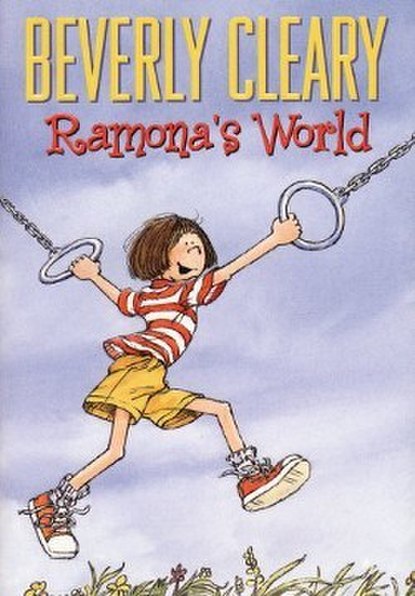
 Cleary, Beverly. 1999. Ramona's World.
Ramona's World is the final in the Ramona series. In our last encounter with Ramona, Ramona Forever, her sister, Roberta Day Quimby, is born. Ramona's World opens several months later. Ramona is starting fourth grade. And she's relatively optimistic. She loves being a big sister (most of the time). In the first chapter we read, "She was often excited. She liked to be excited." Isn't that a great description? It does describe Ramona. But it also describes me. I knew there was a reason Ramona and I were such good friends.
In Ramona's World, Ramona gets a best friend. A girl best friend, Daisy. She also has more than a few battles over the evil that is spelling. Ramona has never liked to spell. But it comes to a head in Ramona's World. Spelling threatens to ruin her happiness, unless she finds a way to conquer it once and for all.
I love this quote: "All this made Ramona feel surrounded by words. There were words every place she looked in books and newspapers, on signs and television, on cereal boxes and milk cartons. The world, Ramona decided, was full of people who used their dictionary skills and probably weren't any fun."
There are quite a few things I could highlight from Ramona's World. Elements I loved or found charming. But I think one of my favorite recurring elements are about Mrs. Quimby and her book club. Now that she's back at home, Mrs. Quimby wants to join a book club and stimulate her mind. The first book that the club chooses is Moby Dick. Every now and then, Ramona has some key insight into her mother and her mother's club. It is just really fun.
Example 1: Ramona picked up her mother's book. Moby Dick. "What's this about?" she asked.
"A whale that bit off a man's leg," said Mrs. Quimby. "Our book club decided to read a book we had all heard about all our lives but had never actually read."
"Sounds exciting." Ramona opened the book, which turned out not to look exciting at all. The print was small, the lines were close together, and there were almost no quotation marks. She closed the book. She liked her own writing better. (22)
Example 2: Mrs. Quimby found more time to read Moby Dick, a book with so many pages that members of the book club, most of them mothers or women who worked outside their homes or both, had difficulty finishing it. They postponed their meeting for another month. Ramona wondered why they didn't just skip the hard parts. (40)
© Becky Laney of Becky's Book Reviews
Friday, April 18, 2008
Ramona Forever
 Cleary, Beverly. 1984. Ramona Forever.
"Guess what?" Ramona Quimby asked one Friday evening when her Aunt Beatrice dropped by to show off her new ski clothes and to stay for supper.
Big changes are on the way for Ramona. And it all starts off with Howie's rich uncle. Aunt Beatrice is an important-but-not-often mentioned character in the Ramona books. She was definitely a player in Beezus and Ramona. But not much has been said about her since, not really. But all that changes in Ramona Forever. You see, Aunt Beatrice will soon not be the old-maid aunt anymore. Not when she meets (and gets reacquainted with) Howie's uncle, Hobart. And she's not the only one that is changing. Mrs. Quimby is getting bigger and bigger and bigger. Ramona soon won't be the baby! Shocking concept isn't it? Soon they'll be another little Quimby running around and being a pest. Yes, changes are on the way. And Ramona isn't quite sure she's ready for them all. She's grown up quite a bit, but there's always more to do!
© Becky Laney of Becky's Book Reviews
Thursday, April 17, 2008
I Have Lived A Thousand Years
Bitton-Jackson, Livia. 1997. I Have Lived A Thousand Years.
I Have Lived A Thousand Years: Growing Up in the Holocaust is the memoir of Elli L. Friedmann. Born in Czechoslovakia, Elli along with her family were taken to Auschwitz when the ghettos were liquidated in 1944. The book covers the years 1944-1945, although it hints at what came before and what comes after. The book concludes with Elli and her remaining family members arriving in America in 1951.
Her prose is concise and powerful. As a child, she loved to write poems. And this is evident in her memoir. The imagery is strong; there is power in her words. The emotions resonate. When our story opens she is around the age of 13. Here is her description of when the Nazis came and her school was closed, "I weep and weep. I weep for my classroom, which is no longer my classroom. For the school that will never be my school again. I weep for my life, which will never be the same." A bit further on we read her description of what it was like to be shown where the family's treasure was buried. The unspoken words being that she may be the only one to survive. "I don't want to know the spot! I don't want to be the one to survive! I don't want to survive alone! Alone, I don't want to live. Oh God, I don't want to live if you don't! I don't want to know about anything! I don't want to know!"
Her descriptions are so powerful, so real. The way they are written, so straight-forward, so concise, instantly put me in her shoes. The people aren't just numbers, aren't just statistics, aren't just nameless, faceless strangers. They're real; they matter; their stories, their lives count.
This was a very powerful book for me. Elli's determination to survive, to ensure her mother's survival is so courageous, so incredible. The fact that hope and strength and courage and dignity can survive in the midst of such horror is amazing to me. Wonderfully amazing to me.
This book is definitely a must read.
The title of the book comes from the liberation scene. Elli and her brother and mother are all together. They are trying to survive until they can be liberated. Freedom is within their grasp, yet there is still danger and fear on the prowl. When they are liberated, Elli is taken for an old woman. They think she is a woman who is in her sixties, they're flabbergasted to learn that she is just fourteen years old. She says, "I am fourteen years old, and I have lived a thousand years." What great imagery.

© Becky Laney of Becky's Book Reviews
Monday, April 14, 2008
Ramona Quimby, Age 8

 Cleary, Beverly. 1981. Ramona Quimby, Age 8.
Ramona Quimby is eight years old and starting third grade. While in former years, Ramona was a pest--though she'd deny it to her dying day--she has in recent years began maturing, began becoming more thoughtful and responsible. That doesn't mean she doesn't slip up now and then, but it does mean she tries--really tries--to be a good girl. Ramona Quimby Age 8 is one of my favorites in the series. (Probably in the top three. Beezus and Ramona and Ramona the Pest being the top two though not necessarily in that order) Highlights in this one include Ramona taking a raw egg to school--thinking it's hard boiled of course--and throwing up her oatmeal in front of her entire class. It also includes the rather humorous adventures of Beezus and Ramona in the kitchen cooking dinner for their parents! The Quimbys are definitely quite good sports in eating "cornbread" made from cream of wheat and banana yogurt!
I love Ramona. And I love her family. The Quimbys are far from perfect, but they're so loving that you just gotta love them!
© Becky Laney of Becky's Book Reviews
Ramona and Her Mother

 Cleary, Beverly. 1979. Ramona and Her Mother.
Ramona and Her Mother follows Ramona and Her Father. The previous book closes with the Quimby family celebrating Christmas. Ramona and Her Mother opens shortly thereafter. Ramona is still in second grade. Beezus is still in seventh. Mr. Quimby, however, is newly employed. Not happily newly employed, but employed nevertheless. His job is at the super market. It's quite understandable how doing check out isn't the career-fulfilling job of his dreams.
Ramona has grown and matured since we first met her. But trouble does still have a way in finding her. Some of my favorite episodes in this book is Ramona giving Willa Jean a box of kleenex to occupy her while the grown-ups visit. She joyfully pulls out the whole box one by one and does a little dance. Another highlight is Ramona going to school in her pajamas with her regular clothes on the outside of course.
The Quimby family is great, and I really am enjoying getting reacquainted after all these years!
© Becky Laney of Becky's Book Reviews
Saturday, April 12, 2008
Ramona and Her Father


Cleary, Beverly. 1977. Ramona and Her Father.
In Ramona and Her Father, the reader finds Ramona in second grade and her older sister, Beezus, in seventh grade. Things aren't all well at the Quimby house. In the opening chapter, Mr. Quimby loses his job. In the upcoming days and weeks and months, we see changes in all sizes at the Quimby house. Her mother now works full time. Her dad is at home. Not at home doing nothing, but at home anxiously job-seeking and in a constant state of waiting. Waiting for the phone call. Waiting for news of work. At first Ramona thinks having her dad home in the afternoons--once she's home from school--will be all fun. She soon learns that while he's doing the best he can under the circumstances, he is unhappy and a little cranky. Beezus is not as perfect as she first appeared in the series. (I for one never bought it.) She's entering that age as Mrs. Quimby says. The stage where she's not her parents' little darling any longer. Ramona is acting less of a pest and more grown-up than ever. Not that she's free of getting into messes. No, a few of those do appear. But the novel is more serious. This typically happy-go-lucky family is facing hard times. But through it all, they remain a family. A family mostly united. A family that can still see the humor in life. Picky-picky's eating of the jack-o'-lantern. Ramona's crown of thorns. Ramona's sheepish Christmas play.
© Becky Laney of Becky's Book Reviews
Friday, April 11, 2008
Ramona the Brave


Cleary, Beverly. 1975. Ramona the Brave.
Yesterday, I reviewed Ramona the Pest. I love that book. I love the illustrations. The classic illustrations. The illustrations I grew up with. The edition of Ramona the Brave that I was able to find on the library shelves was ghastly. Maybe ghastly is too strong a word. Okay, I admit it is exaggerating it a bit.
 I suppose it's what I can expect from HarperCollins. The publishers that removed the Garth Williams illustrations from the Little House books wouldn't bat an eye about updating the illustrations for Ramona. These new illustrations are by Tracy Dockray. And they are wrong, wrong, wrong. Mostly wrong in principle, but wrong all the same. Just a note, a rather important note: the covers that I've been pairing with the reviews are the new books with the new illustrations.
Ramona the Brave. The book in hand. "Ramona Quimby, brave and fearless, was half running, half skipping to keep up with her big sister Beatrice on their way home from the park." Ramona is getting ready to start the first grade now. Big changes are on the way, Beezus now wants to be called Beatrice. Mrs. Quimby is going to be working outside the home. (Shocking, I know. But this was the seventies.) And the Quimbys' are going to be adding another room onto the house so that Beezus and Ramona won't have to share. All that in addition to both girls starting a new school year.
A new school year, a new teacher, some old familiar classmates. Ramona wants to be a good girl. And she's going to try her best not to let Susan and her boing-boing curls tempt her into trouble. But Susan is not making it easy. Susan's prone to copy-catting and tattle taling.
First grade is not making a good impression on Ramona. And her teacher is not like Miss Binney at all. All Ramona wants is for her teacher to like her, to appreciate her, to understand her, to not label her a trouble-maker.
 Drama, drama, drama. I enjoyed Ramona the Brave. Certainly some parts are memorable. Her destroying Susan's owl and then later repenting and feeling guilty. Her note to her mother gets me every time. Such real emotion. And the bit about her getting chased with a dog and making a new shoe with some paper and a stapler. Her loving Beezus' teacher? Gotta love that!
But the absolutely best scene in Ramona the Brave. The one that makes it all worth while. Is Chapter Eight: Ramona Says A Bad Word. The bad word in question. Well, I'll just have to let you see:
Ramona had had enough. She had been miserable the whole first grade, and she no longer cared what happened. She wanted to do something bad. She wanted to do something terrible that would shock her whole family, something that would make them sit up and take notice. "I'm going to say a bad word!" she shouted with a stamp of her foot. That silenced her family. Picky-picky stopped washing and left the room. Mr. Quimby looked surprised and--how could he be so disloyal--a little amused. This made Ramona even angrier. Beezus looked interested and curious. After a moment Mrs. Quimby said quietly, "Go ahead, Ramona, and say the bad word if it will make you feel any better." Ramona clenched her fists and took a deep breath. "Guts!" she yelled. "Guts! Guts! Guts!" There. That would show them. Unfortunately, Ramona's family was not shocked and horrified as Ramona had expected. (137-138)
Don't you just love it? I especially love the process of how it's resolved. "Her parents continued to sit in silence, but Ramona was past caring what anyone did. She cried harder than she ever had cried in her life. She cried until she was limp and exhausted. Then Ramona felt her mother's hand on her back.d 'Ramona,' she said gently, 'what are we going to do with you?' With red eyes, a swollen face, and a streaming nose, Ramona sat up and glared at her mother. 'Love me!' Her voice was fierce with hurt. Shocked at her own words, she buried her face in the pillow. She had no tears left." (141)
Such raw emotion that is as authentic as can be. No wonder I connected with Ramona growing up!
© Becky Laney of Becky's Book Reviews
Thursday, April 10, 2008
Camilla

 Burney, Fanny. 1796. Camilla.
The historian of human life finds less of difficulty and of intricacy to develop, in its accidents and adventures, than the investigator of the human heart in its feelings and its changes. In vain may Fortune wave her many-coloured banner, alternately regaling and dismaying, with hues that seem glowing with all the creation's felicities, or with tints that appear stained with ingredients of unmixt horrors; her most rapid vicissitudes, her most unassimilating eccentricities, are mocked, laughed at, and distanced by the wilder wonders of the Heart of man; that amazing assemblage of all possible contrarieties, in which one thing alone is steady--the perverseness of spirit which grafts desire on what is denied. Its qualities are indefinable, its resources unfathomable, its weaknesses indefensible. In our neighbors we cannot judge, in ourselves we dare not trust it. We lose ere we learn to appreciate, and ere we can comprehend it we must be born again. Its capacity o'er-leaps all limit, while its futility includes every absurdity. It lives its own surprise--it ceases to beat--and the void is inscrutable! In one grand and general view, who can display such a portrait? Fairly, however faintly, to delineate some of its features, is the sole and discriminate province of the pen which would trace nature, yet blot out personality.
Repose is not more welcome to the worn and to the aged, to the sick and to the unhappy, than danger, difficulty, and toil to the young and adventurous. Danger they encounter but as the forerunner of success; difficulty as the spur of ingenuity; and toil, as the herald of honour. The experience which teaches the lesson of truth, and the blessings of tranquility, comes not in the shape of warning nor of wisdom; from such they turn aside, defying or disbelieving. 'Tis in the bitterness of personal proof alone, in suffering and in feeling, in erring and repenting, that experience comes home with conviction, or impresses to any use.
The opening sentences of the book along with the opening sentences of chapter one.
Long story short:
Paragraph one: This is a story about the complexity (and some could argue the depravity) of the human heart. The good, the bad, the ugly.
Paragraph two: Some things you've got to learn the hard way. Life itself teaches and often in such a way that mere lectures cannot.
What can I say about Camilla? Really? I know so few people that would have the courage and the will to persevere through 956 pages. (Included in the page count of course are the introduction and bibliography and footnotes). But even if the length didn't throw you, the opening sentences might. The novel is both delightfully pleasant and sluggishly dull.
Short description: Camilla loves Edgar. Edgar loves Camilla. Edgar's stupidity and Camilla's naivety keep the two apart for at least to eight hundred pages.
The setting: Several locales both in town and country in England (18th century)
The characters: Too many to count. There are dozens and dozens of characters to keep track of. At least a dozen of great importance.
Camilla, Lavinia, Eugenia are three sisters. Camilla and Eugenia having the larger roles. Lionel is their brother. Indiana Lynmore is their cousin. Her brother is Clermont. Miss Margland is largely the companion/governess of Indiana. Dr. Orkborne is the tutor of Eugenia. Sir Hugh Tyrold is the uncle to Camilla, Lavinia, Eugenia, and Indiana, and Clermont Lynmore. Mr. and Mrs. Tyrold are the parents of Camilla, Lavinia, Eugenia, and Lionel. Edgar Mandlebert is the ward of Sir Hugh. He is the 'hero' of the book, I suppose. And those are just the characters who appear most readily throughout the novel. That's excluding friends, recurring acquaintances, and pursuing (or wooing) suitors.
The plot: Thinly drawn out and mostly ill-paced.
The writing: Difficult to understand at times because it is so roundabout. But it's not impossible to understand. You just can't breeze through it quickly.
The story enough in its basics is pleasant enough. But the fact that it takes so very very very long for the story to begin to happen would discourage all but the most determined from reading on through it all. The last two hundred pages of the novel have a completely different pace than the preceding seven hundred.
Most of the novel could be condensed to one or two scenes:
Imagine Camilla in the garden, flower in hand:
He loves me. He loves me not. He loves me. He loves me not. He loves me. He loves me not. He loves me. I love him so. If only I knew how he felt about me?
Imagine Edgar, also alone, deep in thought.
I wonder if I love her. Do I really love her? Is she worthy of me? Is she what I want in a wife? I'm sure I love her. But what if I don't really love her. What if I just think I love her? I better wait and see if I really truly love her. I won't let her know that I even like her. That's what I'll do. I'll pretend to not love her. Then I'll give her lecture after lecture after lecture on how to behave. If she obeys my advice, then maybe that's proof she's worthy of me. Maybe. I just don't know. Do I love her?
It doesn't help matters at all, that both Edgar and Camilla have various older-and-wiser adults counseling them on love and marriage and courtship. Their advice often conflicts with the natural instincts of the two would-be-lovers. And because they choose to listen to other people instead of following their own hearts and minds, their story isn't a nice and lovely one told in two or three hundred pages. It's a monstrously long novel showcasing their stupidity.
It's not just a love story though. It displays the times. Social hierarchies. Social classes. Economics. And like Jane Austen (Burney was a decade or so before Austen's time), Burney writes of the marriage mart. Women and men in pursuit of advantageous matches. The conflict between making marriage a matter of the pocket-book and a matter of the heart.
Other than the fact that it was a bit slow at times, a bit melodramatic at times, a bit verbose when less would have been more, it was an enjoyable enough novel. Oddly enough, I didn't dislike the time spent reading it. It may have been slow and steady, but it wasn't badly written. It's just not a modern-enough book to suit today's taste. Camilla is naive and foolish and hesitant when she should be bold and bold when she should be hesitant. She defies when she should obey, and obeys when she should defy.
© Becky Laney of Becky's Book Reviews
Ramona the Pest

 Cleary, Beverly. 1968. Ramona the Pest.
"I am not a pest," Ramona Quimby told her big sister Beezus.
Ramona is back. Originally published in 1968, a full decade after Beezus and Ramona, Ramona the Pest follows Ramona as she enters a strange, new world: kindergarten. Now five years old, Ramona is ready--or so she thinks--to conquer this thing called school. Eager to learn to read and write so she can catch up with her older sister Beezus. But what Ramona doesn't expect to be quite so challenging is the ever-going struggle to be good, to stay good through the course of a school day. Staying in her seat. Being quiet. Following the rules. Playing nicely with others. Ramona hasn't encountered much resistance. This has been Ramona's philosophy, and up to a point, it has always worked for her: "If she had to, she would make a great big noisy fuss, and when Ramona made a great big noisy fuss, she usually got her own way. Great big noisy fusses were often necessary when a girl was the youngest member of the family and the youngest person on her block." (12) So you can only imagine what a rude awakening is in store for her as she enters Miss Binney's kindergarten class.
Ramona the Pest is completely delightful. The novel is from Ramona's perspective, and she captures kid-thinking, kid-acting so authentically. Ramona and her classmates. What can I say? There's the ever-so-cute, ever-so-kissable Davy, Susan with the boing-boing curls, and Howie who is Ramona's playmate not by choice but because their parents are good friends. What I didn't realize growing up was how authentically she captures the teacher, Miss Binney.
I have so many favorite scenes from Ramona the Pest. But my favorite favorite favorite scene comes from chapter five, "Ramona's Engagement Ring." Henry Huggins, boy hero, saves Ramona and earns her new-found love and attention.
One of the things that makes these novels so charming, so perfectly delightful (besides the brilliantly witty and authentic characters and dialogue) is the artwork by Louis Darling.
© Becky Laney of Becky's Book Reviews


Subscribe to:
Posts (Atom)