Showing posts with label by the decades challenge. Show all posts

Thursday, September 18, 2008

The Mysteries of Udolpho


Radcliffe, Ann. 1794. The Mysteries of Udolpho: A Romance Interspersed with Some Pieces of Poetry.

On the pleasant banks of the Garonne, in the province of Gascony, stood, in the year 1584, the chateau of Monsieur St Aubert.

Emily St Aubert is our heroine in Ann Radcliffe's gothic classic, The Mysteries of Udolpho. When we first meet Emily, she is quite happy and living with her mother and father. Everything is as it should be. But this blissful existence won't last long. The beginning of the end comes with the death of her mother. Grief-stricken but brave, this father-daughter team decide (after some time) a vacation would be ideal for his health. He hasn't been the same since his wife's death. And the truth of the matter is, he is slipping away as well. Of course, Emily, dear that she is, isn't aware of how desperate her situation is. How close she is to becoming an orphan. But she senses that all isn't right with the world, with her father.
On this journey together the two meet a young man, a Monsieur Valancourt. (He joins them and they journey all three together here and there and everywhere. But he can't stay with them forever. He can't just invite himself along wherever they go. So they do eventually part ways. Their destination is Provence and the Mediterranean.) The sights are exquisite. And a good time is had by all. But as they arrive at their final destination, little do they know that St Aubert is about to arrive at his. While staying with some kind strangers in a small cottage, her father takes a turn for the worse. And after confessing to a local priest (or clergy of some sort), he dies. This locale is situated by an abandoned castle whom legend has is haunted. The home of a former Marchioness, Villefort I believe is the name. Besides this strange wonder, there is a convent of nuns nearby as well. And Emily does have some interaction with the abbess and a few of these nuns. They do provide some relief for her grief.

Charged with an important mission, Emily--weeping all the way--makes her way back home. Her father's dying wish was for her to burn some of his papers hidden away in his office. And to do so without reading them. She's a bit stunned that her father would have that big a secret from her. But she's a good girl, and does as told. She also finds a mysterious picture (or portrait) of a woman that she witnessed her father weeping over the night before they home for their mountain journey. She keeps this with her. And it's a good thing she does--it makes a great plot device later on.

But while Emily would love to remain in her own little home going about in her own little way. Sad, yes. But in familiar surroundings and with the servants she's known and loved her whole life through providing for her. This is an in-between period for everyone. Emily has been left under the guardianship of an aunt she's never met. A woman named Madame Cheron. Emily is aware of this shift. But she's naive enough--perhaps hopeful enough--to think that life couldn't change that drastically. (While I'm at it, before I forget, her only other relations are the Quesnels. Monsieur Quesnel is her uncle (by marriage). His wife, her natural aunt, isn't brought up much but occasionally the Quesnel name does pop up.) Before her aunt can arrive, M. Valancourt reappears in Emily's life. He's there to comfort her. There to woo her. There to pay his respects and earn her devotion. He wants to marry her naturally. But Madame Cheron's arrival changes all that. Not his desire or devotion. Nor Emily's. But she is definitely trying to end this relationship of young lovers before it even gets much of a chance to start.

Madame Cheron is heartless, cruel, unthinking. And poor Emily is under her control. Cheron jumps to dozens of erroneous conclusions about Emily, about her relationship with Valancourt, about her character and reputation. Cheron takes an instant dislike to Emily. But Valancourt isn't the only one doing the wooing. No. Someone is courting Madame Cheron. A Count named Montoni. Once those two are wed, Emily's nightmare is born. The Montonis--Count and Madame--are dragging the weeping Emily with them to Venice. She's to be forever-and-ever separated from her true love, Valancourt.

In Venice, Montoni's true nature begins to shine through his facade. But it's only a fraction of the horror to come--as Emily later realizes. Here Emily is being pursued--with Montoni's blessing--by a Count Morano. This guy just won't take no for an answer. I think he proposes each and every day that he sees her. The count says yes. The mademoiselle says no. Emphatically. But Montoni seems to have her in his power. And he tells her that she must marry who he says she must marry.

Fortunately or unfortunately as the case may be, the Montoni's (Count, Madame, Emily) after some time flee Venice without a word. Their destination is one of his estates, an abandoned castle (again rumored to be haunted) called Udolpho. The former mistress of the house is a woman called Laurentini. It is after their arrival at this dismal and foreboding castle that Emily's worst fears and imaginings are realized. Montoni is revealed to be the cruel, vindictive, lying scumbag that he is. And Madame Montoni realizes much much too late just how stupid she was to have married a man she knew little about and given away her power. Both parties were liars--to be fair. Both were putting on a show for the other. Both wanted to bamboozle the other. She thought he was rich. He thought she was rich. And now when it's revealed their both...not...then the problems are magnified. The count is in debt, yes, and a gambler at heart. And he makes a career change--turns banditti. He becomes a captain of rogue soldiers-turned-bandits/highway men.

The Madame does have something he wants, however, some property that remained in her name after the marriage. She is convinced to hold onto this no matter what. Her first hope is that this may be her refuge should she ever escape. Her only possession left in the world. Her only thing of value. But eventually, she realizes that this isn't her hope any longer. It is the hope and refuge and prayer of her niece, Emily. She will never escape--she'll die imprisoned in Udolpho--but maybe just maybe Emily can break free of Montoni. You see, as soon as the Count realized that his wife wouldn't budge on this property, he imprisoned her, tortured her, starved her, essentially left her for dead. He thought--erroneously--that he would be the one to inherit if she died. He wasn't. It was clearly left to Emily.

Now the cruel count turns his focus to Emily. And Emily's only two friends are two servants, her maid Annette, and her maid's lover, Ludovico.

And that's where I'll leave you. With Emily still hopelessly stuck under Montoni's control. An Emily who is still dreaming of salvation by her M. Valancourt. An Emily whose only solace is sitting by the window night after night waiting for the mysteriously-haunting happenings to occur beneath her room. (Music is heard sometimes. And also sometimes mysterious strangers that seem out-of-this-world.) I leave you with over the half the book remaining.

The settings for this novel are rich--France and Italy--and the tone is melancholy and haunting. The characters are intricately drawn. And the plot while not perhaps conforming to the tightest structure is beautifully done. More than I first expected. It's complex, but surprisingly easy to follow given its age. Yes, they talk differently. And the sensibilities are different. A modern-day woman wouldn't hardly be trapped by Emily's situations. But it works beautifully.

For the record, I skipped 99% of the poetry. And guess what...the book still made sense. So old fashioned? Sure. But good, delicious fun? Definitely!

© Becky Laney of Becky's Book Reviews

Monday, July 21, 2008

Adventures of Tom Sawyer

jacket image for The Adventures of Tom Sawyer by Mark Twain - large version

Twain, Mark. 1876. The Adventures of Tom Sawyer.

It is my hope and prayer that no one is ever assigned Tom Sawyer for "required reading." Why? Because this one is just too much fun to be boiled down to work. That and the fact that Tom himself would hate it. He has no use for school, you see.

In my opinion, Tom Sawyer is one of the best characters ever. He's young. He's playful. He's trouble, it's true, but beneath the surface he is a good boy. I like seeing life through Tom's eyes. I like hanging out with him. He's just a good companion.

Tom Sawyer is proof that Twain is a genius. Plain and simple. Anyone who could write a book as funny and as charming as Tom Sawyer is a genius.

"Monday morning found Tom Sawyer miserable. Monday morning always found him so, because it began another week's slow suffering in school. He generally began that day with wishing he had had no intervening holiday, it made the going into captivity and fetters again so much more odious." (52)

Definitely recommended as proof that classics are NOT boring and are EASILY accessible to the modern reader.

Loved this quote:

"I was rereading Tom Sawyer. I couldn't read it the day before because Mark Twain, like most of my favorite writers, is not thought suitable reading for a Sunday. I've tried to argue with Ma about this.
"When does a person need comfort from a good book more than on a Sunday?" I asked. Beth [his sister] just snorted. Seems all her favorite books are suitable for Sunday reading." From PREACHER'S BOY by Katherine Paterson, p. 24-25

Dewey asks, "Who is your favorite character in The Adventures of Tom Sawyer?"

That would probably be Tom himself. Though I love Becky as well. Their budding relationship is just cute.

Heather asks a series of questions:

1 - Have you read this before? If so, did your opinion of the book vary from last time?

This is actually my second time to read Tom Sawyer. My first experience with this fun-loving rascal of a boy was in the fall of 2003. I must say that it only improved on rereading. My memory isn't always the greatest...so I found the humorous parts to be just as charming, surprising, and delightful as before. The humor is what I loved most. Though this one has a lot of heart too.

2 - Some people complain about the racism in Twain's books. Does the racism of that time period bother you in the same was a modern writer making racist comments would? (I don't know if I'm making sense here ... let me know if you don't get what I'm asking.)

No and yes. I'll explain. I didn't find the use of the n-word to be negative in this book. I didn't think it was used in a negative way. It wasn't a slam or a slur. It wasn't a hate-filled word. Tom was not using it venomously. It was used a handful of times it's true. But it was casual. I think looked at in context, it was just a word that was common, casual, and natural at that time period. It just was.

I think Twain's books both because of the n-word and because of the character of "Injun Joe" should be read thoughtfully by placing the book in context. I'm not sure if kids are as gullible as we sometimes think. Meaning that I think most are smart enough to figure out that just because things used to be a certain way doesn't mean they should still be that way. You can't really see progress, see change, unless you ground everything historically. You need to know about the past so you can see the present clearly and plan on an even better future.

I didn't find Tom Sawyer racist. Not in the same way that other books are. For example, Gone With The Wind is much more racist--openly racist than Tom Sawyer is. And Little House on the Prairie is much more racist than Tom Sawyer is. So when viewed in a spectrum of other literature, I think Tom Sawyer is a fairly safe.

3 - If you have not read other books by Twain, will you? If you have, how does this compare with his other works?

I've read Tom Sawyer twice. Diary of Adam and Eve once. And Huck Finn once, though Huck was required reading in school and thus wasn't much appreciated. Tom Sawyer is probably my favorite. I hope to read more Twain this year or next.

Chris asked, " As an adult, did you find Tom Sawyer to be charming or a brat? "

Well, I felt like a kid when I was reading it. It's one of those that if it was my son or my nephew or my cousin or my student that I'd probably find him to be bratty. If I was in charge of "disciplining" him, he'd be too much to handle. But I just find him so likable. I just genuinely found him to be charming. I think this would be a textbook of hate the sin, love the sinner.

© Becky Laney of Becky's Book Reviews

Sunday, June 01, 2008

Are you a kindred spirit too?


Montgomery, L.M. 1908. Anne of Green Gables.

I first 'discovered' Anne Shirley through watching the 1985 and 1987 films by Kevin Sullivan/Wonderworks when they aired on my local PBS station. As far as I'm concerned, these two are the ONLY films that are 'real.' Meaning that the monstrosity of a film released in 2000 doesn't exist at all. It's something that should be avoided at all costs. It is evil, evil, pure evil.

It would have been around sixth or seventh grade (1989-1990 or 1990-1991) that I 'discovered' the Anne of the books by L.M. Montgomery. It was love at first sight pure and simple. I loved Anne of Green Gables, yes, but I loved all of the Anne books. Then I moved from loving all the Anne books to loving all the Emily books. And then I started loving all the stand-alone novels too...like Tangled Web and Blue Castle. And then I discovered the short story collections. My sister started it, I suppose. She was the official owner of all the L.M. Montgomery books. And she never let me forget it either. I simply loved and adored L.M. Montgomery. She was the best of the best as far as I was concerned.

What is there to love about Anne Shirley? Everything! She's creative, imaginative, bright, vibrant, contagiously fun, good-spirited, and lovable. In a word she is charming. Oh to see the world through the eyes of Anne. There is something so wonderfully innocent and optimistic about Anne.

In Anne of Green Gables (1908), the reader is introduced to Avonlea. We meet Anne, Marilla, Matthew, Rachel, Diana, Gilbert, and those awful Pyes as well. The characters, the settings, the rich-and-detailed text...everything about this book is perfect.

Anne of Green Gables
Walk with her through Avonlea
Kindred spirit, yes?


© Becky Laney of Becky's Book Reviews

Tuesday, May 06, 2008

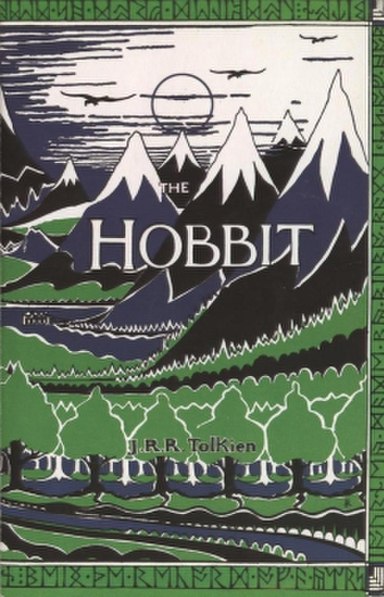
The Hobbit


Tolkien, J.R.R. 1937, 1966. The Hobbit.

In a hole in the ground there lived a hobbit. Not a nasty, dirty, wet hole, filled with the ends of worms and an oozy smell, nor yet a dry, bare, sandy hole with nothing in it to sit down on or to eat: it was a hobbit-hole, and that means comfort. (3)

Hobbits do like to be comfortable. That is a fact. But in The Hobbit, we read of one hobbit in particular, a Mr. Bilbo Baggins, who leaves his life of comfort behind him to go on a once-in-a-lifetime adventure with thirteen dwarves and one wizard. It is the story of how he went from being a respectable hobbit to a very unrespectable, "odd" little hobbit. Bilbo never meant to have an adventure. He was quite clear on that. But never say never. It all starts with a visit from a wizard, Gandalf. That visit leads to another visit--a visit by thirteen dwarves--who call upon him unawares and give him the surprise of his life. They want him--they expect him--to be a part of their expedition, their adventure, their journey to go off and kill a dragon, Smaug by name, and steal his treasure. It's laughable almost, at least at first, but slowly and surely Bilbo gets carried away with it all. And the adventures that follow--oh my!

The Hobbit is a charming and delightful though-not-a-thin adventure book that everyone should read. (Or at least attempt to read! By that I mean, while I loved it--while I think many many people love it--I suppose no one book can please everyone. But this one should at least be attempted, tested to see if you like this sort of thing.)

© Becky Laney of Becky's Book Reviews

Saturday, April 12, 2008

Ramona and Her Father


Cleary, Beverly. 1977. Ramona and Her Father.

In Ramona and Her Father, the reader finds Ramona in second grade and her older sister, Beezus, in seventh grade. Things aren't all well at the Quimby house. In the opening chapter, Mr. Quimby loses his job. In the upcoming days and weeks and months, we see changes in all sizes at the Quimby house. Her mother now works full time. Her dad is at home. Not at home doing nothing, but at home anxiously job-seeking and in a constant state of waiting. Waiting for the phone call. Waiting for news of work. At first Ramona thinks having her dad home in the afternoons--once she's home from school--will be all fun. She soon learns that while he's doing the best he can under the circumstances, he is unhappy and a little cranky. Beezus is not as perfect as she first appeared in the series. (I for one never bought it.) She's entering that age as Mrs. Quimby says. The stage where she's not her parents' little darling any longer. Ramona is acting less of a pest and more grown-up than ever. Not that she's free of getting into messes. No, a few of those do appear. But the novel is more serious. This typically happy-go-lucky family is facing hard times. But through it all, they remain a family. A family mostly united. A family that can still see the humor in life. Picky-picky's eating of the jack-o'-lantern. Ramona's crown of thorns. Ramona's sheepish Christmas play.

© Becky Laney of Becky's Book Reviews

Friday, April 11, 2008

Ramona the Brave


Cleary, Beverly. 1975. Ramona the Brave.

Yesterday, I reviewed Ramona the Pest. I love that book. I love the illustrations. The classic illustrations. The illustrations I grew up with. The edition of Ramona the Brave that I was able to find on the library shelves was ghastly. Maybe ghastly is too strong a word. Okay, I admit it is exaggerating it a bit. I suppose it's what I can expect from HarperCollins. The publishers that removed the Garth Williams illustrations from the Little House books wouldn't bat an eye about updating the illustrations for Ramona. These new illustrations are by Tracy Dockray. And they are wrong, wrong, wrong. Mostly wrong in principle, but wrong all the same. Just a note, a rather important note: the covers that I've been pairing with the reviews are the new books with the new illustrations.

Ramona the Brave. The book in hand. "Ramona Quimby, brave and fearless, was half running, half skipping to keep up with her big sister Beatrice on their way home from the park." Ramona is getting ready to start the first grade now. Big changes are on the way, Beezus now wants to be called Beatrice. Mrs. Quimby is going to be working outside the home. (Shocking, I know. But this was the seventies.) And the Quimbys' are going to be adding another room onto the house so that Beezus and Ramona won't have to share. All that in addition to both girls starting a new school year.

A new school year, a new teacher, some old familiar classmates. Ramona wants to be a good girl. And she's going to try her best not to let Susan and her boing-boing curls tempt her into trouble. But Susan is not making it easy. Susan's prone to copy-catting and tattle taling.

First grade is not making a good impression on Ramona. And her teacher is not like Miss Binney at all. All Ramona wants is for her teacher to like her, to appreciate her, to understand her, to not label her a trouble-maker.

Drama, drama, drama. I enjoyed Ramona the Brave. Certainly some parts are memorable. Her destroying Susan's owl and then later repenting and feeling guilty. Her note to her mother gets me every time. Such real emotion. And the bit about her getting chased with a dog and making a new shoe with some paper and a stapler. Her loving Beezus' teacher? Gotta love that!

But the absolutely best scene in Ramona the Brave. The one that makes it all worth while. Is Chapter Eight: Ramona Says A Bad Word. The bad word in question. Well, I'll just have to let you see:

Ramona had had enough. She had been miserable the whole first grade, and she no longer cared what happened. She wanted to do something bad. She wanted to do something terrible that would shock her whole family, something that would make them sit up and take notice. "I'm going to say a bad word!" she shouted with a stamp of her foot. That silenced her family. Picky-picky stopped washing and left the room. Mr. Quimby looked surprised and--how could he be so disloyal--a little amused. This made Ramona even angrier. Beezus looked interested and curious. After a moment Mrs. Quimby said quietly, "Go ahead, Ramona, and say the bad word if it will make you feel any better." Ramona clenched her fists and took a deep breath. "Guts!" she yelled. "Guts! Guts! Guts!" There. That would show them. Unfortunately, Ramona's family was not shocked and horrified as Ramona had expected. (137-138)

Don't you just love it? I especially love the process of how it's resolved. "Her parents continued to sit in silence, but Ramona was past caring what anyone did. She cried harder than she ever had cried in her life. She cried until she was limp and exhausted. Then Ramona felt her mother's hand on her back.d 'Ramona,' she said gently, 'what are we going to do with you?' With red eyes, a swollen face, and a streaming nose, Ramona sat up and glared at her mother. 'Love me!' Her voice was fierce with hurt. Shocked at her own words, she buried her face in the pillow. She had no tears left." (141)

Such raw emotion that is as authentic as can be. No wonder I connected with Ramona growing up!

© Becky Laney of Becky's Book Reviews
Thursday, April 10, 2008

Ramona the Pest


Cleary, Beverly. 1968. Ramona the Pest.

"I am not a pest," Ramona Quimby told her big sister Beezus.

Ramona is back. Originally published in 1968, a full decade after Beezus and Ramona, Ramona the Pest follows Ramona as she enters a strange, new world: kindergarten. Now five years old, Ramona is ready--or so she thinks--to conquer this thing called school. Eager to learn to read and write so she can catch up with her older sister Beezus. But what Ramona doesn't expect to be quite so challenging is the ever-going struggle to be good, to stay good through the course of a school day. Staying in her seat. Being quiet. Following the rules. Playing nicely with others. Ramona hasn't encountered much resistance. This has been Ramona's philosophy, and up to a point, it has always worked for her: "If she had to, she would make a great big noisy fuss, and when Ramona made a great big noisy fuss, she usually got her own way. Great big noisy fusses were often necessary when a girl was the youngest member of the family and the youngest person on her block." (12) So you can only imagine what a rude awakening is in store for her as she enters Miss Binney's kindergarten class.

Ramona the Pest is completely delightful. The novel is from Ramona's perspective, and she captures kid-thinking, kid-acting so authentically. Ramona and her classmates. What can I say? There's the ever-so-cute, ever-so-kissable Davy, Susan with the boing-boing curls, and Howie who is Ramona's playmate not by choice but because their parents are good friends. What I didn't realize growing up was how authentically she captures the teacher, Miss Binney.

I have so many favorite scenes from Ramona the Pest. But my favorite favorite favorite scene comes from chapter five, "Ramona's Engagement Ring." Henry Huggins, boy hero, saves Ramona and earns her new-found love and attention.

One of the things that makes these novels so charming, so perfectly delightful (besides the brilliantly witty and authentic characters and dialogue) is the artwork by Louis Darling.

© Becky Laney of Becky's Book Reviews


Wednesday, April 09, 2008

Beezus and Ramona


Cleary, Beverly. 1955. Beezus and Ramona.

Originally published in 1955, Beezus and Ramona is a true children's classic. Beezus, age 9, and Ramona, age 4, are the stars of Beezus and Ramona. This story is told from Beezus' perspective. (I believe the others in the series are told from Ramona's perspective.) This is how it opens: "Beatrice Quimby's biggest problem was her little sister Ramona. Beatrice, or Beezus (as everyone called her, because that was what Ramona had called her when she first learned to talk), knew other nine-year-old girls who had little sisters who went to nursery school, but she did not know anyone with a little sister like Ramona." If you've read any of the Ramona series, you know what she's talking about. Ramona. That love-to-hate, pesky little sister who is always into something. She has to be one of the best-loved, most-memorable characters ever created.

In Beezus and Ramona, we see the family dynamics of the Quimby household and the tension between two sisters. Beezus is almost perpetually frustrated with her younger sister. And Ramona is well, Ramona. Prone to wanting what she wants when she wants it.

I must have read this series dozens and dozens of times growing up. But I haven't read it recently. I probably last read it in 1999. Ramona is just as great as I remembered it. Each chapter has a scene that I almost know by heart. From the opening chapter, where Ramona's fascination with steam shovels lead her to destroy a library book, to the last chapter where Ramona's imaginative "acting-out" of Hansel and Gretel leads her to bake her doll, Bendix, in the oven and ruin her sister's birthday cake in the process.

I highly recommend this series to readers young and old. I think they make especially nice read-alouds! You can read the first chapter online here.

© Becky Laney of Becky's Book Reviews

Sunday, April 06, 2008

Stardust


Gaiman, Neil. 1999. Stardust.

If this book doesn't have you at hello, I don't know that I can help you. There was once a young man who wished to gain his Heart's Desire. And while that is, as beginnings go, not entirely novel (for every tale about every young man there ever was or will be could start in a similar manner) there was much about this young man and what happened to him that was unusual, although even he never knew the whole of it. What a great beginning. It's just so beautiful, so magical. Doesn't it just feel right?

Stardust is set in nineteenth century England in the community of Wall. (1830s and 1840s to be exact.) This community is built by a large (and by large I mean high and long) grey rock wall. There is a gap in the wall, however, a gap that is guarded at all times. Guarded so no one--especially children--can slip through, and guarded so no one can slip in. Beyond the gap, there is a meadow, a beautiful meadow that is forbidden. Forbidden except for one day (and one night) every nine years when the Faerie market comes to the meadow. This is the only time when the two communities (the rather mundane humans and the fantastical, magical faerie world) interact. Our novel opens with us meeting Dunstan Thorn.

I really can't say much more about it. I could, but I won't. It's magical. It's beautiful. It's adventuresome. It's just great storytelling. I loved every moment of it. There were so many things I loved about it that I couldn't begin to describe them in such a way as to do the book and its characters justice. Just trust me. If you haven't met Neil Gaiman, use Stardust as an introduction!!! This isn't my first Gaiman. It's my third. But it is by far my favorite.

© Becky Laney of Becky's Book Reviews

Saturday, April 05, 2008

Pictures AND conversations


Carroll, Lewis. 1865. Alice's Adventures in Wonderland.

(This edition is the one published in 1999 featuring the illustrations of Lisbeth Zwerger.)

Alice was beginning to get very tired of sitting by her sister on the bank, and of having nothing to do: once or twice she had peeped into the book her sister was reading, but it had no pictures or conversations in it, "and what is the use of a book," thought Alice, "without pictures or conversations?"

If you're like Alice (when it comes to books), then you'll be pleased to know that Alice in Wonderland has plenty of pictures and conversations to offer readers of all ages. How to describe it? Magically wonderful? Practically perfect in every way? I think I'll go the chattier route, though.

My mom read Alice in Wonderland to us (me and my sister, my older sister) at least once or twice growing up. It was one of those books that was magical. Proof that reading was magic, that reading was the best way to spend an afternoon or evening. She had multiple copies, and we'd all three "read" along together. Of course, mom and my sister could read. I wasn't quite old enough to read it on my own, but oh-how-I-loved-to-pretend. But whether remembering the first time or the next dozen times, one thing was always the same. It was magic to go along on these adventures with Alice.

The story for those that may not be familiar with all the particulars begins when Alice follows a white rabbit down a rabbit hole. She spends some time falling down, down, down, down. But eventually she does reach the bottom. What she finds is an ever-changing, quite-strange world that both puzzles and delights and even at times frights. This strange place, this wonderland, has its own strange set of rules, its own logic, something that Alice can't quite wrap her mind around. (Not that I'd do any better, mind you!) Like her surroundings, she finds herself changing in unpredictable ways as well. Everything is fluid. Just when she starts to make sense of her situation, something changes, something transforms. Wonderland can be portrayed as dark or as light as you imagine. Especially when it comes to film and other adaptations.

The unique characters, the unique settings, the unique logic. All three make Alice's Adventures in Wonderland ever-so-magical and always-memorable.

Alice's Wonderland is strange. No doubt about it. But it has always made sense in a strange sort of way to me. It was like Lewis Carroll was a genius in capturing in conveying the dream world. Haven't you had dreams as strange as this one? Haven't you in-the-moment-of-the-dream gotten caught up in the new reality? Dreams have their own logic and so does Wonderland. And the more of a dreamer you are, I suppose, the more you love Alice and her 'friends.'

Though I read the Zwerger version, I'm going to be honest and admit that I prefer Tenniel's original illustrations. Perhaps because I grew up with them, perhaps because they're just the best and there is no improving on something that is 'the best.' But I will admit that they are good in their own little way.

© Becky Laney of Becky's Book Reviews

Friday, March 28, 2008

The Lion, The Witch, and the Wardrobe


The Lion, The Witch, and The Wardrobe by C.S. Lewis

My review of C.S. Lewis' classic children's book The Lion, The Witch, and the Wardrobe is going to be chatty--quite chatty--and there's nothing I can do about it. I first encountered the magic of Narnia in fourth grade when my teacher read it aloud to us. My teacher, Mrs. Watts, was known for many things. She inspired much fear and trembling. Like Aslan, she was not tame, but good. While, other students may remember the discipline or the hard work...I'll always remember my magical introduction to Narnia. Soon after, I added book by book the series to my collection. Most of my copies were used. Most were ugly. But I devoured each one. I seem to remember my sister reading a few of the series at least.

But unlike Little House and Ramona and Anne, this series was more me and less her. Narnia belonged to me--the magic, the wonder, the glory of it all. I remember the pure pleasure I experienced each and every time I opened up a book. I remember the book covers, yes. And I definitely have strong opinions on which book covers through the years are 'the best' of the bunch. But more precisely, I fell in love with the proper order of the series. Few things irritate me more than someone who insists on that new-fangled order. Which is why, if you could see me, you'd know how frustrating it is to read my 7-in-1 novel. But some things must be preserved at all costs.

Once there were four children whose names were Peter, Susan, Edmund, and Lucy. This story is about something that happened to them when they were sent away from London during the war because of the air-raids. (p. 111 in the 7-in-1 edition)

The adventures in and out of the wardrobe that these four experience during the course of the novel are oh-so-magical. The characters--both major and minor--so memorable. The story, familiar yet resilient, even after having read it a dozen times. So many wonderful scenes. Scenes that resonate. In case you haven't read it, let me give you a teaser. Lucy, the youngest of the children, accidentally discovers a magical land of ice and snow while hiding in a wardrobe in the Professor's house. Her three siblings--Peter, Susan, and Edmund--at first don't believe her. They take her tale as a wild, silly, foolish story of a girl whose homesick and wanting attention. Edmund, the brother closest to her in age and thus her biggest tormentor, also wanders into Narnia unexpectedly. But who he meets there, will perhaps undo them all. Narnia is not a land at peace. Not at all. For the land is under a spell--an enchantment--the White Witch--the supposed Queen of the land--has made it always winter and never Christmas. And the lives of the children--all four children--are in grave danger when they're in Narnia. For there is a prophecy that four humans--two sons of Adam and two daughters of Eve--will come to rule the land as Kings and Queens and restore peace and order to the kingdom.

The heart and soul of The Lion, The Witch, and The Wardrobe is the revelation of Aslan, the King of the land, a lion.

And now a very curious thing happened. None of the children knew who Aslan was any more than you do; but the moment the Beaver had spoken these words everyone felt quite different. Perhaps it has sometimes happened to you in a dream that someone says something which you don't understand but in the dream it feels as if it has some enormous meaning--either a terrifying one which turns the whole dream into a nightmare or else a lovely meaning too lovely to put into words, which makes the dream so beautiful that you remember it all your life and are always wishing you could get into that dream again. It was like that now. At the name of Aslan each one of the children felt something jump in its inside. Edmund felt a sensation of mysterious horror. Peter felt suddenly brave and adventurous. Susan felt as if some delicious smell or some delightful strain of music had just floated by her. And Lucy got the feeling you have when you wake up in the morning and realize that it is the beginning of the holidays or the beginning of summer. (141 of 7-in-1 edition)

The children's journey to Narnia, their quest to meet Aslan at the Stone Table, and their battle to save Narnia and their brother from the grasp of the evil and wicked witch....are unforgettable adventures that deserve to be experienced again and again by readers of all ages. You're never too old to experience the magic of Narnia.

© Becky Laney of Becky's Book Reviews

Here's the super-trailer for the movie:

Thursday, March 27, 2008

Sense and Sensibility


Sense and Sensibility by Jane Austen. What can I say? I didn't love it like I loved (or loved, loved, loved) Persuasion or Pride and Prejudice. It was so different to Northanger Abbey in a way which makes it more difficult to compare. But in its favor, I didn't dislike it like I disliked Mansfeld Park or Emma. (A word on Emma's behalf. Emma, the character, annoys me. I know she's supposed to be annoying because she represents the young and foolish and rich and selfish and spoiled stereotype. But still. It's hard to like someone like that. It would be like reading a book told from Lydia's perspective. I wonder if anyone has done that???)

Sense and Sensibility is the story of the Dashwood family. The mother has recently been widowed. She's got a step-son who's inherited everything, and her own three daughters. She's also got a daughter-in-law from hell. Really. This woman would make even a saint think that. The two are somewhat indirectly pushed out the door by the couple--Mr. and Mrs. John Dashwood. They're insufferable to live with. And they're rude and pushy. Contemptible really. The only good thing that happens is that Elinor meets a young man, Edward Ferrars, and falls in love. Though nothing is promised or exchanged between them.

The Dashwoods (mother and three daughters: Elinor, Marianne, Margaret) move to a cottage quite a distance away. (Barton I believe is the place where they're staying.) While there, Marianne 'makes' two men fall in love with her. Colonel Brandon, a respectable but older gentleman, and the young and dashing and ever-so-handsome Mr. Willoughby. Marianne sees only Willoughby. Brandon doesn't stand a chance. They also meet many people in the neighborhood--Mrs. Jennings, the Middletons, the Palmers, the Steeles, etc.

The story centers around the love lives of the two older sisters Elinor and Marianne. Often the two are down on their luck. Money plays a big role in the novel. But Jane Austen loved happy endings so never fear. It may take a good many pages, but Marianne and Elinor are assured of finding men that suit them perfectly one way or another.

368 pages.
Originally published in 1811.
First sentence: The family of Dashwood had long been settled in Sussex.

© Becky Laney of Becky's Book Reviews

Thursday, March 20, 2008

Out of the Dust


Hesse, Karen. 1997. Out of the Dust.

Out of the Dust is a Newbery winner. And honestly I can't believe I missed this one. I'm just now getting to it. (Though I don't think I would have been as ready for it then as I am now.) Set in the 1930s, the novel focuses on a family living in Oklahoma during the Dust Bowl during the Depression. To say things are a bit bleak would be an understatement. Our heroine, Billie Jo, has many hopes and dreams, but the lack of rain, the lack of crops, the lack of money do have a way of weighing the family down--Billie Jo included. Her mother is pregnant. And her father is always busy working on the farm. Billie Jo's biggest dreams revolve around the piano. She loves to play the piano. She loves to make music. It's a part of who she is; it's a part of her soul. But when tragedy strikes, Billie Jo's dreams get buried in despair. Will things ever get better? Will she ever find the courage and strength and will to play again?

Life. Love. Hope. Disappointment. Anger. Grief. Despair. Loneliness. Guilt. Families. Forgiveness. Grace. Peace. It's all here. The story is definitely one that resonates. But I would be lying if I said it was an easy read. The tragedy is a tragedy. And it changes everything in her life forever.

Thursday, February 28, 2008

Their Eyes Were Watching God

Hurston, Zora Neale. 1937. Their Eyes Were Watching God.

If ever a book is going to grab you at 'hello', let it be Their Eyes Were Watching God by Zora Neale Hurston.

Ships at a distance have every man’s wish on board. For some they come in with the tide. For others they sail forever on the horizon, never out of sight, never landing until the Watcher turns his eyes away in resignation, his dreams mocked to death by Time. That is the life of men.

Now women forget all those things they don’t want to remember, and remember everything they don’t want to forget. The dream is the truth. Then they act and do things accordingly. (1)

This book, which I just recently finished reading for my online reading group, has to be one of my favorite, favorite, favorite, favorite books of all time. (Yes, it's right up there along with Ender's Game by Orson Scott Card and Frankenstein by Mary Shelley.) I first "discovered" Zora Neale Hurston by force. She was required reading in a short story course I was taking in the Fall of 1997. When I signed up for the course, I was not an English major. I was just looking to fulfill the core requirements. (The very fact that I was in that class was an accident because of schedule conflicts and classes having to be changed, rearranged, etc. at the last moment. One thing I don't miss about college is the hassle of registering for classes, having some be canceled and having to scramble to find something new at the last minute.) By the end of the semester, however, I had changed majors and chosen to walk down a new path. (Zora Neale Hurston wasn't solely responsible, however, she had help from some other greats.) Hurston kept popping up on reading lists in college. A short story here and there. And then there came the novel--Their Eyes Were Watching God--I honestly don't remember if it was assigned reading just once or if I read it twice 'officially' (meaning for a grade). But regardless, it was love. I've read this one at least four or five times since that first introduction.

The story. At the heart of the story is a woman. Janie. Except for the very briefest introductions, we first meet Janie as a young woman, sixteen or seventeen and just awakening to the possibilities of love and life and passion.
Oh to be a pear tree–any tree in bloom! With kissing bees singing of the beginning of the world! She was sixteen. She had glossy leaves and bursting buds and she wanted to struggle with life but it seemed to elude her. Where were the singing bees for her? Nothing on the place nor in her grandma’s house answered her. She searched as much of the world as she could from the top of the front steps and then went on down to the front gate and leaned over to gaze up and down the road. Looking, waiting, breathing short with impatience. Waiting for the world to be made. (11)
But life and love don't come easy for Janie. Her grandmother, the woman who raised her, forces her into a loveless marriage. Logan is Janie's first husband, her first introduction to what it means to 'be' a woman. In chapter three, we read, "She knew now that marriage did not make love. Janie’s first dream was dead, so she became a woman." (25) But Janie goes on to have other dreams and second chances.

Janie's life isn't easy, and the things that take her from an unhappy wife of seventeen to a grown woman, a sadder but wiser woman, in her forties are often bittersweet. But her story is one that must be told, must be shared. It is an emotional journey of one woman's life, one woman's experiences and heart aches. Her hopes. Her dreams. Her everything laid before the world.

“Love is lak de sea. It’s uh movin’ thing, but still and all, it takes its shape from de shore it meets, and it’s different with every shore.” (191)

“Two things everybody’s got tuh do fuh theyselves. They got tuh go tuh God, and they got tuh find out about livin’ fuh theyselves.” (192)

The book is beautiful. Full of imagery--some beautiful, some haunting, some heartbreaking, but always, always authentic imagery. The language. The characters. The style. This one is a real gem of a book. The best of the best. A true masterpiece.

Official site of Zora Neale Hurston

On the official site you can listen to excerpts of Their Eyes Were Watching God, Mules & Men, and Every Tongue Got To Confess. All performed by Ruby Dee. (Now, if only MY library would have these audio books, I’d be very happy indeed.)

Their Eyes Were Watching God (Official)

A nice, brief summary that fills in the “why” of why you should read it! Also linked to the first chapter online, the reading group guide, and the teaching guide.

National Endowment for the Arts: The Big Read: Their Eyes Were Watching God.

To call Zora Neale Hurston’s Their Eyes Were Watching God an “African American feminist classic” may be an accurate statement-it is certainly a frequent statement-but it is a misleadingly narrow and rather dull way to introduce a vibrant and achingly human novel. The syncopated beauty of Hurston’s prose, her remarkable gift for comedy, the sheer visceral terror of the book’s climax, all transcend any label that critics have tried to put on this remarkable work. First published amid controversy in 1937, then rescued from obscurity four decades later, the novel narrates Janie Crawford’s ripening from a vibrant, but voiceless, teenage girl into a woman with her finger on the trigger of her own destiny. Although Hurston wrote the novel in only seven weeks, Their Eyes Were Watching God breathes and bleeds a whole life’s worth of urgent experience.

Sunday, February 24, 2008

White Lilacs


Meyer, Carolyn. 1993. White Lilacs.

In the time before we knew that we would be driven away, our lives uprooted, and our people scattered, Grandfather Jim Williams spent every spare minute tending his beautiful garden in Freedomtown. He loved that garden, and I loved him. The garden was my favorite place.

Set in the fictional town of Dillon, Texas, White Lilacs tells the story of a community within a community. Freedomtown, a community of African Americans (Though of course they weren't called that then, negroes or colored being the terminology then. Though Meyer does use the n* word later on when relations become more strained.) Our narrator is Rose Lee Jefferson, a twelve year old who is about to forced into growing up rather quickly. She is a girl that loves life, loves her family, loves to draw. She especially loves spending time with her grandfather. He is a gardener for the Bell family. Her Aunt Tillie works for the Bell family as well. (I believe as the cook.) One day, soon after our narrative opens, Rose is unexpectedly called into the Bell's kitchen by her aunt and told that she needs her to serve luncheon to the Bells and their guests. She had been having fun with her grandfather, and the garden was a place she felt at home, felt comfortable. But she does what she must. It's a day that will change her life forever. Why? She overhears that the white folks of the community are planning to force them out, force them to sell. They want a park, a library, a woman's club.

Throughout that summer, Rose works when she can and overhears as much as she dares. But by the middle of July, it's clear that the whites will have their way. Change is a coming. And coming fast. Knowing that it would be impossible to save their community, Rose acts quickly to preserve what she can--on paper. She draws what she can--the school, the churches, the homes, the businesses.

White Lilacs is a heartbreaking story of prejudice and hate. But it is also a story of a loving family, a family that holds onto hope, holds onto the good, that holds together.

Though fictional in nature, the book tells the all-too-real story of Quakertown. In the early 1920s, the African Americans of Quakertown were forced to sell their land so that the white folks of the city could have a park. You can read more about the actual Quakertown here. There is now a museum opened that tells the story of the community and documents its past.

Thursday, February 21, 2008

The Moffats


Estes, Eleanor. 1941. The Moffats.

The Moffats may not be the most exciting, thrilling, page-turning book I've ever read, but it is enjoyable none the less in its quiet, subtle, gentle way. The book focuses on the Moffat family. A mother raising her kids alone. The family is not rich--as you can imagine--but there is a loving, caring atmosphere that makes for a very happy home. The book is episodic. The narrator or main character changes from chapter to chapter. And there is no one connecting plot that threads them altogether. (Well, maybe that isn't quite true. If there is such a plot it would be that their landlord has put their house up for sale. This occurs in the first or second chapter. And the house is sold and the Moffats have to move in the last chapter.) Each chapter is a story of sorts about what life is like--daily life around the house, around school, around town, etc. The stories are mostly lighthearted and fun. But there are some serious moments as well, some moments that border on being a lesson in morality. For readers looking for family-oriented, family-friending reading material, The Moffats is sure to satisfy.

First sentences: The way Mama could peel apples! A few turns of the knife and there the apple was, all skinned! Jane could not take her eyes from her mother's hands. They had a way of doing things, peeling apples, sprinkling salt, counting pennies, that fascinated her.

224 pages

Tuesday, February 19, 2008

B is for Betsy


Haywood, Carolyn. 1939. B is for Betsy.

I'll keep this one short and sweet. I read this book because I've been going way way back this month. (Who knows why???) Anyway, as far as books from the thirties go, this one is charming enough. The heroine is, of course, named Betsy. And the plot is episodic. Each chapter is a new adventure. Most of them center around life at home and life at school. It's not that the book is bad, it's just a bit dated. You can love it, I hope, and still admit that it's dated. (If you grew up with this book and loved it and want to share it with your kids, I don't want to offend you by saying it's "dated." But as an adult reader I've got to be honest and say that I'm not so sure that today's young readers are going to be as charmed with it as their grandmothers may have been. You may pull it off if you do it as a read aloud, but I don't know that a kid would pick this one up on their own and stick with it. Not without some motivation or guidance or exuberance from a trusted adult.)

Another point--that may be neither here nor there. But I think *sometimes* your response to a book is dependent on when you read it. Some books that I only "like" now, I probably would have loved as a kid. Some books I loved as a kid, if I was reading them for the first time as an adult, would only merit a "like" as an adult reader. It's just something to consider.

First sentence: "Betsy lay in her little white bed. She had been awake a long time. Outside her window the birds were calling "Good Morning" to each other, but Betsy did not hear them. All summer long she had jumped out of bed as soon as her eyes were open. She had always run to the window and thrown sunflower seeds out to the birds for their breakfast. But this morning Betsy was so busy feeling unhappy that she forgot all about the birds. Betsy was unhappy because today was the first day of school. She had never been to school and she was sure she would not like it."

159 pages.

Matilda


Dahl, Roald. 1988. Matilda.

I read this one because I was inspired by Melissa. What can I say about it? It's wild. It's definitely out there. But it's fun. Oodles and oodles of fun. Realistic? Never in a million years. Was it meant to be? Of course not. A zany (how often do I use that word???) over-the-top thoroughly enjoyable read. Matilda is a young genius. (4 or 5 years old) An under appreciated genius at that. Her parents are ghastly. There really isn't any other way to say it. They're abominable. So Matilda has a way of getting back at her parents for their cruel and horrid behavior. Then it's time for Matilda to start school. She's got a good teacher--a teacher that is practically a saint--but the superintendent (my guess is the equivalent of a principal) is evil incarnate. The battle between good and evil has never been quite so strange. Anyway, it's a fun read. But as I said, it probably isn't for everyone.

It's a funny thing about mothers and fathers. Even when their own child is the most disgusting little blister you could ever imagine, they still think that he or she is wonderful. Some parents go further. They become so blinded by adoration they manage to convince themselves their child has qualities of genius. Well, there is nothing very wrong with all this. It's the way of the world. It is only when the parents begin telling us about the brilliance of their own revolting offspring, that we start shouting, "Bring us a basin! We're going to be sick!"

240 pages.