Showing posts with label "M" Authors. Show all posts

Monday, February 09, 2009

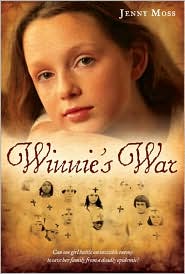
Winnie's War


Moss, Jenny. 2009. Winnie's War. Walker Books.

"Winnie, stop playing with those forks," said my grandmother.

The novel, Winnie's War, is set in 1918 during the epidemic or outbreak of the Spanish influenza. Winnie lives with her family--mother, father, grandmother, and her younger sisters--in a small-town in Texas. Her mother is emotionally scarred and a bit unresponsive--having survived the great Galveston hurricane of 1900. The novel is about many things--life, death, survival, risk, fear, love, loss, hope, friends, and family--but above all else it is a novel about growing up and trying to hold onto hope. But is that possible? To have hope when you fear for the well being of your family, of your friends, of life as you've always known it? Does having hope make a difference? Can it protect you? save you? What does having hope teach you about yourself and about the world around you? If Winnie could, she'd stop the influenza from coming into her town, her neighborhood. If she could, she'd stop death from claiming the lives of those she loves--even if that love is without understanding at times. But Winnie's just a girl, a girl with heart and soul that you may come to love as you turn the pages of the book.

© Becky Laney of Becky's Book Reviews

Friday, January 09, 2009

The House at Pooh Corner


Milne, A.A. 1928. The House At Pooh Corner. With illustrations by Ernest H. Shepard.

One day when Pooh Bear had nothing else to do, he thought he would do something, so he went round to Piglet's house to see what Piglet was doing.

Last January, I read and reviewed Winnie the Pooh. It was a reread, as is House at Pooh Corner, an indulgence, too, if you will. Milne's characters: Pooh, Piglet, Eeyore, Rabbit, Owl, Tigger, Kanga, Roo, even Rabbit's friends-and-relations like 'Small' are endearing. They're not just characters in a book, they're friends. And visiting with these particular friends is always pleasant, always welcome. If you haven't read his books--even if you're eighty-two--you really should! It's never too late to go to the 100 Acre Woods.

What will you find in House at Pooh Corner? Poohsticks. Hums. Blustery days. The arrival of Tigger, and so much more. It's written in such a way that you could open it up anywhere and find something quotable. It's just that good.

Here are some of Pooh's thoughts on Poetry taken from House At Pooh Corner.

© Becky Laney of Becky's Book Reviews

Tuesday, January 06, 2009

Veronica


Miner, Jane Claypool. 1986. Veronica. Sunfire Romance.

This particular Sunfire Romance novel is set during World War II. In Hawaii. Our heroine, Veronica, is sixteen. Her father is in the U.S. Navy. He's been stationed there all of her life, she was born and raised there. Veronica portrays the subtle-and-not-so-subtle prejudices of the day. Prejudices against those native Hawaiians; prejudices against the Japanese. Veronica Bennett, unlike her parents, has an open mind. Her best friend, Toshi Nakamura, is of Japanese descent. Her boyfriend, Mike Kokohuilano, is Hawaiian.

When the book opens, she is at a party. A party mostly consisting of those her parents' age. However, there just happens to be one boy there--a very cute boy at that--who is around her age. Two years older, in fact, a Navy man, Phillip Easterwood who's stationed on the U.S.S. Arizona. They meet in the late autumn of 1941.

Before Veronica knows it, she's being wooed by two men: Phillip, a so-called "romantic" man who likes to hear himself talk; and Mike, a guy who's more down-to-earth and all-around-nice-guy. Who will Veronica choose? Or will the Japanese bombers choose for her? Will Phillip survive to the end of the book?

This is from one of Phillip's speeches on their first date:

"The minute I saw you standing in the garden with all these flowers around you, I knew you were right for me. Your hair looked like gold against the blue sky, and then you smiled at me. Do you know how long it's been since someone really smiled at me? Sunny, will you be my girl?"

© Becky Laney of Becky's Book Reviews

Wednesday, November 26, 2008

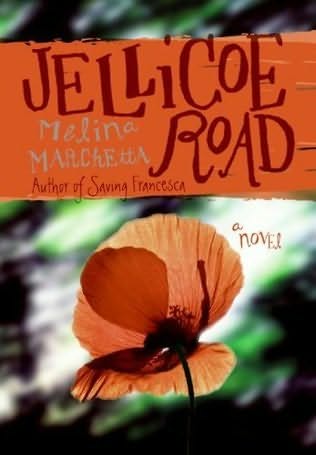
Travel the World: Australia: Jellicoe Road


Marchetta, Melina. 2008. Jellicoe Road.

Prologue:
My father took one hundred and thirty-two minutes to die. I counted. It happened on the Jellicoe Road. The prettiest road I'd ever seen, where trees made breezy canopies like a tunnel to Shangri-la. We were going to the ocean, hundreds of miles away, because I wanted to see the ocean and my father said that it was about time the four of us made that journey. I remember asking, "What's the difference between a trip and a journey?" and my father said, "Narnie, my love, when we get there, you'll understand," and that was the last thing he ever said.
We heard her almost straightaway. In the other car, wedged into ours so deep that you couldn't tell where one began and the other ended. She told us her name was Tate and then she squeezed through the glass and the steel and climbed over her own dead--just to be with Webb and me; to give us her hand so we could clutch it with all our might. And then a kid called Fitz came riding by on a stolen bike and saved our lives. Someone asked us later, "Didn't you wonder why no one came across you sooner?" Did I wonder? When you see your parents zipped up in black body bags on the Jellicoe Road like they're some kind of garbage, don't you know? Wonder dies.
Powerful, isn't it? I won't lie...Jellicoe Road is a difficult read in many different ways. But worth it? Yes! Resoundingly yes! Why is it difficult? It weaves two stories together. The stories are seemingly unconnected...at least in the beginning. And because you--the reader--don't know what is going on...it's easy to get frustrated. Easy to get confused. We've got the past--from which the prologue serves as an introduction--and the present. (In a way it reminds me of Tamar.)

The present. We've got several teens whose lives intersect--Taylor Markham, Ben Cassidy, Jonah Griggs, Chaz Santangelo, Raffaela, Jessa McKenzie--of whom Taylor is the main character. Taylor doesn't know where she fits in, "One day when I was eleven, my mother drove me out here and while I was in the toilets at the 7-Eleven on the Jellicoe Road, she drove off and left me there. It becomes one of those defining moments in your life, when your mother does that. It's not as if I don't forgive her, because I do" (20). Taylor is one of many students at Jellicoe School, a boarding school; she's the leader of her dorm or "house". (There are six houses.) And the school tradition is that there are "wars" between three sects--those that live at the boarding school (led by Taylor), the Townies (led by Chaz Santangelo), and the Cadets (led by Jonah Griggs). These wars involve territories. And these games last six weeks or so. And they're a big deal for those involved. But what at first seems like a senseless, pointless book on children playing war--tactical strategies, trapping, pranking, and such--soon turns into an emotional journey of the heart, soul, and mind.

Taylor Markham is concerned, worried, anxious about Hannah, a woman who is the closest thing she has to family, when she disappears without a word. One day she's there, the next day she's gone. And Taylor can't get a straight word out of any of the adults around at the school or in the town about Hannah's whereabouts. Taylor--though Hannah is still missing--likes to take refuge in Hannah's house. She loves to read Hannah's manuscript, for example, which is the story of five kids who live on Jellicoe Road: Tate, Narnie, Webb, Fitz, and Jude.

I don't want to spoil this one in any way. But I think this *may* help readers out a bit. I didn't catch on that the italicized portions--the stories of Tate, Webb, Narnie, Jude, Fitz, etc.--were written down stories. That Taylor was reading something Hannah had written down. I'm still not sure all of them are meant to be. But I think some of them are. And it is these stories which help Taylor to piece everything all together. (I had assumed that they were flashbacks. That they were there for the reader's benefit, but not for the characters within the book.)

This is a book that had to grow on me. It wasn't one that I knew I would love--or thought I would love--from the very first page. But by the time the story comes together, by the finale, it had me completely won over. The story is intricately told and well written. Haunting, yes. Bittersweet, definitely. But one that I think is worth reading and recommending.

© Becky Laney of Becky's Book Reviews

Tuesday, October 21, 2008

Ink Exchange


Marr, Melissa. 2008. Ink Exchange.

Ink Exchange is the follow-up novel to Wicked Lovely. (Same fictional world, different narrators. Wicked Lovely, by the way, is a book that I could have sworn that I'd read last year...but for some reason or other...it isn't showing up in my archives. Which leaves me with the puzzlement...did I really read it? Regardless of if that is yes or no...I can say that I was able to get swept away into this book, this story, this world.)

Leslie is a mortal girl who is very troubled. Her father's essentially a broken man, a man who's almost completely out of her life. Her brother, Ren, is a drug addict/drug dealer. He's not beyond selling his sister's body--without her consent--to get what he wants or what he needs. Leslie is angry, hurt, and confused. Very angst-filled teen with good reason. She seeks an escape. She seeks a new identity. And for Leslie, step number one of this new life is getting a tattoo.

Leslie's right in a way. The tattoo will change her life. But Leslie had no idea what she was really in for. What a tangled mess she was getting into when she requested this one particular tattoo.

This tattoo links her body-and-soul with the king of the dark court. This faery king needs a mortal to "feed" his court, his followers. (It's only half as bad as it sounds. The dark faeries feed on emotions felt by humans. So it's exploitive and manipulative and sometimes cruel and sometimes just plain awful.)

Irial and Niall aren't mortals, they're part of the faerie world. Each desires Leslie. Each recognizes to a certain extent that they'd be bad for Leslie in that interactions between mortals and faeries almost always end badly for humans. But they're both drawn to her. Both lust for her. Both love her. Or claim to love her. Both have a bad track record with human women.

One of the things I enjoyed about this dark little story were the characters. Each was flawed. Each had good qualities; each had bad qualities. No one character was completely good or completely evil. Each was selfish and looking out for themselves, but most also were loving enough to want what was best for those around them whom they loved as well. Few (if any)was so completely self-absorbed that they were a monster.

This book was also way more complex than I was bargaining for. The characters had so much baggage, so much depth, so much I don't quite what the right word is. The characters were complicated which made them feel real to me as opposed to feeling that they were flat and lifeless or stereotypical or boring or whatever.

© Becky Laney of Becky's Book Reviews

Tuesday, September 23, 2008

Wake


McMann, Lisa. 2008. Wake.

Janie has a problem. No, it’s not that she thinks she’s too fat. It’s not that her dream guy isn’t asking her to the prom. Her problem? She has been falling into other people’s dreams. She first discovered this ability as a child—on a subway I believe (or public transit of some sort)—but it’s been getting worse, a lot worse since she’s become a teen. At school, her classmates have a tendency of falling asleep. And that spells trouble for our heroine, Janie. It’s not that all the dreams she falls into are nightmares, but any dream can become tedious after awhile. After all, how many times has she lived through others dreams of falling, or of being naked in a crowd of people, or other people’s sex dreams. (Just imagine it! Having to face your friends, your classmates, your enemies on a day to day basis after witnessing their most embarrassing dreams!) Yes, Janie wish this ability, this power would disappear. Maybe then she could have a normal social life, normal dating life.

I enjoyed Wake. It is an interesting premise, and I am pleased there will be a follow-up novel called Fade. While it has an intriguing opening, Janie experiencing a dream during the study period at the library, the book perhaps spends too much time setting up the story through a series of flashbacks. The flashbacks were like vignettes. Loosely connected. As a reader, you don’t really realize their significance, their purpose, until later. It is through these flashbacks that Janie is revealed, her friends and enemies revealed, her home life revealed. Did I enjoy this one? Yes. I definitely enjoyed it and would recommend it. I enjoyed it more once the ‘action’ was back to the present year of 2005 because the narrative flowed more smoothly then and read more like a traditional novel.

First sentence: Janie Hannagan’s math book slips from her fingers. She grips the edge of the table in the school library. Everything goes black and silent. She sighs and rests her head on the table. Tries to pull herself out of it, but fails miserably. She’s too tired today. Too hungry. She really doesn’t have time for this. (1)


© Becky Laney of Becky's Book Reviews

Monday, September 15, 2008

The Road Of Lost Innocence


Mam, Somaly. 2008. The Road of Lost Innocence: The True Story of a Cambodian Heroine.

Powerful. That is one of the best words to describe this heartbreaking memoir of Somaly Mam. Here is how it begins,
"My name is Somaly. At least that's the name I have now. Like everyone in Cambodia, I've had several. Names are the result of temporary choices. You change them the way you'd change lives. As a small child, I was called Ya, and sometimes just Non--"Little One." When I was taken away from the forest by the old man, I was called Aya, and once at a border crossing, he told the guard my name was Viriya--I don't really know why. I got used to people calling me all sorts of names, mostly insults. Then, years later, a kind man who said he was my uncle game me the name Somaly: "The Necklace of Flowers Lost in the Virgin Forest." I liked it; it seemed to fit the idea of who I felt I really was. When I finally had the choice, I decided to keep that name as my own. I will never know what my parents called me. But then I have nothing from them, no memories at all." (1-2)
The book is compelling, gripping, raw and intense, straightforward, and above all else heartbreaking. Her story is powerful in that she survived despite it all; amazing in that she had the courage and strength to go back, to face her demons; inspiring in that she had the determination and heart to do something--to make a change, to become a hero, to take a stand.

Hers is the story of an unloved child. A child broken, beaten, abused and misused in countless cruel ways by the adults in her life. The story of how she was raped, sold into prostitution, endured the unimaginable--years of prostitution against her will, thousands of rapes, thousands of beatings, unimaginable punishments by the brothel owners if she didn't "perform" to their satisfaction. A story that is heartbreaking not only for what she endured, but for what everyone around her endured as well. She was not the only one. She wasn't one of few. This treatment, this abuse, this cruelty, this horror is common. Her story highlights just how abominable and cruel and evil humanity can be. The lack of humane treatment. The lack of justice. The lack of compassion. The lack of human decency and respect.

"It's still happening, today, tonight. Imagine how many girls have been raped and hit since you started to read this book. My story doesn't matter, except that it stands for their story too, and their stories are why I don't sleep at night. They haunt me." (61)

Somaly Mam was able to escape her life of prostitution--though it wasn't easy, though it left her scarred emotionally and psychologically. And after a time--with a little help and support, with some training and a boost in confidence--she was able to face her past and make the decision that would change lives. She'd return (with her husband) to her home country to make a change. To seek out those girls that just like her were sold into prostitution, that were abused daily, that were unloved, unwanted by their families, their society.

"I don't feel like I can change the world. I don't even try. I only want to change this small life that I see standing in front of me, which is suffering. I want to change this small real thing that is the destiny of one little girl. And then another, and another, because if I didn't, I wouldn't be able to live with myself or sleep at night." (129)

This book is heartbreaking to read, but I feel it is important. Definitely recommended.

http://www.somaly.org/

© Becky Laney of Becky's Book Reviews

Tuesday, September 09, 2008

Cycler


McLaughlin, Lauren. 2008. Cycler.

This book is blurbed by Scott Westerfeld, one of my favorite authors, "Artfully fractured and wickedly smart. A brilliant screwball comedy about love, self-knowledge, and the secret identities inside all of us." Part of me is curious what book he read, because that sure wasn't my take on Cycler. Proof yet again that reading is subjective.

I have mixed feelings on this one. I'll try to explain the pros and cons as I see them throughout my review.

First sentence: "I am all girl."

Premise: Narrated by Jill and Jack, the book tells the stories of two teens living in one body. Jill is Jill. She has the body--a female body--most of the month. But four days out of every month, Jill transforms into Jack, a teen boy with very real male desires and thoughts. It's hard to wrap your mind around this one. Imagine being a girl most of the time--but four days out of each month having a penis. (Though never once (to my recollection) does the author actually use the word penis. It's always referred to not-so-subtly in often-lame terms which you typically only find in bad romances.) It's something that Jill doesn't want to cope with--and neither do her parents. Fortunately or unfortunately you may say, Jill has discovered a way to block out her Jack memories. To erase him from her mind most of the time. But still.

The novel opens with this transformation from Jack-to-Jill in progress.
"I am all girl."
I say it because my body is betraying me.
In my dream, the colorful autumn day becomes night. The Ferris wheel speeds up, breaks free of its foundation and rolls through the darkened woods. Shearing tree branches with loud splintery crunches, it rolls toward the black lake at the edge of the tree line.
From deep within me, behind organs, beneath muscles, a jagged pain is born.
"I am all girl."
I open my eyes to the real night, the thick molasses darkness of it. But it's only when I spot the red numbers of my clock that I'm sure I'm awake: 4:27 AM. The pain is building to a sure and steady climax and I don't know who I am.
Jack or Jill.
"I am all girl!" I squeeze through clenched teeth.
There's a land mine exploding outward from my stomach and lower spine.
I'm not supposed to wake up in the middle of things. All of this is supposed to happen while I sleep. I shove my hand beneath the sheets, praying, hoping the transformation is nearly complete, but when I reach lower, there it is--limp, smooth and insistent.
Jack.
He's supposed to fade in the night and I'm supposed to wake up fully constructed. Instead I have his thing* to contend with and a deep ache that, now that I think of it, is not exploding outward but sucking inward like a vortex.
"I am all girl."
That's my mantra. I use it to forget. But it does nothing to ease the pain. (1-2)
I found the transformation sequences a bit odd in terms of writing--of language and style.
Then the split begins. At the base of Jack's thing, the pain gathers to a diamond point. I grab Mom's cool hand and squeeze. My flesh punctures from within. Then, zipperlike, it tears itself open. I throw my head from side to side.
"I." Gasp. "Am." Gasp. "All." Gasp. "Girl!"
"It's okay," Mom says. But I hear the strain in her voice. She's starting to panic too.
The split now complete beneath Jack's quivering thing, I try to pull my legs together. I don't know why. Protective instinct, I guess. But I can't control my legs or anything else. My body is in control, orchestrating its mal proceedings from the angry vortex at the base of my spine.
The vortex sucks harder now, pulling at my bones, my muscles, retracting my thighs, melting the firm stomach until it's soft and feminine. My body remakes itself with no mercy, sanding crisp edges from my jawbone, deflating the gentle biceps, brutally inflating my breasts.
"I am all girl!" I scream, all sense gone. (3-4)
The chapters alternate between the two narrators. In Jill's sections, she's dealing with your typical issues. She has a crush on a guy, Tommy Knutson, and she wants to figure out a way to get him to ask her to prom. She has a best friend, Ramie, who's into designing clothes. The two often get together and gossip. In Jack's sections, we meet a very frustrated guy. A guy who has literally never been let out of the house. He's a typical guy too. All about porn and masturbating. He has a crush on Ramie, Jill's best friend. And he replays those scenes--of Jill with Ramie--over and over again in his mind. But there comes a time when Jack refuses to stay compliant. He wants out. He decides to visit Ramie at night. That is to go to her house and try to look into her window. To see if he can watch her. (A bit stalkerish I suppose. But then again he has no social training.) Ramie does notice eventually. And the two become better acquainted--a lot better acquainted.

Life is far from perfect for both Jack and Jill.

This is a novel that is meant to explore gender, sexual orientation, sexuality, etc.** And while I can respect that, I'm not sure it was able to execute it well. The writing had some awkward moments. And I really think Leila's rogue editor would have a field day.

Word selection. There were certain words/phrases that were overused. Not just a little bit. A lot. Now this doesn't make the writing necessarily inauthentic--after all, people (including teens) do have a tendency to do this. ("Like." "Totally." "Anyway." "You know." "So" etc) But it makes for a distracting read in this instance. Mal. Malness. Deeply.

"mal proceedings" (3)
"malness of his existence" (5)
"deeply non-dumb" (7)
"mal universe of yoga" (7)
"deeply flattering" (10)
"deeply cool" (13)
"deeply over it" (18)
"deeply fake" (20)
"deeply challenging" (46)
"deeply, deeply." (47)
"Oh mal" (56)
"deeply boring" (80)
"deeply not homophobic" (113)
"deeply did" (113)
"deeply normal" (124)
"new depth of malness" (128)
"deeply cool" (129)
"deeply pull it off" (130)
"deeply French" (131)
"deeply sue you" (131)
"deeply suck" (132)
"Oh mal" (143)
"mal of all mals" (143)
"Oh mal" (158)
"mal thing" (158)
"deeply sucks" (183)
"its malness" (183)
"feel mal or anything" (197)
"Oh mal" (244)

And those were just the ones I caught with casual reading. And while part of me feels that it is petty to be distracted by sloppy writing. The rest of me feels it is a legitimate complaint. After all, I've read hundreds of books, and I can't recall any with a similar issue.

All that being said, I think the story itself is interesting. And if you can look past the malness of the writing, you may find it deeply entertaining. Who knows? Reading is subjective--deeply subjective even--and most readers may be able to really enjoy this one.

Other reviews: Reading is My Superpower, YA New York, I Like Books, Westerblog, Good Reads page, Amazon Reviews,

*Yes, the book really has it in italics.
**Spoiler--Don't read this unless you're okay with spoilers--Tommy is bisexual. And as Jack/Jill become blended, there is a bit of a triangle between Tommy, Ramie, and Jack/Jill.


© Becky Laney of Becky's Book Reviews

Wednesday, August 13, 2008

Breaking Dawn


Meyer, Stephenie. 2008. Breaking Dawn.

What more can be said about Breaking Dawn. Chances are you either a) have already read it and are very opinionated (loved it; hated it) b) are planning to read it and have already read other spoiler reviews (like all the ones on Amazon) c) are planning to read it and are avoiding all reviews just in case they have some spoilers d) have no interest in reading it at all. (So far--on Amazon--as of Wednesday, September 13th 10AM Central time, it has received 2, 251 reviews: 925 5 star reviews, 317 4 star reviews, 197 3 star reviews, 250 2 star reviews, and 562 1 star reviews.) There will be spoilers.

I have extremely mixed feelings on Breaking Dawn. Probably the biggest problem with the novel is that it defies logic. And I'm not just talking because they're werewolves and vampires. In the first three novels, Meyer has created--for the most part--a very realistic accounting. Yes, there are vampires and other supernatural beings, but they're written in such a way that they feel real. It reads like typical realistic fiction. It's not hard to swallow, to suspend your disbelief. Yes, Meyer's fictional world doesn't quite match up with reality, but it has its own set of rules to go by. Its own logic. Not in Breaking Dawn.

Breaking Dawn reminds me of the movie Soap Dish. It almost seems to be a spoof of the first three novels. The rules are being rewritten as you go. The rules and logic are very slippery. Almost all of the logic that has evolved in the first three novels and in the first few chapters of Breaking Dawn even will be tossed out the window by book two. The only explanation used by the characters are that they didn't know. They're just as surprised as the rest of us at the strange goings on in the plot. Meyer really doesn't give us much more to go on. We're just supposed to believe so thoroughly that Bella--both as human and vampire--was so one-of-a-kind, so unique, so magically supernatural that of course she can do anything she wants. She's had the power all along. In New Dawn and Eclipse and even Twilight, Meyer backs up her supernatural beings with supernatural mythology and logic. She explains why they exist, how they exist, gives them purpose, defines their limitations, explores their needs and intents. Not so with Breaking Dawn. There are no answers to the questions.

The other reason is that Breaking Dawn is just so weird, so very very weird. The fast-acting, miracle-gro vampire sperm that compacts a nine month pregnancy into three or four weeks. The wonder-baby that develops from a newborn to a preschooler (almost looks 5) in just five months. We're told in the end that she'll be fully grown (an adult) in just seven years. Jacob's imprinting on the baby. Edward calling Jacob both "brother" and "son." Jacob's living in the Cullen house. Edward asking Jacob at one point to have sex with Bella and give her some pups. The all-night sex marathons just a week after giving birth. I could go on and on and on.

Bella. I've had my fair share of issues with Bella. She was whiny. She was too dependent. She was too immature. She was manipulative (though to be fair all the characters have been manipulative.) Bella has never been the "role model" teen in my opinion. Her whole world is Edward, she idolizes him. She places him so far above herself in the first three books--and in half of this book as well--that it's just too unhealthy. She sees him as perfect, flawless, the one and only reason for her existence. And that's just dangerous as we saw in New Moon. In some ways, becoming a vampire corrects some of these Bella-flaws. She's more of his equal now. But the doting has only intensified. The scary thing for me is the portrayal of their love. For me it isn't their age. It's not that they're 17-and-18 and getting married. They're going to be trapped at those ages for eternity. And age is just a number after all. (Though I must say that if it was any other "human" experiencing that much panic and anxiety and cold feet and still going to go through with the wedding anyway it would be a big mistake. I don't typically buy into the hidden-or-not-so-hidden messages in books. But the message of this one early on could be frightening; ignore your own feelings, ignore your intuitions and judgment, and get married anyway. That would be frightening for any age.) No, the issue for me is how sickeningly sweet, perfectly perfect, oozing in euphoria the happy couple is at all times.

"Happiness was the main component in my life now, the dominant pattern in the tapestry." (527)

"And then Edward hugged me tightly, because nothing pleased him more than my overwhelming ecstasy in this new life. And I was euphoric the vast majority of the time. The days were not long enough for me to get my fill of adoring my daughter, the nights did not have enough hours to satisfy my need for Edward." (527)

I believe that people can be happy in their marriages. But overwhelming ecstatic and euphoric the vast majority of time on a day in day out forever and ever basis? Not likely. Problems happen. Arguments happen. You get annoyed. You get frustrated. You have bad days. You have good days. You have so-so days. Life happens. Life is not perfect. No one gets everything they want. But I don't think its possible--single or married--to go through life "overwhelmingly ecstatic." Some of Bella's descriptions are just over-the-top sickeningly sweet.

And it's not like I want Bella to be miserable. Or for Edward to become un-perfect in her eyes. Or vice versa. But still.

Yet, if you could go outside yourself you could find yourself enjoying it in a very amusing way. Yes, it's not believable. Yes, it's very very weird. But entertaining? I must say that it is.

© Becky Laney of Becky's Book Reviews

Thursday, August 07, 2008

The Resistance


Malley, Gemma. 2008. The Resistance. (September 2008 Release) This book is the sequel to The Declaration.
Overhead lighting, harsh, bleak and uncompromising, shone from the ceiling down into the small room like a prison guard's searchlight, picking out every speck of dust, every mark on the cheap carpet, every smudged finger on the window sill. It was a room which, Peter suspected, had been used for many purposes; the ghosts of its former inhabitants clung to it like cobwebs.
'Tell me how Peter is. Tell me what he's been thinking about lately.'
Peter looked into the eyes of the woman sitting in front of him and sat back in his chair, circling his ring around his finger, the only possession he'd been found with as a baby.
The chair was padded, obviously intended to make him feel comfortable, to put him at ease, but it wasn't working. He rarely felt comfortable; Anna said it was because he liked to make things difficult for himself, but he wasn't sure. He figured that it just wasn't in his nature to feel too comfortable. Comfort made you lazy. Comfort was the easy option.
(1)
Peter, Anna, and Ben are all technically legal now. All technically allowed to exist in society. All potentially eligible to sign The Declaration and begin taking the wonder-drug Longevity when they come of age. But will they? Could they? Ben is just a baby. His thoughts don't enter into the book at all. But for Anna and Peter there is a great dilemma. Do they become part of the society they hate? Do they assimilate with their former enemies? Do they turn their back on who they once were? Forget all they know about what it is really and truly like to be illegal, to be "a burden." To be a Surplus.

Peter and Anna are living as a couple. Young as they are, they seem to be more than just playing house with one another. There's Ben to look out for. And children of their own to start planning for. This need to procreate, to produce offspring of their own, is fundamental to who they are, to their cause. At least to Anna's cause. (If having a baby is a slap in the face to the powers-that-be, then Anna wants a dozen.) Each want to resist. Each want to play a role in the ongoing struggle between the current authority and the underground resistance movement.

Peter is getting ready to try something risky. Very risky. He's going to join the workforce, join the enemy--Pincent Pharma. He's going to accept the job his grandfather offered him. His goal is to learn how things work and leak that information back to the Underground.

We meet new characters in The Resistance. And we learn more about this world and how it operates. We learn more secrets. I won't go into all that here. It's best not to know too much going into it after all. What fun would it be to have the mystery out in the open too soon?

Anna's character seems a bit unbelievable to me. She seems a bit too certain, a bit too mature. A bit too comfortable at her new role. She's young--fifteen maybe sixteen--and she has the responsibilities of keeping her own house (cleaning, cooking, washing, etc), of having a husband (relationship issues, sex), and of being a mother to her brother who is only a year old. That plus the emotional/mental baggage she should be carrying around from her days as a Surplus. Anna seems a bit too put together to come from this reality. Granted, all of this know-how could have been drilled into her at Grange Hall so that it is in fact easy for her to manage it all and then some. Maybe this no-stress, no-pressure, no-complaining has been a part of her brain's programming. Could be. But there is no whining about how hard life is. How difficult it is to do it all...and on her own for most of the time since Peter is at work so much. Ben must be the best behaved baby in the world not to cause any stress or worry or frustration.

320 pages.

The quote is from the ARC, so there might be some differences between this and the final edition.

© Becky Laney of Becky's Book Reviews

Monday, August 04, 2008

The Navigator


McNamee, Eoin. 2006. The Navigator.

"There was something different about the afternoon. It seemed dark although there wasn't much cloud. It seemed cold although the sun shone. And the alder trees along the river stirred and shivered although the wind did not seem to blow. Owen came over the three fields and crossed the river just below the Workhouse on an old beech tree that had fallen several years before, climbing from branch to branch with his eyes almost closed, trying not to look down, even though he knew the river was narrow and sluggish at that point and that there were many trailing branches to cling to if he fell. Only when he reached the other side did he dare to look down, and even then the black, unreflecting surface seemed to be beckoning to him so that he turned away with a shudder." (1)

Owen is the boy seemingly "chosen to save the world." When The Harsh (the bad guys, feel free to boo and hiss, etc.) create a machine that makes Time run backward, it is up to Owen and his newfound friends--The Watcher and the other Resisters--to stop them and set things right. Again. As Owen discovers this won't be the first or last time that The Harsh will attack humans, attack Time, attack progress. Among other things these Harsh people want to go to a time and place before humans existed. Their perfect world is a frozen one. (Don't ask me why.) These faceless enemies pose quite a threat. Fortunately, Owen and Kati and friends are there to fight them day by day to the bitter (or not so bitter) end. Come what may, these Resisters won't give up without a fight. Owen is fighting for his life, fighting for everything he has ever known and loved. (The world as Owen knows it has vanished. Every person he has ever known has vanished. All signs of human life have begun to vanish. Though some of the ruins of their civilization have remained.)

The Navigator was a bit confusing to me--at least at first--it took a good many chapters for me to feel comfortable in this world that McNamee created. But once I got a certain familiarity with it, I admit that it was an entertaining read. For those that love adventure, love books with quests, love books with young heroes (and heroines) that set out to save the world, then this one might be just the thing.

© Becky Laney of Becky's Book Reviews

Saturday, July 26, 2008

The Viper Within


Mills, Sam. 2008. The Viper Within. (Originally published in Great Britain in 2007 as The Boy Who Saved the World.)
Opening paragraph:

7:00 PM: Two Hours To Go...
In two hours' time I--and the rest of the Brotherhood--will kidnap a terrorist. Our code for this terrorist is SNAKE. By kidnapping SNAKE tonight, we the Brotherhood of the Religion of Hebetheus--will prevent a bomb from going off at St. Sebastian's Secondary School.
Our narrator is teen guy named Jon. (His story is told in first person.) And his story is an intense one. Let me warn you now, it won't be for everyone. Exceedingly well-written, it keeps you hooked from cover to cover. In fact, I would venture a guess that you could open the book to any page, begin reading any paragraph, and within a sentence or two be hooked. And you can't say that lightly. Not many books can make good on such a boast. But this is a rare book.

Snake is a girl, an Indian girl named Padma--a Hindu. And she stands accused by a small group of her peers--her classmates--of being a terrorist, of being a Muslim, of being against 'the West.' This group of guys--Jon, Jeremiah, Martyn, Chris, Thomas, and Raymond--are ready to be prosecutor, judge, and jury. To say much more would risk spoiling it for those brave enough to go where this one goes. But Sarah Miller got it right when she said the book was, "The Patron Saint of Butterflies' evil twin."


© Becky Laney of Becky's Book Reviews

Saturday, June 21, 2008

In Mozart's Shadow

Meyer, Carolyn. 2008. In Mozart's Shadow: His Sister's Story.

"In the beginning, when I was four, Papa sat beside me at the clavichord, the music book open to minuets and other short pieces he had prepared for me, and he taught me how to play." (7)

In Mozart's Shadow is a novelization of Nannerl Mozart. Several years older than Wolfgang Amadeus Mozart, she was a talented, gifted musician in her own right.  When Wolferl showed talent and promise as well, the family--mom, dad, brother, sister--went on the road together. The children performed together. Nannerl would have her time to shine. Wolferl would have his spotlight. They'd perform together as well playing duets. Their father would join in on occasion as well. Music was the family business. The Mozart's world revolved around music. Unfortunately, while many many people enjoyed their performances, money never really quite rolled in the way the parents hoped. They wanted fame, yes, but they also wanted money. Lots and lots of money. The father had a habit of living beyond his means, beyond his income. He wanted the best of everything. He thought that by spending money he would look aristocratic. And he thought that by looking aristocratic, people would give him more money.

These times together on the road as a family performing music were some of the happiest of her life. Unfortunately, the good times would not--could not--last. Sooner than Nannerl would have liked, her father stopped touring as a family. Wolferl, her younger brother, was the rising star now. He was the one that everyone hoped and prayed would be a big STAR. If the family were to make a fortune, to have a rise in social standing--fame, glory, success, money--it would be because of Wolfgang Amadeus Mozart. And the father didn't want Nannerl along for the journey--not even in the background.

Nannerl's hopes and dreams would not disappear or dissipate overnight. No, she clung to her dreams, her hopes for many years. Many. But her happiness was not to be. Not at all. Her life was full of  disappointments, shattered dreams, and losses. It brings to mind Langston Hughes' "A Dream Deferred." Though she was talented, she was a she. There were not any famous women musicians, keyboard players. Women singers occasionally made it big and became stars. But not musicians. There was no place in that society for a grown woman to succeed in the world of men. The best she could hope for--if she wanted to keep music in her life--was to teach music. That and to play privately for family and friends and acquaintances and such. But there would be no career as a professional musician.

Though Nannerl's story is far from happy, the book itself is rich in detail. The people. The places. The culture and society. Hair. Fashion. Gossip. Those who love historical fiction will find it interesting I'm sure.

P
a
r
t
i
a
l

S
p
o
i
l
e
r

Nannerl's life is one of frustration. Raised by a domineering, controlling, authoritative, demanding father--worst stage dad ever perhaps--she was kept reined in even at home. She was in her early thirties and her father would not even consider letting her get married. He turned away any suitors that came around. She did fall in love. She did hope to marry. There was a man very much in love with her. But her father said never in a million years. She did eventually marry, but she never found love in that marriage. She married a man just as abominable--if not more so--than her father. Her true love stayed true to her even though they could never be together.

I'm not quite sure how well-known the existence the life of Mozart's sister, Nannerl, (Maria Anna) is generally speaking. (I was going to say with teens. But then I got to thinking...how many adults are familiar with her? I just don't know. I certainly didn't learn of her until a year or so ago. And that was just through a conversation with a friend. She mentioned her casually. So maybe I was clueless and the rest of the world is more aware. Or maybe she's just well known in certain sets.)
Blogged with the Flock Browser

Wednesday, June 18, 2008

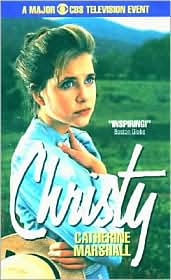
Christy


Marshall, Catherine. 1967. Christy.

Except for a brief prologue, Christy is set in the mountains of Tennessee (the Smokies) in the early 1910s (the novel opens in 1912, and I *believe* it covers maybe a year to two years tops. So probably 1912-1913 or possibly even 1914). Christy Huddleston is our heroine. She is nineteen and leaving her home in Asheville, North Carolina. Her mission is to teach in a one-room school house, a school started by a mission, in Cutter Gap, a small mountain community. She's in for quite a culture shock let me tell you. I think we would all be in for a culture shock. What we see is life through her eyes--at first innocent and naive--but later as she's grown and matured through the eyes of love, mercy, and grace.

Based on a true story, Christy is a coming-of-age story. One woman, one small but determined young woman, who is out to save the world one child, one adult, at a time. Her optimism, her hope, her love is balanced with the gritty portrayal of harsh, often-primitive conditions. It's not only the landscape that is harsh and rugged, but the mindset as well. Christy travels from the twentieth century modern world to the mountains where feuds and murders and such are common. It's not all ugly and harsh, there are things of great beauty, great joy, as well. Christy sees it all--the good, the bad, the ugly, the regrettable, the hopeful and inspiring.

Part story. Part commentary. Christy is an enjoyable book. I'm not sure all readers will appreciate these little asides that document the life of a school teacher, the life of a Christian, but I believe many will. Christy, like so many other young people, is on quest to see who she is and what she's made of. She's a bit unsure of herself. She's full of questions but not on answers. Her quest to grow, to learn, to understand is one that I feel most can relate to in one way or the other.

There is some romance. But I'd hesitate to classify it fully as a romance. I think it would probably be found wanting if you stuck that label on it. Yes, there is a love story. But it is just one of the small threads running through the novel. It is a story about humanity, about life, about death, about friendship, about finding meaning and significance in all our days. It's an emotional journey, a realistic journey.

There have been at least two adaptations of Christy. There was a television show starring Kellie Martin, and there were a series (three) of made-for-television movies starring Lauren Lee Smith. Both versions featured Stewart Finlay-McLennan as Doc MacNeill. That was a good thing. I admit I have a weakness for the third and final movie, Choices of the Heart, part 2. Though all adaptations take some liberty with the book.

Christy: The Movie"Christy"
Blogged with the Flock Browser

Sunday, June 08, 2008

Gods of Manhattan


Mebus, Scott. 2008. Gods of Manhattan.

The 'gods' in question in Scott Mebus' Gods of Manhattan are not Greek gods. Just so you know. They are men and women immortalized by legend and fame and success. The mayor of the gods, of Manhatta a world that is invisible to most mortals, is Alexander Hamilton. (All of the gods started out as mortals, but their fame, their success, their ingenuity made them be reborn as immortal gods in this spirit world residing side by side with modern Manhattan.) It's a rather fun premise, for the most part. The gods, these immortal gods, are in danger--real danger. Though immortal, a way has been discovered to kill them, murder them. A special knife that threatens to end everything...unless they get some help from a rather extraordinary mortal, a young boy, Rory.

Rory is your typical hero. He doesn't want to be a hero. He doesn't want the responsibility of saving the world. But with the proper motivation, he may prove to be hero material after all. Like quite a few heroes, he has a younger sister. And this sister plays quite an important role. This butt-kicking heroine loves to be strong and brave. The idea thrills her. She carries around a sword called 'Butt-kicker' for example. Definitely spunky.

I won't get into the particulars now. But fans of Percy Jackson and Fablehaven might enjoy this one. It has history and fantasy colliding...and the result is mostly fun and entertaining. It is the first in a series, and I would imagine that the second one will be even better.

© Becky Laney of Becky's Book Reviews

Saturday, June 07, 2008

Jessie's Mountain


Madden, Kerry. 2008. Jessie's Mountain.

I liked the first Maggie Valley novel, Gentle's Holler (2005); I loved the second Maggie Valley novel, Louisiana's Song (2007); I really really loved the third novel in the series, Jessie's Mountain. My expectations were high. Really high. Yet somehow it surpassed them, my expectations that is. It was so beautifully done. I just love Livy Two Weems and her family. Even Grandma Horace is beginning to grow on me--much more than I ever thought she would when I first met her. The novels, in case you're not familiar with them, are set in North Carolina, in the mountains, during the early 1960s. (Jessie's Mountain opens in December of 1963.) There is so much depth, so much love, so much meaning in the pages. The Weems family has to be one of my favorite fictional families ever. The family is large, yet, it seems right. The siblings might seem confusable at first glance, but they're not.

Livy is our narrator, and this is her story, her coming-of-age story. The novel's moving force is in the characters and not the action of the plot. The plot is there, mind you, but don't expect a thrilling, adventure story that will have you on the edge of your seat. That is not this novel. It's gentler, subtler. I loved it, absolutely loved it. Definitely recommended. But do read them in order!!!

© Becky Laney of Becky's Book Reviews

Sunday, June 01, 2008

Are you a kindred spirit too?


Montgomery, L.M. 1908. Anne of Green Gables.

I first 'discovered' Anne Shirley through watching the 1985 and 1987 films by Kevin Sullivan/Wonderworks when they aired on my local PBS station. As far as I'm concerned, these two are the ONLY films that are 'real.' Meaning that the monstrosity of a film released in 2000 doesn't exist at all. It's something that should be avoided at all costs. It is evil, evil, pure evil.

It would have been around sixth or seventh grade (1989-1990 or 1990-1991) that I 'discovered' the Anne of the books by L.M. Montgomery. It was love at first sight pure and simple. I loved Anne of Green Gables, yes, but I loved all of the Anne books. Then I moved from loving all the Anne books to loving all the Emily books. And then I started loving all the stand-alone novels too...like Tangled Web and Blue Castle. And then I discovered the short story collections. My sister started it, I suppose. She was the official owner of all the L.M. Montgomery books. And she never let me forget it either. I simply loved and adored L.M. Montgomery. She was the best of the best as far as I was concerned.

What is there to love about Anne Shirley? Everything! She's creative, imaginative, bright, vibrant, contagiously fun, good-spirited, and lovable. In a word she is charming. Oh to see the world through the eyes of Anne. There is something so wonderfully innocent and optimistic about Anne.

In Anne of Green Gables (1908), the reader is introduced to Avonlea. We meet Anne, Marilla, Matthew, Rachel, Diana, Gilbert, and those awful Pyes as well. The characters, the settings, the rich-and-detailed text...everything about this book is perfect.

Anne of Green Gables
Walk with her through Avonlea
Kindred spirit, yes?


© Becky Laney of Becky's Book Reviews

Tuesday, May 27, 2008

The Glory Field


Myers, Walter Dean. 1994. The Glory Field.

Recently released in a new paperback edition, The Glory Field is a true must-read. Why? It's practically perfect in every way. It is a novel that traces a family from its Sierra Leone roots to what was at the time of its publishing modern-day, urban America. The Glory Field loosely weaves together the story of one family through multiple generations. Our story begins with a brief vignette (1753) focusing on Muhammad Bilal, a young boy who is captured and sold into slavery in the South. Many settings, many narrators, many individual stories and legacies that collectively capture the African-American experience. (1753, 1864, 1900, 1930, 1964, 1994). It is an emotional, well-written, almost poetic journey. Very heartfelt. Very real. Very moving. The characterization is wonderful. I really came to love, came to care for all the characters across the generations. I've read a few other novels through the years that have sought to tell a multi-generational story...but none have been so effective, so masterfully done.

If you love historical fiction, then you MUST read this one. It's a truly great novel.

"We come a long way and we got a long way to go. You can't make much progress if you don't leave home, but you can sure mess yourself up if you don't remember where home is." (232)

© Becky Laney of Becky's Book Reviews

Monday, May 12, 2008

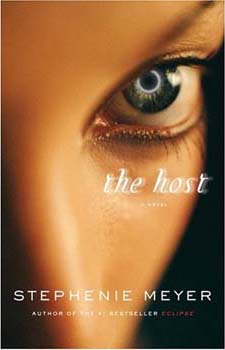
The Host


Meyer, Stephenie. 2008. The Host.

The Healer's name was Fords Deep Waters. Because he was a soul, by nature he was all things good: compassionate, patient, honest, virtuous, and full of love. Anxiety was an unusual emotion for Fords Deep Waters. Irritation was even rarer. However, because Fords Deep Waters lived inside a human body, irritation was sometimes inescapable.

Thus begins the highly anticipated first adult novel by Stephenie Meyer. The opening scene shows a man, occupation Healer, getting ready to implant a Soul into a human being. These souls are parasitic aliens that have spread across the galaxy. They are able to take hosts--different hosts--on each planet. Our narrator is a Soul named Wanderer. She's unusual, in a way, because she has been to many planets--I can't remember if it's seven or eight or nine--and lived that many lifetimes. The souls know no death, they just move onto a new host when their host's body dies. This is Wanderer's first time on Earth, her first time in a human host. Our secondary narrator is a woman named Melanie. And you've probably guessed by now that she is the host body to Wanderer.

These aliens didn't take over the world overnight. They didn't announce their arrival at all. Their goal--if they had a goal--was to assimilate quietly and peacefully with humans. It wasn't until the humans noticed that something was off that there was any resistance, any battles, any blood shed. What was off? Humans were being too nice, too perfect, too Mayberry. From the Souls' perspective, they were doing humanity a huge favor. They were turning these rowdy and unpredictable and altogether too violent and volatile humans into peace-loving, happy-go-lucky people. Souls love everybody, accept everybody, trust everybody. Except for that one teeny tiny little detail that they won't take no for an answer. All humans must be implanted. As long as their are humans without Souls then there is the potential for blood shed and loss. To "protect" themselves--or so they claim--they must either assimilate or destroy those resisting pesky humans. Those Souls that are seeking to destroy and/or assimilate humans are called Seekers.

Melanie's luck has run out. Or so she thinks. On the verge of being captured, she throws herself down an elevator shaft. She thinks that she'll avoid her fate by destroying her body. But Healers are really good at repairing the human body--another so called "benefit" to this alien domination.

Wanderer and Melanie are soon to be linked together for life. Not that that is the plan. Souls are supposed to erase, eradicate, the consciousness, the personality of their hosts. But Wanderer finds that Melanie will not go down without a fight. She guards her life, her secrets, closely. She will not accept the finality of the situation.

Life is about to turn very interesting for this two-in-one package as they journey together into the Arizona desert to find the meaning of it all. It's a story about humanity, about sentient life forms, about right and wrong, about justice, about love, about forgiveness, and grace, and redemption. It's a novel with a lot of heart and soul and gumption.

This concept isn't completely original. They're not as overtly (openly) evil as the goa'uld (go-ah-OOLD) by any means. But the concept of a parasite invading through the neck and wrapping themselves around the spine and brain and 'controlling' the human and 'erasing' the host personality has been done before. So has the concept of a human host living side-by-side compatibly with a parasite--that's a Tok'ra for you. Tok'ras are the 'good guys' in the parasite world (supposedly though Jack still calls them snakeheads) who only enter voluntary hosts. Even the concept of love can be seen to be similar to that found in Stargate--the parasite and host body falling in love with their mate's parasite and host body. Four personalities, two bodies, love all around.

It was hard not to think about goa'ulds and tok'ras while reading The Host. That could be because I tend to relate all things back to Stargate eventually if at all possible. It doesn't have to be oh-so-obvious. In this case, I think if you've seen Stargate at all, you can see the connection in some ways, but not in all ways.

This story has plenty to make it special all on its own. I don't want to get into the particulars but the environment was very unusual but it worked. In some very teeny tiny way it reminded me of Dune. I don't know why. I've only seen the movie once. But there were scenes from that movie that came to mind when reading the book. Maybe it's the desert environment. (There are no giant worms however.) I don't know. At this point, it's irrelevant. (Maybe also slightly Journey to the Center of the Earth). She created a world that is so strange, so different from present day life, from reality. It's a world that it's easy to get swept up into in a way. The setting, the characters. It just worked. It was very rich in detail. I thought the depths of the back-story was just really well done. (The little details that Wanderer discloses in her storytelling and her question and answer sessions.)

I can't say that I fell quite in love with it as much as I did Twilight upon first reading it. But it's good. The romance, the chemistry, isn't quite as intense, quite as magical as it is for Bella/Edward/Jacob. But it isn't a romance without some merit. I personally was more into Ian than Jared, but that's just me.

First sentence of chapter one: I knew it would begin with the end, and the end would look like death to these eyes. I had been warned. Not these eyes. My eyes. Mine. This was me now. (9)

So I definitely recommend it. Do you have to love science fiction? It might help. But if you're not a fan, don't let the genre turn you off. This is a story about what it means to be human. (In some ways it mirrors the themes of the novel Frankenstein--what it means to be human, to live, what it means to be a monster.) It's a human-interest story therefore. It explores the depths--the good, the bad, the ugly--of humanity in general. The fact that some humans have been possessed by aliens while others haven't is just a distinction that separates it from other novels you might have read through the years. But science fiction fans, I hope, will be pleased with it as well as newbies.

I would have read it anyway--it's got Stephenie Meyer's name attached to it--but it comes with a blurb from Orson Scott Card himself. So you know it has to be good.

And for those that are curious, I tend to like Wanda/Melanie much much more than Bella as far as personality goes. In Twilight, Bella didn't annoy me so much. But in some of the sequels, I found myself growing more and more irked at her. Definitely to a point where I understood where all the hate was coming from saying that she was too whiny and mindless (in a way). Not that I'll ever reach a point where I'll stop reading the series. Who could stop now? (I'm on Team Jacob by the way.)

You can read the prologue and the first four chapters here.

© Becky Laney of Becky's Book Reviews

Tuesday, January 30, 2007

The Pull of the Ocean

Mourlevat, Jean-Claude. 2006. The Pull of the Ocean.

Recently won the Mildred L. Batchelder Award for 2007.

To be honest, which I always am but I like to use prefaces, I never would have read this title if it hadn't just won an award. First of all, I wouldn't have known it existed. Second, if I had seen it on the shelf and been curious enough to pull it out to read the back cover, I probably would have placed it right back on the shelf. The book flap (side flap) reads: that The Pull of the Ocean is a 'social fable' and 'a modern reinterpretation of 'Tom Thumb' that deftly gives life to memorable characters and explores resonating themes. Which leads me to make this point: if someone has to tell you that a book has 'memorable' characters right on the bookcover that tends to make me suspicious. Don't get me wrong, it's fine with classic novels that have been around a generation or two...but for a 2006 book to flaunt or assert how wonderfully memorable the characters are leaves me with a certain degree of doubt. Furthermore to be told that a book 'explores' resonating themes is very condescending. Like a reader can't judge for him/herself that a book has 'memorable' characters and explores 'resonating' themes??? It's like someone is warning you: you SHOULD like this book because it is smart and clever and a social fable. And saying if you don't like this book it is because you're just not smart enough to 'get it.'

But putting aside certain prejudices, after all I don't know who is responsible for the book flap nonsense it could have been a perfectly fine book, I read the book practically in one sitting.

The book is about a young boy, a midget or dwarf, who has six older brothers--three sets of twins. They are very poor. Their situation is desperate. Their father and mother are too poverty-stricken, too stressed, too everything to care about the emotional needs of their children. Particularly their youngest child whom they openly despise because he is different. They blame him for not only being different but they use him as a scape goat. It's okay to verbally abuse him and treat him horribly because he deserves it. He asks for it. I'm a good parent. Really. If he didn't go around thinking he was 'better' than everyone else because he can read and write...then I wouldn't have to smack him around. Some of the twins are nice. Some are violent like their father. But it is the youngest, Yann, the one small enough to fit in a sack who is considered 'wise beyond his years' and 'respected and revered' despite his size and age.

The story is told through many voices. Voices of the young and old. Male and female. All walks of life. The story is one of a young boy leading his brothers on a journey far from home. He wakes them up in the middle of the night with a threat: I just heard Dad say he was going to kill all seven of us tomorrow. Their journey is not an easy one. They listen to Yann and trust Yann no matter what he leads them into.

If this character is supposed to inspire affection from the reader...it falls short. He is not an inspiration. Don't get me wrong. He shouldn't be picked on because he is small. He shouldn't be picked on because he likes to read. But he isn't a likeable character either. He does not talk. The book leaves the reader with the idea that his muteness is one of choice. He doesn't want to communicate with his family, his parents. They allude to the fact that he expresses everything that needs to be said with his eyes. Is the fact that he's a mute midget supposed to make him a hero who can do no wrong??? Not in my eyes.

S
P
O
I
L
E
R

He is a liar. The father was not going to kill him or his brothers. He was going to kill a stray cat and her kittens. If you're struggling to feed seven children should you be expected--on a farm in the country--to provide nourishment and care for stray animals? Apparently, Yann equated the death of cats with a certain amount of cruelty that he felt was intolerable. He would not try to stay in a house with a man who would 'take care' of strays in this manner. True his parents hated him. True they were abusive in the past. True the kids probably deserved a better homelife...but to reward his lies and make him a hero???? He's a liar. He's a thief.

If this is a social fable I fail to see what the message is...