Showing posts with label "N" Titles. Show all posts

Monday, January 12, 2009

Never Let Me Go


Ishiguro, Kazuo. 2005. Never Let Me Go. 288.

My name is Kathy H. I'm thirty-one years old, and I've been a carer now for over eleven years. That sounds long enough, I know, but actually they want me to go on for another eight months, until the end of this year. That'll make it almost exactly twelve years.

Sounds like a confession, doesn't it? Like she's apologizing for being alive. And in a way, that's true, I suppose. Because although it's set in England in the late 1990s, the novel is anything but realistic fiction. No, the world created by Kazuo Ishiguro is frighteningly surreal. Kathy--and others like her--exist for one reason, and one reason only. But I suppose some won't want to go there. To know the ending before they've got acquainted with the beginning.

Kathy, our narrator, is reflecting back on her life--her childhood, her teen years, her young adult years before, during, and after "becoming" a carer. For most of that time, she had a secluded life, a privileged life considering the truth of the matter, in a boarding school called Hailsham. The book is about her life and her relationships. Primarily the book is about her relationships with two people: Ruth and Tommy.

Never Let Me Go is a good example of the distinction between adult and young adult fiction. Though the book is about teenagers--Kathy and friends--the book is for adults. It's tone is reflective, contemplative, distant. It never felt like a child was telling the story. Or a teen. The perspective was all grown up, all the time. (Then again, I think you'd grow up pretty fast if this was your reality.)

And this distance serves a purpose, mostly. Kathy is a strange narrator, an odd woman, a woman eerily comfortable with the truth: what has happened to her friends, her acquaintances, everyone 'like' her... and what will happen to her in the days, weeks, and months ahead. It's hard to know just what is the most disturbing in this book--the truth itself or the fact that there is no reaction, no horror at the truth. The matter-of-factness of it all. The cold acceptance.

© Becky Laney of Becky's Book Reviews

Friday, January 02, 2009

Need


Jones, Carrie. 2008. Need.

Everybody has fears, right?

Need would be good for fans of Stephanie Meyer and Melissa Marr. It's YA fantasy with plenty of thrills: danger and romance. Our heroine, Zara, is unhappy to be moving to Maine. True, life had become almost impossible living with her mother since the death of her stepfather--the only man she ever knew as dad. But is packing her up and sending her to good-old-grandma (her stepfather's mother) really the answer?

While on the surface, Zara appears to be a typical teen with typical angst...but nothing is as it seems. And the town she's moved to is NOT your typical town. Well, unless you like things King-style. (And her grandma--so NOT typical!) It all begins when Zara notices one man--one very strange man--who seems to be following her around. This started on the day her stepdad died. He was there at the airport when she left. He is here in her new town too. She seems him--he's always alone--outside her home, outside her school. She knows something is up when she notices he leaves a trail of glitter behind him.

With the help of her new friends--Issie, Devyn, Nick--Zara is out to solve this mystery. What is driving this is the fact that since shortly before her arrival--boys have been going missing. Something similar occurred in her mom's generation--her days as a teen living in that town. Could the strange man following Zara be the key to solving the mystery of who is kidnapping (and most likely murdering) these teen guys?

Zara is anything but a damsel in distress. She's strong. She's opinionated. She's stubborn. She doesn't follow the rules unless it suits her--and let's be honest--that rarely happens. She's broken in a way--mourning the loss of her stepdad, confused by her new surroundings, and more than a little interested in this ever-dreamy-guy named Nick.

Nick.
Nick has thick, dark hair.
Nick has big, chestnut eyes.
Nick has nice, white teeth.
Nick has a big chest with runner's lungs so he could huff and puff and blow my house in. And I do not care. I lean in. He's so cozy warm but I shiver anyway, remembering the woods. My eyelids just don't want to be open and I really want them open because Nick is so cute when he isn't bossing me around. (114, ARC)
Some mystery. Plenty of action. Some romance. Some angst.

Overall, I liked it.

© Becky Laney of Becky's Book Reviews

Monday, August 04, 2008

The Navigator


McNamee, Eoin. 2006. The Navigator.

"There was something different about the afternoon. It seemed dark although there wasn't much cloud. It seemed cold although the sun shone. And the alder trees along the river stirred and shivered although the wind did not seem to blow. Owen came over the three fields and crossed the river just below the Workhouse on an old beech tree that had fallen several years before, climbing from branch to branch with his eyes almost closed, trying not to look down, even though he knew the river was narrow and sluggish at that point and that there were many trailing branches to cling to if he fell. Only when he reached the other side did he dare to look down, and even then the black, unreflecting surface seemed to be beckoning to him so that he turned away with a shudder." (1)

Owen is the boy seemingly "chosen to save the world." When The Harsh (the bad guys, feel free to boo and hiss, etc.) create a machine that makes Time run backward, it is up to Owen and his newfound friends--The Watcher and the other Resisters--to stop them and set things right. Again. As Owen discovers this won't be the first or last time that The Harsh will attack humans, attack Time, attack progress. Among other things these Harsh people want to go to a time and place before humans existed. Their perfect world is a frozen one. (Don't ask me why.) These faceless enemies pose quite a threat. Fortunately, Owen and Kati and friends are there to fight them day by day to the bitter (or not so bitter) end. Come what may, these Resisters won't give up without a fight. Owen is fighting for his life, fighting for everything he has ever known and loved. (The world as Owen knows it has vanished. Every person he has ever known has vanished. All signs of human life have begun to vanish. Though some of the ruins of their civilization have remained.)

The Navigator was a bit confusing to me--at least at first--it took a good many chapters for me to feel comfortable in this world that McNamee created. But once I got a certain familiarity with it, I admit that it was an entertaining read. For those that love adventure, love books with quests, love books with young heroes (and heroines) that set out to save the world, then this one might be just the thing.

© Becky Laney of Becky's Book Reviews

Thursday, July 24, 2008

Nothing Pink

Nothing Pink

Hardy, Mark. 2008. (November release date). Nothing Pink.

First sentence: My father begs people to come down to the altar, to get right with God.

As a preacher's kid, Vincent, has many reasons to feel uncomfortable. Not wanting to bring shame to his father and mother, but wanting to remain true to who he is, he has quite an internal dilemma. You see, he's gay. He's always known he was gay. And though he's never even held hands with a boy, he feels guilty about his homosexuality. In fact, every altar call his father gives, he feels drawn to make the walk down the aisle, to pray once again that he be delivered from this shame, from this sin. Time and time again he's prayed. He's read his Bible, his whole Bible--three times. He knows all the hymns. He's listened to all the sermons. God is never far from his thoughts--not really--and this closeness with God is something he longs to experience. Yet his gayness, his homosexuality, is part of who he is. And it is something that he wrestles with through the book, Nothing Pink, as he experiences his first love with another church-going boy, Robert Ingle. And as he falls in love, he begins to love himself just the way he is. How could loving someone be wrong, he reasons with himself? Vincent's journey is one from self-loathing to self-acceptance. The question for Vincent is simple but profound...can Vincent be a gay man who loves God? Or does accepting his sexuality mean turning his back on God. Both his spirituality and his homosexuality are part of who he is, part of his identity.

Set in the late seventies or possibly even the very early eighties (I'm judging based on cultural references to John Travolta, Barry Manilow, Commodores, The Dating Game, Farrah Fawcett, Wild Wild West, Mork and Mindy, Three's Company, Emergency.) the novel is rich in detail and character development. This is one of the first truly compelling male/male romances I've encountered where it seems authentic and not "issue"y if that makes sense. In other words, this book goes beyond stereotypes and has layer upon layer. It's a very human book. (I'm used to seeing books where there is always a "gay" best friend that plays a very limited role in the book as a whole. They're always stereotypically the same. And always just sidekicks. There for straight-women to confide in, shop with, and have crushes on. This one is a rather refreshing change from all that.

© Becky Laney of Becky's Book Reviews

Thursday, July 10, 2008

No Cream Puffs


Day, Karen. 2008. No Cream Puffs.

This isn't what we usually do. If we have time after lunch, we shoot baskets with the boys in the gym. Today we're lined up in front of the mirror in the girls' bathroom. I stand to the side and twist my mood ring around and around my finger. My mess of curly blond hair is a disaster compared to the new feathered style everyone else has. "This is plushy pink." Casey Cunningham pulls a tube of lip gloss out of her purse and opens it. The sweet smell of cotton candy fills the bathroom. She rolls it onto her lips. "It's new."
She rolls it onto Gina's lips and then reaches for Sara, who stands next to me, holding her new purse with both hands. I'm next.
Casey snaps the cap on the lip gloss and puts it back in her purse. I feel the tops of my ears burn; she left me out on purpose. I glance at Sara, but she won't look at me.
"You smell like a circus," I blurt. Their lips sparkle under the lights. Could my lips look like that too?
"I'm sorry, Madison." Casey looks at me, eyes wide. "I didn't think baseball players wore lip gloss."
(1-2)

Set in the summer of 1980, No Cream Puffs is the story of Madison Mitchell, a twelve-year-old baseball player who hates to be called a tom boy. So what if she likes to play sports? Does that make her a boy not a girl? NO. She's a girl alright. Her developing breasts (which she tries to disguise whenever she plays ball) and a crush on a teammate prove that.

No Cream Puffs is a sports story. No doubt about it. There's baseball games, baseball practice, and plenty of baseball talk. But it is more than that. Much more. It's the story of a girl who feels uncomfortable with herself, her body, her life. A girl who doesn't feel comfortable with her identity. She doesn't want to be solely defined as "the girl" (the only girl) who plays in a baseball league of boys. But as the girl she does get attention at all the games especially by the media who want to turn her into something she's not. It's a story about family. A story about friendship. A story about growing up. Here we see the first glimpses of a young girl changing into a young woman. Her first crushes. This age is often (or should I say always) awkward and painful. Madison's experiences are authentically so. I loved Madison's voice. And I loved her story.

I really loved this book. Karen Day knows how to do real, to do authentic. Everything just feels right about this one.

http://www.klday.com/index.html
© Becky Laney of Becky's Book Reviews

Wednesday, June 25, 2008

Travel the World: China: No! That's Wrong


Looking for something that is purely silly and giggle-worthy? Giggle-worthy that is if you're a young child or a playful adult! Look no further than No! That's Wrong! by Zhaohua Ji and Cui Xu. This picture book comes to us from China. It is published by Kane/Miller.

I'm not a complete expert on what "funny" looks like. But I do know this: kids and books featuring underpants/underwear get along really really well together. When the wind blows a pair of red underpants off the clothes line and onto the head of a white rabbit...well, let's just say it's the beginning of a comical adventure.

It's a story told in multiple voices. On one side, we've got rabbit and friends discussing and debating what this red garment is...and on the other side, we've got the narrator clearly clinging to reality.

For example:

"What's This? It's a hat!"

"No, that's wrong. It's not a hat."

The narrator really has a fit trying to talk sense into this bunny character.

Anyway, I'm not sure that this one will delight each and every reader. But I thought it was fun and playful. And I think kids will like it.

A review by Fuse #8, Kids Lit, The Well-Read Child, and Books & Other Thoughts

© Becky Laney of Becky's Book Reviews

Tuesday, June 03, 2008

Never On These Shores

Pastore, Stephen R. 2007. Never On These Shores.

The time? 1942. The place? America. Jacket flap:
1942: The Nazis have successfully landed in Mexico and have invaded the United States through Texas. The Japanese have conquered western Canada and have captured and occupied most of the West Coast from Seattle to the outskirts of Los Angeles. The Italians have launched a massive amphibious assault from Cuba and have taken control of Florida and the Southeast as far north as Atlanta. New York City and Washington D.C. are fortifying and preparing for the onslaught. American forces are stranded in Europe and Southeast Asia. the homeland is being defended neighborhood to neighborhood by women, the elderly, and gay men, all ineligible for military service. The KKK and Right Wing radicals are supporting the invaders hoping to establish concentration camps where blacks and Jews are being transported all over the western U.S. Amid the carnage and brutality of an enemy seeking to destroy everything in its path, the American Spirit is put to its greatest test. Pastore weaves a tale that will not soon be forgotten as this highly imaginative story unfolds. It is an awe-inspiring parable of the true nature of the American people when put to their greatest test.
Except for the end where it gets a little too proud for its britches, it is a fairly good assessment of the plot. As far as alternate histories, alternate realities go, exploring the "what if's" of the Nazi's winning the war is a highly popular subject for "imaginative" speculation. There are several Star Trek (Original Series) episodes, for example, that feature Nazis or Nazi-thinking. There are several Twilight Zone episodes as well. (And that's just what I've seen. I can only imagine that they're is much more out there in film and in print that I'm not familiar with.) There must be something inexplicably fascinating or captivating about going there, about allowing yourself to go that dark and scary place and envisioning how events would unfold if the Nazis (Nazi thought, Nazi culture, or flesh-and-blood actual Nazis) controlled the world. Maybe it's because they just make the ultimate bad guys? Who knows? But this book relishes the idea of being your worst nightmare.


Told through multiple points of view, Never on These Shores is the most violent, most hate-filled, most vile imagining possible. The language. The violence. The murder. The rapes. It's meant to 'shock-and-awe' you I imagine. When I was *warned* to expect dirty language, I shrugged it off. I've seen plenty of movies, read quite a few books, how much more "shocking" can something get? Well, there is the language of an "R" film, and then 500 miles past that is this book. Is it as it should be? Maybe. Maybe not. As I mentioned earlier, if the Nazis had invaded, if war was invading our neighborhoods, our backyards, if our lives were being threatened by three enemy armies...keeping our language clean and pristine WOULD not be on the agenda. If ever there would be a time to let loose, then that might be the time. Still, it makes for an uncomfortable read.

Everything about this book is designed to make you uncomfortable and ill-at-ease. The fact that invading armies are slaughtering people. The fact that Americans--both civilians and politicians--are joining up with the Nazis, supporting them fully, working against the American resistance. The fact that the murderous agenda is being carried out--the rounding up of blacks to be gassed and burned. (Of course they're not called black.) This book is just a million and one disturbing images.

What can I really say about this one? It's not for everyone. I can see that some people might like it. Might enjoy it. (If enjoy is the right word.) But it's not for those that are easily disturbed. Reading it can turn your stomach. Is it realistic? I'm not sure. I don't think it is. Not really. Maybe in some areas, but not others. I have a hard time accepting it from the military point of view. I don't know how even working together these three armies have enough men, enough soliders, enough troops to hold their positions in Europe and Asia (and wherever) and conquer North America as well. I don't know how they could spread their armies out so thin to hold positions in so many places. And if they were using their newly-conquered enemies as soldiers, I'd imagine that sooner or later that would backfire on them. And I certainly don't buy that the entire nation was soldier-free in the spring of 1942. I'm not an expert. Obviously. But I've done *some* reading, and it just seems unlikely. War takes training, it takes recruitment, it takes time.

But one idea that this book stirs up is racism and prejudice and propaganda. Modern readers can look back at this time and see how "wrong" we were to hate the Germans, hate the Italians, hate the Japanese. How "wrong" we were to fear an invasion. How "wrong" we were to tell people to keep an eye out, to keep a watch out for suspicious behavior. How "wrong" we were to mistrust German, Italian, and Japanese citizens. How "wrong" we were to doubt anyone's loyalty based on descent. How "wrong" we were to create propaganda--ads, cartoons, etc.--during the war. But in this book, we see that the propaganda was right. We did have something to fear. We did have ample reason to mistrust. Not that there is much they could do about being "right." But still. But the part that is really unsettling, the part that throws doubt on everything is the fact that the book shows 'normal' and 'average' American citizens (some politicians, but most just regular folks) joining in the Nazi cause. In most cases, not out of fear, not out of wanting to come out on the winning side, but because of genuine support for the Nazi's white supremacist philosophy. It's the out-in-the-open (as well as the behind-closed-door variety) of racism, of hate, of prejudice that turns my stomach so. The thought that maybe just maybe racism is so dangerous, so deadly that something like this could have happened then. And the fear, the realization, that racist thought might not be as dead as we'd like to believe. Racism should be scary, should be crazy to modern readers. It should carry some shock-and-awe kind of punches.

© Becky Laney of Becky's Book Reviews

Saturday, May 31, 2008

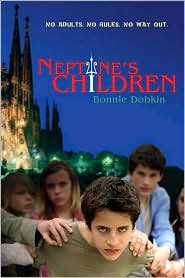
Neptune's Children


Dobkin, Bonnie. 2008. Neptune's Children.

From the jacket flap: "A dream vacation at the Isles of Wonder theme park becomes a nightmare when biological terrorism causes the death of every adult on the Islands. Younger teens and children survive, only to face the resulting horror and the chaos of a world without authority. The figure of King Neptune, symbol of the Islands, unites them as they begin to build a society within the park, safe from outside dangers. Led by a group called the Core, made up mostly of former park workers' children, the survivors slowly organize their world. But when mysterious events bring danger, some of the Islanders begin to wonder if their home is as safe as they think and if their leaders can really be trusted. As suspicions grow and rivalries intensify, the stage is set for a war that will determine the future of everyone on the islands."

Intrigued? I know I was. The plot centers around Josh and his "family." (He's an older younger teen--13 or 14--and he's caring for his younger sister, Maggie. From the very beginning, he pairs up with another set of siblings--Zoe and Sam. Together they form a family unit.) In the first few days after IT happens, there is confusion. But within 48 hours, order and structure and authority are introduced into the theme park. Josh is one of the contributors to the sanity. The "king," the boy behind King Neptune's oddly soothing voice, is Milo. He calls all the kids together and asks the older ones--minus the babysitters--to help him. Josh is one of his volunteers, and for a while he is one of the Core, but his "family" responsibilities soon prove more important than his social ones. Through the course of a year--a little over a year--these kids survive on their own without too many glitches, but soon that changes. Little questions, little doubts, a few things that rub our characters the wrong way. Why? Why is Milo so insistent that no one ever leave the theme park? Why can't they have the freedom to leave if they want? To explore the outside world for themselves?

While some adults (and a few teens) might find this one predictable, there is much to enjoy in Neptune's Children. I found that even if I was fairly certain where everything was going, I wanted to be along for the ride, for each step in the journey. It was definitely a page-turner for me. Reminiscent of both a Star Trek episode and a Twilight Zone episode, this one was a darkly fun read.
© Becky Laney of Becky's Book Reviews

Tuesday, February 20, 2007

Nick and Norah

Cohn, Rachel and David Levithan. 2006. Nick and Norah's Infinite Playlist.

Nick & Norah's Infinite Playlist won the 2006 Cybils award in the YA fiction category. Its competition was The Book Thief by Markus Zusak (a more serious book), A Brief Chapter In My Impossible Life by Dana Reinhardt (a more melodramatic book), Hattie Big Sky by Kirby Larson (a more family-friendly book), and Rules of Survival by Nancy Werlin (a harsher and more violent book). Of the five books, I can honestly say that I truly enjoyed four of them. (Don't get me started on A BRIEF CHAPTER OF MY IMPOSSIBLE LIFE). But before the Cybils announcement, I had not read Nick & Norah. It was on my stack of to be read books. So with the announcement, it became top of my list.

Perhaps it was no coincidence that in the past few weeks the Middle_School_Lit group on Yahoo has been discussing profanity in YA books. I am not making the connection that Nick & Norah's is a Middle School book--it isn't--but I just find it interesting to be reading all these postings about what is and is not authentic. And what should authors and editors do about profanity. Should they have more? less? the same? Does profanity make a book authentic? Does profanity establish characters and personalities? Are authors being more creative by using profanity or less creative? Is it harder to not use profane language and keep a book clean? If authors know that using certain words will make it offensive why do they keep using them? Do they not care? Are they making an artistic statement? I will add this to the debate. As a reviewer, how much is too much profanity? In a book of 183 pages--for example--how many times should you reasonably expect to see the f word??? 10? 25? 50? 100? Not even close to the number of times that Cohn and Levithan use it in their collaborative work of fiction NICK & NORAH'S INFINITE PLAYLIST. (Don't believe me, check out page 95 where it occurs 26 times). My question when does excessive (and I would argue that 26 times on the same page is excessive) use of profanity lower the quality of a book? The more profanity is used, the more redeeming, the more satisfying the other elements of the book have to be to make up for the fact that it's so profane. At some point you've got to ask yourself, are these characters just one dimensional characters that like to use the f-word over and over and over and over again for apparently no reason whatsoever? Don't they ever say or do anything else? Isn't there more to a person's character than a particular word??? Is profanity really artistic? Is the best an author has to offer the reader?

I will say this. I read NICK & NORAH'S INFINITE PLAYLIST. I enjoyed Nick & Norah NOT because of the profanity but in spite of the profanity. I didn't enjoy it enough to want to buy it. And I'd hate to have to hear an audiobook of this one. But it had a good story at heart. Nick is a young guy, a bass player in a band. A band where he is the only straight guy. So he's playing at a club and he sees his ex-girlfriend in the crowd. He begins to lose it. It's been three weeks since the break-up and he's still not over her. The thought of her still gets to him. Upsets him. He told her never to come see him play again, and so obviously she had to come and bring along her new boy toy. Enter Norah. Norah is at the club with her friends. She sees the band. She's hanging out at the bar afterwards, not drinking but watching her friend drink herself silly. Nick joins her at the bar after his band finishes up. The next band is on stage, and everything is going fine until....Nick sees his ex-girlfriend and her boyfriend heading his way. He panics and does the first thing that pops into his head. He turns to the girl next to him and says: Will you be my girlfriend for the next five minutes????? The big question that starts a long, quirky nighttime adventure between two young strangers.

The characters were even likeable. While they surrounded themselves with the party crowd who drank, did drugs, smoked, etc...Nick & Norah weren't into underage drinking or illegal substances. And as much as the book uses the f-word, there is very little sexual content (the actual act) in the book. Plenty of references. Some temptation. A few very racy scenes that are not going to sit so well with some readers. And a lot of scenes of questionable taste. I can't see the scenes with the transvestite strippers dressed as nuns stripping to Edelweiss and Climb Every Mountain going over so well with some readers. The truth is there is so much that could just as easily offend as entertain. It could go either way.

If you're offended by profanity, gay clubs, stripping transvestites, underage drinking and partying, sexual references both heterosexual and homosexual...then this book is NOT for you.

The developing love story, the relationship as its being formed, is a good one. Nick and Norah are made for each other. It just depends on how much you're willing to put up with to get to that conclusion. For me, NICK & NORAH was like LOVE ACTUALLY. Love Actually was a movie I bought without seeing it first. I had no idea of the content. Did not like 95% of the movie. There were only two possibly three storylines I cared about. The rest was absurd, offensive, distasteful, excessive nonsense. I liked the Colin Firth storyline where he falls in love with a foreign woman and has to learn the language so he can go back and propose to her. And I liked the widower and his young son storyline where they are coping with loss and death and discovering how to live again. The rest of the stories ranged from awful to nasty to pointless to stupid.

I should also mention since I'm focusing on what not to like in the book. That I actually LIKED elements of the writing style. I thought some of the sentences that weren't filled with profanity were actually quite beautiful and rhythmic. Very musical. Very enjoyable. But I think at least one of the authors got confused into thinking that profanity WAS the style of the novel instead of just a minor part of the style.

I am ticking, I am the pulsing, I am underneath every part of this moment. We don't have a drummer....I am the generator. I am listening and I am not listening because what I'm playing isn't something I'm thinking about, it's something I'm feeling all over. All eyes are on us. Or at least that's what I can imagine in my stageblindness. (1)

I throw the chords at them, I drench them in the soundwaves, I am making time so loud that they have to hear it. I am stronger than words and I am bigger than the box I'm in, and then I see her in the crowd and I fall apart. (2)

http://www.randomhouse.com/teens/nickandnorah/home.php#play

Monday, January 15, 2007

Author Spotlight: Ann Rinaldi

Spotlight On: Ann Rinaldi
Author Website http://www.annrinaldi.com/
About the Author:

  • Ann Rinaldi was born in New York City on August 27, 1934.
  • Discouraged by her family from writing and pursuing further education at college, she went into the business world and became a secretary.
  • In 1960, Ann married Ron Rinaldi. While raising her two sons, she decided she wanted to become a writer. After a few failed attempts at novel-writing, she decided to start small and begin by writing newspaper columns.
  • Her first creative piece of fiction was published in 1979.
  • As to why she writes historical fiction: Ann was drawn into the study of American history when her son, Ron, became involved in Revolutionary War reenactments while he was in high school. After visiting historical sites, participating in reenactments, and ". . .see[ing] the history. . .as it was, from the bottom up, hands on, instead of out of a history book," Ann was addicted.
  • As to why she writes for young adults: Ann Rinaldi explains, "I write young adult novels because I like writing them. But, as with my first book, I don't write for young people. I just write. Real life, as I know it, as I've learned it to be from my newspaper experience and own past, goes into my books. I draw all my characters fully, give my adults as many problems and as much dimension as the young protaganist. I give my readers good writing, literary writing. My books have been praised for the strength of my characters and my dialogue. "


Today I am beginning my author study on Ann Rinaldi. Today's review is NINE DAYS A QUEEN which was published in 2005.

Rinaldi, Ann. 2005. NINE DAYS A QUEEN.

When I first read NINE DAYS A QUEEN, I was not the self-proclaimed expert I am now on all things Tudor having worked my way through all four of Carolyn Meyer's historical novels or David Starkey's Six Wives of Henry the VIII. But I recognized it as a good story even then. Later, when I first began reading Meyer, I searched my memory and said I must go back and reread that one and see this all from Jane's eyes. But perhaps I'm rambling too much. NINE DAYS A QUEEN is the story of Jane Grey's childhood and adolescence. The daughter of a very important family--a titled family--she spent at least a year or two at court in London. As a child, she was a favorite playmate of Edward. She was on familiar terms with the other royal children as well, Mary and Elizabeth. The story focuses on her time spent at court and on her time spent with Katherine Parr and Sir Thomas Seymour--the former queen who was widowed and her new husband. Also in that household was Princess Elizabeth. Through it all, Jane Grey remains a likeable character. Mistreated by her family, she trusts no one really. She's come to view life as a skeptic. She's seen how dangerous it is to get involved with the royal family and the power struggle. She's seen close loved ones pay with their lives. Now, as a teen (fifteen or sixteen) her family involves her in a dangerous power play. Her husband and father-in-law have determined to make her queen instead of Princess Mary. Why? Because they don't want a Catholic on the throne. So manipulating the dying king, Jane is named next in line for the throne. Does Jane want to be queen? NO! There is nothing tempting her to claim power and wield the authority of life and death over her subjects. But can she escape the throne with her life?

NINE DAYS A QUEEN pairs well with Carolyn Meyer's series on others in the Tudor family: MARY, BLOOD MARY, BEWARE, PRINCESS ELIZABETH, DOOMED QUEEN ANNE, and PATIENCE, PRINCESS CATHERINE. These books show both the glamour and the danger that being royal involves.

Sunday, December 03, 2006

The Night of the Burning

Wulf, Linda Press. 2006. The Night of the Burning: Devorah's Story.

Linda Press Wulf's first novel is inspired by the childhood of her mother-in-law, Devorah Lehrman. Beautifully written, it is a story about the anguish of losing family and home and the importance of remembering. The novel won the Sydney Taylor Manuscript Award and first prize for a juvenile fiction manuscript from the California Writers Club.

Based on a true story, The Night of the Burning, tells the story of two sisters, orphans who at the ages of twelve and nine have witnessed too much already: the death of their uncle, father, mother, aunt, and the destruction of the entire Jewish community where they lived. As their community's sole survivors, the girls are rescued and sent to an orphanage in Pinsk. There the girls are chosen to be part of two hundred children sent to the Jewish community in South Africa. Their leader, a philanthropist, Isaac Ochberg, whom the children call "Daddy Ochberg."

The man patted the bench next to him, and I sat down warily. "I'll explain why I am here," he began. "I've come a long way, from a country called South Africa, down at the tip of Africa. There are Jewish people there, and they're worried about all the children in Europe who have no fathers and mothers because of the Great War. Ant that craziness they call the Russian Revolution." I knew about the Great War and the Russian Revolution, but they meant nothing to me. I only thought about the morning when we tucked Papa's blankets in to try to keep him warm, when he was already dead. And I thought about Mama before she died, calling for more water, more water, as the typhoid burned her from inside. I thought about the flames galloping through our village, the synagogue glowing red against the night. I shook my head to get rid of those thoughts. I needed to concentrate on the strange things Mr. Ochberg was saying. "So they sent me to find two hundred children and bring them back to South Africa. It's a beautiful country and a safe place for Jews. I'll take you and your little sister. But only if you really want to go with me." (7-8)

The story is communicated through a series of flashbacks, juxtaposing her journey to South Africa with her memories of home both pleasant and frightening. Our narrator is Devorah who ages from twelve to fourteen throughout the telling of this story. It is an amazing story of hope and despair, fear and joy, tears and laughter. It is the journey of how two sisters learned to laugh, love, and hope once more.

http://www.lindapresswulf.com/
Isaac Ochberg

Sunday, November 19, 2006

Michael Cadnum's Nightsong

Cadnum, Michael. 2006. Nightsong: The Legend of Orpheus and Eurydice.

Adapted from Ovid’s epic Metamorphoses, Michael Cadnum presents the story of Orpheus and Eurydice, a pair of lovers torn tragically apart not once but twice. Orpheus, the son of Calliope and a mortal (and the grandson of Jupiter himself) is beloved by the gods--or so everyone believes. Playing a lute he received from Apollo, he spends his time traveling through various countries and cities entertaining the crowds and enchanting the maidens. Until one day he falls madly in love with a princess, Eurydice. All seems to be going well until tragedy strikes on their wedding night. Now it is up to Orpheus to brave the underworld and seek an audience with Pluto and Persophone to plead his case. (Those familiar with the tale knows the rescue doesn’t go quite as planned.) Nightsong is a friendly introduction to a mythological classic tale of love and loss.

http://www.michaelcadnum.com/

Thursday, October 05, 2006

No More Cookies! By Paeony Lewis

NO MORE COOKIES is the perfect book for young cookie lovers! Florence, a young girl, and Arnold, a stuffed monkey, are friends who share a great passion: eating cookies. But when Florence's mother sees that her daughter has eaten ALL the cookies in the cookie tin, she says "No More Cookies!" for an entire week. Florence and Arnold's response, "No cookies for a week. That's forever." So they team up and use their imaginations to find creative ways to change her mom's mind. The plans range from Florence and Arnold dressing up as the tooth fairy and fairy monkey who need a cookie so they can fly home to Florence dressing as a nurse and splashing red paint on Arnold--Arnold of course needs an emergency cookie to make him feel better. But none of their plans--as creative as they are--works. But Florence's mother is not completely unfeeling, the book ends with everyone in the kitchen making Magic Monkey Bananas (chocolate-covered frozen bananas with sprinkles).

NO MORE COOKIES is a participatory picture book with a familiar refrain that cookie lovers everywhere will join in on, "It's not fair! All we want is a cookie--just one."

The illustrations are great. An assortment of cookies decorate the green end papers. I love how Florence is portrayed throughout the illustrations. Florence is first shown sitting down holding Arnold, her monkey, on her lap, and one cookie in each hand. Beneath her is a cookie tin holding mainly--if not exclusively--crumbs or broken cookies. The colors are bright and vibrant, red, green, yellow, and purple. Although the reader first sees Florence wearing a red hat, in later illustrations she's shown with black hair that is very tangled. (It looks like she has either given herself her own hair do, or else she won't let her mom near her with a brush!) My favorite illustration of Florence is when she is sitting with Arnold on the front porch. Both are wearing chef's hats. Both have their arms crossed on their chest. Florence has this pouty face, and of course, Arnold's expression hasn't changed any. But I love the fact that Florence has placed Arnold into the same position as herself. But what I especially love are the "drawings" made by Florence throughout the book. (Kid-drawn art is so fun!) Highlights of some of Florence's art include: on green construction paper a self portrait done in blue crayon showing her fierce monster teeth. Her face is surrounded by a circle of seven cookies. Each cookie has an arrow pointing in the direction of her mouth. The caption of her picture: cookie monster! Another great kid-drawn portrait is done on yellow construction paper. Again Florence has drawn herself with blue crayon. The picture shows herself with a ring of chocolate around her face and a bright red tongue sticking out. The caption reads: "For the most chocolate just lick in a circle." Although I won't take the time to describe them individually, each of Florence and Arnold's plans for obtaining cookies is illustrated in one or more plans done on various colors of construction paper.

Tuesday, August 29, 2006

Birthday Nightmares

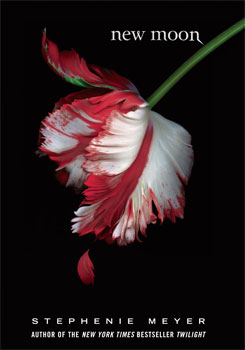
Meyer, Stephenie. 2006. New Moon.

Life is far from normal for Bella Swan during her senior year of high school. True, her life is full of drama and boy troubles, but for Bella who sees herself as a danger magnet life holds much much more. Edward Cullen, her ever-handsome boyfriend who just happens to be a vampire, breaks her heart when he leaves after Bella receives a near-fatal paper cut at her eighteenth birthday party. Realizing that his family no matter how determined to avoid human blood, can within seconds be overwhelmed with tempation and violence leads him to place Bella’s safety ahead of his own desires. To say that Bella is devastated is an understatment, she becomes zombie-like in her loss, a fact which is finally realized when Bella and one of her friends are watching a Zombie movie. “It wasn’t until almost the very end, as I watched a haggard zombie shambling after the last shrieking survivor, that I realized what the problem was. The scene kept cutting between the horrified face of the heroine, and the dead emotionless face of her pursuer, back and forth as it closed the distance. And I realized which one resembled me the most. . . But it was ironic, all things considered, that, in the end, I would wind up a zombie. I hadn’t seen that one coming. Not that I hadn’t dreamed of becoming a mythical monster once--just never a grotesque, animated corpse. . . It was depressing to realize that I wasn’t the heroine anymore, that my story was over.” (106) But Bella’s story is far from over. Reintroduce into the picture, Jacob Black, the young man who first shared with Bella the fact that she was falling in love with a vampire, this new friendship reenergizes Bella’s existence and gives her a reason to continue on. But is her friendship with Jacob any safer for her than her relationship with Edward was? Or is Jacob hiding a dangerous secret of his own? Is Edward out of the picture for good, or will he make a comeback to try to reclaim her heart?

Stephenie Meyer’s novel NEW MOON, sequel to TWILIGHT, is an exciting read, and one that I highly recommend.

http://stepheniemeyer.com/