Showing posts with label "I" Authors. Show all posts

Monday, January 12, 2009

Never Let Me Go


Ishiguro, Kazuo. 2005. Never Let Me Go. 288.

My name is Kathy H. I'm thirty-one years old, and I've been a carer now for over eleven years. That sounds long enough, I know, but actually they want me to go on for another eight months, until the end of this year. That'll make it almost exactly twelve years.

Sounds like a confession, doesn't it? Like she's apologizing for being alive. And in a way, that's true, I suppose. Because although it's set in England in the late 1990s, the novel is anything but realistic fiction. No, the world created by Kazuo Ishiguro is frighteningly surreal. Kathy--and others like her--exist for one reason, and one reason only. But I suppose some won't want to go there. To know the ending before they've got acquainted with the beginning.

Kathy, our narrator, is reflecting back on her life--her childhood, her teen years, her young adult years before, during, and after "becoming" a carer. For most of that time, she had a secluded life, a privileged life considering the truth of the matter, in a boarding school called Hailsham. The book is about her life and her relationships. Primarily the book is about her relationships with two people: Ruth and Tommy.

Never Let Me Go is a good example of the distinction between adult and young adult fiction. Though the book is about teenagers--Kathy and friends--the book is for adults. It's tone is reflective, contemplative, distant. It never felt like a child was telling the story. Or a teen. The perspective was all grown up, all the time. (Then again, I think you'd grow up pretty fast if this was your reality.)

And this distance serves a purpose, mostly. Kathy is a strange narrator, an odd woman, a woman eerily comfortable with the truth: what has happened to her friends, her acquaintances, everyone 'like' her... and what will happen to her in the days, weeks, and months ahead. It's hard to know just what is the most disturbing in this book--the truth itself or the fact that there is no reaction, no horror at the truth. The matter-of-factness of it all. The cold acceptance.

© Becky Laney of Becky's Book Reviews

Saturday, November 15, 2008

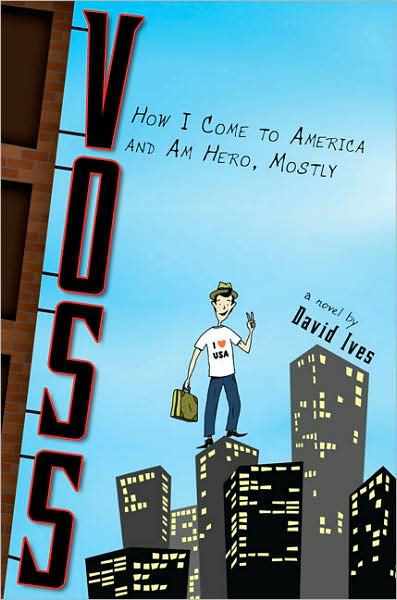
Voss: How I Come To America And Am Hero Mostly


Ives, David. 2008. Voss: How I Come To America And Am Hero Mostly.

Back of the book:
My name is Vospop Vsklzwczdztwczky. This is a name nobody can forget, because nobody can pronounce it. Donut try to pronounce me. You will only hurt yourself! In ancient Slobvian, my name means "car crash." It also sounds like car crash. So, plizz, call me Voss. A good, easy, American-sounding name! You will learn all my American experiences in the ladders I wrote to my good friend Meero. In these ladders you will also learn about my gloomy father Bogdown and my crazy uncle Shpoont and the dipp, dipp trobble I got into. Maybe from my ladders you will learn what to do. Maybe you will learn what not to do. Or maybe not? In any cases, donut do what I did. As pipple say in Slobavia: Be yourself, mostly.
This is a wild and zany book. Unlike books you have probably read in the past, mostly. Voss and his family (and friends)--all illegal immigrants--are charming through and through. His experiences are recounted through letters--"ladders"--back home to his best friend. It has a lot of humor. But a good amount of heart as well. This is one of those books where you could open it to practically any page and soon be drawn into it. It's funny. It's fast-paced. It's unusual. But I like it. I more than "like" it in fact. I love it.

Here's one of my favorite passages:

She stomped back and forth up and down the street, making great noise in her Slobovian shoes. Indeed, Leena's feet stamped out the rhythm of our ancient Slobovian love ballad, "Angry Woman, Stupid Man." This is the song with the chorus, You're in the soup, you're in the soup, she's waving her iron spoon, you're in the soup and drowning. Listening to the sound of her shoes, I felt like what Americans call a heel. (55)

The book earned a starred review in Publisher's Weekly.

© Becky Laney of Becky's Book Reviews

Friday, June 13, 2008

A Countess Below Stairs

A Countess Below Stairs

Ibbotson, Eva. 1997. (2007?) A Countess Below Stairs.

This one is a fun one. One that has been in my TBR pile for quite a while. Probably since January or February 2007 when I saw it reviewed on one of my favorite blogs. Our heroine, Anna, was born a countess in Russia. But World War I and Russia's own Bolshevik Revolution, changes her destiny (if you want to be dramatic) or her station in life (if you don't). Anna flees along with most of her family (minus her poor father who didn't survive) to England. There Anna finds employment as a maid though it is apparent to all whom she encounters that she was not born for that life, her manners, her mannerisms, the way she carries herself speak of class and grace. The family for whom she is working has a son, Rupert, who is newly home from the war. He brings with him his future wife--a truly appalling woman named Muriel. But try as he may, Rupert can't help but notice how extraordinary and beautiful this new servant is.

If you love historical romance, then you'll want to make time for A Countess Below Stairs. A bit predictable? Maybe. But that's not a bad thing. It makes for a nice indulgently satisfying read. There were so many things I enjoyed about this one.

This review is also too good to be missed.
Blogged with the Flock Browser