Showing posts with label "L" Authors. Show all posts

Saturday, June 06, 2009

Liar (YA)


Larbalestier, Justine. 2009. (October Release). Liar. Bloomsbury. 388 pages.

I was born with a light covering of fur. After three days it had all fallen off, but the damage was done. My mother stopped trusting my father because it was a family condition he had not told her about. One of many omissions and lies. My father is a liar and so am I. But I'm going to stop. I have to stop. I will tell you my story and I will tell it straight. No lies, no omissions. That's my promise. This time I truly mean it.

Is Micah Wilkins, our narrator, a compulsive liar? Is she trustworthy? Is she sane? Divided into three parts, (Telling the Truth, Telling the True Truth, and The Actual Real Truth) Justine Larbalestier offers readers an always compelling, somewhat-unbelievable, but oh-so-thrilling read. When we first meet Micah, she's just learned something horrible: her boyfriend, Zach, is dead. Murdered. Everyone is stunned including Sarah, Zach's actual girlfriend, and Tayshawn, Zach's best friend. Who is Micah? Where does she fit in? Everywhere and Nowhere. As his after-hours girl--well, lover--she doesn't run in the same circles as Zach. She's little better than a freak at school. A girl with extremely short hair who doesn't wear makeup, who doesn't look or act like the other girls. A girl who once for a few days convinced everyone that she was a boy.

It's true that Micah feels out of sorts and all in-between. Not white enough to be white. Not black enough to be black. Not feminine enough to fit in with the popular girls, the gossipy girls. She doesn't feel pretty, that's for sure.

She is good at many things: lying, for one, biology, for another, and last but certainly not least, running. She is faster than fast. At least that is what she tells us. Why doesn't she have friends? Is it her appearance? The fact that she likes attention and tells outrageous lies?

What's her secret? Does that secret involve murder? What's the real story? Can we ever know the truth?

I liked this one mostly. It was definitely intense and suspenseful. It definitely made me think. It's a complex book, which is always nice to see. But I'm not sure I liked it, liked it. I'm not sure I want to hang out with Micah any time soon. I don't think we're meant to.

This is one of those books that could be easily spoiled for readers by too much description. So I'm purposefully keeping it short. The more I describe my thoughts (and reactions) about Micah, the more preconceived ideas and notions you might have to carry with you if you decide to pick it up on your own.

I am not quite sure I get the cover though. I'm not saying the US cover isn't attractive enough in its own little way. But it doesn't take the reader very long to discover that the main character, Micah, is black with very short, very cropped hair. True, the narrator is a compulsive liar, so maybe readers should doubt her when she says that she is black with short, cropped hair and can sometimes pass as a boy. But if this girl on the cover is meant to be Micah, well, there's nothing freaky or awkward about her. And even if you don't consider all that, I'm not sure that this cover matches the mood of the book. Do those eyes and that hair say it's a dark-mysterious-thriller?

The Australian cover.


© Becky Laney of Becky's Book Reviews

Saturday, January 24, 2009

The King's Rose


Libby, Alisa. M. 2009. (March 2009) THE KING'S ROSE. Dutton. 296.

The King's Rose is one of those books that just captured my attention (and my heart!). It is a fictionalized account of Catherine Howard, and for those not in the know, she was the fifth wife of Henry VIII. Catherine Howard was just fifteen (perhaps even fourteen) when she caught the lusty eyes of the King. (And Henry liked them young.) Catherine's tale is tragic in that while the king chose her...she quite honestly didn't have a choice in the matter. Prompted and urged by her family--she became the person they created her to be, that the king wanted or needed her to be. And thus her life of deception began. For Catherine has a secret or two that may be her undoing...

The king is in love with me. But who am I? Who is this girl that the Howards created out of their words, to whom the king has given his love? I am King Henry's sweet wife--Catherine Howard, no more. I wonder if God can see me now, see the treason in my heart. I squeeze my eyes shut, pushing these thoughts from my mind. I am a player upon a stage, even when the stage is a bed, even in an intimate moment such as this, with no costume or mask to cover my nakedness, I must play my part well, especially in an intimate moment such as this. I must become my role, and nothing else. (56)
She's haunted by a kiss shared with her distant cousin, one of the King's men, Thomas Culpepper, a perfect kiss with much promise...because it occurred before she caught the King's attention.
My life will be more than I ever could have imagined--but perhaps it will also be a little bit less. All of this must be put aside now, the words and dreams that led to his perfect kiss, near midnight in the dark garden at Westminster, and all the happiness that kiss seemed sure to promise. This was a different Catherine who received these letters, who responded to that kiss--since then I have been transformed by the king's eyes, by the royal jewels around my neck and a cloth-of-gold gown...but who is the real Catherine: the shadow or the light? The smoke or the flame? (44)
The King's Rose is engaging and richly detailed. Libby is an excellent storyteller. It's just not the story itself that is fascinating, but how the story is told that makes it so captivating.

Other reviews: Peeking Between Pages, YA or STFU, Just One More Page, The Book Bag. Stop, Drop, and Read.
Author's official site, official blog.


© Becky Laney of Becky's Book Reviews

Monday, December 15, 2008

Under the Night Sky


Lundebrek, Amy. 2008. Under the Night Sky. Illustrated by Anna Rich. Tilbury House Publishers.

Under the Night Sky is a picture book story of a single working mom and her son taking time to be spontaneous and enjoy the wonder and spectacular beauty of the natural world around them. In this case, it is the northern lights--the aurora borealis--that they are enjoying together side by side. It is moments like these that make special memories, a life worth living. The illustrations by Anna Rich are nice. I love the colors and tones. They complement the text well. As to the text, I enjoyed it as well. The story was a good one--a mother and son seeing each other and the world in a new way, sharing these unplanned moments together.

© Becky Laney of Becky's Book Reviews

Sunday, November 23, 2008

The Disreputable History of Frankie Landau-Banks


Lockhart, E. 2008. The Disreputable History of Frankie Landau-Banks.

I may get a few boos for this one. But I couldn't quite like it*. Blame it on the tense. Third person past tense (as far as I can reckon). Or blame it on the expostulating tone, purposefully pretentious and off-putting. A blend of intelligence and condescension. It's not like every page was of this style, but there were little asides by the narrator--I suppose it's the narrator--that just intruded in on the story. Created too much distance for my taste. Added in too much reflection.
How does a person become the person she is? What are the factors in her culture, her childhood, her education, her religion, her economic stature, her sexual orientation, her race, her everyday interactions--what stimuli lead her to make choices other people will despise her for?
This chronicle is an attempt to mark out the contributing elements in Frankie Landau-Banks's character. What led her to do what she did: things she would later view with a curious mixture of hubris and regret. Frankie's mental processes had been stimulated by Ms. Jensson's lectures on the panopticon , her encounters with Alpha, her mother's refusal to let her walk into town on the Jersey Shore, her observation of the joy Matthew took in rescuing her from her bicycle accident, and her anger at Dean for not remembering her. All these were factors in what happened next... (107)
I do like several things about it however. I just have a love-hate relationship with the narrative style. There are paragraphs that I love, and there are paragraphs that I hate. Phrases that I think are a bit too much, and phrases that I think are just right. I like how the first chapter begins, for example, "Though not, in hindsight, so startling as the misdeeds she would perpetrate when she returned to boarding school as a sophomore, what happened to Frankie Landau-Banks the summer after her freshman year was a shock." I think both the prologue and the first few chapters offer quite a hook or incentive to readers.

Frankie is a boarding school student whose sophomore year presents great opportunities for adventure and misadventure. She'll experience the ups and downs of having a relationship with a "popular" boy, a real somebody. Rich too. Her old friendships will be threatened by the aforementioned relationship and all that brings about. Frankie is smart. She's determined. She's got her own way of seeing the world. And none of those things are bad. All quite good actually.

It's not Frankie that I dislike but the meddling narrator who likes to tell instead of show.

*I'll qualify this statement. Based on the all the buzz, the hype, I couldn't "like" it as much as I "should". See, this is one that has been getting love all over the place. People saying it's the best of the best, one of the year's must-reads. A book people are just raving about. I didn't think it was that good, that deserving. But it's a good read. A solid read. I wouldn't put this one in my top ten of the year. I probably wouldn't even have it in the top twenty. But it is a good book all the same. In other words, I've read dozens and dozens that I disliked more than this one.

This is neither here nor there. But one of the things I found unbelievable was that Frankie's sister, Zada, took her under her wing. Zada's a senior. Frankie was a freshman. She let Frankie sit with her and her junior and senior friends at lunch. She allowed Frankie to tag along with her. To be a part of her "cool" set of friends. I have a hard time believing that even a good sister would do this. I shared two years of school with my sister, we overlapped two years I mean, and never once would I have been encouraged/allowed to sit with her at lunch. To hang out with her friends at school. It was one thing to be allowed to tag along after school (on occasion) or at home.

© Becky Laney of Becky's Book Reviews

Sunday, August 03, 2008

How They Met and Other Stories


Levithan, David. 2008. How They Met and Other Stories.

How They Met and Other Stories is a short story collection for young adults. The themes? Love and romance, lust and desire, heartache and joy. What may or may not surprise you--depending on how familiar you are with the name David Levithan--is that most of these stories are about same sex couples. Not all of the stories are, there are a handful of stories featuring straight teens, but most aren't. One review says of Levithan that he is, "
Best known for his positive, normalizing portrayals of teen relationships --- regardless of sexual orientation --- Levithan's stories focus on those longings that are the common denominators for the human heart." There are eighteen stories in all. And they do vary in quality. For example, he features a handful of stories that he wrote when he was a teen in high school. Obviously, they are not of the same quality and depth as some of his newer works. They do, in fact, show just how far he has come through the years. And I think it was rather brave to publish them. (Goodness knows, time does change things. Even a difference of a few years--the stories and poems I wrote in high school that I thought were so "good" and showed "promise" were excruciatingly cringe-worthy when I read them again just a few years later.) Do I have any favorites? Yes. I enjoyed Starbucks Boy, The Alumni Interview, The Number of People Who Meet On Airplanes, Flirting With Waiters, and What A Song Can Do the most. It's not that the others weren't good. Most of them were, but those five were my favorites. Other reviews: Little Willow, TeenReads.com, Flamingnet.

© Becky Laney of Becky's Book Reviews

Saturday, August 02, 2008

Hero-Type

Hero-Type

Lyga, Barry. 2008. (September 2008 release, I believe). Hero-Type.

Overture (aka the Prologue)

You know those pictures of fat people?
I'm talking about the ones in the ads for diets and weight-loss drugs and stuff like that. You know them. They always show the "Before" picture of the person back when they were a big fat slop. And then they show the "After" picture, which is like this totally buff hottie.
Here's the thing about those pictures, though: For the longest time I couldn't figure out why the pictures were labeled "Before" and "After," because to me it was obvious they were two completely different people.
But I get it now--we're at least supposed to think that it's the same person, made over thanks to the miracle of whatever the company is peddling. It doesn't have to be just for weight loss. It can be for any big life change.
I've always been skinny, so I don't need to lose weight, but I think about those pictures a lot. Especially now. After my own big life change.
So why do my "Before" and "After" pictures look exactly the same?

First sentence of chapter one: Everywhere you go, it seems like there's a reminder of what happened, of what I did. You can't escape it. I can't escape it.

I was *thrilled* when I received an ARC of Barry Lyga's latest YA novel, Hero-Type. Boy Toy and The Astonishing Adventures of Fanboy and Goth Girl were great novels; they were novels that established Lyga as someone to be read.

Hero-Type is the novel of a young teen guy that is at first glimpse a true American hero. A young man who just happened to be in the right place at the right time to save a teen girl (Leah) from being raped and murdered. This "heroic" episode in Kevin's life gets him quick fame--national fame and local. But right away, the reader knows there's more to the story. We know because chapter one concludes with the first and barest glimpse of a confession: "Maybe that's because I didn't tell them the whole story."

Hero-Type also chronicles Kevin's fall from grace. From hero to villain. His so-called crime? The act that made the locals turn on him in an instant? He removed the patriotic-support-the-troop magnet ribbons from the car that a local dealership gave him. That's it. Thus begins the long and melodramatic crucifixion of his "good name." Kevin becomes the most hated guy in town. And Kevin's father isn't very far behind. An ex-soldier, a former hero, who is now seen as a villain because he's now anti-war. Because he knows that war is hell, and he doesn't want other people--other soldiers--to go through that hell like he did.

Kevin does find his voice, in a way, in a big way. But no matter what he says or what he does...no one seems to really listen to him. And it's frustrating, beyond frustrating for him. He never wanted to be a hero to begin with. Never wanted the attention. But he doesn't want to be the villain either. He doesn't want to live with this--and who would???--hatred following him around. He's picked on. He's bullied. He's beaten up. Kevin does begin to learn, to grow, from the experience, however. And chances are he'll be a better, stronger man because of it.

The story has many layers, many characters. And I won't get into all of them. It's complex. It's well-written. I didn't love, love, love this one, however. For one, I found bits of it a bit over-the-top. In a way, I can understand how his rescue of a girl might lead to some fame and some attention for a short period of time. Until the next big story hit. But the removal of a ribbon from a car? I don't know how that one act--it's not like he spray-painted "I hate America" on his car or anything--can get such media attention and lead to social disaster. I don't know how this act could go beyond the local media. It doesn't seem headline worthy to me local, state, or national. "Boy removes patriotic magnet." So what? But after a few chapters, I suspended my disbelief and began to get into the story. So it does work. And it is good.


© Becky Laney of Becky's Book Reviews
Blogged with the Flock Browser

Wednesday, July 23, 2008

Travel the World: England: Narnia: Last Battle


Lewis, C.S. 1956. The Last Battle.

In the last days of Narnia, far up to the west beyond Lantern Waste and close beside the great waterfall, there lived an Ape. He was so old that no one could remember when he had first come to live in those parts, and he was the cleverest, ugliest, most wrinkled Ape you can imagine. He had a little house, built of wood and thatched with leaves, up in the fork of a great tree, and his name was Shift. There were very few Talking Beasts or Men or Dwarfs, or people of any sort, in that part of the wood, but Shift had one friend and neighbour who was a donkey called Puzzle. At least they both said they were friends, but from the way things went on you might have thought Puzzle was more like Shift's servant than his friend.

The beginning of the end starts with one donkey, one ape, and one lion skin that floats downstream. From that skin an evil plot is born, and from that plot much blood is shed and much harm is done for every living thing (man, animal, tree, etc.) in Narnia. Shift's plot? To have Puzzle wear the lion skin and "be" Aslan for curious persons to gaze upon from a distance. Shift's real plot? To use the name of Aslan to get exactly what he wants.

It has been many generations since King Rilian ruled. Now his descendant, a king named Tirian, reigns. Though his luck seems to change overnight. One day a king, the next a prisoner. And all because "Aslan" has arrived back in Narnia.

Using the famed line "He's not a tame lion" people reason away all the signs that this is NOT Aslan. He commands the destruction of trees with spirits? Not a tame lion. He demands talking beasts to become his slaves? Not a tame lion. Demands servitude and exile from dwarfs? Not a tame lion. It's easy to say from our perspective that these animals, these individuals are a bit too gullible. But when you stop and think about it, the reader knows more, has experienced more. There haven't been any Aslan spottings in hundreds perhaps a thousand years. What the average Narnian knows is just stories passed down generation by generation by generation. Is it really so hard to see that perhaps their faith has more doubt than certainty? The truth is the average Narnian has not had any "use" for Aslan and his stories in their practical lives. So their faith isn't as "active" as it could be, should be perhaps.

King Tirian won't be fooled for long. He starts off highly suspicious and remains so for the most part. Once he's been captured, imprisoned, Tirian starts to think, to really think about Narnia, about Narnian history, about what he knows to be true, to be right. He realizes that humans from another world have always always been a part of the action. That the arrival of humans almost always accompanies these Aslan sightings. There is always a link. So he delivers a heartfelt prayer that these human saviors will come once again and fight for Narnia, to fight for freedom, to fight for right.

His prayer is answered in a way, but not in the way he hoped. I hope this isn't too much of a spoiler for readers. But it is called The Last Battle for a reason. Narnia is coming to an end. The world, the country, is dying. Tirian and the humans who arrive--Jill, Eustace, Lucy, Edmund, Peter, Digory, and Polly--are there to witness the end of Narnia and the beginning of their after lives.

As a child, I enjoyed this one. I would have put it above many of the other books in the series--including Horse and His Boy and Silver Chair--but as an adult I have a new perspective altogether. While some of the aspects of this one work for me, there were quite a few significant problems.

I'm not sure if other readers will share my quibbles or not. They may have different issues than I do. Among one of the reasons why people may find the last one disappointing is that...

S
P
O
I
L
E
R

all the humans die. Jill. Eustace. Peter. Edmund. Lucy. Digory. Polly. Most of them (I think most of them) die as a result of a train accident. (The Pevensie parents die as well but we still don't see them in the book.) I'm not sure if killing off all your characters will leave readers satisfied. Yes, the characters themselves are happy. But the deaths of so many seem tragic to me. Not that death itself is tragic. (Death can be a good thing. It can be a blessing.)

Second. Susan is missing. She's no longer a "friend" of Narnia. This is 'tragic' for several reasons. One is that technically speaking she will have lost her mother, father, two brothers, and a sister. She'll be all alone in the world. Two is the not-so-subtle theme that you can lose your salvation. If being a friend of Narnia translates directly into being a Christian, then Lewis' message seems to be that Susan represents Christians that have fallen from grace and lost their salvation, lost their way. Of course there are some believers who do in fact believe that this is the case. That Christians can un-Christian themselves, un-save themselves, re-damn themselves. I for one am not one of them. Of course, there is the potential that this fictional Susan could regain her friend status later on in life. That she could have another opportunity to believe. But Susan as allegory just doesn't work for me.

The other problems I had with this book were all theological. And they were pretty significant. But this blog isn't the proper place to really get into theological debates.

For those readers who are not approaching these seven novels as a Christian believer, for those that are reading them because they are fantasy--pure and simple and fun fantasy--then The Last Battle is a fitting conclusion.© Becky Laney of Becky's Book Reviews

Wednesday, July 16, 2008

Travel the World: England: Narnia: Magician's Nephew


Lewis, C.S. 1955. The Magician's Nephew.

As long as folks don't erroneously place this one first in the series, I have no problems with this one at all. It's an interesting story of a young boy, Digory, and a young girl, Polly, and their adventures and misadventures in and out of this world, this reality.

"This is a story about something that happened long ago when your grandfather was a child. It is a very important story because it shows how all the comings and goings between our own world and the land of Narnia first began."

It assumes--presumes--a familiarity of sorts with Narnia, with Aslan, with the White Witch, with the Lamp Post, with the Wardrobe, with the Professor. (And it's just a bit silly to think this one should come first.)

Digory, the young boy, grows up to be the Professor from The Lion, The Witch, and The Wardrobe. And this story is one of creation. How the world of Narnia came to be. How it was created. How evil was introduced into it. And how a promise of a savior was introduced as well. Hope. Promise. This one is rich in meaning.

The story for this one? Digory has a sick mother. Him and his mother are living with the Ketterleys. Mr. Ketterley is the boy's uncle. And he is mad, crazy, out-of-touch with reality, obsessed. He feels as the last person (in his reckoning at least) who had a godmother with a touch of real fairy blood in her that he is destined for great things, great discoveries. His dreams are of being a powerful and great magician. He loves power; he uses it as a front to his own weakness both physical and mental. He's really an overgrown baby. Very fearful. Very immature. He tricks Polly so he can use her in an experiment, and then using Polly as incentive, he has Digory as a human guinea pig as well.

Polly and Digory travel to another reality--several different realities--in fact. The book is full of their adventures and misadventures as they keep trying to set things right.

Aslan plays a big role in this one. And I love those scenes. I do.

© Becky Laney of Becky's Book Reviews

Wednesday, July 09, 2008

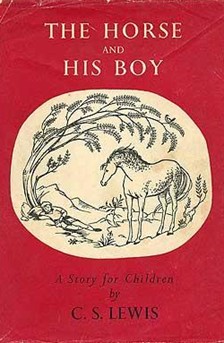
Travel the World: England: Narnia: The Horse and His Boy


Lewis, C.S. 1954. The Horse and His Boy.

"This is the story of an adventure that happened in Narnia and Calormen and the lands between, in the Golden Age when Peter was High King in Narnia and his brother and his two sisters were King and Queens under him."

Our hero is a young boy named Shasta. He meets two talking horses, Bree and Hwin, and a young girl, Aravis. Together--all for various reasons--are traveling secretly to the North, to Narnia. Shasta, for example, is running away because his 'father' wants to sell him into slavery. Bree, one of the horses, is a talking horse that has been "owned" too long for his liking by a foreign soldier. He dreams of Narnia and of freedom. Aravis is running away from an arranged marriage. And Hwin, like Bree, is a horse Narnia-bound. Their journey isn't as easy and as smooth as they'd like. There are a few bumps along the way. Unexpected detours and delays. A few scares. A few close calls. Great danger that they always seem to be one step ahead of. But they soon discover that there is a purpose--strange as it seems to them--behind everything.

One of my favorite things about The Horse and His Boy is that it illustrates Romans 8. Aslan the lion is behind everything. Though silent and unrecognized, unacknowledged, he is traveling with these four on their way. And he has a plan and a purpose.

"Don't you think it was bad luck to meet so many lions?" said Shasta.
"There was only one lion," said the Voice.
"What on earth do you mean? I've just told you there were at least two the first night, and--"
"There was only one: but he was swift of foot."
"How do you know?"
"I was the lion." And as Shasta gaped with open mouth and said nothing, the Voice continued. "I was the lion who forced you to join with Aravis. I was the cat who comforted you among the houses of the dead. I was the lion who drove the jackals from you while you slept. I was the lion who gave the Horses the new strength of fear for the last mile so that you should reach King Lune in time. And I was the lion you do not remember who pushed the boat in which you lay, a child near death, so that it came to shore where a man sat, wakeful at midnight, to receive you."
"Then it was you who wounded Aravis?"
"It was I."
"But what for?"
"Child," said the Voice, "I am telling you your story, not hers. I tell no one any story but his own."
"Who are you?" asked Shasta.
"Myself," said the voice, very deep and low so that the earth shook: and again, "Myself", loud and clear and gay: and then the third time "Myself", whispered so softly you could hardly hear it, and yet it seemed to come from all round you as if the leaves rustled with it.
Shasta was no longer afraid that the Voice belonged to something that would eat him, nor that it was the voice of a ghost. But a new and different sort of trembling came over him. Yet he felt glad too. (281)


So perhaps if this one has a spiritual message it is one of God's providence and sovereignty.

As a child reader, I didn't get this one at all. I didn't get the theme. It wasn't an obvious one to me then. Not even as a teen. It was only in this past reading that I saw some inkling of a spiritual message within the pages. I thought, growing up, that it was a rather dinky story about horses. And I'm not really a horse-loving person. But this time I seem to see just a bit more.

© Becky Laney of Becky's Book Reviews

Saturday, June 28, 2008

In the Company of Whispers

Lowenstein, Sallie. 2008. In the Company of Whispers.

Weird. Weird. Weird. There is really no other way to describe this one. Weird doesn't equal bad. Not really. Especially not in this case. But it does mean different, very very different. That is unless you can name a list of novels that are part memoir and part science fiction that focus on Burma's troubled past in the 1950s and a Big-Brother type government of the 2040s. Certainly none came to my mind.

I'll try to give you an impression of what you'll find IN THE COMPANY OF WHISPERS. First, you'll find lots of quotes. These are drawn from the Burmese culture--history, mythology, etc. Second, you'll find lots of photos. Black and white photos. There is a list (an appendix perhaps?) of photo credits. That's something you don't find every day. Third, you'll find letters, personal letters, from 1958. These letters are based on those from the author's family from their time in Burma. Fourth, you'll find a fictional story of a family and society in turmoil. This is where the science fiction elements come more into play.

So it was interesting and fascinating in a way. But very strange and other-ly as well.

Three strange characters share this futuristic story--Zeyya, a teen girl, Granna, her grandmother, I think her name might be Louise but I'm not 100% sure, and Jonah, a tattooed stranger that appears on their doorstep soon after Zeyya's parents are "quarantined."

Another review: Wands and Worlds.

© Becky Laney of Becky's Book Reviews

Sunday, June 08, 2008

Savvy


Law, Ingrid. 2008. Savvy.

Savvy is another book that had me at hello. "When my brother Fish turned thirteen, we moved to the deepest part of inland because of the hurricane and, of course, the fact that he'd caused it." Isn't that a great first sentence? Puzzling enough to hook you? I think so. A few pages later we read, "Monday through Wednesday, we called our thin stretch of land Kansaska. Thursday through Saturday, we called it Nebransas. On Sundays, since that was the Lord's Day, we called it nothing at all, out of respect for His creating our world without the lines already drawn on its face like all my grandpa's wrinkles." (4) So right from the beginning, the reader knows to expect the unexpected. Our narrator, a young girl named Mississippi (Mibs), has quite a way with words. She's fantastic. She's fun. And she's almost thirteen.

Mibs comes from a "special" family. Around the age of 13, every member of the family comes into their own on their thirteenth birthday. They discover their savvy, their special know-how power. For Fish, it was power of water--rain, thunder, winds, etc. For her brother Rocket it was electricity. Her mother's savvy is perfection. She can do things perfectly or mess up perfectly. Each member of her mother's side of the family is special like that--all unique, all special, all a bit weird.

Mibs is curious, super-super curious to get her savvy. Listen to this description of her waiting, "The itch and scritch of birthday buzz was about all I was feeling on the Thursday before the Friday before the Saturday I turned thirteen." But a few days before--the very day this passage was taken from the narrative--her birthday, her father is in a serious car accident. He's in a hospital almost 100 miles a way. While her mother goes to be with him, she leaves the kids--Rocket, Fish, Mibs, Samson, and Gypsy--at home.

Soon Mibs becomes convinced that her savvy will cure her father, will heal him, make him all better. But as you might imagine, savvy powers, don't quite work like that.

The novel focuses on her impromptu journey to visit her father--no matter what--and the lives she changes along the way on her special birthday weekend.

Definitely recommended.


© Becky Laney of Becky's Book Reviews

Saturday, June 07, 2008

The Willoughbys


Lowry, Lois. 2008. The Willoughbys.

I honestly didn't know what to expect from this one. Would I love it? Would I like it? Would I "get" it? You see The Willoughbys is an old-fashioned story. It's very tongue-in-cheek. It's very funny. Very enjoyable. But it's just strange enough that it has the potential to either really charm you or really irritate you. So which would it do to me? That was the question. I knew some bloggers appreciated it. But I know that sometimes I can't help being contrary. Well, I'm glad to say that I did really enjoy this one. I don't know that it was L-O-V-E, sing a song, do a little happy dance good. But I really really enjoyed it. I did love it. (I just don't know if it will be one that will go on my love, love, love list.) It's Lois Lowry. Expectations are naturally high. But this one is unlike what Lowry I've read. It's not The Giver. It's not Number the Stars. It isn't Gossamer. It isn't Messenger. Or Gathering Blue. It's very unique. You'll just have to give it a try yourself because there is no way I can do it justice. Not really.

Once upon a time there was a family named Willoughby: an old-fashioned type of family, with four children. The eldest was a boy named Timothy; he was twelve. Barnaby and Barnaby were ten-year-old twins. No one could tell them apart, and it was even more confusing because they had the same name; so they were known as Barnaby A and Barnaby B. Most people, including their parents, shortened this to A and B, and many were unaware that the twins even had names. There was also a girl, a timid, pretty little thing with eyeglasses and bangs. She was the youngest, just six and a half, and her name was Jane. They lived in a tall, thin house in an ordinary city and they did the kinds of things that children in old-fashioned stories do. They went to school and to the seashore. They had birthday parties. Occasionally they were taken to the circus or the zoo, although they did not care much for either, excepting the elephants. Their father, an impatient and irascible man, went to work at a bank each day, carrying a briefcase and an umbrella even if it was not raining. Their mother, who was indolent and ill-tempered, did not go to work. Wearing a pearl necklace, she grudgingly prepared the meals. once she read a book but she found it distasteful because it contained adjectives. Occasionally she glanced at a magazine. (11-12)
Quote is taken from an ARC, so it might not be true to the book in its published form.

Definitely recommended!!

© Becky Laney of Becky's Book Reviews

Sunday, May 25, 2008

Don't Know Where, Don't Know When


Laing, Annette. 2007. Don't Know Where, Don't Know When.
We'll meet again, don't know where, don't know when, But I know we'll meet again, some sunny day. Keep smiling through, just like you always do, 'Til the blue skies drive the dark clouds far away.
Don't Know Where, Don't Know When is the book that would have been perfect for the eight or nine year old me. It had everything I was looking for then: history, history, and time travel. Oh, and light mysteries to solve. How could I forget that little hook?! I've always always had a thing for time travel whether in tv shows, movies, or books. I've also always been fascinated with history. With learning the ins and outs of daily life in various time periods, in various locales. So this book so would have been right my speed at that age. That's not to say I don't have an appreciation for it now. But the degree has lessened to a certain extent. I enjoyed it now. I did. But I would have been crazy about it as a kid.

Set in three time periods, Don't Know Where, Don't Know When is the story of three children. Two of the children are brother and sister. The third child is a stranger whom the children meet just minutes before this exciting adventure begins. The siblings are Hannah and Alex Dias--though they later go by the names of Hannah and Alex Day. The third child is an African-American child named Brandon Clark. (Yes, race does play a role in this book.) He goes by several different names further along in the text--George Braithwaite, George Clark. The three meet seemingly by chance at the University library. They all three live in the (fictional) college town Snipesville, Georgia.

I mentioned three time periods. The first, the one in which we meet our narrators, is present day America. The other two time periods are a small town in England--Balesworth--both World War II and World War I. If it sounds confusing, don't worry. It flows smoother than it might at first appear. I promise.

These three children know very little about wartime Britain--but they're about to get an up, close, and personal tour of Britain during both World Wars, and the reader is along for the ride.

I won't say the book had me at hello. It didn't. I had to overcome my prejudice of the book cover. No offense is meant to whoever--or whomever--designed it. But it just doesn't say "read me, read me" for this particular reader. And it didn't have me hooked for the introduction and the prologue. However, by the second or third chapter, once the characters had mysteriously or magically time traveled back to 1940 England, I was one curious reader. And by the time Brandon/George vanished to time travel--on his own--to 1915 England, there was no doubt about it. I was liking it. The more I read, the more I wanted to read. So if you decide to pick up this one, please promise me to give it the fifty page test.

Don't Know Where, Don't Know When is an enjoyable treat of a novel. Proof that you NEVER should judge a book by the cover.

© Becky Laney of Becky's Book Reviews

Tuesday, May 20, 2008

Fearless


Lott, Tim. 2007. Fearless.

Prologue:
The girl could hear sobbing in the front room. Her mother was always crying about something or other, so the girl didn't take much notice. She just kept staring at the vidscreen in the corner of her bedroom. It was playing a vacation ad, all blue sea and white waves and sand like a field of honey. She wished she could just climb into the vidscreen and stretch out on the sand, dip her toes into the water, and never return. She would stay there and watch the world from the other side of the screen.
Then the knocking on the front door began. The girl thought that was odd, because they had a perfectly good doorbell. The knock seemed almost like a message. It went rap-rap-rappety-rap, as if it were a friend or a neighbor who always did their own special knock. But friends never came after dark, and the neighbors kept to themselves.
The girl heard a noise behind her. She turned and saw her mother. A dark birthmark the size of a fingernail and the shape of a star protruded from her hairline. Her cheeks were still damp from crying; her eyes were red and scrunched up like meat from a butcher's shop. She hadn't answered the door. Instead she lifted the girl up and pressed their faces together. The girl kissed her mother and tasted salt.. Her mother smiled, as if to tell her that everything was OK. Then she said she had some presents for her. The girl didn't understand. Her birthday was months away.
Her mother produced a small cloth bag and brought out three objects. The first was a picture of the girl's grandmother and grandfather, mounted in a bronze frame. Her grandfather wore a black suit with a cravat, and her grandmother wore a long pale dress and a floppy dark hat.
The second was a beautiful old silver watch with a fine leather strap that she said had once belonged to her father. She said she ought to have something to remind her that she did once have a father.
Finally she gave the girl once more thing: a golden locket containing a tiny photograph of her mother on her wedding day. She hung it gravely around the girl's neck. Then she put the framed photo and the watch back into the little cloth bag, handed it to the girl, and kissed her.
The knock on the door came again, louder this time. Rap-rap-rappety-rap. Her mother left the room. The girl heard the door catch being released, and then her mother began to shout. She heard a man's voice, stern and official sounding.
A few seconds later, a man wearing a uniform and a black peaked cap walked into the girl's room and, without a word, lifted her up. She could see her mother crying. The man didn't pause to let her say goodbye to her mother. He started to carry her down the stairs. The girl went limp. She felt unable to speak.
The door closed behind her. Then she heard her mother's voice through the thin panel of wood.
The locket. Read the words. Never forget the words on the locket.
In the harsh light of the street, the girl studied the back of the locket. She could just make out three lines of faint engraving. The girl pushed the locket inside her blouse and closed her eyes. She didn't resist as the man bundled her into the back of the ugly gray car with no side windows, started the engine, and drove away into the darkness. (3-5)
Fearless or "Little Fearless" is just one of many girls imprisoned at the "City Community Faith School." There the girls have no name, no identity other than a letter and a number. The institution--be it prison or school or work camp--is composed of X's Y's and Z's. The X girls being ranked higher than the Z girls meaning they have higher privileges in a way but also higher responsibilities. They get to be "X" girls by doing the bidding of The Controller. In other words, they work for the enemy.

Fearless and her friends--Beauty, Soapdish, Tattle, and Stargazer--are in a hopeless situation. They all are. Imprisoned, worked to exhaustion, malnourished, unloved and mistreated, the girls are emotionally and physically starving. Fearless is popular--at least somewhat popular--among the girls because she tells stories of hope. She tells stories of the day when they'll all be free. Stories of the girls reuniting with family. Of the girls leaving for the outside world. Fantasies at this point as far as most girls are concerned but oh-how-good-it-sounds. Fearless and Stargazer believe, however, that their freedom will come. The day will arrive when someone will rescue them.

Fearless knows however that NO ONE can rescue them, will rescue them, unless they know the truth. She believes with all her heart and soul that the reason they're still there, still miserable, is that the public, the men and women of the city simply do not know the truth. The truth will set you free, right? If Fearless can escape to tell her story, help will come won't it? It has to, right?

This story is emotional and heartbreaking. Some might argue that it is more than a little predictable. But that might be a matter of age and experience of the reader, the more you've read the genre, the more familiar you are with the twists and turns one is likely to take. Others might think it's a bit too parablesque. More obvious than subtle. More a loud shout than a whisper. I agree in part. But I think that when it comes down to it you either believe or you don't believe. Little Fearless either touches you, resonates with you, or she doesn't. I believe that Fearless, the book not the character, can work for some readers. Not for every reader, but then again no book works for every reader. (For example, the plot twist where Fearless gathers the tears of every girl and captures them in a perfume bottle. And then later that perfume bottle is analyzed to reveal the exact number of tears. It's silly and requires you to suspend your disbelief long enough to go with the flow. And it's not the only plot element that requires this suspension of belief. If you care enough about Fearless, then you can go with the flow and overlook a few things that don't quite work.)

The book offers a way to look at life, at humanity. While it is not a perfect novel, for me at least, it worked well enough for me to lose myself in Fearless's world. While I read this book, followed her journey, I was hooked. Only time will tell if this one stays with me like The Giver and other such novels.

As dystopian fiction, it definitely portrays a world that would qualify for my "It's The End of the World As We Know It" challenge under the category of evil governments. It's not too late to join that challenge by the way. Here's a list of participants so far.

Other reviews: here, here, and here. Most reviews I found were skeptical at best and found more than a little to criticize. I think that might have influenced me to give the book the benefit of the doubt a little bit more than I might otherwise. I'm contrary like that.

© Becky Laney of Becky's Book Reviews

Saturday, May 17, 2008

Once Upon A Prom: Date


Le Ny, Jeanine. 2008. Once Upon A Prom: Date.

My name is Becky. I am not a cranky pants. I promise. It's just that I seem to be reading a lot of three star books lately that I can't really get excited enough to jump up and down about. These books are perfectly fine--okay--books. And they might strike readers--especially teen readers--as being really something. But they didn't do much for me. So there you have it.

So on to the third installment of the Once Upon A Prom series. This is a series focusing on three friends: Tara, Jordan, and Nisha. At the beginning, each of the girls had their heart set on going to their senior prom. Each girl had a different obstacle in her path. Jordan, the girl who seemingly had it all, began to develop feelings for an emo guy. A guy she met in line at the movies. Her boyfriend, Nate, whom she'd been dating for over a year didn't want to see the movie--I think it was a foreign film. Anyway, it wasn't his "thing." So Jordan struck up a conversation in line with a guy--harmless conversation--and that led to a coffee that led to this that and the other. The first book ends with her "accidentally" kissing him. His name is Shane by the way. Tara's conflicts are threefold. She doesn't have a date. She doesn't have a dress. And she's having some conflicts with the prom committee. She gets a date in the first book--a guy named Victor--but it's a casual, convenience type thing--at least at first. She doesn't see him as a guy she'd really and truly want as a boyfriend. He's an emergency fill-in guy until her real guy comes along. Since prom is just a few weeks away, Victor will have to do. But she's only going to go with him if he gets a make over. As is he just won't do. She wants Victor to be just like Nate. Nisha, an Indian (yes from India), has problems as well. Her parents don't believe in dating (especially in high school) and they especially don't believe in interracial dating. The fact that Nisha has a secret boyfriend, a white boyfriend, of six months can only lead to major trouble if she's discovered. The first book served as an introduction, the middle book served up conflicts galore, and the third book offered spectacularly melodramatic resolutions.

As much as I wanted this series to be more than what it seems, it just didn't work out that way. It's light. It's fluffy. It's got a rare glimpse of substance now and then. But it can't be a substantive and satisfying meal. It just can't. It's light and harmless fun for the youngest of teens. It's formulaic (in part) writing designed to delight middle schoolers. Those who dream of one day having it all in high school themselves. Those who fantasize about dating and going to school dances and having it all. I remember being that age once. I outgrew that stage. But I can remember it. So this series (and others like it) do serve a purpose.

© Becky Laney of Becky's Book Reviews

Once Upon A Prom: Dress


Le Ny, Jeanine. 2008. Once Upon A Dream: Dress.

This is the middle novel in the trilogy 'Once Upon A Prom' focusing on a trio of girls: Jordan, Tara, and Nisha. I don't know quite what to say honestly. It's incomplete at best. Meaning there is no resolution. This is the novel where everything falls apart, where conflicts are introduced one after another after another for all three narrators. The focus is still on proms, dating, and boys. And of course there is emphasis on friendship--how much can it withstand secrets and lies and betrayals (or supposed betrayals) and stress.

On its own, it's not much. With the other two, perhaps, there is something of value. I haven't read the third one yet. It somehow got separated from the first two--so it might take some digging through the boxes to find. So I'll let you know more when I've finished the series.

The good? For teens (younger teens especially) that love soap-opera type action--melodrama--then this series will probably be fun for you. It could work. But for young teens (12-14???) dreaming of high school days this could work.

© Becky Laney of Becky's Book Reviews
Saturday, May 10, 2008

Once Upon A Prom: Dream

Le Ny, Jeanine. 2008. Once Upon A Prom: Dream.

Depending on your expectations, you might just be surprised. Or not. I never know what to think about these original-as-paperback books. Especially when they seem to be gimmicky--tied to a theme like prom or cheerleading or summer romance. No offense. I mean plenty of people love to read about those types of things. The formulaic type approaches to those typical sorts of things. I just don't happen to be one of them. So my expectations were low. I expected average writing and average plot twists. I expected to be entertained certainly. What I found was a bit of substance. (Consider it the Snicker bars of junk food reading.)

The characters have more depth than I was expecting. The novel focuses on three friends: Jordan, Nisha, and Tara. Tara, for some reason, seems to be the only character that isn't working for me personally. Jordan, the cheerleader, turns out to have more substance and a dilemma on her hands when she tries to go beyond her stereotype. Nisha is an Indian. (Yes, I mean from India). Her parents don't believe in dating, and they certainly DO NOT believe in their daughter dating a white boy. The fact that she is and is keeping it a big secret gives her some depth. I don't know if that's the right word. What I mean is that it makes her believable. Call me strange but Nisha is so far one of the big reasons I'm liking this series. It does ring as authentic. In college, my sister got immersed in the Indian circle on campus--most of her friends were Indian. I befriended a few of her friends, but certainly not to the same extent. So we got to know a few families quite well. So I know the debates, the conversations, the conflicts between the generations--on dating, on love, on marriage, on who is and isn't acceptable, on what 'the right age' for settling down is, the matchmaking, etc. And this book does seem to ring true from what I know.

The focus of the novel is on these three girls, their friendship, their relationships with guys, etc. It is the first of three books following these three girls. And as such, it doesn't really end...nothing is really resolved yet...so I'll be finishing up on the series. I'll probably reserve my final judgments for later on. But so far, I'm liking it. Liking doesn't mean loving or proclaiming it the most wonderfully philosophically deep reading in the universe. But it's fun. It's light. Definitely an appetizer and not a main course. But I think it's certainly enjoyable enough for teens if they like this sort of thing.

© Becky Laney of Becky's Book Reviews

Wednesday, May 07, 2008

Travel the World: England: Narnia: Voyage of the Dawn Treader


The Voyage of the Dawn Treader by C.S. Lewis is the third novel in the seven-book series The Chronicles of Narnia. I loved both of these books--both Prince Caspian and The Lion, the Witch, and the Wardrobe. Loved. Yet I'm at a loss of words when it comes to the Voyage of the Dawn Treader. The Lion, the Witch, and The Wardrobe is the start of the magic. It is the first. It could arguably be the best. Prince Caspian has a charm all its own. It's consise; it's action-packed. It's thoroughly enjoyable. Yet The Voyage of the Dawn Treader--for me--has a certain magic all its own that I can't really explain. There are times when I feel it is my favorite. But at the same exact time I'm feeling that it's my favorite, I feel guilty for thinking that anything could be better than The Lion, the Witch, and The Wardrobe. I guess I feel I need permission to love another just as much--however differently--as I do my first love.

This is a book that had me at hello. Say what you will about the first two books, neither have a first sentence that pops or sparks with magic. "There was a boy called Eustace Clarence Scrubb, and he almost deserved it." This sentence has to be one of my favorite, favorites of all time.

It goes on to say, "His parents called him Eustace Clarence and masters called him Scrubb. I can't tell you how friends spoke to him for he had none. He didn't call his Father and Mother "Father" and "Mother", but Harold and Alberta. They were very up-to-date and advanced people. They were vegetarians, non-smokers and tee-totallers, and wore a special kind of underclothes. In their house there was very little furniture and very few clothes on beds and the windows were always open."

This is our first description of Eustace, "Eustace Clarence liked animals, especially beetles, if they were dead and pinned on a card. He liked books if they were books of information and had pictures of grain elevators or of fat foreign children doing exercises in modern schools."

Can you tell already that The Voyage of the Dawn Treader is unique but uniquely wonderful? Eustace, as the reader soon learns, is the cousin of Peter, Susan, Edmund, and Lucy. And The Voyage of the Dawn Treader is the story of what happens when Lucy and Edmund go to visit their most unpleasant cousin. You'll find that magic follows the Pevensies wherever they go. This time the magic doesn't come from a wardrobe or the blowing of a magical horn. This time it's a painting--a portrait of a ship sailing the ocean that "calls" or "invites" the children to an unforgettable but dangerous thoroughly adventurous journey.

Edmund and Lucy--as you can imagine--are elated, thrilled, ever-so-happy to be back in Narnia. To be reunited with their good friend, Prince Caspian. But Eustace is miserable, cranky, mean, and downright unpleasant.

The dangers they face on their journey are unique. They're not like the dangers faced in The Lion, The Witch, and the Wardrobe or even the dangers faced in Prince Caspian. There are more dangers to be faced overall. But they're subtler. Quieter. The book has them sailing along on the seas, then occasionally stopping at various islands--some known, most unknown. Each chapter (though sometimes several chapters are related) has an adventure all its own. The novel is a handful of episodes, mini-adventures if you will. All of them unique. All of them memorable. Some episodes, I think I'll carry with me always. There's just something about this novel that just works for me.

© Becky Laney of Becky's Book Reviews

Wednesday, February 21, 2007

Raider's Night

Lipsyte, Robert. 2006. Raider’s Night.

First of all, I should probably mention that I am not really a sports person. So I checked out RAIDER’S NIGHT without really reading what it was about, I chose it simply because it made the Librarians’ Choices 2006 list. So when I read that it was a book about football players doing drugs and taking steroids, I was skeptical at best. But it is a well-written novel. If a writer can make me look past the fact that most of the action occurring revolves around sports--whether it is playing, training, or talking--then it is saying something. Seriously. So I was pleasantly surprised that I got anything positive from this novel. Now I know there are many people--adults and teens--who would seek out a sports related novel on purpose. They would actually like it because of the content instead of in spite of the content. But let me begin. Matt Rydek is one of the captains on his football team. It is his senior year, and as the school year approaches he is more than ready for the upcoming season. True at one time he would have preferred playing baseball to football, he has found something he excels at. Thanks to a little help from a fitness trainer who keeps him and his team well supplied with prescription painkillers and steroids. But as training season begins, Matt has no idea what is ahead of him. When his co-captain--an obnoxious jerk--Ramp rapes (with a baseball bat) one of the sophomore students newly transferred to the school and the football team, Matt is one of the senior witnesses. And perhaps more importantly, as captain of the team he bears the responsibility of seeing that justice is done. The rest of the players were blindfolded. Thus begins Matt’s ethical and moral dilemma. Does he ruin the team’s season before it really even gets a chance to begin? Does he throw away his opportunities to impress college scouts? Does he let down the whole team? the whole administration? the whole student body? Does being a team player mean looking out for the whole team? or for each member of the team? As his selfishness wages war with his conscience the reader is along for the ride. What are the consequences of staying silent? And what will happen if he comes forward?

Tuesday, February 20, 2007

Nick and Norah

Cohn, Rachel and David Levithan. 2006. Nick and Norah's Infinite Playlist.

Nick & Norah's Infinite Playlist won the 2006 Cybils award in the YA fiction category. Its competition was The Book Thief by Markus Zusak (a more serious book), A Brief Chapter In My Impossible Life by Dana Reinhardt (a more melodramatic book), Hattie Big Sky by Kirby Larson (a more family-friendly book), and Rules of Survival by Nancy Werlin (a harsher and more violent book). Of the five books, I can honestly say that I truly enjoyed four of them. (Don't get me started on A BRIEF CHAPTER OF MY IMPOSSIBLE LIFE). But before the Cybils announcement, I had not read Nick & Norah. It was on my stack of to be read books. So with the announcement, it became top of my list.

Perhaps it was no coincidence that in the past few weeks the Middle_School_Lit group on Yahoo has been discussing profanity in YA books. I am not making the connection that Nick & Norah's is a Middle School book--it isn't--but I just find it interesting to be reading all these postings about what is and is not authentic. And what should authors and editors do about profanity. Should they have more? less? the same? Does profanity make a book authentic? Does profanity establish characters and personalities? Are authors being more creative by using profanity or less creative? Is it harder to not use profane language and keep a book clean? If authors know that using certain words will make it offensive why do they keep using them? Do they not care? Are they making an artistic statement? I will add this to the debate. As a reviewer, how much is too much profanity? In a book of 183 pages--for example--how many times should you reasonably expect to see the f word??? 10? 25? 50? 100? Not even close to the number of times that Cohn and Levithan use it in their collaborative work of fiction NICK & NORAH'S INFINITE PLAYLIST. (Don't believe me, check out page 95 where it occurs 26 times). My question when does excessive (and I would argue that 26 times on the same page is excessive) use of profanity lower the quality of a book? The more profanity is used, the more redeeming, the more satisfying the other elements of the book have to be to make up for the fact that it's so profane. At some point you've got to ask yourself, are these characters just one dimensional characters that like to use the f-word over and over and over and over again for apparently no reason whatsoever? Don't they ever say or do anything else? Isn't there more to a person's character than a particular word??? Is profanity really artistic? Is the best an author has to offer the reader?

I will say this. I read NICK & NORAH'S INFINITE PLAYLIST. I enjoyed Nick & Norah NOT because of the profanity but in spite of the profanity. I didn't enjoy it enough to want to buy it. And I'd hate to have to hear an audiobook of this one. But it had a good story at heart. Nick is a young guy, a bass player in a band. A band where he is the only straight guy. So he's playing at a club and he sees his ex-girlfriend in the crowd. He begins to lose it. It's been three weeks since the break-up and he's still not over her. The thought of her still gets to him. Upsets him. He told her never to come see him play again, and so obviously she had to come and bring along her new boy toy. Enter Norah. Norah is at the club with her friends. She sees the band. She's hanging out at the bar afterwards, not drinking but watching her friend drink herself silly. Nick joins her at the bar after his band finishes up. The next band is on stage, and everything is going fine until....Nick sees his ex-girlfriend and her boyfriend heading his way. He panics and does the first thing that pops into his head. He turns to the girl next to him and says: Will you be my girlfriend for the next five minutes????? The big question that starts a long, quirky nighttime adventure between two young strangers.

The characters were even likeable. While they surrounded themselves with the party crowd who drank, did drugs, smoked, etc...Nick & Norah weren't into underage drinking or illegal substances. And as much as the book uses the f-word, there is very little sexual content (the actual act) in the book. Plenty of references. Some temptation. A few very racy scenes that are not going to sit so well with some readers. And a lot of scenes of questionable taste. I can't see the scenes with the transvestite strippers dressed as nuns stripping to Edelweiss and Climb Every Mountain going over so well with some readers. The truth is there is so much that could just as easily offend as entertain. It could go either way.

If you're offended by profanity, gay clubs, stripping transvestites, underage drinking and partying, sexual references both heterosexual and homosexual...then this book is NOT for you.

The developing love story, the relationship as its being formed, is a good one. Nick and Norah are made for each other. It just depends on how much you're willing to put up with to get to that conclusion. For me, NICK & NORAH was like LOVE ACTUALLY. Love Actually was a movie I bought without seeing it first. I had no idea of the content. Did not like 95% of the movie. There were only two possibly three storylines I cared about. The rest was absurd, offensive, distasteful, excessive nonsense. I liked the Colin Firth storyline where he falls in love with a foreign woman and has to learn the language so he can go back and propose to her. And I liked the widower and his young son storyline where they are coping with loss and death and discovering how to live again. The rest of the stories ranged from awful to nasty to pointless to stupid.

I should also mention since I'm focusing on what not to like in the book. That I actually LIKED elements of the writing style. I thought some of the sentences that weren't filled with profanity were actually quite beautiful and rhythmic. Very musical. Very enjoyable. But I think at least one of the authors got confused into thinking that profanity WAS the style of the novel instead of just a minor part of the style.

I am ticking, I am the pulsing, I am underneath every part of this moment. We don't have a drummer....I am the generator. I am listening and I am not listening because what I'm playing isn't something I'm thinking about, it's something I'm feeling all over. All eyes are on us. Or at least that's what I can imagine in my stageblindness. (1)

I throw the chords at them, I drench them in the soundwaves, I am making time so loud that they have to hear it. I am stronger than words and I am bigger than the box I'm in, and then I see her in the crowd and I fall apart. (2)

http://www.randomhouse.com/teens/nickandnorah/home.php#play