Showing posts with label "L" Titles. Show all posts

Thursday, December 24, 2009

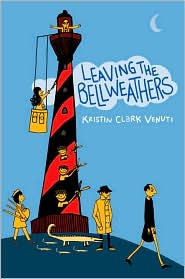
Leaving the Bellweathers (MG)


Venuti, Kristin. 2009. Leaving the Bellweathers. Egmont. 242 pages.

It is nighttime in the village of Eel-Smack-by-the-Bay.

If ever a book surprised me--completely surprised me--it was this one. Looking at the title, the cover, even the first sentence, nothing whispered the promise of how much fun this book would be, how funny and how right this book would be. Will every reader love this one? Will every reader fall for the quirky humor? Well, it would be nearly impossible for any one book to be beloved by every reader. But oh-how-I-wish this one would find a large fan base! Because I think it's just the right blend of what makes a book work.

What is it about? It's about a disgruntled but oh-so-loyal (but not that loyal) butler who is counting down the days until he leaves his job. For two hundred years, his family has served the Bellweathers. But not anymore. When the two hundred years of pledged service are up, he is so out of there! And to make money for his new start, this butler--Tristan Benway--has decided to write a tell-all book about the Bellweathers. He's got a story to tell, and oh what a story that is! Each member of the family--especially all the Bellweather children--get a chance in the spotlight. And it is a real contest (at times) to see just which one is the wildest, craziest, out-there of the bunch.

I definitely recommend this one. It is funny and unusual. And there is just something about it that works.

© Becky Laney of Becky's Book Reviews

Saturday, June 06, 2009

Liar (YA)


Larbalestier, Justine. 2009. (October Release). Liar. Bloomsbury. 388 pages.

I was born with a light covering of fur. After three days it had all fallen off, but the damage was done. My mother stopped trusting my father because it was a family condition he had not told her about. One of many omissions and lies. My father is a liar and so am I. But I'm going to stop. I have to stop. I will tell you my story and I will tell it straight. No lies, no omissions. That's my promise. This time I truly mean it.

Is Micah Wilkins, our narrator, a compulsive liar? Is she trustworthy? Is she sane? Divided into three parts, (Telling the Truth, Telling the True Truth, and The Actual Real Truth) Justine Larbalestier offers readers an always compelling, somewhat-unbelievable, but oh-so-thrilling read. When we first meet Micah, she's just learned something horrible: her boyfriend, Zach, is dead. Murdered. Everyone is stunned including Sarah, Zach's actual girlfriend, and Tayshawn, Zach's best friend. Who is Micah? Where does she fit in? Everywhere and Nowhere. As his after-hours girl--well, lover--she doesn't run in the same circles as Zach. She's little better than a freak at school. A girl with extremely short hair who doesn't wear makeup, who doesn't look or act like the other girls. A girl who once for a few days convinced everyone that she was a boy.

It's true that Micah feels out of sorts and all in-between. Not white enough to be white. Not black enough to be black. Not feminine enough to fit in with the popular girls, the gossipy girls. She doesn't feel pretty, that's for sure.

She is good at many things: lying, for one, biology, for another, and last but certainly not least, running. She is faster than fast. At least that is what she tells us. Why doesn't she have friends? Is it her appearance? The fact that she likes attention and tells outrageous lies?

What's her secret? Does that secret involve murder? What's the real story? Can we ever know the truth?

I liked this one mostly. It was definitely intense and suspenseful. It definitely made me think. It's a complex book, which is always nice to see. But I'm not sure I liked it, liked it. I'm not sure I want to hang out with Micah any time soon. I don't think we're meant to.

This is one of those books that could be easily spoiled for readers by too much description. So I'm purposefully keeping it short. The more I describe my thoughts (and reactions) about Micah, the more preconceived ideas and notions you might have to carry with you if you decide to pick it up on your own.

I am not quite sure I get the cover though. I'm not saying the US cover isn't attractive enough in its own little way. But it doesn't take the reader very long to discover that the main character, Micah, is black with very short, very cropped hair. True, the narrator is a compulsive liar, so maybe readers should doubt her when she says that she is black with short, cropped hair and can sometimes pass as a boy. But if this girl on the cover is meant to be Micah, well, there's nothing freaky or awkward about her. And even if you don't consider all that, I'm not sure that this cover matches the mood of the book. Do those eyes and that hair say it's a dark-mysterious-thriller?

The Australian cover.


© Becky Laney of Becky's Book Reviews

Monday, March 23, 2009

The Love We Share Without Knowing


Barzak, Christopher. 2008. The Love We Share Without Knowing.

Everything you think you know about the world isn't true. Nothing is real, it's all made up. We live in a world of illusion. I'm telling you this up front because I don't want you thinking this story is going to have a happy ending. It won't make any sense out of sadness. It won't redeem humanity in even a small sort of way.

This isn't your traditional novel. If you know that going in, I think you will appreciate it more. Think of it more as a collection of loosely woven short stories. Some stories are more 'connected' than others. The stories share a common thread or two--mainly that of theme. To sum it up in one word: Humanity. What it means to be human, to experience the ups and downs, highs and lows of being human. Love. Loss. Pain. Anger. Bitterness. Frustration. Disappointment. Heartache. Homesickness. Loneliness. Some stories are darker than others. Some seem to be without hope or redemption. Others are more uplifting. What they all have in common, however, is the Barzak touch. He, quite simply, has a way with words. Even if you don't like where the story is going, he keeps you so in love with the words on the page, that you just have to keep reading.

Love isn't what we think. It's a living, changing creature that takes as many shapes as the fox women in the old tales my mother used to tell me. Love comes in and sometimes she's a woman who woos you with soft words and promises. Love comes in and sometimes he's a man with a strong smile and a grip on your shoulder. Love comes in and sometimes it's something beyond the usual circumstances of two people becoming one. It can slip through our hands before we even realize what it is we're holding. (97)


"But sweetheart," said her mother, "the things you don't speak of are the loudest things you say." (146)


We wear our masks in between dreams. It's one of the rules of living here. You can't not wear a mask in those spaces of time. But if you want, you can change the one you've been given. All you have to do is be strong and make it so. (188)


Have you seen Because of Winn Dixie? Do you remember the scenes where the librarian is sharing hard candy with Opal? And Opal is then sharing this candy with others? How every single person has a different way of describing how the candy tastes? That's what this novel was like. That's what this novel was trying to do, in my humble opinion, capture the 101 different flavors of life itself.

All of the stories are set in Japan.

My favorite chapter? Perhaps "If You Can Read This You're Too Close." Listen to how it starts off, "This is the truth. A blind man saw me on the train." Within this story there is a beautiful exchange from which the title of the book comes. But I'm not going to share it here! If you think this one is for you, I encourage you to pick it up and read it for yourself!

I won't lie and say I think this novel is for everyone. The book deals in quite a few chapters with the subject of suicide and the seeming 'hopelessness' of life. (I personally did NOT like the chapter with the suicide club. I do not buy into suicide as a good idea for solving life's hiccups.) It is an adult book, and some of the stories may not be appropriate for younger readers. (Though I think most teens could handle it just fine.)

© Becky Laney of Becky's Book Reviews
If you're reading this post on another site, or another feed, the content has been stolen.

Tuesday, December 30, 2008

Love That Dog


Creech, Sharon. 2001. Love That Dog.

I can't believe I never knew about this little book. It is so very, very good. It's a book in verse--a verse novel. The narrator, Jack, is in English class. His teacher, Miss Stretchberry, requires them to write. This *appears* to be a journal-assignment. But I could be wrong there, but these poetic entries are written by Jack and read regularly by his teacher...so draw your own conclusions. Jack is your typical boy--he doesn't like reading poetry, analyzing poetry, or writing poetry. In that way, this book becomes very humorous as he slowly but surely starts to see life a little differently. As he becomes a poet himself.

There are SO MANY things I loved about this one...Jack's voice, Jack's poems, the inclusion of the poems that Miss Stretchberry's class studied in the first place, the fact that Jack wrote a fan letter to Walter Dean Myers, that the book included an author visiting a school, the running gag that with each new poem/poet studied that Jack was curious to know if they were alive or not, the fact that Jack used poetry to help heal his brokeness after his dog's death...I could go on and on. This one won't take you long to read...and it is so worth it!!

© Becky Laney of Becky's Book Reviews

Tuesday, December 09, 2008

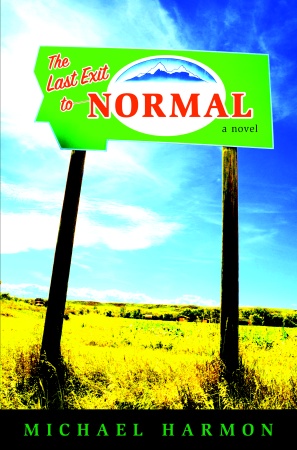
The Last Exit to Normal


Harmon, Michael. 2008. The Last Exit to Normal.

The decoder card to the universe wasn't included in the box of cereal God gave humanity. At the ripe old age of seventeen, I'd at least figured out that no matter how hard you try to guess what happens next, you can't. Life wasn't set up that way and we don't like it, so we spend most of our time running around like a bunch of dimwits.

Ben Campbell, our narrator, I must admit, is one of my favorite characters of the year. He makes this book work for me. The story itself? It's as simple and complex as life itself. Ben moves with his two fathers to a small Montana town after Ben has some emotional problems after the big reveal and its aftermath. (His father is gay; his mother moved out and away.) The three move in with Edward's mother, Bonnie Mae Ingerson. And let me tell you, Bonnie Mae is quite a character. Character with a capital C. (Just one of many reasons why I love this one!) The book is a coming of age story of a boy coming to terms with his life as it now is. It's about a boy learning that it's okay that it's not okay. It's more than that. It's about life and love; work and play; friends and enemies. It's about a boy becoming a hero, making a stand when and where he can.

I can't promise you'll love this one. (I did though.) But you should definitely give it a try.

© Becky Laney of Becky's Book Reviews

Thursday, October 23, 2008

Lydia Bennet's Story


Odiwe, Jane. 2008. Lydia Bennet's Story.

The true misfortune, which besets any young lady who believes herself destined for fortune and favour, is to find that she has been born into an unsuitable family. Lydia Bennet of Longbourn, Hertfordshire, not only believed that her mama and papa had most likely stolen her from noble parents, ut also considered it a small miracle that they could have produced between them her own fair self and four comely girls--Jane, Lizzy, Mary, and Kitty--though to tell the truth, she felt herself most blessed in looks. Lydia's greatest desire in life was to be married before any of her sisters, but a lack of marriageable beaux in the county and her papa's reluctance to accompany her to as many Assembly Balls as she wished had thwarted her efforts thus far.

Shall Lydia live happily ever after like her two older sisters? You'll have to read Lydia Bennet's Story for yourself to see. The greater question may just be...does she deserve to have her happily ever after? Lydia is many things. Playful. Boy-crazy. Immature. Irresponsible. Impulsive. Selfish. Vain. Spoiled. Silly. Naive. Flighty. Flirtatious. Entitled. (Reading that description, I think of Scarlett O'Hara. Isn't that an odd comparison waiting to happen!) And as the youngest of the Bennet clan, she is the least ready (emotionally and psychologically) to be married. She is one of those girls that is stuck-on-herself. Who believes that the world revolves around her. For her to get her happily-ever-after Lydia will have to change. She'll have to start growing up. She'll have to start maturing. She'll have to begin to think of others, to be respectful and considerate. She'll have to learn to compromise. She'll have to learn to think before acting. She'll have to become wiser and more genuine. Which leads to my question, is Lydia capable of growth and transformation?

Lydia's story is revealed through rather obnoxious diary entries and letters (simply because they're written by her), and through a more traditional third-person-narrative. The book is in two parts. The first which parallels what we know from Pride and Prejudice, and the second which is a sequel to the action. It is in this second section, that we see if Lydia does get her happily ever after.

It's hard to review this one without giving it away. George Wickham is George Wickham. And if you've read Pride and Prejudice you know exactly what that means. He's a shameless bad boy incapable of change, incapable of integrity. If George is who he is...is it possible even remotely for Lydia to have her happily ever after and remain Mrs. George Wickham? I'll leave that for you to decide!!!

S
P
O
I
L
E
R

So what do I think of this one. I found the ending to be a bit unbelievable. Don't get me wrong, I wasn't hoping for Lydia to get what she deserves--to pay for the consequences of her impulsive rashness. Okay, maybe a part of me was. But I knew better than to expect that in a contemporary sequel. But the ending seemed a bit rushed...not giving Lydia the needed time to mature and develop into a woman.

Other reviews: A Book Blogger's Diary, Jane Austen Today, Austenprose, Austen-tatious.

© Becky Laney of Becky's Book Reviews

Monday, August 18, 2008

La Petite Four


Scott, Regina. 2008. La Petite Four.

Lady Emily Southwell, trained from birth to be the refined daughter of a duke, did the unthinkable. (2)

I had every intention in the world of loving this one. I did. When I heard there was a YA Regency Romance being published, I wasn't just vaguely interested, I was happy. I was eager. I love Regency romances, mostly. Austen. Heyer. Quinn. I'm so there. (Jane Austen, Georgette Heyer, Julia Quinn.) Another fun Regency title (for adults) that I discovered this year was Rules of Gentility by Janet Mullany. But this one just felt off for me. It felt a bit modern, a bit rushed, a bit silly, a bit underdeveloped. It's the story of four best friends who are preparing for their first season. Emily. Daphne. Priscilla. Ariadne. But for me, these characters weren't distinct enough to distinguish among. They all blurred together. Even Emily.

But even more problematic for me than the indistinguishable heroines is the plotting. It's flimsy at best. When Emily is told she's to marry a gentleman, Lord Robert, she takes an instant dislike to him. With no real reasoning, no real logic, she comes to the conclusion that Robert is a criminal. And she seeks to convince her three friends of this as well. Here we have the "mystery" element of the story. But for me, I had no proof other than the whim of an immature and often whiny "child" (disguised as a young woman) that Robert was a suspicious-- no, dangerous--character. Her only reasoning a) she doesn't want to get married b) he won't let her go to a Ball c) he thinks her paintings are silly. I can see why she might dislike him. But you can't logically jump from "I don't like you." to "I think you're a criminal." (There are plenty of people that I've met through the years that I've disliked based on first impressions. I've never once leaped to the conclusion that they must be a criminal mastermind. And then proceeded to try to prove it to have that person arrested.) The whole novel revolves around this must-prove-Robert-to-be-a-criminal plot. For this reader to find the book enjoyable, believable, there needs to be clues laid throughout the book--undeniable proof that crimes are being committed and clues and motivations and intent presented. There's none of that until the grand finale of a climax.

So as a mystery, it is a bit weak. When it comes to romance, well, it's a bit sudden and rushed as well. There is a hero--other than Robert--involved, but he seems to pop up and disappear erratically. He's a convenient hero. But he goes from mere acquaintance to soul mate a bit too quickly and without too much development. There is no wooing really. No scenes of courtship. Again Emily is just making a giant leap. My guess is that this hero-she-proclaims-to-love-truly is just a way to escape (and irritate) Robert.
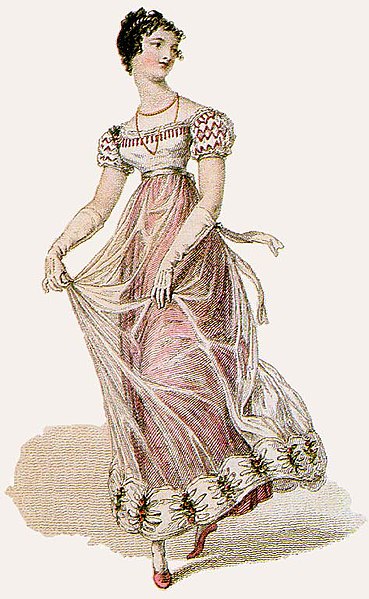
Initial thoughts on the cover: I know the cover is nice, pink and frilly. But it doesn't work for me at all. I see this cover and I don't think "Regency England" I think prom. (Or perhaps I think bride's maid. Or Barbie.) From the half-decapitated model with the glistening gloss on the lips to the wispy wavy hair and the strapless--yes, strapless--pink ball gown. It looks like something from David's Bridal. When I think Regency, I think empire waist gowns. I think most people do. True, I just did a fact check which said that waistlines were lowering and tightening by around 1825, but still this dress doesn't feel right for the era. This image is, for example, from 1823. I don't think the cover will turn away many readers, in fact it may draw in modern readers. But for me, personally, the cover did some damage to the legitimacy of the book. I don't blame Scott for this, however, since covers are rarely the design or brainchild of the author. Her other novels, all adult Regency novels, have fashion appropriate enough for the era.

For fans of Luxe and Rumours, this may work as "historical" fiction. But it didn't quite work for me.

Note: There are three factors that might bias my review a bit. 1) The cover. It's awful. 2) I read this book over a period of three weeks. A chapter or two at a time. This can taint a reading. It might be why I found the characters so indistinguishably whiny. 3) I've read several Austen novels, several Quinn novels, and several Heyer novels this past year. It's hard to go from the really really good stuff to something that feels a bit mediocre without making some comparisons. But one could easily make the argument that a 12 to 14 year old is a lot less likely to have a familiarity with Austen and Heyer and therefore would not find this as lacking.

The good news? I am almost exclusively finding positive reviews (on the blogs) for this one. Apparently, I'm the only one that read this and had a Miss Cranky Pants reaction.

Other reviews: The Story Siren, Genre Go Round, Trainspotting Reviews,

© Becky Laney of Becky's Book Reviews

Tuesday, August 12, 2008

Love Me Tender

Couloumbis, Audrey. 2008. Love Me Tender.

"Early Friday afternoon, Daddy left mad.
He carried his guitar. The weather had turned so hot, the sweaty circles on his T-shirt looked like the wings of an insect against his back.
I followed him, dragging his duffel and panting, "Daddy, this thing is too heavy. What all are you carrying in here?"
What, besides his blue suede shoes and tight white jeans, did he need?"

The narrator of Love Me Tender is thirteen-year-old Elvira. The oldest of what will soon be three children. She's got an eight year old sister, Kerrie, and another sibling on the way. Her mom, whom she calls Mel because that's what her Daddy calls her, is seven months pregnant and very, very cranky. Elvira is worried that it's only going to get worse from here on out--first the hormones of pregnancy, later the diapers and crying and babysitting.

The family is in the beginning stages of crisis. Her dad is unhappy with his job, her mom is unhappy and moody with this unplanned pregnancy, and her younger sister has reverted to acting like a three year old. When we first meet the family, it doesn't look good. The parents have just had a big fight. Her dad is on his way to Vegas. On his way to compete in an Elvis impersonator competition. Her mom is glued to the recliner and hooked to cheesy TV movies. And her sister is driving her crazy.

And then the phone call comes.

It's a strange call. Almost cryptic. Mel's sister, Clare, says simply that their mother's time has come. Thinking that she only has hours--maybe a day or two--to make amends with her estranged family, Mel quickly packs up her two kids, borrows her husband's most prized possession--a classic car in great condition--and heads to Memphis, Tennessee. Taking turns behind the wheel, Mel and Elvira make it to her grandmother's house--just barely with all their nerves and spirits intact. (After a bit of a scare with Kerrie and some "toy" eyelashes.)

This will be the children's first time to meet their grandmother, and to meet their mother's younger sister, Clare. That family--much like Elvira's--seems to be in crisis as well. Clare is convinced that her mother--their mother--needs to be put in a nursing home.

During this weekend, lives will changes, fences will be mended, there will be laughter and tears as well.

Family drama galore (mainly through intense conversations/confrontations) is what you'll find in Love Me Tender.

Honestly, I thought this one was a bit disappointing. When I see the name Coulombis, I expect better things, greater things. Not that this one was bad, it just wasn't as magical as I expected. The premise, the author, the cover, I expected to be wowed a bit more than I was. I kept reading thinking that there was a big reveal on the way, something huge that would shake this family up, something that would act as a catalyst for this family. But nothing really happened.

Other reviews: Flamingnet, Not Acting My Age,

© Becky Laney of Becky's Book Reviews

Friday, August 08, 2008

Lady of Quality


Heyer, Georgette. 1957. Lady of Quality.

"The elegant travelling carriage which bore Miss Wychwood from her birthplace, on the border of Somerset and Wiltshire, to her home in Bath, proceeded on its way at a decorous pace." (1)

Lady of Quality's first line may not sparkle as much as Austen's famous one, "IT is a truth universally acknowledged, that a single man in possession of a good fortune must be in want of a wife." But just give it time. Trust me. This one has everything and more that you'd expect in an Austen novel: wit, humor, romance, quirky characters, as well as a few genuinely likable ones.

Such is the case with Lady of Quality. Miss Annis Wychwood is almost thirty years old. And in that time, the Regency period, thirty might as well have been sixty. Spinster is spinster no matter if you're thirty, blond, and witty or wrinkly, gray, and stubborn. But Annis is comfortable in her singleness. Or at least she prefers to see herself as comfortable. It helps that in Annis' situation, she's wealthy enough to have her own house and household. (By household I mean servants and such). If Annis had to live under her brother's roof, well, it would be a different story altogether. She does NOT get along with her brother, Geoffrey, though she does get along in a way with her sister-in-law. Yes, folks might think it a bit strange that she'd rather be independent and living on her own--and a good day's travel away from her brother and his wife--but they've become accustomed to it. But when our novel opens, Annis is about to do something a bit more unexpected, a bit more shocking.

Lucilla Carleton is just a young thing--not even eighteen--when she decides to run away from her aunt. (Her aunt is her primary guardian.) Her aunt wants her to marry the son of her father's best friend. A man, Ninian, that she's practically grown up with. It's not that she doesn't like him. But she doesn't like him like him. At least she says as much. As does he when given the opportunity. (The two like to bicker about how they don't want to be together.) Annis comes across this bickering pair on her way to Bath. Their carriage (or vehicle) has broken down--a problem with one of the wheels. Annis is too much of a lady to leave the poor girl in distress. She invites the young woman to come with her, to stay with her. Through their trip and the first day back at home, Annis hears all about Lucilla, her aunt, Ninian, and his over-bearing parents the Lord and Lady Iverley. Lucilla has runaway it's true but it's because her aunt is passive aggressive. She manipulates through tears and pleas and looks.

What is Annis to do? Welcome her home to this girl she barely knows yet instantly likes? Or send her packing with much tears of distress? She decides that the girl must write a letter to an aunt. She'll be allowed to stay with Miss Wychwood in Bath, it's true, but it's a temporary solution to the girl's problem. But this nice letter home has unattended results. Her aunt being of the nervous sort on the best of days writes a letter--a tear-soaked and illegible letter to the girl's legal guardian--Lucilla's Uncle Oliver. Oliver Carleton.

The last thing Annis expected was to be visited by Oliver Carleton. A man (from London) with the reputation of the worst sort. A truly grumpy, stubborn sort of man who speaks without thinking of the consequences, who enjoys speaking the truth, the whole truth, and nothing but the truth come what may. Obey society's nicety-nice rules? Not a chance! A man with a sharp but witty tongue comes to Bath to get to the bottom of this mess. He doesn't want Lucilla. He's not there to take her away, he's there to investigate this woman, this stranger who has interfered and butted into his business, his family.

Let the fun begin.

Oliver and Annis. Oh the sparks will fly. Despite her claims of being ancient and spinsterly, Oliver can't help thinking that she's entirely unsuitable for chaperoning his niece. She should be the one being courted and pursued and wooed by men. She's beautiful. She's witty. She's intelligent. There's just a certain something about her that he can't ignore. Annis never in a million years thought she'd feel this way, this maddeningly confusingly wonderful feeling. She can't stand him; and yet, she keeps hoping she'll see him again.

For anyone who loves Much Ado About Nothing and/or Pride and Prejudice, Lady of Quality is for you. It is a wonderfully giddy-making novel.

Heyer's novels are rich in detail combining history and romance with wit and charm and some unforgettable characters. If you're looking for a place to start, I'd highly recommend beginning with Lady of Quality.

© Becky Laney of Becky's Book Reviews

Wednesday, July 23, 2008

Travel the World: England: Narnia: Last Battle


Lewis, C.S. 1956. The Last Battle.

In the last days of Narnia, far up to the west beyond Lantern Waste and close beside the great waterfall, there lived an Ape. He was so old that no one could remember when he had first come to live in those parts, and he was the cleverest, ugliest, most wrinkled Ape you can imagine. He had a little house, built of wood and thatched with leaves, up in the fork of a great tree, and his name was Shift. There were very few Talking Beasts or Men or Dwarfs, or people of any sort, in that part of the wood, but Shift had one friend and neighbour who was a donkey called Puzzle. At least they both said they were friends, but from the way things went on you might have thought Puzzle was more like Shift's servant than his friend.

The beginning of the end starts with one donkey, one ape, and one lion skin that floats downstream. From that skin an evil plot is born, and from that plot much blood is shed and much harm is done for every living thing (man, animal, tree, etc.) in Narnia. Shift's plot? To have Puzzle wear the lion skin and "be" Aslan for curious persons to gaze upon from a distance. Shift's real plot? To use the name of Aslan to get exactly what he wants.

It has been many generations since King Rilian ruled. Now his descendant, a king named Tirian, reigns. Though his luck seems to change overnight. One day a king, the next a prisoner. And all because "Aslan" has arrived back in Narnia.

Using the famed line "He's not a tame lion" people reason away all the signs that this is NOT Aslan. He commands the destruction of trees with spirits? Not a tame lion. He demands talking beasts to become his slaves? Not a tame lion. Demands servitude and exile from dwarfs? Not a tame lion. It's easy to say from our perspective that these animals, these individuals are a bit too gullible. But when you stop and think about it, the reader knows more, has experienced more. There haven't been any Aslan spottings in hundreds perhaps a thousand years. What the average Narnian knows is just stories passed down generation by generation by generation. Is it really so hard to see that perhaps their faith has more doubt than certainty? The truth is the average Narnian has not had any "use" for Aslan and his stories in their practical lives. So their faith isn't as "active" as it could be, should be perhaps.

King Tirian won't be fooled for long. He starts off highly suspicious and remains so for the most part. Once he's been captured, imprisoned, Tirian starts to think, to really think about Narnia, about Narnian history, about what he knows to be true, to be right. He realizes that humans from another world have always always been a part of the action. That the arrival of humans almost always accompanies these Aslan sightings. There is always a link. So he delivers a heartfelt prayer that these human saviors will come once again and fight for Narnia, to fight for freedom, to fight for right.

His prayer is answered in a way, but not in the way he hoped. I hope this isn't too much of a spoiler for readers. But it is called The Last Battle for a reason. Narnia is coming to an end. The world, the country, is dying. Tirian and the humans who arrive--Jill, Eustace, Lucy, Edmund, Peter, Digory, and Polly--are there to witness the end of Narnia and the beginning of their after lives.

As a child, I enjoyed this one. I would have put it above many of the other books in the series--including Horse and His Boy and Silver Chair--but as an adult I have a new perspective altogether. While some of the aspects of this one work for me, there were quite a few significant problems.

I'm not sure if other readers will share my quibbles or not. They may have different issues than I do. Among one of the reasons why people may find the last one disappointing is that...

S
P
O
I
L
E
R

all the humans die. Jill. Eustace. Peter. Edmund. Lucy. Digory. Polly. Most of them (I think most of them) die as a result of a train accident. (The Pevensie parents die as well but we still don't see them in the book.) I'm not sure if killing off all your characters will leave readers satisfied. Yes, the characters themselves are happy. But the deaths of so many seem tragic to me. Not that death itself is tragic. (Death can be a good thing. It can be a blessing.)

Second. Susan is missing. She's no longer a "friend" of Narnia. This is 'tragic' for several reasons. One is that technically speaking she will have lost her mother, father, two brothers, and a sister. She'll be all alone in the world. Two is the not-so-subtle theme that you can lose your salvation. If being a friend of Narnia translates directly into being a Christian, then Lewis' message seems to be that Susan represents Christians that have fallen from grace and lost their salvation, lost their way. Of course there are some believers who do in fact believe that this is the case. That Christians can un-Christian themselves, un-save themselves, re-damn themselves. I for one am not one of them. Of course, there is the potential that this fictional Susan could regain her friend status later on in life. That she could have another opportunity to believe. But Susan as allegory just doesn't work for me.

The other problems I had with this book were all theological. And they were pretty significant. But this blog isn't the proper place to really get into theological debates.

For those readers who are not approaching these seven novels as a Christian believer, for those that are reading them because they are fantasy--pure and simple and fun fantasy--then The Last Battle is a fitting conclusion.© Becky Laney of Becky's Book Reviews

Tuesday, July 22, 2008

Living Dead Girl


Scott, Elizabeth. 2008. Living Dead Girl.

Just when you thought Elizabeth Scott was getting to be predictable...along comes LIVING DEAD GIRL. To clarify, I love, love, love Elizabeth Scott. I have happily read and gushed about her first three books: Bloom, Perfect You, and Stealing Heaven.

If I had just a handful of words to describe Living Dead Girl, they'd be: powerful, haunting, and unputdownable.

It is the story of a girl caught in a nightmare. "Alice." A girl who at the age of ten was reborn.
Get up.
Those were the first words I ever heard.
Open my eyes, see a girl, black and blue all over, dried blood along her thighs. Red brown stains smeared across the hairless juncture between.
"Get up and take a bath, Alice," the man in the blue shirt said, and Alice did.
I did.
That's how I was born. Naked, hairless, covered in blood like all babies.
Named, bathed, and then taken out into the world. (20)
Kidnapped by a pedophile during a class field trip, Alice has endured the unthinkable for five years. Now she's fifteen, five foot seven, and a hundred pounds. Her time is running out, she knows this, she wasn't the first Alice. But it is in how she lives--her world, her thoughts, her decisions--that will haunt you most of all. Suspenseful, dark, and very chilling. Definitely not for everyone. But if you can go to the dark side, if you can walk in her shoes for a bit, it is really something.

Scott's writing is incredible. If I were in charge of handing out awards, one would be heading her way. Her book is amazingly haunting. It just resonates with feeling, emotion. The mood might be dark. The ending bittersweet, but oh-what-a-book.

In previous posts, I've compared Elizabeth Scott to Sarah Dessen. She may not realize it, but that is high praise, very high praise coming from me. Some people may think that Stephenie Meyer is the "perfect" writer. But for me, Sarah Dessen, has always provided the most satisfying of reads. But with her fourth novel, Living Dead Girl, new comparisons must be made. Alice Sebold. Nancy Werlin. Gail Giles. Laura Wiess.

I read an ARC of this. It isn't due to be published until September, I believe. As I'm quoting from this ARC, be aware that there could be changes between this and the final published version.

http://www.elizabethwrites.com/
Another review: Reader Rabbit,

If you've read this one, please let me know and I'll add your link to the list.

© Becky Laney of Becky's Book Reviews

Friday, July 04, 2008

Poetry Friday: Lady Liberty


Rappaport, Doreen. 2008. Lady Liberty: A Biography. Illustrated by Matt Tavares.

Lady Liberty is both beautifully written and beautifully illustrated. Though I must admit it was the illustrations that first caught my eye. I love Tavares' style. The colors. The tones. There's just something so rich, so expressive. It works for me really really well. I just love the illustrations. They are a large part of why this book is so amazing. The book itself, Lady Liberty, tells the twenty year story of how 'Lady Liberty' came to be.


The Statue of Liberty has come to symbolize America. To symbolize freedom. To symbolize all our nation stands for and believes. This is the story of her creation to her dedication ceremony a little over twenty years later.

The story is told through poems. Poems with many voices or narrators all telling one story, sharing one dream. Two nations, one goal.

My favorite, if I had to choose, is the poem narrated by Emma Lazarus.
Emma Lazarus
Poet
New York City,November 1883

A gala auction is being held
to raise money for Liberty's pedestal.
Famous artists are donating paintings.
I was asked to write a poem
to be sold along with poems
by Longfellow and Whitman.
It is a great honor to be asked.
I can write about anything I want.
But I have had trouble writing lately
because I feel too sad.

In the past few years in Russia,
hundreds of Jews have been killed.
Thousands have been persecuted,
their homes burned, their shops destroyed.
They trek hundreds of miles across Europe
with only the clothes on their backs,
hoping to find ships to take them to America.

We Jews are not new to hatred.
Almost two hundred years ago
my ancestors fled Europe, too.
America was a land of hope for them.
it is still a land of hope.

Soon when people arrive in the New World,
they will be welcomed
by a caring, powerful woman.

Give me your tired, your poor,
Your huddled masses yearning to breathe free,
The wretched refuse of your teeming shore.
Send these, the homeless, tempest-tost to me:
I lift my lamp beside the golden door!

http://www.doreenrappaport.com/
http://matttavares.com/ladyliberty.html

© Becky Laney of Becky's Book Reviews

Thursday, June 26, 2008

Looks


George, Madeleine. 2008. Looks.
Start in the sky. Look down at the valley. Green, plush, peaceful landscape. Drop down a little, towards the town, then skim over it, past the low beige buildings of the university, the clean white spires of the Congregational churches, the flat green welcome mat of the town common, out towards the edge of town, towards Valley Regional High School, a rambling, one-story brick building surrounded by soccer fields, field hockey fields, football fields, parking lots. Hover above Valley Regional High. Watch the crowd of kids as it streams into the school like water sucked down a storm drain. And listen: Even from high up you can hear the hum of a school on the first day back in September.
Now drop, plummet straight down like a stone, through the pebbly roof and the air-conditioning ducts and the bundles of wiring and the soft acoustic tiles, until you burst into the teeming front hall of the school. Float up by the ceiling where you can take it all in, the blended smoothie of backpacks and T-shirts and freckled shoulders and tank tops, ponytails and crew cuts and hoop earrings and knotted leather necklaces. Wince at the noise, the crashing surf of screeching, laughing, yelling.
Now pivot, face the light blue cinderblock wall next to the main doors of the school. Someone is standing there, pressed into the auditorium door alcove, someone so huge and still she might be mistaken for a piece of architecture if it weren't for the sky blue windbreaker that marks her as human, the backpack sitting limply on the floor by her feet. Look at her. Nobody else is, but you look at her. Look at Meghan Ball. (1-2)
Meghan Ball, one of our two narrators, is obese. "Meghan Ball is at once the most visible and invisible person in school. In the obvious way, she is unbearably visible. She takes up the most space of any person in the entire school--in the entire town, in fact. She is impossible to overlook in class pictures or on the risers during chorus concerts--they always make her stand in the back row, where her round head hovers above a space big enough to accommodate three normal-sized kids. She has a back as wide as a basketball backboard, perfect for spitting on and pelting things at. In this way, Meghan is a walking bull's-eye target. But then, just when she feels like she can't get any bigger, when she's feeling brontosaurically huge and exposed, someone will walk right past her--right past her--saying something totally private they would never want anyone else to hear, just as if Meghan wasn't there at all--like right now, right this very second, watch." (3)

Heavy on descriptions and details, Looks examines high school life through two sets of eyes. Meghan, whom we've already met, and Aimee Zorn, a girl with an obvious eating disorder, a girl obviously in pain who is struggling with her life the only way she knows how: by controlling what goes in and out of her mouth and by writing poetry. In alternating voices, Looks explores most facets of high school life.

There are moments when the observations, the descriptions, are right on:

"It's amazing what people will say right in front of you when you're obese, like you're deaf or something, like you're retarded. Or like you don't even speak the language, like you're a tourist lost in the land of the thin." (5)

"The fat girl who loses her only friend sees, all at once, how everything works. She sees that all promises are fictions, all friendships are games with winners and losers. The fat girl left alone in the world sees that every human being has a value assigned to them that they are helpless to change no matter what they do, and she sees that people trade each other like baseball cards: three cheap friends for two valuable friends, a whole group of worthless friends for one popular friend. It's like dying and coming back to life, being a fat girl who loses her only friend; it gives you an insight into the people around you that the average person couldn't bear to have.
But if it doesn't break her, this insight makes the friendless fat girl strong. The fat girl left alone in the world becomes the ultimate outsider, and outsiders always know the insiders' secrets, because insiders don't care what's happening on the outside--they never check to see what the outsiders know. They usually don't even know who the outsiders are. The person on the bottom sees what's happening on top, the person at the back sees what's happening in front, the person on the outside sees what's happening at the center, and the fat girl who loses her only friend is under, behind, and outside all at once; if she cares to look, she can see everything in every direction. God must be a friendless fat girl, because only friendless fat girls are as omniscient as God." (144)
But for me, the narrative was too detached. The third person present tense which surprisingly blended seamlessly with passages written directly to address the reader (that would be second person plural???) just didn't work well for me all the time. I became impatient. I became annoyed. While I wanted to love this book--really wanted to love it--I found myself increasingly annoyed by a few things. Nothing major. But the fact that "the fat girl" was always "the fat girl" and sometimes the "friendless fat girl" or the "lonely fat girl" but hardly ever just Meghan was something that really really really really annoyed me. Fat wasn't only a label, it was the defining characteristic for Meghan. And that just doesn't sit well with me. I felt that a bit more fleshing out for all the characters was in order. I felt Aimee Zorn got the better treatment, better back story, more heart and soul. At the end of the book, I felt I still didn't know Meghan. She was still just the fat girl. She may be the fat girl who now has a friend. But still. I didn't feel that way with Aimee. I felt she was more developed as a character. This was her story. Fat girl was just there along to help skinny girl win the day.

Based on what reviews I've read, I'm alone in seeing that this one has a few flaws. Most seem to really really enjoy it. And it's not that I didn't enjoy aspects of it. But it seemed impersonal and detached in places. Unemotional even in a few spots. And while detachment doesn't make a novel good or bad or whatnot. It does make it slightly less satisfying. Would I recommend it? Yes. Other people seem to be enjoying this one a good deal. And the story is a good one even if it reads closer to a parable (is that the right word???) than an actual story.


Other reviews: Little Willow, Bookshelves of Doom, Sarah Miller, Teen Book Review.

Also of interest: Publishers' Weekly article, author's website.

© Becky Laney of Becky's Book Reviews

Tuesday, June 24, 2008

The Lost Queen

http://cdn.harpercollins.com/harperimages/isbn/large/5/9780060871055.jpg

Jones, Frewin. 2007. The Lost Queen. (Book Two of the Faerie Path.

In The Faerie Path by Frewin Jones, we met a young teen girl, 15-almost-16, named Anita who at the beginning seemed quite ordinary.

From my first review: But on the eve of her sixteenth birthday, something big happens that changes everything. It all starts with a boat accident. It ends with several missing teenagers that disappeared from the hospital. Anita transformed, if you will, into Tania on her sixteenth birthday. She is the seventh daughter of the royal faerie couple Oberon and Titania. She'd been missing from the world of Faerie for around five hundred years give or take a few. And her disappearance had made quite an impact--a horrible awful no good impact--on the land and on her parents. But she somehow magically made it back. Tania was back, that's all that seemed to matter. Her mother, Titania, was missing. Her father was unhappy. Her sisters mostly good except for that one that was up to no good...

At the end of The Faerie Path, Tania along with Edric, whom we first met as Evan, choose to return to the land of mortals. Tania wants to find her mother and be able to bring her back. But she also wants to return to her own parents. Tania realizes that her disappearance from this world, this mortal world, from the hospital in particular would be heartbreaking to her parents.

Thus opens The Lost Queen. Tania/Anita is back home with her mortal parents. She's in BIG BIG BIG trouble for disappearing. And she's not allowed to see her boyfriend, Evan, anymore outside of play rehearsals. (If you remember, the two are playing Romeo and Juliet.) She's having some difficulty fitting back into the mortal way of life--school, friends, dating, parents, etc. Especially since at the same time she's supposed to be behaving herself and earning back her parents' trust she's supposed to be tracking down her mother. She has her suspicions--and they are soon confirmed--that it must have been her mother (alive and well) who sent her that mysterious birthday present that wakened this faerie self that had been dormant for so many years.

Full of action, adventure, and some romance, The Lost Queen is an exciting sequel.

Note: If you've read the first one but it's been a while, you can probably pick this one up and go on. There is a very nice two or three page summary that tells you everything you need to know.

© Becky Laney of Becky's Book Reviews

Thursday, June 05, 2008

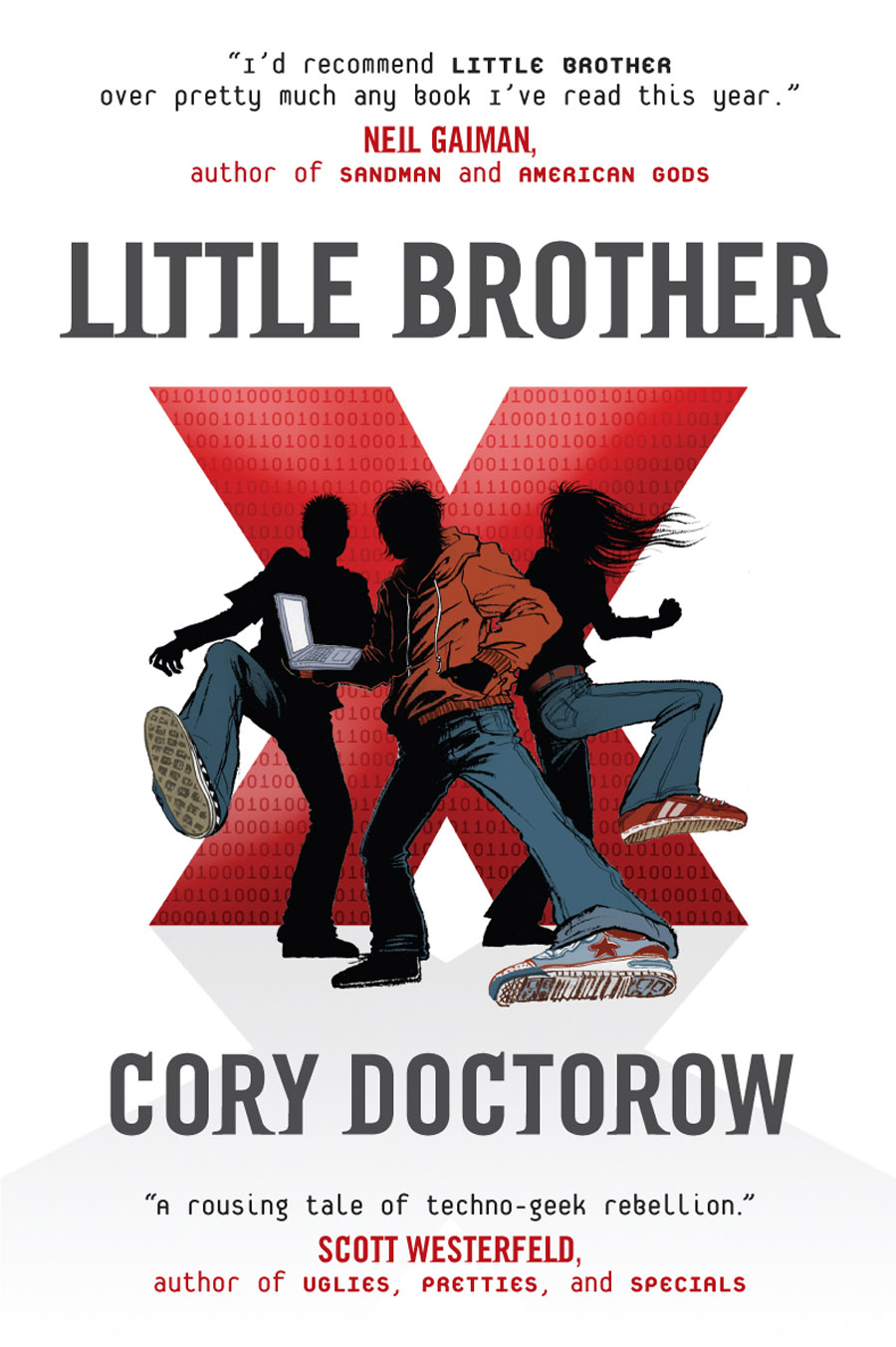
Little Brother


Doctorow, Cory. 2008. Little Brother.

I'm not sure I can adequately cover this one. Wow. Really wow. Then again with Neil Gaiman saying things like, "I'd recommend Little Brother over pretty much any book I've read this year" and "It made me want to be thirteen again right now and reading it for the first time"... I'm not sure my input is needed at all. It's also got, for the record, Scott Westerfeld calling it a, "Rousing tale of techno-geek rebellion--as necessary and dangerous as file sharing, free speech, and bottled water on a plane." Those two names alone would compel me to give this one a go.

Set in the near-future, we see the battle between safety and freedom reach its climax. Marcus and his friends, four techno-geeks, happen to be in the wrong place at the wrong time when terrorists strike the Bay Bridge in San Francisco. The four are taken prisoner by the Department of Homeland Security--not arrested, they just conveniently "disappear" without a trace. They are held prisoner for a week. At the end of a week, three of the four are released. Marcus, our narrator, is told that he's not "safe" yet. They'll be watching him. They feel sure that he must be a terrorist some way or some how.

Feeling the injustice of it all and grieving over the loss of his best friend, Darryl, whom he hasn't seen since the arrest, he vows to take down the DHS. Can he outsmart the bad good-guys by being a good bad-guy? Well, you'll just have to read for yourself.

Freedom. Safety. The Bill of Rights. The Constitution. Terrorists. Courage. Fear. The book is smart, very smart. And it's very effective. Though I know nothing about the world of computer coding and hacking, I could not put this one down.

I would think fans of Evil Genius and Genius Squad would appreciate this one.

You can download the novel here.

© Becky Laney of Becky's Book Reviews

Thursday, May 01, 2008

A Long Way From Chicago


Peck, Richard. 1998. A Long Way From Chicago. Review by Becky Laney.

Prologue
It was always August when we spent a week with our grandma. I was Joey then, not Joe: Joey Dowdel, and my sister was Mary Alice. In our first visits we were still just kids, so we could hardly see her town because of Grandma. She was so big, and the town was so small. She was old too, or so we thought--old as the hills. And tough? She was tough as an old boot, or so we thought. As the years went by, though, Mary Alice and I grew up, and though Grandma never changed, we'd seem to see a different woman every summer.
Now I'm older than Grandma was then, quite a bit older. But as the time gets past me, I seem to remember more and more about those hot summer days and nights, and the last house in town, where Grandma lived. And Grandma. Are all my memories true? Every word, and growing truer with the years.


A Long Way From Chicago is a book that is practically perfect in every way. (It did win a Newbery Honor.) It's historical fiction. The book is set during the Depression. The title page calls it a "novel in stories" and that's a fair assessment. The book does consist of loosely connected stories or memories told within a framework of an old man recalling his youth fondly. There are eight 'memories' shared within the book that are the heart and soul of the book. Seven are the consecutive stories of his summer vacations. Each August (starting in 1929 and ending in 1935), Joey and his younger sister Mary Alice leave Chicago to visit their grandmother who lives in a small town in Illinois.

Here is how the first chapter begins, "You wouldn't think we'd have to leave Chicago to see a dead body. We were growing up there back in the bad old days of Al Capone and Bugs Moran. Just the winter before, they'd had the St. Valentine's Day Massacre over on North Clark Street. The city had such an evil reputation that the Thompson submachine gun was better known as the Chicago typewriter. But I'd grown to the age of nine, and my sister Mary Alice was sever, and we'd yet to see a stiff. We guessed that most of them were where you douldn't see them, at the bottom of Lake Michigan, wearing concrete overshoes. No, we had to travel all the way down to our Grandma Dowdel's before we ever set eyes on a corpse."

Joey's voice is of immediate interest to me. He's a great little narrator. The story is rich in detail, rich in character. Every person--man, woman, child--has depth. Peck is just a genius when it comes to writing, to capturing human personalities with wit and humor and heart. The reader becomes intimately acquainted with Joey, Mary Alice, and most importantly Grandma Dowdel. A woman that is one-of-a-kind. A woman that has spirit, gumption, personality, heart, and a mind of her own. A very strong woman who sees the world in her own unique way.

I definitely recommend A Long Way From Chicago!!! It was a fantastic book.

© Becky Laney of Becky's Book Reviews

Thursday, February 01, 2007

Larklight


The title of the book I’m reviewing today is in full: Larklight: Or the Revenge of the White Spiders!: Or To Saturn’s Rings and Back!: A Rousing Tale of Dauntless Pluck in the Furthest Reaches of Space.
Quite a mouthful, isn’t it?

Reeve, Philip. 2006. Larklight.
I remember in elementary school having an end of the year awards ceremony where each child received a certificate reflecting their ‘character.’ If Larklight were to receive an award, here are some possibilities: ‘Best 8-Legged Villains’ ‘Quirkiest Flying House’ ‘Longest Chapter Titles in A Work of Fiction’ etc. What is Larklight about you may be wondering?
It’s a historical science fiction/fantasy title. Set in the Victorian era, it answers the question...what could have happened if scientists like Isaac Newton had discovered space flight. The answer, the British would have sought to colonize and rule outer space much like she was known for colonizing earth. (Hence, the saying that the sun never sets on the British empire.) Arthur “Art” Mumby and his sister Myrtle live with their father in a rather unique house ‘Larklight’ that orbits the moon, I believe. With robotic servants and ancient gravity devices, the house is unique in many ways. When our story begins the children are anxiously awaiting the arrival of a visitor. But with the arrival of this visitor, the danger and adventure begins. With aliens of every shape and size, some ‘good’ and some ‘bad,’ the two must find a way to save the British empire before its too late. Art loves living in space, but Myrtle wishes for a simpler life in British--particularly London--society. For those who can suspend their disbelief of absurd and silly adventures defying everything we know about the world we live in, Larklight is sure to entertain. If you’re looking for a fantasy world where pirates and aliens interact...this might be your dream come true.

http://www.philipreeve.co.uk/

Wednesday, January 31, 2007

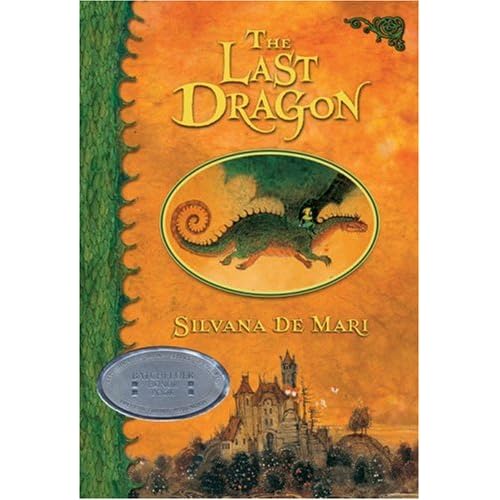
The Last Dragon


Recently was recognized as Mildred L. Batchelder Honor Book for 2007.

de Mari, Silvana. 2006. The Last Dragon.

Yesterday, I spent quite a bit of time discussing the award-winning title THE PULL OF THE OCEAN. I didn’t feel it had much merit. Granted, I don’t read extensive amounts of international literature so I don’t know what the competition was like this year. But I do know an overrated, much-too-clever-for-its-own-good book when I see one. And one of my all-time favorite books THE LEGEND OF THE WANDERING KING is an international book from a Spanish writer, Laura Gallego Garcia. (Not to mention The Diary of Ma Yan which was translated first into French and then into English). So I know that there are good books out there being translated...just look at Cornelia Funke, a German writer. But I am digressing.

Focusing on the book in hand, THE LAST DRAGON was a treat of a book. I won’t lie. It’s not a perfect book. But it has something going for it: it’s generally entertaining. Yes, some of the jokes and gags might have lost something in the translation. But throughout, it is an interesting, FUN, book. If you can look past a few running gags or punchlines that get a little old after the third or fourth time, you’ll find yourself lost in the story of an elf...the last elf. Yorsh, when we first meet him, is a ‘baby’ elf. He’s new to the world, and not the brightest fellow. He’s confused. He makes mistakes. Some funnier than others. He can cause lots of mischief without really meaning too. It’s not his fault. He just doesn’t know any better. His mother died and his only memories are of his grandmother grieving the loss of her daughter. He has no memories of his father--he just knows he’s dead--perhaps even dead before his birth. So he is the ‘last’ elf on earth. An earth ravaged with floods and wild weather. When he and his two human companions find a prophecy about the ‘last elf’ meeting the ‘last dragon’ and saving the world...he has hope for the first time in his life. Now on a quest, Yorsh is out to save himself and the world. Can two humans and an elf set out to fulfill the ancient prophecy? What will they find when they venture into the mountains where dragons are supposed to dwell?

The Last Dragon is divided into two parts. However, as a reviewer I can’t really review both parts without spoiling everything. Needless to say, the first part of the book deals with the first half of the prophecy, and the second part set ten to twelve years later fulfills the second half of the prophecy. Two parts, two different quests, one very entertaining book. It has humor. It has adventure. It has a teeny bit of romance.

The book is translated from the Italian by Shaun Whiteside.

Thursday, December 14, 2006

Holly Claus

Ryan, Brittney. 2004. The Legend of Holly Claus.

The Legend of Holly Claus by Brittney Ryan is a fantasy novel loosely set in Victorian America; its two main locales being the fantasy world FOREVER where all IMMORTALS dwell and Victorian America—primarily New York City. Christopher Carroll is a young poor boy who surprises everyone—especially Santa Claus—when instead of asking Santa to bring him what he wants, he asks Santa what he most wants. Santa is moved to tears, and him and his wife, Viviana, wish for a child. Holly Claus is born a year later. Of course SANTA and his accompanying friends and relations do not live in the “real world” that you can see on a map. They are residents of FOREVER a land built on glaciers of jewels. Only the immortal can enter the gates of FOREVER and Santa or Nicholas Claus reigns as king of this land. FOREVER land is your typical magical kingdom. Everything is true, good, pure, and beautiful…and there is no fear in the kingdom. Love reigns supreme in the kingdom. Mortals can work their way into FOREVER by being loving, compassionate, selfless, generous people while on earth. Of course, every novel—or fantasy novel at least—needs a villain. Herrikhan is your typical evil villain. He’s full of hate, greed, pride…and his main goals in life are to conquer the world and make people worship him. Herrikhan is in bondage to the underworld—far below the depths of the world. He can roam the mortal realm for small periods of time, but he is restricted from entering FOREVER. Herrikhan only has power where there is fear. To make a long story short, reminiscent of Sleeping Beauty, Holly is cursed by Herrikhan and given a heart of snow to “protect” her perfect, pure, loving heart until he can marry her and gain for himself a get out of hell free card. There are plenty of fairies and magical/fantasy creatures who are Holly’s friends and companions. Eventually, Holly joins the mortal world for an adventure where she knows she will eventually have a showdown with Herrikhan who has the magical power to appear in whatever form he wants. While having her mortal adventure she meets and falls in love with Christopher who is partly responsible—magically speaking—for her existence. Of course all ends happily ever after with all curses being broken. Herrikhan is defeated/destroyed/obliterated by the power of selfless pure love. While the novel borders on being sickenly sweet in places—where abstract qualities take on a life/personality of their own (LOVE, FEAR, GOOD, EVIL, etc.), I enjoyed it overall. I thought that while certain aspects of the novel were predictable, there remained some surprise elements. The book will appeal most to readers of fantasy. There are talking animals, goblins, fairies, fauns, centaurs, magical charms and spells, evil curses, wizards, etc. It is 500+ pages long. So it will take a dedicated reader. But I thought it was overall a good story. Not perfect, but entertaining. I could see this book being brought either to the theatre or as a made-for-tv movie.

Sunday, November 05, 2006

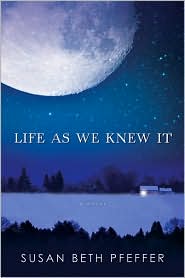
Life As We Knew It


Imagine waking up one day to find that everything had changed practically over night. All over the world massive destruction due to one natural disaster after another. And what if there was no way to turn back the clock. To wake up knowing that each day will be worse than the one before. No electricity. No phone service. No gas or oil. Limited food supplies. What is there left to hope for? How would you live your last days?

Meet Miranda your personal guide through this terrifying adventure.

Pfeffer, Susan Beth. 2006. Life As We Knew It.

When we first meet Miranda she is a happy, practically care-free young girl with so much to look forward to. It's May of her sophomore year. She's sixteen and dealing with ordinary problems. Friends. Boys. Schoolwork. But less than one week after our narrative opens, Miranda's world is about to change and she doesn't even know it. When they first hear that astronomers are predicting that a meteor will hit the moon, it's a time of light-hearted celebration. Teachers assign students moon-based assignments. After all, wasn't meteors hitting the moon how the moon got all those craters to begin with? What's the big deal? But what astronomers failed to predict--or failed to announce--is that this would be the largest meteor to ever hit the moon. Still families make plans to sit out on the lawn, some even baking cookies or popping popcorn to celebrate this once-in-a-lifetime event, to watch history in the making. Miranda and her family witness the meteor hitting, but what no one could have predicted is that they are witnessing the destruction of life as we know it. The meteor hits the moon setting it not only off-tilt but bringing it dangerously close to Earth. Scary to witness, but Miranda has no idea what it has set into motion. Tsunamis, earthquakes, floods, volcanoes, wild fires. And that is just the beginning.

Journey with Miranda through these terrifying months (May-March) as everyone struggles to survive.

Susan Beth Pfeffer has created a very exciting novel sure to leave an impact on her readers. Writing since 1970, she has written over sixty books for children and young adults.

Randomhouse's Author spotlight