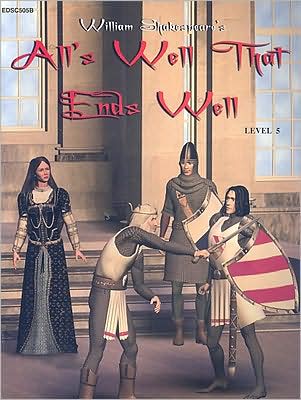
All's Well That Ends Well. William Shakespeare. 1605. [Source: Bought]
I first read All's Well That Ends Well
in the summer of 2009. It was, I believe, one of the first Shakespeare plays I read on my own without being in a class and having structured discussions and analysis. It was an interesting read. And an interesting reread for that matter. For Helena, our heroine, is a puzzlement. Is her undeniable love for Bertram her greatest strength or her biggest weakness? Is being willing to go to such great lengths to be with the one you LOVE especially when considered with the obvious fact that he clearly despises you ever a good thing? a healthy thing? And yet, Helena, is resourceful, bold, clever, determined. She has plenty of supporters, people who love and respect her. But Bertram, the man she's OBSESSED with, clearly does not like her--let alone love her. He does not want to be anywhere near her. He is repulsed by her even. Readers know that Bertram is so not worthy of Helena. He doesn't deserve a woman that good. Bertram is clearly a JERK. He's bad news through and through. (I don't know what Helena sees in him! Seriously. It's one thing for his mother to put up with him. But why would any woman choose to look past Bertram's obvious immaturity and jerkiness?!)
Quotes:
Love all, trust a few,
Do wrong to none: be able for thine enemy
Rather in power than use; and keep thy friend
Under thy own life's key: be check'd for silence,
But never tax'd for speech.
Countess,
'I
have sent you a daughter-in-law; she hath recovered the king and undone
me. I have wedded her, not bedded her; and sworn to make the "not"
eternal. You shall here I am run away: know it before the report come.
If there be breadth enough in the world, I will hold a long distance. My
duty to you. Your unfortunate son, Bertram
Look
on this letter, madam; here's my passport. 'When thou canst get the
ring upon my finger, which never shall come off, and show me a child
begotten of thy body that I am father to, then call me husband; but in
such a "then" I write a "never."
'Tis not the many oaths that makes the truth,
But the plain single vow that is vow'd true.
The
web of our life is of a mingled yarn, good and ill together: our
virtues would be proud if our faults whipped them not; and our crimes
would despair if they were not cherished by our virtues.
Who knows himself a braggart,
Let him fear this; for it will come to pass
That every braggart shall be found an ass.
My first review:
What does a girl have to do to catch a husband? Apparently a lot if
you're a young maiden named Helena. In All's Well That Ends Well, the
readers meet a young woman, Helena, who is madly in love with a young
man, Bertram. Bertram is, in my opinion, an ass. He is stupid and lusty,
and lusty and stupid. And he hangs out with with a truly annoying guy
named Parolles. What is keeping these two apart? I mean, besides the
fact that Bertram has no interest in her? Well, Helena, though
well-beloved by her guardian, The Countess of Rousillon, is not noble by
birth. She's the daughter of a very good (but now dead) doctor. And she
can't reasonably hope to marry well--let alone marry her dream guy,
Bertram, who is a Count (the son of the (above) Countess). So what's a
girl to do, I say?!
Well, if you're Helena, you'll think up a
couple of schemes. Scheme #1 being that you will head off to the King of
France, who is conveniently dying, cure him with your father's
wonderful secret remedies, and earn his devotion, respect, and favor.
Once you've been granted the hand of ANY man in the kingdom, then you
can go about nonchalantly (or maybe not so much) choosing the man you've
loved all along, which in Helena's case is Bertram. Is Bertram
extra-stupid, or is he just a typical guy in need of a couple years
maturity? I'll leave that up to others to decide. Meanwhile, his
response to Helena--and to the King--is to throw a temper tantrum, sulk
and pout, and stomp off stealthily (again, not so much) to a whole other
country--but not before he says, "I do."

Having
won her husband in name only, Helena returns to the Countess who is
pleased to see her but annoyed with her son for being the way he is. (He
probably needed more spankings, perhaps?) After receiving a letter from
him that he will not be her
true
husband until she has his ring on her finger and his child in her womb,
she runs away to plot more schemes. The Countess is upset to see her
go, but not too distressed since she has a full-time Clown to entertain
her and make bawdy jokes night and day.
Bertram and his
companions are in Florence, in the army, and when they're not off, you
know, fighting, he is busy trying to have his way with various women.
One woman that he is wooing is named Diana, she is the daughter of a
widow woman. This widow-woman just happens to meet up with
Helena--Helena has followed her husband secretly to Florence--and oh the
plotting that these two do!
Can Helena (with some help, of course) win her husband's heart?

My thoughts on All's Well That Ends Well:
This
is my first time with this play. I was a little nervous tackling it all
on my own. But it was surprisingly easy to follow. At least
surprisingly easy to follow....for being Shakespeare. I think the fact
that it is a comedy, and that the jokes still translate (at least
relatively so) as funny all these centuries later just shows you how
some things never change. Is Helena stupid for loving a man who doesn't
love her back? Should the Countess--or the King, or the Widow--have just
told her that 'he's just not that into you'? Does Helena's loving
Bertram make her weak by today's standards? Shouldn't Bertram have some
say in who he marries? After all, it is his life. And couldn't Helena's
persistent devotion be seen as proof of how stubborn she is? And if
she's stubborn about this, she could very well turn out to be stubborn
in everything else. I'm not saying Helena's wrong, not really, every
single character--almost every single character anyway--seems to praise
Helena as being the essence of a good woman, a great woman, an amazingly
wonderful woman. But does the reader have enough proof that this is so?
She does save the King's life, and that is something, and while her
motives may be double in nature--wanting the king's favor to grant her
Bertram--she probably does want to see him live for his own sake. And
she does save the king by her own skill, her own smarts, so that says
something: she is smart in some things at least. Why does she love
Bertram? Why is he 'the one' for her? What makes him so wonderful in
Helena's eyes? (Fortunately, Shakespeare was no Stephenie Meyer else all
Helena's speeches would talk about his eyes.) Do we as readers need to
know? It's always nice if we're
shown
why a hero and heroine belong together. (I think that is why I heart
Much Ado About Nothing so much!!!) If the reader comes to feel what the
heroine feels, then we have a connection with both hero and heroine. It
makes for a more satisfying story. And that is something that is
definitely lacking in All's Well That Ends Well. Helena loves him. End
of story. Throw a party.
(mini-)
S
P
O
I
L
E
R
With
a title like "All's Well That Ends Well," I feel it's not much of a
surprise that things end well. For me to be convinced that things were
really well,
I'd need to feel that Bertram grew up...at least grew up a little. What
has Bertram done to prove to readers that he is good-husband-material?
Nothing. At all. Sure, he says he'll be a good and true husband to her.
But really, what else can he say with all his boasting of how he came to
care for her only after Helena's "death"? He could talk big to his
mother and to his king when he thought his wife was dead.
Yes,
I repented of not loving her. Yes, I'm a fool. But having come to love
her though too late, I'm a better man now. Can I get married to this
other chick, now? I'm suspicious of Bertram still. Why? Because
he's not honest. That and he's stupid. He's stupid for thinking he can
get away with telling lie after lie. (I wouldn't have been surprised to
hear him say emphatically and imploringly,
I did not have sex with that woman.)
Bertram's also insulting. Not only does he insult Helena (a few times
to her face, but mostly by letter), he's insulting to Diana as well.
When Diana is before the king, confessing all, he uses the old
sure-but-she's-just-a-whore excuse. Of course, Diana wasn't a whore.
She's a maiden still, as the reader well knows. (I personally would have
written in a few face slaps. You know how Jack Sparrow is always
getting his face slapped by women he's done wrong, well, Bertram needs a
comeuppance.) Can Helena change Bertram? Really? Truly? Is a happily
ever after likely here?
Have you read All's Well That Ends Well? Did you like it? What do you
think are the chances for these two being happy together? Have you seen a
good production of this play? I'd love to hear about it if you have! If
you've
not read the play (or even if you have, I suppose), what is it about Shakespeare that you love or hate most?
© 2013 Becky Laney of
Becky's Book Reviews