Showing posts with label 1605. Show all posts

Thursday, December 01, 2022

164. Don Quixote


Don Quixote. Miguel de Cervantes Saavedra. Translated by Edith Grossman. 1605. 940 pages. [Source: Bought]

First sentence: Somewhere in La Mancha, in a place whose name I do not care to remember, a gentleman lived not long ago, one of those who has a lance and ancient shield on a shelf and keeps a skinny nag and a greyhound for racing.

Premise/plot: Don Quixote has an impossible dream. [That would be a short and sweet summary, though not particularly accurate.] In a world of his own making, Don Quixote IS a knight; a real-life, honest-to-goodness knight like those in his favorite books. Every day offers an opportunity for thrilling quests. The world may think him mad, foolish, insane, delusional, out of his wits. But to Don Quixote, he thinks the world is under an enchantment. They cannot see the truth. They are the fools for being blind to 'the truth' not he. 

Sancho Panza is Don Quixote's squire. Is he more or less foolish than his master? His dream is different than Quixote's dream. He isn't brave, dashing, daring, adventurous. In some ways, he's the exact opposite of Quixote in every way. But Quixote has promised that he'll give Sancho an insula to govern if he goes with him as a squire. And, I suppose, this hope of future power is his dream. Maybe. Mostly, I think Sancho Panzo dreams of a comfortable life--food to eat, soft bed to rest, and NO brutal beatings. 

These two are out on the road [except for when they are not]. Ever-restless [except for when they are not.] 

 My thoughts: The book is in two volumes. The first was published in 1605. The second was published in 1615. There are highs and lows in each volume. When it is good, it is very good. When it is dull, it is very dull, incredibly dull. 

There are dozens--if not hundreds--of asides. The narrative branches out into little side stories. These stories have very little if anything to do with the main narrative. Don Quixote keeps running into people who like to tell random stories. Sometimes not even their own stories. The main narrative is a platform of sorts for other stories the author wanted to tell/publish. 

At times this is a story easy to love. At other times, it's really not.

Quotes:

In short, our gentleman became so caught up in reading that he spent his nights reading from dusk till dawn and his days reading from sunrise to sunset, and so with too little sleep and too much reading his brains dried up, causing him to lose his mind.

The truth is that when his mind was completely gone, he had the strangest thought any lunatic in the world ever had, which was that it seemed reasonable and necessary to him, both for the sake of his honor and as a service to the nation, to become a knight errant and travel the world with his armor and his horse to seek adventures and engage in everything he had read that knights errant engaged in, righting all manner of wrongs and, by seizing the opportunity and placing himself in danger and ending those wrongs, winning eternal renown and everlasting fame.

“Oh, Señor!” said the niece. “Your grace should send them to be burned, just like all the rest, because it’s very likely that my dear uncle, having been cured of the chivalric disease, will read these and want to become a shepherd and wander through the woods and meadows singing and playing, and, what would be even worse, become a poet, and that, they say, is an incurable and contagious disease.”
 
According to what I have heard, true love is not divided and must be voluntary, not forced. If this is true, as I believe it is, why do you want to force me to surrender my will, obliged to do so simply because you say you love me?
 
“Even so, I want you to know, brother Sancho,” replied Don Quixote, “that there is no memory that time does not erase, no pain not ended by death.”
 
“Have I acted so badly with you, Sancho,” Don Quixote responded, “that you wish to see me dead so soon?” “That’s not the reason,” Sancho replied, “but I don’t like keeping secrets, and I wouldn’t want them to spoil because I kept them too long.”
 
“It is your fear, Sancho,” said Don Quixote, “that keeps you from seeing or hearing properly, because one of the effects of fear is to cloud the senses and make things appear other than they are; if you are so frightened, withdraw somewhere and leave me alone; alone I suffice to give victory to the army to whom I shall proffer my assistance.”
 
“Your grace, come back, Señor Don Quixote, I swear to God you’re charging sheep! Come back, by the wretched father who sired me! What madness is this? Look and see that there are no giants or knights, no cats or armor or shields either parted or whole, no blue vairs or bedeviled ones, either. Poor sinner that I am in the sight of God, what are you doing?”
 
Sancho came so close that his eyes were almost in his master’s mouth; by this time the balm had taken effect in Don Quixote’s stomach, and just as Sancho looked into his mouth, he threw up, more vigorously than if he were firing a musket, everything he had inside, and all of it hit the compassionate squire in the face.

You should know, Sancho, that a man is not worth more than any other if he does not do more than any other.

“I don’t know how you can speak of righting wrongs,” said the bachelor, “for you have certainly wronged me and broken my leg, which won’t ever be right again; and in rectifying my injuries, you have injured me so much that I’ll go on being injured for the rest of my life; it was a great misadventure for me to run across a man who is seeking adventures.”
 
“There’s no reason to waste time and money making that face,” said Sancho. “What your grace should do instead is uncover yours and show it to those who are looking at you, and right away, without any images or shields, they’ll call you The Knight of the Sorrowful Face; believe me, I’m telling you the truth, because I promise your grace, Señor, and I’m only joking, that hunger and your missing teeth give you such a sorry-looking face that, as I’ve said, you can easily do without the sorrowful picture.”
 
“Fate has willed that I cannot help listening to you, and so continue.”
 
If your misfortune were one that had all doors closed to any sort of consolation, I intended to help you weep and lament to the best of my ability, for it is still a consolation in affliction to find someone who mourns with you.
 
The Knight of the Forest, who heard the Knight of the Sorrowful Face speak in this way, did nothing but look at him, and look at him again, and look at him one more time, from head to toe;
 
A knight errant deserves neither glory nor thanks if he goes mad for a reason.       
 
The great achievement is to lose one’s reason for no reason, and to let my lady know that if I can do this without cause, what should I not do if there were cause?
 
“Do not waste your time, Señora, in offering anything to this woman, since it is her custom never to give thanks for anything that is done for her, and do not encourage her to respond, unless you wish to hear her tell a lie.”
 
The poet can recount or sing about things not as they were, but as they should have been, and the historian must write about them not as they should have been, but as they were, without adding or subtracting anything from the truth.
 
 “Trust in God, Sancho,” said Don Quixote, “that everything will turn out well and perhaps even better than you expect; not a leaf quivers on a tree unless God wills it.”
 
Historians who make use of lies ought to be burned.

History is like a sacred thing; it must be truthful, and wherever truth is, there God is; but despite this, there are some who write and toss off books as if they were fritters.

“There is no book so bad,” said the bachelor, “that it does not have something good in it.”

The best sauce in the world is hunger, and since poor people have plenty of that, they always eat with great pleasure.

“Once or twice,” responded Sancho, “if I remember correctly, I’ve asked your grace not to correct my words if you understand what I mean by them, and when you don’t understand, to say: ‘Sancho, you devil, I don’t understand you,’ and if I can’t explain, then you can correct me; I’m so plaint. . . .” “I do not understand you, Sancho,” said Don Quixote, “because I do not know what I am so plaint means.” “So plaint means,” responded Sancho, “That’s just the way I am.”

 
We must slay pride by slaying giants; slay envy with generosity and a good heart; anger with serene bearing and tranquility of spirit; gluttony and sleep by eating little and watching always; lust and lasciviousness by maintaining our fealty toward those whom we have made mistresses of our thoughts; sloth by wandering everywhere in the world, seeking those occasions when we may become famous knights as well as Christians.

 “Oh, well, if none of you understand me,” responded Sancho, “it’s no wonder my sayings are taken for nonsense. But it doesn’t matter: I understand what I’m saying, and I know there’s not much foolishness in what I said, but your grace is always sentencing what I say, and even what I do.” “Censuring is what you should say,” said Don Quixote, “and not sentencing, you corrupter of good language, may God confound you!”

“Is that the kind of talk appropriate to this place?” “Señor,” responded Sancho, “each person must talk of what he needs no matter where he is; here I remembered about my donkey, and here I talked about him; if I remembered about him in the stable, I’d talk about him there.”

“You cite so many witnesses, Sancho, and so many particulars, that I cannot help but say that you must be telling the truth. But proceed, and shorten the story, because you are on the way to not concluding for another two days.” “You’re on the way to not finishing your story until you’re in the next world.” “I’ll stop when I’m less than halfway there, God willing,”

Be a father to virtues and a stepfather to vices. Do not always be severe, or always mild, but choose the middle way between those two extremes; this is the object of wisdom. Visit the prisons, the slaughterhouses, and the market squares, for the presence of the governor in these places is of great importance: it consoles the prisoners, who can hope for a quick release; it frightens the butchers, who then make their weights honest; it terrifies the market women, and for the same reason.    

 And this doctor says about himself that he doesn’t cure diseases when they’ve arrived but prevents them so they won’t come, and the medicines he uses are diet and more diet until the person’s nothing but skin and bones, as if being skinny weren’t a worse ailment than having a fever.
 
“What did you get from your governorship?” asked Ricote. “I got,” responded Sancho, “the lesson that I’m not good for governing unless it’s a herd of livestock, and that the riches you can gain in governorships come at the cost of your rest and your sleep and even your food, because on ínsulas the governors have to eat very little, especially if they have doctors who are looking out for their health.”
 
Trying to restrain the tongues of slanderers is the same as trying to put doors in a field.
 
“You should know, Sancho,” said Don Quixote, “that love shows no restraint, and does not keep within the bounds of reason as it proceeds, and has the same character as death: it attacks the noble palaces of kings as well as the poor huts of shepherds, and when it takes full possession of a heart, the first thing it does is to take away fear and shame; lacking them, Altisidora declared her desires, which gave rise in my bosom to more confusion than compassion.”
 
I often stop to look at your grace from the tips of your toes to the last hair on your head, and I see more things to drive her away than to make her fall in love; I’ve also heard that beauty is the first and principal quality that makes people love, and since your grace doesn’t have any, I don’t know what the poor maiden fell in love with.”  
 

“Look, Sancho,” responded Don Quixote, “I say proverbs when they are appropriate, and when I say them they fit like the rings on your fingers, but you drag them in by the hair, and pull them along, and do not guide them, and if I remember correctly, I have already told you that proverbs are brief maxims derived from the experience and speculation of wise men in the past, and if the proverb is not to the point, it is not a maxim, it is nonsense.


© 2022 Becky Laney of Becky's Book Reviews

Friday, October 25, 2013

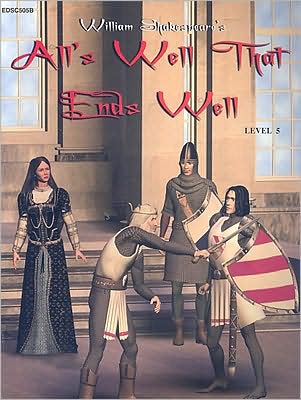
All's Well That Ends Well

All's Well That Ends Well. William Shakespeare. 1605. [Source: Bought]

I first read All's Well That Ends Well in the summer of 2009. It was, I believe, one of the first Shakespeare plays I read on my own without being in a class and having structured discussions and analysis. It was an interesting read. And an interesting reread for that matter. For Helena, our heroine, is a puzzlement. Is her undeniable love for Bertram her greatest strength or her biggest weakness? Is being willing to go to such great lengths to be with the one you LOVE especially when considered with the obvious fact that he clearly despises you ever a good thing? a healthy thing? And yet, Helena, is resourceful, bold, clever, determined. She has plenty of supporters, people who love and respect her. But Bertram, the man she's OBSESSED with, clearly does not like her--let alone love her. He does not want to be anywhere near her. He is repulsed by her even. Readers know that Bertram is so not worthy of Helena. He doesn't deserve a woman that good. Bertram is clearly a JERK. He's bad news through and through. (I don't know what Helena sees in him! Seriously. It's one thing for his mother to put up with him. But why would any woman choose to look past Bertram's obvious immaturity and jerkiness?!) 

Quotes:
Love all, trust a few,
Do wrong to none: be able for thine enemy
Rather in power than use; and keep thy friend
Under thy own life's key: be check'd for silence,
But never tax'd for speech. 
Countess,
'I have sent you a daughter-in-law; she hath recovered the king and undone me. I have wedded her, not bedded her; and sworn to make the "not" eternal. You shall here I am run away: know it before the report come. If there be breadth enough in the world, I will hold a long distance. My duty to you. Your unfortunate son, Bertram
Look on this letter, madam; here's my passport. 'When thou canst get the ring upon my finger, which never shall come off, and show me a child begotten of thy body that I am father to, then call me husband; but in such a "then" I write a "never." 
'Tis not the many oaths that makes the truth,
But the plain single vow that is vow'd true.
The web of our life is of a mingled yarn, good and ill together: our virtues would be proud if our faults whipped them not; and our crimes would despair if they were not cherished by our virtues. 
Who knows himself a braggart,
Let him fear this; for it will come to pass
That every braggart shall be found an ass.
My first review:

 What does a girl have to do to catch a husband? Apparently a lot if you're a young maiden named Helena. In All's Well That Ends Well, the readers meet a young woman, Helena, who is madly in love with a young man, Bertram. Bertram is, in my opinion, an ass. He is stupid and lusty, and lusty and stupid. And he hangs out with with a truly annoying guy named Parolles. What is keeping these two apart? I mean, besides the fact that Bertram has no interest in her? Well, Helena, though well-beloved by her guardian, The Countess of Rousillon, is not noble by birth. She's the daughter of a very good (but now dead) doctor. And she can't reasonably hope to marry well--let alone marry her dream guy, Bertram, who is a Count (the son of the (above) Countess). So what's a girl to do, I say?!

Well, if you're Helena, you'll think up a couple of schemes. Scheme #1 being that you will head off to the King of France, who is conveniently dying, cure him with your father's wonderful secret remedies, and earn his devotion, respect, and favor. Once you've been granted the hand of ANY man in the kingdom, then you can go about nonchalantly (or maybe not so much) choosing the man you've loved all along, which in Helena's case is Bertram. Is Bertram extra-stupid, or is he just a typical guy in need of a couple years maturity? I'll leave that up to others to decide. Meanwhile, his response to Helena--and to the King--is to throw a temper tantrum, sulk and pout, and stomp off stealthily (again, not so much) to a whole other country--but not before he says, "I do."

Having won her husband in name only, Helena returns to the Countess who is pleased to see her but annoyed with her son for being the way he is. (He probably needed more spankings, perhaps?) After receiving a letter from him that he will not be her true husband until she has his ring on her finger and his child in her womb, she runs away to plot more schemes. The Countess is upset to see her go, but not too distressed since she has a full-time Clown to entertain her and make bawdy jokes night and day.

Bertram and his companions are in Florence, in the army, and when they're not off, you know, fighting, he is busy trying to have his way with various women. One woman that he is wooing is named Diana, she is the daughter of a widow woman. This widow-woman just happens to meet up with Helena--Helena has followed her husband secretly to Florence--and oh the plotting that these two do!

Can Helena (with some help, of course) win her husband's heart?

My thoughts on All's Well That Ends Well:

This is my first time with this play. I was a little nervous tackling it all on my own. But it was surprisingly easy to follow. At least surprisingly easy to follow....for being Shakespeare. I think the fact that it is a comedy, and that the jokes still translate (at least relatively so) as funny all these centuries later just shows you how some things never change. Is Helena stupid for loving a man who doesn't love her back? Should the Countess--or the King, or the Widow--have just told her that 'he's just not that into you'? Does Helena's loving Bertram make her weak by today's standards? Shouldn't Bertram have some say in who he marries? After all, it is his life. And couldn't Helena's persistent devotion be seen as proof of how stubborn she is? And if she's stubborn about this, she could very well turn out to be stubborn in everything else. I'm not saying Helena's wrong, not really, every single character--almost every single character anyway--seems to praise Helena as being the essence of a good woman, a great woman, an amazingly wonderful woman. But does the reader have enough proof that this is so? She does save the King's life, and that is something, and while her motives may be double in nature--wanting the king's favor to grant her Bertram--she probably does want to see him live for his own sake. And she does save the king by her own skill, her own smarts, so that says something: she is smart in some things at least. Why does she love Bertram? Why is he 'the one' for her? What makes him so wonderful in Helena's eyes? (Fortunately, Shakespeare was no Stephenie Meyer else all Helena's speeches would talk about his eyes.) Do we as readers need to know? It's always nice if we're shown why a hero and heroine belong together. (I think that is why I heart Much Ado About Nothing so much!!!) If the reader comes to feel what the heroine feels, then we have a connection with both hero and heroine. It makes for a more satisfying story. And that is something that is definitely lacking in All's Well That Ends Well. Helena loves him. End of story. Throw a party.

(mini-)
S
P
O
I
L
E
R

With a title like "All's Well That Ends Well," I feel it's not much of a surprise that things end well. For me to be convinced that things were really well, I'd need to feel that Bertram grew up...at least grew up a little. What has Bertram done to prove to readers that he is good-husband-material? Nothing. At all. Sure, he says he'll be a good and true husband to her. But really, what else can he say with all his boasting of how he came to care for her only after Helena's "death"? He could talk big to his mother and to his king when he thought his wife was dead. Yes, I repented of not loving her. Yes, I'm a fool. But having come to love her though too late, I'm a better man now. Can I get married to this other chick, now? I'm suspicious of Bertram still. Why? Because he's not honest. That and he's stupid. He's stupid for thinking he can get away with telling lie after lie. (I wouldn't have been surprised to hear him say emphatically and imploringly, I did not have sex with that woman.) Bertram's also insulting. Not only does he insult Helena (a few times to her face, but mostly by letter), he's insulting to Diana as well. When Diana is before the king, confessing all, he uses the old sure-but-she's-just-a-whore excuse. Of course, Diana wasn't a whore. She's a maiden still, as the reader well knows. (I personally would have written in a few face slaps. You know how Jack Sparrow is always getting his face slapped by women he's done wrong, well, Bertram needs a comeuppance.) Can Helena change Bertram? Really? Truly? Is a happily ever after likely here?

Have you read All's Well That Ends Well? Did you like it? What do you think are the chances for these two being happy together? Have you seen a good production of this play? I'd love to hear about it if you have! If you've not read the play (or even if you have, I suppose), what is it about Shakespeare that you love or hate most?

© 2013 Becky Laney of Becky's Book Reviews