Showing posts with label Richard Peck. Show all posts

Friday, May 02, 2014

Reread #18 A Teacher's Funeral

The Teacher's Funeral. Richard Peck. 2004. Penguin. 208 pages. [Source: Library]
If your teacher has to die, August isn't a bad time of year for it. You know August. The corn is earring. The tomatoes are ripening on the vine. The clover's in full bloom. There's a little less evening now, and that's a warning. You want to live every day twice over because you'll be back in the jailhouse of school before the end of the month. Then our teacher, Miss Myrt Arbuckle, hauled off and died. It was like a miracle, though she must have been forty. You should have seen my kid brother's face. It looked like Lloyd was hearing the music of the spheres. Being ten that summer, he was even more willing to believe in miracles than I was. 
 The Teacher's Funeral is my favorite, favorite, favorite Richard Peck novel. It is one of my favorite historical fiction books. I loved the humor. I loved the writing--the narration. One humorous incident after another, just more and more to love. I also loved the characters. I loved Russell, the narrator. I loved his sister, Tansy. I loved their Dad who was oh-so-wise. I loved Charlie, Russell's best friend, and it was fun to see Glenn Tarbox as well. I was cheering for him through the book! But one of my FAVORITE, FAVORITE characters, and probably secretly the reason I ADORE the book so very, very much is LITTLE BRITCHES (aka Beulah).

This historical fiction novel is set in 1904. Most of the action occurs in a one room school house. The teacher is Russell's OLDER sister. Russell had been hoping--dreaming really--that since their teacher literally died a day or two before school was to start, that there would be NO MORE SCHOOL. He was dreaming of FREEDOM. What he got, of course, is his sister for a teacher. A sister who could see through him, who knew him backwards and forwards, and could tell when he was TROUBLE. He can do pranks, sure enough, but she always knows it was HIM and she punishes him.

This one has plenty of laugh-out-loud moments. And there is a lovely audio book edition of it as well.


 My first review October 2006. My second review March 2011

Favorite quotes:

This was the night me and Lloyd always went to the crick and camped out. It was a sacred part of our year. After the Case Special came through, we always spent that night at the crick, and hung on till morning, no matter what. It was how we kissed the summer goodbye before the darkness of learning fell about us. (13)
"Who died?" I inquired.
"Take a guess," Charlie said. "Go ahead."
"Somebody we know?"
"You can believe that."
"Somebody old or young?"
"Old," Charlie said, "as the hills."
Lloyd was looking back and forth between us, clutching J.W. He was on the hook again, and I was getting there.
"Old as Old Man Lichtenberger?"
"Nobody's that old," Charlie said.
"Man or woman?"
"That'd be tellin' too much."
"Somebody we like?"
"Not hardly," Charlie said.
"Somebody who's been feeling poorly late?" I was wracking my brains.
Charlie shrugged his big shoulders. "She must of felt pretty poorly tonight. She died."
"So it's a woman!"
"More or less," Charlie said.
The truth burst over me. "You don't mean Miss Myrt Arbuckle!" (24)

Nobody would miss Miss Myrt, so Preacher Parr got them to miss the good old days when the winters were worse and the kids were better. At a funeral you want to miss something. (39)

When Pearl came back, she had a grip on the little kid who didn't want to be anywhere near here. Her bonnet hung by its strings. Her dinner pail scraped the floor. She kept setting her bare heels. "Turn me loose," she squawked. "I don't wanna, and I'm not gonna!"
Pearl pushed her toward Tansy and resumed her seat.
Tansy pulled the small girl's skirttails free of her drawers and settled her skirts for her. But it was too late. Forever more, she was known as "Little Britches." Even unto the distant day of her wedding. Besides, come to find out her real name was Beulah.
"Who are you?" Tansy asked with an arm around her.
"I ain't sayin'," said Little Britches. "I ain't stayin'."
"Then whisper who you are in my ear before you go."
Little Britches whispered. It would turn out that she was a Bradley. They were a family who hadn't had anybody in school for some years. Little Britches was an afterthought. "I'm goin' on home now." She wiggled free of Tansy. "Pleased to meetcha."
"Well, you can go home at noon, Tansy told her. "Till then just wait up there at my desk. You can...help me be teacher." (80-1)

"Tansy, how come the female sex think they know more than the male sex?"
"Because we do. What's the capital of Delaware?"
"I don't know."
"Know by tomorrow," Tansy warned. "I'm the teacher, and I won't have dumb brothers." (107)

I thought we'd need a block and tackle to lift her. But getting Aunt Fanny Hamline out of the ditch became one of Tansy's most famous days of teaching. It was a lesson in engineering too. It should have been studied at Purdue University. (127)

© 2014 Becky Laney of Becky's Book Reviews

Friday, April 18, 2014

Reread #16: A Year Down Yonder

A Year Down Yonder. Richard Peck. 2000. Penguin. 144 pages. [Source: Library]

I loved A Year Down Yonder so much more than Richard Peck's A Long Way From Chicago. And I definitely enjoyed A Long Way From Chicago! While A Long Way From Chicago was told from Joey's point of view, A Year Down Yonder is told from Mary Alice's point of view. Because of the Depression, Mary Alice has been sent by her parents to live with Grandma Dowdel. Mary Alice has spent more than a few summers with her Grandma, alongside her brother, but this time she'll be there all year long, and without her brother.

While A Long Way From Chicago is fun, in many ways, it is a bit disjointed as well. Each chapter tells the story of a summer vacation. In A Year Down Yonder, the plot is more traditional. The book follows the course of an entire year. Readers get a better chance to KNOW the characters, to appreciate the characters and the small town setting. And Mary Alice is a great narrator!!! I loved her story. My favorite chapters were "Rich Chicago Girl," "Vittles and Vengeance," "Heart and Flour," and "A Dangerous Man." I loved the slight traces of romance. 


I would definitely recommend both A Long Way From Chicago and A Year Down Yonder. Both books do stand alone, but, they do go together well.

I first reviewed A Year Down Yonder in May 2008.

© 2014 Becky Laney of Becky's Book Reviews

Friday, March 21, 2014

Reread #12 Long Way From Chicago

A Long Way From Chicago. Richard Peck. 1998. Penguin. 148 pages. [Source: Library book]

  A Long Way From Chicago has a great premise. Joey Dowdel and his younger sister, Mary Alice, are "forced" to visit their Grandma Dowdel every summer. Each chapter in the novel tells the story of a summer visit. There is a story for 1929, 1930, 1931, 1932, 1933, 1934, 1935, and 1942. The prologue says it all, "As the years went by, though, Mary Alice and I grew up, and though Grandma never changed, we'd seem to see a different woman every summer."

Through the stories, readers catch glimpses of the past. These stories capture family moments. There is plenty of humor and a good bit of heart.

For any reader who enjoys quirky small-town, long-ago, family-based stories from the heart, this one is a must.

I think I prefer Peck's more traditional novels to his stories.


I loved this one the first time I read and reviewed it in 2008

© 2014 Becky Laney of Becky's Book Reviews

Tuesday, March 18, 2014

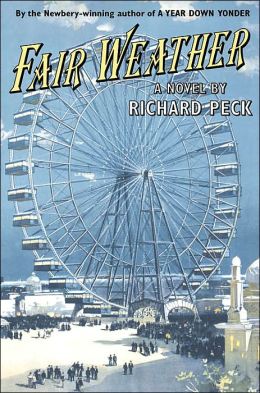
Fair Weather (2001)

Fair Weather. Richard Peck. 2001. Penguin. 160 pages. [Source: Library]

Is Fair Weather my absolute favorite novel by Richard Peck? In all fairness, how could I really ever choose? Sure, I love, love, love some more than others. Some I've reread more than others. Some I've recommended more than others. But most that I've read (so far) have been worth it. Fair Weather is no exception.

World's Fair. Chicago. 1893. I really enjoyed so many things about Fair Weather. I liked the three Beckett siblings. I liked the narrator, Rosie. I liked the younger brother, Buster. I liked the older sister, Lottie. I liked the fact that Lottie had a big, big secret. I liked the extended family. That Grandpa. He's SOMETHING. I loved, loved, loved every scene he was in. He was FABULOUS. I wish more children's books had such wonderful grandparent-characters. I really really enjoy books that focus on the special bond between grandparents and grandchildren. My favorite, favorite chapters in this one are the two chapters that focus on his best day ever. They also happen to mention Buffalo Bill's Wild West Show. I liked the aunt as well. She wasn't quite as quirky as the grandpa--but who could be?! I was glad to see how hosting her family for a week changes her--for the better. The details. I love historical fiction BECAUSE I love history. OR. Do I love history because I love historical fiction?! I love how this one is grounded in real-life details. I loved learning more about the World's Columbian Exposition. I loved the little things, the descriptions, the scenes. I love how it captured the feel of The Midway. It made me want to read more, to learn more. I also loved the Chicago setting.

A few weeks ago, I happened to watch Annie Oakley (1935). I had seen the musical, of course, but this one really impressed me. Reading Fair Weather and "experiencing" the show through fiction--through characters that I had come to really care about--was really fun for me!

I definitely recommend this one!

© 2014 Becky Laney of Becky's Book Reviews

Thursday, October 01, 2009

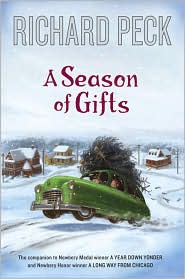
Season of Gifts (MG)


Peck, Richard. 2009. A Season of Gifts.

I really wanted to love this one. I mean really wanted to. You see, I love Richard Peck. A Teacher's Funeral. Here Lies the Librarian. On the Wings of Heroes. Long Way From Chicago. Year Down Yonder. (I can't believe I never blogged about Here Lies the Librarian.) And besides that I love Grandma Dowdel. So I had high hopes and big expectations. Perhaps, my hopes were too high.

So I didn't love it, but I didn't hate it. What is it about? It's about a new family who has come to town. A preacher, his wife, and their three children. An older daughter, Phyllis. A younger daughter, Ruth Ann. And the middle child, a son, our narrator, Bob. It covers a little under half a year--from August to December. It focuses on this family's growing pains as they adjust to a new town, a new community. It's historical fiction. Set in the late 1950s. There's talk of Elvis joining the army and being shipped out, talk of the Russian threat and the potential for Russian spies, and then there's the bit more controversial talk of Indians. (I'll get into that in a bit.) This family lives next door to the ever-cranky Mrs. Dowdel. A strange woman, an old woman, a character who says and does whatever she wants whenever she wants. (You don't have to have one of those in your family to know that that can be a bad thing at times.) How much is the book about Mrs. Dowdel? How much is the book about growing up in a small town? It's a nice blend of the two. Mrs. Dowdel adds some flavor to the story--both sour and sweet, and now that I think about it, a little salt too. But this story isn't only about a family growing up with a strange and sometimes scary neighbor. It's about growing up. It's about family and friends. It's about bullies. It's about life--the good, the bad, the ugly. It's not about sugar-coating the past. Making it into something it's not. But there is a nostalgic feel to it.

I liked this one. But there were a few chapters I loved. For example, the "E'er the Winter Storms Begin" section, the final section, was just great. What I expected from the whole book really. We've got Mrs. Dowdel at her finest. Behaving like you'd expect. You get to see the community as a whole. And it had its moments. Sweet and tender. Yet raw and bittersweet in a way. Life wasn't ever presented as being perfect.

Yet even though this one felt right in some places, it felt wrong in others. I didn't really feel as connected as I'd hoped to the characters. Is that my fault as a reader? Maybe. I just didn't feel we got beneath the surface of some of these. Is that to be expected? How many twelve-year-old brothers can really, truly know their sisters and do them justice in the narration? Maybe my disconnect with Phyllis was because Phyllis was disconnecting from her family. So maybe this is intentional. Phyllis was having growing pains of her own, and her story isn't this story. I think the truth of the matter is that part of me almost wishes the story was told from another perspective. Or from multiple perspectives. I found Ruth Ann interesting. And I wouldn't have minded the story from Phyllis' perspective.

S
P
O
I
L
E
R

I mentioned the controversy over this one. The two articles over at SLJ. A Season of Gifts...Don't Throw the Popcorn, and The Grinch Who Stole Christmas. (Thanks goes to Roger for pointing these out. He also wrote about the potential for offense here.)

Here are the facts. In chapters six, seven, and eight...(titled "The Haunted Melon Patch," "Fuss and Feathers," and "Indian Summer"). We've got some story lines that could give offense to readers. They involve a supposed ghost of an Indian Princess. A rumor gets started in town that Mrs. Dowdel's melon patch is haunted by an Indian ghost. And one of the supposed-scary things about Mrs. Dowdel and her house is that it is supposedly built on burial grounds. (Anther scary thing about Mrs. Dowdel is that she has a gun and is not afraid to use it (so she says). She's always threatening to shoot trespassers.) So with this sudden appearance of a ghost, Mrs. Dowdel sets up shop. She capitalizes on these rumors, these stories, these other-worldly happenings, to make a quick buck or two. Once all her crops are in, once she's run out of everything that she can think of to sell, she shows up next door with an alleged box of bones and asks the preacher to bury the Indian princess. Not just bury, have a grand funeral. This funeral turns his church around. He goes from having a congregation of eight or nine, to having a full house.

I'm slightly confused by these posts because I had a different interpretation--a not so literal interpretation of these chapters. Not that my interpretation has to be the correct one. And there may be a dozen different ways this could be interpreted, and ten of them may be offensive to somebody. But, the way I read the book was that it was Ruth Ann dressing up pretending to be the Indian princess. Ruth Ann became attached to Mrs. Dowdel, and became her shadow for much of the book. In chapter six, or "The Haunted Melon Patch" the chapter concludes with this statement:

"We glanced across the pink stripe to Ruth Ann's side. She was this little mound in the bed, snoring lightly, with one small hand on top of the covers. A drying hollyhock doll nestled by her chin. "For Pete's sake," Phyllis murmured, "what are those feathers doing all around her bed? It looks like a pheasant flew in here and blew up." (65)

The next chapter, "Fuss and Feathers" seems to be the biggie in offensiveness. And it concludes with this:

"Dad jiggled the box. The label on the blanket around it read: Made in the USA Pendleton, Oregon. "I don't think there's much of anything in this box," Dad said. "Or anybody." "Maybe she's there in spirit," Mother said. "Or maybe Mrs. Dowdel dreamed her up out of thin air," Dad said. "I'm not sure the truth is always in her." But then they both noticed Ruth Ann right below them, all ears and as innocent as if she'd never worn a feathered headdress in all her six years. (74)
I thought it was fairly obvious that there were no *real* bones involved. That this was just a fabrication. Does that make it acceptable? Does that make it less offensive? Maybe, maybe not. I think it's an opportunity for discussion perhaps. I think even if this was all make-believe, a fabrication, that Mrs. Dowdel was using the situation to her advantage. Her attitude being: If people want to believe this story, this superstition, this ghost, then I'll make some money off of folks' curiosity. I don't know that she started the rumor, but I think she knew what was going on, and didn't stop it until she'd made the last drop of money from it. And then decided to end it for good by putting it to rest with a fake funeral. In other words, I *thought* Mrs. Dowdel was telling Ruth Ann to stop playing her game. So whether the funeral was 'real' or 'fake' I think you could probably find offense somewhere.

Of course, whether you read these chapters as being literal or not so literal, there are no easy answers. Even if there were no real bones, no desecration of sacred burial grounds, no condescending let's give these bones a christian burial so there will be peace attitude, you've still got a couple of problems.

One, I think it is still offensive (or potentially offensive) to "play" Indian. I think it is something that was certainly done then. I think during the time period this is set--the fifties--that playing dress up, 'playing Indian', or playing cowboys and Indians, is something that was just done. It was a game to be played. I don't think it was seen then, viewed then, as being wrong or out of place or insensitive.

Two, I think Mrs. Dowdel doesn't come off as a good role model. I think it's hard to read these chapters without seeing her as a bit greedy and manipulative. In other words, she was cashing in on people believing stupid and untrue rumors. Should the people have known better? Probably. Did she take advantage of them being gullible? Yes. Was that unethical or immoral? Probably. It's not like she forced people to give her money. She comes across as childish to me in this section. Like she should have known better, acted more like a grown up.

Three, the funeral itself. Was it unethical or immoral for the preacher to go along with this mess? Was it wrong for him to go through with this gimmicky service? He knew it was a game. I think he knew Mrs. Dowdel was full of it. And I think he suspected that his daughter was not so innocent as she appeared. He was not taking Mrs. Dowdel seriously. Should the reader be taking her seriously then? So the service didn't dwell on the supposed "Indian princess" they were burying. In fact, his son, Bob, conjectured that most people forgot why they came in the first place. This was an opportunity for the people to hear this new preacher speak, to preach, to read from the Word, for the first time. Once they were there, they liked what they heard. They thought he sounded fine, that he preached well. So they wanted to come back for more. Was this wrong to trick them into coming into the church doors to begin with? Do the ends justify the means? Here is a preacher with an empty church being given the opportunity to turn things around. But does the fact that he went along with it make the reader lose respect for him and his decision?

So even a non-literal reading of these chapters isn't problem free. And if you take the Peck-meant-this-literally approach then you've got big, big problems that I think you can't ignore. As I said, I don't think it was meant literally. But the thing is, it isn't about what I think. Each reader's interpretation matters. Each reader's opinion matters.

So what do you do--what can you do--when something like this comes up in your reading? You can ignore it. Pretend the problem isn't there. You can highlight the book's strength and tuck away the criticism. You can try to be as fair as possible and mention the good and the bad. You can focus solely on the book's weakness and fail to even mention what works about it. You can take your interpretation and argue emphatically that that is what the author absolutely, positively meant. Or turn the criticism of the book into the criticism of the author.

But perhaps the best thing to do is to turn it into a discussion. To use it as an opportunity to dialogue.

Other reviews: Kids Lit, Sarah Miller,

© Becky Laney of Becky's Book Reviews

Thursday, May 01, 2008

A Year Down Yonder


Peck, Richard. 2000. A Year Down Yonder.
Review by Becky Laney.

A Year Down Yonder is the sequel to A Long Way From Chicago. However, this is not a novel in stories. Nor is it narrated by Joey Dowdel. No, A Year Down Yonder is the story of Mary Alice, the little sister that is almost-but-not-quite all grown up. The year is 1937. The Depression is making life difficult both in urban and rural areas. It is economic necessity which prompts Mary Alice's parents to send their daughter away. (Joey is sent away also, but not with Mary Alice.) Mary Alice is being sent to live with the vivacious, one-of-a-kind, sometimes embarrassing Grandma Dowdel. How will this "city" girl fit in with these country bumpkins? Will they accept her? welcome her? Not if the Burdicks have their way!

A Year Down Yonder is a treat. It's rich in detail, rich in humor, rich in heart and humanity. The characters, the place all come alive. Richard Peck is a pro when it comes to capturing the good, the bad, the ugly, and the laughable. Mary Alice does have a few adjustments to make, but this book captures her unforgettable journey, her coming-of-age in small town America.

If you haven't read A Long Way From Chicago, this book does stand alone. In case you're wondering. But I would recommend reading both books. Both books are such a joy, a treat, a delight.

© Becky Laney of Becky's Book Reviews

A Long Way From Chicago


Peck, Richard. 1998. A Long Way From Chicago. Review by Becky Laney.

Prologue
It was always August when we spent a week with our grandma. I was Joey then, not Joe: Joey Dowdel, and my sister was Mary Alice. In our first visits we were still just kids, so we could hardly see her town because of Grandma. She was so big, and the town was so small. She was old too, or so we thought--old as the hills. And tough? She was tough as an old boot, or so we thought. As the years went by, though, Mary Alice and I grew up, and though Grandma never changed, we'd seem to see a different woman every summer.
Now I'm older than Grandma was then, quite a bit older. But as the time gets past me, I seem to remember more and more about those hot summer days and nights, and the last house in town, where Grandma lived. And Grandma. Are all my memories true? Every word, and growing truer with the years.


A Long Way From Chicago is a book that is practically perfect in every way. (It did win a Newbery Honor.) It's historical fiction. The book is set during the Depression. The title page calls it a "novel in stories" and that's a fair assessment. The book does consist of loosely connected stories or memories told within a framework of an old man recalling his youth fondly. There are eight 'memories' shared within the book that are the heart and soul of the book. Seven are the consecutive stories of his summer vacations. Each August (starting in 1929 and ending in 1935), Joey and his younger sister Mary Alice leave Chicago to visit their grandmother who lives in a small town in Illinois.

Here is how the first chapter begins, "You wouldn't think we'd have to leave Chicago to see a dead body. We were growing up there back in the bad old days of Al Capone and Bugs Moran. Just the winter before, they'd had the St. Valentine's Day Massacre over on North Clark Street. The city had such an evil reputation that the Thompson submachine gun was better known as the Chicago typewriter. But I'd grown to the age of nine, and my sister Mary Alice was sever, and we'd yet to see a stiff. We guessed that most of them were where you douldn't see them, at the bottom of Lake Michigan, wearing concrete overshoes. No, we had to travel all the way down to our Grandma Dowdel's before we ever set eyes on a corpse."

Joey's voice is of immediate interest to me. He's a great little narrator. The story is rich in detail, rich in character. Every person--man, woman, child--has depth. Peck is just a genius when it comes to writing, to capturing human personalities with wit and humor and heart. The reader becomes intimately acquainted with Joey, Mary Alice, and most importantly Grandma Dowdel. A woman that is one-of-a-kind. A woman that has spirit, gumption, personality, heart, and a mind of her own. A very strong woman who sees the world in her own unique way.

I definitely recommend A Long Way From Chicago!!! It was a fantastic book.

© Becky Laney of Becky's Book Reviews