Showing posts with label Nonfiction Five. Show all posts

Thursday, June 18, 2009

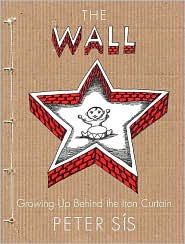
The Wall


Sis, Peter. 2007. The Wall: Growing Up Behind The Iron Curtain. FSG.

Another nonfiction picture book for older readers. This time it's about the cold war, communism, and art. It's the autobiography of Peter Sis, an author and illustrator. It's both simple and complex.
"As long as he could remember, he had loved to draw. At first he drew shapes. Then he drew people. After drawing whatever he wanted to at home, he drew what he was told to at school. He drew tanks. He drew wars."
The art has captions providing a time line, facts which are crucial in placing everything into context. Also included in The Wall are selections from his journals. These entries are both informative of his culture and his personal life. One being,
"My father's cousin Lamin is in prison as an enemy of the state. My grandmother talks to my parents about it in German so my sister and I won't understand. But we understand some of it. He was on a national volleyball team that was going to a tournament in the West, and the players were all planning to stay there. The secret police found out. Lamin is twenty years old and will be in prison for the rest of his life. (1956)"
Another being,
"I built a scooter that collapsed when my sister, Hana, was riding it downhill. She hates me!" (1963).
The picture book covers several decades. I found it interesting in a way to see how rock music came to symbolize "the West" and helped many young people see the light if you will. Sis' interest in rock music--his love for the Beatles and Beach Boys, among others of course, was fun to read about.

Overall, I really liked this one. I can see why it got such great reviews a few years back. If you haven't picked this one up yet, it's not too late. Try it, see if you like it.

© Becky Laney of Becky's Book Reviews

Wednesday, June 17, 2009

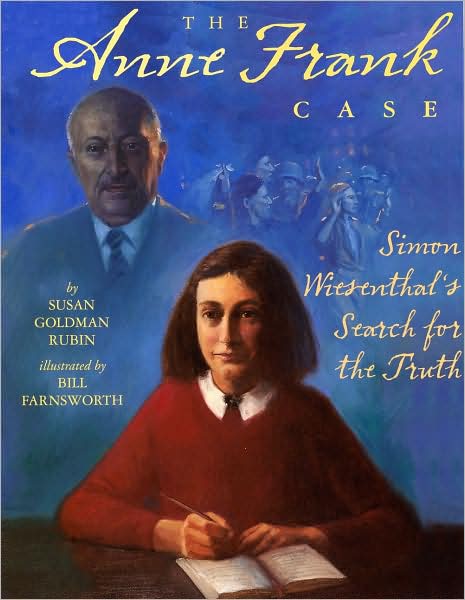
The Anne Frank Case (MG)


Rubin, Susan Goldman. 2009. The Anne Frank Case: Simon Wiesenthal's Search For The Truth. Illustrated by Bill Farnsworth. Holiday House. 40 pages.

I love finding great nonfiction picture books for older readers. Especially if they're Holocaust-related. Though this one is an illustrated book, don't mistake it for being for too young a crowd. The text is rich in detail. (And the content naturally leads itself to an older crowd--upper elementary to middle school, perhaps.)

One night in October 1958 at nine thirty, the phone rang in Simon Wiesenthal's apartment in Linz, Austria. "Can you come at once to the Landes Theater?" asked a friend, who sounded upset. Simon's friend told him that he was attending a performance of The Diary of Anne Frank. But it had been disrupted. "Traitors! Swindlers!" a group of teenagers had shouted at the actors, booing and hissing. The show had stopped as demonstrators dropped leaflets from the balcony that read: This play is a fraud. Anne Frank never existed....

The book follows what happens next. It follows Simon Wiesenthal's quest to "prove" that Anne Frank did exist. His goal? To find the Nazi SS officer who captured the Frank family. It's a journey that would take him several years. But that was part of his life's goal: to find Nazis and bring them to justice.

The book is interesting--as you'd expect it to be--and it's very beautifully done. I loved the ending as well.

When a fellow survivor from Mauthausen congratulated Simon on his detective work, he said, "If you had gone back to building houses, you'd be a millionaire. Why didn't you?" Simon replied, "When we come to the other world and meet the millions of Jews who died in the camps and they ask us, 'What have you done?' there will be many answers...But I will say, 'I didn't forget you.'"
That's a wow moment for me. How about you?

Highly recommended.


© Becky Laney of Becky's Book Reviews

Wednesday, April 23, 2008

My Bridges of Hope


Bitton-Jackson, Livia. 1999. My Bridges of Hope.

My Bridges of Hope is the sequel to I Have Lived A Thousand Years. It is the middle book in a trilogy of the author's memoirs. (Though each book can and does stand alone just fine.) The book opens with Elli Friedmann and her mother and brother returning to their home town of Samorin after they were liberated by the Russian soldiers. Unlike some of the other returning Jews, they did find their home relatively intact. Stripped of furniture, yes, but still standing. The neighbors are shocked, extremely shocked to see them again. Shocked that they're living skeletons. But most of their closest neighbors are helpful. They give what they can, do what they can to make the Friedmann's home habitable again. This doesn't mean that every neighbor is this nice. And it doesn't mean that the family's possessions are returned from the neighbors who took them for safekeeping at the beginning of the war. But a few are ethical enough to return and restore.

"Out of Samorin's more than five hundred Jewis citizens, only thirty-six returned, mostly young men and women. Those who did not--our children, parents, grandparents, siblings, husbands, wives, aunts, uncles, cousins, friends, and lovers--have been replaced by an abyss." (18)

Imagine that if you will. Really think about it. My Bridges of Hope tells the stories of those in between years. Those years between 1945 and 1951 when Elli was growing up in such a strange and foreign environment. It looked a bit like her old home, her old town. But so many people missing, so many new people in their place, so many strangers--the Russians, the Communists coming to town and taking over. Nothing is ever the same, nothing could ever be the same.

In these years, Elli dreams of going to Israel. At the beginning of the book, it isn't even a state or nation yet. But the dreams, the Zionist dreams, are there both in Elli and in her friends. But it is decided that America will be their destination, if they can get in.

These are years of waiting and years of growing. A turbulent time of changing for Elli as she matures from a fourteen year old girl into a young woman of nineteen or twenty. The book records her hopes, her dreams, her loves, her losses, her disappointments.

© Becky Laney of Becky's Book Reviews

Thursday, April 17, 2008

I Have Lived A Thousand Years


Bitton-Jackson, Livia. 1997. I Have Lived A Thousand Years.

I Have Lived A Thousand Years: Growing Up in the Holocaust is the memoir of Elli L. Friedmann. Born in Czechoslovakia, Elli along with her family were taken to Auschwitz when the ghettos were liquidated in 1944. The book covers the years 1944-1945, although it hints at what came before and what comes after. The book concludes with Elli and her remaining family members arriving in America in 1951.

Her prose is concise and powerful. As a child, she loved to write poems. And this is evident in her memoir. The imagery is strong; there is power in her words. The emotions resonate. When our story opens she is around the age of 13. Here is her description of when the Nazis came and her school was closed, "I weep and weep. I weep for my classroom, which is no longer my classroom. For the school that will never be my school again. I weep for my life, which will never be the same." A bit further on we read her description of what it was like to be shown where the family's treasure was buried. The unspoken words being that she may be the only one to survive. "I don't want to know the spot! I don't want to be the one to survive! I don't want to survive alone! Alone, I don't want to live. Oh God, I don't want to live if you don't! I don't want to know about anything! I don't want to know!"

Her descriptions are so powerful, so real. The way they are written, so straight-forward, so concise, instantly put me in her shoes. The people aren't just numbers, aren't just statistics, aren't just nameless, faceless strangers. They're real; they matter; their stories, their lives count.

This was a very powerful book for me. Elli's determination to survive, to ensure her mother's survival is so courageous, so incredible. The fact that hope and strength and courage and dignity can survive in the midst of such horror is amazing to me. Wonderfully amazing to me.

This book is definitely a must read.

The title of the book comes from the liberation scene. Elli and her brother and mother are all together. They are trying to survive until they can be liberated. Freedom is within their grasp, yet there is still danger and fear on the prowl. When they are liberated, Elli is taken for an old woman. They think she is a woman who is in her sixties, they're flabbergasted to learn that she is just fourteen years old. She says, "I am fourteen years old, and I have lived a thousand years." What great imagery.


© Becky Laney of Becky's Book Reviews

Sunday, April 06, 2008

Diary of A Young Girl


Frank, Anne. 1952. The Diary of A Young Girl.

"You're reading that again?" That's what my mother said as she caught me reading Anne Frank. Like I haven't read anything but this one book in all these years. She's right. I have read Anne Frank's Diary of A Young Girl before. But some things are worth repeating. Diary of A Young Girl is one of them. The first time I read this book, I would have been in high school. Close enough to Anne's age to feel it--the drama of adolescence on top of extreme political and social upheaval. The Diary of A Young Girl captures both. The war. The threat of death. The threat of captivity. The threat of starvation and disease. But it also captures youth. What it means to be young, to be at that ever-awkward stage in life, in development. Always a me-in-the-making, never quite done finding out who you are and what you believe and what you want out of life. Anne could be any girl in any place and time. But because she was born a Jew. Because Hitler came to power. Her life--her perfectly ordinary life--was cut short.

The book begins in June of 1942. The last entry is in August of 1944. In these two years, these two turbulent years, Anne and her family and several other people as well all go into hiding in the Secret Annexe. Mr. and Mrs. Frank. Margot, the older sister. Mr. and Mrs. Van Daan. Their son Peter. And Mr. Dussel. Eight people. Cramped living conditions. This isn't reality tv. This is life and death. Yes, every person gets super-cranky and super-sensitive. But wouldn't you?

The reader gets a glimpse into the lives of real people through the eyes of one very young sometimes-mature, sometimes-immature girl. Anne Frank. Very famous now because of her diary. But just then--at the moment--one very ordinary girl with a natural desire to write a diary. I think most kids (or teens) at one time or another try their hand at keeping journals. Though perhaps now, blogging has replaced all that. Diaries are intimate, personal, private. Each entry is a snapshot into that one day, that one hour, that one moment. When you're young, (and even when you're older and supposedly all grown up) your mood, your outlook changes moment by moment, day by day. Happy one minute, miserable the next. Such is the case with Anne. Personally, I'm surprised that Anne had as many happy moments, contented moments, grateful moment in the Annexe as she did. I think it would only be natural to be unhappy, scared, miserable, depressed. Living in cramped quarters with people you dislike, people you disagree with, not being able to go outside, to go anywhere you want. Not having the freedom to move, to make noise when you want. To always be on alert. To always worry about the threat of discovery, the threat of capture, the threat of bombs blowing you to bits. High stress. Very high stress.

But this isn't just a book about war, about being Jewish, about being a victim. This book is so much more than that. It's a book about growing up. A book about changing from a girl into a young woman with hopes and dreams and fears and desires. It's a book about being that age. That extremely awkward stage of life. My mom thought all people of that age should be shipped off to junior high island until they grew out of it. That moody, I-hate-you, you-don't-understand-me stage. Anne was a work-in-progress. There's no doubt about it. When we first meet her, she's entering that phase of life. She doesn't get along with her mother. At all. She feels completely disconnected from her. Misunderstood. Unloved. Unwanted. Unappreciated. And her relationship with her father is better, but not perfect. Sometimes she feels the disconnect with him too. And her sister. She feels that her parents love her sister more. That her sister gets all the praise, the love, the positive attention. And she feels that she gets attacked, bombarded with negative attention--lectures, lectures, more lectures. Everyone is always out-to-get-her. But though this does seem to be Anne's story, Anne's predicament, by the second half of the book, Anne is growing, changing, maturing. She looks back over past entries and realizes that things are different, things have changed. And she realizes that most of the changes were in her. She is beginning to build, to establish a better relationship with her family. She is beginning to get comfortable in her own skin.

Anne is someone I think we all can relate to in a way. Anne was just a girl. A girl with interests and hobbies. Likes and dislikes. She could be anybody.

The Diary of A Young Girl was originally published in Holland in 1947. It was soon translated into other languages, including English, and printed in the United States. 1952 is the first publication date for the United States. Almost from the very beginning, it was recognized as a good book, a powerful book, a book worthy of time and attention and respect. But it's not without its enemies.

Though I'll never in a million years understand the mindset of those that challenge books, I'll never ever ever understand why Diary of A Young Girl is one of their targets. I just don't understand it. Can't understand it. One challenge brought against the book stated that it was pornographic. How??? Why??? Fortunately, the challenge failed, and the book stayed on the shelves. I suppose pornography is subjective. But a young girl writing about her period is so not pornographic! A young girl writing about her breasts developing? Not pornographic. A young girl writing about her first kiss? Not pornographic. There is no talk, no hint of sex in the book. Though Anne spends the last part of the book making out with Peter, the son of the Van Daans. But it's not pornographic in the slightest. Not unless it's the mention of Anne reading a book where there is mention of a woman selling her body. Or perhaps it is the conversation about the cat's male organs that is so offensive to folks? Whether the cat is a tom cat.

I could go on for hours about all the suffering the war has brought, but then I would only make myself more dejected. There is nothing we can do but wait as calmly as we can till the misery comes to an end. Jews and Christians wait, the whole earth waits, and there are many who wait for death. (64)

I see the eight of us with our "Secret Annexe" as if we were a little piece of blue heaven, surrounded by heavy black rain clouds. The round, clearly defined spot where we stand is still safe, but the clouds gather more closely about us and the circle which separates us from the approaching danger closes more and more tightly. (115)

But seriously, it would seem quite funny ten years after the war if we Jews were to tell how we lived and what we ate and talked about here. Although I tell you [the diary] a lot, still even so, you only know very little of our lives. (192)

And if I haven't any talent for writing books or newspaper articles, well, then I can always write for myself. . . I want to go on living after my death! And therefore I am grateful to God for giving me this gift, this possibility of developing myself and of writing, of expressing all that is in me. I can shake off everything if I write; my sorrows disappear, my courage is reborn. But, and that is the great question, will I ever be able to write anything great, will I ever become a journalist or a writer? I hope so, oh, I hope so very much. (197)

© Becky Laney of Becky's Book Reviews

Friday, March 14, 2008

Joining #45 Non-Fiction Five Challenge


Hosted by Joy. Read about the challenge here. The challenge goes from May to September 2008. Joy does say that lists can change--added or subtracted, substituted etc. But this is what I'm thinking now.

Nonfiction Five Challenge

Official Choices:
I Have Lived A Thousand Years by Livia Bitton Jackson
In My Hands by Irene Gut Opdyke
Diary of A Young Girl by Anne Frank
To Life by Ruth Minsky Sender
Golden Legacy: How Golden Books Won Children's Hearts, Changed Publishing Forever, and Became An American Icon Along the Way by Leonard S. Marcus

Alternate Choices:
The Real Benedict Arnold by Jim Murphy
Facing Your Final Review Job Review: The Judgment Seat of Christ, Salvation, and Eternal Rewards by Woodrow Kroll
Vintage Jesus: Timeless Answers to Timely Questions by Mark Driscoll & Gerry Breshears
Mao's Last Dancer by Li Cunxin
Sixtyfive Roses: A Sisters Memoir by Heather Summerhayes Cariou