Showing posts with label history. Show all posts

Wednesday, February 18, 2026

22. A World without Summer


22. A World Without Summer: A Volcano Erupts, a Creature Awakens, and the Sun Goes Out. Nicholas Day. 2025. 304 pages. [Source: Library] [4 stars, nonfiction, middle grade nonfiction, history]

First sentence: The only way to understand is to have been there. The world loud isn't loud enough. The word hot isn't hot enough. The word-- None of the words are enough. The only way to understand is to have been there. But if you had been there, you would be--well, you would be dead. So we will do the best we can.

Premise/plot: Nonfiction. History. Nature. Science. This is the story of the eruption of a the volcano Tambora in April 1815 and how it impacted the world for several years. YES, years. The book's title might mislead you into thinking it was a short span of time the world's global climate was changed by this volcanic eruption--and all its aftermath. But it was in fact several years before things began to stabilize and 'return' to 'normal.' Of course, that's not quite the whole truth. For that generation there would always be some effect. (For example, the malnutrition--starving or nearly so--of those growing up would leave a forever impact on their bodies whose growth and development would remain stunted.) 

The book is equally fascinating and bleak. It is impactful. For sure.

My thoughts: I loved, loved, loved much about this one. What I didn't love--well--I hated. The book doesn't allow much for subtly messaging the reader, allowing the reader to connect dots between the past and present. (IF in fact there are any dots to be connected between the past and the future.) The author is all about hitting readers over the head with a hammer. Perhaps with both hands holding a hammer. While I would say most of the book can be read and enjoyed, the agenda is so heavy-handed and extremely not subtle that it becomes obnoxious. There's a right way and a wrong way to get your message across. Sometimes less is more. Sometimes being subtle is more effective. Let readers reach their own conclusion and trust them a bit more.


© 2026 Becky Laney of Becky's Book Reviews

21. Bittersweet


21. Bittersweet: Based on the True Tale of the Berlin Candy Bombers. Christy Mandin. 2025. 40 pages. [Source: Library] [4 stars, nonfiction picture book, history, world war II aftermath]

First sentence: A bitter war was over. But for Hilda, the war didn't end when the bombs stopped falling. The war raged on in her belly, a rumbling hunger that never seemed to go away. Her too-tight shoes pinched her toes. Rubble piled up where buildings once stood. Neighbors waited in long lines for little bits of food. Hilda's country was broken into chunks like a wheel of old cheese, each part controlled by a different military.

Premise/plot: This picture book tells of the Berlin Candy Bombers and how one man's act of kindness started it all. It is set in Berlin after the Second World War. While it uses Hilda as a main character, the story is true, or true enough. I believe it is classified as narrative nonfiction.

My thoughts: What a great story! I'd read a little about the Berlin Candy Bombers but not in such a kid-friendly format. I thought it was a great story. Nonfiction that reads as easily as fiction. I would definitely recommend this one for elementary ages.


© 2026 Becky Laney of Becky's Book Reviews

Friday, February 13, 2026

18. If You Traveled West in a Covered Wagon


18. If You Traveled West in a Covered Wagon. Ellen Levine. Illustrated by Elroy Freem. 1986. 80 pages. [Source: Bought] [4 stars, children's nonfiction]

First sentence: One hundred and fifty years ago there was no railroad that went all across the country. There were no cars or buses or airplanes. The only was to travel across the country was to ride a horse, or if you went with your family, to travel in a covered wagon. In the 1840s and 1850s, thousands of people traveled West. So if you lived at that time, there was a chance you might have traveled in a covered wagon. This book is about traveling and living in a covered wagon. It tells what it was like to be one of the early pioneers to travel to Oregon.

Premise/plot: What you see is what you get. Each two page spread answers one question. All questions relate to traveling in a covered wagon or traveling west. The questions cover the basics and also goes beyond that a bit to more specific, detailed questions. Will it answer every single possible question? Maybe. Maybe not. But it is a great nonfiction book to pair with fiction titles.

My thoughts: I don't remember all the books in this series, but, I know there were a few at least. I loved these kinds of books as a kid. I was so happy to thrift a copy of this one!

© 2026 Becky Laney of Becky's Book Reviews

Wednesday, August 13, 2025

90. Clara the Triumphant Rhinoceros


90. Clara the Triumphant Rhinoceros. Jane Kurtz. Illustrated by Claire Messer. 2025. 40 pages. [Source: Library] [nonfiction picture book, 5 stars]

First sentence: Clara was born in India in 1738. In the beginning, her life was anything but splendid. Only a few months old and she was already an orphan. One small rhinoceros in a big, terrifying world. 

Premise/plot: Clara the Triumphant Rhinoceros is a nonfiction picture book for young readers, or readers of all ages who happen to love HISTORY or animals.

My thoughts: Was I familiar with CLARA before reading this nonfiction picture book? No. Did I absolutely love learning her story? YES. I am curious. I love learning new things. I love a good story. Narrative nonfiction can be a delight! Such is the case with this book. I love this well-crafted story. It was a great read. Happy to recommend this one!


© 2025 Becky Laney of Becky's Book Reviews

Monday, July 17, 2023

134. Dressing Barbie


Dressing Barbie: A Celebration Of the Clothes That Made America's Favorite Doll and the Incredible Woman Behind Them. Carol Spencer. 2019. 160 pages. [Source: Library] [adult nonfiction; history; fashion design; toys; adult collectors]

First sentence:  Barbie quite simply changed my life.

Premise/plot: Carol  Spencer shares her experiences as a fashion designer for Barbie at Mattel. She worked as a designer for Mattel from 1963 through the 1990s. Four decades designing fashion and fashion accessories for Barbie (and friends). The book is packed with back stories and photographs. It is organized by decade. When she started at Mattel, there were four women working as fashion designers. I'm not sure how many more were added to that team through the decades. But she definitely played an important role in styling Barbie. This one provides context for Barbie's style. She gives behind-the-scenes look in various inspirations for various looks. 

MY thoughts: I absolutely loved this one!!!! I enjoyed reading about each of the decades. I don't know that I have a favorite, favorite section. I loved finding out more behind-the-scenes glimpses of memorable and iconic dolls. Like the creation for Totally Hair Barbie, for example. She was responsible for the first MY FIRST BARBIE doll and the subsequent My First Barbie line. One of my the funniest stories is how she shares WHY there were three different fashions with gold and white stripes--a bathing suit and headdress, a holiday dress, and another shorter dress. They accidentally ordered 2,500 yards instead of 250 yards! 

I read this one in one sitting. It was an awesome read. Perhaps not for every single reader. But for those that do love BARBIE or those that love fashion design or history. 

I think this one works as a book that you read cover-to-cover. OR as a reference book that you skim. The photographs are awesome. 


© 2023 Becky Laney of Becky's Book Reviews

Wednesday, March 01, 2023

46. The Woman They Could Not Silence


The Woman They Could Not Silence: The Shocking Story of a Woman Who Dared to Fight Back. Kate Moore. 2021. 537 pages. [Source: Library]

First sentence from the author's note: This is not a book about mental health, but about how it can be used as a weapon. It's a historical book. 

First sentence from the prologue: If she screamed, she sealed her fate. She had to keep her rage locked up inside her, her feelings as tightly buttoned as her blouse. Nevertheless, they came for her. Two men pressed around her, lifting her in their arms, her wide skirts crushed by their clumsy movements--much like her heart inside her chest. Still, she did not fight back, did not lash out wildly, did not slap or hit. The only protest she could permit herself was this: a paralysis of her limbs. She held her body stiff and unyielding and refused to walk to her destiny, no matter how he begged. Amid the vast crowd that had gathered to bear witness, just one person spoke.

First sentence from chapter one: It was the last day, but she didn't know it. In truth, we never do. Not until it is too late. 

Premise/plot: The Woman They Could Not Silence is a biography of Elizabeth Packard. It is the story of how she turned an absolutely horrible and unjust circumstance into an opportunity to change laws and society. Theophilus and Elizabeth Packard, but, not entirely happily. It seems that after some [early] years together [that were mostly quiet and peaceful], Elizabeth began to think, to think for herself, to think above and beyond what her husband wanted. Namely, her husband, a minister, became greatly upset when his wife began to reach different conclusions about religion. Not only did she form contrary opinions to his doctrine, she would talk about her opinions with others--men, women, her own children. Whether he truly and sincerely believed that she was actually insane and must be committed to an insane asylum for her own good, or, if her committal to an insane asylum was just beneficial to him personally, I don't know if we--the readers--can know. But we do know that she was committed against her will--at the will of her husband (and father, and many members of the congregation, there was a petition)--for several years. Being locked away had unintended consequences, it gave her a voice. Or perhaps the better way to phrase it, was instead of taking away her voice, it strengthened it. Instead of silencing her and hampering her circle of influence, it strengthened her voice, impassioned her, and gave her a life-long calling.

The book covers her life--and life's work--from 1860 onward. It discusses the rights--or lack of rights--for women, married women, for those women deemed insane. It covers laws, politics, and religion.

My thoughts: Elizabeth Packard is an author I'd never heard of before. I found her story--this biography--fascinating. It is a complex read. I would recommend for those who enjoy history, biography, legislation and law, politics, and culture.


© 2023 Becky Laney of Becky's Book Reviews

Monday, February 06, 2023

23. Peace Is A Chain Reaction


Peace is A Chain Reaction: How World War II Japanese Balloon Bomb Brought People of Two Nations Together. Tanya Lee Stone. [Plenty of photographs]. 2022. [September] 176 pages. [Source: Library]

First sentence: From a very young age, we can be taught to hate or fear people who are different from us. Sometimes this racism is buried so deep, it can be hard to see. Sometimes it is clearly visible. War is one of the more obvious ways in which entire nations can be taught to hate--and fear--people of other nations.

Premise/plot: Some books are hard to summarize, Peace Is A Chain Reaction is one of them. It tells primarily of three stories during the second world war: the internment camps of Japanese-Americans, specifically focusing in on one family; a group of young teenage girls [Japanese] whose school closed down to become a factory--a factory where balloon bombs were made; and an American community shaken by the death of six children [or perhaps five children and an adult] due to the resulting explosion of a balloon bomb. Yuzuru John Takeshita, who spent time in several internment/prison camps, brought these two communities together. The book provides context for the second world war and brings to light these events for young readers.

My thoughts: I thought I was relatively well informed on the subject of world war II. I had never heard of the Japanese inventing/using/implementing balloon bombs. I had never heard of balloon bombs successfully reaching the United States and detonating. This was hushed up during the war for various reasons. I'd also never heard or thought about young Japanese women [teenagers] doing factory work, war factory work. So while I'd heard plenty about Japanese-American internment/imprisonment camps, so much of this was new to me. For that reason alone it was a worthwhile read for me.

I liked how these stories were woven together to tell a cohesive story.


© 2023 Becky Laney of Becky's Book Reviews

Saturday, February 04, 2023

22. Baking Powder Wars


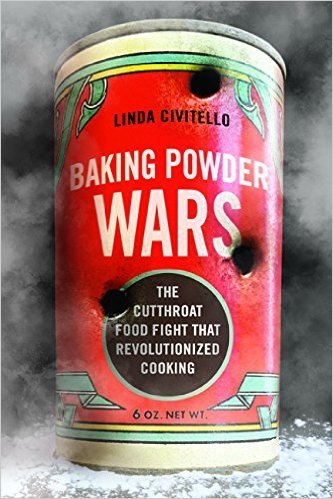
Baking Powder Wars: The Cutthroat Food Fight That Revolutionized Cooking. Linda Civitello. 2017. 264 pages. [Source: Review copy]

First sentence: Business is war. Cooking is chemistry. Food is political.

Premise/plot: At its simplest, Baking Powder Wars is just that a history of the evolution/revolution of baking powder. The book begins pre-baking-powder-era and tells the story of what once was, of how bread [and cakes, etc.] used to be made. It then goes step by step through its evolution/revolution. [If it sounds dramatic, well, it's for good reason. It's a story of industry, corporations, commercialization and advertising, espionage, bribery, politics...and plenty of homemaking and 'domestic arts.' It has some to do with the role of women inside the home, and the role of the home inside society. The author uses baking powder to tell the story of convenience, of our love affair with convenience--fast, easy, cheap, consistent. This book truly offers a little something to every reader. It's got recipes. It's got stories about cookbooks and the role they play in society. It's got tension--as companies (and families who own companies) BATTLE it out literally and figuratively for supremacy. You might think naturally this would involve advertising, media, and market space...but it includes actual politics and politicians. It's also a history of what we eat, where we eat, how we eat, etc. (Bread, quick bread, muffins, pancakes, doughnuts, cakes, cupcakes, etc.) What we eat has definitely evolved through the centuries. It isn't just a story of one product--but of many. (Think Bisquick, Martha White, cake-mixes, etc.)

My thoughts: Until the last little bit--second half of last chapter--this one was actually fairly absorbing. I found that while it covered many subjects and seemed to present facts and factoids almost at random, it was almost always interesting and entertaining. The last half of the last chapter brings readers "up to date" on the families who started the big baking powder companies. These "updates" had nothing to do with food, advertising, cooking, etc. Most of them had to do with RACING. And it was like WHY IS THIS IN HERE? DO I CARE ABOUT RACE CARS? NO, I DO NOT. But so much of this one was interesting to me. 

This one admittedly won't be for every reader. But for those who have an interest in the subject--be it food, cooking, baking, domestic arts, advertising and marketing, business, history of cookbooks, history of supermarkets, history of society/culture "becoming" modern and industrialized...I think this one has a little bit of everything.


© 2023 Becky Laney of Becky's Book Reviews

Tuesday, March 29, 2022

40. Why the Titanic Was Doomed


Why the Titanic Was Doomed. Bryan Jackson. 2022. [June] 224 pages. [Source: Review copy]

First sentence from the preface: It is an understatement to say that much has been written about one of the world's most famous ships, Titanic. 

First sentence from the introduction: Ask someone what caused the Titanic to sink and they will tell you, 'It hit an iceberg.'

Premise/plot: Bryan Jackson argues in his book that the Titanic was doomed before it ever left the shipyard. He organizes his book around fourteen main circumstances. But within each "main" circumstance, there seemed to be more additional circumstances that would reasonably lead to trouble or "doom" for the Titanic. For example, the first circumstance is "A Delayed Maiden Voyage," the third circumstance is, "Telegrams That Could Have Changed History," and the twelfth circumstance, "The Coal Strike that Increased the Death Toll."

The first hundred pages (give or take) are sharing all the reasons--or circumstances--why the Titanic was doomed. The last hundred pages (give or take) are sharing about the aftermath of the Titanic. The book goes into great detail--before, during, and after. And it brings in related subjects. Like other ships--the Olympic, the Britannic, the Carpathia, the Californian.

My thoughts: I LOVED this one. It was packed with facts and details. While I had definitely heard some of these facts before, there were plenty new-to-me facts that kept me turning pages. Reading all these facts--the way he compiles these together--it is easy to form a big picture. It is easy to conclude alongside the author that yes, the Titanic was doomed. 

I loved both sections. I found the first half fascinating and engaging. I couldn't stop reading. Yes, I knew what happened and what was coming. But I was learning. And what wasn't "new" information was being put into context in a better way. Instead of being "scattered" or completely random tidbits, I was putting everything together into a whole picture. The second half might be considered side tangents--in some ways--but I found it still to be of interest.


© 2022 Becky Laney of Becky's Book Reviews

Monday, April 12, 2021

37. Why Longfellow Lied


Why Longfellow Lied: The Truth about Paul Revere's Midnight Ride. Jeff Lantos. 2021. [August] 160 pages. [Source: Review copy]

First sentence from the introduction: In the twenty-five years between 1856 and 1881, if you wanted to send a letter to poet Henry Wadsworth Longfellow, all you had to do was put his name on the envelope, and the letter carrier would deliver it to his home at 105 Brattle Street in Cambridge, Massachusetts.

First sentence from the prologue: In the days, weeks, and months following Paul Revere's daring midnight ride, no one, it seemed, wanted to cheer about it. Heck, no one even wanted to acknowledge it.

Premise/plot: Henry Wadsworth Longfellow wrote The Midnight Ride of Paul Revere. Turns out, he lied! But why did he lie? Why did he twist history to suit his own poetical fancy? Jeff Lantos explains all as he works through the famous poem stanza by stanza telling the truth, the whole truth, and nothing but the truth. (Well, mostly, you get the idea!) It seems that Longfellow left out some bits that are crucial to understanding and appreciating the story--Lantos has added those back into the story.


My thoughts: After a brief introduction, the book opens with the full poem. If you haven't revisited the poem since your school days, it's well worth taking your time: reading and savoring the rhythm of it all. Lantos' book does a couple of things. First, it tells the true story of Paul Revere and his 'midnight ride.' It separates fact from fiction. Second, it places the poem into context. The poem was published in 1860. The country was on the brink of another war. Lantos seeks to examine Longfellow's CRAFT. Why did he make the choices he made? Stanza by stanza, Lantos highlights the author's workmanship and examines the question WHY.

It is packed with detail. I learned so much! It's a compelling story whether your interest is in HISTORY, POETRY, or writing. I enjoyed the main narrative. But I also loved the side bars!

I loved, loved, loved everything about this one! I loved the layout. It was beautiful work. It looks absolutely nothing like the nonfiction texts available when I was growing up. The text itself was well written--backed up with research and notes--but the narrative itself was compelling. Far from dry. I love that this book encourages readers to question, to dig deep into a text.


© 2021 Becky Laney of Becky's Book Reviews

Thursday, April 01, 2021

31. Ordeal by Hunger


Ordeal by Hunger: The Story of the Donner Party. George R. Stewart. 1936. 392 pages. [Source: Online]

First sentence from the preface: The misadventure of the Donner Party constitutes one of the most amazing stories of that land of amazing stories, the American West. It is worthy of record as a historical document upon what human beings may achieve, endure, and perpetrate, in the final press of circumstance. This account is intended for a full and critical history of that ill-fated band of pioneers, and has been made possible by the remarkable preservation of detailed records. It is strictly factual, based upon the evidence of the sources and upon reasonable deduction from that evidence; it is not fiction.

It almost goes without saying that the Ordeal by Hunger: The Story of the Donner Party won't be for every reader. It is a nonfiction account written in 1936 by George R. Stewart. 

To put the book into a little context, there were two survivors of the Donner Party still living--Naomi Pike and Isabella Breen--when he began his first draft of this nonfiction narrative. Both died before the book's publication--one in the spring of 1934 and the other in the spring of 1935. 

Stewart stresses that this book is nonfiction and not a fictional treatment of the Donner Party. That his narrative is derived from factual accounts. He drew from contemporary letters and journals, works written and published soon after 1847 (including oral testimonies), and works written and published after 1870 (including autobiographies and memoirs). 

The book opens with a decision--a decision to take a shortcut recommended by a fellow named Hastings--that would increasingly prove fatal. It is here with this decision that "the Donner Party" came into existence. These were the wagons that broke away from the main wagon train--who were also going to California but by a different route. 

His narrative provides an overview of the tragic events in 1846/1847. Sometimes his narrative focuses on specific individuals and perhaps may be said to reflect a more personal account of those events. But overall I wouldn't say his narrative style is personal or intimate. His account doesn't so much focus on feelings and emotions--trying to put the reader inside the minds of those who lived and/or died that winter--but on the actions and deeds. 

Contemporary readers may fault Stewart a couple of things. One that his narrative focuses almost exclusively on men (and boys). The narrative doesn't ask if the women were equally heroic, brave, determined, hard-working, and/or strong as the men. Occasionally, he does shift his focus to the women--briefly, very briefly. But honestly the women, for the most part, weren't the decision makers on this trip (or any trip). What choice did a woman have if she disagreed with the decisions? It's not like she could abandon the wagon train, her family, her supplies and set off cross country on her own to try to find a better way to California. 

In the case of the Donner Party, it wouldn't be completely unfair to say it was like the blind leading the blind. They didn't have an actual, physical guide guiding them along the route. They were following some pretty sketchy written guides that didn't exactly prove all that accurate. The decision makers were making best guesses or not-best guesses as the case may be. But they had no way of knowing--after that one big decision coming at the beginning of the book--if their decision would be WISE or FOOLISH. They had no way of knowing/predicting the future.

Another thing that may prove difficult for modern readers in Stewart's text, is his treatment of other races--specifically Native Americans and Mexicans. This mindset when you think about it isn't all that unexpected. He is writing an account of settlers and pioneers traveling in 1846/1847. Manifest Destiny. The West is yours for the taking. It is yours if you want it, if you work for it. COME, COME, COME. That the settlers themselves felt entitled to it, well, it shouldn't be surprising. Many of his sources would have had this perspective or bias. Stewart was also writing in the 1930s. Perhaps western films and shows weren't in their golden era just yet--but if not yet, it was still coming. Now his descriptions of events--the way he phrases things beyond telling the bare facts (which can't be changed, can't be erased, can't be cancelled)--is cringe-worthy and offensive.

Quotes:

If in the story I have told much which is unpleasant and much which the actors themselves would have been glad to let be forgotten, I may at least plead that I have told all in charity. I blame none of the emigrants for their acts during that winter, any more than I should blame a man for his acts during a  delirium. Upon controversial points I have honestly considered  both sides, and have given each a chance to speak, in the notes if not always in the text. 

A microcosm of humanity, to be tested with a severity to which few groups of human beings in recorded history have been subjected, destined to reveal the extremes of which the human body and mind are capable — and yet to the eye of the trapper or wandering Indian merely one more emigrant train going west.  

From the very journey which they made they must indeed be called pioneers, but they cannot be called frontiersmen. They were merely country-folk and townspeople of the middle-west, not mountain-men...By now they had adapted themselves to the routine. To the mere hardships of the life they were inured, used as they were at best to but few of the comforts of civilization. But this was not the life to which they were accustomed. 

Worst of all, they were playing — and they knew it — against Time, and they had lost the first game. 

Hatred and inhumanity walked beside the wagons. 

But in the game which the emigrants were playing against Time, the score could not be evened by a rifle bullet, and it stood heavily against them. During those last days of October snow fell as they moved along. The cattle had to nose through it for grass. On the distant mountains it lay white upon the pine-branches. Winter was in the air; it was bitter cold, and the sky was bleak. 

Sensing the crisis, some of the emigrants urged a bold push forward, but most of them were too exhausted to make a further effort. So they prepared to spend the night as best they could upon the snow. They gathered about the fire, and had something to eat. Then they laid blankets and buffalo-robes on the snow, put the children to bed bundled up as well as possible. The men and women huddled about, some making themselves beds, and some sitting crouched by the fire. They were too weary now; they would cross in the morning. Then it began to snow. 

Back across the lake, as they looked through the darkening atmosphere of the short winter afternoon, they could see the solid rampart of the pass, a mass of snow unbroken except where bare precipices stood darkly out. It was November 4th. The trap which had clicked behind them at Fort Bridget had closed in front. 

Every week now was making a perceptible difference in the emigrants. Beaten upon by blizzards, half starved, they now had more and more difficulty in cutting and dragging firewood through the deep snows. They began to suffer from the cold. About this time they must have begun to notice what afterwards seemed to them so astonishing. The women stood the strain better than the men did. Whether food was apportioned by individuals rather than by size, whether the men did more physical work and therefore expended more energy, whether the constitution of a woman is more enduring than that of a man, whether merely in these individual cases the women were hardier — these questions cannot be surely answered. Most likely several of these factors were at work, but certainly, with some exceptions, the men failed sooner. 

When men abandon a sinking ship, so the stories go, they at first conduct themselves with some degree of steadiness and order. But as the ship lurches more heavily, they feel the tension, and the rhythm quickens until the last moments are a wild running about the decks. Then the boats go down with a run; men leap overboard; and the vessel dips to the final plunge. So the rhythm seems to quicken in the rescue of the Donner Party. Glover’s men had doggedly pushed ahead in a spirit of calculated audacity; Reed’s party had been more hurried; and now Eddy and Foster with their two aids seen by comparison to run, as if they felt the ship settling beneath them.

A little after midday they came to the cabins. They found no one alive. Around them lay a scene of filth and mutilated corpses, even worse than that which earlier relief-parties had been forced to witness. The seven men stood speechless and awestruck, and as the intense silence of the forest seemed to sweep in upon them, even Fallon, the mountain-man, felt the creeping horror. 

Probably the best way to feel the actuality of the story is to travel through its setting. For the country is tangible and solid, now as then. And for this reason, I have in the telling often stressed the scene until the reader has, I hope, come to feel the land itself as one of the chief characters of the tale. 

The very fact that it may be called spectacular should warn us, however, against the fallacy of considering it typical. It is no more typical of the wagon-journey to California than the last voyages of the Titanic and the Lusitania are typical of the trans- Atlantic passage. Emigrants ordinarily suffered hardships along the Humboldt, and had a difficult struggle in getting over the Sierra, but they also had some good times upon the road, and often got through to California in good enough health and spirits.

One turns naturally to the question of what caused the disaster of the Donner Party. It was of course the direct result of their taking the so-called cut-off advocated by Hastings. But who was responsible? I have found widely spread a tendency to blame the emigrants themselves, to consider that they, or at least their leaders, were a pig-headed, ignorant lot who thought they knew more about matters than other people did and who by blundering ahead brought upon themselves pretty much what they deserved. As I have tried to show in the first chapters of this book, such an attitude is not well based.

I do not maintain that the men, or even the women, of the Donner Party were faultless, that they always made the right decisions, or that they were immune from the ordinary human shortcomings, including that of common stupidity. I do not believe, however, that they had more than their share of such weaknesses. And I object strongly to the smug conviction that because they starved to death we of a later day knowing only very different conditions can conclude that it was all their own fault. 

Nevertheless, the cannibalism, although it might almost be called a minor episode, had become in the popular mind the chief fact to be remembered about the Donner Party. For a taboo always allures with as great strength as it repels. 

The story of their ordeal is not pleasant. Few, I fear, will find it always easy reading. But after all, the merely pleasant It is thin and bloodless; a picnic in the park scarcely gives humanity a chance to show of what it is capable. Not of that sort, all will agree, is this adventure in the snow. Here, if anywhere, we see men and women and children put to the final strain of body and spirit. Yet suicide finds no place in the story. And since these too in great part endured, others in evil circumstance may be encouraged to fight boldly. By this, their story may even be said to meet the demands of some that literature should serve an extraneous social purpose. For though despair is often close at hand, it never triumphs, and through all the story runs, a sustaining bond, the primal force which humanity shares with all earthly creatures, the sheer will to live.


© 2021 Becky Laney of Becky's Book Reviews

Tuesday, October 27, 2020

129. Grace Banker and Her Hello Girls


Grace Banker and Her Hello Girls Answer the Call. Claudia Friddell. Illustrated by Elizabeth Baddeley. 2021. [February] 40 pages. [Source: Review copy]

First sentence: Grace Banker opened the newspaper on a brisk December morning in 1917--the world was at war, and General John J. Pershing, the commander of US troops across the Atlantic, was calling for female telephone operators to join the fight against Germany. 

Premise/plot: This nonfiction picture book biography stars Grace Banker one of the female telephone operators recruited to serve overseas in France during World War I at great risk to her own life. (She became the Chief Operator of the 1st Unit of World War I telephone operators.)

My thoughts: I really enjoyed this one! I had not heard of Grace Banker or the 'Hello Girls.' (Earlier this year or maybe late last year I came across a sentence or two in another book mentioning telephone operators during the first world war, but I had no idea really about what these women experienced.) I found the story fascinating. It is a well written narrative--well researched too. I loved all that back material which provided more context for understanding their place in history.


© 2020 Becky Laney of Becky's Book Reviews

Tuesday, June 02, 2020

78. Jeannie's Demise: Abortion on Trial in Victorian Ontario

Jeannie's Demise: Abortion on Trial in Victorian Ontario. Ian Radforth. 2020. [October] 258 pages. [Source: Review copy] [adult nonfiction; history]

First sentence: Growing impatient, Lovell took an axe and broke open the box. Inside he found some straw, a white chemise, and the naked body of a young woman. A few hours later, Coroner E.C. Fisher held an inquest nearby at Mrs. Mantle’s Robin Hood Hotel on Dundas Street. Two physicians, who had already performed a post-mortem examination of the body, reported that the deceased was an otherwise robust and healthy woman whose death was caused by a violent abortion. The jury at the inquest concluded that there had been a wilful murder of “an unknown woman” by some “person or persons unknown.”

Premise/plot: Jeannie's Demise is an up-close-and-personal, behind-the-scenes glimpse at abortion on trial in Ontario Canada in 1875. In the summer of that year, Jeannie Gilmour got an abortion and died as a result of complications. That fall and winter her two abortionists--husband and wife--went on trial. This news story was covered widely and broadly. (Though for the record, the two were on trial for murdering Jeannie and not for murdering the unborn child.) The book chronicles the case in great depth giving background and context.

My thoughts: I love a good true crime book occasionally. This one fits into that category nicely enough. It is a detailed accounting of three trials: the first trial being that of the two accused abortionists (abortion was illegal in 1875), the second trial being that of the accused seducer, the third being that of a man accused of helping dispose of the body via a coffin in a wagon. Readers get a glimpse of how the police department worked the case, how the prosecution and defense handled the case, the evidence, the testimonies and witnesses. One also definitely got a glimpse of how the media reacted to the case AND influenced the case. One also saw some statistics.

If the book had kept this a book about the past, it perhaps would have set better with me. One could read about the facts of the case--in the past--without trying to moralize, preach, or reveal a modern AGENDA to the case.
It wasn't until the last page or possibly two that the pro-choice cause is championed and glorified. He leaves readers with a warning that there are some in the United States that want to rob women of their oh-so-human right to have access to abortions.

I think both pro-life and pro-choice readers can agree that illegal abortions can be dangerous and risky to women. But to be fair, in 1875 legal or illegal abortion would have been risky. As was childbirth itself it 1875. There was so much about germs and bacteria and care that doctors, midwives, nurses, the general public did not know that lives were put at risk. Medicine has come a long way since the nineteenth century. 


© 2020 Becky Laney of Becky's Book Reviews

Tuesday, March 10, 2020

38. An American Plague

An American Plague: The True and Terrifying Story of the Yellow Fever Epidemic of 1793. Jim Murphy. 2003. 165 pages. [Source: Library] [nonfiction, mg nonfiction; history]

First sentence: The sun came up, as it had every day since the end of May, bright, hot, and unrelenting.

Premise/plot: An American Plague is an award-winning nonfiction narrative about the yellow fever epidemic of 1793. The setting is Philadelphia. The characters are many; there isn’t one point of view. Though readers do spend some time focusing on one of Philadelphia’s most prominent (and opinionated) doctors, Benjamin Rush. It is well researched and provides young readers plenty of details.

My thoughts: I enjoyed this one. I didn’t love, love, love nonfiction as a child, but to be fair nonfiction has come a long, long way since I was a child. Also perhaps my interests have matured a bit too.

I would recommend this one to kids that enjoy history, or enjoy nonfiction, or enjoy medical thrillers. It is hard to know with certainty what makes a book or subject appealing.

I have really enjoyed all the Jim Murphy books I have read


© 2020 Becky Laney of Becky's Book Reviews

Thursday, October 04, 2018

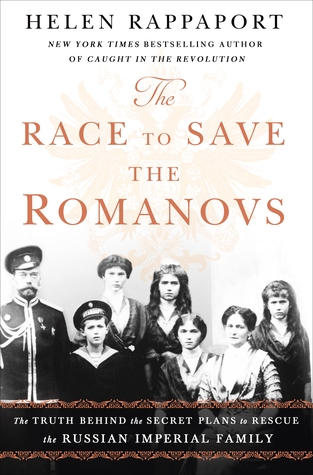
The Race to Save the Romanovs

The Race to Save the Romanovs: The Truth Behind the Secret Plans to Rescue the Russian Imperial Family. Helen Rappaport. 2018. 464 pages. [Source: Library]

First sentence: In April 1894 the last of a succession of royal dynastic marriages engineered by Queen Victoria as 'Grandmama of Europe' took place in Coburg, the capital of the German Duchy of Hesse and by Rhine.

Premise/plot: The title says it all. This one is about "the race" to "save" the Romanovs. Of course, the Romanovs were not saved. There may have been many people from quite a few countries talking about trying to save, making plans and plotting. Though they had a LOT of relatives in MANY countries across Europe, there is ongoing debate about which countries were willing to welcome them and accept them and which countries decidedly did NOT want them.

This one asks questions: Could the Romanovs have been saved? Why weren't the Romanovs saved? Why were there no real attempts made to get them out of Russia and safely into another country? Was there more talk than action? How can you know what is actually true and what is myth?

All "attempts" to save them have to figure out HOW to get them out of Russia (by sea, by land) and WHERE they will go--which country will take them in and welcome them. Rescue attempts must be well thought out and possible. This isn't Star Wars.

Essentially her response is that there are many, many, many factors to consider. It would never have been an easy matter to get the whole family out of Russia. Not all members of the family were in good health and up to the trip--at least not all the time. Other factors include: the military and political factions warring within Russia, the warring nations without, the mob(s) that have been hating on the family for decades, transportation logistics (how to get them from point to point to point until they are safe), WEATHER, the emotional and mental states of the family. Weather, for example, limited rescue attempts to certain weeks or months of the year. To carry out a plan would require meticulous planning and no mistakes. (Thousands of things could go wrong.) As far as the mental/emotional health of the family goes, did the family want to be rescued if it meant permanent exile? did they welcome attempts that would separate the family? were there countries they were unwilling to live? Did they want to be "rescued" but only on their own terms?

Rappaport essentially argues that there is no one person responsible for their deaths. King George V though often blamed for failing to save them is not solely responsible. It was not in his power to save them. Even if he had wanted to save them, even if he was willing to risk political instability in his own country, even if he was willing to keep pursuing a rescue, there never would have been a guarantee that the Romanovs could have been saved in the end. No one monarch, no one country could have managed it. Too many factors were involved. Together--united as one, working seamlessly together--perhaps, perhaps.   

My thoughts: I needed to put this one in the freezer. It was a hard read at times. You can know it's coming and know it's coming and still be surprised by your response when it actually happens. Her ultimate conclusion is that from the moment Nicholas II abdicated, the family was doomed.

© 2018 Becky Laney of Becky's Book Reviews

Friday, July 27, 2018

The Storm of the Century

The Storm of the Century. Al Roker. 2015. 320 pages. [Source: Library]

First sentence: A man pinned under the water struggles to free himself. Fifteen feet below the water's surface and the air he needs so badly, his thrashing body begins to weaken.

Premise/plot: The Storm of the Century is a nonfiction book about the hurricane of 1900 that devastated Galveston, Texas.

The prologue, "Underwater,"throws you into the action and introduces readers to one of the main characters, Isaac Cline, one of the best weatherman in America.

Part One, "They All Had Plans" consists of five chapters. Readers get the opportunity to learn about meteorology--the history and science of it as well as the leading men in the field; some basic Texas history--an overview; the history of Galveston, Texas--the island, the people, the geography, the businesses, the culture and society; hurricanes in general; AND this specific hurricane--its start in Africa, the path it followed, the mentions of it by ship captains and meteorologists, the super-complicated relationship between the U.S. and Cuba. This part introduces readers to the men, women, and children whose stories we will be following closely throughout the book.

Did you know that local weathermen weren't allowed to issue warnings about local weather? All local forecasts came from the national weather service in Washington, D.C.

Did you know that Cuba had some of the best meteorologists in the world at this time? There were men in Cuba that made it their life's work to study--to know--all about tropical depressions, storms, and hurricanes. The goal. of course, being to be able to better predict or forecast them.

Furthermore, did you know that the head of the U.S. weather bureau, Willis Moore, did not credit Cuba's meteorologists. It wasn't that Cuba had a history of poor forecasts--inaccurate forecasts--Moore just didn't believe that hurricanes could be predicted or forecast. Long story short, Cuban meteorologists were not allowed--were forbidden--from sending telegraphs about the weather to any weather station in the United States--to any meteorologist--except Washington, D.C. And since Moore didn't like, didn't trust, didn't credit Cuba's reports, he could choose to ignore them or respin the information as he saw fit.

Cuban meteorologists knew that Galveston, Texas was in for a monstrous, devastating, life-threatening storm, but could do nothing to warn Texas. They could--they did--warn Washington, D.C. Moore knew there was a storm but he predicted it would turn course and head for Florida. Who got issued the storm warnings? Florida and the East Coast. It wasn't until that predicted storm never arrived that people started questioning--maybe the storm went somewhere else?!

To his credit, Isaac Cline DID disobey protocol and issue local warnings about the impending storm--but it wasn't much notice--just half a day. If things had gone differently, the island could have--would have--had several days notice to prepare, to evacuate, to choose to act. Granted that would not have been enough time to build a sea wall--something the city desperately needed but naively didn't want to have to need. But the island could have been evacuated. Those that stayed--and probably there would have been people who chose to stay--would have been there by choice not lack of choice.

Part Two, "Maelstrom" consists of five chapters. This part chronicles life in Galveston from Thursday, September 6, 1900 to Saturday, September 8, 1900. Here readers spend time with the people first introduced in part one. Notably Isaac Cline and his brother Joseph--both weathermen. But also other men, women, and even children. What was it like to experience the storm's approach and the storm itself? What was happening on the island? Where were the people going? How were they handling it? What were they doing?

These chapters are incredibly intense and dramatic. We've got almost hour-by-hour chronicling from multiple perspectives.

Part Three, "The White City on the Beach" consists of five chapters. This part chronicles life after the storm: those first few days, weeks, months, etc. It focuses on the survivors. How the island residents came together immediately to handle the devastation. It focuses on those coming from the outside to help: from the state of Texas, from the national government, volunteers from all over the United States. It tells of the newspaper journalist, Winifred Blake, and also of Clara Barton and the Red Cross organization. What did Galveston look like now? How bad were the losses? How many people died? Was anything left at all? What were they going to do about the dead? about preventing illness? about treating the injured? How were they going to clean up the wreckage, the carnage? How were they to go about rebuilding the community? What changes would need to be made on the island?

This chapter was perhaps slightly less intense but perhaps slightly more graphic. The sights--the smells--horrific and traumatic to all who witnessed it. The rebuilding effort gets a little attention--that process was interesting. The narrative is still focused on the personal.

My thoughts: I really found this a captivating, fascinating, compelling read. It was intense; it was scary. It was packed with facts I didn't know or perhaps hadn't considered. I felt like I learned a lot by reading it. For that reason this one is easy to recommend.

In 1900, it was the poor who lived on the beaches, near the beaches. The wealthier you were--the more status you had--the further away you lived from the beach itself. And Galveston, in 1900, was a place with many millionaires. But whether you were rich or poor, white or black--the storm was coming and would hit every community equally hard. Being rich didn't mean you were safer or more secure. The wind, the waves, the floodwater, the wreckage--devastated everything and would ultimate change everything. 


© 2018 Becky Laney of Becky's Book Reviews

Thursday, June 21, 2018

My Dear Hamilton

My Dear Hamilton: A Novel of Eliza Hamilton. Stephanie Dray and Laura Kamoie. 2018. 672 pages. [Source: Library]

First sentence from the prologue: The promise of liberty is not written in blood or engraved in stone; it's embroidered into the fabric of our nation. And so is Alexander Hamilton. My husband. My hero. My betrayer.

First sentence from chapter one: I was someone before I met Alexander Hamilton., Not someone famous or important or with a learned philosophical understanding of all that was at stake in our revolution. Not a warrior or a philosopher or statesman. But I was a patriot.

Premise/plot: My Dear Hamilton is a novelization of the life of Eliza Schuyler Hamilton. The climax is not her discovery of his affair with that Reynolds woman nor is it her husband's death at the hands of Aaron Burr. The climax is her confrontation with James Monroe in 1825. He has come in pursuit of reconciliation, of peace. He has come without apology or humility. Will she put aside their differences and let bygones be bygones? This is where the novel opens--the prologue--and where it climaxes near the end. This is the framework of the novel. (Chapter one begins in 1777.)

My thoughts: I would recommend My Dear Hamilton to anyone who a) enjoys historical fiction b) enjoys American history c) has a love/hate relationship with politics d) enjoys spending time with complex characters e) has spent any amount of time listening to Hamilton.

I LOVED, LOVED, LOVED it. I loved it so much I'm almost at a loss of words. Almost.

It is well-written. The writing is compelling and beautiful. "The people we love are not entirely knowable. Even to themselves. But we love them anyway. The only other choice is to live without love, alone."

It is well-researched. For example, I love that the authors tried their best to let these historical figures speak for themselves--using letters to craft some of the dialogue. I love that they documented their choices giving readers a real behind-the-scenes glimpse. What was true? What was fiction? Does the novel's timeline differ from history? Why? What did they choose to include? What did they not choose to include? OFTEN I read historical fiction and I have a dozen or so questions for the author. NOT so in this one. They really go above and beyond here.

It is character-driven and stars VERY complex characters. PERSPECTIVE. This novel is all about perspective AND perception. How do we perceive ourselves? How do we perceive others? Can we ever really know someone else? Can we ever really know ourselves? Do we have to love all of a person to love them at all? Can you wholly love someone--love someone unconditionally? And if you do does that make you weak or strong? What does forgiveness look like? Is forgiveness woven into unconditional love?

It's not unusual for novels about Alexander and Eliza to be ALL Alexander all the time even when the book is supposed to be from Eliza's point of view. I like that Eliza is her own person.  The focus of the novel is the inner life of Eliza Schuyler. We see these events through her eyes--with her heart, mind, and soul. Readers do not witness many dramatic scenes; scenes that are central to the musical Hamilton. Her son's duel. Her husband's duel. Just the devastating consequences of those events. But you don't have to witness the action to witness the pain.

Is the book smutty? No. Yes. Maybe. It depends on how strict your definition is. When sex scenes are relatively infrequent and just take up two or three sentences here and there--as opposed to five or six pages of graphic what-goes-where, I don't consider it smut. I don't necessarily stamp a CLEAN label on it. But I don't find it problematic.


© 2018 Becky Laney of Becky's Book Reviews
Tuesday, May 01, 2018

The Magnificent Century

The Magnificent Century (The Plantagenets #2). Thomas B. Costain. 1951. 324 pages. [Source: Library]

First sentence: October 19, 1216. King John was dead.

Premise/plot: The Magnificent Century is the second volume in Thomas B. Costain's history of the Plantagenets. The first volume is The Conquering Family.

The first volume focused mainly on the royal family itself over several generations--centuries. The second volume has a much broader--yet narrower focus. (Narrower in that it just covers the reign of one king, Henry III. Broader in that it goes way beyond the royal family.) History. Religion. Science. Architecture. Politics. King vs. Parliament. Wars. Costain believes the thirteenth century to be a MAGNIFICENT century. In this volume, readers learn about Henry III and his family, the Marshal family, Hubert de Burgh, Simon de Montfort, and Roger Bacon.

My thoughts: I was less familiar with this time period. I was not equally interested in ALL the chapters. The chapters on war and civil war confused me a bit. I'm not sure if that's because war interests me less than other subjects of if Costain's narrative was unclear. Either is possible.

My absolute favorite chapter was probably "Queen's Men, King's Men, and the Villain of the Piece." Apparently there was a LOT of strife caused in England by the king's extended family. Namely Henry III's half brothers who came to England from France AND his in-laws. Henry's wife was unpopular, but his his wife's family was REALLY unpopular. Everyone WANTED something from Henry.

© 2018 Becky Laney of Becky's Book Reviews