Showing posts with label Texas. Show all posts

Monday, January 10, 2022

6. Once Upon a Camel


Once Upon A Camel. Kathi Appelt. 2021. [September] 336 pages. [Source: Library]

First sentence: "Incoming!" Even in her sleep, Zada recognized that voice. The old camel raised one eyelid. It was still dark.

Premise/plot: Once Upon a Camel is Kathi Appelt's newest animal fantasy. It is set in Texas circa 1910 (though it has flashbacks dating from the 1850s) and stars a camel, Zada, and a family of kestrels. A sand storm is coming--and fast--and all are in danger. It is ultimately up to 'Auntie' Zada (and her stories) to save the lives of the chicks Wims and Beulah. These two are left in her care--atop her head to be precise--when their parents Perlita and Pard are blown away or caught up in the storm. Can she keep them safe? Will they make it to the mission? (their prearranged meeting spot after the storm) Will everyone survive?

My thoughts: Once Upon a Camel is animal fantasy with a historical setting that very much celebrates stories and the idea of linking stories and survival. Zada's stories--selectively covering her past--give her the mental/emotional/spiritual boost she needs to keep going, keep hoping, keep it together. And the chicks, well, they love Zada's stories. The stories are both entertainment, distraction, and love language.

I was a little nervous about this one so I had my mom read it first. I don't handle SAD well. She highly recommended that I read this one. I'm so glad I did. I definitely found it a captivating story. Though I don't consider myself a 'bird person' I soon got caught up in the story. I was hoping that all would be well and that Wims and Beulah would be reunited with their parents. 

The ending was GOOD.

© 2022 Becky Laney of Becky's Book Reviews

Wednesday, August 01, 2018

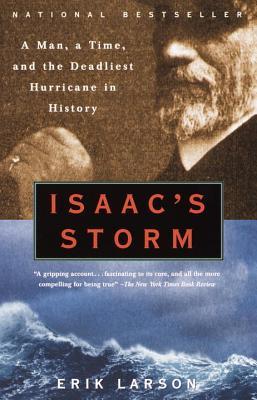
Isaac's Storm

Isaac's Storm. Erik Larson. 1999. 336 pages. [Source: Library]

First sentence: Throughout the night of Friday, September 7, 1900, Isaac Monroe Cline found himself waking to a persistent sense of something gone wrong.

Premise/plot: Isaac's Storm is a nonfiction book about the hurricane of 1900 that devastated Galveston, Texas. It partly chronicles the life and times of Isaac Cline, the head meteorologist in Galveston, and partly chronicles the storm and its impact on the other residents of Galveston, Texas.

My thoughts: A little while ago I reviewed Al Roker's Storm of the Century. Both books are about the same subject. I am so glad I read both books because it serves as a good reminder that there is always more than one perspective.

Having just read the other book, I had plenty of details still in mind. What I didn't learn in Roker's book was the incredibly bitter falling out between Isaac Cline and Joseph Cline.

These two brothers worked side by side. Isaac was the head meteorologist in Galveston, but, Joseph was employed under him as an observer. (I believe there may have been other employees as well.) These two--as presented by Larson--appear to represent two extremes. Isaac perceived Joseph as being the chicken little, 'the sky is falling' type. His conclusions based on observations and instrument readings tended to err on the side of something bad could happen. Joseph perceived Isaac as being too cautious, too calm and relaxed. The same observations and readings often led Isaac to conclude that everything would be okay, there was no reason to worry.

Isaac, no doubt about it, seemed to live in a make-believe world where nothing truly bad could ever happen to Galveston. Galveston need a sea wall? RIDICULOUS. Hurricanes never enter the Gulf of Mexico. That was just one of his many, many reasons he gave for why Galveston was one of the safest places to live, to build, to work.

So as the storm approached and hit, Joseph and Isaac had VERY different reactions. Here is where this book differs from Roker's a bit. After the storm, Isaac and Joseph both wrote and published accounts of the storm. (By this point the two were bitterly estranged.)

There are differences between
  • what Isaac actually said and did during the storm
  • what Isaac initially said and wrote directly after the storm
  • what Isaac wrote a decade or so after the storm 
  • what Joseph wrote about the storm 
  • other people's accounts of the storm and how the brothers entered into it (if they did)
Roker's book seems to take Cline's memoirs at face value. In that account, Isaac saw the storm for what it was and reacted appropriately warning anyone and everyone he could as he raced to save as many lives as possible. But is that account true? Who was the Cline brother worried about the storm? Who wanted to warn people to evacuate? Who feared that there was no truly safe place island to wait out the storm? It may have been Joseph. And Isaac may have been the more reluctant to act and to warn.

Directly after the storm, Isaac Cline supported the weather bureau and praised his boss. He was more concerned about protecting the bureau at a vulnerable time in its history than telling the truth, the whole truth, and nothing but the truth. Moore, his boss, sent warnings to Galveston, he said. Those messages must not have gotten through because of downed telegraph lines. But Moore knew the storm was coming and did his part to prepare the island. There's no real evidence to back up this possible flim-flam. Cline was still very much concerned about his career. He did receive a promotion after the storm. But later he was demoted and sent to one of the worst centers--regions--in the country. The one with the worst meteorologists, the worst reputation. By the time he was writing his memoirs, I believe he'd had a complete falling out with his former boss. So in his memoirs, he was the daring, rule-breaking meteorologist who saw the storm coming and acted to save lives. He claims that his warnings led to thousands leaving the island by train early in the day. (Is this true? Did the trains take that many people off the island? Was there a rush to leave while they still could? Or did Cline make this up years after the fact?) If Isaac Cline was making his best effort all that day to save lives, to cry warning to the residents, why did do many die? Did he know that it was impossible to save everyone, that there wasn't enough time and enough resources to evacuate everyone? Did he want to avoid creating a panic-driven riot? If he believed that the storm was as dangerous as he later claimed, why didn't he act to get his own family to safety? Just as he was confident that nothing bad could ever happen to Galveston, he seemed to be confident that his new house could withstand any storm no matter what. (It didn't.)

The facts of the storm are brutal; the images are haunting.

I would recommend both books. It's a complex story--perhaps one with no heroes.


© 2018 Becky Laney of Becky's Book Reviews

Friday, July 27, 2018

The Storm of the Century

The Storm of the Century. Al Roker. 2015. 320 pages. [Source: Library]

First sentence: A man pinned under the water struggles to free himself. Fifteen feet below the water's surface and the air he needs so badly, his thrashing body begins to weaken.

Premise/plot: The Storm of the Century is a nonfiction book about the hurricane of 1900 that devastated Galveston, Texas.

The prologue, "Underwater,"throws you into the action and introduces readers to one of the main characters, Isaac Cline, one of the best weatherman in America.

Part One, "They All Had Plans" consists of five chapters. Readers get the opportunity to learn about meteorology--the history and science of it as well as the leading men in the field; some basic Texas history--an overview; the history of Galveston, Texas--the island, the people, the geography, the businesses, the culture and society; hurricanes in general; AND this specific hurricane--its start in Africa, the path it followed, the mentions of it by ship captains and meteorologists, the super-complicated relationship between the U.S. and Cuba. This part introduces readers to the men, women, and children whose stories we will be following closely throughout the book.

Did you know that local weathermen weren't allowed to issue warnings about local weather? All local forecasts came from the national weather service in Washington, D.C.

Did you know that Cuba had some of the best meteorologists in the world at this time? There were men in Cuba that made it their life's work to study--to know--all about tropical depressions, storms, and hurricanes. The goal. of course, being to be able to better predict or forecast them.

Furthermore, did you know that the head of the U.S. weather bureau, Willis Moore, did not credit Cuba's meteorologists. It wasn't that Cuba had a history of poor forecasts--inaccurate forecasts--Moore just didn't believe that hurricanes could be predicted or forecast. Long story short, Cuban meteorologists were not allowed--were forbidden--from sending telegraphs about the weather to any weather station in the United States--to any meteorologist--except Washington, D.C. And since Moore didn't like, didn't trust, didn't credit Cuba's reports, he could choose to ignore them or respin the information as he saw fit.

Cuban meteorologists knew that Galveston, Texas was in for a monstrous, devastating, life-threatening storm, but could do nothing to warn Texas. They could--they did--warn Washington, D.C. Moore knew there was a storm but he predicted it would turn course and head for Florida. Who got issued the storm warnings? Florida and the East Coast. It wasn't until that predicted storm never arrived that people started questioning--maybe the storm went somewhere else?!

To his credit, Isaac Cline DID disobey protocol and issue local warnings about the impending storm--but it wasn't much notice--just half a day. If things had gone differently, the island could have--would have--had several days notice to prepare, to evacuate, to choose to act. Granted that would not have been enough time to build a sea wall--something the city desperately needed but naively didn't want to have to need. But the island could have been evacuated. Those that stayed--and probably there would have been people who chose to stay--would have been there by choice not lack of choice.

Part Two, "Maelstrom" consists of five chapters. This part chronicles life in Galveston from Thursday, September 6, 1900 to Saturday, September 8, 1900. Here readers spend time with the people first introduced in part one. Notably Isaac Cline and his brother Joseph--both weathermen. But also other men, women, and even children. What was it like to experience the storm's approach and the storm itself? What was happening on the island? Where were the people going? How were they handling it? What were they doing?

These chapters are incredibly intense and dramatic. We've got almost hour-by-hour chronicling from multiple perspectives.

Part Three, "The White City on the Beach" consists of five chapters. This part chronicles life after the storm: those first few days, weeks, months, etc. It focuses on the survivors. How the island residents came together immediately to handle the devastation. It focuses on those coming from the outside to help: from the state of Texas, from the national government, volunteers from all over the United States. It tells of the newspaper journalist, Winifred Blake, and also of Clara Barton and the Red Cross organization. What did Galveston look like now? How bad were the losses? How many people died? Was anything left at all? What were they going to do about the dead? about preventing illness? about treating the injured? How were they going to clean up the wreckage, the carnage? How were they to go about rebuilding the community? What changes would need to be made on the island?

This chapter was perhaps slightly less intense but perhaps slightly more graphic. The sights--the smells--horrific and traumatic to all who witnessed it. The rebuilding effort gets a little attention--that process was interesting. The narrative is still focused on the personal.

My thoughts: I really found this a captivating, fascinating, compelling read. It was intense; it was scary. It was packed with facts I didn't know or perhaps hadn't considered. I felt like I learned a lot by reading it. For that reason this one is easy to recommend.

In 1900, it was the poor who lived on the beaches, near the beaches. The wealthier you were--the more status you had--the further away you lived from the beach itself. And Galveston, in 1900, was a place with many millionaires. But whether you were rich or poor, white or black--the storm was coming and would hit every community equally hard. Being rich didn't mean you were safer or more secure. The wind, the waves, the floodwater, the wreckage--devastated everything and would ultimate change everything. 


© 2018 Becky Laney of Becky's Book Reviews

Wednesday, August 24, 2016

Alamo All Stars

Alamo All-Stars (Nathan Hale's Hazardous Tales #6) 2016. Abrams. 128 pages. [Source: Library]

First sentence: Three hundred families...land grand....Texas...almost home.

Premise/plot: Nathan Hale and his two pals (the hangman and the British Officer) are joined by Juan Seguin and his three executioners (firing squad, I believe?) to tell the story of the Alamo. It doesn't rush into the story of the Alamo though. Readers learn about Mexico declaring its independence from Spain, the setting up and deposing of several Mexican governments, the arrival, with permission, of American settlers (families) into Texas, the clashes and near-clashes of those settlers with the native tribes in Texas (all given names, I won't mention them all here) and with the Mexican government. Not all Mexican leaders welcomed the idea of settlers, some feared that the more settlers there were, the more likely they would rebel and claim Texas for their very own. Readers learn about Stephen F. Austin, Jim Bowie, Sam Houston, Davy Crockett, William Travis, etc. Some of the people we learn about center around the Alamo--lived, fought, and died at the Alamo--some not. The book explores why they were fighting, what they thought they were fighting for, and their strong personalities that certainly didn't always help in their decision making.

My thoughts: Though a Texan, Texas history has not been my strongest subject especially when I was in school! I found this book a lot more interesting than a textbook. It also helps knowing that I'll never be quizzed on the subject again. Quite the difference between reading for the story and reading to remember names, dates, and places.

There were a LOT of characters in this one. It was fun that our familiar gang was joined by four more. Juan Seguin and his executioners added something to the story. I liked how the hangman came to get along with them and wanted to have a sleepover.

© 2016 Becky Laney of Becky's Book Reviews

Friday, August 30, 2013

Solstice (2013)

Solstice by P.J. Hoover. 2013. Tor. 384 pages. [Source: Review Copy]

Solstice hints at being a dystopian novel, but, in truth it is a retelling of a Greek myth. It is set in the future in a devastated world, a world with endless summer and no changing seasons. For eighteen years, the world has suffered tremendously, Piper, our heroine, has never known the world to be any different.

Solstice won't please every reader. Some readers find romance-driven dystopias to be sickening--especially when there are two men madly in love with the same young woman, when it appears that she cannot make up her mind. I can see why Piper might annoy some readers. The author offers readers an excuse, some might see it as completely valid, others might dismiss it.

The two men in Piper's life are Reese and Shayne. Reese is the son of a councilmen. He encourages Piper to break the rules set by her mother, and the two share a memorable first date. Piper has a busy night, however, for that is also her first date with Shayne, a classmate. She finds both men completely irresistible. Though she never really has a second date with Reese, he's never out of influence.

Shayne fascinates Piper, and she loves seeing where he lives...how he lives...though some of what she learns she finds unsettling at times.

Greek mythology is at the heart of this YA romance. It worked for me at times, though not ever  perfectly.   

© 2013 Becky Laney of Becky's Book Reviews
Thursday, February 14, 2013

Revenge of the Girl with the Great Personality (2013)

Revenge of The Girl With The Great Personality. Elizabeth Eulberg. 2013. [March] Scholastic. 272 pages.

I have enjoyed Elizabeth Eulberg's work in the past--The Lonely Hearts Club and Prom and Prejudice--so I was hoping that I would enjoy her newest YA novel. It didn't work for me. But I think it may still work for many readers.

The heroine of Revenge of the Girl with The Great Personality is Lexi. She is the girl with the "great personality." It's a label that she has difficulty letting go of, in a way, because she believes what she hears or overhears about herself. What should you know about Lexi? Well, she has a seven year old sister who's into beauty pageants. Her mom is obsessed with putting her sister into every pageant possible--no matter the cost, no matter the drama. Lexi is part of this lifestyle--like it or not. And her favorite thing about the pageant life is spending time with Logan. (Logan has a girlfriend, Alyssa, who's in pageants.)

Essentially Lexi hates not having a boyfriend or a life and one day she's dared by her gay best friend, Benny, to do something about it. He dares her to wear make-up for a week, to do her hair, to wear dresses, etc. She then dares him to start talking to the guy he likes, to ask him out, etc.

What will happen when Lexi transforms into the most beautiful woman ever? Will she get attention? The right kind of attention? Will everyone suddenly think she's worth knowing? worth talking to? worth eating lunch with? worth inviting to parties? worth dating? What will people start saying about her and her new look? And dare she go back to her old self?

I did not like this one. Lexi's obsession with Logan prevents her from taking the one guy who might actually like her seriously. Though it doesn't stop her from dating him [Taylor] for most of the book. While I am glad that Lexi did not get a happily ever after--with either Taylor or Logan--and that she eventually realized how silly she'd been over Logan once she caught a glimpse of the real Logan, I still found most of the book annoying. 

Revenge of The Girl with the Great Personality has plenty of drama and conflict. Lexi's family is certainly dysfunctional and broken. Lexi struggles to have a good relationship with her mom and her sister. And there is even a love triangle, of sorts. For those that like YA books focusing on popularity and fitting in or not fitting in...it may be right for you. But. It didn't work for me. 

© 2013 Becky Laney of Becky's Book Reviews