Showing posts with label Dorothy Sayers. Show all posts

Thursday, December 13, 2018

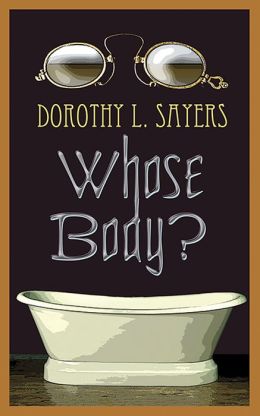
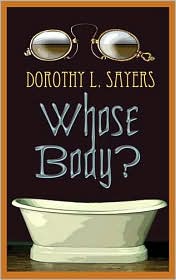
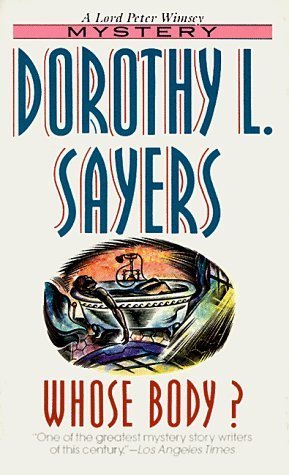
Whose Body?

Whose Body? Dorothy L. Sayers. 1923/1995. HarperTorch. 224 pages. [Source: Bought]

First sentence: "Oh damn!" said Lord Peter Wimsey at Piccadilly Circus.

Premise/plot: Whose Body? is the first novel in a mystery series starring Lord Peter Wimsey as an amateur detective. (He solves crimes with a little help from his butler/valet, Bunter, and in later mysteries with his girlfriend/wife.) In the opening pages of the novel, Lord Peter receives a phone call--or 'phone call--from his mother the Dowager Duchess. A murder has been committed. A naked man has been found in a bath tub of an acquaintance of hers. Is he interested in solving the case and working with Scotland Yard?

My thoughts: As a whole, I love, love, love the series by Dorothy Sayers. That being said, I don't love each and every book in the series equally. I enjoyed this one very much. I found it to be witty and delightful. It was super quotable. I would recommend it as a starting point for reading the series.

Quotes:
  • Exit the amateur of first editions; new motive introduced by solo bassoon; enter Sherlock Holmes, disguised as a walking gentleman. There goes Bunter. Invaluable fellow--never offers to do his job when you've told him to do somethin' else. (5)
  • "Sugg's a beautiful, braying ass," said Lord Peter. "He's like a detective in a novel." (18)
  • "I love trifling circumstances," said Lord Peter. "so many men have been hanged by trifling circumstances." (20)
  •  "Parker, acushla, you're an honour to Scotland Yard. I look at you, and Sugg appears a myth, a fable, an idiot-boy, spawned in a moonlight hour by some fantastic poet's brain. Sugg is too perfect to be possible." (23)
  • "Look here, Wimsey--you've been reading detective stories; you're talking nonsense." (29)
  • Of course, if this were a detective story, there'd have been a convenient shower exactly an hour before the crime and a beautiful set of marks which could only have come between two and three in the morning, but this being real life in a London November, you might as well expect footprints in Niagra. (44)
  • "It's a hard life, valeting by day and developing by night--morning tea at any time from 6:30 to 11, and criminal investigation at all hours. It's wonderful, the ideas these rich men with nothing to do get into their heads." (49)
  • "Have you any Scotch blood in you, Parker?" inquired his colleague, bitterly.
    "Not that I know of," replied Parker. "Why?"
    "Because of all the cautious, ungenerous, deliberate and cold-blooded devils I know," said Lord Peter, "you are the most cautious, ungenerous, deliberate and cold-blooded. Here I am, sweating my brains out to introduce a really sensational incident into your dull and disreputable little police investigation, and you refuse to show a single spark of enthusiasm."
    "Well, it's no good jumping at conclusions."
    "Jump? You don't even crawl distantly within sight of a conclusion. I believe if you caught the cat with her head in the cream-jug you'd say it was conceivable that the jug was empty when she got there."
    "Well, it would be conceivable, wouldn't it?" (51)
  • "There's nothing you can't prove if your outlook is only sufficiently limited. Look at Sugg." (69)
  • Assigning a motive for the murder of a person without relations or antecedents or even clothes is like trying to visualize the fourth dimension--admirable exercise for the imagination, but arduous and inconclusive. (82)
  • "One demands a little originality in these days, even from murderers," said Lady Swaffham. "Like dramatists, you know--so much easier in Shakespeare's time, wasn't it? Always the same girl dressed up as a man, and even that borrowed from Boccaccio or Dante or somebody. I'm sure if I'd been a Shakespeare hero, the very minute I saw a slim-legged young page-boy I'd have said: "Odsbodikins! There's that girl again!" (123)
  • "And in short stories," said Lord Peter, "it has to be put in statement form, because the real conversation would be so long and twaddly and tedious, and nobody would have the patience to read it. Writers have to consider their readers, you see." (158)


© 2018 Becky Laney of Becky's Book Reviews

Wednesday, June 12, 2013

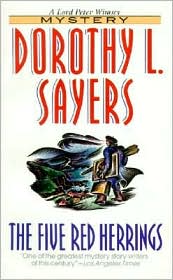
The Five Red Herrings (1931)

The Five Red Herrings. Dorothy L. Sayers. 1931. HarperCollins. 325 pages.

If one lives in Galloway, one either fishes or paints. "Either" is perhaps misleading, for most of the painters are fishers also in their spare time. To be neither of these things is considered odd and almost eccentric.

I enjoyed rereading The Five Red Herrings. This one is not a particular favorite of mine. But it is always fun to spend time with Lord Peter and Bunter! In this mystery, Lord Peter is visiting a small community of artists in Scotland. One of the most obnoxious artists gets murdered within the opening chapters. There are plenty of suspects, plenty of motives, plenty of opportunities. Hardly anyone in this community has a good, believable alibis. It seems like most of the suspects are keeping back things from the police. Can Lord Peter solve the crime? If anyone can do it, he can. For it was his detective instincts which showed this death was murder and not an accident. He KNOWS that there is a huge clue to solving the crime, a clue that the police don't place the same importance on. Which is why Lord Peter may just be one of the best!

Favorite quotes:
I was born looking foolish and every day in every way I am getting foolisher and foolisher. (52)
One of these days I shall write a book in which two men are seen to walk down a cul-de-sac, and there is a shot and one man is found murdered and the other runs away with a gun in his hand, and after twenty chapters stinking with red herrings, it turns out that the man with the gun did it after all. (114)
The essence of detection is secrecy. It has no business to be spectacular. But you can watch me if you like. (218)

© 2013 Becky Laney of Becky's Book Reviews

Tuesday, June 11, 2013

Strong Poison (1930)

Strong Poison. Dorothy L. Sayers. 1930/1995. HarperCollins. 272 pages.

There were crimson roses on the bench; they looked like splashes of blood.

I am rereading Dorothy Sayer's mysteries this year. Strong Poison was one of the first mysteries I read, and it was great fun to return to it! Strong Poison introduces Harriet Vane into Lord Peter Wimsey's life. She is on trial for murder, suspected of poisoning an ex-boyfriend. Lord Peter falls in love with her almost instantly, and decides to trust his instincts that she just has to be innocent of the crime. In a very short time, her fate will be decided. So if Lord Peter is to have a chance of a happily ever after, he must get his new love acquitted! He needs to solve this case quickly! He has quite a bit of help in gathering together clues and evidence and building a strong case to prove Harriet's innocence and another person's guilt.

  I really enjoyed this one cover to cover! I love Lord Peter and Bunter and Inspector Charles Parker and the Dowager! I think I was able to appreciate the characters more since I've become familiar with the whole story now.

Favorite quotes:
I have been reading one of her books, really quite good and so well-written, and I didn't guess the murderer till page 200, rather clever, because I usually do it about page 15. So very curious to write books about crimes and then be accused of a crime one's self, some people might say it was a judgment. (27) -- The Dowager to her son
Wimsey sat down and waited, a prey to curious sensations. Presently there was a noise of footsteps, and the prisoner was brought in, attended by a female wardress. She took the chair opposite to Wimsey, the wardress withdrew and the door was shut. Wimsey, who had risen, cleared his throat.
"Good afternoon, Miss Vane," he said unimpressively.
The prisoner looked at him.
"Please sit down," she said in the curious, deep voice which had attracted him in Court. "You are Lord Peter Wimsey, I believe, and have come from Mr. Crofts."
"Yes," said Wimsey. Her steady gaze was unnerving him.
"Yes, I--er--I heard the case and all that, and--er--I thought there might be something I could do, don't you know."
"That was very good of you," said the prisoner.
"Not at all, not at all, dash it! I mean to say, I rather enjoy investigating things, if you know what I mean."
"I know. Being a writer of detective stories, I have naturally studied your career with interest."
She smiled suddenly at him and his heart turned to water.
"Well, that's rather a good thing in a way, because you'll understand that I'm not really such an ass as I'm looking at present."
That made her laugh.
"You're not looking an ass--at least, not more so than any gentleman should under the circumstances. The background doesn't altogether suit your style, but you are a very refreshing sight. And I'm really very grateful to you, though I'm afraid I'm rather a hopeless case." (37)
"I quite see that," said Wimsey. "Such a Victorian attitude, too, for a man with advanced ideas. He for God only, she for God in him, and so on. Well, I'm glad you feel like that about it."
"Are you? It's not going to be exactly helpful in the present crisis."
"No, I was looking beyond that. What I mean to say is, when all this is over, I want to marry you, if you can put up with me and all that."
Harriet Vane, who had been smiling at him, frowned, and an indefinable expression of distaste came into her eyes.
"Oh, are you another of them? That makes forty-seven."
"Forty-seven what?" asked Wimsey, much taken aback.
"Proposals. They come in by every post. I suppose there are a lot of imbeciles who want to marry anybody who's at all notorious."
"Oh," said Wimsey. "Dear me, that makes it very awkward. As a matter of fact, you know, I don't need any notoriety. I can get into the papers off my own bat. It's no treat to me. Perhaps I'd better not mention it again."
His voice sounded hurt, and the girl eyed him rather remorsefully.
"I'm sorry--but one gets rather a bruised sort of feeling in my position. There have been so many beastlinesses."
"I know," said Lord Peter. "It was stupid of me--"
"No, I think it was stupid of me. But why--?"
"Why? Oh, well--I thought you'd be rather an attractive person to marry. That's all. I mean, I sort of took a fancy to you. I can't tell you why. There's no rule about it, you know."
"I see. Well, it's very nice of you."
"I wish you wouldn't sound as if you thought it was rather funny. I know I've got a silly face, but I can't help that. As a matter of fact, I'd like somebody I could talk sensibly to, who would make life interesting. And I could give you a lot of plots for your books, if that's any inducement."
"But you wouldn't want a wife who wrote books, would you?"
"But I should; it would be great fun. So much more interesting than the ordinary kind that is only keen on clothes and people. Though of course, clothes and people are all right too, in moderation. I don't mean to say I object to clothes."
"And how about the old oaks and the family plate?"
"Oh, you wouldn't be bothered with them. My brother does all that…" (39-40)
"What a clear mind you have," said Miss Climpson.
"When I die you will find 'Efficiency' written on my heart. (47)
"Oh, and Bunter."
"My lord?"
"It seems that I am being obvious. I have no wish to be anything of the kind. If you see me being obvious, will you drop me a hint?"
"Certainly, my lord." (70)
It was natural that the conversation should turn to the subject of murder. Nothing goes so well with a hot fire and buttered crumpets as a wet day without and a good dose of comfortable horrors within. (85) 
"If anybody ever marries you, it will be for the pleasure of hearing you talk piffle," said Harriet, severely. (111)
"Damn it, she writes detective stories and in detective stories virtue is always triumphant. They're the purest literature we have." (115)
"Oh, God! Shall I ever live down this disastrous reputation for tom-foolery?" (150)
"Anything a Wimsey does is is right and heaven help the person who gets in the way. We've even got a damned old family motto about it…" (213)


© 2013 Becky Laney of Becky's Book Reviews

Wednesday, February 06, 2013

Clouds of Witness (1926)

Clouds of Witness. Dorothy L. Sayers. 1926/1966. Avon. 224 pages.

Lord Peter Wimsey stretched himself luxuriously between the sheets provided by the Hotel Meurice. After his exertions in the unraveling of the Battersea Mystery, he had followed Sir Julian Freke's advice and taken a holiday.

I hope to reread all of Dorothy Sayers' Lord Peter books this year. This is my first reread of the series. My first review of Clouds of Witness

While Clouds of Witness is not my absolute favorite in the Lord Peter Wimsey series, I definitely enjoyed it. Lord Peter is still Lord Peter. I still enjoy seeing Lord Peter in discussion with Bunter and Parker. I still love references to Lord Peter's mother!

In this mystery, Lord Peter rushes home because his brother has been arrested for murder. The victim was engaged to be married to his sister, Mary. But with his brother staying silent about WHERE he was and WHO he was with at the time of the crime, and Mary being caught in a handful of lies, Peter is having difficulty establishing just who the real murderer was.

Lord Peter to Inspector Charles Parker:

"True, O King. Well, you've sat on all my discoveries so far. Never mind. My head is bloody but unbowed. Cathcart was sitting here--"
"So your brother said."
"Curse you, I say he was; at least, somebody was; he's left the impression of his sit-me-down-upon on the cushion."
'That might have been earlier in the day."
"Rot. They were out all day. You needn't overdo this Sadducee attitude, Charles. I say Cathcart was sitting here..." (38)
Lord Peter to Inspector Charles Parker:
"I say, I don't think the human frame is very thoughtfully constructed for this sleuth-hound business. If one could go on all-fours, or had eyes in one's knees, it would be a lot more practical." (48)

Lord Peter to Inspector Charles Parker:
"Did you ever read The Lay of the Last Minstrel?"
"I learnt a good deal of it at school," said Parker. "Why?"
"Because there was a goblin page-boy in it," said Lord Peter, "who was always yelling 'Found! Found! Found!' at the most unnecessary moments. I always thought him a terrible nuisance, but now I know how he felt. See here." (52)

Sir Impey Biggs to the Dowager Duchess:
"Lawyers enjoy a little mystery, you know. Why, if everybody came forward and told the truth, the whole truth, and nothing but the truth straight out, we should all retire to the workhouse." (62)
A solemn Peter...
With that instinct which prompts one, when depressed, to wallow in every circumstance of gloom, Peter leaned sadly upon the hurdles and abandoned himself to a variety of shallow considerations upon (1) The vanity of human wishes; (2) Mutability; (3) First love; (4) The decay of idealism; (5) The aftermath of the Great war; (6) Birth-control; (7) The fallacy of free-will. (71)

Lord Peter to Inspector Charles Parker:
"Mother said--well, I told you what she said. By the way, how do you spell ipecacuanhna?"
Mr. Parker spelt it.
"Damn you!" said Lord Peter. "I did think I'd stumped you that time. I believe you went and looked it up beforehand. No decent-minded person would know how to spell ipecacuanha out of his own head. Anyway, as you were saying, it's easy to see which side of the family has the detective instinct."
"I didn't say so--"
"I know. Why didn't you? I think my mother's talents deserve a little acknowledgment. I said so to her, as a matter of fact, and she replied in these memorable words: 'My dear child, you can give it a long name if you like, but I'm an old-fashioned woman, and I call it mother-wit, and it's so rare for a man to have it that if he does you write a book about him and call him Sherlock Holmes.'" (97)
Read Clouds of Witness
  • If you enjoy mysteries--cozy mysteries, vintage mysteries, British mysteries
  • If you enjoy Dorothy Sayers' mysteries
  • If you can't get enough of Lord Peter!
© 2013 Becky Laney of Becky's Book Reviews

Wednesday, January 09, 2013

Whose Body? (1923)

Whose Body? Dorothy L. Sayers. 1923/1995. HarperCollins. 224 pages. 

"Oh damn!" said Lord Peter Wimsey at Piccadilly Circus.

In 2013, I am going to try to reread all the Lord Peter mysteries by Dorothy Sayers. The first mystery in the series is Whose Body? (My original review.) In this mystery, readers are introduced to Lord Peter Wimsey, an aristocratic gentleman whose hobby is being a detective. The mystery begins with a telephone call from his mother...

The case Peter Wimsey is working on involves an unidentified dead man in a bathtub. WHO IS HE? Where did he come from? Was he murdered there? Or did someone dump his body there? Since no one knows his identity, it's hard to arrive at motives and work out a narrative for the crime. 

The case Wimsey's friend, Inspector Parker, is working on involves a missing person. A well-known Jewish financier has gone missing. There is no body, no evidence of violent crime, but Parker suspects that a crime has been committed.

These two friends are helping each other out, helping piece clues together for both cases. Though neither man is sure that the two are connected cases. It does help having someone to reason things out with.

Favorite quotes:

"Sugg's a beautiful, braying ass," said Lord Peter. "He's like a detective in a novel." (18)
"I love trifling circumstances," said Lord Peter. "so many men have been hanged by trifling circumstances." (20)
"Parker, acushla, you're an honour to Scotland Yard. I look at you, and Sugg appears a myth, a fable, an idiot-boy, spawned in a moonlight hour by some fantastic poet's brain. Sugg is too perfect to be possible." (23) 
"Look here, Wimsey--you've been reading detective stories; you're talking nonsense." (29)
"Have you any Scotch blood in you, Parker?" inquired his colleague, bitterly.
"Not that I know of," replied Parker. "Why?"
"Because of all the cautious, ungenerous, deliberate and cold-blooded devils I know," said Lord Peter, "you are the most cautious, ungenerous, deliberate and cold-blooded. Here I am, sweating my brains out to introduce a really sensational incident into your dull and disreputable little police investigation, and you refuse to show a single spark of enthusiasm."
"Well, it's no good jumping at conclusions."
"Jump? You don't even crawl distantly within sight of a conclusion. I believe if you caught the cat with her head in the cream-jug you'd say it was conceivable that the jug was empty when she got there."
"Well, it would be conceivable, wouldn't it?" (51)
 "There's nothing you can't prove if your outlook is only sufficiently limited. Look at Sugg." (69)
Assigning a motive for the murder of a person without relations or antecedents or even clothes is like trying to visualize the fourth dimension--admirable exercise for the imagination, but arduous and inconclusive. (82)
"One demands a little originality in these days, even from murderers," said Lady Swaffham. "Like dramatists, you know--so much easier in Shakespeare's time, wasn't it? Always the same girl dressed up as a man, and even that borrowed from Boccaccio or Dante or somebody. I'm sure if I'd been a Shakespeare hero, the very minute I saw a slim-legged young page-boy I'd have said: "Odsbodikins! There's that girl again!" (123)
Read Whose Body?
  • If you like vintage mysteries, cozy mysteries, or mystery series
  • If you enjoy mysteries set in Britain
  • If you want to spend time with some memorable characters

© 2013 Becky Laney of Becky's Book Reviews

Wednesday, December 21, 2011

Busman's Holiday

Busman's Honeymoon. Dorothy L. Sayers. 1937. HarperCollins. 403 pages.

My dear Honoria, 
So Peter is really married: I have ordered willow-wreaths for half my acquaintance...

There were parts of this mystery novel that I just LOVED. I mean there were scenes that made me giddy, absolutely giddy. (So many Harriet and Peter scenes!!!) And scenes that had me smiling! (I love Peter and Bunter, and we were introduced to a lovely Chief Superintendent, Mr. Kirk, his scenes with Peter were quite fun!) So I would definitely recommend this one to anyone who loves Lord Peter Wimsey, to those excited to read about his marriage to Harriet. The writing, as always, was great. And their is something almost magical about the way Sayers does dialogue...

Anyway, this novel is about their busy honeymoon. They've only been married a brief time--maybe two days?--when they discover a body in the basement of their new home, the home they've chosen to honeymoon in. And the case isn't an easy one to solve....

I really can't begin to express how much I LOVE, LOVE, LOVE Peter Wimsey. And how much this whole series has meant to me. These books are so good, so wonderful, so worth reading!!!

Harriet:
Whatever fantastic pictures she had from time to time conjured up of married life with Peter, none of them had ever included attendance at village concerts. But of course they would go. She understood now why it was that with all his masking attitudes, all his cosmopolitan self-adaptations, all his odd spiritual reticences and escapes, he yet carried about with him that permanent atmosphere of security. He belonged to an ordered society, and this was sit. More than any of the friends in her own world, he spoke the familiar language of her childhood. In London, anybody, at any moment, might do or become anything. But in a village--no matter what village--they were all immutably themselves; parson, organist, sweep, duke's son, and doctor's daughter, moving like chessmen upon their allotted squares. She was curiously excited. She thought, "I have married England." (98)  

Lord Peter:

"When I'm investigating a murder, I hate to have too much sympathy with the corpse. Personal feelings cramp the style." (130)

Lord Peter:

"Murders go to my head like drink. I simply can't keep them off." (130)

Lord Peter, Harriet, and Mr. Kirk:

"Enter the obvious suspect," said Peter, lightly.
"The obvious suspect is always innocent," said Harriet in the same tone.
"In books, my lady," said Mr. Kirk, with a little indulgent bow towards her, as who should say, 'The ladies. God bless them!'" (143)

Mr. Kirk:
"Reckon there's several kinds of truth, my lord. There's truth as far as you know it; and there's truth as far as you're asked for it. But they don't represent the whole truth--not necessarily. (170)

Lord Peter:
"I don't know what to think. The fact is, we've got dashed little material for thinking with. It's probably too early for thinking." (231)
Lord Peter:
"I am always trying to say something too silly to be believed; but I never manage it." (256)

Lord Peter and Harriet:

"How can I find words? Poets have taken them all, and left me with nothing to say or do--"
"Except to teach me for the first time what they meant."
He found it hard to believe.
"Have I done that?"
"Oh Peter--" Somehow she must make him believe it, because it mattered so much that he should. "All my life I have been wandering in the dark--but now I have found your heart--and am satisfied."
"And what do all the great words come to in the end, but that?--I love you--I am at rest with you--I have come home." (293) 

This is the eleventh novel featuring Lord Peter Wimsey.

Others in the series:


© 2011 Becky Laney of Becky's Book Reviews

Tuesday, December 06, 2011

The Nine Tailors

The Nine Tailors. Dorothy L. Sayers. 1934. 312 pages.

"That's torn it!" said Lord Peter Wimsey.

While I enjoyed The Nine Tailors--in some places really loved it--I can't say that The Nine Tailors is my favorite Lord Peter mystery by Dorothy L. Sayers. I do love the series. I have enjoyed the time I've spent in each and every book. And I definitely see myself rereading these in the future. But. This one, for me, had such a slow start!

Last year before I "discovered" how much I love mysteries--vintage mysteries, cozy mysteries--I tried The Nine Tailors. But the slow start didn't quite work for me. I decided I should start at the beginning of the series. Which ended up being THE BEST decision I could have made.

So Lord Peter Wimsey (and Bunter) have a small car accident over winter holidays that leaves them stranded in the country. They're taken in by the vicar, I believe, who is just delighted with the company. (Who wouldn't be?! It's LORD PETER WIMSEY!) His accident is providential because he can ring one of the bells in the church tower for an oh-so-special service or observation. (All the bell-ringing, well, it BORED me. That could be just me. And I am not saying you'll be bored by the focus of this one.) Of course, that's just the beginning of this one.

It will be months before the real action begins, months before Lord Peter Wimsey's real services are needed. For it is in this quiet country community that a body is discovered in a grave. An extra body is discovered in a grave that is. Who was he?

There are actually a few mysteries for Lord Peter to solve in this novel, and once the body is discovered, well, this book just keeps getting better and better and better. When Lord Peter is busy on a case, well, he's irresistible.

So there is much to love in this one....after the first fifty pages. It is possible that this one will improve upon rereading. Because I am guessing that if you read it knowing how it all comes together, it may prove interesting...

Lord Peter to Bunter:

"I am always so delighted to find that there are things you cannot do." (15)

About the bells...

The art of change-ringing is peculiar to the English, and, like most English peculiarities, unintelligible to the rest of the world. (17)


Lord Peter to Hilary:

"If that's the way your mind works, you'll be a writer one day."
"Do you think so? How funny! That's what I want to be. But why?"
"Because you have the creative imagination, which works outwards, till finally you will be able to stand outside your own experience and see it as something you have made existing independently of yourself. You're lucky."
"Do you really think so?" Hiilary looked excited.
"Yes--but your luck will come more at the end of life than at the beginning, because the other sort of people won't understand the way your mind works. They will start by thinking you dreamy and romantic, and then they'll be surprised to discover that you are really hard and heartless. They'll be quite wrong both times--but they won't ever know it, and you won't know it at first, and it'll worry you."
"But that's just what the girls say at school. How did you know?...Though they're all idiots--mostly that is."
"Most people are," said Wimsey, gravely "but it isn't kind to tell them so. I expect you do tell them so. Have a heart; they can't help it." (106)

Lord Peter on Uncle Edward...

"Frightful blithering ass. Handy thing to be, sometimes. Easily cultivated. Five minutes' practice before the glass every day, and you will soon acquire that vacant look so desirable for all rogues, detectives, and Government officials." (121)

Lord Peter on gossip...

"In a quiet place like this, if one doesn't talk about one's neighbors, what is there to talk about?" (140)

Mr. Blundell on his witnesses...

"I don't like witnesses to be so damned particular about exact truth. They get away with it as often as not, and then where are you?"

Lord Peter being Lord Peter...

"My family," observed Lord Peter, "have frequently accused me of being unrestrained and wanting in self-control. They little know me. Instead of opening this letter at once, I reserve it for Superintendent Blundell. Instead of rushing off at once to Superintendent Blundell, I remain quietly at Walbeach and eat roast mutton. It is true that the good Blundell is not at Leamholt today, so that nothing would be gained if I did rush back, but still, it just shows you. (153)

A good example Sayer's writing style:

There are harder jobs in detective work than searching a couple of French departments for a village ending in "y," containing a farmer's wife whose first name is Suzanne, whose children are Pierre, aged nine, Marie and a baby of unknown age and sex, whose husband is an Englishman. All the villages in the Marne district end, indeed, in "y," and Suzanne, Pierre and Marie are all common names enough, but a foreign husband is rarer. (161)

Others in the series:


© 2011 Becky Laney of Becky's Book Reviews

Tuesday, November 15, 2011

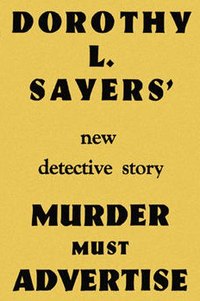
Murder Must Advertise

Murder Must Advertise. Dorothy L. Sayers. 1933. Harper & Row. 323 pages.

"And by the way," said Mr. Hankin, arresting Miss Rossiter as she rose to go, "there is a new copy-writer coming in today."

I love and adore Lord Peter Wimsey. I do. Dorothy Sayers' mysteries had me at hello. In fact, after the first one, I knew I just HAD to read the entire series. So in this Lord Peter adventure, he is going undercover to solve a murder. He has been hired as a copy-writer for an advertising agency. The man he is replacing had a horrid accident on the stairs. Was it really an accident? Or did he have some enemies? Did those enemies come from within the agency? Or was he just hanging out with the wrong crowds after hours?

It took more than a few chapters for Lord Peter to reveal himself to readers. For the first third of the novel, readers just know him as the new employee. Yes, this new employee is asking questions here, there, and everywhere. And, of course, I was a little suspicious and a lot hopeful that he would turn out to be Lord Peter.

Did I like this one? Of course!!! It's Lord Peter! What's not to love? I'm not sure it's my favorite or best. But with the exception of one little chapter, I found it satisfying and just about perfect. Lord Peter can definitely make me giddy!
"Truth in advertising is like leaven, which a woman hid in three measures of meal. It proves a suitable quantity of gas, with which to blow out a mass of crude misrepresentation into a form that the public can swallow." (68) 
Others in the series:

I still need to read:
  • The Nine Tailors (1934)
  • Busman's Honeymoon (1937)
  • Complete Stories of Lord Peter (1972)
  • Thrones, Dominations (Dorothy Sayers and Jill Paton Walsh) (1998)
  • A Presumption of Death (Jill Paton Walsh) (2002)
  • The Attenbury Emeralds (Jill Paton Walsh) (2010)

© 2011 Becky Laney of Becky's Book Reviews

Tuesday, September 06, 2011

The Five Red Herrings

The Five Red Herrings. Dorothy L. Sayers. 1931. HarperCollins. 325 pages.

If one lives in Galloway, one either fishes or paints. "Either" is perhaps misleading, for most of the painters are fishers also in their spare time. To be neither of these things is considered odd and almost eccentric. 

The Five Red Herrings is the seventh mystery starring Lord Peter Wimsey. Lord Peter is a character that I just love and adore. He's just one of my favorite, favorite, favorite characters ever. So I was so happy to read another mystery in this series.

In The Five Red Herrings, Lord Peter Wimsey is on vacation in Scotland. Though he neither paints or fishes, he is accepted--for the most part--by the community. It's hard to not like him, after all! Early in the novel--though I'm not sure if it's early in his holiday--a murder is committed. The "victim" is someone EVERYONE hates; threats against this guy were so common that they were hardly worth taking seriously. I mean Campbell, the victim, was just impossible to get along with. But now that he's dead, it is up to the police (the constables and detectives, etc.) to solve the crime. And since Lord Peter just happens to be very, very good at detecting, he offers to help them out.

There are six suspects--all artists. Hugh Farren, Henry Strachan, Matthew Gowan, Jock Graham, Michael Waters, and Ferguson. All had motive, all had opportunity. All of them are lying, all of them are hiding things from the police. Since there are so many suspects, since they all appear equally capable of committing the crime, it's just a matter of discerning the truth. Which theory--which plausible theory--is the truth? Which is most likely? Which uses all the clues that have been left behind?

Five Red Herrings is set in Scotland. And, for me, it was a delightful mystery.

Lord Peter Wimsey:

I was born looking foolish and every day in every way I am getting foolisher and foolisher. (52)

One of these days I shall write a book in which two men are seen to walk down a cul-de-sac, and there is a shot and one man is found murdered and the other runs away with a gun in his hand, and after twenty chapters stinking with red herrings, it turns out that the man with the gun did it after all. (114)

The essence of detection is secrecy. It has no business to be spectacular. But you can watch me if you like. (218)

© 2011 Becky Laney of Becky's Book Reviews

Monday, June 27, 2011

The Unpleasantness at the Bellona Club

The Unpleasantness at the Bellona Club. Dorothy L. Sayers. 1928/1995. HarperCollins. 256 pages.

"What in the world, Wimsey, are you doing in this Morgue?" demanded Captain Fentiman, flinging aside the "Evening Banner" with the air of a man released from an irksome duty.

Lord Peter Wimsey's skills will be tested in The Unpleasantness at The Bellona Club. For a great deal of money depends on his preciseness, his thoroughness. General Fentiman, a ninety-year-old man, died at his club (and Peter's club). No one thought anything of it at all.

Until they learned that the General's sister, Lady Dormer, had also died that morning. Until they learned that there was some question as to inheritance.

If the General died first, then Ann Dorland would inherit most of Lady Dormer's money, Major Robert Fentiman and Captain George Fentiman would receive a little money. If Lady Dormer died first, then the General would have inherited most of his sister's money. And with the General being dead too, well, that leaves his two sons quite a bit wealthier.

But who died first? The Lady's death was discovered first. But that doesn't necessarily mean she died first. For nobody is quite sure when the General died. No one suspected him of being dead. He was just sitting still in his chair holding a newspaper for hours and hours.

So Lord Peter Wimsey is asked to help 'solve' this mystery. And at first, it is just a matter of determining when he died naturally. But some of the clues just don't make sense unless he died by unnatural causes.

Was it murder? Can Lord Peter Wimsey solve this case?

I love Lord Peter Wimsey. I do. I love him. And I enjoyed The Unpleasantness at The Bellona Club. I thought it was an interesting mystery.

Lord Peter Wimsey to Mr. Murbles:
"Acid man you are," said Wimsey. "No reverence, no simple faith or anything of that kind. Do lawyers ever go to heaven?"
"I have no information on that point," said Mr. Murbles dryly. (15)

Marjorie Phelps to Lord Peter:

"Peter Wimsey! You sit there, looking a perfectly well-bred imbecile, and then in the most underhand way you twist people into doing things they ought to blush for. No wonder you detect things. I will not do your worming for you!" (162)

"Moral certainty is not the same thing as proof." (205)
Other books in the series:
  • Whose Body (1923)
  • Clouds of Witness (1926)
  • Unnatural Death (1927)
  • The Unpleasantness at the Bellona Club (1928)
  • Strong Poison (1931)
  • Five Red Herrings (1931)
  • Have His Carcase (1932)
  • Murder Must Advertise (1933)
  • The Nine Tailors (1934)
  • Gaudy Night (1935)
  • Busman's Honeymoon (1937)
  • Complete Stories of Lord Peter (1972)
  • Thrones, Dominations (Dorothy Sayers and Jill Paton Walsh) (1998)
  • A Presumption of Death (Jill Paton Walsh) (2002)
  • The Attenbury Emeralds (Jill Paton Walsh) (2010)


© 2011 Becky Laney of Becky's Book Reviews

Thursday, June 16, 2011

Clouds of Witness

Clouds of Witness. Dorothy L. Sayers. 1927/1966. Avon. 224 pages.

Lord Peter Wimsey stretched himself luxuriously between the sheets provided by the Hotel Meurice. After his exertions in the unraveling of the Battersea Mystery, he had followed Sir Julian Freke's advice and taken a holiday.

Lord Peter's holiday is disrupted by shocking news! His sister's fiance, Captain Denis Cathcart, has been murdered, and his brother, the Duke of Denver, Gerald, is the number one suspect. He was spotted standing over the dead body at 3AM outside his home. Lady Mary Wimsey, the sister, was too shocked to make much sense in her statements to the authorities.  Lord Peter Wimsey (and Bunter) arrive to help decipher the clues in this case, in this investigation.

His family isn't exactly helping him. His brother won't say a word in his own defense. Won't let anyone--not even his brother--know where he was on the night of the murder. And his sister? Well, Lord Peter has his suspicions--as does Parker (Scotland Yard)--that she's not telling the whole truth. In fact, her story is a string of lies. So Lord Peter begins to expand his search to the surrounding neighborhood...

Can Lord Peter find a way to free his brother? Can he find a way to help his sister? Can he solve the case so that justice prevails?

I love Lord Peter Wimsey. I do. I just LOVE him. (Just don't ask me to choose between Archie Goodwin and Lord Peter Wimsey--because at the moment, I don't know that I could!!!!) I would have loved to read all the Lord Peter Wimsey books in order, but, I didn't own them all when I first began my adventure into vintage mysteries. So I'm catching up now! According to Wikipedia, the proper order of the books are:
While I wouldn't say that Clouds of Witness is as good as say Strong Poison or Gaudy Night, I must say it is still a fun read!

Lord Peter to Inspector Charles Parker:
"True, O King. Well, you've sat on all my discoveries so far. Never mind. My head is bloody but unbowed. Cathcart was sitting here--"
"So your brother said."
"Curse you, I say he was; at least, somebody was; he's left the impression of his sit-me-down-upon on the cushion."
'That might have been earlier in the day."
"Rot. They were out all day. You needn't overdo this Sadducee attitude, Charles. I say Cathcart was sitting here..." (38)
Lord Peter to Inspector Charles Parker:
"I say, I don't think the human frame is very thoughtfully constructed for this sleuth-hound business. If one could go on all-fours, or had eyes in one's knees, it would be a lot more practical." (48)

Lord Peter to Inspector Charles Parker:
"Did you ever read The Lay of the Last Minstrel?"
"I learnt a good deal of it at school," said Parker. "Why?"
"Because there was a goblin page-boy in it," said Lord Peter, "who was always yelling 'Found! Found! Found!' at the most unnecessary moments. I always thought him a terrible nuisance, but now I know how he felt. See here." (52)

Sir Impey Biggs to the Dowager Duchess:
"Lawyers enjoy a little mystery, you know. Why, if everybody came forward and told the truth, the whole truth, and nothing but the truth straight out, we should all retire to the workhouse." (62)
A solemn Peter...
With that instinct which prompts one, when depressed, to wallow in every circumstance of gloom, Peter leaned sadly upon the hurdles and abandoned himself to a variety of shallow considerations upon (1) The vanity of human wishes; (2) Mutability; (3) First love; (4) The decay of idealism; (5) The aftermath of the Great war; (6) Birth-control; (7) The fallacy of free-will. (71)

Lord Peter to Inspector Charles Parker:
"Mother said--well, I told you what she said. By the way, how do you spell ipecacuanhna?"
Mr. Parker spelt it.
"Damn you!" said Lord Peter. "I did think I'd stumped you that time. I believe you went and looked it up beforehand. No decent-minded person would know how to spell ipecacuanha out of his own head. Anyway, as you were saying, it's easy to see which side of the family has the detective instinct."
"I didn't say so--"
"I know. Why didn't you? I think my mother's talents deserve a little acknowledgment. I said so to her, as a matter of fact, and she replied in these memorable words: 'My dear child, you can give it a long name if you like, but I'm an old-fashioned woman, and I call it mother-wit, and it's so rare for a man to have it that if he does you write a book about him and call him Sherlock Holmes.'" (97)

© 2011 Becky Laney of Becky's Book Reviews

Saturday, January 22, 2011

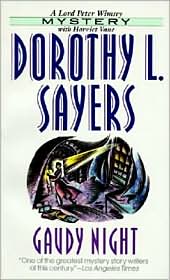
Gaudy Night

Gaudy Night. Dorothy L. Sayers. 1936/1995. HarperCollins. 512 pages.

Harriet Vane sat at her writing-table and stared out into Mecklenburg Square. The late tulips made a brave show in the Square garden, and a quartet of early tennis-players were energetically calling the score of a rather erratic and unpracticed game. But Harriet saw neither tulips nor tennis-players.

This is the third novel starring Lord Peter Wimsey and Harriet Vane. The first two being Strong Poison and Have His Carcase. Both featured Lord Peter prominently. In the first, he "rescued" an accused murderess, Harriet Vane, she stood accused of poisoning her former lover. In a little under a month, he proved his love by proving her innocence. Upon their first meeting, he proposed. It was--for him--love at first sight. In the second, Lord Peter proves helpful once again when Harriet discovers a dead body on the beach. He doesn't even wait for there to be a sign of trouble, he's there on the spot to do what he does best.

In the third novel, Lord Peter is strangely absent for the first half of the novel. At first, this irritated me. I mean, I want LORD PETER to be appearing in every chapter--if not on every page. I mean, I just can't get enough of him. I LOVE AND ADORE him. But. I think his absence serves at least two purposes. First, I think it reflects the times surprisingly well. Sayers has Lord Peter working for the Foreign Office; she has Lord Peter off in Europe trying to be a peacemaker. There are a few conversations that reflect that all is not as it should be in Europe, in the world, that there are tremors of political turmoil and uprising. That another war may be coming. Second, I think it's for Harriet's benefit. With Peter gone, she realizes--perhaps a little too slowly for this reader--just how much she needs him. Needs him not to "rescue" her perhaps though he has a way of doing just that. But needs him--as in needs his company, his humor, his wit, his strength, his intelligence. She almost aches for him. If that makes sense. So Harriet and I were both in the same place (for a change), we were both wanting Lord Peter, longing to hear his voice again.

So what is Gaudy Night about? Well, Harriet Vane has returned to Oxford, to her college (Shrewsbury College). At first this return is just for the "Gaudy" reunion. But. After the women's college experiences a series of pranks and other (small) crimes, she's called back to lend a hand in the investigation. They don't want to go to the police. They don't want outsiders to know that there is someone writing obscene letters and destroying college property. Since these letters are anti-feminist--the person writing them obviously feels that women should not be educated or work outside the home. A large part of this one is set in an academic environment. It features a handful of women discussing big issues of the day. It was hard, for me, to keep track of all the new characters introduced. All the women professors, tutors, dons, and students. But there was one new character that was unforgettable: Lord Peter's nephew, Lord St. George! (I really, really liked him!) As the months go by, the crimes start to change. The case may prove a little too challenging to solve all on her own, but Lord Peter can't stay away forever. And together, they may just do more than solve the case...

I enjoyed the romance in Gaudy Night. I enjoyed seeing Lord Peter through different eyes. (For example, Wimsey is discussed by a good many women at the college. Sometimes in a flattering way, sometimes not. But it is interesting to see Harriet's reaction to other people's opinion of Lord Peter. When she sees that Lord Peter is a desirable man in other women's eyes, well, it doesn't hurt the situation any!) I loved the characterization too. I loved Lord St. George and Reggie Pomfret, for example.  I wasn't such a big fan of the mystery plot in this one--it wasn't much of a surprise to me who was at fault. But overall, the writing still worked well for me.

Favorite quotes:

"How all occasions do inform against me!" muttered Harriet to herself. One would have thought that Oxford at least would offer a respite from Peter Wimsey and the marriage question. But although she herself was a notoriety, if not precisely a celebrity, it was an annoying fact that Peter was a still more spectacular celebrity, and that, of the two, people would rather know about him than about her. As regards marriage--well, here one certainly had a chance to find out whether it worked or not. Was it worse to be a Mary Atwood (nee Stokes) or a Miss Schuster-Slatt? Was it better to be a Phoebe Bancroft (nee Tucker) or a Miss Lydgate? And would all these people have turned out exactly the same, married or single? (46)

"Do you know any man who sincerely admires a woman for her brains?"
"Well, said Harriet, "certainly not many."
"You may think you know one," said Miss Hillyard, with a bitter emphasis. "Most of us think at some time or other that we know one. But the man usually has some other little axe to grind." (55)

"Peter" said Harriet. And with the sound of her own voice she came drowsing and floating up out of the strong circle of his arms, through a green sea of sun-dappled beechleaves into darkness. "Oh damn," said Harriet softly to herself. "Oh, damn, I didn't want to wake up." The clock in the New Quad struck three musically. "This won't do," said Harriet. "This really will not do. My sub-conscious has a most treacherous imagination." She groped for the switch of her bedside lamp, "It's disquieting to reflect that one's dreams never symbolize one's real wishes, but always something Much Worse." She turned the light on and sat up. "If I really wanted to be passionately embraced by Peter,  I should dream of something like dentists or gardening." (113)

If you learn how to tackle one subject--any subject--you've learnt how to tackle all subjects. (171)

"But what's Mock Turtle about?" inquired Harriet? On this point the authors were for the most part vague; but a young man who wrote humorous magazine stories, and could therefore afford to be wide-minded about novels, said he had read it and thought it rather interesting, only a bit long. It was about a swimming instructor at a watering place, who had contracted such an unfortunate anti-nudity complex through watching so many bathing-beauties that it completely inhibited all his natural emotions. So he got a job on a whaler and fell in love at first sight with an Eskimo, because she was such a beautiful bundle of garments. So he married her and brought her back to live in a suburb, where she fell in love with a vegetarian nudist. So then the husband went slightly mad and contracted a complex about giant turtles, and spent all his spare time staring into the turtle tank at the Aquarium, and watching the strange, slow monsters swimming significantly round in their encasing shells. But of course a lot of things into it--it was one of those books that reflect the author's reaction to Things in General. Altogether, significant was, he thought, the word to describe it. (233)

"He's a precocious little monkey," said his uncle, without enthusiasm. "Though I can't blame him for that; it runs in the blood. But it's characteristic of his impudence that he should have gate-crashed your acquaintance, after you had firmly refused to meet any of my people."
"I found him for myself, you see, Peter."
"Literally, or so he says. I gather that he nearly knocked you down, damaged your property and generally made a nuisance of himself, and that you instantly concluded he must be some relation to me."
"That's--If he said that, you know better than to believe it. But I couldn't very well miss the likeness."
"Yet people have been known to speak slightingly of my personal appearance! I congratulate you on a perception worthy of Sherlock Holmes at his keenest." (308)

How fleeting are all human passions compared with the massive continuity of ducks... (325)

"Do you find it easy to get drunk on words?"
"So easy that, to tell you the truth, I am seldom perfectly sober. Which accounts for my talking so much." (330)

"Something worried you about this room. What was it?"
"You don't need to be told."
"No, I am convinced that our two hearts beat as one. But tell Miss Martin." (345)

"Just exercise your devastating talent for keeping to the point and speaking the truth."
"That sounds easy."
"It is--for you. That's what I love you for. Didn't you know?" (365)

"I don't know. I have a reputation for flippant insincerity. You think I'm honest?"
"I know you are. I couldn't imagine your being anything else." (382)

It is said that love and a cough cannot be hid. (427)

© 2011 Becky Laney of Becky's Book Reviews

Wednesday, January 19, 2011

Have His Carcase

Have His Carcase. Dorothy L. Sayers. 1932/1995. HarperCollins. 448 pages. 

The best remedy for a bruised heart is not, as so many people seem to think, repose upon a manly bosom. Much more efficacious are honest work, physical activity, and the sudden acquisition of wealth.

Harriet Vane and Lord Peter Wimsey star in this mystery novel by Dorothy L. Sayers. After the murder charge against her has been dropped, Harriet Vane needs a good vacation. And so we find her, when the novel opens, on a little trip. But relaxing isn't quite the right word for her vacation. For it turns into another murder mystery. She discovers the body of a man on the beach. She has just enough time to take a few quick pictures of the body--of the crime scene--before the tide begins to threaten both. She seeks help--the police--but the damage has already been done. The body has vanished into the sea.

Is this murder? Is this suicide? There seems to be problems with both theories. Lord Peter Wimsey has his ideas--as does Harriet--but can they ever agree with the police in the matter? As these two set about privately investigating the affair, can they work out some of their personal problems too? For you see, Lord Peter still is madly, deeply in love with Harriet. And. He's still proposing. Often.

I still love Harriet and Lord Peter. I do. I just LOVE, LOVE, LOVE Lord Peter Wimsey! I've included some of my favorite scenes--but none of what I include is a spoiler to the mystery, so don't worry about that!

She fell a victim to an inferiority complex, and tripped over her partner's feet.
"Sorry," said Wimsey, accepting responsibility like a gentleman.
"It's my fault," said Harriet. "I'm a rotten dancer. Don't bother about me. Let's stop. You haven't got to be polite to me, you know."
Worse and worse. She was being peevish and egotistical. Wimsey glanced down at her in surprise and then suddenly smiled.
"Darling, if you danced like an elderly elephant with arthritis, I would dance the sun and moon into the sea with you. I have waited a thousand years to see you dance in that frock."
"Idiot!" said Harriet (151).

"Why didn't you sock him one over the jaw?"
"It was a temptation. I felt that you would love me better if I did. But you would not, in your calmer moments, really wish me to put my love before my detective principles."
"Certainly not. But what's his idea?" (152)

"I may be everything you say--patronizing, interfering, conceited, intolerable, and all the rest of it. But do give me credit for a little intelligence. Do you think I don't know all that? Do you think it's pleasant for any man who feels about a woman as I do about you, to have to fight his way along under this detestable burden of gratitude? Damn it, do you think I don't know perfectly well that I'd have a better chance if I was deaf, blind, maimed, starving, drunken, or dissolute, so that you could have the fun of being magnanimous? Why do you suppose I treat my own sincerest feelings like something of a comic opera, if it isn't to save myself the bitter humiliation of seeing you try not to be utterly nauseated by them? Can't you understand that this damned dirty trick of fate has robbed me of the common man's right to be serious about his own passions? Is that a position for any man to be proud of?"
"Don't talk like that."
"I wouldn't, if you didn't force me. And you might have the justice to remember that you can hurt me a damned sight more than I can possibly hurt you."
"I know I'm being horribly ungrateful--"
"Hell!" (167)

"I could kiss you for it. You need not shrink and tremble. I am not going to do it. When I kiss you, it will be an important event--one of those things which stand out among their surroundings like the first time you tasted li-chee. It will not be an unimportant sideshow attached to a detective investigation." (203)

"Now then! My dear, what's happened? You're all of a doodah!"
"Peter! I believe I've been kissed by a murderer."
"Have you? Well, it serves you right for letting anybody kiss you but me. Good heavens! You raise all sorts of objections to a perfectly amiable and reasonably virtuous man like myself, and the next thing I hear is that you are wallowing in the disgusting embraces of a murderer. Upon my soul! I don't know what the modern girl is coming to." (234)
I would definitely recommend Dorothy Sayers. Particularly, Whose Body, Strong Poison, and Have His Carcase.


© 2011 Becky Laney of Becky's Book Reviews
Thursday, January 13, 2011

Strong Poison

Strong Poison. Dorothy L. Sayers. 1930/1995. HarperCollins. 272 pages.

There were crimson roses on the bench; they looked like splashes of blood.

I loved this one. I just LOVED, LOVED, LOVED this one! It is a mystery starring Lord Peter Wimsey. And it introduces a new character, Harriet Vane, a novelist. She writes detective novels. Which may not be to her benefit, since when readers first meet her she's on trial for murder, accused of poisoning her ex-boyfriend, Philip Boyes. Since arsenic poisoning happened to be the subject of her latest book, well, they're saying she has all the know-how and a motive to match. One of the last places he was seen--before he took ill--was her place.


But. Hope is not lost. For Lord Peter Wimsey believes wholeheartedly in her innocence. And though he has only a month to prove it, he's determined to find all the proof and evidence needed to clear her name. In Strong Poison, it is more than curiosity motivating him to act. For he has fallen in love with Harriet--heart and soul, truly, deeply, madly in love with her. I *knew* that a romance between these two was coming. I just didn't expect the proposal to be so soon! And it's a little swoon-worthy, I think!
"Such a Victorian attitude, too, for a man with advanced ideas. He for God only, she for God in him, and so on. Well, I'm glad you feel like that about it."
"Are you? It's not going to be exactly helpful in the present crisis."
"No; I was looking beyond that. What I mean to say is, when all this is over, I want to marry you, if you can put up with me and all that."
Harriet Vane, who had been smiling at him, frowned, and an indefinable expression of distaste came into her eyes.
"Oh, are you another of them? That makes forty-seven."
"Forty-seven what?" asked Wimsey, much taken aback.
"Proposals. They come by in every post..." (44)

and
"Why? Oh, well--I thought you'd be rather an attractive person to marry. That's all. I mean, I sort of took a fancy to you. I can't tell you why. There's no rule about it, you know."
"I see. Well, it's very nice of you."
"I wish you wouldn't sound as if you thought it was rather funny. I know I've got a silly face, but I can't help that. As a matter of fact, I'd like somebody I could talk sensibly to, who would make life interesting. And I could give you lots of plots for your books, if that's any inducement."
"But you wouldn't want a wife who wrote books, would you?"
"But I should; it would be great fun. So much more interesting than the ordinary kind that is only keen on clothes and people. Though of course, clothes and people are all right too, in moderation. I don't mean to say I object to clothes." (45)
It was inevitable really. How could I not love Harriet Vane and Lord Peter Wimsey?!

Can Wimsey find the real murderer? Can he free the woman he loves? And if he does free her, will he win her heart?

I would definitely recommend this one. I loved so many things about it--the characters, the writing style, the dialogue, the humor, the suspense.

More of my favorite quotes:
"What a clear mind you have," said Miss Climpson.
"When I die you will find 'Efficiency' written on my heart." (53)
"If anybody ever marries you, it will be for the pleasure of hearing you talk piffle," said Harriet, severely.
"A humiliating reason, but better than no reason at all." (128)

© 2011 Becky Laney of Becky's Book Reviews

Thursday, January 06, 2011

Unnatural Death

Unnatural Death. Dorothy L. Sayers. 1927/1995. HarperCollins. 288 pages. 

"But if he thought the woman was being murdered--"

Unnnatural Death begins with Lord Peter Wimsey overhearing a certain conversation. He becomes so curious, he asks the speaker to tell his story--the whole story. Dr. Carr is willing to comply--but, for him, the story does not have a happy ending. Because he followed his instincts, because he voiced his suspicions, he lost his medical practice in a small gossipy town. He is happy to tell what he knows. But he doesn't want to be a part of this new investigation.

Dr. Carr was the physician to an elderly woman, Agatha Dawson. The lady's great niece, Mary Whittaker, was her companion and caretaker. When it became too much for one woman--even a woman with training to be a nurse--to handle, the doctor provided a nurse (or two). The doctor became suspicious when his patient died suddenly. He was almost certain that she had more time to live. He thought for sure she had several months at least. The niece did call him telling him that her aunt was doing poorly, but, his subsequent examination of her didn't match that diagnosis. He definitely had doubts about how "natural" her death was. But he had no proof.

Can Lord Peter Wimsey and Mr. Parker--the 'official' detective from Scotland Yard--find the proof needed to reopen the case? Will this new case prove dangerous?

I liked Unnatural Death. I didn't like it as much as Whose Body? I still like Lord Peter Wimsey. I still like Parker. I still like Sayers' style, her narration. But Unnatural Death seemed more racist (to me) than Whose Body? While Whose Body? was not perfect--in that regard--it didn't seem as abrasive.

Here are a few of my favorite lines:

"I told you I'd be turnin' up again before long," said Lord Peter cheerfully. "Sherlock is my name and Holmes is my nature. I'm delighted to see you, Dr. Carr. Your little matter is well in hand, and seein' I'm not required any longer I'll make a noise and buzz off." (38)

"Who is Miss Climpson?"
"Miss Climpson," said Lord Peter, "is my ears and tongue," said Lord Peter, dramatically, "and especially my nose. She asks questions which a young man could not put without a blush. She is the angel that rushes in where fools get a clump on the head. She can smell a rat in the dark. In fact, she is the cat's whiskers."
"That's not a bad idea," said Parker.
"Naturally--it is mine, therefore brilliant. Just think. People want questions asked. Whom do they send? A man with large flat feet and a note-book--the sort of man whose private life is conducted in a series of inarticulate grunts. I send a lady with a long, woolly jumper on knitting-needles and jingly things round her neck. Of course she asks questions--everyone expects it. Nobody is surprised. Nobody is alarmed." (28-9)

© 2011 Becky Laney of Becky's Book Reviews

Tuesday, January 04, 2011

Whose Body?

Whose Body? Dorothy L. Sayers. 1923/1995. HarperCollins. 224 pages. 

"Oh damn!" said Lord Peter Wimsey at Piccadilly Circus.

Whose Body? is Sayers first mystery novel. It stars Lord Peter Wimsey, a man who enjoys doing detective work as a hobby. In Whose Body? Wimsey becomes fascinated by a curious case. His mother phones him to say that a dead body has been found in Mr. Thipp's bathroom. Though he had plans for the day, he reasons that it's not every day you get to go see a crime scene like this one. The dead man is naked in a bath tub, naked except for a pince-nez. He is able to examine the crime scene thoroughly before Inspector Sugg--the 'official' investigator arrives. Wimsey does NOT get along with Sugg! However, he is quite good friends with Inspector Parker, who has quite an interesting case of his own.

These two friends exchange details about their cases and decide to help one another out as needed. Parker is happy to 'help' Wimsey piece together the details of his case. (Why did the dead body have such horrible teeth--and toenails? He has well manicured hands. He's well scented. He's clean-shaven.) And Wimsey is happy to 'help' Parker with his case. (Parker has no body, no "proof" that a murder has been committed. But this important (Jewish) financier has gone missing.)

Can both crimes be solved? Are they in any way connected?

I loved Whose Body. I just LOVED it. I think Lord Peter Wimsey is such a great narrator! The writing style is 'just right' for me. It matches my taste exactly. It's funny--witty--and charming. Wimsey has quirks and flaws--which are necessary in my opinion. But he's also very intelligent, very clever.

Some of my favorite lines:

"Sugg's a beautiful, braying ass," said Lord Peter. "He's like a detective in a novel." (18)

"I love trifling circumstances," said Lord Peter. "so many men have been hanged by trifling circumstances." (20)

"Parker, acushla, you're an honour to Scotland Yard. I look at you, and Sugg appears a myth, a fable, an idiot-boy, spawned in a moonlight hour by some fantastic poet's brain. Sugg is too perfect to be possible." (23)

"Look here, Wimsey--you've been reading detective stories; you're talking nonsense." (29)

Assigning a motive for the murder of a person without relations or antecedents or even clothes is like trying to visualize the fourth dimension--admirable exercise for the imagination, but arduous and inconclusive. (82)

"One demands a little originality in these days, even from murderers," said Lady Swaffham. "Like dramatists, you know--so much easier in Shakespeare's time, wasn't it? Always the same girl dressed up as a man, and even that borrowed from Boccaccio or Dante or somebody. I'm sure if I'd been a Shakespeare hero, the very minute I saw a slim-legged young page-boy I'd have said: "Odsbodikins! There's that girl again!" (123)

© 2011 Becky Laney of Becky's Book Reviews