Showing posts with label 1932. Show all posts

Monday, December 15, 2025

124. Little House in the Big Woods


124. Little House in the Big Woods. Laura Ingalls Wilder. 1932. 238 pages. [Source: Library] [5 stars, children's classic, j historical, audio book]

First sentence: Once upon a time, sixty years ago, a little girl lived in the Big Woods of Wisconsin, in a little gray house made of logs.

Premise/plot: Little House in the Big Woods is the first in an autobiographical FICTION series by Laura Ingalls Wilder. Laura Ingalls Wilder is sharing her vivid memories of childhood starting with her Wisconsin years. She writes of Pa, Ma, Mary, and baby Carrie. She writes of grandparents, aunts, uncles, and cousins. She writes of chores, chores, and more chores. She writes of story and song. So many chapters of this one feature an extra-bonus story. Laura recalling Pa recalling a story from his own past, a story from his father's past, a story from his grandfather's past. This one really does capture many of the five senses--the sights, sounds, smells, tastes, etc. of her childhood. It is a personal story, though probably not unique. She is writing of "sixty years ago," a way of life then past, a way of life falling out of [collective] memory perhaps, a way of life that can only be memorialized (is that the right word???) in family stories. Every family has stories. Not all families pass along the stories throughout the generations. The book is an act of love. 

My thoughts:  The series is not without controversy. I know that. You know that. We've lived long enough that Laura Ingalls Wilder--for better or worse--has fallen out of fashion, out of style. At best she's seen as quaint. At worst, well, a racist. I do think Little House in the Big Woods may be the least problematic in the series. The possible offenders being Ma baking a type of bread called "Rye n' Injun bread" and Pa singing a line in a song with the word darky. (The bread is made from rye flour and corn meal.) 

I appreciated many things about this one. I love all the snapshots of day-to-day simple life. I love the snapshots of special memories--like the Christmas chapter, or the one where they go to visit family and make candy. I love the focus on family, on storytelling, on tradition. I wouldn't say the book is overly faith-forward or religious, yet, I think in some ways faith provides the skeleton--the structure--beneath. 

I do read it differently the older I get. Here is the last paragraph that hit me right in the heart:

She thought to herself, "This is now."
She was glad that the cosy house, and Pa and Ma and the firelight and the music, were now. They could not be forgotten, she thought, because now is now. It can never be a long time ago.

Very true to life, in my opinion.


© 2025 Becky Laney of Becky's Book Reviews

Monday, January 15, 2024

4. Little House in the Big Woods


Little House in the Big Woods. Laura Ingalls Wilder. 1932. 238 pages. [Source: Bought]

First sentence: Once upon a time, sixty years ago, a little girl lived in the Big Woods of Wisconsin, in a little gray house made of logs.

Premise/plot: Little House in the Big Woods is the first in an autobiographical FICTION series by Laura Ingalls Wilder. Laura Ingalls Wilder is sharing her vivid memories of childhood starting with her Wisconsin years. She writes of Pa, Ma, Mary, and baby Carrie. She writes of grandparents, aunts, uncles, and cousins. She writes of chores, chores, and more chores. She writes of story and song. So many chapters of this one feature an extra-bonus story. Laura recalling Pa recalling a story from his own past, a story from his father's past, a story from his grandfather's past. This one really does capture many of the five senses--the sights, sounds, smells, tastes, etc. of her childhood. It is a personal story, though probably not unique. She is writing of "sixty years ago," a way of life then past, a way of life falling out of [collective] memory perhaps, a way of life that can only be memorialized (is that the right word???) in family stories. Every family has stories. Not all families pass along the stories throughout the generations. The book is an act of love. 

My thoughts:  The series is not without controversy. I know that. You know that. We've lived long enough that Laura Ingalls Wilder--for better or worse--has fallen out of fashion, out of style. At best she's seen as quaint. At worst, well, a racist. I do think Little House in the Big Woods may be the least problematic in the series. The possible offenders being Ma baking a type of bread called "Rye n' Injun bread" and Pa singing a line in a song with the word darky. (The bread is made from rye flour and corn meal.) 

I appreciated many things about this one. I love all the snapshots of day-to-day simple life. I love the snapshots of special memories--like the Christmas chapter, or the one where they go to visit family and make candy. I love the focus on family, on storytelling, on tradition. I wouldn't say the book is overly faith-forward or religious, yet, I think in some ways faith provides the skeleton--the structure--beneath. 

I do read it differently the older I get. Here is the last paragraph that hit me right in the heart:

She thought to herself, "This is now."
She was glad that the cosy house, and Pa and Ma and the firelight and the music, were now. They could not be forgotten, she thought, because now is now. It can never be a long time ago.

Very true to life, in my opinion.

© 2024 Becky Laney of Becky's Book Reviews

Thursday, May 23, 2019

Footsteps in the Dark

Footsteps in the Dark. Georgette Heyer. 1932/2019. Sourcebooks. 432 pages. [Source: Review copy]

 First sentence: "And I suppose this is the approach-course," said Charles Malcolm. "Full of natural hazards." His wife, Celia, replied with dignity: "That is the tennis-court.' Charles made a derisive noise. "All it needs," she said, eyeing him, "is a little leveling." "All it needs," said Charles rudely, "is a hay-cutter and a steam-roller. And this is the place you wouldn't sell!"

Premise/plot: Is the house haunted or not--that is the question driving Georgette Heyer's Footsteps in the Dark. Local legend has it that the place is haunted by THE MONK. But is it? Or is there a human element to the mischievous happenings?

This mystery stars four main characters. Charles and Celia Malcolm are the married couple. Celia has a brother, Peter, and a sister, Margaret Fortescue. (There's also an aunt.) They work together to try to solve the mystery. Secret passages, tunnels, doors. Weird/spooky howls. And always, always mysterious footsteps in the dark. The men definitely think there's someone in the community with ulterior motives--someone who wants them to sell the property. But who?

My thoughts: Footsteps in the Dark is not Georgette Heyer's finest mystery novel. It's a bit scattered. It can be hilarious--in a dry, witty way--at times. But for the most part, it isn't quite a page-turner. At least not until the very, very end. The last third of the novel ZOOMS. I ultimately found it worth it--but for those with little patience, I'd recommend her other mystery novels.


© 2019 Becky Laney of Becky's Book Reviews

Thursday, March 28, 2019

Devil's Cub

Devil's Cub. Georgette Heyer. 1932/2003. Harlequin. 272 pages. [Source: Bought]

First sentence:  There was only one occupant of the coach, a gentleman who sprawled very much at his ease, with his legs stretched out before him, and his hands dug deep in the capacious pockets of his greatcoat.

Premise/plot: Devil's Cub is the sequel to These Old Shades. (These Old Shades is the unofficial sequel to The Black Moth.) Justin and Leonie have a grown son, Dominic (aka Vidal). I am not surprised a bit that Leonie's child turned out like Dominic. I'm not. Leonie just doesn't seem like a mother who would ever assert any discipline or teach responsibility. But I am a bit surprised that Justin didn't step up and do a better job in raising his son.

Dominic, the "hero" of the novel, is a wild, reckless, self-absorbed. That's his reputation at least. Marriage is not on his mind. Settling down with just one woman?!?!

Mary Challoner, our heroine, has met Dominic. She's safe from his supposed charms. She sees right through him and sees him as TROUBLE. But her sister, Sophie, is looking for trouble. Sophie reminds me of Lydia Bennet. (She doesn't cough enough to remind me of Kitty.) Sophie knows he's a "bad boy" and perhaps that's where the appeal comes in. That plus he's wealthy--or at the very least comes from a wealthy, titled family. Sophie is persuaded--quite easily I might add--by Dominic to run away with him to France, to Paris. Sophie doesn't even need the deception of "I'll marry you when we get there, I promise." She hears the word Paris and she's on board. Dominic will send for her by note.

But Miss Challoner is MARY Challoner--not Sophie. So Dominic's note is received by Mary. Mary's logic is perhaps a bit iffy. This is her reasoning: if she gives the note to Sophie, she'll go with him and her reputation will be ruined; if she gives the note to her mother, her mother will want Sophie to go only she'll try to manipulate the situation; if she ignores the note, will he come in person? Perhaps the answer to get him out of Sophie's life forever is to go herself and try to convince him that Sophie has thrown him over. What she doesn't reckon on is that Vidal will believe her and get ANGRY.

Mary Challoner finds herself kidnapped. But she's no victim and she needs no pity. Mary is fierce. Dominic finds himself in a whole new world, a world that he's not the center of, and he slowly but surely starts to grow up a bit.

My thoughts: Devil's Cub has always been one of my favorites. I don't think it's my favorite because of Dominic. I think it's one of my favorites because of Mary. I love, love, love to see Mary in action.

Quotes:
Lady Fanny almost stamped her foot, "I declare you are as incorrigible as that worthless boy himself!" she cried. "It's very well for the world to call Dominic Devil's Cub, and place all his wildness at poor Avon's door, but for my part I find him very like his mamma." (18)


© 2019 Becky Laney of Becky's Book Reviews

Wednesday, March 30, 2016

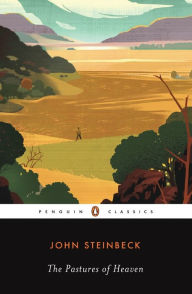
The Pastures of Heaven

The Pastures of Heaven. John Steinbeck. 1932. 207 pages. [Source: Library]

This was not my first Steinbeck, but, even so I didn't know quite what to expect. Sometimes I love, love, love his work, and, other times I really almost hate it. The Pastures of Heaven is a collection of inter-connected short stories set in California, spanning several decades, I believe.

I wouldn't consider myself a fan of short stories--usually. The one notable exception being my love for L.M. Montgomery's short stories. But. I found the stories within The Pastures of Heaven to be compelling and entertaining. I read the book all in one sitting, it was just that hard to put down. True, it's not a huge book. But still, it's worth noting all the same. There was a time when I read many books quickly, but, that isn't the case anymore.

The characters. What can I say? Some I really liked. Some I really hated. Some I almost felt pity for more than anything else. I think overall one could easily say that Steinbeck created very human, very flawed, very authentic-feeling characters. Some stories were on the amusing side; others were almost melancholy. I liked the variety. Not just of the emotions within the stories and the types of stories, but, also of the narratives, of the narrators.

I was not a fan of Grapes of Wrath, but, I am a fan of Pastures of Heaven.

Favorite quote:
He knew that the people who were to be his new neighbors were staring at him although he could never catch them at it. This secret staring is developed to a high art among country people. They have seen every uncovered bit of you, have tabulated and memorized the clothes you are wearing, have noticed the color of your eyes and the shape of your nose, and, finally have reduced your figure and personality to three or four adjectives, and all the time you thought they were oblivious to your presence. (12)


© 2016 Becky Laney of Becky's Book Reviews

Wednesday, November 11, 2015

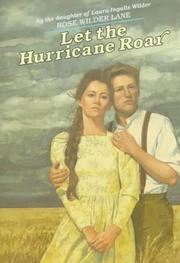
Let the Hurricane Roar (1932)

Let the Hurricane Roar. Rose Wilder Lane. 1932. 118 pages. [Source: Borrowed]

After reading Pioneer Girl by Laura Ingalls Wilder earlier this year, I was curious to read Rose Wilder Lane's Let the Hurricane Roar. If memory serves me, Rose Wilder Lane borrowed freely from her mother in terms of character and plot. That is while she was reading and editing and preparing her mother's manuscript to be sent off for possible publication, she was beginning to write her own pioneer-inspired novels, one of which is Let the Hurricane Roar. It has been a good six months or so since I read Pioneer Girl, so I don't remember the details clearly. This mother-and-daughter team were definitely writing at the same time about the same things, though I suppose for different audiences. Little House in the Big Woods was published in 1932, I believe, and Let the Hurricane Roar was published in 1933.

Let The Hurricane Roar is a historical fiction with a touch of romance. One could possibly say that it "celebrates" the pioneer spirit, but, it doesn't so much celebrate it and honor it as it does present it realistically. Life was hard, tough, at times seeming bleak and hopeless. The only thing abounding was often pride, stubbornness, gumption, if you will, and diligence. In short supply? Money and neighbors and life's luxuries.

Molly and David are the main characters of the novel. These two head out west, and it isn't long before Molly finds herself with child. Fearing to leave their new claim unsettled, she becomes enthusiastic about going with him to the claim and having the child all by herself. Who needs neighbors, friends, family, a midwife or a doctor? Molly proves to be just as proud and stubborn and spirited as her husband. (David DOES play the fiddle. And the two do endure several blizzards.)

To sum it all up, the book is more an account of horrible things happening to them within the first two or three years of settling their claim than anything else. That's not to say that the book lacks characterization. But it does lack characters, in some ways, since Molly and David are essentially on their own. Swedish neighbors, I believe, appear midway through and then depart again. And Molly does visit the nearest town in one or two chapters. But essentially it's just the three of them! (The baby doesn't do much if I'm honest.)

I liked it okay. It wasn't a great book that I simply loved and delighted in. But it was a solidly good read for anyone interested in pioneers.

© 2015 Becky Laney of Becky's Book Reviews

Sunday, February 08, 2015

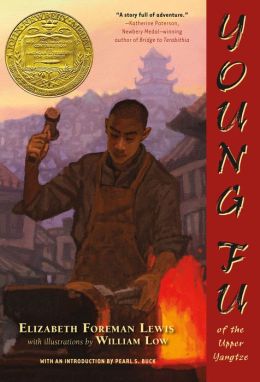
Young Fu of the Upper Yangtze (1932)

Young Fu of the Upper Yangtze. Elizabeth Foreman Lewis. illustrated by William Low. 1932/2008. Square Fish. 302 pages. [Source: Review copy]

Young Fu stood on the narrow curbing before Dai's two-storied tenement in Chair-Maker's Way, Chungking, and stared about him. In the doorway, Fu Be Be, his mother, directed load-coolies in placing the household goods which she had brought from home, and anxiously examined each article as it passed before her. 

After his father dies, Young Fu and his mother move to the city of Chungking. Young Fu is eager to begin his work as an apprentice to a coppersmith, Tang. He's grateful for the opportunity. And more fortunate still that it isn't his only opportunity for learning, for their new upstairs neighbor is willing to teach him to read and write.

Young Fu of the Upper Yangtze is a coming-of-age novel. The book follows him from the age of thirteen to eighteen, I believe. I would say the book is about his adventures and misadventures growing up, but, I'm not sure adventures is the right word. It captures his experiences growing up in China in the 1920s. Sometimes the experiences are memorable for all the right reasons. Sometimes not. He makes mistakes, he does. But he acknowledges his mistakes, seeks to make restoration, and grows wiser--or at least a little wiser.

I definitely enjoyed this one. I found it interesting. The chapters were long, in my opinion, but ultimately worth it.

© 2015 Becky Laney of Becky's Book Reviews
Wednesday, April 10, 2013

Little House in the Big Woods (1932)

Little House in the Big Woods. Laura Ingalls Wilder. 1932. 238 pages.

It's been almost five years since I last read the Little House books by Laura Ingalls Wilder. These are pure comfort reads. Though not every single book in the series is equally satisfying. I've never finished Farmer Boy, for example.

Little House in the Big Woods is an enjoyable, nostalgic read celebrating "the good life" of a young family. It is a way of life being celebrated or remembered. The focus is just on much on how Ma and Pa used to do things, as it is on the characters themselves.

Attention and detail given to preparing for all seasons of the year, washing, cleaning, cooking, baking, hunting, storing and saving for winter months, celebrating with family and extended family, etc. In the first chapter alone, the reader learns the joys of smoking venison and playing with a pigs' bladder not to mention the how-to's of making head cheese. Each episode, each observation offers the reader a window into the past. Some things have changed--and changed a lot--other things have remained the same. One of the things that resonates in this book--in this series is the love and joy of family life. Pa. Ma. Mary. Laura. Carrie. Each are part of the family. Each are important, valued, loved. The relationship of Laura with her parents and Laura with her sisters and Laura with her beloved dog, Jack, are timeless.

© 2013 Becky Laney of Becky's Book Reviews
Thursday, March 07, 2013

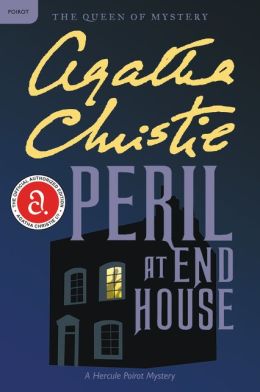
Peril at End House (1932)

Peril at End House. Agatha Christie. 1932. HarperCollins. 287 pages.

It is such a pleasure to read an Agatha Christie mystery. Peril at End House stars Hercule Poirot and Captain Hastings. (I really love it when Hastings is "helping" Poirot solve a case.) This mystery is a hard one for Poirot to solve, though he doesn't realize that until the very, very end! This is a novel that could very easily be spoiled so I won't say much about it except that it was a pure delight to read this one! 

I think I LOVED this one so much because it kept me guessing, and it kept Poirot and Hastings guessing as well! While it's not unusual for a mystery--a crime--to keep Hastings guessing, it was satisfying to see Poirot stumble around a bit!

Favorite quotes:
“Poirot," I said. "I have been thinking."
"An admirable exercise my friend. Continue it.”
“You have a tendency, Hastings, to prefer the least likely. That, no doubt, is from reading too many detective stories.” 
“Evil never goes unpunished, Monsieur. But the punishment is sometimes secret.” 
 Read Peril at End House
  • If you like Agatha Christie
  • If you like classic or vintage mysteries
  • If you like British cozy mysteries
  • If you like Captain Hastings and Hercule Poirot

© 2013 Becky Laney of Becky's Book Reviews
Tuesday, February 12, 2013

Devil's Cub (1932)

Devil's Cub. Georgette Heyer. 1932/2003. Harlequin. 272 pages.

 There was only one occupant of the coach, a gentleman who sprawled very much at his ease, with his legs stretched out before him, and his hands dug deep in the capacious pockets of his greatcoat.

Devil's Cub is the sequel to Georgette Heyer's These Old Shades. (These Old Shades is an adapted sequel of sorts to The Black Moth. All the names have changed from one book to another, the details and characterizations have not.) Leonie and Justin have a grown son who happens to fight duels somewhat regularly: a son who perhaps doesn't value human life quite enough. His name is Dominic (Vidal). And he's something. Does he take after his mother or father more?! That is the question. Either way, he needs some taming in order to be any woman's ideal husband.

Mary Challoner, our heroine, sees Dominic as TROUBLE. She doesn't want him for herself, certainly, and if she has her way, her sister won't have him either. Or should that be if Mary has her way, HE won't have her sister. For she fears that Dominic would never actually MARRY her sister, Sophie. Does she trust Sophie to do the right thing? NO. Mary feels it's her duty to watch out for her sister's reputation. So when Mary accidentally receives a letter from Dominic (Vidal), she decides not to pass the letter on. He's asked for a secret meeting--an "elopement" of sorts, telling her the time and place to meet him. Sophie knows his destination: Paris; but Mary hasn't a clue. She goes--disguised, wearing a mask--in her sister's place. Her true identity hidden at first, and then her true character hidden even more by a few lies she tells him. Perhaps Mary is not behaving wisely, but, she IS brave, opinionated, feisty, stubborn...even if she's not strong enough to prevent the kidnapping.

Does Dominic mean her harm? Perhaps in his initial rage...but it doesn't take him long to do something he's NEVER done before: offer a lady his name. He is willing to marry her, and quickly, and do whatever he can to make sure her reputation is spared, that most of the scandal is avoided. He is not only willing to marry her, he WANTS to marry her. For the more Mary engages in conversation with him, the more he realizes how wonderful she is. The more she holds her own, the more he WANTS her for herself. Not that he communicates this well exactly. For Mary doesn't know that Dominic "wants" her for herself and not just to save a lady in distress because it is honorable.

So much drama and excitement...and that's just one of the stories in The Devil's Cub. There are plenty of characters, plenty of subplots. So many ways to be entertained. Readers get reacquainted with these characters from These Old Shades: Justin and Leonie (duke and duchess of Avon); Lady Fanny Marling, Justin's sister; Lord Rupert Alastair, Justin's brother. We also meet Lady Fanny's son and daughter (John and Juliana). In fact, there is a second romance in Devil's Cub: Juliana and Frederick Comyn.

Loved this one from beginning to end! It would be WONDERFUL if Richard Armitage narrated this Heyer classic. He's narrated three other titles: Convenient Marriage, Venetia, and Sylvester.

Read Devil's Cub
  • If you like historical romances
  • If you like or love Georgette Heyer
  • If you enjoyed These Old Shades
© 2013 Becky Laney of Becky's Book Reviews
Tuesday, October 02, 2012

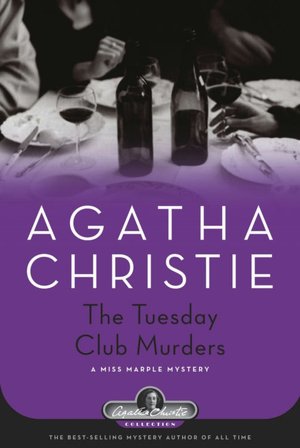
Tuesday Club Murders

The Tuesday Club Murders. Agatha Christie. 1932/2007. Black Dog & Leventhal Publishers. 256 pages.

I enjoyed The Tuesday Club Murders. While short stories are not my favorite, I prefer novels to short stories, I still enjoyed Miss Marple. This one may best be enjoyed one story at a time. There really isn't a need to rush through these stories all at once. There are thirteen stories in all: The Tuesday Night Club, The Idol House of Astarte, Ingots of Gold, The Blood-Stained Pavement, Motive v. Opportunity, The Thumb Mark of St. Peter, The Blue Geranium, The Companion, The Four Suspects, A Christmas Tragedy, The Herb of Death, The Affair at the Bungalow, and Death by Drowning. It wasn't so much that any one story WOWED me, it was more the fact that I enjoyed the cozy atmosphere of the stories as a whole. I liked Christie's writing and her characters. It was a pleasant way to spend my time.  

Read The Tuesday Club Murders
  • If you like short stories
  • If you like mysteries
  • If you like Agatha Christie
  • If you like Miss Marple

© 2012 Becky Laney of Becky's Book Reviews
Saturday, July 23, 2011

Swift Rivers (MG)

Swift Rivers. Cornelia Meigs. 1932/2004. Walker. 288 pages.

It was the summer that Chris Dahlberg was seventeen that he mowed the high meadow alone for the first time.

I can't say that I LOVED Swift Rivers. But I can say that I did enjoy it--most of it at least. I checked it out from the library not really knowing what to expect. My plan was to give it a chapter or two to see if it was even something I wanted to read. And it was. Chris Dahlberg is a great hero for an adventure story. After his parents' death, his Uncle became responsible for him. But this responsibility didn't include love and respect. Chris works hard day after day after day with no one to really appreciate him. Since the Uncle absolutely HATES his father--Chris' grandfather--when Chris decides to leave home for four days to check on his grandfather, the Uncle forbids him, warning him that if he leaves he shouldn't bother coming back. For he'll never, ever, ever welcome him back into his home. Knowing that the grandfather is getting older, knowing that there must be a reason why he didn't come to help the mowing this year--like he has every year since he can remember--he makes his decision. He just has to see if his grandfather needs help. He needs to see if grandfather is ready to make it through the winter. The uncle is true to his word, but that doesn't turn out to be such a bad thing. For Chris and his grandfather and a helpful neighbor or two come up with an idea. It's a bit of a risk, it's not really been done before, but if it succeeds, it will be the start of something big. Chris and his grandfather are determined to enter the logging business, to cut down trees, and float the logs down the river, etc.

Half of the novel is the adventure of the logs-down-the-river. How this journey changes Chris. So it's a coming-of-age adventure story set in the 1830s. It's an industrious novel--one that focuses on men hard at work. It's a dangerous job that requires focus and skill and determination.

I liked this one because I liked Chris. I didn't necessarily love all the descriptions of river rafting. But even though I wasn't loving each and every page, I still enjoyed it for the most part. 


© 2011 Becky Laney of Becky's Book Reviews

Friday, May 13, 2011

Sons

Sons. Pearl S. Buck. 1932/2005. Moyer Bell. 320 pages.

Wang Lung lay dying. He lay dying in his small, dark, old earthen house in the midst of his fields, in the room where he had slept as a young man, upon the very bed where he had lain on his marriage night. 

Sons is the second novel in Pearl S. Buck's Good Earth Trilogy. While the first novel chronicled the life of the farmer, Wang Lung, the second book chronicles the lives of Wang Lung's three sons: Wang the Eldest (also known as, Wang the Landlord), Wang the Second, (also known as, Wang the Merchant), and Wang the Third (also known as, Wang the Tiger). These are the same three sons that were nameless in The Good Earth.

If Sons has a main character, it is the youngest of Wang Lung's sons, Wang the Tiger. This is the 'rebellious' son that left home when his father took his third woman, Pear Blossom, in old age. The son that left home to become a soldier. If his father's ambition was to buy good land, to create a lasting legacy for his sons, Wang the Tiger's ambition is to be a great war lord, to collect an army--a well-trained, trustworthy army--and to make a name for himself. The book follows his life over several decades. We follow him on his ambitious journey. We witness his crimes in the name of justice--murdering robbers and bandits, murdering traitors in his own army, murdering the opposition. Wang the Tiger being just one of many war lords who choose to go to battle in the spring of each year. (And it really did seem that random. Who are we going to go fight this year? Okay! Let's go!) If there was logic involved in the warring, I missed it. I mean it was "I want more power, more land, more glory, more people paying taxes TO ME" which turned into who do I kill to get what I want. (Or at the very least who would I be willing to kill if he doesn't feel like surrendering to me.)

For the first two-thirds of the novel, Wang the Tiger believes that he will never get married, that he'll never have sons of his own. But. As he gets a little older, he begins to see things differently. He begins to want a son of his own. A son to be a great soldier, a great leader, a great war lord. His ambitions turn from himself to his son. So he asks his two brothers for help. Each brother selects a wife for him. And Wang the Tiger does not have a favorite wife--he barely recognizes that they have faces and are capable of speech. (Yes, it really is that bad.) One wife gives birth to a daughter, another gives birth to a son. (I don't believe the wives or the sons have names. Though I could be wrong about the son. Chances are he'll have a name in the next novel, A House Divided.)

So do you think that this son will grow up to please his father in every way? Or will this rebellious son have a rebellious son of his own?

This novel doesn't exclusively focus on Wang the Tiger. We also learn about Wang the Landlord, his two wives (still nameless), his sons and daughters (also nameless) and Wang the Merchant, his wife (still nameless), and their children (also nameless). We see their strengths and weaknesses. We see how these brothers relate to one another--on the rare occasions they come together. It's interesting to see how the brothers treat Wang the Tiger. When his future is still uncertain, when his army is unproved, the two are very reluctant to ally themselves with him. But when things change, then they definitely change the way they treat him!

I'm not sure that I "liked" any of the characters in this one. Wang the Tiger can be fierce and cruel when angry. And sometimes his anger is justifiable. But not always. And Wang the Tiger sees himself as being too soft--not hard enough, not cruel enough. He feels that he should be able to kill on a whim without having to be good and angry first. He wishes that he didn't feel what (little) he feels. He's definitely VERY different from Wang Lung. As for Wang the Merchant and Wang the Landlord, I feel what we get are mostly one-dimensional portraits. Wang the Landlord is given to pleasure--selfish pleasure. He doesn't know how to say no--when it comes to himself, when it comes to his eldest son, when it comes to pleasing his two wives and keeping peace in the house. He spends money freely, recklessly. And he has no great ambition in life other than to feel pleasure at every opportunity. Wang the Merchant, on the other hand, is greedy--but in a different way. He's a shrewd business man. He wants to make as much money as possible. He's not above using guile if it helps him make a bit more money with each transaction. He does not want money so he can spend it. He does not believe in needlessly spending money--just because you have it, just because you can, just to show other people how much you've got. He's practical. He's got a plan. Wang the Tiger definitely has thoughts about each of his brothers!

I'm not sure I'd recommend The Good Earth and Sons. But if you've read The Good Earth, I would recommend--unless you ABSOLUTELY hated it--continuing on with the series. It is interesting to see how these two books contrast one another, and to see the family drama continue through a second generation.

© 2011 Becky Laney of Becky's Book Reviews
Wednesday, January 19, 2011

Have His Carcase

Have His Carcase. Dorothy L. Sayers. 1932/1995. HarperCollins. 448 pages. 

The best remedy for a bruised heart is not, as so many people seem to think, repose upon a manly bosom. Much more efficacious are honest work, physical activity, and the sudden acquisition of wealth.

Harriet Vane and Lord Peter Wimsey star in this mystery novel by Dorothy L. Sayers. After the murder charge against her has been dropped, Harriet Vane needs a good vacation. And so we find her, when the novel opens, on a little trip. But relaxing isn't quite the right word for her vacation. For it turns into another murder mystery. She discovers the body of a man on the beach. She has just enough time to take a few quick pictures of the body--of the crime scene--before the tide begins to threaten both. She seeks help--the police--but the damage has already been done. The body has vanished into the sea.

Is this murder? Is this suicide? There seems to be problems with both theories. Lord Peter Wimsey has his ideas--as does Harriet--but can they ever agree with the police in the matter? As these two set about privately investigating the affair, can they work out some of their personal problems too? For you see, Lord Peter still is madly, deeply in love with Harriet. And. He's still proposing. Often.

I still love Harriet and Lord Peter. I do. I just LOVE, LOVE, LOVE Lord Peter Wimsey! I've included some of my favorite scenes--but none of what I include is a spoiler to the mystery, so don't worry about that!

She fell a victim to an inferiority complex, and tripped over her partner's feet.
"Sorry," said Wimsey, accepting responsibility like a gentleman.
"It's my fault," said Harriet. "I'm a rotten dancer. Don't bother about me. Let's stop. You haven't got to be polite to me, you know."
Worse and worse. She was being peevish and egotistical. Wimsey glanced down at her in surprise and then suddenly smiled.
"Darling, if you danced like an elderly elephant with arthritis, I would dance the sun and moon into the sea with you. I have waited a thousand years to see you dance in that frock."
"Idiot!" said Harriet (151).

"Why didn't you sock him one over the jaw?"
"It was a temptation. I felt that you would love me better if I did. But you would not, in your calmer moments, really wish me to put my love before my detective principles."
"Certainly not. But what's his idea?" (152)

"I may be everything you say--patronizing, interfering, conceited, intolerable, and all the rest of it. But do give me credit for a little intelligence. Do you think I don't know all that? Do you think it's pleasant for any man who feels about a woman as I do about you, to have to fight his way along under this detestable burden of gratitude? Damn it, do you think I don't know perfectly well that I'd have a better chance if I was deaf, blind, maimed, starving, drunken, or dissolute, so that you could have the fun of being magnanimous? Why do you suppose I treat my own sincerest feelings like something of a comic opera, if it isn't to save myself the bitter humiliation of seeing you try not to be utterly nauseated by them? Can't you understand that this damned dirty trick of fate has robbed me of the common man's right to be serious about his own passions? Is that a position for any man to be proud of?"
"Don't talk like that."
"I wouldn't, if you didn't force me. And you might have the justice to remember that you can hurt me a damned sight more than I can possibly hurt you."
"I know I'm being horribly ungrateful--"
"Hell!" (167)

"I could kiss you for it. You need not shrink and tremble. I am not going to do it. When I kiss you, it will be an important event--one of those things which stand out among their surroundings like the first time you tasted li-chee. It will not be an unimportant sideshow attached to a detective investigation." (203)

"Now then! My dear, what's happened? You're all of a doodah!"
"Peter! I believe I've been kissed by a murderer."
"Have you? Well, it serves you right for letting anybody kiss you but me. Good heavens! You raise all sorts of objections to a perfectly amiable and reasonably virtuous man like myself, and the next thing I hear is that you are wallowing in the disgusting embraces of a murderer. Upon my soul! I don't know what the modern girl is coming to." (234)
I would definitely recommend Dorothy Sayers. Particularly, Whose Body, Strong Poison, and Have His Carcase.


© 2011 Becky Laney of Becky's Book Reviews
Friday, December 25, 2009

Devil's Cub


Heyer, Georgette. 1932/2009. Devil's Cub. Sourcebooks. 310 pages.

There was only one occupant of the coach, a gentleman who sprawled very much at his ease, with his legs stretched out before him, and his hands dug deep in the capacious pockets of his greatcoat.

Every Heyer book is packed with potential--with promise. Will it be the one to become my new favorite and best? Can it top the previous Heyer novels I've read? Because just when I think I've found the perfect Heyer, the one that just has to be the best one ever, I find myself falling for another hero, charmed by another great couple, or hooked by another adventure or drama.

Devil's Cub is a sequel to These Old Shades. That giddy-making couple of Justin and Leonie have an all-too-grown-up son, Dominic (aka Vidal). And boy does he have a way of getting into trouble. (Some might say he takes after his dear old dad--back before his marriage calmed him down. Though Leonie fears he takes after her--after her side of the family.) After his latest scandal, his father decides it would be best for him to leave England, to spend some time in Europe. His mother would like to see him settled down, married to a girl who can calm him down and keep him safe and happy. (If he's happily married then surely he won't be getting into so many duels. After all, he's mostly fighting men over women.)

But Vidal doesn't head to France (to Paris) alone. He plans on taking Sophia Challoner along with him. To set her up as his mistress. (Tis done there, he assures her.) He sends a letter, a note, telling her where and when to meet him. She doesn't get the note. It's intercepted by her older sister, Mary. (In poor Mary's defense, it is addressed to "Miss Challoner.) How can one sister save the other? Well, for better or worse, Mary decides to go disguised in her place. Granted, she doesn't know the destination (Paris). She thinks she'll be able (easily) to return home after her true identity is discovered. But what she doesn't know about Vidal could fill a book.

How will he react to this trick? Can Mary hold her own?

I love, love, loved this book. Granted, I didn't love everything about this one. There is one scene in particular that I didn't care for at all. (One scene that made me very uncomfortable--SPOILER--a scene where Vidal wants to show his strength to Mary--pointing out how easy it would be for him to do her harm.) But for the most part, I really enjoyed this one. It wasn't so much Mary-and-Dominic that I loved so much as the whole package. All the characters (about half of these were carried over from These Old Shades) that make this one work really well. I loved how everything came together at the end. It was oh-so-satisfying.

I mentioned that These Old Shades is my mom's favorite book. Well, I think Devil's Cub might end up being mine. At least for now.

© Becky Laney of Becky's Book Reviews