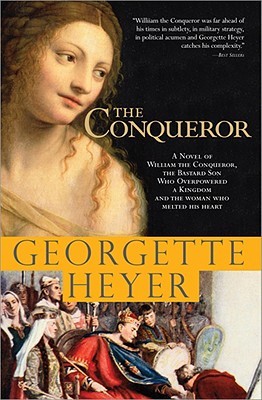
The Conqueror by Georgette Heyer. 1931/2008. Sourcebooks. 469 pages. [Source: Review copy]
First sentence: There was so much noise in the market-place, such a hubbub of shouting and chaffering, that Herleva dragged herself to the window of her chamber and stood peeping down through the willow-slats that made a lattice over the opening.
Premise/plot: The Conqueror is a historical novel about William the Conqueror. It begins with his birth and ends with his coronation in December of 1066. It is not told from his perspective; it is told from the perspective of one of his loyal men--servants, warriors--Raoul.
My thoughts: Would The Conqueror conquer me or would I conquer The Conqueror? I knew from the start it would be a close call. Indeed it was. If I have biases, I thought they would work in favor of The Conqueror. I love history. I love historical fiction. I often enjoy novels about 'the royals.' It was also written by Georgette Heyer. I love and adore her, right?!?! (I can honestly say that if this was the first Heyer novel I picked up, I would never pick up another one.)
I didn't care about the characters for the most part. I don't blame Raoul, not really. One developed character cannot make a good novel. And essentially that's what we get. We may learn enough about Raoul to find him believable as a human being, but, the other characters not so much. Duke William, aka William the Conqueror remains distant, disconnected, unknowable, unlikable. Scenes vary--alternate--from battle scenes to groups of his men sitting around talking about how distant the Duke is. And perhaps that is how it should be. He's the ruler of Normandy. He's an illegitimate son. He's not overly liked or popular in some circles. Every person is a potential threat, a potential enemy, a potential betrayer. Raoul has proved himself loyal where other men had failed him. Raoul is easily part of his inner circle, but Raoul isn't necessarily an equal-equal either.
The one relationship I liked was between Raoul and Edgar.
Duke William has one thing--possibly two--on his mind. He's an ambitious, greedy man who lusts for the throne of England from a relatively early age. I'm not convinced that Heyer wants us to like him. Actually, I'm not sure of what Heyer intended. I doubt her intentions were to put readers to sleep. I doubt her intentions were to make a 470 page novel feel like 2,000 pages. Were we supposed to be cheering William on throughout the novel? Were we supposed to find the battle scenes thrilling? And his quest to be the next king of England noble and admirable?
I felt relief upon finishing the novel.
© 2018 Becky Laney of Becky's Book Reviews
Showing posts with label 1931. Show all posts
Friday, August 24, 2018
Wednesday, July 04, 2018
Barracoon
Barracoon: The story of the Last Black Cargo. Zora Neale Hurston. 2018. HarperCollins. 2018. 256 pages. [Source: Library]
First sentence of the preface: This is the life story of Cudjo Lewis, as told by himself.
Premise/plot: When he was a young man, Kossula was captured by the Dahomey and eventually sold to American slave traders. The year was 1860. Though a slave for just five years--give or take--the experience forever changed him. In 1927, Kossula (aka Cudjo Lewis) met--befriended--a young folklorist named Zora Neale Hurston. His story was important to capture, and Hurston wanted to be the one to do it--in his own words, in his own style. Which meant it was to be written in dialect, in a conversational style. The manuscript did not find a publisher in Hurston's lifetime. But it has now.
He tells his story in his own way in his own words. He speaks of Africa. He tells of his family, his community, his childhood. He shares memories of visiting his grandfather's home, of his funeral, for example. He talks of learning to hunt and initial training to become a soldier. He was still too young to be a soldier, to join the grown-ups in his village; he was still too young to build his own house and marry. But he didn't get a chance to live the life he thought he would.
His life was interrupted--brutally so. The Dahomey attacked his gated village: capturing some, slaughtering the rest. He was among the captured young men and women. He was kept prisoner in the barracoons of Ouidah (Whydah) until he was purchased by slave traders and loaded as cargo onto the ship Clotilda. He tells of the journey and the destination. He shares his experiences as a slave. He talks of his experiences as a free man. There was no going back. There was no erasing those years. He was cut off from the future that should have been his--his home in Africa. There are stories about his wife, his children, his grandchildren. Make no mistake it's a hard life.
I would recommend it.
© 2018 Becky Laney of Becky's Book Reviews
First sentence of the preface: This is the life story of Cudjo Lewis, as told by himself.
Premise/plot: When he was a young man, Kossula was captured by the Dahomey and eventually sold to American slave traders. The year was 1860. Though a slave for just five years--give or take--the experience forever changed him. In 1927, Kossula (aka Cudjo Lewis) met--befriended--a young folklorist named Zora Neale Hurston. His story was important to capture, and Hurston wanted to be the one to do it--in his own words, in his own style. Which meant it was to be written in dialect, in a conversational style. The manuscript did not find a publisher in Hurston's lifetime. But it has now.
He tells his story in his own way in his own words. He speaks of Africa. He tells of his family, his community, his childhood. He shares memories of visiting his grandfather's home, of his funeral, for example. He talks of learning to hunt and initial training to become a soldier. He was still too young to be a soldier, to join the grown-ups in his village; he was still too young to build his own house and marry. But he didn't get a chance to live the life he thought he would.
His life was interrupted--brutally so. The Dahomey attacked his gated village: capturing some, slaughtering the rest. He was among the captured young men and women. He was kept prisoner in the barracoons of Ouidah (Whydah) until he was purchased by slave traders and loaded as cargo onto the ship Clotilda. He tells of the journey and the destination. He shares his experiences as a slave. He talks of his experiences as a free man. There was no going back. There was no erasing those years. He was cut off from the future that should have been his--his home in Africa. There are stories about his wife, his children, his grandchildren. Make no mistake it's a hard life.
"My Grandpa, he a great man. I tellee you how he go."
I was afraid that Cudjo might go off on a tangent, so I cut in with, "But Kossula, I want to hear about you and how you lived in Africa."
He gave me a look full of scornful pity and asked, "Where is de house where de mouse is de leader? In de Affica soil I cain tellee you 'bout de son before I tellee you 'bout de father; and derefore, you unnerstand me, I cain talk about de man who is father till I tellee you bout de man who he father to him, now, dass raight ain' it?" (20)
"Ole Charlie, he de oldest one come from de Afficky soil. One Sunday after my wife left me he come wid all de others dat come cross de water and say, 'Uncle Cudjo, make us a parable.'My thoughts: I am so glad I read this one. I have long been a fan of Zora Neale Hurston. I was introduced to her work in college and LOVED, LOVED, LOVED it. I would recommend this one. It isn't necessarily easy reading. Some readers may struggle with the dialect. More readers may struggle with the content. I think many of us--if not most of us--want to look away from pain and cruelty and injustice. Even when we know we shouldn't. We don't want to know how it feels, what it looks like. We don't want to be witness to it. But his story deserves to be known and known widely.
'Well den,' I say, 'You see Ole Charlie dere. S'pose he stop here on de way to church. He got de parasol 'cause he think it gwine rain when he leave de house. But he look at de sky and 'cide hit ain' gwine rain so he set it dere by de door an' go on to church. After de preachin' he go on home 'cause he think de parasol at Cudjo house. It safe. He say, 'I git it nexy time I go dat way.' When he come home he say to one de chillun, 'Go to Cudjo house and tellee him I say sendee me my parasol.' 'De parasol it pretty. I likee keep dat one.' But I astee dem all, 'Is it right to keep de parasol?' Dey all say, 'No it belong to Charlie.' 'Well,' I say, 'my wife, she b'long to God. He lef' her by my door.'" (92)
I would recommend it.
© 2018 Becky Laney of Becky's Book Reviews
Friday, March 30, 2018
Angus and the Cat
Angus and the Cat. Marjorie Flack. 1931. 32 pages. [Source: Bought]
First sentence: Each day as Angus grew older he grew longer but not much higher. Scottie dogs grow that way. Now as Angus grew older and longer he learned MANY THINGS.
Premise/plot: After a few pages sharing what Angus has learned, readers learn that there was one thing Angus was very curious about but had never learned about: CATS. He will have plenty of opportunity to do so when his owner (whom we never see) adopts a cat. Will Angus and the new cat get along?! How much will life change for Angus?!
My thoughts: This is a great little story! I was not familiar with this classic. I discovered it at a local charity bookstore earlier this month. It was instant love on my part!!! I adore the illustrations. And the story is super-sweet!
Text: 4 out of 5
Illustrations: 5 out of 5
Total: 9 out of 10
© 2018 Becky Laney of Becky's Book Reviews
First sentence: Each day as Angus grew older he grew longer but not much higher. Scottie dogs grow that way. Now as Angus grew older and longer he learned MANY THINGS.
Premise/plot: After a few pages sharing what Angus has learned, readers learn that there was one thing Angus was very curious about but had never learned about: CATS. He will have plenty of opportunity to do so when his owner (whom we never see) adopts a cat. Will Angus and the new cat get along?! How much will life change for Angus?!
My thoughts: This is a great little story! I was not familiar with this classic. I discovered it at a local charity bookstore earlier this month. It was instant love on my part!!! I adore the illustrations. And the story is super-sweet!
Text: 4 out of 5
Illustrations: 5 out of 5
Total: 9 out of 10
© 2018 Becky Laney of Becky's Book Reviews
Monday, January 27, 2014
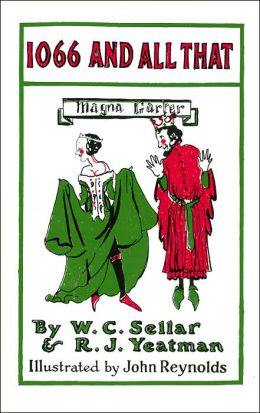
1066 And All That (1931)
1066 And All That. W.C. Sellar & R.J. Yeatman. 1931/1993. Barnes & Noble. 116 pages. [Source: Bought]
What an odd little book. An odd little book that purposefully messes around with historical facts and figures just trying to make readers of all ages laugh. I'll try to give you several examples of what makes this book unique. I think that is probably the only way to do this book justice. It will either be a book that appeals to your sense of humor, or, not.
© 2014 Becky Laney of Becky's Book Reviews
What an odd little book. An odd little book that purposefully messes around with historical facts and figures just trying to make readers of all ages laugh. I'll try to give you several examples of what makes this book unique. I think that is probably the only way to do this book justice. It will either be a book that appeals to your sense of humor, or, not.
The Ancient Britons were by no means savages before the Conquest, and had already made great strides in civilization, e.g. they buried each other in long round wheelbarrows (agriculture) and burnt each other alive (religion) under the guidance of even older Britons called Druids or Eisteddfods, who worshipped the Middletoe in the famous Druidical churchyard at Stoke Penge. (3)
The conversion of Britain was followed by a Wave of Danes, accompanied by their sisters or Sagas, and led by such memorable warriors as Harold Falsetooth and Magnus the Great, who, landing correctly in Thanet, overran the country from right to left, with fire. After this the Danes invented a law called the Danelaw, which easily proved that since there was nobody else left alive there, all the right-hand part of England belonged to them. The Danish Conquest, was, however undoubtedly a Good Thing, because although it made the Danes top nation for a time it was the cause of Alfred the Cake (and in any case they were beaten utterly in the end by Nelson). (8)
King Arthur invented Conferences because he was secretly a Weak King and liked to know what his memorable thousand and one Knights wanted to do next. (10)
Alfred had a very interesting wife called Lady Windermere (The Lady of the Lake), who was always clothed in the same white frock, and used to go bathing with Sir Launcelot (also of the Lake) and was thus a Bad Queen. (11)
With Edward the Confessor perished the last English King (viz. Edward the Confessor), since he was succeeded by Waves of Norman Kings (French), Tudors (Welsh), Stuarts (Scottish), and Hanoverians (German), not to mention the memorable Dutch King Williamanmary. (15)
The Norman Conquest was a Good Thing, as from this time onwards England stopped being conquered and thus was able to become top nation. (17)
The chapters between William I (1066) and the Tudors (Henry VIII, etc.) are always called the Middle Ages, on account of their coming at the beginning. (22)
About this time the memorable hero Robin Hood flourished in a romantic manner. Having been unjustly accused by two policemen in Richmond Park, he was condemned to be an outdoor and went and lived with a maid who was called Marion, and a band of Merrie Men, in Greenwood Forest, near Sherborne. Amongst his Merrie Men were Will Scarlet (The Scarlet Pimpernel), Black Beauty, White Melville, Little Red Riding Hood (probably an outdaughter of his) and the famous Friar Puck who used to sit in a cowslip and suck bees, thus becoming so fat that he declared he could put his girdle round the Earth. (27)
Richard II was only a boy at his accession; one day, however, suspecting that he was now twenty-one, he asked his uncle and, on learning that he was, mounted the throne himself and tried first being a Good King and then being a Bad King, without enjoying either very much; then, being told that he was unbalanced, he got off the throne again in despair, exclaiming gloomily, "For God's sake let me sit on the ground and tell bad stories about cabbages and things." Whereupon his cousin Lancaster (spelt Bolingbroke) quickly mounted the throne and said he was Henry IV, Part I. (43)
During this reign the Hundred Years War was brought to an end by Joan of Ark, a French descendant of Noah who after hearing Angel voices singing Do Re Mi became inspired, thus unfairly defeating the English in several battles. (47)I thought it was an interesting read, definitely unique. But I can't say that I loved it or anything.
© 2014 Becky Laney of Becky's Book Reviews
Tuesday, July 02, 2013
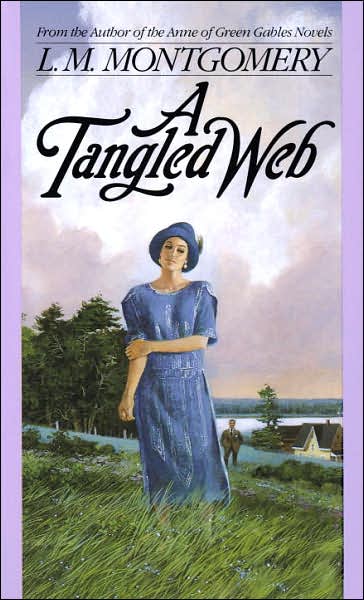
Tangled Web (1931)
A dozen stories have been told about the old Dark jug. This is the true one.
A Tangled Web is certainly different from L.M. Montgomery's other novels. There isn't one main character or even one main story. Though I suppose one could argue that the two family clans putting on a show--acting their absolute best, just in case--over the "old Dark jug" might be the "big story." (While Aunt Becky left a will concerning all of her possessions, the new owner of the "old Dark jug" will not be revealed until a year has passed from her death.)
Tangled Web is ALL about relationships. It's about a family. A dysfunctional family. A large clan of somewhat eccentric, wonderfully flawed characters. The Darks and the Penhallows. The matriarch of the clan is Aunt Becky. (Becky Dark, nee Penhallow). She's an old woman (85), a character if ever there was one. A lady who speaks her mind. The kind of character you love reading about.
The
book opens with Aunt Becky deciding to hold a "levee." A clannish get
together--minus the food and drinks--to discuss her will. At the party
everyone will learn who gets what. All of them--young and old, married
and single--want the old Dark jug, the "priceless" family heirloom
dating back a hundred years or so. The
book examines so many characters, so many relationships, that it is easy
to see why the title "A Tangled Web" is appropriate. But it is also one
of the reasons that I love it. It's complex and clever and memorable.
Unlike
some of L.M. Montgomery's other books, this one was a contemporary
novel. Published in 1931, it was set within that time frame, the modern
era. It's told in six parts or sections: "Aunt Becky's
Levee," "Wheels Within Wheels," "Midsummer Madness," "The Moving
Finger," "Blindly Wise," and "Finally, Brethren." It follows individuals
within the family through the course of a year as everyone waits and
sees who will be the one to get the jug. Some of the characters include: Gay Penhallow, Noel Gibson, Nan Penhallow, Dr. Roger Penhallow, Donna Dark, Peter Penhallow, Joscelyn and Hugh Dark, Big Sam Dark, Little Sam Dark, and Margaret Penhallow.
L.M. Montgomery was wonderful with characters. She was an amazing storyteller. I love her characterization, her descriptions, her dialogue, her stories. A Tangled Web is a very enjoyable read!
© 2013 Becky Laney of Becky's Book Reviews
Wednesday, June 12, 2013
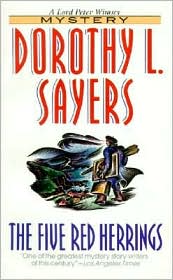
The Five Red Herrings (1931)
The Five Red Herrings. Dorothy L. Sayers. 1931. HarperCollins. 325 pages.
If one lives in Galloway, one either fishes or paints. "Either" is perhaps misleading, for most of the painters are fishers also in their spare time. To be neither of these things is considered odd and almost eccentric.
I enjoyed rereading The Five Red Herrings. This one is not a particular favorite of mine. But it is always fun to spend time with Lord Peter and Bunter! In this mystery, Lord Peter is visiting a small community of artists in Scotland. One of the most obnoxious artists gets murdered within the opening chapters. There are plenty of suspects, plenty of motives, plenty of opportunities. Hardly anyone in this community has a good, believable alibis. It seems like most of the suspects are keeping back things from the police. Can Lord Peter solve the crime? If anyone can do it, he can. For it was his detective instincts which showed this death was murder and not an accident. He KNOWS that there is a huge clue to solving the crime, a clue that the police don't place the same importance on. Which is why Lord Peter may just be one of the best!
Favorite quotes:
I was born looking foolish and every day in every way I am getting foolisher and foolisher. (52)
One of these days I shall write a book in which two men are seen to walk down a cul-de-sac, and there is a shot and one man is found murdered and the other runs away with a gun in his hand, and after twenty chapters stinking with red herrings, it turns out that the man with the gun did it after all. (114)
The essence of detection is secrecy. It has no business to be spectacular. But you can watch me if you like. (218)
© 2013 Becky Laney of Becky's Book Reviews
Monday, February 04, 2013
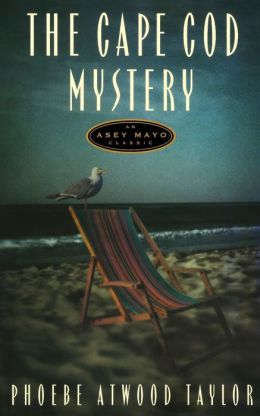
The Cape Cod Mystery (1931)
The Cape Cod Mystery. Phoebe Atwood Taylor. 1931. Countryman Press. 190 pages.
"'Heat wave hits East,'" Betsey read. "'Prostration record of all time. Mercury soaring.' Well that's gone and torn our peaceful vacation, that has. By tonight we'll have a stack of telegrams a yard high from city-sizzling friends who want to get cooled off." I sighed a little. "I know," I said wearily. As a perennial and thoroughly experienced summer cottager on Cape Cod I sat back to await the inevitable deluge.
I really enjoyed Phoebe Atwood Taylor's The Cape Cod Mystery. This is the first Asey Mayo mystery. There are twenty-four in the series spanning twenty years. The Cape Cod Mystery is not narrated by Asey Mayo, in fact, Maso is not introduced until after the body has been discovered and an arrest has been made. It is narrated by Prudence Whitsby; she is a very charming narrator. The novel opens with Prudence and Betsey deciding to invite TWO guests to visit them in their summer cottage. They have received plenty of telegrams already. But. They eventually decide to invite two women who have not asked for an invitation. Betsey selects one guest, Dot, and Prudence selecting the second, Emma. Soon after their arrival, Prudence discovers a dead body. The victim is a writer, Dale Sanborn. He's just recently arrived and rented a cottage, very few people know that "a famous writer" is in their midst. But someone obviously knew where to find him and had reason enough to kill him...
Prudence and Asey Mayo have no idea who the real killer is. But both know beyond a doubt that it isn't the man arrested for the crime, Bill Porter. These two will have to do some detective work. The officials have stopped looking for the murderer since they're sure they've already arrested him... There are plenty of clues, plenty of suspects, plenty of details to try to make a logical narrative of the crime.
I loved so many things about this one! I would definitely recommend this author!
Read The Cape Cod Mystery
"'Heat wave hits East,'" Betsey read. "'Prostration record of all time. Mercury soaring.' Well that's gone and torn our peaceful vacation, that has. By tonight we'll have a stack of telegrams a yard high from city-sizzling friends who want to get cooled off." I sighed a little. "I know," I said wearily. As a perennial and thoroughly experienced summer cottager on Cape Cod I sat back to await the inevitable deluge.
I really enjoyed Phoebe Atwood Taylor's The Cape Cod Mystery. This is the first Asey Mayo mystery. There are twenty-four in the series spanning twenty years. The Cape Cod Mystery is not narrated by Asey Mayo, in fact, Maso is not introduced until after the body has been discovered and an arrest has been made. It is narrated by Prudence Whitsby; she is a very charming narrator. The novel opens with Prudence and Betsey deciding to invite TWO guests to visit them in their summer cottage. They have received plenty of telegrams already. But. They eventually decide to invite two women who have not asked for an invitation. Betsey selects one guest, Dot, and Prudence selecting the second, Emma. Soon after their arrival, Prudence discovers a dead body. The victim is a writer, Dale Sanborn. He's just recently arrived and rented a cottage, very few people know that "a famous writer" is in their midst. But someone obviously knew where to find him and had reason enough to kill him...
Prudence and Asey Mayo have no idea who the real killer is. But both know beyond a doubt that it isn't the man arrested for the crime, Bill Porter. These two will have to do some detective work. The officials have stopped looking for the murderer since they're sure they've already arrested him... There are plenty of clues, plenty of suspects, plenty of details to try to make a logical narrative of the crime.
I loved so many things about this one! I would definitely recommend this author!
Read The Cape Cod Mystery
- If you love vintage mysteries
- If you enjoy mysteries, American mysteries
Tuesday, September 06, 2011
The Five Red Herrings
The Five Red Herrings. Dorothy L. Sayers. 1931. HarperCollins. 325 pages.
If one lives in Galloway, one either fishes or paints. "Either" is perhaps misleading, for most of the painters are fishers also in their spare time. To be neither of these things is considered odd and almost eccentric.
The Five Red Herrings is the seventh mystery starring Lord Peter Wimsey. Lord Peter is a character that I just love and adore. He's just one of my favorite, favorite, favorite characters ever. So I was so happy to read another mystery in this series.
In The Five Red Herrings, Lord Peter Wimsey is on vacation in Scotland. Though he neither paints or fishes, he is accepted--for the most part--by the community. It's hard to not like him, after all! Early in the novel--though I'm not sure if it's early in his holiday--a murder is committed. The "victim" is someone EVERYONE hates; threats against this guy were so common that they were hardly worth taking seriously. I mean Campbell, the victim, was just impossible to get along with. But now that he's dead, it is up to the police (the constables and detectives, etc.) to solve the crime. And since Lord Peter just happens to be very, very good at detecting, he offers to help them out.
There are six suspects--all artists. Hugh Farren, Henry Strachan, Matthew Gowan, Jock Graham, Michael Waters, and Ferguson. All had motive, all had opportunity. All of them are lying, all of them are hiding things from the police. Since there are so many suspects, since they all appear equally capable of committing the crime, it's just a matter of discerning the truth. Which theory--which plausible theory--is the truth? Which is most likely? Which uses all the clues that have been left behind?
Five Red Herrings is set in Scotland. And, for me, it was a delightful mystery.
Lord Peter Wimsey:
© 2011 Becky Laney of Becky's Book Reviews
If one lives in Galloway, one either fishes or paints. "Either" is perhaps misleading, for most of the painters are fishers also in their spare time. To be neither of these things is considered odd and almost eccentric.
The Five Red Herrings is the seventh mystery starring Lord Peter Wimsey. Lord Peter is a character that I just love and adore. He's just one of my favorite, favorite, favorite characters ever. So I was so happy to read another mystery in this series.
In The Five Red Herrings, Lord Peter Wimsey is on vacation in Scotland. Though he neither paints or fishes, he is accepted--for the most part--by the community. It's hard to not like him, after all! Early in the novel--though I'm not sure if it's early in his holiday--a murder is committed. The "victim" is someone EVERYONE hates; threats against this guy were so common that they were hardly worth taking seriously. I mean Campbell, the victim, was just impossible to get along with. But now that he's dead, it is up to the police (the constables and detectives, etc.) to solve the crime. And since Lord Peter just happens to be very, very good at detecting, he offers to help them out.
There are six suspects--all artists. Hugh Farren, Henry Strachan, Matthew Gowan, Jock Graham, Michael Waters, and Ferguson. All had motive, all had opportunity. All of them are lying, all of them are hiding things from the police. Since there are so many suspects, since they all appear equally capable of committing the crime, it's just a matter of discerning the truth. Which theory--which plausible theory--is the truth? Which is most likely? Which uses all the clues that have been left behind?
Five Red Herrings is set in Scotland. And, for me, it was a delightful mystery.
Lord Peter Wimsey:
I was born looking foolish and every day in every way I am getting foolisher and foolisher. (52)
One of these days I shall write a book in which two men are seen to walk down a cul-de-sac, and there is a shot and one man is found murdered and the other runs away with a gun in his hand, and after twenty chapters stinking with red herrings, it turns out that the man with the gun did it after all. (114)
The essence of detection is secrecy. It has no business to be spectacular. But you can watch me if you like. (218)
© 2011 Becky Laney of Becky's Book Reviews
Tuesday, May 10, 2011
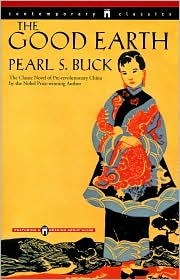
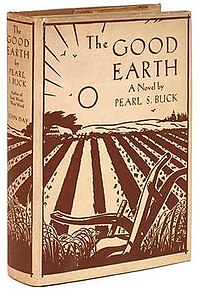
The Good Earth
The Good Earth. Pearl S. Buck. 1931/2004. Simon & Schuster. 368 pages.
It was Wang Lung's marriage day. At first, opening his eyes in the blackness of the curtains about his bed, he could not think why the dawn seemed different from any other. The house was still except for the faint, gasping cough of his old father, whose room was opposite to his own across the middle middle room. Every morning the old man's cough was the first sound to be heard. Wang Lung usually lay listening to it and moved only when he heard it approaching nearer and when he heard the door of his father's room squeak upon its wooden hinges. But this morning he did not wait.
The Good Earth was Pearl S. Buck's second novel. (Her first novel was East Wind: West Wind, a novel that I just LOVED AND ADORED!)
The Good Earth is very different from East Wind: West Wind. Though both books are, of course, set in China. East Wind: West Wind focused on a changing China and the tension between the East and West and how that change impacted family life and added drama and stress to family dynamics. How the new way of life threatened centuries-old traditions. The Good Earth is more about the haves and have-nots. It's a novel about poverty and riches.
Wang Lung, our hero, is a humble farmer. He works the land. Slaves on it really. Has barely enough food to feed himself and his father. Most days they can't even afford to have tea leaves in their hot water. Yet he's managed to arrange himself a marriage with a hand-me-down woman, a slave from a rich household--one of the richest households in the village, the House of Hwang. O-lan, his wife, is ugly but hardworking. (For example, she joins her husband in the fields just hours after giving birth to their son.)
The early years of their marriage--the first three to four years of their marriage--are happy. Wang Lung is able to save up money to buy some land--land formerly owned by the House of Hwang. He's working harder than ever. He's got his wife by his side--most of the time. And she's given birth to two sons and one daughter. Things seem to be going well for them. Wang Lung is hopeful that things will keep looking up, that the land will keep producing, etc.
But then drought and famine come and devastate the region. And because he's done better than his neighbors in the past, they don't feel bad for robbing what little he has now in this distress. Things begin to look very bleak indeed. How will Wang-Lung support his father, his wife, his three children, himself, and the new little one on the way?! He can't. Not if he stays where he is.
So the family travels and begins to beg. It's a tough, tough life. A life that calls for HORRIBLE decisions to be made.
Through chance--through morally ambiguous opportunities you might say--their fortunes are reversed. The family goes from being a day away from starvation to being rich enough to return to their former home, rich enough to buy more land, to plant more seed, to hire workers for the land. But does money buy happiness? Does money buy contentment? Does money buy security?
Wang Lung is still a man from humble beginnings. A man who prefers to work his lands himself, a man who prefers to smell of the earth, the land. But he's wealthy enough that he's now beginning to think that his sons could have a different life, a different lifestyle. A lifestyle that begins with education. A lifestyle enhanced by *good* arranged marriages.
If Wang Lung had come to love and appreciate his ugly self-sacrificing wife. (I mean more besides feeling regret or remorse that he doesn't love her as he should. Which is something at least. But not quite the same thing.) If Wang Lung had been a better father to all his children, all the time. (But then again is any father that perfect?) If Wang Lung hadn't had a midlife crisis and become involved with Lotus, a younger woman, a prostitute, whom Wang Lung "buys" to be his own special concubine. Then I'd have an easier time "liking" Wang Lung. Did I hate him? No. Not really. I didn't respect him on each and every page. There were times I wanted to yell at him. But then there were moments where he showed gratitude and loyalty and affection. In particular his relationship with Ching, a neighboring farmer, and Pear Blossom, a young slave girl "raised" in part by Lotus.
The Good Earth is a good novel. But it's a bit uneven at times. It's complex in that it addresses many issues. The tension between fathers and sons. How misunderstandings occur between the generations. How fathers frustrate and/or disappoint their children. How children frustrate/disappoint their parents. Wang Lung is ALL about the land. It is his first and last love. When it comes to his three sons, well, the land means practically nothing. It's just something to be sold after their father dies. Class issues. How the rich get richer--unless they become addicted to opium--how the poor get poorer--unless they starve to death. Why are the rich so wealthy? Why are the poor so poor? Circumstance has just as much to do with it as wisdom and hard work. Society and culture. But in particular gender roles for women. Wives, concubines, slaves. How women are property to be bought, sold, used, discarded. Fortune. Good or bad. Many events in this book appear to depend on chance or luck or circumstance. There are also hints of political unrest--rumors of war and revolution--in this one. But that issue isn't fully explored--though there is a cousin-soldier that comes bringing chaos to the family for a chapter or two.
But while the novel is complex in many ways. It's uneven in its characterization. Besides Wang Lung very few, if any, are well-developed. Some characters remain nameless--including his three sons and daughter, and his two daughters-in-law--others are given names, but we really see very little development beyond "she's ugly" or "she's pretty" or "she's fat" or "she's thrifty." We get a little bit of insight into his three sons and into his wives/concubines. But I'd not really say that they are completely well-developed.
Still. Even though I wouldn't say I loved this one--or even especially liked it--I can't say that it's poorly written. The style is simple and straightforward. Perhaps not quite as beautiful (to me) as East Wind: West Wind. But compelling nonetheless. I'm not exactly sure why but this one reminds me of some of the John Steinbeck I've read. (Not all of them mind you.)
© 2011 Becky Laney of Becky's Book Reviews
It was Wang Lung's marriage day. At first, opening his eyes in the blackness of the curtains about his bed, he could not think why the dawn seemed different from any other. The house was still except for the faint, gasping cough of his old father, whose room was opposite to his own across the middle middle room. Every morning the old man's cough was the first sound to be heard. Wang Lung usually lay listening to it and moved only when he heard it approaching nearer and when he heard the door of his father's room squeak upon its wooden hinges. But this morning he did not wait.
The Good Earth was Pearl S. Buck's second novel. (Her first novel was East Wind: West Wind, a novel that I just LOVED AND ADORED!)
The Good Earth is very different from East Wind: West Wind. Though both books are, of course, set in China. East Wind: West Wind focused on a changing China and the tension between the East and West and how that change impacted family life and added drama and stress to family dynamics. How the new way of life threatened centuries-old traditions. The Good Earth is more about the haves and have-nots. It's a novel about poverty and riches.
Wang Lung, our hero, is a humble farmer. He works the land. Slaves on it really. Has barely enough food to feed himself and his father. Most days they can't even afford to have tea leaves in their hot water. Yet he's managed to arrange himself a marriage with a hand-me-down woman, a slave from a rich household--one of the richest households in the village, the House of Hwang. O-lan, his wife, is ugly but hardworking. (For example, she joins her husband in the fields just hours after giving birth to their son.)
The early years of their marriage--the first three to four years of their marriage--are happy. Wang Lung is able to save up money to buy some land--land formerly owned by the House of Hwang. He's working harder than ever. He's got his wife by his side--most of the time. And she's given birth to two sons and one daughter. Things seem to be going well for them. Wang Lung is hopeful that things will keep looking up, that the land will keep producing, etc.
But then drought and famine come and devastate the region. And because he's done better than his neighbors in the past, they don't feel bad for robbing what little he has now in this distress. Things begin to look very bleak indeed. How will Wang-Lung support his father, his wife, his three children, himself, and the new little one on the way?! He can't. Not if he stays where he is.
So the family travels and begins to beg. It's a tough, tough life. A life that calls for HORRIBLE decisions to be made.
Through chance--through morally ambiguous opportunities you might say--their fortunes are reversed. The family goes from being a day away from starvation to being rich enough to return to their former home, rich enough to buy more land, to plant more seed, to hire workers for the land. But does money buy happiness? Does money buy contentment? Does money buy security?
Wang Lung is still a man from humble beginnings. A man who prefers to work his lands himself, a man who prefers to smell of the earth, the land. But he's wealthy enough that he's now beginning to think that his sons could have a different life, a different lifestyle. A lifestyle that begins with education. A lifestyle enhanced by *good* arranged marriages.
If Wang Lung had come to love and appreciate his ugly self-sacrificing wife. (I mean more besides feeling regret or remorse that he doesn't love her as he should. Which is something at least. But not quite the same thing.) If Wang Lung had been a better father to all his children, all the time. (But then again is any father that perfect?) If Wang Lung hadn't had a midlife crisis and become involved with Lotus, a younger woman, a prostitute, whom Wang Lung "buys" to be his own special concubine. Then I'd have an easier time "liking" Wang Lung. Did I hate him? No. Not really. I didn't respect him on each and every page. There were times I wanted to yell at him. But then there were moments where he showed gratitude and loyalty and affection. In particular his relationship with Ching, a neighboring farmer, and Pear Blossom, a young slave girl "raised" in part by Lotus.
The Good Earth is a good novel. But it's a bit uneven at times. It's complex in that it addresses many issues. The tension between fathers and sons. How misunderstandings occur between the generations. How fathers frustrate and/or disappoint their children. How children frustrate/disappoint their parents. Wang Lung is ALL about the land. It is his first and last love. When it comes to his three sons, well, the land means practically nothing. It's just something to be sold after their father dies. Class issues. How the rich get richer--unless they become addicted to opium--how the poor get poorer--unless they starve to death. Why are the rich so wealthy? Why are the poor so poor? Circumstance has just as much to do with it as wisdom and hard work. Society and culture. But in particular gender roles for women. Wives, concubines, slaves. How women are property to be bought, sold, used, discarded. Fortune. Good or bad. Many events in this book appear to depend on chance or luck or circumstance. There are also hints of political unrest--rumors of war and revolution--in this one. But that issue isn't fully explored--though there is a cousin-soldier that comes bringing chaos to the family for a chapter or two.
But while the novel is complex in many ways. It's uneven in its characterization. Besides Wang Lung very few, if any, are well-developed. Some characters remain nameless--including his three sons and daughter, and his two daughters-in-law--others are given names, but we really see very little development beyond "she's ugly" or "she's pretty" or "she's fat" or "she's thrifty." We get a little bit of insight into his three sons and into his wives/concubines. But I'd not really say that they are completely well-developed.
Still. Even though I wouldn't say I loved this one--or even especially liked it--I can't say that it's poorly written. The style is simple and straightforward. Perhaps not quite as beautiful (to me) as East Wind: West Wind. But compelling nonetheless. I'm not exactly sure why but this one reminds me of some of the John Steinbeck I've read. (Not all of them mind you.)
© 2011 Becky Laney of Becky's Book Reviews
Labels:
1931,
adult fiction,
classics,
Historical Fiction,
library book,
Pearl Buck
Tuesday, June 16, 2009
Tangled Web
Montgomery, L.M. 1931. A Tangled Web. Bantam Books. 257 pages.
A dozen stories have been told about the old Dark jug. This is the true one.
What can I say about A Tangled Web. I love it. I absolutely love it. It's one that had me at hello. But. It's so completely different from Anne (her most widely known and most beloved heroine) that it may come as a shock to some readers. I think you can love both. But not every reader does. What is it about? It's about a family. A dysfunctional family. A large clan of somewhat eccentric, wonderfully flawed characters. The Darks and the Penhallows. The matriarch of the clan is Aunt Becky. (Becky Dark, nee Penhallow). She's an old woman (85), a character if ever there was one. A lady who speaks her mind. The kind of character you love reading about, but not necessarily the kind of person you want to sit next to at Christmas or Thanksgiving!
The book opens with Aunt Becky deciding to hold a "levee." A clannish get together--minus the food and drinks--to discuss her will. At the party everyone will learn who gets what. All of them--young and old, married and single--want the old Dark jug, the "priceless" family heirloom dating back a hundred years or so. The book doesn't have one main character. The book doesn't even have six or seven main characters. The book examines so many characters, so many relationships, that it is easy to see why the title "A Tangled Web" is appropriate. But it is also one of the reasons that I love it. It's complex and clever and memorable.
Unlike some of L.M. Montgomery's other books, this one was a contemporary novel. Published in 1931, it was set within that time frame, the modern era. No rose-colored glasses imagining of the past, this one is more vibrant and colorful. It's told in six parts or sections: "Aunt Becky's Levee," "Wheels Within Wheels," "Midsummer Madness," "The Moving Finger," "Blindly Wise," and "Finally, Brethren." It follows individuals within the family through the course of a year as everyone waits and sees who will be the one to get the jug.
My good friend, Anonymous L asks, "Which L M Montgomery did you like best? Why? Which book was the funniest? Which had the characters you cared most about? Which characters were they and why did you like/enjoy reading about them?"
I love L.M. Montgomery. My favorites (over all the Montgomery books, not just these listed) would probably include Anne of Green Gables, Anne of the Island, Anne's House of Dreams, and Rilla of Ingleside. But I also love, love, love A Tangled Web. It doesn't make me cry--with sorrow--like Anne of Green Gables and Rilla of Ingleside; or cry with joy like Anne of the Island. But I have always found it smart, clever, and memorable. The stories and characters have stuck with me. Down to the details. My favorite story line from A Tangled Web would probably be the one of Joscelyn and Hugh. As for favorite characters from the Anne books, don't get me started! Seriously though, I heart Matthew. I so need a Matthew in my life. And Gilbert--oh my, what can I say about him. I wouldn't mind a Gilbert in my life either ;) What I love about Montgomery are her characters. Whether she's writing a short story, a stand-alone novel, or a series (be it long or short), her characters always have such depth and substance. They feel real, they act real; there is just something so genuine about her work.
Yati asks,
Did you enjoy it? Did you find the many characters and relationships confusing? If you've read the Anne books, how does it compare?
Yes, I loved it. No, I didn't. I'm not sure why. I had read this one back as a teen, but I hadn't read it since. Yet, it felt like I was coming home. All the characters, all the stories just felt right to me. Maybe because I knew which relatives were mentioned just briefly during the levee, and which ones we would come to follow in the subsequent chapters. It's not like I could diagram out the family tree or anything. But the main characters I found charming and easy to follow. The others I didn't worry about so much.
I don't know that comparison is possible between A Tangled Web and the Anne series. They're both good. One requires more of a long-term commitment. One book versus eight, I believe. But they're both well done. Anne is a bit more nostalgic and feel-good in a sweet way. Anne is a character that is hard not to love. She's so lovably friendly and optimistic. She's so amusingly drawn. She's a people-person with an active imagination. There's her zeal for life, she's a very passionate, emotional, heart-on-her-sleeve (at times) kinda girl. A romantic at heart. She wants to believe the best about the world, about others. There's really no keeping her down. She's strong and wonderful and charming.
But I love A Tangled Web. I loved the family dynamics. I loved the complexity of it. The secrets. The lies. The betrayals. The hopes. The dreams. The loves. The losses. So many different personalities. So many different relationships. Things happen in A Tangled Web. There is something that I've always found clever and funny about this one. I loved the characters. I loved how eccentric and quirky they all were.
Labels:
1931,
adult fiction,
dysfunctional families,
L.M. Montgomery
Subscribe to:
Posts (Atom)