Showing posts with label 1927. Show all posts

Monday, September 29, 2014

In Search of England

In Search of England. H.V. Morton. 1927/2007. Da Capo Press. 304 pages. [Source: Bought]

I enjoyed reading H.V. Morton's travel book In Search of England. If you enjoy reading leisurely, sometimes amusing, travel books with observations and stories you should consider reading it. I liked the casual, often-charming style of Morton's travel writing.

The premise of this book is simple: the author returns home to England from Palestine with one simple goal to go "in search of England." His homesickness has given him the desire to have an adventure, "I will see what lies off the beaten track. I will, as the mood takes me, go into famous towns and unknown hamlets. I will shake up the dust of kings and abbots; I will bring the knights and the cavaliers back to the roads, and once in a while, I will hear the thunder of old quarrels at earthwork and church door. If I become weary of dream and legend I will just sit and watch the ducks on a village pond, or take the horses to water: I will talk with lords and cottagers, tramps, gipsies, and dogs; I will, in fact, do anything that comes into my head as suddenly and light-heartedly as I will accept anything, and everything, that comes my way in rain or sun along the road."

In Search of England is best read with leisure and patience. Don't expect the book to be a thrilling fast-paced adventure. Expect to take your time, to read it in between other books you're reading. I enjoyed what I read. But I never enjoyed it so much that I felt the need to read the whole book in one sitting. It's not that kind of book. It's a book that you don't lose momentum on by taking a break.

(I've also read and reviewed H.V. Morton's In the Steps of the Master.)

Favorite quotes:
How often in London rain weighs on the spirit and soaks itself into the very soul; but in the country it seldom saddens you - in fact, there is a kind of country rain that exhilarates and causes you to sing aloud.
Whenever I see a small boy sail a boat I long to join in. I can never see him without wondering whether boys still have the heavenly time with boats that I have had.
I once heard a bright young man say at a party that living in Bath was rather like sitting in the lap of a dear old lady. Nobody laughed, because it is true. Bath is the dear old lady of Somerset: grey-haired, mittened, smelling faintly of lavender; one of those old ladies who have outlived a much-discussed past, and are now as obviously respectable as only old ladies with crowded pasts can be. She nurses you with a shrewd twinkle in which you detect experience mellowed by age. You look at her lovingly, wondering how she could ever have been wicked; wishing that she could grow young again for one wild evening and show you! That might wake you up!
I have been reading with avidity the medical pamphlets provided free in Bath, and I feel that my arteries become harder and harder every minute. I wonder whether the ache in my left eye is paraplegia. I have no idea what this is, but when I whisper the word something ominous seems in mid-air with bared claws. It is hardly possible that I shall escape from oxularia. (Obesity does not worry me.) Intestinal stasis? Well, perhaps! Chronic vesical catarrh? I wonder? As I glance down the long list of diseases cured at Bath - feeling a sharp twinge of fibrocitis, a swift jab of lithiasis, and an alarming touch of rhinitis - it is perfectly clear to me that the average human being's chance of seeing Bath more than once is about a hundred to one.
This story has no right in this book, and I apologize for writing it. It happened like this. I was finding my way out of Carlisle with the intention of crossing the Roman Wall that runs across England from Solway Firth to the Tyne, when I saw a signpost: `To Gretna Green io miles.' I pulled up sharply: `This,' I said, `is where I go right off the rails. I must see Gretna Green! I'll take a holiday and - go to Scotland!' How could I neglect to visit the scene of so much folly? In a few minutes I had left England behind me and was spinning along in a country which looked exactly like it, but was not. I had crossed the Border! Scotland does not begin to get `bonny' just here, but it was stimulating to realize that we were in the land of red whiskers and freckled maids, of brown trout streams, of purple moors, of great mountains, which, even in fair weather, wear white caps of cloud. At the cottage doors clustered brawny sandy-haired boys (who some day, of course, go south) and little girls who will grow up and speak the most delicious English in the world. The road runs straight from Carlisle to Gretna, as if anxious to cut off all the corners and give a sporting finish to the race. At the end of this road - and in the heart of a great crowd - I found Gretna Green. 
How much romance, beauty and drama can be skipped over by a guide-book! As I was standing behind the high altar of Durham Cathedral earlier in the day I saw a large platform with one word carved in the stone: `Cuthbertus.' The guide-book says: `In the place of honour behind the high altar is the tomb of St Cuthbert, who died A.D. 687. The body still rests below....' Now as I read this bald truth my imagination went on a long journey. At the end of a tunnel of time, 1,239 years long, I saw a strange England, and I saw the hill of Durham before its great Norman church was built, before the stone Saxon church was built, before the first little reed chapel was built: just a woody hill of red sandstone, with perhaps a speckled.fawn standing in the fern. The roots of Durham go back into an England difficult to see: an England wild, bloody, savage; an England which prayed to Wotan and Thor in the ruins of Roman temples; an England beautiful at this time beyond words, because, caring nothing for the clash of kingdom on kingdom, the sound of swords and the trail of fire, Christ was walking through English meadows humbly as He walked through Galilee. The legions of Rome had returned with shaven heads bearing not a sword, but a message. Men have done deeds in the name of God which would have made Christ weep, but the story of the conversion of England to Christianity, with which Durham is so marvellously linked, is, I believe, one of the loveliest stories since the New Testament.
York is the lovely queen - as London is the powerful king - of English cities.
Men didn't just arrive with cartloads of stones and start to build a church. There is a story of faith and struggle behind every English cathedral.
I am the only person I have ever known who has been to Rutland. I admit that I have known men who have passed through Rutland in search of a fox, but I have never met a man who has deliberately set out to go to Rutland; and I do not suppose you have. Rutland - which I believe most people think is in Wales - is the smallest county in England, and the most remarkable. It is only seventeen miles long and seventeen miles wide, and it contains only two towns, Oakham and Uppingham, neither large enough to be a municipal borough. The county of Rutland, nestling like a baby in arms between Lincolnshire, Leicestershire, and Northamptonshire, is included in `The Shires'. Rutland is the only shire carved out of old Saxon Mercia not named after its county town, otherwise we would know it as Oakhamshire. On the other hand, no one would dream of calling it Rutlandshire! Tiny Rutland is the only example of an ancient Mercian division which has survived the West Saxon shire-ing of the district.
Norfolk is the most suspicious county in England. In Devon and Somerset men hit you on the back cordially; in Norfolk they look as though they would like to hit you over the head - till they size you up. You see, for centuries the north folk of East Anglia were accustomed to meet stray Vikings on lonely roads who had just waded ashore from the long boats...`Good morning, 'bor!' said the Vikings. `Which is the way to the church?' `What d'ye want to know for?' was the Norfolk retort. `Well, we thought about setting fire to it!' You will gather that Norfolk's suspicion of strangers, which is an ancient complex bitten into the East Anglian through centuries of bitter experience, is well grounded, and should never annoy the traveller... They mean well. Once they bring themselves to call you "bor' (which, I conclude, is the short for `neighbour' or, perhaps, `boy'), you can consider yourself highly complimented. In East Anglia men are either neighbours or Vikings.

© 2014 Becky Laney of Becky's Book Reviews

Sunday, June 09, 2013

Sunday Salon: Reading Emily's Quest (1927)

Emily's Quest. L.M. Montgomery. 1927. 228 pages.

Emily's Quest is the sequel to Emily Climbs. (The first book is Emily of New Moon). Of the three Emily books, this one is my least favorite. Emily seems more distant, more strange in this attempt at a romance novel. As a romance novel, I felt it was weak. Emily's emotions were messy, at best. Sometimes feeling depression and despair because a certain someone (Teddy) didn't appear to care for her in that way. Sometimes feeling extremely giddy--almost ecstatic--because she found a new love that was oh-so-perfect for her. Sometimes feeling at peace with herself precisely because she's decided to be done with love for once and all. Emily's love life, for better or worse, is the focus of this last novel. And Emily understands herself and her wants and her needs least of anyone.

There is Emily's relationship with Dean Priest. In some ways, readers *know* him even better than Teddy. He definitely gets more scenes and more dialogue in all the books. Now more time doesn't necessarily mean readers appreciate him more. Readers can decide for themselves if Dean's love for Emily is true and pure and good. Or if Dean is a manipulator. (I think they're both using each other, in a way.)

While the first two books emphasized Emily's writing, this one didn't focus on her writing or her writing career as much. In fact, Emily decides that writing is something she could give up after all. Though she returns to it after a while. My favorite chapter comes with Emily's publication of a novel. It is chapter 22 when the reviews of her books start coming in! The quotes are so much fun! My favorite might just be, "The general impression left by the book is that it might be much worse."

While Emily was surrounded by friends and family in previous books. In this last book, readers mainly get a lonely, confused Emily. Almost all of Emily's former friends have left her behind and started their lives, their new beginnings. So a moody at-times hypocritical Emily is what readers get most of the time. An Emily who isn't always honest with herself is likewise dishonest with those closest to her. Which is why Teddy ends up almost marrying the wrong girl. (There are so many wrong things in this one!)

Have you read the Emily books? Which one is your favorite?

Favorite quotes:
Don't let a three-o'clock-at-night feeling fog your soul.
"I want you to promise me," said Emily,"that whenever you see that star you'll remember that I am believing in you--hard."
"Will you promise me that whenever you look at that star you'll think of me?" said Teddy. "Or rather, let us promise each other that whenever we see that star we think of each other--always. Everywhere and as long as we live." 
 Oh, I don't wonder babies always cry when they wake up in the night. So often I want to do it too.
There is always such a fascinating expectancy and uncertainty about the mail.
Emily decided that she liked a man whose eyes said more than his lips. But he told her she looked like "the moonbeam of a blue summer night" in that gown. I think it was that phrase that finished Emily--shot her clean through the heart--like the unfortunate little duck of the nursery rhyme. Emily was helpless before the charm of a well-turned phrase. Before the evening was over Emily, for the first time in her life, had fallen wildly and romantically into the wildest and most romantic kind of love--"the love the poets dreamed of," as she wrote in her diary. The young man--I believe his beautiful and romantic name was Aylmer Vincent--was quite as madly in love as she. He literally haunted New Moon. He wooed beautifully. His way of saying "dear lady" charmed her. When he told her that "a beautiful hand was one of the chief charms of a beautiful woman" and looked adoringly at hers Emily kissed her hands when she went to her room that night because his eyes had caressed them. When he called her raptly "a creature of mist and flame" she misted and flamed about dim old New Moon until Aunt Elizabeth unthinkingly quenched her by asking her to fry up a batch of doughnuts for Cousin Jimmy. When he told her she was like an opal--milk-white outside but with a heart of fire and crimson, she wondered if life would always be like this. "And to think I once imagined I cared for Teddy Kent," she thought in amazement at herself. She neglected her writing and asked Aunt Elizabeth if she could have the old blue box in the attic for a hope chest. Aunt Elizabeth graciously acceded. The record of the new suitor had been investigated and found impeccable. Good family--good social position--good business. All the omens were auspicious.
A house isn't a home without the ineffable contentment of a cat with its tail folded about its feet. A cat gives mystery, charm, suggestion.
Yet the Dunbars were at least a respectable family; but what was to be said of Larry Dix--one of the "notorious Priest Pond Dixes"--whose father had once pastured his cows in the graveyard and whose uncle was more than suspected of having thrown a dead cat down a neighbour's well for spite? To be sure, Larry himself was doing well as a dentist and was such a deadly-serious, solemn-in-earnest young man that nothing much could be urged against him, if one could only swallow the fact that he was a Dix. Nevertheless, Aunt Elizabeth was much relieved when Emily turned him adrift. "Such presumption," said Aunt Laura, meaning for a Dix to aspire to a Murray. "It wasn't because of his presumption I packed him off," said Emily. "It was because of the way he made love. He made a thing ugly that should have been beautiful." "I suppose you wouldn't have him because he didn't propose romantically," said Aunt Elizabeth contemptuously. "No. I think my real reason was that I felt sure he was the kind of man who would give his wife a vacuum cleaner for a Christmas present," vowed Emily.
"Jasper Frost has been coming out here from Shrewsbury of late. I don't think he will come any more--after our conversation of last night. He told me he loved me with a love 'that would last through eternity.' But I thought an eternity with Jasper would be rather long. Aunt Elizabeth will be a little disappointed, poor dear. She likes Jasper and the Frosts are 'a good family.' I like him, too, but he is too prim and bandboxy. "'Would you like a slovenly beau?' demanded Aunt Elizabeth. "This posed me. Because I wouldn't. "'Surely there's a happy medium,' I protested. "'A girl shouldn't be too particular when she is'--I feel sure Aunt Elizabeth was going to say 'nearly twenty-four.' But she changed it to 'not entirely perfect herself.' "I wish Mr. Carpenter had been alive to hear Aunt Elizabeth's italics. They were killing."

© 2013 Becky Laney of Becky's Book Reviews

Monday, February 18, 2013

Unnatural Death (1927)

Unnatural Death. Dorothy L. Sayers. 1927. HarperCollins. 288 pages.

Unnatural Death is probably my least favorite Lord Peter mystery. I still enjoyed Lord Peter, Bunter, Parker, and Miss Climpson. And the writing--when it wasn't being racist--was pleasant enough. But. The mystery didn't thrill me. In this mystery novel, Lord Peter is trying to determine if a crime has actually been committed. The old woman's death was ruled natural. But Agatha Dawson's death was convenient, a little too convenient, in Peter's reckoning. Especially when Lord Peter realizes that Mary Whittaker's right to inherit may have been challenged by a new law which would have gone into effect with the new year. Unnatural Death is a mystery with a lot of technicalities (legal and genealogical) and a lot of additional deaths.

Here are a few of my favorite lines:

"I told you I'd be turnin' up again before long," said Lord Peter cheerfully. "Sherlock is my name and Holmes is my nature. I'm delighted to see you, Dr. Carr. Your little matter is well in hand, and seein' I'm not required any longer I'll make a noise and buzz off." (38)
"Who is Miss Climpson?"
"Miss Climpson," said Lord Peter, "is my ears and tongue," said Lord Peter, dramatically, "and especially my nose. She asks questions which a young man could not put without a blush. She is the angel that rushes in where fools get a clump on the head. She can smell a rat in the dark. In fact, she is the cat's whiskers."
"That's not a bad idea," said Parker.
"Naturally--it is mine, therefore brilliant. Just think. People want questions asked. Whom do they send? A man with large flat feet and a note-book--the sort of man whose private life is conducted in a series of inarticulate grunts. I send a lady with a long, woolly jumper on knitting-needles and jingly things round her neck. Of course she asks questions--everyone expects it. Nobody is surprised. Nobody is alarmed." (28-9)

© 2013 Becky Laney of Becky's Book Reviews

Thursday, June 16, 2011

Clouds of Witness

Clouds of Witness. Dorothy L. Sayers. 1927/1966. Avon. 224 pages.

Lord Peter Wimsey stretched himself luxuriously between the sheets provided by the Hotel Meurice. After his exertions in the unraveling of the Battersea Mystery, he had followed Sir Julian Freke's advice and taken a holiday.

Lord Peter's holiday is disrupted by shocking news! His sister's fiance, Captain Denis Cathcart, has been murdered, and his brother, the Duke of Denver, Gerald, is the number one suspect. He was spotted standing over the dead body at 3AM outside his home. Lady Mary Wimsey, the sister, was too shocked to make much sense in her statements to the authorities.  Lord Peter Wimsey (and Bunter) arrive to help decipher the clues in this case, in this investigation.

His family isn't exactly helping him. His brother won't say a word in his own defense. Won't let anyone--not even his brother--know where he was on the night of the murder. And his sister? Well, Lord Peter has his suspicions--as does Parker (Scotland Yard)--that she's not telling the whole truth. In fact, her story is a string of lies. So Lord Peter begins to expand his search to the surrounding neighborhood...

Can Lord Peter find a way to free his brother? Can he find a way to help his sister? Can he solve the case so that justice prevails?

I love Lord Peter Wimsey. I do. I just LOVE him. (Just don't ask me to choose between Archie Goodwin and Lord Peter Wimsey--because at the moment, I don't know that I could!!!!) I would have loved to read all the Lord Peter Wimsey books in order, but, I didn't own them all when I first began my adventure into vintage mysteries. So I'm catching up now! According to Wikipedia, the proper order of the books are:
While I wouldn't say that Clouds of Witness is as good as say Strong Poison or Gaudy Night, I must say it is still a fun read!

Lord Peter to Inspector Charles Parker:
"True, O King. Well, you've sat on all my discoveries so far. Never mind. My head is bloody but unbowed. Cathcart was sitting here--"
"So your brother said."
"Curse you, I say he was; at least, somebody was; he's left the impression of his sit-me-down-upon on the cushion."
'That might have been earlier in the day."
"Rot. They were out all day. You needn't overdo this Sadducee attitude, Charles. I say Cathcart was sitting here..." (38)
Lord Peter to Inspector Charles Parker:
"I say, I don't think the human frame is very thoughtfully constructed for this sleuth-hound business. If one could go on all-fours, or had eyes in one's knees, it would be a lot more practical." (48)

Lord Peter to Inspector Charles Parker:
"Did you ever read The Lay of the Last Minstrel?"
"I learnt a good deal of it at school," said Parker. "Why?"
"Because there was a goblin page-boy in it," said Lord Peter, "who was always yelling 'Found! Found! Found!' at the most unnecessary moments. I always thought him a terrible nuisance, but now I know how he felt. See here." (52)

Sir Impey Biggs to the Dowager Duchess:
"Lawyers enjoy a little mystery, you know. Why, if everybody came forward and told the truth, the whole truth, and nothing but the truth straight out, we should all retire to the workhouse." (62)
A solemn Peter...
With that instinct which prompts one, when depressed, to wallow in every circumstance of gloom, Peter leaned sadly upon the hurdles and abandoned himself to a variety of shallow considerations upon (1) The vanity of human wishes; (2) Mutability; (3) First love; (4) The decay of idealism; (5) The aftermath of the Great war; (6) Birth-control; (7) The fallacy of free-will. (71)

Lord Peter to Inspector Charles Parker:
"Mother said--well, I told you what she said. By the way, how do you spell ipecacuanhna?"
Mr. Parker spelt it.
"Damn you!" said Lord Peter. "I did think I'd stumped you that time. I believe you went and looked it up beforehand. No decent-minded person would know how to spell ipecacuanha out of his own head. Anyway, as you were saying, it's easy to see which side of the family has the detective instinct."
"I didn't say so--"
"I know. Why didn't you? I think my mother's talents deserve a little acknowledgment. I said so to her, as a matter of fact, and she replied in these memorable words: 'My dear child, you can give it a long name if you like, but I'm an old-fashioned woman, and I call it mother-wit, and it's so rare for a man to have it that if he does you write a book about him and call him Sherlock Holmes.'" (97)

© 2011 Becky Laney of Becky's Book Reviews
Thursday, February 17, 2011

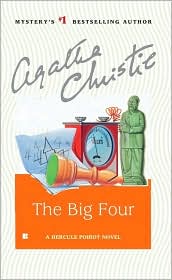
The Big Four

The Big Four. Agatha Christie. 1927/2001. Penguin. 208 pages.

I have met people who enjoy a channel crossing; men who can sit calmly in their deck-chairs and, on arrival, wait until the boat is moored, then gather their belongings together without fuss and disembark.

Captain Hastings narrates this Hercule Poirot novel. First, I must say that it was GREAT to have him back as narrator. I'd missed him lately. Second, I must say that this Hercule Poirot is very different from others I've read. There is a big mystery to be solved. And there are plenty of little mysteries to be solved. The motives for these crimes are very different. More political, more conspiracy theory, more intellectual intrigue than the traditional murder mystery.

Who are the Big Four? Well, Poirot believes them to be a secret organization running the world behind the scenes. The masterminds behind several political upheavals. One from China. One from France. One from the United States. And the fourth, well, that's the mystery. For this "destroyer" is the most elusive of them all. An expert at disguise he certainly must be. For Hastings and Poirot believe they've encountered him at many, many of their recent crime scenes. But no matter how many times they catch a glimpse, they're never able to describe him.

At the beginning, they've only got a lead on the identity of one of the members. But they're hoping to find all four so they can be brought to justice. For the bodies do begin to pile up in this one--and each one gives them a little clue. It won't be an easy case to solve--for it's all a game with traps hidden within traps within traps. But if anyone can solve it, Poirot's the man for the job.

I liked this one. I didn't love it exactly. But it was a good read, a compelling one!

© 2011 Becky Laney of Becky's Book Reviews

Thursday, January 06, 2011

Unnatural Death

Unnatural Death. Dorothy L. Sayers. 1927/1995. HarperCollins. 288 pages. 

"But if he thought the woman was being murdered--"

Unnnatural Death begins with Lord Peter Wimsey overhearing a certain conversation. He becomes so curious, he asks the speaker to tell his story--the whole story. Dr. Carr is willing to comply--but, for him, the story does not have a happy ending. Because he followed his instincts, because he voiced his suspicions, he lost his medical practice in a small gossipy town. He is happy to tell what he knows. But he doesn't want to be a part of this new investigation.

Dr. Carr was the physician to an elderly woman, Agatha Dawson. The lady's great niece, Mary Whittaker, was her companion and caretaker. When it became too much for one woman--even a woman with training to be a nurse--to handle, the doctor provided a nurse (or two). The doctor became suspicious when his patient died suddenly. He was almost certain that she had more time to live. He thought for sure she had several months at least. The niece did call him telling him that her aunt was doing poorly, but, his subsequent examination of her didn't match that diagnosis. He definitely had doubts about how "natural" her death was. But he had no proof.

Can Lord Peter Wimsey and Mr. Parker--the 'official' detective from Scotland Yard--find the proof needed to reopen the case? Will this new case prove dangerous?

I liked Unnatural Death. I didn't like it as much as Whose Body? I still like Lord Peter Wimsey. I still like Parker. I still like Sayers' style, her narration. But Unnatural Death seemed more racist (to me) than Whose Body? While Whose Body? was not perfect--in that regard--it didn't seem as abrasive.

Here are a few of my favorite lines:

"I told you I'd be turnin' up again before long," said Lord Peter cheerfully. "Sherlock is my name and Holmes is my nature. I'm delighted to see you, Dr. Carr. Your little matter is well in hand, and seein' I'm not required any longer I'll make a noise and buzz off." (38)

"Who is Miss Climpson?"
"Miss Climpson," said Lord Peter, "is my ears and tongue," said Lord Peter, dramatically, "and especially my nose. She asks questions which a young man could not put without a blush. She is the angel that rushes in where fools get a clump on the head. She can smell a rat in the dark. In fact, she is the cat's whiskers."
"That's not a bad idea," said Parker.
"Naturally--it is mine, therefore brilliant. Just think. People want questions asked. Whom do they send? A man with large flat feet and a note-book--the sort of man whose private life is conducted in a series of inarticulate grunts. I send a lady with a long, woolly jumper on knitting-needles and jingly things round her neck. Of course she asks questions--everyone expects it. Nobody is surprised. Nobody is alarmed." (28-9)

© 2011 Becky Laney of Becky's Book Reviews

Wednesday, June 10, 2009

Travel the World: Canada: Emily's Quest (YA, Adult)


Montgomery, L.M. 1927. Emily's Quest. Bantam Books. 228 pages.

"No more cambric tea" had Emily Byrd Starr written in her diary when she had come to New Moon from Shrewsbury, with her high school days behind her and immortality before her.

Emily's Quest is the third and final book in the Emily series by L.M. Montgomery. (My review of Emily of New Moon and Emily Climbs.) And as perhaps fitting, Emily's Quest has a different feel than the first two books. Through the course of Emily's Quest, we see her grow-up completely--from recent high school graduate to mid-twenty-something. It's more sorrowful, more serious, more grown-up. From the bittersweetness of her opening a letter from her 14-year-old self on her twenty-fourth birthday, to her on-again-off-again depression and melancholy. Emily isn't as happy-go-lucky as Anne. One doesn't get the sense that every day is a good day. While Anne may have had her Jonah-days, it seems Emily has months of them. It makes Emily easy to relate to in more than a few ways. Here's someone who is thoroughly human.

Emily's Quest isn't so much about anything in particular as it is about relationships: comings and goings, gains and losses. At the start, we have Emily wishing and hoping that Teddy will tell her he loves her, show her he loves her. When he doesn't, at least not in so many words, then she's disappointed. But her Murray pride keeps her going. If Teddy isn't the one, perhaps then her special someone is still out there somewhere. There are men that come and go in her life certainly. And then there's Dean. The one guy that I hate-to-love and love-to-hate. A middle-aged man who has had his eye on her since she was a young thing--early teens maybe? He's always known that he can't have her. That she's too young for him. That their friendship would be something she'd likely grow out of as she grew up and fell in love. But when Teddy disappoints and an traumatic accident (or two) occurs leading to a very quiet, very still winter where it's just the two of them getting all cozy, then Emily tells him that though she doesn't love him, love him, she'd like to marry him. So they start making plans for the "Disappointed House" which is the house of her dreams.

There are many reasons why her marriage to Dean would be wrong. Many. But one of them is how her relationship to him prohibits her from being herself. Dean has never liked her writing. Always discouraged her. Always told her she couldn't or shouldn't write. But can Emily be Emily without it? If Dean really loves her, shouldn't he love all of her? And then there's the little, incidental fact that Emily still loves Teddy with all her heart and soul.

Emily's Quest is about disappointments and heartaches and wrong turns. It's a novel about second chances and reconciliations as well.

My thoughts on this one: It was hard to know Teddy. Maybe that was just me. Maybe I'm expecting Teddy to be like Gilbert and sweep me off my feet. Maybe Teddy's more reserved and shy than most-romantic-heroes. But I didn't ever get that swooney feeling. I know Emily loves him. But he always seemed too distant for me to love. And that hasn't changed with this reading. Emily is easy to love. Her love of writing, her love of words, the way she can capture the world around her. The way she can describe the people she loves and hates. Even her struggles with depression and melancholy. The way she isolates herself. The way that making-friends isn't all that natural for her. Teddy was an absent hero in this one. The novel follows (roughly speaking) a decade and we only see glimpses of him here and there. He might come home for a few weeks to visit every other year or every two years. But he's not a constant in Emily's life. He doesn't even write letters. And with the fact that he never told her he loves her, it's hard for me to think of him as a great romantic hero. True, he begins to redeem himself in the last few chapters. But still. He's no Gilbert. So don't expect that.

Emily is very introspective. And perhaps I'm just now realizing this. Or maybe I'm misreading the novels. But it seems to be mainly introspection in these later books. It's rare for the books to capture dialogue between characters. In Emily Climbs when Emily is off to school, we rarely see her interacting with her friends and classmates. We're not really a witness to her conversations with Ilse and Perry and Teddy. We get a few with Perry. Especially the late-night-window scene that leads to some trouble. And we get the confrontation with Ilse about the mustache drawing accusation. But we don't see her interact with her peers on a daily basis. We see more of her interacting with her family: Aunt Elizabeth, Aunt Laura, Aunt Ruth, Cousin Jimmy. We see a lot of her interacting with Dean Priest. And then there's that touching scene between her and Mr. Carpenter. But where is Teddy in all of this? He's always off painting or drawing. Or else he's off consoling and reassuring his mother that he loves her best.


© Becky Laney of Becky's Book Reviews