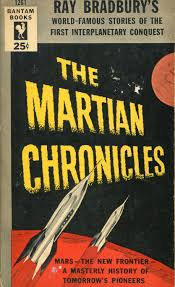
Martian Chronicles. Ray Bradbury. HarperCollins. 1958/2006 edition. 268 pages. [Source: Library] [science fiction; short stories; classic]
One minute it was Ohio winter, with doors closed, windows locked, the
panes blind with frost, icicles fringing every roof, children skiing on
slopes, housewives lumbering like great black bears in their furs, along
the icy streets.
And then a long wave of warmth crossed the small town. A flooding sea of
hart air; it seemed as if someone had left a bakery door open. The heat
pulsed among the cottages and bushes and children. The icicles dropped,
shattering, to melt. The doors flew open. The windows flew up. The
children worked off their wool clothes. The housewives shed their bear
disguises. The snow dissolved and showed last summer's ancient green
lawns.
Rocket summer. The words passed among the people in the open, airing
houses. Rocket summer. The warm desert air changing the frost patterns
on the windows, erasing the art work. The skis and sleds suddenly
useless. The snow, falling from the cold sky upon the town, turned to a
hot rain before it touched the ground. Rocket summer. People leaned from
their dripping porches and watched the reddening sky. (1)
I LOVE, LOVE, LOVE Ray Bradbury's The Martian Chronicles. This is the
second or third time (probably fourth) I've read this one. And each time I read it, I end
up loving it even more. It's like each time I'm surprised by how much I
love it. Like in between readings I forget how engaging and compelling
it is. I settle into thinking that it was just me exaggerating things
(again). That it couldn't possibly be that good. But no. It is
that good.
The edition I read this time had twenty-seven stories; some of these
'stories' are just vignettes, or short preludes, transition pieces of a
paragraph or two. But many are full-length stories. There are some great
stories in this one.
- January 2030 Rocket Summer
- February 2030 Ylla
- August 2030 The Summer Night
- August 2030 The Earth Men
- March 2031 The Taxpayer
- April 2031 The Third Expedition
- June 2032 --And the Moon Be Still as Bright
- August 2032 The Settlers
- December 2032 The Green Morning
- February 2033 The Locusts
- August 2033 Night Meeting
- October 2033 The Shore
- November 2033 The Fire Balloons
- February 2034 Interim
- April 2034 The Musicians
- May 2034 The Wilderness
- 2035-2036 The Naming of Names
- April 2036 Usher II
- August 2030 The Old Ones
- September 2036 The Martian
- November 2036 The Luggage Store
- November 2036 The Off Season
- November 2036 The Watchers
- December 2036 The Silent Towns
- April 2057 The Long Years
- August 2057 There Will Come Soft Rains
- October 2057 The Million Year Picnic
 |
| 1950 edition of The Martian Chronicles |
I wasn't aware that there were different editions of this one, and that
the stories could vary depending on the edition. Also the dates have
been modified (by thirty years) in some editions, like the edition I
read this time around. The very, very newest edition has the original
dates, 1999-2026. This newest edition does not have "The Fire Balloons."
Also, instead of "The Wilderness" it has "Way in the Middle of the
Air."
My thoughts on individual stories, and, first sentences from the stories
"Ylla"
They had a house of crystal pillars on the planet Mars by the edge of an
empty sea, and every morning you could see Mrs. K eating the golden
fruits that grew from the crystal walls, or cleaning the house with
handfuls of magnetic dust which, taking all dirt with it, blew away on
the hot wind.
A story told solely from the perspective of the Martians, in this case, a
husband and wife. A husband has a very definite reaction to his wife's
strange dreams. She dreams of a man, Nathaniel York, coming in a ship,
in a rocket, and landing. The dream even tells her where and when. But
her controlling and perhaps jealous husband has a way of dealing--for
once and for all--with his wife's dreams.
"The Earth Men"
Whoever was knocking at the door didn't want to stop. Mrs. Ttt threw the door open. "Well?"
The story of the second expedition. Let's just say that the welcoming
committee wasn't quite what they expected! First, NO ONE wanted to
bother with them, then they were greeted by a strange assortment of
Martians all claiming to be from Earth. And then....well, that wouldn't
be polite of me to spoil it!
"The Third Expedition" (aka Mars is Heaven)
The ship came down from space. It came from the stars and the black
velocities, and the shining movements, and the silent gulfs of space. It
was a new ship; it had fire in its body and men in its metal cells, and
it moved with a clean silence, fiery and warm. In it were seventeen
men, including a captain.
This one is a classic short story that you may have stumbled across in
another context from The Martian Chronicles. (I've heard two radio
adaptations, for example.) And the title is self-explanatory. It is the
story of what happens when the third expedition lands. It is the story
of what they see and WHO they see. It is a story that stretches you,
perhaps. But it's a good one!
"--And the Moon Be Still As Bright"
It was so cold when they first came from the rocket into the night that
Spender began to gather the dry Martian wood and build a small fire. He
didn't say anything about a celebration; he merely gathered the wood,
set fire to it, and watched it burn.
And now we're on to the fourth expedition, the fourth rocket ship to
successfully land on Mars. This time they manage to stay alive past the
initial day or two or three. This is the story of what happens when one
of the crew members, Spender, goes off on his own to learn the Martian
culture, to explore the ruins, to explore the cities, to examine the
artifacts and remnants of a culture that is gone with the wind. What
happens next...well....there are a million reasons why readers shouldn't
sympathize with Spender, but, like Captain Wilder, they may feel the
pull all the same.
"The Settlers"
The men of Earth came to Mars. They came because they were afraid or
unafraid, because they were happy or unhappy, because they felt like
Pilgrims or did not feel like Pilgrims. There was a reason for each man.
They were leaving bad wives or bad jobs or bad towns; they were coming
to find something or leave something or get something, to dig up
something or bury something or leave something alone. They were coming
with small dreams or large dreams or none at all.
One of my favorite vignettes. For some reason it reminds me of John Steinbeck.
"Night Meeting"
Before going on up into the blue hills, Tomas Gomez stopped for gasoline at the lonely station.
There is something haunting and fantastical about this short story of a
human and Martian meeting and not exactly seeing the same reality.
"The Fire Balloons"
Fire exploded over summer night lawns.
I first read "The Fire Balloons" in another collection of Ray Bradbury
stories. I didn't, at the time, see it as being part of The Martian
Chronicles. (And, in fact, it wasn't part of the edition I first read.)
But now it is one of my favorite stories! In it two priests go to Mars
as missionaries. One at least was expecting, was hoping, to meet
Martians, to actually BE a missionary TO Martians, to an alien species.
So when given the opportunity of going out into the hills and trying to
communicate with blue balloon-like hovering creatures OR ministering to
humans who have migrated to Mars, the answer is clear to Father
Peregrine. But do the Martians need his church? This story has one of my
favorite quotes:
"Father Peregrine, won't you ever be serious?"
"Not until the good Lord is. Oh, don't look so terribly shocked, please.
The Lord is not serious. In fact, it is a little hard to know just what
else He is except loving. And love has to do with humor, doesn't it?
For you cannot love someone unless you put up with him, can you? And you
cannot put up with someone constantly unless you can laugh at him.
Isn't that true? And certainly we are ridiculous little animals
wallowing in the fudge bowl, and God must love us all the more because
we appeal to His humor."
"The Wilderness"
Oh, the Good Time has come at last--
It was twilight and Janice and Leonora packed steadily in their summer
house, singing songs, eating little, and holding to each other when
necessary. But they never glanced at the window where the night gathered
deep and the stars came out bright and cold.
This is another story that I ended up loving. And it was new-to-me too,
it not being part of the original. But in this story we meet two women
who are about to travel to Mars to get married and settle down. (The men
having gone first.) The story likens exploring and settling Mars to
exploring and settling the Old West (places like Wyoming, California,
Oregon, etc.) It is about how the two handle their last night on Earth.
Is this how it was over a century ago, she wondered, when the women, the
night before, lay ready for sleep, or not ready, in the small towns of
the East, and heard the sound of horses in the night and the creak of
the Conestoga wagons ready to go, and the brooding of oxen under the
trees, and the cry of children already lonely before their time?...Is
this then how it was so long ago? On the rim of the precipice, on the
edge of the cliff of stars. In their time the smell of buffalo, and in
our time the smell of the Rocket. Is then then how it was? And she
decided, as sleep assumed the dreaming for her, that yes, yes indeed,
very much so, irrevocably, this was as it had always been and would
forever continue to be.
"Usher II" (aka Carnival of Madness)
"During the whole of a dull, dark and soundless day in the autumn of
the year, when the clouds hung oppressively low in the heavens, I had
been passing alone on horseback, through a singularly dreary tract of
country, and at length found myself, as the shades of evening drew on,
within view of the melancholy House of Usher..." Mr. William Stendahl
paused in his quotation. There, upon a low black hill, stood the house,
its cornerstone bearing the inscription: 2036 A.D.

I remembered this as being one of the stories in A PLEASURE TO BURN, a
Ray Bradbury collection celebrating the creative stories leading up to
the writing/publishing of Fahrenheit 451. And it was first published as
"Carnival of Madness." But it was also part of Ray Bradbury's book, The
Martian Chronicles. And it is perhaps one of the most memorable of the
collection. It is a true must read for anyone who loves Fahrenheit 451,
for it continues on some of the same themes. I don't want to say too
much about it really, because it shouldn't be spoiled at all if you want
to get the full enjoyment of it!
"The Martian"
The blue mountains lifted into the rain and the rain fell down into the
long canals and old LaFarge and his wife came out of their house to
watch.
An elderly couple have come to Mars and one night they are surprised by
the appearance of their "son" (who died and was buried back on Earth).
Their "son" doesn't want to leave the house, and is enjoying his family
too much to risk getting "trapped" by going into the city and
interacting with others. This story is creepy.
"The Luggage Store," "The Off Season," "The Watchers," "The Silent
Towns," "The Long Years," "There Will Come Soft Rains," and "The Million
Year Picnic."
These stories, I feel, work best as a sequence showing what happens both
on Earth and Mars when the worst happens--atomic war on Earth. In "The
Luggage Store," one speculates that his business will improve greatly if
the war happens, if the worst happens. He feels that everyone will want
to go back home to Earth to be with their loved ones, to find out if
their loved ones are okay, to try to piece their society and
civilization back together. In "The Off Season" readers learn that the
war has started and the destruction has begun. There is nothing truly
comical about it, but, it does happen to be told from the point of view
of a man who has just opened a hot dog stand. "The Watchers" shows the
people leaving Mars to return to Earth--for better or worse. "The Silent
Towns" and "The Long Years" are two stories set on Mars. The first,
"The Silent Towns" is told from the point of view of a man who chose to
stay behind. He's lonely, but not THAT lonely it turns out. He does meet
one woman who stayed behind, but, he decides that his own company is
enough after all. "The Long Years" sees the return of Captain Wilder, I
believe, who discovers a man and his family. There is a twist, however,
which prevents this one from being a happy story. "There Will Come Soft
Rains" is a very, very, very lonely story where we get a glimpse--just a
small glimpse perhaps--of the desolation and destruction of life as we
know it in at least one human city. We see the ending of an era,
perhaps. There are no human characters in this one. "The Million Year
Picnic" resonates even more when seen back-to-back with "There Will Come
Soft Rains." In this story, readers meet a family: parents and sons who
have come to Mars on their own private Rocket--a rocket that has been
hidden away for many years, a rocket that has been saved for a true
emergency. We meet a father who has prepared for THE END in a big, big
way.
Read The Martian Chronicles
- If you love science fiction
- If you like science fiction
- If you enjoy short stories; if you don't enjoy short stories
- If you are a fan of Ray Bradbury
- If you are a fan of the Twilight Zone
© 2020 Becky Laney of
Becky's Book Reviews