The Widow of Windsor. Jean Plaidy. 1974. 318 pages. [Source: Bought]
First sentence: Mourning hung heavily over Windsor. The Queen was stunned; now and then her tears would cease and she would ask in a bewildered voice: "It's not true? Tell me it's not true. This time last year he was with us. Oh God, how could this be? I always believed we should go together."
Premise/plot: The Widow of Windsor chronicles the last decades of Queen Victoria's life, starting with the death of Prince Albert in 1861 and ending with her own death in 1901. The book does not focus on Queen Victoria alone, but also on her children, their spouses, and her grandchildren. A marginal story line, in fact, despite the misleading book jacket, is the Queen's relationship with Mr. John Brown. Politics is never far from center stage either.
My thoughts: This one is well worth reading despite the melodramatic jacket copy. The good news is that The Widow of Windsor is NOT the book described in the jacket copy. I have taken to reading Plaidy's jacket copy in a certain voice in my head, starting with "Jean Plaidy who is also Victoria Holt." In the matter of The Widow of Windsor, it's dreadful: "She was the Queen. She was a widow. But she was also a woman...." How could you not read that in a melodramatic way?!
I enjoyed reading this one very much. I enjoyed learning more about Bertie (Edward VII) and his wife Alix (Alexandra). Scandal was never far away from the Prince of Wales. The book shows him at his best and worst. Queen Victoria's other children are also very much present in the novel, though not all equally.
© 2018 Becky Laney of Becky's Book Reviews
Showing posts with label Jean Plaidy. Show all posts
Tuesday, January 09, 2018
Tuesday, August 19, 2014
The Princess of Celle (1967)
The Princess of Celle. Jean Plaidy. 1967/1985. Ballantine. 400 pages. [Source: Bought]
The Princess of Celle felt longer than it actually was. Perhaps because the chapters were so long. Perhaps because the book was complicated. If it helps, it was necessarily complicated. It is the story of a dysfunctional German family, one of whom would come to the throne of England as George I.
I was a bit disappointed that George Lewis does not become George I until the epilogue of this one! I suppose I had the silly idea that this book would focus on the obviously unhappy marriage between George Lewis (George I) and Sophia Dorothea (the so-called Princess of Celle). And, in a way, it is. But George Lewis is one of the most unimportant characters in the whole book. Seriously. Readers get to know--for better or worse--his mother, his father, his uncle, his aunt, some of his brothers. But for George himself? Well, he gets a tiny fraction of the author's attention.
If I had to describe The Princess of Celle, I would say it was a tug of war between multiple generations of mistresses in a super dysfunctional German family. I would say that almost all the men in the novel are vile, power-hungry, lusty creatures with big egos. I would say that the mistresses in the novel are vile, power-hungry, lusty creatures with big egos. The wives, well, have to make the best of it. They may hate their husbands. They may hate the mistresses their husbands keep. They may be humiliated in public by those mistresses. But they can take comfort that their children are legitimate.
For better or worse, the "main" story of The Princess of Celle begins in the middle of the novel. It is at the halfway point that readers see Sophia Dorothea marry her cousin George Lewis. She had wanted to marry someone else, another cousin. He had not cared who he married. He was content to marry whomever pleased his mother...and his father. He very much cared about picking his own mistresses. But a wife?! Not worth his bother. It's not like he'll be enjoying her company!
Is Sophia Dorothea the main character? I'm not sure that she is if I'm honest. She's not the strongest character. The most obnoxious or ambitious or strong-willed. George Lewis's mother is SOMETHING. As is his father's mistress, Clara von Platen. I would say that Clara gets more time and attention from the novel than any other character in this one. What does Clara want? What will Clara do to get what she wants? Who will Clara hurt to get her way? How many lives can she destroy? How much power can she grab? How can she keep the power? Clara is a disgusting character, truly revolting.
Did I like Sophia Dorothea? Well. She may not be as horrid as Clara. Who could be?! But she could not keep my sympathy. Yes, to a certain point I could see why she was so miserable and so trapped. She could not escape her in-laws and her husband. Not that her husband stayed remotely close to her. He was off doing whatever, whenever, whoever. But court-life was miserable for her because of the dominant women: her mother-in-law and her father-in-law's mistress. There were people at court, namely Clara that hated her and were actively plotting against her, plotting to ruin her life thoroughly. It was almost Clara's one ambition in life to destroy Sophia Dorothea, or perhaps the right word is obsession.
A sick love triangle. What every book needs is a love triangle, right?! Sophia Dorothea falls for the same man as Clara. His name was Königsmarck. There was nothing about him that I could admire or respect. Because his love for Sophia Dorothea was oh-so-pure and oh-so-true, he satisfied his lusts with Clara. Until he went off to war and was thought to be missing in action. Then Sophia Dorothea rejoiced with his return! Of course, she abandoned her morals, she was so happy! Clara then takes evil to a whole new level. You see, Clara already hated her and despised her. She already was out to get her. But NOW...she was a million times more determined to win the day.
I did not like spending time with any of these characters. I really didn't.
© 2014 Becky Laney of Becky's Book Reviews
The Princess of Celle felt longer than it actually was. Perhaps because the chapters were so long. Perhaps because the book was complicated. If it helps, it was necessarily complicated. It is the story of a dysfunctional German family, one of whom would come to the throne of England as George I.
I was a bit disappointed that George Lewis does not become George I until the epilogue of this one! I suppose I had the silly idea that this book would focus on the obviously unhappy marriage between George Lewis (George I) and Sophia Dorothea (the so-called Princess of Celle). And, in a way, it is. But George Lewis is one of the most unimportant characters in the whole book. Seriously. Readers get to know--for better or worse--his mother, his father, his uncle, his aunt, some of his brothers. But for George himself? Well, he gets a tiny fraction of the author's attention.
If I had to describe The Princess of Celle, I would say it was a tug of war between multiple generations of mistresses in a super dysfunctional German family. I would say that almost all the men in the novel are vile, power-hungry, lusty creatures with big egos. I would say that the mistresses in the novel are vile, power-hungry, lusty creatures with big egos. The wives, well, have to make the best of it. They may hate their husbands. They may hate the mistresses their husbands keep. They may be humiliated in public by those mistresses. But they can take comfort that their children are legitimate.
For better or worse, the "main" story of The Princess of Celle begins in the middle of the novel. It is at the halfway point that readers see Sophia Dorothea marry her cousin George Lewis. She had wanted to marry someone else, another cousin. He had not cared who he married. He was content to marry whomever pleased his mother...and his father. He very much cared about picking his own mistresses. But a wife?! Not worth his bother. It's not like he'll be enjoying her company!
Is Sophia Dorothea the main character? I'm not sure that she is if I'm honest. She's not the strongest character. The most obnoxious or ambitious or strong-willed. George Lewis's mother is SOMETHING. As is his father's mistress, Clara von Platen. I would say that Clara gets more time and attention from the novel than any other character in this one. What does Clara want? What will Clara do to get what she wants? Who will Clara hurt to get her way? How many lives can she destroy? How much power can she grab? How can she keep the power? Clara is a disgusting character, truly revolting.
Did I like Sophia Dorothea? Well. She may not be as horrid as Clara. Who could be?! But she could not keep my sympathy. Yes, to a certain point I could see why she was so miserable and so trapped. She could not escape her in-laws and her husband. Not that her husband stayed remotely close to her. He was off doing whatever, whenever, whoever. But court-life was miserable for her because of the dominant women: her mother-in-law and her father-in-law's mistress. There were people at court, namely Clara that hated her and were actively plotting against her, plotting to ruin her life thoroughly. It was almost Clara's one ambition in life to destroy Sophia Dorothea, or perhaps the right word is obsession.
A sick love triangle. What every book needs is a love triangle, right?! Sophia Dorothea falls for the same man as Clara. His name was Königsmarck. There was nothing about him that I could admire or respect. Because his love for Sophia Dorothea was oh-so-pure and oh-so-true, he satisfied his lusts with Clara. Until he went off to war and was thought to be missing in action. Then Sophia Dorothea rejoiced with his return! Of course, she abandoned her morals, she was so happy! Clara then takes evil to a whole new level. You see, Clara already hated her and despised her. She already was out to get her. But NOW...she was a million times more determined to win the day.
I did not like spending time with any of these characters. I really didn't.
© 2014 Becky Laney of Becky's Book Reviews
Tuesday, January 14, 2014
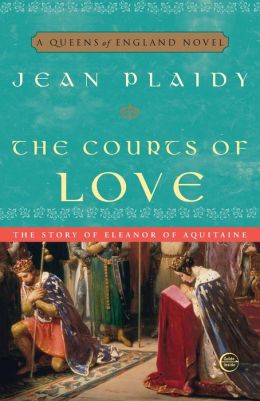
The Courts of Love (1987)
The Courts of Love. Jean Plaidy. 1987. Broadway Books. 576 pages. [Source: Bought]
When I look back over my long and tempestuous life, I can see that much of what happened to me--my triumphs and most of my misfortunes--was due to my passionate relationships with men. I was a woman who considered herself their equal--and in many ways their superior--but it seemed that I depended on them, while seeking to be the dominant partner--an attitude which could hardly be expected to bring about a harmonious existence.
The Courts of Love is told in first person; it is told exclusively, I believe, through the eyes of Eleanor of Aquitaine.
The Courts of Love has such a different feel from the other Plaidy novels I've read lately. It seems more sophisticated, more tasteful, more literary than the three books in the Norman series. And I must admit that The Courts of Love, which stars Eleanor of Aquitaine and Henry II, was more interesting than Caroline the Queen. Though in some ways it feels "classier" that does not mean it's not sensual, it just refrains some of the ridiculousness. (Plaidy is NOT graphic in details; she's very matter-of-fact and succinct.)
Eleanor is an interesting narrator. The novel begins with her life in the court of her grandfather, I believe. It follows her life through her marriages; her first marriage to the king of France and her second marriage to Henry II. (He was not king quite yet. The battle between Stephen and Matilda was still ongoing.) Readers also get to see Eleanor in the role of mother. While she did not have a place in her life for her two children with the King of France, she had plenty of children with Henry. It felt like she was ever-pregnant for almost half of the novel! The last third of the novel focuses on King Richard and King John.
Eleanor was definitely not presented as a saint. (I found the bit with her uncle to be quite disturbing.) Henry II was definitely not a saint either. Even before he "unintentionally" suggested that Thomas Becket should be taken care of permanently. Henry II and Eleanor had a strange relationship. There was passion in abundance, but horribly bitter bickering. The two would eventually separate, but not in the way you might expect. She was a prisoner of her husband for over a decade! Henry II, meanwhile, presided at court with his favorite mistresses nearby.
I am glad I read this one! Have you read any Jean Plaidy novels? Do you have a favorite? Which would you recommend?
© 2014 Becky Laney of Becky's Book Reviews
When I look back over my long and tempestuous life, I can see that much of what happened to me--my triumphs and most of my misfortunes--was due to my passionate relationships with men. I was a woman who considered herself their equal--and in many ways their superior--but it seemed that I depended on them, while seeking to be the dominant partner--an attitude which could hardly be expected to bring about a harmonious existence.
The Courts of Love is told in first person; it is told exclusively, I believe, through the eyes of Eleanor of Aquitaine.
The Courts of Love has such a different feel from the other Plaidy novels I've read lately. It seems more sophisticated, more tasteful, more literary than the three books in the Norman series. And I must admit that The Courts of Love, which stars Eleanor of Aquitaine and Henry II, was more interesting than Caroline the Queen. Though in some ways it feels "classier" that does not mean it's not sensual, it just refrains some of the ridiculousness. (Plaidy is NOT graphic in details; she's very matter-of-fact and succinct.)
Eleanor is an interesting narrator. The novel begins with her life in the court of her grandfather, I believe. It follows her life through her marriages; her first marriage to the king of France and her second marriage to Henry II. (He was not king quite yet. The battle between Stephen and Matilda was still ongoing.) Readers also get to see Eleanor in the role of mother. While she did not have a place in her life for her two children with the King of France, she had plenty of children with Henry. It felt like she was ever-pregnant for almost half of the novel! The last third of the novel focuses on King Richard and King John.
Eleanor was definitely not presented as a saint. (I found the bit with her uncle to be quite disturbing.) Henry II was definitely not a saint either. Even before he "unintentionally" suggested that Thomas Becket should be taken care of permanently. Henry II and Eleanor had a strange relationship. There was passion in abundance, but horribly bitter bickering. The two would eventually separate, but not in the way you might expect. She was a prisoner of her husband for over a decade! Henry II, meanwhile, presided at court with his favorite mistresses nearby.
I am glad I read this one! Have you read any Jean Plaidy novels? Do you have a favorite? Which would you recommend?
© 2014 Becky Laney of Becky's Book Reviews
Tuesday, January 07, 2014
The Revolt of the Eaglets (1977)
The Revolt of the Eaglets. Jean Plaidy. 1977. 320 pages. [Source: Bought]
I have not read the first novel in Plaidy's Plantagenet series. The Revolt of the Eaglets is the second in the series. It opens with the King Henry II learning of the murder of Thomas Becket, and it ends with his own death, or, news of his death reaching his prisoner-wife Eleanor. The novel is focused on the strife between Henry and his family. Any "love" once felt for his wife, Eleanor, the mother of all his legitimate children, has vanished now that she's older and past her usefulness. The two live separate lives for a short time, but, he eventually holds her prisoner. HATE isn't too strong a word for how these two feel towards one another! It is also focused on "Young Henry" (the oldest son and heir), Richard, Geoffrey, and John. Henry II had a "brilliant" idea to have his heir crowned king. Having two crowned monarchs is a big, big mess. It does not inspire family harmony. The son has no actual power, authority, dominion, or independence. Richard is another son that comes into the story quite a bit. Oh the plotting and scheming that goes on...as his sons "turn" against their father and fight for what is "theirs" by right. Is it horrible for sons to turn against their fathers and lead armies? Of course. But the truth is it is hard to find good excuses for Henry II's bad behavior. Plaidy is very matter-of-fact about his weaknesses, mistakes, or sins.
What might be hardest for modern readers to understand is Henry's relationship with Alice. Richard and Alice were betrothed to each other as young children. She is a French princess. She leaves France to live in England at a young age. When the king first takes notice of his future daughter-in-law she is eleven or possibly twelve. It is lust pure and simple. The book presents the seduction (without graphic details, but what is there is CREEPY ENOUGH) very matter of fact without judgment or commentary. Alice believes this special but must keep it secret attention is marvelous. She expects to be made Queen one day. Alice and Henry's relationship continues throughout the book.
Readers get a glimpse of British history and French history. It isn't always a cozy, satisfying glimpse. But it was an interesting read with plenty of characters.
© 2014 Becky Laney of Becky's Book Reviews
I have not read the first novel in Plaidy's Plantagenet series. The Revolt of the Eaglets is the second in the series. It opens with the King Henry II learning of the murder of Thomas Becket, and it ends with his own death, or, news of his death reaching his prisoner-wife Eleanor. The novel is focused on the strife between Henry and his family. Any "love" once felt for his wife, Eleanor, the mother of all his legitimate children, has vanished now that she's older and past her usefulness. The two live separate lives for a short time, but, he eventually holds her prisoner. HATE isn't too strong a word for how these two feel towards one another! It is also focused on "Young Henry" (the oldest son and heir), Richard, Geoffrey, and John. Henry II had a "brilliant" idea to have his heir crowned king. Having two crowned monarchs is a big, big mess. It does not inspire family harmony. The son has no actual power, authority, dominion, or independence. Richard is another son that comes into the story quite a bit. Oh the plotting and scheming that goes on...as his sons "turn" against their father and fight for what is "theirs" by right. Is it horrible for sons to turn against their fathers and lead armies? Of course. But the truth is it is hard to find good excuses for Henry II's bad behavior. Plaidy is very matter-of-fact about his weaknesses, mistakes, or sins.
What might be hardest for modern readers to understand is Henry's relationship with Alice. Richard and Alice were betrothed to each other as young children. She is a French princess. She leaves France to live in England at a young age. When the king first takes notice of his future daughter-in-law she is eleven or possibly twelve. It is lust pure and simple. The book presents the seduction (without graphic details, but what is there is CREEPY ENOUGH) very matter of fact without judgment or commentary. Alice believes this special but must keep it secret attention is marvelous. She expects to be made Queen one day. Alice and Henry's relationship continues throughout the book.
Readers get a glimpse of British history and French history. It isn't always a cozy, satisfying glimpse. But it was an interesting read with plenty of characters.
© 2014 Becky Laney of Becky's Book Reviews
Thursday, November 07, 2013
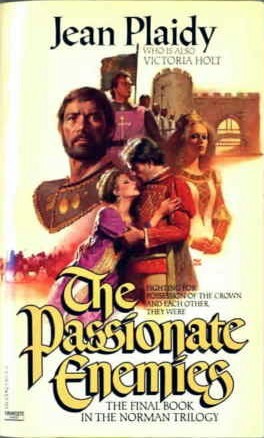
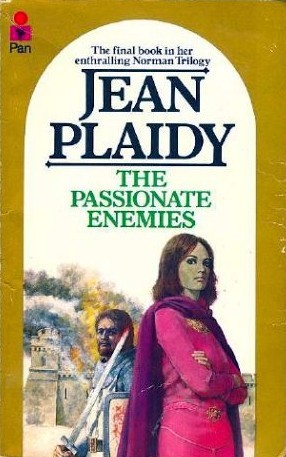
The Passionate Enemies (1976)
The Passionate Enemies. Jean Plaidy. 1976. Fawcett. 320 pages. [Source: Bought]
The Passionate Enemies has a laughable jacket description. Definitely leaning on the side of ridiculousness:
The book begins with the tragedy of the White Ship. Henry I loses his son and heir, William. While Henry I has scores of illegitimate children, he has only one other legitimate child: Matilda. His first idea is, of course, to remarry and have a new son. But after years of waiting for this new wife to conceive, he admits that it isn't to be. He then decides that Matilda will be the one. But can he convince a nation to be be ruled by a Queen? Only time will tell.
Meanwhile, Stephen, is the ever-hopeful nephew. He wants his uncle to name him as heir. He is desperate to be king. If only he wasn't married to ANOTHER MATILDA, he would try to marry his cousin, Matilda. (By the way, the two Matilda's are cousins as well.) Life would be perfect if Matilda and Stephen could "share" the throne. The reader is "privileged" to all of Stephen's daydreams about his cousin.
The battle between Stephen and Matilda begins after Henry I's death...
The book is readable. I couldn't say I enjoyed it exactly. It is so dramatic and ridiculous in places. But it's never boring.
Quotes:
The Passionate Enemies has a laughable jacket description. Definitely leaning on the side of ridiculousness:
She was Matilda.The Passionate Enemies falls into the so bad it's almost good group. I definitely enjoyed The Bastard King more than this one. This is the third book in the trilogy. The middle book is The Lion of Justice. Stephen and Matilda's "love story" begins in the second book. Considering the fact that she left Henry I's court to marry when she was so very young (at most 12 or 13), there are so many creepy layers to this one. (NOT that I'm saying The Passionate Enemies is creepier than say Flowers in the Attic. That would be impossible!!!)
The arrogant, cold daughter of Henry I. An empress, a woman who had worn out one aging husband, only to dominate her next, a mere boy, Geoffrey, first of the fiery Plantagenets.
Only one man had ever mattered to Matilda, ever since childhood.
He was her cousin. He was married. He was her true love.
He was her rival to the throne -- her enemy...
He was Stephen.
A man who used honey in a land of warriors, who sweetened whatever cup would toast his claim to the throne.
And the only obstacle in his path toward ruling all of England and Normandy was Henry's daughter, his own cousin, his one true love.
Forever to fight.
Forever to love, they were...
THE PASSIONATE ENEMIES.
The book begins with the tragedy of the White Ship. Henry I loses his son and heir, William. While Henry I has scores of illegitimate children, he has only one other legitimate child: Matilda. His first idea is, of course, to remarry and have a new son. But after years of waiting for this new wife to conceive, he admits that it isn't to be. He then decides that Matilda will be the one. But can he convince a nation to be be ruled by a Queen? Only time will tell.
Meanwhile, Stephen, is the ever-hopeful nephew. He wants his uncle to name him as heir. He is desperate to be king. If only he wasn't married to ANOTHER MATILDA, he would try to marry his cousin, Matilda. (By the way, the two Matilda's are cousins as well.) Life would be perfect if Matilda and Stephen could "share" the throne. The reader is "privileged" to all of Stephen's daydreams about his cousin.
The battle between Stephen and Matilda begins after Henry I's death...
The book is readable. I couldn't say I enjoyed it exactly. It is so dramatic and ridiculous in places. But it's never boring.
Quotes:
Stephen practiced charm on all so that when it was turned on those who could bring him great good, it seemed to be used naturally and without sly motive. (9)
Stephen lingered over that name. Matilda. It was more than six years ago that the King's daughter had gone to Germany for her marriage with the Emperor but Stephen had not forgotten her. He often wondered whether she ever thought of him... There had been a great bond between them. He had scarcely been able to prevent himself from attempting to seduce her. She would have been willing enough. But she had been only twelve years old when she went away, young in years, but knowledgeable in the ways of the world. Matilda was one of those who appeared to be born with such knowledge. (12)
Words, she thought, charming words. And before the day was out he would be sporting with his newest mistress and telling her she was the most important woman in his life. (18)
The idea of marriage distasteful! The thought of a new woman could never be that. (23)
Often she thought of her cousin Stephen. Was he thinking of her, she wondered, or had he contented himself with his meek little wife? Was he roaming the countryside sporting with mistress after mistress--and doing so, did he ever give a thought to his cousin Matilda? (25)
Perhaps it was not easy for a man who had had more mistresses than any in England to ask a subject to dismiss one. (43)© 2013 Becky Laney of Becky's Book Reviews
Wednesday, November 06, 2013
The Lion of Justice (1975)
The Lion of Justice. Jean Plaidy. 1975. Fawcett. 320 pages. [Source: Bought]
Nature's takin' over my one-track mind
Believe it or not, you're in my heart all the time
All the girls are sayin' that you'll end up a fool
For the time being, baby, live by my rules
The Lion of Justice is the second book in Jean Plaidy's Norman trilogy. Yesterday, I reviewed the first book in the series, The Bastard King. The Lion of Justice focuses on three of William the Conqueror's sons: William Rufus (William II), Robert (duke of Normandy), and Henry (Henry I). It tells the story of William II's brief reign, his mysterious death in the forest, and Henry I's reign. In part the story is told through his queen.
We meet the future-queen as a young woman named Edith. She is royal: the daughter of the king and queen of Scotland. She is also among the last of the Saxon royal dynasty. The novel opens with Edith and her sister, Mary, going to a convent for safekeeping. They have an aunt there who is convinced that Edith should take vows and become a nun. Edith finds the idea repugnant. Equally repugnant to her is marrying an old man of the William II's choosing. There are two close calls before she is married to King Henry. Readers definitely know more of Henry than she does! One other thing that you should know: he makes her change her name to Matilda; Matilda was his mother's name.
There is a good reason why I quoted Lou Christie's Lightin' Strikes at the start of this review. Henry I is depicted as arrogant and lusty and selfish. He's repugnant. And he's able to fool Matilda for several years at least. She actually believes all his lines. She actually trusts him. He seems a bit surprised that there is any woman so gullible and naive to buy what he's saying. He almost seems relieved when she confronts him to see if it is the truth.
In my opinion, the back of the book LIED. Its description: A DAZZLING PORTRAIT OF A MAN FOR WHOM COUNTLESS MISTRESSES WEREN'T ENOUGH--AND ONE GIRL WAS EVERYTHING. Henry married Matilda because she was Saxon royalty. It was a politically advantageous match for the kingdom's good. He didn't dislike her. But she was never his everything. I get the impression that women were completely interchangeable to him. One being very much like another.
Did I like it? It wasn't so much a matter of liking or not liking. I found it quite readable. I often found Henry infuriating, and I suppose I thought a lot of conversations to Matilda, not that she could hear me. I am glad I read on in the series!
Quotes:
Nature's takin' over my one-track mind
Believe it or not, you're in my heart all the time
All the girls are sayin' that you'll end up a fool
For the time being, baby, live by my rules
The Lion of Justice is the second book in Jean Plaidy's Norman trilogy. Yesterday, I reviewed the first book in the series, The Bastard King. The Lion of Justice focuses on three of William the Conqueror's sons: William Rufus (William II), Robert (duke of Normandy), and Henry (Henry I). It tells the story of William II's brief reign, his mysterious death in the forest, and Henry I's reign. In part the story is told through his queen.
We meet the future-queen as a young woman named Edith. She is royal: the daughter of the king and queen of Scotland. She is also among the last of the Saxon royal dynasty. The novel opens with Edith and her sister, Mary, going to a convent for safekeeping. They have an aunt there who is convinced that Edith should take vows and become a nun. Edith finds the idea repugnant. Equally repugnant to her is marrying an old man of the William II's choosing. There are two close calls before she is married to King Henry. Readers definitely know more of Henry than she does! One other thing that you should know: he makes her change her name to Matilda; Matilda was his mother's name.
There is a good reason why I quoted Lou Christie's Lightin' Strikes at the start of this review. Henry I is depicted as arrogant and lusty and selfish. He's repugnant. And he's able to fool Matilda for several years at least. She actually believes all his lines. She actually trusts him. He seems a bit surprised that there is any woman so gullible and naive to buy what he's saying. He almost seems relieved when she confronts him to see if it is the truth.
In my opinion, the back of the book LIED. Its description: A DAZZLING PORTRAIT OF A MAN FOR WHOM COUNTLESS MISTRESSES WEREN'T ENOUGH--AND ONE GIRL WAS EVERYTHING. Henry married Matilda because she was Saxon royalty. It was a politically advantageous match for the kingdom's good. He didn't dislike her. But she was never his everything. I get the impression that women were completely interchangeable to him. One being very much like another.
Did I like it? It wasn't so much a matter of liking or not liking. I found it quite readable. I often found Henry infuriating, and I suppose I thought a lot of conversations to Matilda, not that she could hear me. I am glad I read on in the series!
Quotes:
"And what has he ever done but bring trouble and bastards into the realm?"
The young man laughed obediently.
"Come, my fine friend, what is there to laugh at? I am a man beset by brothers, and now Henry has squandered his patrimony and roams the countryside seeking consolation in robbing ladies of their virtue since he cannot rob me of my throne." (22)
It had been at this time that Henry had become so incensed against his brothers. He said they ignored his existence; they forgot that he was also their father's son, and he demanded to know what his inheritance would be.
"The ladies of England," retorted Rufus. "And I doubt Robert would debar you from enjoying the Norman ones when you visit his Duchy." (25)
"No man should enter the Abbey."
"Of a certainty no ordinary man should be allowed in," said Henry. "But I am no ordinary man." (89)
"Why have you come to see me?" she asked.
"Because my inclinations first prompted me and then insisted. They would not be denied."
"The sisters are right. It is unseemly."
"That which is unseemly is often delightful you will discover." (89)
He was laughing at her. He took her hands suddenly and kissed her fingers.
"Then," he said, "You like me well."
"Yes," she answered. "I like you well."
"And when I am King you will be my Queen."
"I could ask nothing more of life."
"Will you be a good wife to me?"
"I will."
"And love me tenderly and bear my children."
"I will."
"Why 'twould seem we are married already. Would there were a priest here who would marry us, and bridal chamber where I could make you my wife in every truth." (90)
When Henry rode back from Wilton to Winchester he was feeling more than ever dissatisfied with his fate. The Princess Edith was not uncomely; her innocence was amusing and she could give him some diversion which he could not find with his many mistresses. Moreover it was time he was married. He was thirty years of age and he wanted sons. Edith had interested him; he had seen more beautiful women...It was said that he had more bastards than any man in England. (93)
Henry was too clever not to know himself, and that he was the most fitted to rule of all his brothers. (94)
He thought a little of the virginal Princess to whom he had talked of marriage. She was in love with him already. She would be submissive. He liked a little spirit in his women; on the other hand variety was always enticing; and marriage would be a new adventure. (95)
"You always had the right answers. I wonder if Matilda will find it so?" (143)
"Could I be faithless to what is his name...Gerald?"
"Yes I think you might."
"As you will be to Matilda?"
"It seems likely."
"Oh yes," said Nesta, "it seems very likely." (144)
Well, she who was so innocent of the world would have to learn, and when she did, as she inevitably must, she would after the first shock settle down to be a loving wife and when she produced the heirs of the kingdom she would be a good mother. That should satisfy her so that when he strayed--as he surely would--she would come to accept this state of affairs as a natural course of events. For the time though he feigned to share her ecstatic happiness. (151)
It was one of those occasions when he wondered what she would feel when she discovered the truth about him, which he supposed she would in due course. When he began bringing his illegitimate children to Court and bestowing favours on them, which indeed he must, he hoped she would not be too badly hurt. It might well be that by the time she would have more understanding of the world. But it was disconcerting when she showed so clearly that she looked upon him as a knight of shining purity. He supposed he was growing fond of her. (163)© 2013 Becky Laney of Becky's Book Reviews
Tuesday, November 05, 2013
The Bastard King (1974)
The Bastard King. Jean Plaidy. 1974. Fawcett Crest. 320 pages. [Source: Bought]
I really enjoyed reading Jean Plaidy's The Bastard King. The Bastard King is a novelization of the life of William I or "William the Conqueror." It was certainly a well-paced read! Especially once he comes of age. His courtship with Matilda was quite unique. (As this horrible histories sketch shows quite clearly!!!) The novel isn't exactly a romance novel, it is grounded in history with a focus on ambition, politics, and manipulation. Matilda and William are very interesting characters even if they don't come across as nice or pleasant or lovable. Readers see the tension between husband and wife increase year after year and decade after decade as the two happen to play favorites with their very large family. He has his favorite child; she has hers. This leads to some complications which lead to some big trust issues!!!
The last part of the novel focuses on William invading England and becoming King William I. The novel is sympathetic to William in many ways, so often books have a bias one way or another on whether or not William had any right to England at all. I thought the ending was a bit rushed, we spent much more time with him before he became King, but still I really liked this one. Enjoying this one gives me hope that I will read other Plaidy novels with pleasure!
William the Conqueror and Normanopoly
Battle of Hastings, News at 1066; Now That's What I Call Miserable, vol. 3
Words We Get From the Normans
© 2013 Becky Laney of Becky's Book Reviews
I really enjoyed reading Jean Plaidy's The Bastard King. The Bastard King is a novelization of the life of William I or "William the Conqueror." It was certainly a well-paced read! Especially once he comes of age. His courtship with Matilda was quite unique. (As this horrible histories sketch shows quite clearly!!!) The novel isn't exactly a romance novel, it is grounded in history with a focus on ambition, politics, and manipulation. Matilda and William are very interesting characters even if they don't come across as nice or pleasant or lovable. Readers see the tension between husband and wife increase year after year and decade after decade as the two happen to play favorites with their very large family. He has his favorite child; she has hers. This leads to some complications which lead to some big trust issues!!!
The last part of the novel focuses on William invading England and becoming King William I. The novel is sympathetic to William in many ways, so often books have a bias one way or another on whether or not William had any right to England at all. I thought the ending was a bit rushed, we spent much more time with him before he became King, but still I really liked this one. Enjoying this one gives me hope that I will read other Plaidy novels with pleasure!
William the Conqueror and Normanopoly
Battle of Hastings, News at 1066; Now That's What I Call Miserable, vol. 3
Words We Get From the Normans
© 2013 Becky Laney of Becky's Book Reviews
Thursday, October 10, 2013
Caroline the Queen (1968)
Caroline the Queen. Jean Plaidy. 1968. 415 pages. [Source: Library]
Caroline, The Queen was my first introduction to the historical writer Jean Plaidy. (It is the third book in the Georgian Saga.) The novel opens shortly before the Prince of Wales, George Augustus, learns that his father (whom he REALLY hated) has died and he is now king. Caroline, his Queen, may be the main character of this one, but she is not our only point of view--far from it. This novel tells many stories from many different points of view.
Husband and wife. The novel spends some amount of time with George II and his wife, Caroline. She is presented as being oh-so-clever. Readers are never allowed to forget for a moment that Caroline is smarter and wiser than her husband. George is presented as a complete fool: short, ugly, boring, bad-tempered, easily flattered. Caroline loves being married to him because she can rule through him. But she has absolutely no respect for her husband. Caroline is presented as noble because she tolerates her husband's many mistresses.
King and mistresses. The novel mentions George II having many mistresses both in England and Hanover. His mistresses are presented as a necessary, oh-so-expected habit. Kings have mistresses, he is now king, therefore, to show how kingly he is, he must have mistresses, the people will love him even more because he is acting like other kings. Future kings must have mistresses as well. To be Prince of Wales gives you freedom to gather as many mistresses as possible and put them on display. Some of George II's mistresses are quite "old" by the time he is king. He visits them on schedule not out of desire but out of habit. The last half of the novel focuses on the King acquiring much younger, much prettier mistresses.
Family. The glimpses we get of Caroline and George as parents is disturbing, at least in my opinion. Frederick, the prince of Wales, is DESPISED by both of his parents. He is their oldest son, but both of his parents HATE him and wish that he'd never been born. Neither wants him around. And he knows it. He hates them both. At one point he's shown as hating his mother even more than his father because he feels his father is just being ruled. Some time is spent on their other children. But I can't say that Caroline and George were extraordinarily good parents to any of their children. Anne, the oldest girl, is given some time in the novel.
Prince of Wales. Some time is spent with Frederick and his friends and mistresses. Readers see people trying to get close to him so they can use him, people trying to get favors. Some spy on him and tell all to the powers-that-be.
Politics. Caroline has several politician friends--notably Sir Robert Walpole and Lord Hervey. She loves power and politics and manipulating things behind the scenes so that George does precisely what they want without being wise to the fact that he's being manipulated.
The novel was quite interesting and very readable. The characters were all believably flawed; I found no one sympathetic, however. I liked this one.
© 2013 Becky Laney of Becky's Book Reviews
Caroline, The Queen was my first introduction to the historical writer Jean Plaidy. (It is the third book in the Georgian Saga.) The novel opens shortly before the Prince of Wales, George Augustus, learns that his father (whom he REALLY hated) has died and he is now king. Caroline, his Queen, may be the main character of this one, but she is not our only point of view--far from it. This novel tells many stories from many different points of view.
Husband and wife. The novel spends some amount of time with George II and his wife, Caroline. She is presented as being oh-so-clever. Readers are never allowed to forget for a moment that Caroline is smarter and wiser than her husband. George is presented as a complete fool: short, ugly, boring, bad-tempered, easily flattered. Caroline loves being married to him because she can rule through him. But she has absolutely no respect for her husband. Caroline is presented as noble because she tolerates her husband's many mistresses.
King and mistresses. The novel mentions George II having many mistresses both in England and Hanover. His mistresses are presented as a necessary, oh-so-expected habit. Kings have mistresses, he is now king, therefore, to show how kingly he is, he must have mistresses, the people will love him even more because he is acting like other kings. Future kings must have mistresses as well. To be Prince of Wales gives you freedom to gather as many mistresses as possible and put them on display. Some of George II's mistresses are quite "old" by the time he is king. He visits them on schedule not out of desire but out of habit. The last half of the novel focuses on the King acquiring much younger, much prettier mistresses.
Family. The glimpses we get of Caroline and George as parents is disturbing, at least in my opinion. Frederick, the prince of Wales, is DESPISED by both of his parents. He is their oldest son, but both of his parents HATE him and wish that he'd never been born. Neither wants him around. And he knows it. He hates them both. At one point he's shown as hating his mother even more than his father because he feels his father is just being ruled. Some time is spent on their other children. But I can't say that Caroline and George were extraordinarily good parents to any of their children. Anne, the oldest girl, is given some time in the novel.
Prince of Wales. Some time is spent with Frederick and his friends and mistresses. Readers see people trying to get close to him so they can use him, people trying to get favors. Some spy on him and tell all to the powers-that-be.
Politics. Caroline has several politician friends--notably Sir Robert Walpole and Lord Hervey. She loves power and politics and manipulating things behind the scenes so that George does precisely what they want without being wise to the fact that he's being manipulated.
The novel was quite interesting and very readable. The characters were all believably flawed; I found no one sympathetic, however. I liked this one.
© 2013 Becky Laney of Becky's Book Reviews
Friday, September 20, 2013
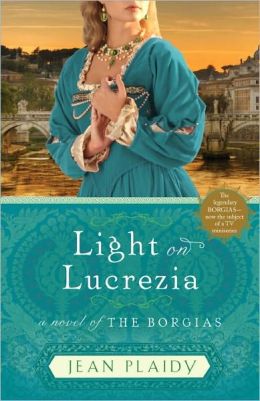
Light on Lucrezia (1958)
Light on Lucrezia: A Novel of the Borgias. Jean Plaidy. 1958/2011. Crown. 384 pages. [Source: Bought]
Light on Lucrezia is the sequel to Madonna on the Seven Hills. The novel opens with the moody Lucrezia preparing for her second marriage. The marriage has been arranged for her by her father, the Pope. She happens to be marrying Sanchia's brother, Alfonso. (Sanchia is her sister-in-law.) The two are a great couple; however, Lucrezia isn't to be allowed her happily ever after for politics and family interfere once again. After her husband's murder, Lucrezia's life is a bit of a mess. A third marriage is arranged after a time, but, it's less than ideal. At least as depicted by Plaidy! But though Lucrezia's fate is the happiest of the Borgia family, that really is not saying much considering what happens...
Reading Light On Lucrezia is like suffering through the last half of Gone With The Wind. There are highlights, of course, but overall it just gets more depressing and hopeless with every single chapter until the dreariest of endings. Is the ending inevitable? Sure. It is (very loosely) based on history. Cesare's fate is set in stone. And Lucrezia's childbearing misfortunes are realistic enough, but it was so very sad to read of all the miscarriages and the babies that died so very young.
Madonna of the Seven Hills and Light on Lucrezia have recently been published as one novel. Plaidy's depiction of the Borgias is interesting. They have their fascinating-but-troubling moments to shine. And the first novel, at least, had some lightness and frivolity to it. I think Plaidy's characterization is better than say, The Borgia Bride, but not as wonderful as Blood and Beauty. I really want Sarah Dunant to write another Borgia novel!!!
© 2013 Becky Laney of Becky's Book Reviews
Light on Lucrezia is the sequel to Madonna on the Seven Hills. The novel opens with the moody Lucrezia preparing for her second marriage. The marriage has been arranged for her by her father, the Pope. She happens to be marrying Sanchia's brother, Alfonso. (Sanchia is her sister-in-law.) The two are a great couple; however, Lucrezia isn't to be allowed her happily ever after for politics and family interfere once again. After her husband's murder, Lucrezia's life is a bit of a mess. A third marriage is arranged after a time, but, it's less than ideal. At least as depicted by Plaidy! But though Lucrezia's fate is the happiest of the Borgia family, that really is not saying much considering what happens...
Reading Light On Lucrezia is like suffering through the last half of Gone With The Wind. There are highlights, of course, but overall it just gets more depressing and hopeless with every single chapter until the dreariest of endings. Is the ending inevitable? Sure. It is (very loosely) based on history. Cesare's fate is set in stone. And Lucrezia's childbearing misfortunes are realistic enough, but it was so very sad to read of all the miscarriages and the babies that died so very young.
Madonna of the Seven Hills and Light on Lucrezia have recently been published as one novel. Plaidy's depiction of the Borgias is interesting. They have their fascinating-but-troubling moments to shine. And the first novel, at least, had some lightness and frivolity to it. I think Plaidy's characterization is better than say, The Borgia Bride, but not as wonderful as Blood and Beauty. I really want Sarah Dunant to write another Borgia novel!!!
© 2013 Becky Laney of Becky's Book Reviews
Thursday, September 19, 2013
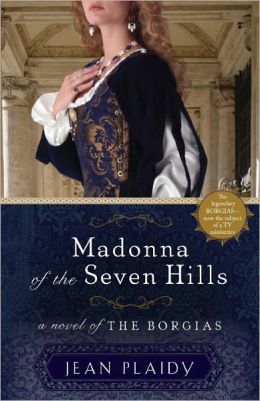
Madonna of the Seven Hills (1958)
Madonna of the Seven Hills: A Novel of the Borgias. Jean Plaidy. 1958/2011. Broadway. 320 pages. [Source: Bought]
What disturbs me most about Madonna of the Seven Hills is that Jean Plaidy bothered listing The Life of Cesare Borgia by Rafael Sabatini in her bibliography. If indeed she read the biography, she chose to disregard it completely. For this novel breaks all of Sabatini's rules. This novel thrives on the LEGENDARY sins of the Borgia family. It builds up this fantastical, sensational notion of what the family was like. The most sympathetically presented is, of course, Lucrezia.
Two of Plaidy's novels are devoted to Lucrezia Borgia. The second is Light on Lucrezia. This novel tells her story up to the point of her (supposed) mysterious pregnancy following her scandalous divorce. It ends with her learning that the father of the child (supposed father, I should say) has been murdered by her family (presumably Cesare) and so has her maid because she knew too much.
Obviously, Madonna of the Seven Hills is SO MUCH BETTER than a certain romance novel I read in the summer, The Borgia Bride. (That one was so awful). The characterization might be a bit biased, assuming that Cesare and Rodrigo are always up to no good and almost certainly being immoral or unwise, but it wasn't completely unpleasant either. Cesare comes across as mad, bad, and dangerous to know. Plaidy was perhaps, in her own little way, presenting him as the ultimate swoon-worthy bad boy. So Cesare and Rodrigo though they are presented as murderers and poisoners come across as quite likable at times. I found her presentation of Sanchia to be quite entertaining!
The book was a quick read. I didn't necessarily agree with her conclusions and presentation. But it was entertaining.
Quotes:
What disturbs me most about Madonna of the Seven Hills is that Jean Plaidy bothered listing The Life of Cesare Borgia by Rafael Sabatini in her bibliography. If indeed she read the biography, she chose to disregard it completely. For this novel breaks all of Sabatini's rules. This novel thrives on the LEGENDARY sins of the Borgia family. It builds up this fantastical, sensational notion of what the family was like. The most sympathetically presented is, of course, Lucrezia.
Two of Plaidy's novels are devoted to Lucrezia Borgia. The second is Light on Lucrezia. This novel tells her story up to the point of her (supposed) mysterious pregnancy following her scandalous divorce. It ends with her learning that the father of the child (supposed father, I should say) has been murdered by her family (presumably Cesare) and so has her maid because she knew too much.
Obviously, Madonna of the Seven Hills is SO MUCH BETTER than a certain romance novel I read in the summer, The Borgia Bride. (That one was so awful). The characterization might be a bit biased, assuming that Cesare and Rodrigo are always up to no good and almost certainly being immoral or unwise, but it wasn't completely unpleasant either. Cesare comes across as mad, bad, and dangerous to know. Plaidy was perhaps, in her own little way, presenting him as the ultimate swoon-worthy bad boy. So Cesare and Rodrigo though they are presented as murderers and poisoners come across as quite likable at times. I found her presentation of Sanchia to be quite entertaining!
The book was a quick read. I didn't necessarily agree with her conclusions and presentation. But it was entertaining.
Quotes:
She, who had known so many men that she read them easily, was aware of this, and she determined now to make Cesare forget his ambitions in his pursuit of her. They were both experienced, and they would find great pleasure in surprising each other by their accomplishments. Each was aware of this as they danced; and each was asking: Why delay longer? Delay was something which neither of them would tolerate.© 2013 Becky Laney of Becky's Book Reviews
"You are all that I heard you were," Sanchia told him.
"You are all that I hoped you would be," he answered her.
"I wondered when you and I would be able to talk together. This is the first time it has happened, and all eyes are on us now."
"They were right," said Cesare, "when they said you were the most beautiful woman in the world."
"They were right when they said there was something terrifying about you."
"Do you find me terrifying?"
She laughed. "No man terrifies me."
"Have they always been so kind?"
"Always," she said. "From the time I was able to talk, men have been kind to me."
"Are you not weary of my sex, since you know it so well?"
"Each man is different from all others. That is what I have found. Perhaps that is why I have always discovered them to be so fascinating. And none that I have ever known has been remotely like you, Cesare Borgia; you stand apart."
"And you like this strangeness in me?"
"So much that I would know it so well that it ceases to be strangeness and is familiar to me."
"What tales have you heard of me?"
"That you are a man who will never take no for an answer, that men fear your frown, and that when you beckon a woman she must obey, in fear if not in desire. I have heard that those who displease you meet ill fortune, that some have been discovered in alleys, suffocated or with knives in their bodies. I have heard that some have drunk wine at your table and have felt themselves to be merely intoxicated, only to learn that they are dying. These are the things I have heard of you, Cesare Borgia. What have you heard of me?"
"That you practice witchcraft so that all men whom you desire fall under your spell, and that having once been your lover none can ever forget you."
"And do you believe these tales of me?"
"And do you believe the tales of me?"
She looked into his eyes and the flame of desire in hers was matched by that in his.
"I do not know," she said, "but I am determined to discover."
"Nor do I know," he answered; "and I think I am as eager to make my discoveries as you are."
His hand tightened on hers.
"Sanchia," he said, "this night?"
And she closed her eyes and nodded. (190-91)
Subscribe to:
Comments (Atom)


