Showing posts with label 1976. Show all posts

Wednesday, October 13, 2021

131. Roll of Thunder, Hear My Cry


Roll of Thunder, Hear My Cry. Mildred D. Taylor. 1976. 288 pages. [Source: Library]

First sentence: "Little Man, would you come on? You keep it up and you're gonna make us late."

Roll of Thunder, Hear My Cry earned the Newbery Medal for 1977. The novel is set circa 1933 and stars the Logan family. Cassie Logan, our heroine, has brothers--many brothers, some older, some younger. The family is put through many trials as tension builds in their community. There is a thin line between holding onto one's dignity and staying strong and resolute AND doing what one must to survive the times. 

The family definitely is facing many grown-up problems. But the problems aren't limited to the grown-ups. No, the children--Cassie, Robert (her older brother), TJ (Robert's friend), etc. also face their own trials and tribulations. At its heart, Roll of Thunder, Hear My Cry is a coming of age story.

Roll of Thunder, Hear My Cry is a heavy novel. It is more bitter than sweet. There are many tragic notes. I do wonder if this is the kind of book that adults would appreciate a million times more than a child reader. 

The love and tenderness in this family are heartwarming. There are other books--some set earlier, some set later--that follow the Logan family. This is the only one I've read. I *believe* this was the first to be published. But GoodReads now lists it as FOURTH in the series. It used to be a trilogy--that I remember from book fair days--but now there are ten books in the series.

© 2021 Becky Laney of Becky's Book Reviews

Monday, October 11, 2021

128. Letters from Father Christmas

Letters From Father Christmas. J.R.R. Tolkien. 1976/1999. 160 pages. [Source: Library]

First sentence: Dear John, I heard you ask daddy what I was like and where I lived. I have drawn me and my house for you. Take care of the picture. I am just off now for Oxford with my bundle of toys--some for you. Hope I shall arrive in time: the snow is very thick at the North Pole tonight. Your loving Father Christmas.

Premise/plot: The earliest letter from 'Father Christmas' to the Tolkien children is 1920. The latest letter is dated 1943 to his daughter, Priscilla. The letters speak of Father Christmas' affairs--his adventures and misadventures. Little details about the Tolkiens slip through, of course. He refers to their letters in which they mention pets and toys, etc. He speaks of Polar Bear, his greatest assistant. He speaks of red elves--some. But Father Christmas has a war to fight of his own--against the goblins! (Christmas is almost sabotaged several times!)

 My thoughts: How quickly time flies! These letters capture moments. I suppose that's as good a way as any to describe this one. We don't get to see the children's letters to Father Christmas through the years, but, we do get to see Father Christmas's letters to the Tolkien children... But children don't write letters to Father Christmas forever, one by one they grow up and grow out of belief. Still these are moments where we catch glimpses of Tolkien as both loving parent and creative artist.

Near the North Pole
Christmas 1925
My dear boys,
I am dreadfully busy this year—it makes my hand more shaky than ever when I think of it—and not very rich; in fact awful things have been happening, and some of the presents have got spoilt, and I haven’t got the North Polar bear to help me, and I have had to move house just before Christmas, so you can imagine what a state everything is in, and you will see why I have a new address, and why I can only write one letter between you both.
It all happened like this: one very windy day last November my hood blew off and went and stuck on the top of the North Pole. I told him not to, but the North Polar Bear climbed up to the thin top to get it down—and he did. The pole broke in the middle and fell on the roof of my house, and the North Polar Bear fell through the hole it made into the dining room with my hood over his nose, and all the snow fell off the roof into the house and melted and put out all the fires and ran down into the cellars, where I was collecting this year’s presents, and the North Polar Bear’s leg got broken.
He is well again now, but I was so cross with him that he says he won’t try to help me again—I expect his temper is hurt, and will be mended by next Christmas. I send you a picture of the accident and of my new house on the cliffs above the North Pole (with beautiful cellars in the cliffs). If John can’t read my old shaky writing (one thousand nine hundred and twenty-five years old) he must get his father to. When is Michael going to learn to read, and write his own letters to me? Lots of love to you both and Christopher, whose name is rather like mine.
That’s all: Good Bye
Father Christmas

Cliff House
October 31st 1931
Dear Children,
Already I have got some letters from you! You are getting busy early. I have not begun to think about Christmas yet. It has been very warm in the North this year, and there has been very little snow so far. We are just getting in our Christmas firewood.
This is just to say my messengers will be coming round regularly now Winter has begun—we shall be having a bonfire tomorrow—and I shall like to hear from you: Sunday and Wednesday evenings are the best times to post to me.
The Polar Bear is quite well and fairly good—(though you never know what he will do when the Christmas rush begins.) Send my love to John.
Your loving
Father Nicholas Christmas
Glad Father Christmas has wakt up. He slept nearly all this hot summer. I wish we kood have snow. My coat is quite yellow.
Love Polar Bear


Cliff House,
near North Pole
Christmas Eve 1940
My Dearest Priscilla
Just a short letter to wish you a very happy Christmas. Please give my love to Christopher. We are having rather a difficult time this year. This horrible war is reducing all our stocks, and in so many countries children are living far from their homes. Polar Bear has had a very busy time trying to get our address-lists corrected. I am glad you are still at home!
I wonder what you will think of my picture. “Penguins don’t live at the North Pole,” you will say. I know they don’t, but we have got some all the same. What you would call “evacuees”, I believe (not a very nice word); except that they did not come here to escape the war, but to find it! They had heard such stories of the happenings up in the North (including a quite untrue story that Polar Bear and all the Polar Cubs had been blown up, and that I had been captured by Goblins) that they swam all the way here to see if they could help me. Nearly 50 arrived.
The picture is of Polar Bear dancing with their chiefs. They amuse us enormously: they don’t really help much, but are always playing funny dancing games, and trying to imitate the walk of Polar Bear and the Cubs.
Very much love from your old friend,
Father Christmas


© 2021 Becky Laney of Becky's Book Reviews

Sunday, October 10, 2021

127. Abel's Island

Abel's Island. William Steig. 1976. 117 pages. [Source: Bought]

First sentence: Early in August 1907, the first year of their marriage, Abel and Amanda went to picnic in the woods some distance from the town where they lived.

Premise/plot: Abel is separated from Amanda as a result of a sudden storm. Both seek shelter, of course, but Abel finds himself situated far from home (from a mouse's perspective) and on an island. Cut off by nature from the home he loves, Abel's challenged in more ways than one. He has to learn how to physically survive in a strange-to-him environment. He also has to deal with the emotional and mental stress caused by loneliness and depression. Will he ever see Amanda again? Will he ever get off the island? What does his future hold for him?

My thoughts: This was my second time to read the novel. I did know what to expect the second time around. Since I read it the first time, I've read Robinson Crusoe and ventured into Swiss Family Robinson. This is survival fiction that just happens to star animals.

I also noticed the second time around that it was his romantic (idealistic) gesture that led to their separation and isolation. Readers get his perspective,  not hers, but it must have been truly terrifying for her. To see him get swept away. And to not know if he even survived. She might have thought he died and blamed herself (for better or worse) for what happened. (Not that she asked him to save the scarf.)

2020 has also happened since I first read this one. I think the isolation and loneliness aspects of this one--and the NOT knowing when--if ever--things could/would get back to "normal" comes into play. Certainly the past two years have impacted how I read this one.


© 2021 Becky Laney of Becky's Book Reviews

Monday, January 07, 2019

Tisha

Tisha: The Wonderful True Love Story of a Young Teacher in the Alaskan Wilderness. As told to Robert Specht. 1976. 342 pages. [Source: Bought]

 First sentence: I've lived in the Forty Mile country of Alaska for a long time, but even now, every so often when I'm out rock-hunting or looking for fossils, I get lost.

Premise/plot: This novel is based on the life of a real woman, Anne Hobbs, who in 1927 arrived in Chicken, Alaska, as a teacher. Anne, originally from Colorado, was the daughter of a miner. Though young and lacking perhaps in great life experiences, she felt ready--mostly--to tackle anything and everything. Challenges and obstacles there would be PLENTY. Especially when she found herself falling in love with a half-breed, Fred Purdy, in a town with many, many biases. (To clarify, that is how he's referred to in the book by those living in the community at the time.) Especially when she found herself essentially adopting two Indian children after their mother's death.

"Before you leave this office I'd like to give you a bit of advice. I have the feeling that you are a pretty tolerant young lady--young enough to be open to new ideas. Where you're going you'll find that most people are not. They have their own code and they don't take to anybody who tries to go against that code or change it. In short, I hope you're not going into this job with, well...shall I say a missionary zeal?" (66)

My thoughts: I really LOVED this one. I found it at my local charity bookshop. It was so worth the $1 I spent. I would recommend it to anyone who enjoys historical fiction, romance, or drama. The drama not only comes from the community and tense relationships within Chicken but also the natural environment. Tisha is best read under warm blankets or with a cup of hot tea in hand.

Anne Hobb's heart was BIG and she was STUBBORN in all the right ways. I love how she welcomed everyone--even the town outcasts into her heart and home.

Anne married Fred and they raised eleven children together--all adopted, I believe.

© 2019 Becky Laney of Becky's Book Reviews

Wednesday, May 24, 2017

Harry by the Sea

Harry by the Sea. Gene Zion. Illustrated by Margaret Bloy Graham. 1976. 32 pages. [Source: Library]

First sentence: Harry was a white dog with black spots who liked everything about the seashore, except...the hot sun.

Premise/plot: Harry gets too hot at the beach, and, while looking for some shade, accidentally gets swept out to sea. The good news is he makes it back to shore. The bad news? He's covered in seaweed and EVERYONE mistakes him for a sea monster. Can this misunderstanding be cleared up before he's captured? Will he be reunited with his family?

My thoughts: I enjoyed this one. I'd read other books in the series. But we did not have Harry By the Sea in our home library. I had no idea this one existed until I spotted it at the library. (I might have squealed a bit.) It was a very fun book.

Text: 4 out of 5
Illustrations: 4 out of 5
Total: 8 out of 10
© 2017 Becky Laney of Becky's Book Reviews

Saturday, January 21, 2017

Abel's Island

Abel's Island. William Steig. 1976. 117 pages. [Source: Bought]

First sentence: Early in August 1907, the first year of their marriage, Abel and Amanda went to picnic in the woods some distance from the town where they lived.

Premise/plot: Abel is separated from Amanda as a result of a sudden storm. Both seek shelter, of course, but Abel finds himself situated far from home (from a mouse's perspective) and on an island. Cut off by nature from the home he loves, Abel's challenged in more ways than one. He has to learn how to physically survive in a strange-to-him environment. He also has to deal with the emotional and mental stress caused by loneliness and depression. Will he ever see Amanda again? Will he ever get off the island? What does his future hold for him?

My thoughts: I don't know what I was expecting, but it wasn't this! There is very little that is cutesy about this animal fantasy. Abel is thrust into a harsh environment and there are no easy happily-ever-after answers. It's not a matter of persevere or get creative. Abel's stuck, stuck, stuck, STUCK on that island. And he has to reevaluate everything he thought he knew about himself and life.

This is a contemplative animal fantasy. It has a tiny bit of adventure thrown in now and then. But it is certainly no thriller.

© 2017 Becky Laney of Becky's Book Reviews

Sunday, December 18, 2016

Letters From Father Christmas

Letters From Father Christmas. J.R.R. Tolkien. 1976/1999. 160 pages. [Source: Library]

First sentence: Dear John, I heard you ask daddy what I was like and where I lived. I have drawn me and my house forr you. Take care of the picture. I am just off now for Oxford with my bundle of toys--some for you. Hope I shall arrive in time: the snow is very thick at the North Pole tonight. Your loving Father Christmas.

Premise/plot: The earliest letter from 'Father Christmas' to the Tolkien children is 1920. The latest letter is dated 1943 to his daughter, Priscilla. The letters speak of Father Christmas' affairs--his adventures and misadventures. Little details about the Tolkiens slip through, of course. He refers to their letters in which they mention pets and toys, etc. He speaks of Polar Bear, his greatest assistant. He speaks of red elves--some. But Father Christmas has a war to fight of his own--against the goblins! (Christmas is almost sabotaged several times!)

My thoughts: I like this one. It is an interesting collection shared with readers. Original letters and pictures (illustrations) are shared. But each letter is also typed up making it easier to read. (Father Christmas has very, very shaky writing. And Polar Bear, well, English is NOT his first or even second language. And he writes with such big paws.) His longest letter is from 1932, and this features, I believe, the first mention of the GOBLINS.

My Dearest Priscilla,
I am so glad you did not forget to write to me again this year. The number of children who keep up with me seems to be getting smaller: I expect it is because of this horrible war, and that when it is over things will improve again, and I shall be as busy as ever. But at present so terribly many people have lost their homes: or have left them; half the world seems in the wrong place. And even up here we have been having troubles. I don't mean only with my stores: of course they are getting low. They were already last year, and I have not been able to fill them up, so that I have now to send what I can instead of what is asked for. But worse than that has happened.
I expect you remember that some years ago we had trouble with the Goblins; and we thought we had settled it. Well, it broke out again this autumn, worse than it has been for centuries. We have had several battles, and for a while my house was besieged. In November it began to look likely that it would be captured and all my goods, and that Christmas Stockings would all remain all over the world. Would not that have been a calamity? It has not happened--and that is largely due to the efforts of Polar Bear-- (142, December 22, 1941)


© 2016 Becky Laney of Becky's Book Reviews

Monday, June 20, 2016

Gudgekin, The Thistle Girl

Gudgekin, The Thistle Girl. John Gardner. 1976. 55 pages. [Source: Bought]

If you enjoy folk or fairy tales, you might be a potential reader of John Gardner's story collection. The book contains four stories: "Gudgekin the Thistle Girl," "The Griffin and the Wise Old Philosopher," "The Shape-Shifters of Shorm," and "The Sea Gulls."

I think my favorite story is Gudgekin the Thistle Girl. The heroine is a poor girl named Gudgekin. Every day she gathers thistles for her stepmother. The stepmother is never, never satisfied. But Gudgekin keeps going out to do her best. One day a fairy intervenes and her luck is seemingly changed forever. With the fairies help, she's able to appease her stepmother and please herself. The fairies do the work, while she's spirited away to have fun. One day--again with the fairies help--she meets a Prince who falls in love with her. You might think you know where this one is headed, and, in a way you'd be right. But it is how long it takes for these two to get to happily ever after that may surprise you.

The second story confused me greatly. After the fifth or sixth time through the first two or three pages, it finally clicked that maybe just maybe it was intentional. The griffin visits the poor villagers to distract, confuse, and frustration. No one can remember how to do anything when he is nearby. Eventually I found the rhythm of this story. I still don't like it.

The Shape Shifters of Shorm, the third story, was entertaining. I liked it. But I didn't really love it. Essentially, a kingdom is being bothered by shape-shifters, the king offers an award for anyone who rids the kingdom of all the shape-shifters. A few step forward and volunteer for the task. But none are ever heard of again. Why?!

The Sea Gulls is an odd story. It contains plenty of magic, some spells, etc. I think it is an appealing enough story for readers. Essentially in that story, a king is met one day by an ogre who wants to eat him. The king says let's play a game of chance. If you win, you eat me. If I win, you wait seven years and eat me and my children then. The king won. (He cheated.) Most of the story is set seven years later....

© 2016 Becky Laney of Becky's Book Reviews

Saturday, October 03, 2015

Seuss on Saturday #40

Hooper Humperdink...? Not Him! Theo LeSieg (Dr. Seuss). Illustrated by Charles E. Martin. 1976. Random House. 48 pages. [Source: Library]

First sentence: I'm going to have a party. But I don't think that I'll ask Hooper Humperdink.

Premise/plot: The narrator is having a party and inviting all his friends--A to Z--but the narrator is decidedly against inviting a certain Hooper Humperdink. (Readers never do learn exactly why). Friends are listed by name A through Z. And as the invitation list grows so does the party.

My thoughts: Just okay for me. I didn't really like it, but, I didn't really dislike it either. Not a must read, in my opinion. One thing I did notice is that later editions have been illustrated by someone else. But my library copy is Charles E. Martin.

Have you read Hooper Humperdkink? Not Him!? Did you like it? love it? hate it? I'd love to know what you thought of it!

If you'd like to join me in reading or rereading Dr. Seuss (chronologically) I'd love to have you join me! The next book(s) I'll be reviewing is Would You Rather Be A Bullfrog? and Please Try To Remember the First of Octember!

© 2015 Becky Laney of Becky's Book Reviews

Thursday, April 10, 2014

The Trouble with Magic (1976)

The Trouble with Magic. Ruth Chew. 1976/2014. Random House. 144 pages. [Source: Review copy]

I may not have loved Ruth Chew's Magic in the Park, but, I definitely LOVED her fantasy novel The Trouble with Magic. To think this little fantasy novel starts with a big stink! Barbara and Rick have sensitive noses, I suppose. They are so overwhelmed with disgust at the smell of cooking cabbage, that Rick easily persuades Barbara to spend her allowance money (fifty cents!) on air freshener. She doesn't have enough money for scented spray (that would cost sixty-nine cents), but, she does have enough for a bottle of something--something with a wick?--that will get the job done, or so they think. They take the bottle home...and that's when the adventure begins. For INSIDE the can is a wizard with a magical umbrella! This poor wizard has been TRAPPED. Harrison Peabody is more than happy to grant wishes (via the umbrella, though they don't know that at the beginning) to those lovely children who freed him. Barbara wishes for her room to be covered in roses! Rick wishes for his room to be covered in pine trees. Still the children are thinking of those noses and that CABBAGE. The children spend a few minutes quite pleased with themselves until they realize how impractical magic can be when it comes time to do homework and go to bed! It isn't long before they want the magic undone...

I thought this one was delightful. It definitely reminded me of other wish-related fantasy novels like Five Children and It and Half Magic. I love seeing WHAT these two children wish for and how it almost always goes wrong. I thought it was a fun twist that the wishes can only work IF the umbrella is used when it's raining.
© 2014 Becky Laney of Becky's Book Reviews

Thursday, November 07, 2013

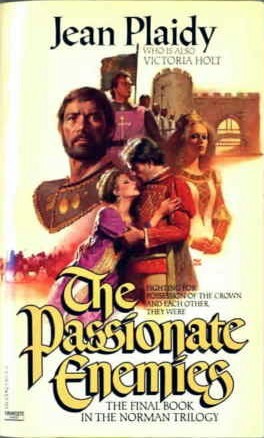
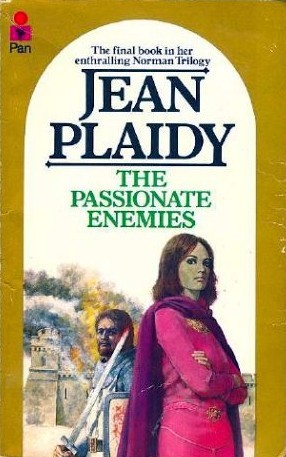
The Passionate Enemies (1976)

The Passionate Enemies. Jean Plaidy. 1976. Fawcett. 320 pages. [Source: Bought]

The Passionate Enemies has a laughable jacket description. Definitely leaning on the side of ridiculousness:
She was Matilda.
The arrogant, cold daughter of Henry I. An empress, a woman who had worn out one aging husband, only to dominate her next, a mere boy, Geoffrey, first of the fiery Plantagenets.
Only one man had ever mattered to Matilda, ever since childhood.
He was her cousin. He was married. He was her true love.
He was her rival to the throne -- her enemy...
He was Stephen.
A man who used honey in a land of warriors, who sweetened whatever cup would toast his claim to the throne.
And the only obstacle in his path toward ruling all of England and Normandy was Henry's daughter, his own cousin, his one true love.
Forever to fight.
Forever to love, they were...
THE PASSIONATE ENEMIES.
The Passionate Enemies falls into the so bad it's almost good group. I definitely enjoyed The Bastard King more than this one. This is the third book in the trilogy. The middle book is The Lion of Justice. Stephen and Matilda's "love story" begins in the second book. Considering the fact that she left Henry I's court to marry when she was so very young (at most 12 or 13), there are so many creepy layers to this one. (NOT that I'm saying The Passionate Enemies is creepier than say Flowers in the Attic. That would be impossible!!!)

The book begins with the tragedy of the White Ship. Henry I loses his son and heir, William. While Henry I has scores of illegitimate children, he has only one other legitimate child: Matilda. His first idea is, of course, to remarry and have a new son. But after years of waiting for this new wife to conceive, he admits that it isn't to be. He then decides that Matilda will be the one. But can he convince a nation to be be ruled by a Queen? Only time will tell.

Meanwhile, Stephen, is the ever-hopeful nephew. He wants his uncle to name him as heir. He is desperate to be king. If only he wasn't married to ANOTHER MATILDA, he would try to marry his cousin, Matilda. (By the way, the two Matilda's are cousins as well.) Life would be perfect if Matilda and Stephen could "share" the throne. The reader is "privileged" to all of Stephen's daydreams about his cousin.

The battle between Stephen and Matilda begins after Henry I's death...

The book is readable. I couldn't say I enjoyed it exactly. It is so dramatic and ridiculous in places. But it's never boring.

Quotes:
Stephen practiced charm on all so that when it was turned on those who could bring him great good, it seemed to be used naturally and without sly motive. (9)
Stephen lingered over that name. Matilda. It was more than six years ago that the King's daughter had gone to Germany for her marriage with the Emperor but Stephen had not forgotten her. He often wondered whether she ever thought of him... There had been a great bond between them. He had scarcely been able to prevent himself from attempting to seduce her. She would have been willing enough. But she had been only twelve years old when she went away, young in years, but knowledgeable in the ways of the world. Matilda was one of those who appeared to be born with such knowledge. (12)
Words, she thought, charming words. And before the day was out he would be sporting with his newest mistress and telling her she was the most important woman in his life. (18)
The idea of marriage distasteful! The thought of a new woman could never be that. (23)
Often she thought of her cousin Stephen. Was he thinking of her, she wondered, or had he contented himself with his meek little wife? Was he roaming the countryside sporting with mistress after mistress--and doing so, did he ever give a thought to his cousin Matilda? (25)
Perhaps it was not easy for a man who had had more mistresses than any in England to ask a subject to dismiss one. (43) 
© 2013 Becky Laney of Becky's Book Reviews
Friday, April 12, 2013

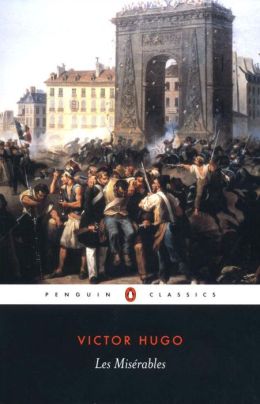
Les Miserables (1862)

Les Miserables. Victor Hugo. Translated and Introduced by Norman Denny. 1862/1976/2012. Penguin. 1232 pages.

Reading Les Miserables was an experience! For six or seven days, I kept good company with the novel. I definitely was not expecting to finish this chunkster in one week! But I found the story so compelling. Political, philosophical, spiritual, dramatic, and romantic. Each word describes the novel, in part. While there are many characters in this novel, I loved the narrator the best of all. Who are some of the characters? Bishop Myriel, Jean Valjean, Fantine, Inspector Javert, Cosette, Marius, Eponine, Enjolras, and Gavroche--just to name a few.

Jean Valjean is an ex-convict who seeks shelter from Bishop Myriel one night. Though he's been treated only with kindness, Valjean in his bitterness (he was sent to prison for stealing a loaf of bread), he steals the bishop's silver. When the theft is discovered, the bishop is all compassion telling the officials that there has been a misunderstanding. Valjean did not steal the silver; it was given as a gift. In fact, he's happy to give Valjean his silver candlesticks as well. Valjean is shocked and overwhelmed. The meeting turns out to be quite life-changing.

When readers next meet Valjean, he has a new name and life. Monsieur Madeleine is a successful business man. He has a BIG heart. He's always giving. He's always thinking of others. He's always doing what he can, when he can to make a difference when and where it matters most. One woman he is determined to help is a young, single mother, Fantine. Circumstances have separated Fantine from her child, Cosette, but, Valjean is determined to correct as many wrongs as he can in this situation. He will see to it personally.

Unfortunately, his past catches up with him. He learns that a man has been arrested; "Jean Valjean" has been caught. Of course, Madeleine knows this is nonsense. Can he let another take his place in prison? If he tells the truth then he can no longer help the poor, but if he doesn't tell the truth, how could he live with himself? He does the honorable thing--though it is one of the greatest challenges he's faced so far.

But that means, for the moment, that Cosette is left in unpleasant circumstances...

There comes a time, an opportunity for Valjean to escape. What he does with his freedom--this time he's assumed drowned, I believe--is go and find Cosette. The two become everything to one another. Cosette is the family he's never had, never even knew he needed or wanted... the two end up in Paris.

Almost half of the novel follows the love story between Marius and Cosette. But it isn't only a love story. Marius is a poor man in conflict with his rich grandfather. The two disagree about many things. But their main source of disagreement is politics. At first, Marius is swept up in his father's politics, with a new awareness of who his father was as a soldier, as a man, as a possible hero. But later, Marius begins to think for himself, to contemplate political and philosophical things for himself. He becomes friendly with a political group at this time. But his love of politics dims when he falls in love with Cosette...and she becomes his whole reason for being. For the longest time these two don't even know each other's names! This romance isn't without challenges...

This novel has so much drama! I found it beautifully written. So many amazing passages! Such interesting characters! I'm not sure I loved the ending. And I was frustrated with Marius at times. But. I definitely loved this book!

Favorite quotes:
What is reported of men, whether it be true or false, may play as large a part in their lives, and above all in their destiny, as the things they do. (19)
We do not claim that the portrait we are making is the whole truth, only that it is a resemblance. (25)
The flesh is at once man's burden and his temptation. He bears it and yields to it. He must keep watch over it and restrain it, and obey it only in the last resort. Such obedience may be a fault, but it is a venial fault. It is a fall, but a fall on to the knees which may end in prayer. To be a saint is to be an exception; to be a true man is the rule. Err, fail, sin if you must, but be upright. To sin as little as possible is the law for men; to sin not at all is a dream for angels. All earthly things are subject to sin; it is like the force of gravity. (29-30)
'The beautiful is as useful as the useful.' Then, after a pause, he added: "More so, perhaps.' (38)
I was not put into this world to preserve my life but to protect souls. (40)
Conscience is the amount of inner knowledge that we possess. (52)
The brutalities of progress are called revolutions. When they are over we realize this: that the human race has been roughly handled, but that it has advanced. (56)
He pondered on the greatness and the living presence of God, on the mystery of eternity in the future and, even more strange, eternity in the past, on all the infinity manifest to his eyes and to his senses; and without seeking to comprehend the incomprehensible he contemplated these things. He did not scrutinize God but let his eyes be dazzled. (67)
There are no bounds to human thought. At its own risk and peril it analyzes and explores its own bewilderment. (68)
We can no more pray too much than we can love too much. (69)
There are men who dig for gold; he dug for compassion. Poverty was his goldmine; and the universality of suffering a reason for the universality of charity. 'Love one another.' To him everything was contained in those words, his whole doctrine, and he asked no more. (69)
The bishop, seated at his side, laid a hand gently on his arm.
'You need have told me nothing. This house is not mine but Christ's. It does not ask a man his  name but whether he is in need. You are in trouble, you are hungry and thirsty, and so you are welcome. You need not thank me for receiving you in my house. No one is at home here except those seeking shelter. Let me assure you, passer-by though you are, that this is more your home than mine. Everything in it is yours. Why should I ask your name? In any case I knew it before you told me.'
The man looked up with startled eyes. 'You know my name?'
'Of course,' said the bishop. 'Your name is brother.' (87)
Is there not true evangelism in the delicacy which refrains from preaching and moralizing? To avoid probing an open wound, is not that the truest sympathy? (90)
'Do not forget, do not ever forget, that you have promised me to use the money to make yourself an honest man.'
Valjean, who did not recall having made any promise, was silent. The bishop had spoken the words slowly and deliberately. He concluded with a solemn emphasis: 'Jean Valjean, my brother, you no longer belong to what is evil but to what is good. I have bought your soul to save it from black thoughts and the spirit of perdition, and I give it to God.' ( 111)
Gold and pearls were her dowry, but the gold was on her head and the pearls were in her mouth. She worked in order to live, and presently fell in love, also in order to live, for the heart, too, has its hunger. (125)
Animals are nothing but the portrayal of our virtues and vices made manifest to our eyes, the visible reflections of our souls. (164)
What is the riddle of these countless scattered destinies, whither are they bound, why are they as they are? He who knows the answer to this knows all things. He is alone. His name is God. (180)
There is a prospect greater than the sea, and it is the sky; there is a prospect greater than the sky, and it is the human soul. (208)
To make a poem of the human conscience, even in terms of a single man and the least of men, would be to merge all epics in a single epic transcending all. (208)
We can no more prevent a thought from returning to the mind than we can prevent the sea from rising on the foreshore. To the sailor it is the tide, to the uneasy conscience it is remorse. God moves the soul as He moves the oceans. (213)
The sisters, then, had this in common when they were girls, that each had her dream, each had wings, those of an angel in the one case and those of a goose in the other. (519)
He never left home without a book under his arm, and often came back with two. (593)
Our imaginings are what most resemble us. Each of us dreams of the unknown and the impossible in his own way. (597)
There comes a moment when the bud bursts overnight into flower and yesterday's little girl becomes a woman to entrap our hearts. This one had not merely grown but was transformed. Just as three April days may suffice for some trees to cover themselves with blossom, so six months had sufficed to clothe her with beauty. Her April had come. (606)
Of all things God has created it is the human heart that sheds the brightest light, and alas, the blackest despair. (844)
'After all, what is a cat?' he demanded. 'It's a correction. Having created the mouse God said to himself, "That was silly of me!" and so he created the cat. The cat is the erratum of the mouse. Mouse and cat together represent the revised proofs of Creation.' (995) 
© 2013 Becky Laney of Becky's Book Reviews