Showing posts with label 1862. Show all posts

Tuesday, October 13, 2020

123. Goblin Market


Goblin Market. Christina Rossetti. 1862. 48 pages. [Source: Bought]

First sentence:

Morning and evening
Maids heard the goblins cry:
“Come buy our orchard fruits,
Come buy, come buy:

Premise/plot: Laura and Lizzie are sisters. Lizzie warns Laura time and time and time again NOT to be tempted by the goblin men nor the wares they sell--their forbidden fruit. But Laura, well, Laura is mightily tempted and gives in despite the warnings, perhaps because of the warnings. At first, nothing tastes so wonderful and amazing as that forbidden fruit, but it comes at high cost--her very life is in danger. Can Lizzie find a way to save her sister? Or will she succumb like others before her now resting in the graveyard?

My thoughts: I have read this multiple times. Whenever I remember it, I remember it fondly. The poem is lovely. The language is exquisite. 

Laugh’d every goblin
When they spied her peeping:
Came towards her hobbling,
Flying, running, leaping,
Puffing and blowing,
Chuckling, clapping, crowing,
Clucking and gobbling,
Mopping and mowing,
Full of airs and graces,
Pulling wry faces,
Demure grimaces,
Cat-like and rat-like,
Ratel- and wombat-like,
Snail-paced in a hurry,
Parrot-voiced and whistler,
Helter skelter, hurry skurry,
Chattering like magpies,
Fluttering like pigeons,
Gliding like fishes,—
Hugg’d her and kiss’d her:
Squeez’d and caress’d her:
Stretch’d up their dishes,
Panniers, and plates:
“Look at our apples
Russet and dun,
Bob at our cherries,
Bite at our peaches,
Citrons and dates,
Grapes for the asking,
Pears red with basking
Out in the sun,
Plums on their twigs;
Pluck them and suck them,
Pomegranates, figs.”—

 It's an atmospheric read for this time of year that I recommend.

© 2020 Becky Laney of Becky's Book Reviews

Thursday, May 16, 2019

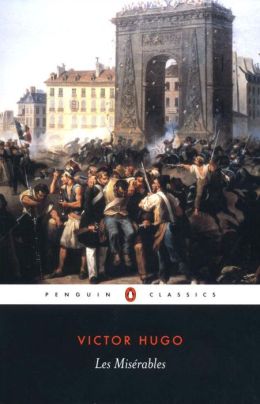
Les Miserables

Les Miserables. Victor Hugo. Translated by Julie Rose. 1862/2008. Modern Library. 1330 pages. [Source: Bought]

First sentence: In 1815, Monsieur Charles-Francois-Bienvenu Myriel was bishop of Digne. He was an elderly man of about seventy-five and he had occupied the seat of Digne since 1806.

Note: This will be my fourth review of Les Miserables for the blog. (It was my fifth time to read the novel.) My 2013 review. My 2014 review. My 2017 review.


I will probably end up cutting and pasting summary bits from other reviews because the plot hasn't changed.

From my 2017 review,
Premise/plot: An ex-convict does his best to live life according to his conscience. Will it ever be enough?


From my 2013 review,

Premise/plot: Jean Valjean is an ex-convict who seeks shelter from Bishop Myriel one night. Though he's been treated only with kindness, Valjean in his bitterness (he was sent to prison for stealing a loaf of bread), he steals the bishop's silver. When the theft is discovered, the bishop is all compassion telling the officials that there has been a misunderstanding. Valjean did not steal the silver; it was given as a gift. In fact, he's happy to give Valjean his silver candlesticks as well. Valjean is shocked and overwhelmed. The meeting turns out to be quite life-changing.

When readers next meet Valjean, he has a new name and life. Monsieur Madeleine is a successful business man. He has a BIG heart. He's always giving. He's always thinking of others. He's always doing what he can, when he can to make a difference when and where it matters most. One woman he is determined to help is a young, single mother, Fantine. Circumstances have separated Fantine from her child, Cosette, but, Valjean is determined to correct as many wrongs as he can in this situation. He will see to it personally.

Unfortunately, his past catches up with him. He learns that a man has been arrested; "Jean Valjean" has been caught. Of course, Madeleine knows this is nonsense. Can he let another take his place in prison? If he tells the truth then he can no longer help the poor, but if he doesn't tell the truth, how could he live with himself? He does the honorable thing--though it is one of the greatest challenges he's faced so far.

But that means, for the moment, that Cosette is left in unpleasant circumstances...

There comes a time, an opportunity for Valjean to escape. What he does with his freedom--this time he's assumed drowned, I believe--is go and find Cosette. The two become everything to one another. Cosette is the family he's never had, never even knew he needed or wanted... the two end up in Paris.

Almost half of the novel follows the love story between Marius and Cosette. But it isn't only a love story. Marius is a poor man in conflict with his rich grandfather. The two disagree about many things. But their main source of disagreement is politics. At first, Marius is swept up in his father's politics, with a new awareness of who his father was as a soldier, as a man, as a possible hero. But later, Marius begins to think for himself, to contemplate political and philosophical things for himself. He becomes friendly with a political group at this time. But his love of politics dims when he falls in love with Cosette...and she becomes his whole reason for being. For the longest time these two don't even know each other's names! This romance isn't without challenges...

My thoughts: I love, love, love this novel. I do. I love to love it. I love to reread it every other year or so. I've come to know the characters well. This is both a good thing and a bad thing. Good in that these characters are memorable and worth knowing and mostly loving. Bad in that it's hard for me to watch film adaptations of Les Miserables without cringing. When writers rewrite Hugo's characters, I have little tolerance. I have some tolerance for condensing or leaving bits out altogether. After all, I don't expect a movie to go scene by scene through the novel. Much is introspective after all. One can film a man "thinking" perhaps but not capture on film his thoughts.

Quotes:
  • True or false, what is said about people often has as much bearing on their lives and especially on their destinies as what they do. (3)
  • Monsieur Myriel had to endure the fate of every newcomer in a small town, where there are always plenty of mouths blathering and not many brains working. He had to endure it even though he was the bishop, and because he was the bishop. (4)
  • We are not saying that the portrait of the man we offer here is accurate, we will restrict ourselves to the claim that it is a passing likeness. (9)
  • The guillotine is the ultimate embodiment of the Law; its name is Retribution. It is not neutral and doesn't allow you to remain neutral either. Whoever sees it quakes in their boots with the most mysterious of terrors. (15)
  • "My dear mayor," said the bishop, "isn't that the point? I'm not in this world to take care of my life. I'm here to take care of souls." (24)
  • Never be afraid of thieves and murderers. They represent the dangers without, which are not worth worrying about. Be afraid of ourselves. Prejudices are the real thieves, vices are the murderers. The greatest dangers are within us. Who cares who threatens our heads or our purses! Let's think only of what threatens our souls. (25)
  • Should the sheep's mange cause the shepherd to recoil? No. (32)
  • Giving up the ghost is a simple business. You don't need the morning for that. So be it. I'll die by starlight. (33)
  • Human thought knows no bounds. At its own peril, it analyzes and explores its own dazzlement. (49)
  • This humble soul was filled with love, that's all. More than likely he inflated his praying into a superhuman longing; but you can't pray too much any more than you can love too much. (49)
  • He gravitated toward those in pain and those who wished for atonement. The world seemed to him like one massive disease; he could feel fever everywhere; everywhere he heard the rattle and wheeze of suffering in people's chests with his special stethoscope and, without seeking to solve the enigma, he tried to stanch the wound. (49)
  • Pain everywhere was an occasion for goodness always. Love one another. He declared this to be complete, desired nothing more; it was the sum total of his doctrine. (49)
  • "You knocked," she asked, "on every door?" "Yes." "Did you knock on that one?" "No." "Knock there." (60)
  • "You didn't have to tell me who you were. This is not my house, it's the house of Jesus Christ. That door does not ask who enters whether he has a name, but whether he has any pain. You are suffering, you are hungry and thirsty; you are welcome. And don't thank me, don't tell me I'm taking you into my home. No one is at home here except the man who is in need of a refuge. I'm telling you, who are passing through, you are more at home here than I am myself. Everything here is at your disposal. What do I need to know your name for? Besides, before you told me your name, you had one I knew." The man opened his eyes in amazement. "True? You knew what I was called?" "Yes," replied the bishop. "You are called my brother." (66)
  • "Yes," the bishop said, "you have come from a place of sadness. Listen. There will be more joy in heaven over the tearful face of a repentant sinner than over the white robes of a hundred righteous men. If you come out of such a painful place full of hate and rage against men, you are worthy of pity; if you come out full of goodwill, gentleness, and peace, you are worth more than any of us." (67)
  • Isn't there, my good madame, something truly evangelical in the sort of delicacy that abstains from sermons, moral lessons, allusions, and isn't the highest form of pity, when a man has a sore spot, not to touch it at all? It seemed to me that this might well have been what my brother was thinking in his heart of hearts. In any case, what I can say is that, if he did have all these ideas, he didn't let on for a moment, not even to me. From start to finish, he was the same as he always is, every night, and he dined with this Jean Valjean the same way and acted just the same as if he were dining with Monsieur Gedeon Le Prevost or with the parish priest. (69)
  • Can man, created good by God, be made wicked by man? Can the soul be entirely remade by destiny and become bad if that destiny is bad?... Isn't there in every human soul, wasn't there in the soul of Jean Valjean, in particular, an initial spark, a divine element, incorruptible in this world, immortal in the next, that good can bring out, prime, ignite, set on fire and cause to blaze splendidly, and that evil can never entirely extinguish? (77)
  • Release is not the same as liberation. You get out of jail, all right, but you never stop being condemned. (83)
  • No one could have said what was happening inside him, not even himself. To try to grasp it, we need to imagine the most violent of men in the presence of the most gentle. (87)
  • "My dear friend," said the bishop, "before you go, here are your candlesticks. Take them." He went to the mantelpiece, swept up the two silver candlesticks, and handed them over to Jean Valjean. The two women watched the bishop without a word, without a movement, without a glance that might upset him. (90)
  • "Don't forget, don't ever forget, that you promised me to use this silver to make an honest man of yourself...Jean Valjean, my brother, you no longer belong to evil but to good. It is your soul that I am buying for you; I am taking it away from black thoughts and from the spirit of perdition, and I am giving it to God." (90)
  • He felt indistinctly that the old priest's forgiveness was the greatest assault and the most deadly attack he had ever been rocked by; that if he could resist such clemency his heart would be hardened once and for all; that if he gave in to it, he would have to give up the hate that the actions of other men had filled his heart with for so many years and which he relished; that this time, he had to conquer or be conquered and that the struggle, a colossal and decisive struggle, was now on between his own rottenness and the goodness of that man. (94-5)
  • He looked at his life and it looked horrible to him; at his soul and it looked revolting. And yet, a new day was dawning and its soft light was settling over his life and over his soul. He felt like he was seeing Satan in the light of paradise. How many hours did he spend crying his heart out? What did he do when he stopped crying? Where did he go? (97)
  • There are no little facts in the human realm, any more than there are little leaves in the realm of vegetation. The face of the century is made up of the lines of the years. (102)
  • Poverty and coquetry are two deadly counselors; one upbraids, the other flatters, and the beautiful daughters of the working class have both of them whispering in their ears, each with its own agenda. (103)
  • She worked in order to live, then, also in order to live, she loved, for the heart has its own hunger. She loved Tholomyes. (104)
  • The two most important civil servants are the nurse and the schoolteacher. (136)
  • He always ate alone, with a book open in front of him, reading. He had a small but well-stocked library. He loved books; books are remote but reliable friends. (138)
  • "My friends remember this: There is no such thing as a weed and no such thing as a bad man. There are only bad cultivators." (139)
  • The ultimate happiness in life is the conviction that one is loved; loved for oneself--better still, loved in spite of oneself. (141)
  • Javert was like an eye forever fixed on Monsieur Madeleine. An eye full of suspicion and conjecture. (145)
  • The following morning, the old man found a thousand franc note on the night table by his bed, with these words written in father Madeleine's hand: "I'm buying your horse and cart." The cart was smashed and the horse was dead. (148)
  • What is this story of Fantine all about? It is about society buying itself a slave. Who from? From destitution. From hunger, from cold, from loneliness, from abandonment, from dire poverty. A painful bargain. A soul for a bit of bread. Destitution makes an offer society gives the nod. The sacred law of Jesus Christ governs our civilization, but it has not yet managed to permeate it. They say slavery has vanished from European civilization. That is wrong. It still exists, but it now preys only on women, and it goes by the name of prostitution. (158)
  • It is a mistake to imagine that you can exhaust fate or that you ever hit rock bottom--in anything. (158)
  • There is a spectacle greater than the sea, and that is the sky; there is a spectacle greater than the sky, and that is the human soul. (184)
  • You can't stop your mind returning to an idea any more than you can stop the sea returning to shore. For the sailor, it is known as the tide; for the person with a guilty conscience, it is known as remorse. God lifts the soul as well as the ocean. (189)
  • The realities of the soul are no less real for not being visible and tangible. (189)
  • The first sacred duty is to think of one's neighbor. Let's see, let's have a closer look. Myself excepted, myself eliminated, myself left out of the picture...(193)
  • Diamonds are found only in the bowels of the earth; truths are found only in the depths of reflection. it seemed to him that having descended into those depths, after groping in the blackness of the shadows for so long, he had finally found one of those diamonds, one of those truths, and that he held it in his hand; and it blinded him to look at it. (194)
  • Javert was the genuine article. He never allowed a wrinkle to ruffle his duty or his uniform; methodical with crooks, rigid with the buttons of his coat. (242)
  • Death is entry into the light everlasting. (246)
  • Hope in a child who has never known anything but despair is a sweet and sublime thing. (345)
  • Children accept joy and happiness instantly and intimately, being themselves, by nature, all happiness and joy. (362)
  • When these two souls saw each other, they knew that each was what the other needed and they hugged each other tight. (364)
  • She called him father, knew him by no other name. (365)
  • To make atonement is a process in which the whole soul is absorbed. (402)
  • This book is a tragedy in which infinity plays the lead. Man plays a supporting role. (422)
  • The Unknown is an ocean. What is conscience? It is the compass of the Unknown. Thought, meditation, prayer. These are great radiant mysteries. Let's respect them. Where do these majestic rays of the soul go? Into the shadows; that is, into the light. (428)
  • Man lives on affirmation even more than on bread. (429)
  • We are living in times of terrible confusion. People don't know what they should know and know things they should not. People are crass and ungodly. (446)
  • The strides of the lame are like the winks of the one-eyed; they don't go straight to the point. (449)
  • Everyone knows how cats like to stop and dawdle wherever a door is half open. Who has not said to a cat: "Well, come in, then!" There are men who, when faced with an opportunity cracking open in front of them, also have a tendency to waver between two different solutions, at the risk of being crushed by fate's suddenly closing the door again. (453)
  • Paris has a boy and the forest has a bird; the bird is called a sparrow and the boy is called a ragamuffin imp, a street urchin: le gamin. (477)
  • He does sometimes have a place to stay, and he loves it, for that is where he finds his mother, but he prefers the street, for that is where he finds his freedom. (478)
  • The peculiar thing about prudery is that, the less the fortress is under threat, the more it puts sentries around. (501)
  • Peace is happiness digesting. (552)
  • Silence always acts a bit like assent--or backing someone into a corner. (556)
  • Life, adversity, loneliness, abandonment, poverty are battlefields that have their heroes; obscure heroes, sometimes greater than the illustrious ones. (560)
  • Misery is like anything else. It reaches the point where it is bearable. It ends up taking shape and assuming a form. (562)
  • A clock doesn't suddenly stand still the exact moment you lose the key that winds it. (570)
  • To read out loud is to assure yourself of what you are reading. There are those who read very loudly as though they are giving themselves their word of honor  about what they are reading. (570)
  • All passions, other than those of the heart, are dissipated by daydreaming. (571)
  • Our fantasies are what most closely resemble us. Each of us dreams of the unknown and the impossible according to his nature. (572)
  • Humanity is identity. All men are made of the same clay...But when ignorance is mixed with human dough, it blackens it. (595)
  • Anyone who has seen the misery of men only, has seen nothing, you have to see the misery of women; anyone who has seen the misery of women only, has seen nothing, you have to see the misery of a child. (611)
  • Is there a straw we won't clutch at when we feel ourselves drowning? (627)
  •  God delivers his will as visible in events, an obscure text written in a mysterious tongue. People toss off instant translations of it, hasty translations that are incorrect, full of faults, omissions, and misreadings. Very few minds understand the divine tongue. The wisest, the calmest, the deepest, set about slowly deciphering it, and when they finally turn up with their text, the job has been done; there are already twenty translations in the marketplace. From each translation a party is born, and from each misreading a faction; and each party believes it has the only true text, and each faction believes it holds the light. (688)
  • The glance has been so abused in love stories that we have ended up discounting it. Hardly anyone ever dares now say that two beings fell in love because their eyes met. And yet that is the way you fall in love and it is the only way you fall in love. The rest is simply the rest and comes after. Nothing is more real than those great seismic shocks that two souls give each other in exchanging that spark. (736)
  • Laziness, pleasure--what bottomless pits! To do nothing is a woeful choice to make, don't you know? (757)
  • Loving is the only thing that can occupy and fill eternity. The infinite requires the inexhaustible. (767)
  • Nothing is enough for love. We have happiness, we want paradise; we have paradise, we want heaven. (768)
  • What a great thing to be loved! What an even greater thing, to love! (769)
  • If there wasn't someone who loved, the sun would go out. (769)
  • The true division of humanity is this: those filled with light and those filled with darkness. To reduce the number of those filled with darkness, to increase the number of those filled with light, that is the goal. That is why we cry: education! knowledge! science! To learn to read is to light a fire; every syllable spelled out sparkles. (810)
  • When you learn finally to know and when you learn finally to love, you will suffer still. The day begins in tears. Those filled with light weep, if only over those filled with darkness. (810)
  • Ideas can't flow backward any more than rivers can. But let those who don't want anything to do with the future think carefully. By saying no to progress, it is not the future they condemn, it is themselves. They give themselves a fatal disease when they inoculate themselves with the past. There is only one way to reject Tomorrow and that is to die. (822)
  • Love has no middle ground, either it destroys or it saves. (825)
  • Of all the things that God has made, the human heart is the one that shines brightest--and blackest, alas! (826)
  • They lived in that ravishing state that we might describe as the bedazzlement of one soul by another soul. (826)
  • Loving almost takes the place of thinking. Love is an ardent forgetting of the rest. (830)
  • What make a riot? Nothing and everything. (861)
  • "What's wrong with your hand?" he said. "It's been ripped open." "Ripped open!" "Yes." "What by?" "A bullet." "How?" "Didn't you see a gun that was aimed at you?" "Yes, and a hand that blocked it." "That was my hand." (937)
  • "And then you see, Monsieur Marius, I think I was a little bit in love with you." She tried to smile again and died. (939)
  • "Who is that man?" asked Bossuet. "A man," replied Combeferre, "who saves others." Marius added in a grave voice: "I know him." (976)
  • The right to the alphabet--that's where we have to start. Primary school imposed on everyone, secondary school offered to everyone--that's the rule. From the school that is identical springs the equal society. Yes, education! Light! Light! Everything comes from light and everything comes down to it. (978)
  • It was in the Paris sewer that Jean Valjean found himself. (1045)
  • To love or to have loved is enough. Don't ask for anything more. There is no other pearl to be found in the shadowy folds of life. To love is an achievement. (1129)
  • "I told the truth," answered Jean Valjean. "No," Marius retorted, "the truth is the whole truth and that you did not tell. You were Monsieur Madeleine. Why didn't you say so? You saved Javert, why didn't you say so? I owe my life to you, why didn't you say so?" (1188)
  • You are part of us. You are her father and mine. You're not spending another day in this hellhole of a place. Don't imagine that you'll still be here tomorrow." (1188)


© 2019 Becky Laney of Becky's Book Reviews

Friday, May 18, 2018

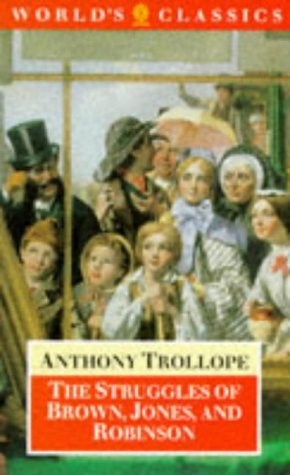
The Struggles of Brown, Jones, and Robinson

The Struggles of Brown, Jones, and Robinson, by One of the Firm. Anthony Trollope. 1862. 254 pages. [Source: Bought]

First sentence: It will be observed by the literary and commercial world that, in this transaction, the name of the really responsible party does not show on the title-page. I — George Robinson — am that party.

Premise/plot: Brown, Jones, and Robinson may have failed miserably in their business venture BUT George Robinson's account of their attempt is a delightful treat. 

Mr. Brown is an older man, nearing retirement, let's say. He brings the money--the capital--to the business. He has two partners each with a twenty-five percent share. Mr. Jones is Mr. Brown's son-in-law. He's married to Sarah Jane, I believe. But Mr. Brown has ANOTHER daughter: Maryanne. Mr. Robinson has hopes to marry her one day. If she'll say yes and actually mean it. 

You see, Maryanne has ISSUES. First, she thinks the world revolves around her. Second, she doesn't like having just one suitor begging for her hand in marriage. Third, she doesn't care WHERE or HOW her father gets the money to pay her potential groom, so long as he does it SOON. Mr. Brisket is the other suitor. And he wants MONEY before saying I do. More money than Mr. Brown has. Perhaps more money than Mr. Brown can earn in the next year. 

Now don't be thinking that Maryanne is the only selfish person in the novel. She's not alone. Mrs. Jones--Sarah--is a piece of work as well. She wants what she wants when she wants it. And she's not above TAKING what she wants and hoping that no one else will notice. Her husband is like-minded. In fact, Robinson is all but sure that these two have been helping themselves to the store's money. That Mr. Brown probably WOULD have the money to pay Mr. Brisket if Mr. Jones wasn't such a scoundrel. The store seems destined for bankruptcy. 

Will she or won't she become Mrs. Robinson? Will she or won't she become Mrs. Brisket? Will Mr. Brown lose his home and his business? Will George Robinson land on his feet and find happiness and success elsewhere? Will lessons be learned?

My thoughts: George Robinson is far from perfect. He has mixed up priorities. But his narrative voice is so delightful. Even when the situation is dire--serious--there's a touch of humor to be found. I enjoyed this one so much. It was a GREAT reminder as to why I love Trollope. Orley Farm was a CHORE. But this one was a treat. 

Quotes: 
Advertise, advertise, advertise; — and don’t stop to think too much about capital.
Capital is a very nice thing if you can get it. It is the desirable result of trade. A tradesman looks to end with a capital. But it’s gammon to say that he can’t begin without it. You might as well say a man can’t marry unless he has first got a family. Why, he marries that he may have a family. It’s putting the cart before the horse.
To obtain credit the only certain method is to advertise. Advertise, advertise, advertise. That is, assume, assume, assume. Go on assuming your virtue. The more you haven’t got it, the more you must assume it.
 Smile sweet enough, and all the world will believe you. Advertise long enough, and credit will come.
 O Commerce, how wonderful are thy ways, how vast thy power, how invisible thy dominion! Thou civilizest, hast civilized, and wilt civilize. Civilization is thy mission, and man’s welfare thine appointed charge. The nation that most warmly fosters thee shall ever be the greatest in the earth; and without thee no nation shall endure for a day. Thou art our Alpha and our Omega, our beginning and our end; the marrow of our bones, the salt of our life, the sap of our branches, the corner-stone of our temple, the rock of our foundation. We are built on thee, and for thee, and with thee. To worship thee should be man’s chiefest care, to know thy hidden ways his chosen study. “Buy in the cheapest market and sell in the dearest.” May those divine words be ever found engraved on the hearts of Brown, Jones, and Robinson!
 “George,” said he, “all the world wears stockings; but those who require African monkey muffs are in comparison few in number.
The whole world wants stockings, [he began, not disdaining to take his very words from Mr. Brown] — and Brown, Jones, and Robinson are prepared to supply the whole world with the stockings which they want. One hundred and twenty baskets of ladies’ Spanish hose, — usual price, 1s. 3d.; sold by B., J., and R. at 9¾d. “Baskets!” said Mr. Brown, when he read the little book. Four hundred dozen white cotton hose, — usual price, 1s. 0½d.; sold by B., J., and R. at 7¼d. Eight stack of China and pearl silk hose, — usual price, 3s.; sold by B., J., and R. for 1s. 9¾d. Fifteen hundred dozen of Balbriggan, — usual price, 1s. 6d.; sold by B., J., and R. for 10½d. It may not, perhaps, be necessary to continue the whole list here; but as it was read aloud to Mr. Brown, he sat aghast with astonishment. “George!” said he, at last, “I don’t like it. It makes me quite afeard. It does indeed.”
“But, George,” said Mr. Brown, “I should like to have one of these bills true, if only that one might show it as a sample when the people talk to one.” “True!” said Robinson, again. “You wish that it should be true! In the first place, did you ever see an advertisement that contained the truth? If it were as true as heaven, would any one believe it? Was it ever supposed that any man believed an advertisement? Sit down and write the truth, and see what it will be! The statement will show itself of such a nature that you will not dare to publish it. There is the paper, and there the pen. “Did you ever believe an advertisement?” Jones, in self-defence, protested that he never had. “And why should others be more simple than you? No man, — no woman believes them. They are not lies; for it is not intended that they should obtain credit. I should despise the man who attempted to base his advertisements on a system of facts, as I would the builder who lays his foundation upon the sand. The groundwork of advertising is romance. It is poetry in its very essence. Is Hamlet true?”
Brown, Jones, and Robinson have sincere pleasure in presenting to the Fashionable World their new KATAKAIRION SHIRT, in which they have thoroughly overcome the difficulties, hitherto found to be insurmountable, of adjusting the bodies of the Nobility and Gentry to an article which shall be at the same time elegant, comfortable, lasting, and cheap. B., J., and R.’s KATAKAIRION SHIRT, and their Katakairion Shirt alone, is acknowledged to unite these qualities. Six Shirts for 39s. 9d. The Katakairion Shirt is specially recommended to Officers going to India and elsewhere, while it is at the same time eminently adapted for the Home Consumption.
 “There is nothing so fickle as the taste of the public. The most popular author of the day can never count on favour for the next six months.”
Would that women could be taught to hate bargains! How much less useless trash would there be in our houses, and how much fewer tremendous sacrifices in our shops!
As far as I can see, everything is mostly lies. The very worst article our people can get for sale, they call ‘middlings;’ the real middlings are ‘very superior,’ and so on. They’re all lies; but they don’t cost anything, and all the world knows what they mean.
Bad things must be bought and sold, and if we said our things was bad, nobody would buy them.
“Fourteen hours’ work a day is nothing, if you don’t do anything. A man may sweat hard digging holes and filling them up again. But what I say is, he does not do any good.
It’s only the sheep that lets themselves be shorn. The lions and the tigers know how to keep their own coats on their own backs.
The world of purchasers will have cheap articles, and the world of commerce must supply them.
The world of purchasers will have their ears tickled, and the world of commerce must tickle them.
Could it be that a man had a double duty, each separate from the other; — a duty domestic and private, requiring his devotion and loyalty to his wife, his children, his partners, and himself; and another duty, widely extended in all its bearings and due to the world in which he lived?

© 2018 Becky Laney of Becky's Book Reviews

Monday, May 07, 2018

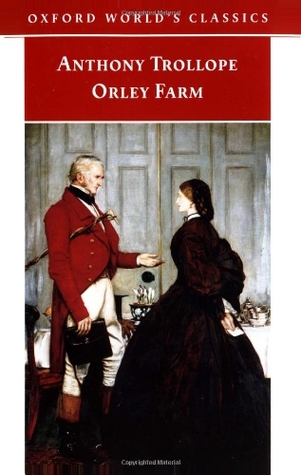
Orley Farm

Orley Farm. Anthony Trollope. 1862. 825 pages. [Source: Bought]

First sentence: It is not true that a rose by any other name will smell as sweet. Were it true, I should call this story “The Great Orley Farm Case.” But who would ask for the ninth number of a serial work burthened with so very uncouth an appellation? Thence, and therefore, — Orley Farm.

Premise/plot: Can Orley Farm be condensed into a single plot or premise?! Doubtful. Should it have been condensed into a single plot or premise by an editor way back when? Maybe. There are essentially two very different stories unfolding with a few overlapping characters to tie them together.

Lady Mason is one of the heroines of the novel. Twenty years before our novel properly opens she made a decision inspired by the story of Rebekah and Isaac from the book of Genesis. Her husband was dying, and, she needed to act then and there to do what was best for her baby son, Lucius. She did not think it fair that Orley Farm should be left to the older son, Joseph, Lucius' much much older half-brother. Why should he get it all when he already had property? There was a trial after the husband's death. Joseph found it strange--suspicious--that his father should at the last minute add a codicil to his will leaving Orley Farm to Lucius. But the jury found in favor of Lady Mason.

Twenty years have come and gone. Her son is all grown up. Her son is beginning to have ambitions of his own. Ambitions for improving the property. Ambitions of marrying well. But obstacles spring up in his path. An embittered man with questionable motives and intents decides the Orley Farm case should be reopened. He just has to convince Joseph Mason and the lawyers that it will be worth their while. And emphasis that if it is worth their while that they will make it worth his while.

The community is shocked when Lady Mason's honor and innocence is challenged. Hasn't the will and its codicil been challenged and verified already? What new evidence could there be to make a new trial worth the time and effort? Who will stand by Lady Mason?

Lady Mason takes refuge with the Orme family of The Cleeve. She's disliked by the grandson, but BELOVED by the grandfather. He falls madly, deeply head-over-heels in love with her. He's ready to sacrifice his good reputation for her sake, to be a complete fool for her. But will she let him make that sacrifice? She finds great support with Mrs. Orme--the daughter-in law/mother. Mrs. Orme may best be compared to Melanie Wilkes. She sees the best in people even in the darkest situations. She is compassionate, sympathetic, true to herself and steadfast to others. Is it any wonder that she's my favorite character in the book?

There are PLENTY of other characters in the book. Some of them are loosely connected to the 'main' story by being friends, neighbors, lawyers, or even acquaintances. For example, there are several young men that are acquaintances/friends with Lucius Mason. The book begins following their adventures/misadventures in love and courtship.

Mr. and Mrs. Furnival are two people we meet in the novel. Mr. Furnival is one of Lady Mason's lawyers. Mrs. Furnival is VERY unhappy in her marriage and becomes viciously jealous. Is she right to do so? She is right to suspect that her husband's attentions are not what they used to be and not what they should be. But she is wrong to suspect that Lady Mason is a no-good flirt out to steal Mr. Furnival. These domestic scenes are lively to say the least.

Two young women that we meet are Sophia Furnival and Madeline Staveley. The young men we meet are Lucius Mason, Augustus Staveley, Peregrine Orme (the younger), and Felix Graham. One successful marriage results in the end. But NOT every proposal gets a yes in this one.

My thoughts: Last year I set out to read Anthony Trollope in chronological order. I knew it would take more than one year. I knew that it could possibly take a good many years. I knew there would be stumbles along the way and that I'd encounter books that would be sluggish to get through. I knew that there would be books that were "easy" because I LOVED them from the start. I knew that there would be books that were "hard" because I'd find them difficult to get into. I didn't expect any book to take as long to read as Orley Farm did. It is a LONG book not made any easier because of its story.

I found it picked up quite nicely once the new trial began. But that was like sixty-something chapters into an eighty-chapter novel!!!

Quotes to share since last week's My Victorian Year:
But a woman can do things for which a man’s courage would never be sufficient.
“As long as a man can pay twenty shillings in the pound and a trifle over, what does it matter if all the judges in the land was to call him stupid?” said Snengkeld. “Stupid is as stupid does,” said Kantwise.
Had Lady Mason been guilty of all the sins in the calendar except one, Mrs. Furnival could find it within her heart to forgive her.
But no lesson is truer than that which teaches us to believe that God does temper the wind to the shorn lamb. To how many has it not seemed, at some one period of their lives, that all was over for them, and that to them in their afflictions there was nothing left but to die! And yet they have lived to laugh again, to feel that the air was warm and the earth fair, and that God in giving them ever-springing hope had given everything.
My top quotes overall:
Men will not be talked out of the convictions of their lives. No living orator would convince a grocer that coffee should be sold without chicory; and no amount of eloquence will make an English lawyer think that loyalty to truth should come before loyalty to his client.
We can do nothing by interference. Remember the old saying, You cannot touch pitch without being defiled.
Nobody holds a good opinion of a man who has a low opinion of himself.
What are love and friendship worth if they cannot stand against such trials as these?
Friendship between true friends must extend to all the affairs of life.
 It is easy to talk of repentance, but repentance will not come with a word.
When heart has spoken to heart, or even head to head, very little other speaking is absolutely necessary.


© 2018 Becky Laney of Becky's Book Reviews

Thursday, November 19, 2015

Goblin Market and Other Poems

Goblin Market and Other Poems. Christina Rossetti. 1862. 208 pages. [Source: Bought]

Poetry is not something I review frequently at Becky's Book Reviews. I tend to have a love-hate relationship with the genre. Either I love, love, love a particular poet, or, I don't. Typically, it isn't so much "hate" as indifference or even confusion. But now and then I "discover" a poet that makes me really love sitting down with a book of poetry. One of my happy discoveries of the year is Christina Rossetti. Technically I was familiar with her poem "Goblin Market" having studied it in school way back when. But since I haven't read another poem by Rossetti until this year, I'm counting her as a NEW discovery.

This poetry collection was first published in 1862. It begins with "Goblin Market." And I do have to say that if you just read one poem this year, it should be Goblin Market, in my opinion!!! It is about two sisters, Laura and Lizzie. And, of course, it features goblins selling forbidden fruit and other goodies. One sister is tempted beyond what she can stand, and, well, you should read it for yourself!

The collection includes other poems as well. Some short. Some long. Some darker than others perhaps. But not all the poems are dreary and melancholy. All feel authentically human, and capture something of the human experience. Rossetti also wrote devotional poems, but, the poems in this collection are different. Almost like the poems capture not what we should feel or ought to feel or what we want to feel, but, instead how we do feel--for better or worse.


Some poems focus on the seasons, on nature, on the natural way of things--including life, death, change, renewal. Some poems focus on love and relationships. Not all poems end happily ever after, in fact, many don't. But there is something beautiful about the poems even when they are about broken relationships.

Poems I'd recommend:

© 2015 Becky Laney of Becky's Book Reviews

Sunday, September 20, 2015

Notting Hill Mystery

Notting Hill Mystery. Charles Warren Adams. 1862/2015. Poisoned Pen Press. 284 pages. [Source: Review copy]

Dare I say that I enjoyed The Notting Hill Mystery at least as much as Wilkie Collin's A Woman in White? What if I say I liked it even more?! Granted, it has been a few years since I've read A Woman in White. But Notting Hill was such a surprisingly wonderfully old-fashioned mystery, and, with good reason, I suppose, since it was published in the 1860s!

If you enjoy sensational Victorian novels, this one proves a satisfying treat. The "hero" of the novel has collected all the evidence he can about a certain case. He's not positively sure it's a murder case, because if it is murder, it's far from straight-forward. The less you know, the better the novel will read, in my opinion. But it involves TWINS and mesmerism and poison.

At first, I thought this one would be a slow read, since the evidence consists of letters, diaries, interviews, etc. But I found it an entertaining and satisfying read.

It is easy for me to recommend this one. I think mystery lovers will appreciate it. And if you have a love for all things Victorian, then you may really, really LOVE it, just as I did.


© 2015 Becky Laney of Becky's Book Reviews

Sunday, September 21, 2014

No Name (1862)

No Name. Wilkie Collins. 1862/1998. Oxford University Press. 748 pages.

No Name is my third Wilkie Collins novel to read this year. I've also read A Rogue's Life and The Law and the Lady. I don't know if I'll have time to squeeze in another before the year is over or not. But it's looking like No Name will definitely be my favorite. This novel reminded me of why I enjoy reading Wilkie Collins! And sometimes I do need reminding. I have been disappointed before. But when he's good, he tends to be really, really good. No Name is definitely Collins at his best! I enjoyed No Name best when I stopped trying to categorize it.

Magdalen Vanstone is the heroine of No Name. After her parents die within weeks of each other, she learns some startling news that changes everything for herself and her sister. Her father was not legally married to her mother; that is he was not legally married to her until a few months ago. His honorable intentions, unfortunately, have ruined their lives. For his marriage discredits his previous will. If he had NOT gotten married, then the girls would have been in his will and they would have inherited everything. Now his everything goes to an estranged older brother that is mean and cruel. (Collins would like you to boo, hiss now)

Norah, the good sister, the good older sister, accepts this news with grace and courage. She will follow Miss Garth's advice closely. She will become a governess. She will be far from wealthy, but, she'll hold onto as much dignity as she can cling to under the circumstances.

Magdalen, the younger sister, refuses to accept it at all. And she's just as clever and crafty as she is stubborn. Magdalen teams up with a relation of a relation, a con man named Captain Wragge. Both are clever and willing to be a bit immoral in pursuit of what they want most, of what they feel they deserve. Captain Wragge may sound like a villain, but, there's just something about him that I can't help liking. He certainly makes NO NAME an interesting read!!!

Magdalen has a plan, a scheme, for recovering the money that is rightfully hers. She will stop at nothing to get it. What is her plan? Well, it involves her (mean) uncle, Michael Vanstone, and his heir, Noel.

The scheme does not go unnoticed, however. Mrs. Lecount is a servant in the Vanstone household, and she is very controlling and extremely observant. She is always on the lookout for people who might be tempted to take advantage of the family since they are old and/or weak and/or very stupid!

It is a plot-driven novel with plenty of twists and turns. I enjoyed every single one. The book may be over 700 pages, but it's a quick 700 pages!!! It's a surprisingly quick read. Once you become hooked on the story, on learning what happens next, once you start to CARE about the characters, you just have to read on and on!!!

Will Magdalen's scheme succeed?
Will she get her hands on the money?
Will she share the money with Captain Wragge?
Will he find a way of getting his share? Is he really on her side no matter what? Or will he turn traitor?
Will either sister get married? Will either sister live happily ever after?

© 2014 Becky Laney of Becky's Book Reviews

Friday, April 12, 2013

Les Miserables (1862)

Les Miserables. Victor Hugo. Translated and Introduced by Norman Denny. 1862/1976/2012. Penguin. 1232 pages.

Reading Les Miserables was an experience! For six or seven days, I kept good company with the novel. I definitely was not expecting to finish this chunkster in one week! But I found the story so compelling. Political, philosophical, spiritual, dramatic, and romantic. Each word describes the novel, in part. While there are many characters in this novel, I loved the narrator the best of all. Who are some of the characters? Bishop Myriel, Jean Valjean, Fantine, Inspector Javert, Cosette, Marius, Eponine, Enjolras, and Gavroche--just to name a few.

Jean Valjean is an ex-convict who seeks shelter from Bishop Myriel one night. Though he's been treated only with kindness, Valjean in his bitterness (he was sent to prison for stealing a loaf of bread), he steals the bishop's silver. When the theft is discovered, the bishop is all compassion telling the officials that there has been a misunderstanding. Valjean did not steal the silver; it was given as a gift. In fact, he's happy to give Valjean his silver candlesticks as well. Valjean is shocked and overwhelmed. The meeting turns out to be quite life-changing.

When readers next meet Valjean, he has a new name and life. Monsieur Madeleine is a successful business man. He has a BIG heart. He's always giving. He's always thinking of others. He's always doing what he can, when he can to make a difference when and where it matters most. One woman he is determined to help is a young, single mother, Fantine. Circumstances have separated Fantine from her child, Cosette, but, Valjean is determined to correct as many wrongs as he can in this situation. He will see to it personally.

Unfortunately, his past catches up with him. He learns that a man has been arrested; "Jean Valjean" has been caught. Of course, Madeleine knows this is nonsense. Can he let another take his place in prison? If he tells the truth then he can no longer help the poor, but if he doesn't tell the truth, how could he live with himself? He does the honorable thing--though it is one of the greatest challenges he's faced so far.

But that means, for the moment, that Cosette is left in unpleasant circumstances...

There comes a time, an opportunity for Valjean to escape. What he does with his freedom--this time he's assumed drowned, I believe--is go and find Cosette. The two become everything to one another. Cosette is the family he's never had, never even knew he needed or wanted... the two end up in Paris.

Almost half of the novel follows the love story between Marius and Cosette. But it isn't only a love story. Marius is a poor man in conflict with his rich grandfather. The two disagree about many things. But their main source of disagreement is politics. At first, Marius is swept up in his father's politics, with a new awareness of who his father was as a soldier, as a man, as a possible hero. But later, Marius begins to think for himself, to contemplate political and philosophical things for himself. He becomes friendly with a political group at this time. But his love of politics dims when he falls in love with Cosette...and she becomes his whole reason for being. For the longest time these two don't even know each other's names! This romance isn't without challenges...

This novel has so much drama! I found it beautifully written. So many amazing passages! Such interesting characters! I'm not sure I loved the ending. And I was frustrated with Marius at times. But. I definitely loved this book!

Favorite quotes:
What is reported of men, whether it be true or false, may play as large a part in their lives, and above all in their destiny, as the things they do. (19)
We do not claim that the portrait we are making is the whole truth, only that it is a resemblance. (25)
The flesh is at once man's burden and his temptation. He bears it and yields to it. He must keep watch over it and restrain it, and obey it only in the last resort. Such obedience may be a fault, but it is a venial fault. It is a fall, but a fall on to the knees which may end in prayer. To be a saint is to be an exception; to be a true man is the rule. Err, fail, sin if you must, but be upright. To sin as little as possible is the law for men; to sin not at all is a dream for angels. All earthly things are subject to sin; it is like the force of gravity. (29-30)
'The beautiful is as useful as the useful.' Then, after a pause, he added: "More so, perhaps.' (38)
I was not put into this world to preserve my life but to protect souls. (40)
Conscience is the amount of inner knowledge that we possess. (52)
The brutalities of progress are called revolutions. When they are over we realize this: that the human race has been roughly handled, but that it has advanced. (56)
He pondered on the greatness and the living presence of God, on the mystery of eternity in the future and, even more strange, eternity in the past, on all the infinity manifest to his eyes and to his senses; and without seeking to comprehend the incomprehensible he contemplated these things. He did not scrutinize God but let his eyes be dazzled. (67)
There are no bounds to human thought. At its own risk and peril it analyzes and explores its own bewilderment. (68)
We can no more pray too much than we can love too much. (69)
There are men who dig for gold; he dug for compassion. Poverty was his goldmine; and the universality of suffering a reason for the universality of charity. 'Love one another.' To him everything was contained in those words, his whole doctrine, and he asked no more. (69)
The bishop, seated at his side, laid a hand gently on his arm.
'You need have told me nothing. This house is not mine but Christ's. It does not ask a man his  name but whether he is in need. You are in trouble, you are hungry and thirsty, and so you are welcome. You need not thank me for receiving you in my house. No one is at home here except those seeking shelter. Let me assure you, passer-by though you are, that this is more your home than mine. Everything in it is yours. Why should I ask your name? In any case I knew it before you told me.'
The man looked up with startled eyes. 'You know my name?'
'Of course,' said the bishop. 'Your name is brother.' (87)
Is there not true evangelism in the delicacy which refrains from preaching and moralizing? To avoid probing an open wound, is not that the truest sympathy? (90)
'Do not forget, do not ever forget, that you have promised me to use the money to make yourself an honest man.'
Valjean, who did not recall having made any promise, was silent. The bishop had spoken the words slowly and deliberately. He concluded with a solemn emphasis: 'Jean Valjean, my brother, you no longer belong to what is evil but to what is good. I have bought your soul to save it from black thoughts and the spirit of perdition, and I give it to God.' ( 111)
Gold and pearls were her dowry, but the gold was on her head and the pearls were in her mouth. She worked in order to live, and presently fell in love, also in order to live, for the heart, too, has its hunger. (125)
Animals are nothing but the portrayal of our virtues and vices made manifest to our eyes, the visible reflections of our souls. (164)
What is the riddle of these countless scattered destinies, whither are they bound, why are they as they are? He who knows the answer to this knows all things. He is alone. His name is God. (180)
There is a prospect greater than the sea, and it is the sky; there is a prospect greater than the sky, and it is the human soul. (208)
To make a poem of the human conscience, even in terms of a single man and the least of men, would be to merge all epics in a single epic transcending all. (208)
We can no more prevent a thought from returning to the mind than we can prevent the sea from rising on the foreshore. To the sailor it is the tide, to the uneasy conscience it is remorse. God moves the soul as He moves the oceans. (213)
The sisters, then, had this in common when they were girls, that each had her dream, each had wings, those of an angel in the one case and those of a goose in the other. (519)
He never left home without a book under his arm, and often came back with two. (593)
Our imaginings are what most resemble us. Each of us dreams of the unknown and the impossible in his own way. (597)
There comes a moment when the bud bursts overnight into flower and yesterday's little girl becomes a woman to entrap our hearts. This one had not merely grown but was transformed. Just as three April days may suffice for some trees to cover themselves with blossom, so six months had sufficed to clothe her with beauty. Her April had come. (606)
Of all things God has created it is the human heart that sheds the brightest light, and alas, the blackest despair. (844)
'After all, what is a cat?' he demanded. 'It's a correction. Having created the mouse God said to himself, "That was silly of me!" and so he created the cat. The cat is the erratum of the mouse. Mouse and cat together represent the revised proofs of Creation.' (995) 
© 2013 Becky Laney of Becky's Book Reviews

Thursday, July 19, 2012

Lady Audley's Secret

Lady Audley's Secret. Mary Elizabeth Braddon. 1862/1998. Oxford World's Classic. 496 pages.  

It lay low down in a hollow, rich with find old timber and luxuriant pastures; and you came upon it through an avenue of lines, bordered on either side by meadows, over the high hedges of which the cattle looked inquisitively at you as you passed, wondering, perhaps, what you wanted; for there was no thoroughfare, and unless you were going to the Court you had no business there at all. At the end of this avenue there was an old arch and a clock-tower, with a stupid, bewildering clock, which had only one hand; and which jumped straight from one hour to the next, and was therefore always in extremes. Through this arch you walked straight into the gardens of Audley Court.

I definitely enjoyed this one! I thought it was a GREAT read. I'm not sure it is a great book, but, it offers entertainment and thrills. I personally liked the writing style of this one, I found it very suspenseful and satisfying. If possible, it's best not to know Lady Audley's "secret" before reading. I'd say avoid reading too much detail about this one. I am going to try my best not to give away any details that are best left as surprises. But I do want to introduce you to the characters...

People you'll meet:

Michael Audley, a widower with a near-grown daughter, Alicia, who falls madly, deeply in love with a younger woman, Lucy Graham, who is employed as a governess by one of his friends.

Lady Audley, a young woman with a secret; It was almost too easy for Lucy Graham to agree to become Lady Audley. He's a rich man, a man with status, and he wants HER, a nobody. Who could say no?! Especially if you don't have your heart set on marrying for love.

Alicia Audley, a young woman too close in age to Lady Audley; she is NOT happy to have a new stepmother. She is not happy that her new stepmother is oh-so-gorgeous and that men seem to see only her. She's also suspicious and distrustful. Granted, she would probably be distrustful of ANY woman in that situation. And the fact that Lady Audley does in fact have a secret shouldn't be taken as proof that she has great instincts.

Robert Audley, a nephew of Michael Audley; Alicia really, really WISHES that Robert would pay attention to her. She really is hoping that he will notice that she is all grown up and ready to be proposed to. When we first meet Robert, you might say that he completely lacks ambition and gumption. In other words, he doesn't do much at all. This doesn't remain the case.

George Talboys, a friend of Robert Audley. He is newly returned to England, he's now got some money. He could potentially have been a very very happy man if he'd found his wife and son alive and waiting for him. Unfortunately, soon after his return, he learns that his wife has died. His son is being cared for by his father-in-law. He's too shocked to really take care of the boy himself, and, he feels perhaps its best not to disturb the boy too much. After all, his mother has died, and the boy's grandfather has been a part of his life from the start.

Phoebe and Luke Marks, Phoebe serves as Lady Audley's maid, Phoebe and her husband are the first to discover her secret.

I would definitely recommend this one!!! This would make a great companion read to The Suspicions of Mr. Whicher by Kate Summerscale, but, do try to read this one FIRST. 

Read Lady Audley's Secret
  • If you want to read one of the first sensation novels
  • If you enjoy suspense and mystery and detective stories
  • If you like classics, Victorian classics
  • If you are interested in reading women writers of the nineteenth century


© 2012 Becky Laney of Becky's Book Reviews

Saturday, March 14, 2009

The Morgesons


Stoddard, Elizabeth. 1862. The Morgesons. 264 pages.

"That child," said my aunt Mercy, looking at me with indigo-colored eyes, "is possessed."

Have you heard of Elizabeth Stoddard? I hadn't either. Not until I stumbled across this book while looking for Steinbeck. In the introduction, it explains a bit why this author fell into obscurity although during her lifetime she was compared with such greats as Balzac, Tolstoy, Eliot, the Brontes, and Hawthorne. (If your library doesn't have a copy, you can read it online here.)

Is it an exciting read? a thrilling one? Not really. Not by today's standards. It's about one girl, Cassandra "Cassy" growing up, coming to age. We follow her roughly from the age of ten to twenty. We see her in various environments and situations--home, visiting relatives for extended periods of time, school, courting, etc. She's not an easy narrator to love. She's more abrasive than that. There seems to be friction, tension, strife in almost all of her relationships. Perhaps because her whole family is 'difficult' to get along with. Perhaps because she's stubborn and makes no apologies. She's not meek or mild.

As a reader, I was never sure of Cassy. If she was the one disconnecting from her family...or if maybe her family were the ones disconnecting from her. There never seemed to be a bond between family members. Not with her mother. Not with her sister. And only slightly with her father. And this slight bond is only because he allows his daughter to go off on all these adventures away from home to visit family and friends, etc. He also keeps her well dressed. So I never was sure if she genuinely loved her father. Or if she just seemed to like him best because he was the one who was able to grant her desires. There seems to be a harsh distance, an emotional barrier that prevents Cassy from genuinely loving and being loved. As I said, I'm not sure who is to blame for this.

Cassy seems to attract some strange men to her. Especially true in the case of her cousin, Charles. Though married, though a father, he seems to find Cassandra irresistible. And though it is never out and out revealed, this attraction is mutual. Cassy, still a teen, maybe fifteen or sixteen?, finds herself in love with her cousin, inappropriate as it may be. See, she's come to live with her cousin and his wife, Alice. She's with this seemingly 'happy' family for a little over a year. And his wife, Alice, is aware that there is something going on between the two. But she's so busy being a good and perfect wife and mother that she pretends she doesn't know or doesn't care. What strikes me is one scene where Charles returns home from a business trip, I believe, and gives Cassandra a diamond ring to wear on her third finger. I don't remember if "good" little Alice gets a present as well, and if so, what it might have been. But there's a distinctly creepy vibe from this family.

Other men in Cassy's life are a pair of brothers, Ben and Desmond Somers. Both alcoholics. (They come from one crazy family!) One marries Cassandra. One marries Cassandra's sister, Veronica. Only one sister will get her happily ever after ending. But which one? Can a 'bad' boy ever turn good and mean it?

Though Cassandra seems a bit of an unnatural heroine, I am glad to have read this one. (After all, Scarlett O'Hara is plenty unnatural!)

© Becky Laney of Becky's Book Reviews
If you're reading this post on another site, or another feed, the content has been stolen.