Showing posts with label Suspense. Show all posts

Monday, February 20, 2023

42. Lost in Time


Lost in Time. A.G. Riddle. 2022. 455 pages. [Source: Library]

First sentence: On the anniversary of his wife’s death, Sam Anderson visited her grave. It was a crisp spring morning in Nevada, with dew on the grass and fog rolling through the cemetery. In one hand, Sam carried a bouquet of flowers. In the other, he gripped his son’s hand. Ryan was eleven years old and strong-willed and introverted, like his mother. After her death, he had withdrawn, spending even more time alone, playing with LEGOs, reading, and generally avoiding life.

Premise/plot: Sam and Adeline Anderson find themselves in quite the mess. This father and daughter are suspects in a murder investigation. There is video evidence that they were the last [last to be seen, at least] to enter the victim's home. Nora and Sam were in a relationship together. Now Sam may just be exiled...forever...to save his daughter from being implicated as well.

Exiled means EXILED in Lost in Time. Criminals/prisoners are sent to the FAR, FAR, FAR, DISTANT past in an alternate universe. Convicts won't get the chance to appeal, they'll be alive as long as they can survive the elements: dinosaurs, earthquakes, volcanoes, meteors, etc. 

What makes it worse for this father of two, is that he is one of SIX scientists who invented the Absolom time machine. It was meant to be a quick new way to "ship" stuff. They didn't know it was a time machine, but not a time machine to their own past, but a multi-verse time machine. 

Adeline will do just about anything to save her father [after the fact] even if it means working/living with the enemy.

My thoughts: I loved, loved, loved, loved, crazy-loved this one. I wish I could find more science fiction like this one. For #lawnerds who also love sci-fi, especially time travel, this one is a dream read. 

I enjoyed the complexity of this one. I loved the world-building and puzzle-building. All the pieces, all the clues, are there to be found. But it takes a while for everything to come together. (I was not expecting it to play out quite like it did.)

I really loved the characterization in this one. In particular, Adeline's character. She is our main narrator....

© 2023 Becky Laney of Becky's Book Reviews

Friday, December 17, 2021

148. A Surprise for Christmas


A Surprise for Christmas And Other Seasonal Mysteries. Martin Edwards, Editor. 2021 (US) 2020 (UK). 304 pages. [Source: Review copy]

Love mysteries and suspense? Enjoy holiday/winter themed short stories? I recommend Martin Edwards' newest collection for the British Library Crime series. The series includes novels and short story collections. (I have read several in this series, but not all by any means!)

The stories included in this collection are as follows:

The Black Bag Left On a Doorstep by Catharine Louisa Pirkis
The Hole in the Wall by G.K. Chesterton
Death on the Air by Ngaio Marsh
Persons or Things Unknown by Carter Dickson
Dead Man's Hand by E.R. Punshon
The Christmas Eve Ghost by Ernest Dudley
Dick Whittington's Cat by Victor Canning
A Surprise for Christmas by Cyril Hare
On Christmas Day in the Morning by Margery Allingham
Give Me a Ring by Gilbert Lucy Malleson
Father Christmas Comes to Orbins by Julian Symons
The Turn-Again Bell by Barry Perowne

I found the collection to be a blend of familiar authors and new-to-me authors. Most of the stories stayed within the mystery/suspense genre. A couple, however, flirted with other genres or sub-genres. For example, stories that focused on crimes from the criminal point of view. One story is definitely ALL thriller. (Give Me a Ring was a LONG thriller-esque story that kept me turning pages.)

I enjoyed almost all of the stories within this collection. (Perhaps with the exception of Father Christmas Comes to Orbins. I don't know WHERE I've read the story before. Perhaps in another Christmas-themed collection. But I didn't enjoy it the first time around. A few paragraphs in, I was THAT STORY AGAIN??? 

Still for the most part I can wholeheartedly recommend this collection for those that enjoy this genre. 

© 2021 Becky Laney of Becky's Book Reviews

Wednesday, August 25, 2021

97. Dark Waters


Dark Waters (Small Spaces #3) Katherine Arden. 2021. [August] 198 pages. [Source: Library]

First sentence: Spring is East Evansburg, and the rain poured down like someone had turned on a hose in the sky.

Premise/plot: Brian, Olivia, and Coco are friends who face DANGERS together--for better or worse. In this their third adventure, they are MAROONED on a haunted island in the middle of a lake facing off against a sea monster. Well, a monster that can hunt on sea or on land. The danger is real and the monster isn't the only threat...Olivia's dad was bitten by a snake during this sailing adventure, and they were never able to contact help before their boat...well...let's just say that the monster took a big bite out of their boat...

My thoughts: I mostly enjoyed spending more time with our heroes: Brian Battersby, Olivia Adler, and Coco Zintner. The three are joined by a classmate, Phil Dimmonds. Turns out these three aren't the only one who remember the terrifying adventures in the first book (like they originally thought).

I personally don't understand why these three children agreed to go on a sailing adventure together. Seriously. After the events of the first and second books, you would think they'd be aware of the dangers of such an adventure.

The book packs plenty of thrills and action sequences...and the ending is quite the cliffhanger.


© 2021 Becky Laney of Becky's Book Reviews

Monday, May 03, 2021

42. The Wife Upstairs


The Wife Upstairs. Rachel Hawkins. 2021. [January] 290 pages. [Source: Review copy]

First sentence: It is the absolute shittiest day for a walk. Rain has been pouring down all morning, making my drive from Center Point out here to Mountain Brook a nightmare, soaking the hem of my jeans as I got out of the car in the Reeds’ driveway, making my sneakers squelch on the marble floors of the foyer. But Mrs. Reed is holding her dog Bear’s leash, making a face at me, this frown of exaggerated sympathy that’s supposed to let me know how bad she feels about sending me out in the rain on this Monday morning.

Premise/plot: If Rod Serling and Alfred Hitchcock got together to retell Charlotte Bronte's Jane Eyre, it might look a little something like Rachel Hawkins' The Wife Upstairs.

What should you know going into it? Well, I'd say very little. I'll keep this section to a bare minimum. It's contemporary. Set in Alabama. A psychological thriller.

My thoughts: No doubt about it if I'd read this one in my night-owl days I'd have stayed up all night to read it in one sitting. As it is I had to split it into two readings. I definitely found it engaging and thought-provoking. (These characters stayed on my mind when I wasn't reading the book. I thought about them throughout the day as I was anticipating picking up the book again.)

It isn't strictly just a retelling of Jane Eyre. It's more like Jane Eyre is the jumping off place for a crazy psychological thriller. Crazy mostly in a good way.

One element completely lacking from The Wife Upstairs is what my mom would call the preachiness of Jane Eyre. Gone are all the religious/moral overtones and imagery. I doubt they'd work well in a contemporary novel anyhow.

I think the gothicness of Jane Eyre AND Rebecca combine well with the Southern setting.

It is told from three perspectives: Jane, Bea, and Eddie. (Though Hawkins keeps us waiting until the (very) end for Eddie's perspective). Because it isn't told in alternating chapters--rigidly going from one to the other in a strict pattern--the suspense builds and builds and builds. (In my opinion).

 Did I love it? I wouldn't say love is the right word. Depending on if you look for premise-driven and/or plot-driven books OR if you are mainly a fan of character-driven works. One or two words about the characters, I can't think of a single character (perhaps with the exception of all the dogs) that I'd classify as likeable. In other words, Hawkins isn't all about sympathetic characters that you cheer on and care about.

Is it clean? Not really. I'd say the number one reason it isn't clean is the language--lots of casual cussing. The language is far from ideal if that matters to you. The smut is kept to a bare minimum of description and gets very little page space. So I wasn't horribly bothered by the content.

Would I recommend it to Jane Eyre lovers that don't like psychological thrillers? No. Yes. Maybe.
No. I would not recommend The Wife Upstairs if Jane and Edward are your most favorite romantic couple of all time and one that you revisit a couple times a year. If what you love is the romance of the original--reader, I married him--then you'll probably be disappointed and not even call this a retelling. You might even call it a murder.
Yes. I would recommend if you enjoy the atmosphere of JANE EYRE and REBECCA and DRAGONWYCK. (Dragonwyck is by Anya Seton). This one is all about SUSPENSE, DANGER, MYSTERY, HORROR, THRILLS. If the actual feel-good romance and happily ever after ending was your least favorite part of the original, this one is for you.
Maybe. If you enjoy the original novel a great deal--perhaps even love and adore it--BUT are also open to psychological thrillers and suspense novels in general, then this one may appeal. If you're open to deconstructing and rearranging, then this one may just work well for you.

© 2021 Becky Laney of Becky's Book Reviews

Monday, March 22, 2021

29. The Vines


The Vines. Shelley Nolden. 2021. 391 pages. [Source: Review copy]

First sentence: A thick keloid encircled the young woman's throat like a noose, ready to seize her last breath. 

Premise/plot: The Vines is suspense novel with paranormal vibes. The setting is North Brother island in New York. One thread of the story is set in the "present day" of 2007/2008. The other thread of the story is set in the past beginning circa 1902.

As for the story itself, well, how much is too much for readers to know BEFORE they pick it up? If I say too little, you might not be curious enough to seek it out. If I say too much, well, you might enjoy it less if some of the piecework has been done for you. 

So my one sentence teaser:

One family plays god with repercussions that are felt for generations to come.

My thoughts: I am so completely torn on how I feel about Shelley Nolden's The Vines.

On the one hand, it is a haunting, atmospheric read that will certainly appeal to some readers. The plot is like a tangled, convoluted knot with a few strands for the main character, Finn, to start pulling. Readers have a benefit over Finn in some ways because they are privy to the PAST sections of the book. Finn isn't working with all the pieces--and readers may not have all the pieces either--and sometimes the harder Finn pulls, the more knotted it becomes. 

Can characters be despicable without being developed and fleshed out? Maybe. Maybe not. I honestly don't know. I do know that I hated almost *all* the characters in this one. (Then again, I doubt readers are meant to *like* the characters.) So in that the author succeeds.

Motivations. This one takes a very long--almost four hundred pages--look at motivations. Do the ends justify the means? Is anything permissible  so long as some good can come from it? If great good can come from great harm, then is that okay?  The book also looks at the excuses we try to use to justify our actions, our decisions, our choices.

Two other questions that come to mind: 

What can you live with?

What can you live without?

On the other hand, The Vines felt tedious. I'll try to clarify. Despicable actions are shown repetitively--think decades worth of repetition of EVIL, despicable, horrible actions. It is unimaginable to think of how it would actually feel to live this fictional life out. Cora, the main character, is definitely the last person you'd ever want to be.

When a book is so dark--even if it is a haunting, atmospheric read--and is so bleakity-bleak, and when a book is peopled with such MONSTERS, then it is hard for me to say wow what a great book I loved every minute of it.

I found it both compelling and wearisome. I know it seems impossible a book can be both. I would have thought so too before reading The Vines. It was compelling because I was always kept curious enough to keep turning pages. It was wearisome because it was so heavy and dark.

I do think some readers will find it worth their time. I don't think it will be for every single reader.

There were two things that I didn't quite like.

s

p

o

i

l

e

r

I didn't like how the author felt the need to push this one into being COVID-19 related. In the author note she mentions this was a work in progress before COVID and how she reworked elements of it to make it tie into the current pandemic. I felt it strains the novel a bit. Other readers may disagree. But I almost feel like it is making the claim that the pandemic is man made and intentional. That may not be the author's intent, I do not claim to know her intentions and thought processes.

I also didn't like the cliff-hanger ending. Being as torn as I am about the book, I really don't want to have to read another four hundred pages or so to find out what happens.


© 2021 Becky Laney of Becky's Book Reviews

Tuesday, November 19, 2019

Dead Voices (Small Spaces #2)

Dead Voices. (Small Spaces #2) Katherine Arden. 2019. 256 pages. [Source: Library]

First sentence: Winter in East Evansburg, and just after dusk, five people in a beat-up old Subaru peeled out of town in a snowstorm.

Premise/plot: Dead Voices stars three friends whom we met in Small Spaces: Ollie, Coco, and Brian. The three are spending the first week of winter vacation—along with Coco’s mom and Ollie’s dad—at a soon to be opened ski resort, Mount Hemlock. The storm could be a sign of things to come. If they are advising people to stay off the roads and stay home, then you should listen. But that would be a very short and incredibly boring book! Dangers abound in this one, especially if you’re a child. If you’re an adult, well, then you just cook, eat, sleep, and never observe your surroundings.

My thoughts: This one promises to be a delightfully spooky ghost story. A family is trapped by a blizzard in an haunted house. That’s the premise. Lots of foreboding and build up. One child keeps seeing and hearing ghosts. Another keeps having dreams. Combined there are plenty of warnings. Warnings like don’t listen to the dead, stay out of closets, never look in mirrors. Yet. Yet what do our narrators do?!?! Listen to the dead, look in closets, and look in mirrors. Part of me was screaming at the characters. The other part of me was racing through the book.

I do not want to include any spoilers in my review. But I do have some thoughts on this one. It is not a little creepy—but very creepy. The adventures with a certain someone from a previous book seem to be just beginning. The books are definitely more connected than I originally thought.

On a side note, I did not like the inclusion of the Ouija board and the subplot of trying to communicate with the dead. The first book was creepy but not in a kids are interested in the occult way.

I do like that there are definite clues throughout. Even though the characters themselves didn’t seem to have eyes that see and ears that hear.


© 2019 Becky Laney of Becky's Book Reviews

Sunday, September 20, 2015

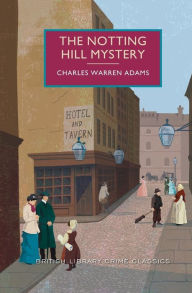
Notting Hill Mystery

Notting Hill Mystery. Charles Warren Adams. 1862/2015. Poisoned Pen Press. 284 pages. [Source: Review copy]

Dare I say that I enjoyed The Notting Hill Mystery at least as much as Wilkie Collin's A Woman in White? What if I say I liked it even more?! Granted, it has been a few years since I've read A Woman in White. But Notting Hill was such a surprisingly wonderfully old-fashioned mystery, and, with good reason, I suppose, since it was published in the 1860s!

If you enjoy sensational Victorian novels, this one proves a satisfying treat. The "hero" of the novel has collected all the evidence he can about a certain case. He's not positively sure it's a murder case, because if it is murder, it's far from straight-forward. The less you know, the better the novel will read, in my opinion. But it involves TWINS and mesmerism and poison.

At first, I thought this one would be a slow read, since the evidence consists of letters, diaries, interviews, etc. But I found it an entertaining and satisfying read.

It is easy for me to recommend this one. I think mystery lovers will appreciate it. And if you have a love for all things Victorian, then you may really, really LOVE it, just as I did.


© 2015 Becky Laney of Becky's Book Reviews

Thursday, July 12, 2012

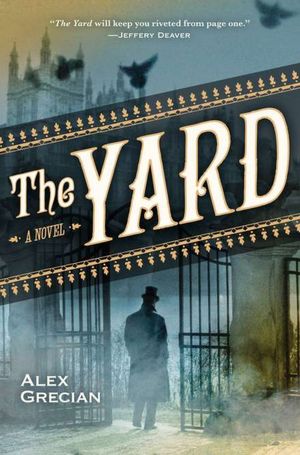
The Yard (with slight spoilers)

The Yard. Alex Grecian. 2012. Penguin. 432 pages.

From the prologue: Nobody noticed when Inspector Christian Little of Scotland Yard disappeared, and nobody was looking for him when he was found.

What can I say about Alex Grecian's The Yard? I was disappointed. If you're expecting a mystery where suspense builds, clues are given, and you're on the edge of your seat to find out who did it, then this one will definitely disappoint. For Grecian will reveal who did it to readers within a chapter or two. Readers will get a behind-the-scenes look at the murderer almost from the beginning. The first entry or so of this murderer his identity is still hidden, but, that doesn't remain the case for long. But Grecian doesn't just reveal the identity of one murderer, he reveals the identity of another murderer. For Scotland Yard is working on two cases during the course of the novel. One, a murderer who is killing police detectives. Two, a murderer who is killing bearded men.

The Yard has multiple narrators. Readers meet several detectives (some remain alive at the novel's end, others aren't so fortunate) throughout the novel, each contributes (to a certain degree) to solving one or the other cases. Some personal details are shared about some of the detectives. For example, readers meet Walter Day and his wife. We get a flashback to before they were married--we get to see the proposal, and, it felt to me it was a very odd proposal! We also see glimpses of their home life as she adjusts to life in London. Another detective we meet is Hammersmith (I can't recall his first name). We get flashes from him as well, including flashbacks to when he was a child. His flashbacks reveal his sensitive side and how difficult the job can be: finding the bodies of children, men, women, etc. Readers also meet Dr. Kingsley who works closely with Scotland Yard, and we meet his young daughter who helps out by sketching all the corpses. While we meet many characters, including a mystery "dancing man", I had a hard time truly connecting with any of the characters. I'll explain, while I wanted to read the book to its end, I wasn't at the edge of my seat. It wasn't that the book was super-compelling and impossible to put down. It wasn't that the book had any suspense (well, readers could perhaps wonder if Fenn would make it back home alive or if he'd end up a corpse; and if you're desperate to find more to be in suspense about I suppose you could wonder if Day's wife was ever going to tell him that she was pregnant), I finished the book because I like to finish what I start.

This one would almost have to be more of a thriller than a mystery, but, I'm not sure it's lack of suspense and uneven pacing would make it a good thriller either. Overall, I'd say the characterization wasn't the best. Some of the characters had potential, they could potentially be developed into something more, into characters that I would care about, but they weren't quite there yet. Some of the characters were incredibly flimsy and flat.

I think some of the scenes were intentionally put in there to aggravate modern readers--which worked, by the way. Having scenes where a boy goes up to a police officer (detective) and clearly states things like, help, please help me, I've been kidnapped, tied up, held prisoner, I only now just escaped, if he catches me again, I don't know what will happen, please help me find my parents. And have him respond with, move along, boy, or I'll send you to the workhouse. I suppose the intention being to highlight that women and children had no value or worth in society.

I wanted to like this one, I was even hoping to love it, but it was just okay. 

Best line: "If all men were sane, we would be blacksmiths." (87)

Read The Yard
  • If you like historical fiction set during the Victorian period
  • If you like Victorian mystery/detective/suspense stories; just don't expect Grecian to write as well as the actual Victorians, his style, his characterization, his pacing, doesn't even come close to matching. 
  • If you don't mind slightly tedious fiction, for example, he spends pages and pages each time (almost) trying to explain the concept of fingerprints. And how each fingerprint is unique, personal; how fingerprints can help establish who was at the scene of the crime, etc. 
© 2012 Becky Laney of Becky's Book Reviews

Friday, June 01, 2012

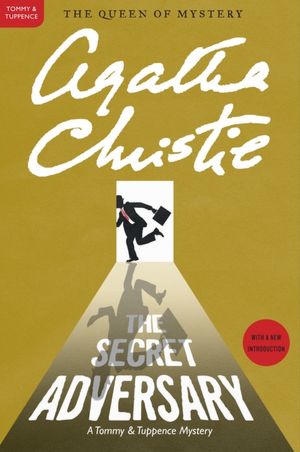
The Secret Adversary

The Secret Adversary. Agatha Christie. 1922/2012. HarperCollins. 352 pages.

 I enjoyed The Secret Adversary. I have read Agatha Christie's novels out of order, without much of a plan. So I've read many of her later novels first. This is my first Tommy and Tuppence novel, however.

I definitely liked it. It has a certain charm to it, I suppose. This first novel introduces readers to the two characters, and introduces a romance between the two. A romance that perhaps seems obvious, but, a somewhat sweet romance nonetheless.

World War I has not been over that long when the novel opens, and both Tommy and Prudence (Tuppence) are continuing to make adjustments now that the war is over and their service has ended. (She was a nurse, I believe.) These two happen to bump into one another one day. And they happen to have a conversation. Their conversation is overheard by a gentleman, a man who assumes Tommy and Tuppence know more than what they in fact do, know a BIG secret somewhat connected to the early days of the War. A secret concerning the identity of Jane Finn. When this man approaches Prudence, all of their lives are changed...

Essentially, Tuppence and Tommy team up (with a few others for help now and then) to solve a mystery, to find out about a woman's identity, to trace her, to trace some important documents. Their adventure is dangerous. Both will risk their lives to find out the truth.

I liked this one. I didn't quite love it. But I did like it.

Read The Secret Adversary
  • If you're a fan of Agatha Christie
  • If you love mystery/spy novels
  • If you want to read one of Christie's earlier novels
  • If you love mysteries with a historical feel to them

© 2012 Becky Laney of Becky's Book Reviews

Tuesday, May 29, 2012

The Lord is My Shepherd

The Lord is My Shepherd. (Psalm 23 Mysteries) Debbie Viguie. 2010. Abingdon Press. 320 pages.

More than anything, Cindy Preston hated Mondays. 

I was skeptical about this book, I'll be honest. I had no idea if it would be something I'd like. But I like to challenge myself to take risks...occasionally. And I am definitely glad I took a chance on Debbie Viguie's The Lord Is My Shepherd. This one is mystery-suspense-thriller. Cindy Preston, the heroine, is a church secretary who discovers--literally stumbles upon--a dead body in the sanctuary of the church one Monday morning. But it isn't just any Monday, no it's Holy Week, it's the Monday of Easter week. Her screams draw the attention of the Rabbi next door, Jeremiah Silverman. Together they meet the police detective...and so it begins.

I really, really, really enjoyed this one!!! It was so hard to put this one down. I definitely liked the heroine, Cindy Preston. I thought she was a good balance. On the one hand, she's terrified and in shock, on the other hand she's strong and strong-willed. She may be afraid--and she may have good reason to be afraid--but she isn't going to be ruled or enslaved by that fear. Not that she's careless. And as for Jeremiah Silverman, well, I loved him!!! I did. I just loved him!!!

Read The Lord Is My Shepherd
  • If you like murder mysteries OR thrillers OR suspense novels
  • If you enjoy "Christian fiction" on the light side; there is nothing heavy-handed or preachy about this one. 

© 2012 Becky Laney of Becky's Book Reviews

Tuesday, April 17, 2012

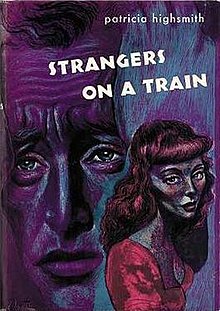
Strangers on a Train

Strangers on a Train. Patricia Highsmith. 1950. 281 pages.

The train tore along with an angry, irregular rhythm. It was having to stop at smaller and more frequent stations, where it would wait impatiently for a moment, then attack the prairie again.

Strangers on a Train was both compelling and repelling. On the one hand, I think the characterization of the "hero" (Guy Haines) and his nemesis (Charlie Bruno) was intriguing. Disturbing and super-creepy, but effectively so. I think the whole point of the novel was to show what could be lurking deep inside (or not-so-deep inside, perhaps just barely under the surface) of the person sitting next to you, the stranger.

Guy Haines is an architect taking a not-so-pleasant trip back to his small hometown in Texas. He meets a stranger on a train. The stranger--Charles Bruno--asks him to join him for dinner and a couple of drinks. Guy doesn't really want to be social. He's feeling cranky and anti-social. He's thinking about his wife, Miriam, who is carrying another man's baby, and his girlfriend, Anne, who happens to be going to Mexico on vacation. He isn't in love with his wife--they've been separated quite a while. He's anxious to get a divorce more than anything else. He's not at his emotional best though. So reluctantly, perhaps to avoid thinking or over-thinking things, he agrees to spend some time with this stranger. This was his first mistake, the mistake that would cost him almost everything in the end.
Why? Well, Bruno is all kinds of evil. And he's not even all that subtle about being evil and creepy.  I mean here is a guy that goes around muttering about how he wants to murder his father, how he has all these plans and schemes to kill his father, how he's just looking for the best way to kill his father so that he doesn't get caught. It's like he's got a one-track mind, and murder is all he can talk about. I honestly can't remember if the dialogue went from "do you want to have a drink with me?" to "do you want to kill my father for me?" in a matter of seconds, minutes, or hours. But. Guy has all the signs right in front of him that he should have been able to read properly. But. For whatever reason, he stays, he listens, he doesn't react. Somehow or other--perhaps before the murder babbling begins--Bruno learns that Guy is on a trip to see his wife. He also learns that she's pregnant. That she's been cheating on Guy for quite a while. Did Guy volunteer all this information willingly? Or did it come out piece by piece by piece by piece? Did Bruno keep pestering him with questions? Well, I'm not sure. Even if it was voluntary on his part. Even if Guy was talking about his wife, it was not with the intent that the stranger on the train should kill her. Because as Guy learns, this is where the conversation is headed. Bruno has  a plot, a plan. He would just love, love, love to kill Miriam. It would make him oh-so-happy to do this as a complete-and-total favor for his new-best-buddy, Guy. Haines was so not expecting this ultra-weird, ultra-creepy offer. And he does say, no, thank you, I don't want my wife murdered. And, I'm not the murdering type. I don't know what you think you see in me. But I'm not the guy. I'm not the one you want to kill your father. I don't want to murder anyone, anywhere. But the obsession has become all-too-firmly-planted in Bruno's mind.

Strangers on a Train is a tragic suspense, a psychological thriller. Haines' sanity is tested in the upcoming months after Bruno murders his wife, after Bruno continues to haunt him--first by letters, then in person. Wherever he goes, Bruno is there watching him, trying to talk to him, trying to coerce or bully him into murdering his father. Bruno starts pestering the people close to him too. Bruno is an obsessed stalker-blackmailer with a history of murder. Haines is worried what will happen if he doesn't murder Bruno's father.

Strangers on a Train reminded me so very much of Frankenstein by Mary Shelley. Except that the creature-figure Bruno is so not sympathetic not by any, any, any stretch of the imagination. And the Victor-Frankenstein-figure, Guy Haines, is actually sympathetic for most of the novel.

To read more of my thoughts, visit my GoodReads review.

Read Strangers on a Train
  • If you're looking to read a classic mystery/suspense/thriller novel of the 1950s
  • If you've seen the movie and are interested in now reading the book
  • If you enjoy psychological elements in your novel; Highsmith created some twisted, disturbed characters
© 2012 Becky Laney of Becky's Book Reviews

Monday, October 10, 2011

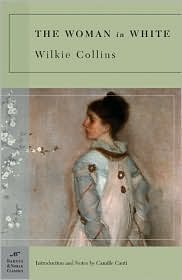
The Woman in White

The Woman in White. Wilkie Collins. 1860. 672 pages.

This is the story of what a Woman's patience can endure, and what a Man's resolution can achieve.

I loved this one. I just LOVED, LOVED, LOVED this one by Wilkie Collins. This isn't my first (mystery) novel by Wilkie Collins, and it won't be the last. Each new read makes me want more, more, more. If you're a fan of this bearded Victorian, I'd love to hear from you which of his I should try to read next. (My library has Basil, No Name, and The Dead Secret.)

The first narrator we meet is Walter Hartright. He is a drawing teacher. He is on his way to a new job--new position--in the country when he meets a strange woman on the way to London. It's the middle of the night. The woman appears from nowhere. She's acting a little peculiar. She's dressed all in white. But there is something about her that makes him sympathetic to her cause, even before he knows her story. By pure chance, so it seems, this woman happens to mention the countryside, the house, where he is to begin his new job that autumn. A fact that makes this meeting a little more memorable perhaps. Memorable enough to mention to Miss Marian Halcombe, one of the two young women he'll be teaching. The other young woman is Miss Laura Fairlie. She is oh-so-beautiful. (Miss Marian is not. Though I'd NEVER be as mean about it as Wilkie Collins.) Laura and Walter fall madly in love with another. Though he won't tell her and she won't tell him. Still. Marian sees how these two feel about one another. And she tries her best to tell Walter that that just can't be. Not because Marian is mean and cruel. But because Laura has been engaged for some time to an older man, Sir Percival Glyde. It was one of her father's wishes that the two wed. Before she fell for Walter, Laura was ready to wed without love, without hope of love. But now that she knows what it feels to love someone, she is having some major regrets about her promises. And the doubts will only grow when she's warned anonymously by letter NOT TO MARRY Sir Percival. She's warned that her husband to be is evil and then some. Marian tells Walter of this anonymous letter, and he believes--they both believe--that the woman in white may just be the writer of this one. If only she would say more, give out the reasons why. They want to know the truth, but they have so little to go on. And a gentleman's word that the letter was written by a crazy woman and that of course he's never had an evil thought in his entire life is accepted as gospel truth. Poor Laura!!!

I found it well-written. I found it suspenseful. I loved the details, the descriptions, the characterizations. I loved how the story unfolded. I loved having the story told by so many different people. Some narrators I preferred to others. But. I think they all added a little something to make this one just right.

The Woman in White was one of those books that I just know I will want to reread again and again. It's just that good.

Previous Collins: Man and Wife, Armadale, The Moonstone, Evil Genius.

© 2011 Becky Laney of Becky's Book Reviews

Friday, October 22, 2010

We Have Always Lived in the Castle

We Have Always Lived in the Castle. Shirley Jackson. 1962. Penguin. 214 pages. 

My name is Mary Katherine Blackwood. I am eighteen years old, and I live with my sister Constance. I have often thought that with any luck at all I could have been born a werewolf, because the two middle fingers on both my hands are the same length, but I have had to be content with what I had. I dislike washing myself, and dogs, and noise. I like my sister Constance, and Richard Plantagenet, and Amanita phalloides, the death-cup mushroom. Everyone else in my family is dead.

Our narrator, Merricat--Mary Katherine Blackwood--tells her story in the first person. It's a strange story--to be sure--about two sisters who are still haunted in many ways by their tragic past.

Merricat--the sister "brave" enough to leave the house--hates to go to town. She does it because she must. Because groceries and library books are essential to life. Constance never goes outside the gates of the family estate--though she loves to be outside in her garden.

Most of We Have Always Lived in the Castle is a flashback. It shows how things went from bad to worse after the arrival of their cousin Charles. I'll say no more. I think it's better not to know what this one is "about" before beginning.

Did I like it? Well enough to keep reading! I read this one for the 24 Hour Read-a-thon. And it was a great choice. It was a quick read. In part because it's so short, but also because it's suspenseful, compelling.

© Becky Laney of Becky's Book Reviews

Friday, December 04, 2009

Wilkie Collins: Man and Wife


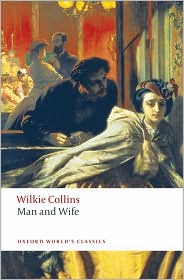
Collins, Wilkie. 1870. Man and Wife. 688 pages.

On a summer's morning, between thirty and forty years ago, two girls were crying bitterly in the cabin of an East Indian passenger ship, bound outward, from Gravesend to Bombay.

No matter how you look at it, Man and Wife is a strange and often uneven novel. Definitely melodramatic. As complicated as any modern soap opera.

Anne and Blanche are best friends. Their mothers--also named Anne and Blanche--were also best friends. (Though both mothers are dead by the time this story really gets started. Perhaps that is why these two--now of marriageable age--cling to one another so fiercely.) But this friendship is about to be tested. And not just a little bit. Anne, out of necessity or "duty" is about to separate herself (perhaps forever) from her closest friend. Foolishly, Anne gave into temptation with Geoffrey Delamayn, and is now reaping the consequences. She's pregnant. And she's trying to push her lover into marriage. Reminding him of all that he's said and done. How he owes her and his unborn child. The two arrange to meet at an inn and pose as man and wife. She wants--of course--for the marriage to take place soon after. But before Geoffrey can arrive (but after Anne's already run away), he receives notice that his father is ill--perhaps dying. He's needed at home. In London, I believe. So he convinces his friend, Arnold Brinkworth, to go in his place. To deliver a note to Anne. But to do this, he has to tell a few white lies to the landlady. To say he is the young lady's husband. (Arnold, for the record, is newly engaged. He's in love with Blanche.) This makes both uncomfortable. Neither likes the deceit. And both would undo this day if they could. But what's done is done, right?

This book is set in Scotland and England. And it concerns the Scottish marriage laws of the time. (Irregular little marriages including marriage by declaration and marriage by correspondence.) It's an integral part of the plot and much too complex to try to explain here. But these vacationing characters get into quite a mess by the end of it!

I mentioned that the book was strange. Perhaps that's not quite the word for it. The book tackles so many different topics. Scottish marriage laws. Marriage in general. The lack of women's rights. (How if a woman is a wife then she is the property of her husband. It doesn't matter how evil and cruel and drunk and abusive he is. She is his for life to do with as he pleases.) Society itself. The 'dangers' of sports and athleticism. Perhaps it is the attack on sports--the correlation Collins makes between moral depravity and physical fitness--that stands out as most strange. Geoffrey Delamayn is quite an athlete, a sportsman, he prides himself on his physique. He exercises and trains. He does various sports--including running. And Collins argues that all the energy Delamayn is putting into sports is ruining him mind, body, and soul.

The book is definitely didactic in places. And not just about sports. The other causes taken up within the book--particularly marriage and how women should have rights even if they are married--are a bit more welcome to readers though. But before you champion Collins as being completely enlightened and wonderful, you have to wrestle with passages like these:

However persistently the epicene theorists of modern times may deny it, it is nevertheless a truth plainly visible in the whole past history of the sexes that the natural condition of a woman is to find her master in a man. Look in the face of any woman who is in no direct way dependent on a man: and, as certainly as you see the sun in a cloudless sky, you see a woman is not happy. The want of a master is their great unknown want; the possession of a master is--unconsciously to themselves--the only possible completion of their lives. (chapter 31)
Still, you've got to weigh the good with the bad. And there are some places where the writing shines out for its wit, charm, and truth. (It is the nature of Truth to struggle to the light.) ("Our little besetting sins!" she said. "What slaves we are to our little besetting sins!")

Here is a little love scene between Arnold and Blanche:

[Blanche] could have boxed Arnold on both ears for being so unreasonably afraid of her.
"Well," she said impatiently, "if I did look in your face, what should I see?"
Arnold made another plunge. He answered: "You would see that I want a little encouragement."
"From me?"
"Yes--if you please."

Blanche looked back over her shoulder. The summer-house stood on an eminence, approached by steps. The players on the lawn beneath were audible, but not visible. Any one of them might appear, unexpectedly, at a moment's notice. Blanche listened. There was no sound of approaching footsteps--there was a general hush, and then another bang of the mallet on the ball and then a clapping of hands. Sir Patrick was a privileged person. He had been allowed, in all probability to try again; and he was succeeding at the second effort. This implied a reprieve of some seconds. Blanche looked back again at Arnold.

"Consider yourself encouraged," she whispered and instantly added, with the ineradicable female instinct of self-defense, "within limits!"

Arnold made a last plunge--straight to the bottom, this time.

"Consider yourself loved," he burst out, "without any limits at all."
So the book has its strengths and weaknesses. I mentioned some of the weaknesses already, but I'd like to focus on one of the strengths now. Sir Patrick Lundie. Wow. I loved Sir Patrick. I really did. He is the uncle to Blanche, a lawyer, an older man who has a big heart. He was such a stand-out character. He was so kind, so wise, so witty, so funny, so intelligent. He was a good man. The complete opposite of our villain, Geoffrey Delamayn. (Geoffrey made Heathcliff look like good boyfriend material.) I found myself smiling every time Sir Patrick collided (in dialogue) with Lady Lundie, his sister-in-law.

This was my first introduction to Wilkie Collins, and I found this one to be interesting. True, it has flaws. It's a bit long, and it's prone to rambling at times. It's definitely didactic in nature. But at the same time it's complex in a good way. We meet a lot of interesting characters--good and bad--that are well-developed. (We may not love all of the characters. We may want to yell at some and slap a few others.) But the suspenseful pace of the last two hundred pages or so of the novel help to make up for some of the heaviness of the earlier sections. Is it for everyone? Probably not. But I'm very glad I read it.

Tour Dates for Wilkie Collins.
The Classics Circuit

© Becky Laney of Becky's Book Reviews

Wednesday, November 18, 2009

Thirsty


Thirsty. Tracey Bateman. 2009. Waterbrook Press. 376 pages.

Thick bass blared through amped-up speakers and drew Markus from his slumber.

Meet Nina Parker. She'd be the first to admit her mistakes. Her life has been full of mistakes. And it's cost her. Her husband has divorced her. He has full custody of both of her children. Her daughter, Meg, doesn't want anything to do with her. She's been arrested several times. She doesn't have a job or a place to live. At the start, anyway. But Nina Parker is being given a second chance. She's moving in with her sister (who is a sheriff) and returning to her hometown of Abbey Hills, a small town in the Ozarks. She'll be waitressing at Barney's, the local diner. And for this first week back, she'll have her daughter, Meg, with her. Can this week start the two on a new path. Can this relationship begin to heal? Can they learn from each other and begin to understand one another?

Unfortunately, this week isn't going to be easy on either of them. In fact, they may not survive the week. You see, there's a murderer on the loose in Abbey Hills. And victims (both human and animal) are being discovered: their bodies drained of blood, their hearts cut out. Who is the murderer, the monster, in their midst?

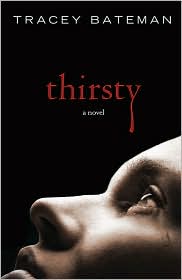
Thirsty--in case you couldn't tell by the cover alone--is a vampire novel. A so-called Christian vampire novel. You can read an interview with Tracey Bateman here.


© Becky Laney of Becky's Book Reviews