Showing posts with label 1860. Show all posts

Monday, October 08, 2018

Me? Listen to Audio?! #38 My Victorian Year #40

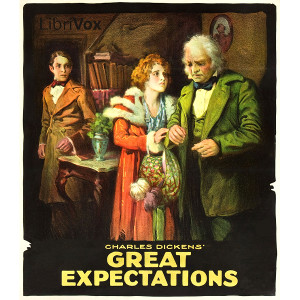
Great Expectations. Charles Dickens. 1860. Read for LibriVox by Mil Nicholson. 20 hours, 13 minutes. [Source: Librivox]

First sentence: My father's family name being Pirrip, and my Christian name Philip, my infant tongue could make of both names nothing longer or more explicit than Pip. So, I called myself Pip, and came to be called Pip.


Note: This was my fourth time to "read" the novel. The first and second times were in high school and college where I rushed through at lightning speed because I was a procrastinator. I remembered nothing. The third time I savored the novel and it finally CLICKED for me. The fourth time was as an audio book. Audio is always slightly different for me. I have a love/hate relationship with it. Sometimes listening doesn't feel like it should count as reading, then again sometimes it does. I was engaged with this audio for the most part--give or take a few interruptions. What I miss most about listening--as opposed to reading--is the inability to mark quotes. For that reason, I am referring back to my first review of the novel.


Premise/plot: Can any Charles Dickens' novel easily--painlessly--be condensed into a couple of sentences that summarizes the plot and introduces the characters in an enticing, compelling way? I say NO. But I'll try. (Because I'm stubborn like that!)

Pip is a young man being raised by his older sister and his brother-in-law--the Gargerys. Mrs. Joe isn't all that nice to him, but, Joe--a blacksmith--is a godsend. The novel opens with some excitement. Pip has been approached--in a cemetery--by a shady character, a grown man, a man readers learn to be an escaped convict. He wants a file--to rid him of his chains--and some food. He's depending on Pip for both. Does Pip have a choice in helping him? Not really. (Though Pip is used to threats since he lives with his sister.) Some time later, Pip is given another opportunity. This time an eccentric old lady, Miss Havisham, wants Pip to be a companion for her and her adopted daughter, Estella. Does Pip have a choice? Again I'll say not really. The meeting is memorable and life-changing. Both his meeting of Miss Havisham and of Estella will change him for better or worse. It is this meeting that brings about his angst--his discontent. After meeting these two, he's no longer content in his home being raised by Joe and Mrs. Joe. He's no longer content being barely literate. He's no longer content with the idea of apprenticing to Joe and following in his footsteps. He wants what seems to be impossible: to be a gentleman--to walk, talk, act, live as a gentleman. But never say never, right? One day--in the middle of his apprenticeship to Joe--his life takes another turn. A lawyer approaches him with glad tidings: he's now a man with expectations. The catch: his benefactor wants to remain anonymous. His life from that moment on will change dramatically. He's being given the opportunity to become a new man. But does new always mean better? And what about those he leaves behind? Joe and Biddy, in particular. (Biddy is a young woman who has come to live with the family after Mrs. Joe is seriously injured. Biddy is of their class but has some education.) He's thrust into a whole new world, and, his manners and morals can sometimes lag behind. Pip goes to live with the Pockets; he becomes best-best friends with Herbert Pocket. Herbert christens him "Handel." The two go through much together; their friendship is deep and sincere. Life seems to be going swell, going according to Pip's grand plan, when Pip learns an unsettling truth. He learns the identity of his benefactor. Pip is shaken, confused, and ANGSTy once again. What is he to do now?! The foundation of his hopes and dreams has collapses. His big plan of marrying Estella seems to be truly impossible now. But not just that plan but all his plans seem to be off-track now. Who can he depend on in this crisis? From this point on, in my opinion, the novel shifts from being a coming-of-age story to a dramatic MYSTERY. So much ACTION and DRAMA are packed into the last hundred or so pages.

My thoughts: I recommend reading Great Expectations at a steady pace. It is not one to rush through in one or two days. If you do, chances are you won't remember what you read, and the novel won't stir up your emotions. It is not one to read slowly hit-or-miss style. If you don't read in it every day or every other day, you might not remember much either. The greatest danger may be that you won't connect with the characters or care about them. And unless you become attached to a character or two, the book won't stay with you. This was my third time to read the novel. In high school, I waited until the day before it was due to open it. It was a NIGHTMARE reading experience. I hated every minute of it. In college, I don't think I made the same mistake twice. I don't think I procrastinated. I think my sin in that instance was holding a grudge and reading it with a closed mind and heart. Since graduating college, I've read Dickens voluntarily. And this year I decided to read Great Expectations--as if for the first time. The goal: to read it with fresh eyes, open heart, open mind, looking for what made Great Expectations GREAT.

What was great about Great Expectations? I really enjoyed the characters, the themes, and the contrasts. What kind of contrasts? Love and hate, foolishness and wisdom, bitterness and forgiveness, friends and enemies, pride and humility. For example, we have two characters that live for revenge and thrive on bitterness to a certain degree. Abel Magwitch and Miss Havisham. Miss Havisham may be the more memorable of the two. She is living in a her worst moment, perpetuating the agony of it. She was jilted at the altar, and from that moment on her life stopped. Instead of moving on with her life, instead of finding a reason to keep living, she became filled with hate, pain, anger, bitterness. Not far behind her is Abel Magwitch. He has an enemy and there is this constant need to get him, to get revenge, to come out on top, to win no matter what. And this enemy haunts him--taunts him. Abel has his good side, as does Miss Havisham. But their worldview is tainted more by hate than love, more by this need to hurt others than to love.

What unites this novel is Pip. And a large part of Pip's identity is his undying, never changing love for Estella. It's unrequited love at that. Pip loves Estella. Estella does not love Pip. Estella loves Estella. I'm not sure if Dickens was trying to enter into the debate of nature versus nurture or not. But Estella has been raised to hate, raised to hurt. Miss Havisham thinks she's protecting Estella from having her heart broken by showing her day in and day out what happens from trusting a man. But in reality, Estella doesn't have a heart to hurt. She doesn't even have a heart to love the woman who raised her. Pip has trouble seeing the real Estella. His Estella is an idealized version, perhaps a version of who she could be if she'd been raised differently, if she'd allow herself to be human, if she'd allow herself to be vulnerable.

"You must know," said Estella, condescending to me as a brilliant and beautiful woman might, "that I have no heart,—if that has anything to do with my memory." I got through some jargon to the effect that I took the liberty of doubting that. That I knew better. That there could be no such beauty without it. "Oh! I have a heart to be stabbed in or shot in, I have no doubt," said Estella, "and of course if it ceased to beat I should cease to be. But you know what I mean. I have no softness there, no—sympathy—sentiment—nonsense."
Then, Estella being gone and we two left alone, she turned to me, and said in a whisper,— "Is she beautiful, graceful, well-grown? Do you admire her?" "Everybody must who sees her, Miss Havisham." She drew an arm round my neck, and drew my head close down to hers as she sat in the chair. "Love her, love her, love her! How does she use you?" Before I could answer (if I could have answered so difficult a question at all) she repeated, "Love her, love her, love her! If she favors you, love her. If she wounds you, love her. If she tears your heart to pieces,—and as it gets older and stronger it will tear deeper,—love her, love her, love her!" Never had I seen such passionate eagerness as was joined to her utterance of these words. I could feel the muscles of the thin arm round my neck swell with the vehemence that possessed her.
"Hear me, Pip! I adopted her, to be loved. I bred her and educated her, to be loved. I developed her into what she is, that she might be loved. Love her!" She said the word often enough, and there could be no doubt that she meant to say it; but if the often repeated word had been hate instead of love—despair—revenge—dire death—it could not have sounded from her lips more like a curse. "I'll tell you," said she, in the same hurried passionate whisper, "what real love is. It is blind devotion, unquestioning self-humiliation, utter submission, trust and belief against yourself and against the whole world, giving up your whole heart and soul to the smiter—as I did!" When she came to that, and to a wild cry that followed that, I caught her round the waist. For she rose up in the chair, in her shroud of a dress, and struck at the air as if she would as soon have struck herself against the wall and fallen dead.
"Herbert," said I, laying my hand upon his knee, "I love—I adore—Estella." Instead of being transfixed, Herbert replied in an easy matter-of-course way, "Exactly. Well?" "Well, Herbert? Is that all you say? Well?" "What next, I mean?" said Herbert. "Of course I know that." "How do you know it?" said I. "How do I know it, Handel? Why, from you." "I never told you." "Told me! You have never told me when you have got your hair cut, but I have had senses to perceive it. You have always adored her, ever since I have known you. You brought your adoration and your portmanteau here together. Told me! Why, you have always told me all day long. When you told me your own story, you told me plainly that you began adoring her the first time you saw her, when you were very young indeed." "Very well, then," said I, to whom this was a new and not unwelcome light, "I have never left off adoring her. And she has come back, a most beautiful and most elegant creature. And I saw her yesterday. And if I adored her before, I now doubly adore her."
"O Estella!" I answered, as my bitter tears fell fast on her hand, do what I would to restrain them; "even if I remained in England and could hold my head up with the rest, how could I see you Drummle's wife?" "Nonsense," she returned,—"nonsense. This will pass in no time." "Never, Estella!" "You will get me out of your thoughts in a week." "Out of my thoughts! You are part of my existence, part of myself. You have been in every line I have ever read since I first came here, the rough common boy whose poor heart you wounded even then. You have been in every prospect I have ever seen since,—on the river, on the sails of the ships, on the marshes, in the clouds, in the light, in the darkness, in the wind, in the woods, in the sea, in the streets. You have been the embodiment of every graceful fancy that my mind has ever become acquainted with. The stones of which the strongest London buildings are made are not more real, or more impossible to be displaced by your hands, than your presence and influence have been to me, there and everywhere, and will be. Estella, to the last hour of my life, you cannot choose but remain part of my character, part of the little good in me, part of the evil. But, in this separation, I associate you only with the good; and I will faithfully hold you to that always, for you must have done me far more good than harm, let me feel now what sharp distress I may. O God bless you, God forgive you!"
Favorite character: I think my favorite character was definitely Joe Gargery. Joe loved Pip unconditionally. Joe loved Pip even when Pip was being a brat or a snob--which was often especially in the first half of the book. Pip did nothing to earn Joe's unconditional love and support. Pip often thought of Joe as a fool, as ridiculous, as an embarrassment. But this reader saw him differently. I didn't need a late hour epiphany to see how awesome and amazing Joe was.

Favorite relationship: I really LOVED Herbert and Handel's friendship. I love how these two supported one another, confided in one another, wanted the best for one another. Herbert knew Pip--his strengths, his weaknesses--and loved him as a brother. That brotherly love was returned. When Pip came of age, he thought of Herbert first. How can I use my wealth to help Herbert get a start in life? When Pip's world started crashing in, I loved that Pip thought first of what this meant to Herbert and only secondly to what it meant for him and his dreams. I loved how these two seemed to understand one another. In hard, dangerous times or easy-going good times, these two were there for each other.

Favorite scene: I think one of my favorite scenes is between Pip and Miss Havisham. He is an adult now; he knows at last who his benefactor was; his own dreams are gone--his illusions shattered. He's come to ask for her help: he is not asking for money for himself, but money for his friend, Herbert, in setting him up in a career. His maturity in this scene effected me.
"If I give you the money for this purpose, will you keep my secret as you have kept your own?" "Quite as faithfully." "And your mind will be more at rest?" "Much more at rest." "Are you very unhappy now?" She asked this question, still without looking at me, but in an unwonted tone of sympathy. I could not reply at the moment, for my voice failed me. She put her left arm across the head of her stick, and softly laid her forehead on it. "I am far from happy, Miss Havisham; but I have other causes of disquiet than any you know of. They are the secrets I have mentioned." After a little while, she raised her head, and looked at the fire Again.
"It is noble in you to tell me that you have other causes of unhappiness, Is it true?" "Too true." "Can I only serve you, Pip, by serving your friend? Regarding that as done, is there nothing I can do for you yourself?" "Nothing. I thank you for the question. I thank you even more for the tone of the question. But there is nothing." She presently rose from her seat, and looked about the blighted room for the means of writing. There were none there, and she took from her pocket a yellow set of ivory tablets, mounted in tarnished gold, and wrote upon them with a pencil in a case of tarnished gold that hung from her neck.
She read me what she had written; and it was direct and clear, and evidently intended to absolve me from any suspicion of profiting by the receipt of the money. I took the tablets from her hand, and it trembled again, and it trembled more as she took off the chain to which the pencil was attached, and put it in mine. All this she did without looking at me. "My name is on the first leaf. If you can ever write under my name, "I forgive her," though ever so long after my broken heart is dust pray do it!" "O Miss Havisham," said I, "I can do it now. There have been sore mistakes; and my life has been a blind and thankless one; and I want forgiveness and direction far too much, to be bitter with you."


© 2018 Becky Laney of Becky's Book Reviews

Thursday, October 19, 2017

Castle Richmond

Castle Richmond. Anthony Trollope. 1860. 500 pages. [Source: Bought]

First sentence: I wonder whether the novel-reading world — that part of it, at least, which may honour my pages — will be offended if I lay the plot of this story in Ireland! That there is a strong feeling against things Irish it is impossible to deny. Irish servants need not apply; Irish acquaintances are treated with limited confidence; Irish cousins are regarded as being decidedly dangerous; and Irish stories are not popular with the booksellers.


Premise/plot: Castle Richmond is set in Ireland at the start of the Irish Potato Famine (1845-1849). Is it solely about the potato famine? No. Not really. Would it be better if it were? Maybe. Maybe not. You see what the plot turns around mainly are two men in love with the same young woman: Herbert Fitzgerald and Owen Fitzgerald are cousins in love with the same woman, Lady Clara Desmond. If that were all, it wouldn't be all that surprising and unusual. But that's not all.

Lady Clara's mother--also named Clara, a countess and a widow--is madly in love with Owen Fitzgerald. It is for herself that she invites this man into her home, into their lives. She doesn't suspect that Owen will be more likely to fall in love with the young daughter instead of herself. Patrick, Clara's brother, is best, best friends with Owen. So Owen is at their place a lot of time. Until...one day he declares his love for Lady Clara. Lady Clara says YES, I'll marry you. Her mother and brother say NO, NEVER. GET OUT AND STAY OUT. Why the rejection? Owen Fitzgerald is a poor man. He has no estate, no wealth, no title. And Lady Clara deserves an estate, wealth, and title.

Herbert Fitzgerald will have an estate, wealth, and title--when his father, Sir Thomas, dies. When the story opens, that is looking like it will happen soon. Sir Thomas is STRESSED. It seems that his wife's first husband is very much alive and that Herbert--and his other children--are illegitimate. Herbert will not inherit after all. And the next in line....is, of course, Owen.

You would think, Owen will win the approval of the family now! Owen and Lady Clara will live happily ever after. All will be well. But I forgot to mention one little thing. While the potato crop is failing, and Owen is sad and depressed--Herbert Fitzgerald starts wooing Lady Clara. Though she swore to be true to her love forever and ever, her mother has said that the marriage is impossible. And Lady Clara finds herself more and more okay with that. When Herbert proposes, she says YES. This happens days--maybe a couple of weeks--before the big reveal. And it isn't long after the big reveal that Sir Thomas dies.

Lady Clara has said I love you to two different men. She's accepted two proposals. Now that the poor man will be the rich man, and the rich man will be the poor man....who will she stand by? who do we want her to stand by?

Owen doesn't want the estate. Owen wants Lady Clara. Herbert does want the estate. He wants Lady Clara too. So when Owen offers to sign the estate back over to Herbert in exchange for Herbert breaking the engagement, Herbert says NO. Owen pouts. But that doesn't really change anything. Owen still doesn't want the estate. Owen still loves and wants Lady Clara.

Meanwhile, Clara (the mother, the countess) is breaking her heart over Owen. If she can't have him for herself, maybe Lady Clara can still have him. At least he'd be part of her life. Maybe that would be enough. Patrick returns (oh so briefly) but Lady Clara says she won't break her engagement with Herbert (no matter how poor) to marry Owen (no matter how rich). Patrick and Lady Clara are a bit confused. Could Lady Clara really have fallen out of love so quickly with Owen and into love so quickly with Herbert?!

Herbert runs away to London, and begins to study law. But this study is cut very short because of two letters the family lawyer receives. One is from Owen saying he has no plans whatsoever to accept the estate. The other is from the book's villain. The son of Lady Fitzgerald's first husband. He has news that will change everything....or so he claims.

Throughout the book, readers get a few sketches here and there of how the failure of the potato crop has disastrous effects on the poor. It is very here and there coverage. And it's mainly on how the gentry and clergy come together to offer "relief" to the poor. One minor plot revolves around whether Catholics and Protestants can come together to help the poor. 

My thoughts: This book reminded me of Spin Doctors' Two Princes. "I ain't got no future or a family tree. But I know what a prince and lover ought to be. I know what a prince and lover ought to be." I had a hard time connecting with Lady Clara. I feel there was a definite lack of development. I know that both men loved and adored her. But we're not shown why exactly. Other than the obvious: she's young; she's presumably beautiful.

It wasn't clear--at least to me--which direction Trollope would take with Owen and Herbert. Would this be a story of young lovers overcoming the objections of their families to be together and live happily ever after? Would Lady Clara prove loyal to her first love and not be persuaded by her family, or by the lure of money?

Trollope never clearly shows us the moment when Herbert and Lady Clara fall in actual love with one another. It's more a matter of  Lady Clara accepting an invitation to visit his estate and get all chummy with his mother, his aunt, his two sisters. The visit lasts a few days, and after that visit he proposes and she says yes. They'd never really had a relationship before that visit.

 Personally, I could see why Owen would be like WHAT'S GOING ON?!?! IS SHE SERIOUS?!

Lady Clara doesn't appear to be a gold digger; she does appear--to me--to be FICKLE. Perhaps readers are supposed to be oh-so-impressed by the fact that when Herbert loses his inheritance, she sticks like glue to her man and refuses to end the relationship. I wasn't. I wasn't sure why she was in relationship with him--so quickly--to begin with.

Both Owen and Herbert are good men. Neither is a villain necessarily. Lady Clara wouldn't be throwing away her life by marrying Owen. She wouldn't be throwing away her life by marrying Herbert. She has in many ways equal chances of happiness with either man. My question: DOES SHE LOVE EITHER MAN? I'm not sure Lady Clara is old enough, wise enough to know her own mind and her own heart. I think she was "caught up" in a moment--twice. I'm not sure she knew either man well enough to say yes.

Lady Clara's mother--pathetic as she may come across--is more developed. One of the sad, awkward moments of the novel comes when Clara pours out her heart and soul to Owen confessing that he is the love of her life. There will be no happy ending for Clara....or for Owen.

Quotes:
Young men among us seldom go quite straight in their course, unless they are, at any rate occasionally, brought under the influence of tea and small talk.
When wars come, and pestilence, and famine; when the people of a land are worse than decimated, and the living hardly able to bury the dead, I cannot coincide with those who would deprecate God’s wrath by prayers. I do not believe that our God stalks darkly along the clouds, laying thousands low with the arrows of death, and those thousands the most ignorant, because men who are not ignorant have displeased Him. Nor, if in his wisdom He did do so, can I think that men’s prayers would hinder that which his wisdom had seen to be good and right. But though I do not believe in exhibitions of God’s anger, I do believe in exhibitions of his mercy. When men by their folly and by the shortness of their vision have brought upon themselves penalties which seem to be overwhelming, to which no end can be seen, which would be overwhelming were no aid coming to us but our own, then God raises his hand, not in anger, but in mercy, and by his wisdom does for us that for which our own wisdom has been insufficient. If He be wise, would we change his wisdom? If He be merciful, would we limit his mercy?

We none of us wish to be drowned; but nevertheless there are some good qualities in water.
Men and women when they are written about are always supposed to have fixed resolves, though in life they are so seldom found to be thus armed.
It was marvellous how well Herbert Fitzgerald could lay down the law on the subject of Clara’s conduct, and on all that was due to her, and all that was not due to Owen. He was the victor; he had gained the prize; and therefore it was so easy for him to acquit his promised bride, and heap reproaches on the head of his rejected rival. Owen had been told that he was not wanted, and of course should have been satisfied with his answer. Why should he intrude himself among happy people with his absurd aspirations? For were they not absurd? Was it not monstrous on his part to suppose that he could marry Clara Desmond?
Everybody should use their own judgment in everything they do or say, more or less.
If we are to sympathise only with the good, or worse still, only with the graceful, how little will there be in our character that is better than terrestrial?
It is the first plunge into the cold water that gives the shock. We may almost say that every human misery will cease to be miserable if it be duly faced; and something is done towards conquering our miseries, when we face them in any degree, even if not with due courage. 
We generally use three times the number of words which are necessary for the purpose which we have in hand; but had he used six times the number, she would not have interrupted him.
What is in a man, let it come out and be known to those around him; if it be bad it will find correction; if it be good it will spread and be beneficent.
A lawyer has always a sort of affection for a scoundrel, — such affection as a hunting man has for a fox. He loves to watch the skill and dodges of the animal, to study the wiles by which he lives, and to circumvent them by wiles of his own, still more wily. It is his glory to run the beast down; but then he would not for worlds run him down, except in conformity with certain laws, fixed by old custom for the guidance of men in such sports. And the two-legged vermin is adapted for pursuit as is the fox with four legs. He is an unclean animal, leaving a scent upon his trail, which the nose of your acute law hound can pick up over almost any ground. And the more wily the beast is, the longer he can run, the more trouble he can give in the pursuit, the longer he can stand up before a pack of legal hounds, the better does the forensic sportsman love and value him. There are foxes of so excellent a nature, so keen in their dodges, so perfect in their cunning, so skilful in evasion, that a sportsman cannot find it in his heart to push them to their destruction unless the field be very large so that many eyes are looking on. And the feeling is I think the same with lawyers.
It is my opinion that nothing seasons the mind for endurance like hard work.


© 2017 Becky Laney of Becky's Book Reviews

Wednesday, August 02, 2017

Great Expectations

Great Expectations. Charles Dickens. 1860. 640 pages. [Source: Library]

First sentence: My father's family name being Pirrip, and my Christian name Philip, my infant tongue could make of both names nothing longer or more explicit than Pip. So, I called myself Pip, and came to be called Pip.

Premise/plot: Can any Charles Dickens' novel easily--painlessly--be condensed into a couple of sentences that summarizes the plot and introduces the characters in an enticing, compelling way? I say NO. But I'll try. (Because I'm stubborn like that!)

Pip is a young man being raised by his older sister and his brother-in-law--the Gargerys. Mrs. Joe isn't all that nice to him, but, Joe--a blacksmith--is a godsend. The novel opens with some excitement. Pip has been approached--in a cemetery--by a shady character, a grown man, a man readers learn to be an escaped convict. He wants a file--to rid him of his chains--and some food. He's depending on Pip for both. Does Pip have a choice in helping him? Not really. (Though Pip is used to threats since he lives with his sister.) Some time later, Pip is given another opportunity. This time an eccentric old lady, Miss Havisham, wants Pip to be a companion for her and her adopted daughter, Estella. Does Pip have a choice? Again I'll say not really. The meeting is memorable and life-changing. Both his meeting of Miss Havisham and of Estella will change him for better or worse. It is this meeting that brings about his angst--his discontent. After meeting these two, he's no longer content in his home being raised by Joe and Mrs. Joe. He's no longer content being barely literate. He's no longer content with the idea of apprenticing to Joe and following in his footsteps. He wants what seems to be impossible: to be a gentleman--to walk, talk, act, live as a gentleman. But never say never, right? One day--in the middle of his apprenticeship to Joe--his life takes another turn. A lawyer approaches him with glad tidings: he's now a man with expectations. The catch: his benefactor wants to remain anonymous. His life from that moment on will change dramatically. He's being given the opportunity to become a new man. But does new always mean better? And what about those he leaves behind? Joe and Biddy, in particular. (Biddy is a young woman who has come to live with the family after Mrs. Joe is seriously injured. Biddy is of their class but has some education.) He's thrust into a whole new world, and, his manners and morals can sometimes lag behind. Pip goes to live with the Pockets; he becomes best-best friends with Herbert Pocket. Herbert christens him "Handel." The two go through much together; their friendship is deep and sincere. Life seems to be going swell, going according to Pip's grand plan, when Pip learns an unsettling truth. He learns the identity of his benefactor. Pip is shaken, confused, and ANGSTy once again. What is he to do now?! The foundation of his hopes and dreams has collapses. His big plan of marrying Estella seems to be truly impossible now. But not just that plan but all his plans seem to be off-track now. Who can he depend on in this crisis? From this point on, in my opinion, the novel shifts from being a coming-of-age story to a dramatic MYSTERY. So much ACTION and DRAMA are packed into the last hundred or so pages.

My thoughts: I recommend reading Great Expectations at a steady pace. It is not one to rush through in one or two days. If you do, chances are you won't remember what you read, and the novel won't stir up your emotions. It is not one to read slowly hit-or-miss style. If you don't read in it every day or every other day, you might not remember much either. The greatest danger may be that you won't connect with the characters or care about them. And unless you become attached to a character or two, the book won't stay with you. This was my third time to read the novel. In high school, I waited until the day before it was due to open it. It was a NIGHTMARE reading experience. I hated every minute of it. In college, I don't think I made the same mistake twice. I don't think I procrastinated. I think my sin in that instance was holding a grudge and reading it with a closed mind and heart. Since graduating college, I've read Dickens voluntarily. And this year I decided to read Great Expectations--as if for the first time. The goal: to read it with fresh eyes, open heart, open mind, looking for what made Great Expectations GREAT.


What was great about Great Expectations? I really enjoyed the characters, the themes, and the contrasts. What kind of contrasts? Love and hate, foolishness and wisdom, bitterness and forgiveness, friends and enemies, pride and humility. For example, we have two characters that live for revenge and thrive on bitterness to a certain degree. Abel Magwitch and Miss Havisham. Miss Havisham may be the more memorable of the two. She is living in a her worst moment, perpetuating the agony of it. She was jilted at the altar, and from that moment on her life stopped. Instead of moving on with her life, instead of finding a reason to keep living, she became filled with hate, pain, anger, bitterness. Not far behind her is Abel Magwitch. He has an enemy and there is this constant need to get him, to get revenge, to come out on top, to win no matter what. And this enemy haunts him--taunts him. Abel has his good side, as does Miss Havisham. But their worldview is tainted more by hate than love, more by this need to hurt others than to love.

What unites this novel is Pip. And a large part of Pip's identity is his undying, never changing love for Estella. It's unrequited love at that. Pip loves Estella. Estella does not love Pip. Estella loves Estella. I'm not sure if Dickens was trying to enter into the debate of nature versus nurture or not. But Estella has been raised to hate, raised to hurt. Miss Havisham thinks she's protecting Estella from having her heart broken by showing her day in and day out what happens from trusting a man. But in reality, Estella doesn't have a heart to hurt. She doesn't even have a heart to love the woman who raised her. Pip has trouble seeing the real Estella. His Estella is an idealized version, perhaps a version of who she could be if she'd been raised differently, if she'd allow herself to be human, if she'd allow herself to be vulnerable.
"You must know," said Estella, condescending to me as a brilliant and beautiful woman might, "that I have no heart,—if that has anything to do with my memory." I got through some jargon to the effect that I took the liberty of doubting that. That I knew better. That there could be no such beauty without it. "Oh! I have a heart to be stabbed in or shot in, I have no doubt," said Estella, "and of course if it ceased to beat I should cease to be. But you know what I mean. I have no softness there, no—sympathy—sentiment—nonsense."
Then, Estella being gone and we two left alone, she turned to me, and said in a whisper,— "Is she beautiful, graceful, well-grown? Do you admire her?" "Everybody must who sees her, Miss Havisham." She drew an arm round my neck, and drew my head close down to hers as she sat in the chair. "Love her, love her, love her! How does she use you?" Before I could answer (if I could have answered so difficult a question at all) she repeated, "Love her, love her, love her! If she favors you, love her. If she wounds you, love her. If she tears your heart to pieces,—and as it gets older and stronger it will tear deeper,—love her, love her, love her!" Never had I seen such passionate eagerness as was joined to her utterance of these words. I could feel the muscles of the thin arm round my neck swell with the vehemence that possessed her.
"Hear me, Pip! I adopted her, to be loved. I bred her and educated her, to be loved. I developed her into what she is, that she might be loved. Love her!" She said the word often enough, and there could be no doubt that she meant to say it; but if the often repeated word had been hate instead of love—despair—revenge—dire death—it could not have sounded from her lips more like a curse. "I'll tell you," said she, in the same hurried passionate whisper, "what real love is. It is blind devotion, unquestioning self-humiliation, utter submission, trust and belief against yourself and against the whole world, giving up your whole heart and soul to the smiter—as I did!" When she came to that, and to a wild cry that followed that, I caught her round the waist. For she rose up in the chair, in her shroud of a dress, and struck at the air as if she would as soon have struck herself against the wall and fallen dead.
"Herbert," said I, laying my hand upon his knee, "I love—I adore—Estella." Instead of being transfixed, Herbert replied in an easy matter-of-course way, "Exactly. Well?" "Well, Herbert? Is that all you say? Well?" "What next, I mean?" said Herbert. "Of course I know that." "How do you know it?" said I. "How do I know it, Handel? Why, from you." "I never told you." "Told me! You have never told me when you have got your hair cut, but I have had senses to perceive it. You have always adored her, ever since I have known you. You brought your adoration and your portmanteau here together. Told me! Why, you have always told me all day long. When you told me your own story, you told me plainly that you began adoring her the first time you saw her, when you were very young indeed." "Very well, then," said I, to whom this was a new and not unwelcome light, "I have never left off adoring her. And she has come back, a most beautiful and most elegant creature. And I saw her yesterday. And if I adored her before, I now doubly adore her."
"O Estella!" I answered, as my bitter tears fell fast on her hand, do what I would to restrain them; "even if I remained in England and could hold my head up with the rest, how could I see you Drummle's wife?" "Nonsense," she returned,—"nonsense. This will pass in no time." "Never, Estella!" "You will get me out of your thoughts in a week." "Out of my thoughts! You are part of my existence, part of myself. You have been in every line I have ever read since I first came here, the rough common boy whose poor heart you wounded even then. You have been in every prospect I have ever seen since,—on the river, on the sails of the ships, on the marshes, in the clouds, in the light, in the darkness, in the wind, in the woods, in the sea, in the streets. You have been the embodiment of every graceful fancy that my mind has ever become acquainted with. The stones of which the strongest London buildings are made are not more real, or more impossible to be displaced by your hands, than your presence and influence have been to me, there and everywhere, and will be. Estella, to the last hour of my life, you cannot choose but remain part of my character, part of the little good in me, part of the evil. But, in this separation, I associate you only with the good; and I will faithfully hold you to that always, for you must have done me far more good than harm, let me feel now what sharp distress I may. O God bless you, God forgive you!"
Favorite character: I think my favorite character was definitely Joe Gargery. Joe loved Pip unconditionally. Joe loved Pip even when Pip was being a brat or a snob--which was often especially in the first half of the book. Pip did nothing to earn Joe's unconditional love and support. Pip often thought of Joe as a fool, as ridiculous, as an embarrassment. But this reader saw him differently. I didn't need a late hour epiphany to see how awesome and amazing Joe was.

Favorite relationship: I really LOVED Herbert and Handel's friendship. I love how these two supported one another, confided in one another, wanted the best for one another. Herbert knew Pip--his strengths, his weaknesses--and loved him as a brother. That brotherly love was returned. When Pip came of age, he thought of Herbert first. How can I use my wealth to help Herbert get a start in life? When Pip's world started crashing in, I loved that Pip thought first of what this meant to Herbert and only secondly to what it meant for him and his dreams. I loved how these two seemed to understand one another. In hard, dangerous times or easy-going good times, these two were there for each other.

Favorite scene: I think one of my favorite scenes is between Pip and Miss Havisham. He is an adult now; he knows at last who his benefactor was; his own dreams are gone--his illusions shattered. He's come to ask for her help: he is not asking for money for himself, but money for his friend, Herbert, in setting him up in a career. His maturity in this scene effected me.
"If I give you the money for this purpose, will you keep my secret as you have kept your own?" "Quite as faithfully." "And your mind will be more at rest?" "Much more at rest." "Are you very unhappy now?" She asked this question, still without looking at me, but in an unwonted tone of sympathy. I could not reply at the moment, for my voice failed me. She put her left arm across the head of her stick, and softly laid her forehead on it. "I am far from happy, Miss Havisham; but I have other causes of disquiet than any you know of. They are the secrets I have mentioned." After a little while, she raised her head, and looked at the fire Again.
"It is noble in you to tell me that you have other causes of unhappiness, Is it true?" "Too true." "Can I only serve you, Pip, by serving your friend? Regarding that as done, is there nothing I can do for you yourself?" "Nothing. I thank you for the question. I thank you even more for the tone of the question. But there is nothing." She presently rose from her seat, and looked about the blighted room for the means of writing. There were none there, and she took from her pocket a yellow set of ivory tablets, mounted in tarnished gold, and wrote upon them with a pencil in a case of tarnished gold that hung from her neck.
She read me what she had written; and it was direct and clear, and evidently intended to absolve me from any suspicion of profiting by the receipt of the money. I took the tablets from her hand, and it trembled again, and it trembled more as she took off the chain to which the pencil was attached, and put it in mine. All this she did without looking at me. "My name is on the first leaf. If you can ever write under my name, "I forgive her," though ever so long after my broken heart is dust pray do it!" "O Miss Havisham," said I, "I can do it now. There have been sore mistakes; and my life has been a blind and thankless one; and I want forgiveness and direction far too much, to be bitter with you."
© 2017 Becky Laney of Becky's Book Reviews
Monday, October 10, 2011

The Woman in White

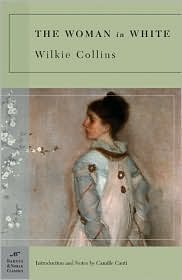
The Woman in White. Wilkie Collins. 1860. 672 pages.

This is the story of what a Woman's patience can endure, and what a Man's resolution can achieve.

I loved this one. I just LOVED, LOVED, LOVED this one by Wilkie Collins. This isn't my first (mystery) novel by Wilkie Collins, and it won't be the last. Each new read makes me want more, more, more. If you're a fan of this bearded Victorian, I'd love to hear from you which of his I should try to read next. (My library has Basil, No Name, and The Dead Secret.)

The first narrator we meet is Walter Hartright. He is a drawing teacher. He is on his way to a new job--new position--in the country when he meets a strange woman on the way to London. It's the middle of the night. The woman appears from nowhere. She's acting a little peculiar. She's dressed all in white. But there is something about her that makes him sympathetic to her cause, even before he knows her story. By pure chance, so it seems, this woman happens to mention the countryside, the house, where he is to begin his new job that autumn. A fact that makes this meeting a little more memorable perhaps. Memorable enough to mention to Miss Marian Halcombe, one of the two young women he'll be teaching. The other young woman is Miss Laura Fairlie. She is oh-so-beautiful. (Miss Marian is not. Though I'd NEVER be as mean about it as Wilkie Collins.) Laura and Walter fall madly in love with another. Though he won't tell her and she won't tell him. Still. Marian sees how these two feel about one another. And she tries her best to tell Walter that that just can't be. Not because Marian is mean and cruel. But because Laura has been engaged for some time to an older man, Sir Percival Glyde. It was one of her father's wishes that the two wed. Before she fell for Walter, Laura was ready to wed without love, without hope of love. But now that she knows what it feels to love someone, she is having some major regrets about her promises. And the doubts will only grow when she's warned anonymously by letter NOT TO MARRY Sir Percival. She's warned that her husband to be is evil and then some. Marian tells Walter of this anonymous letter, and he believes--they both believe--that the woman in white may just be the writer of this one. If only she would say more, give out the reasons why. They want to know the truth, but they have so little to go on. And a gentleman's word that the letter was written by a crazy woman and that of course he's never had an evil thought in his entire life is accepted as gospel truth. Poor Laura!!!

I found it well-written. I found it suspenseful. I loved the details, the descriptions, the characterizations. I loved how the story unfolded. I loved having the story told by so many different people. Some narrators I preferred to others. But. I think they all added a little something to make this one just right.

The Woman in White was one of those books that I just know I will want to reread again and again. It's just that good.

Previous Collins: Man and Wife, Armadale, The Moonstone, Evil Genius.

© 2011 Becky Laney of Becky's Book Reviews