Showing posts with label coming-of-age. Show all posts

Tuesday, February 14, 2023

33. Gold Rush Girl


Gold Rush Girl. Avi. 2020. 306 pages. [Source: Library]

First sentence: Have you ever been struck by lightning? I have. I write not of the sparkling that bolts from the sky, but of gold, the yellow metal buried in the earth and the shatter-wit world of those who seek it. That world turned me topsy-turvy, so that I did things I never dreamed I would or could do.

Premise/plot: Victoria 'Tory' Blaisdell leaves her Rhode Island home with her father and younger brother, Jacob, to go to California to find gold. The book chronicles their many adventures and misadventures. Tory did not want to be left behind with her mother in the care of a bossy aunt. But she didn't quite count on how rough, dangerous, and appalling the situation would be when they arrived. The dad soon leaves to go to the diggings leaving fourteen-year-old, Tory, in charge of Jacob. She has to be his caretaker yet also the one who earns enough money day by day by day to survive. Tory soon learns that she can do just about anything she sets her mind to, but, it is easier to dress as a boy if you want to find work. She makes a few friends--including Sam and Thad--but as the months go by....the family faces the unthinkable.... one day she returns home to discover that Jacob is completely missing. Can she find her brother????

My thoughts: It was a quick read. It was well-paced and packed with adventure, danger, and mystery. I loved Tory's narrative. I loved that she was brave and spunky. She was inspired by Jane Eyre to "take hold" of her own destiny. She was a positive person who tried to hold onto hope despite her circumstances. She wasn't one to let life just happen to her.


© 2023 Becky Laney of Becky's Book Reviews

Wednesday, October 07, 2020

121. We Dream of Space


We Dream of Space. Erin Entrada Kelly. 2020. 400 pages. [Source: Bought]

First sentence: The pinball machine didn’t steal Fitch Thomas’s quarter. Not really. But when one of the flippers is broken, there’s no point in playing.

Premise/plot: We Dream of Space is a middle grade coming of age novel set in January 1986 starring three siblings: Fitch, Bird, and Cash. The book is told from the perspective of all three siblings. Fitch is struggling with anger issues and feelings of shame. Bird is a big, big dreamer but is haunted by insecurity and anxiety. Cash, well, Cash also struggles with finding his place to belong, finding something he is good at; he struggles with worthlessness. The three siblings have so much in common--so so much--but they also share this a feeling of isolation and alone-ness. They seem unaware that their siblings are also struggling and just barely coping. Another thing all three have in common is their parents who always, always, always, always seems to be arguing, fighting, fussing, bickering, spatting, raging. The Nelson-Thomas home is not comfortable, cozy, safe. It's very much a Jekyl-and-Hyde home. (That's how Bird refers to her home). 

The book deals with their lives at home and at school. The three siblings share one teacher--Ms. Salonga--though not all at the same time period. She is a science teacher, I believe, who is dedicating the whole month of January to space and space exploration. Bird, in particular, is thrilled with this focus. And she daydreams conversations with one of the astronauts, Judith Resnik. 

It touches on issues of family dysfunction (in particular spousal verbal abuse, and perhaps a bit of neglect), bullying, self-esteem, body image, and friendship. (Not all friends are *good* or *good-for-you* friends. Some relationships are toxic.) 

My thoughts: We Dream of Space won't satisfy every reader. It ends roughly around the first week of February 1986. There are no pretty little bows tied neatly. Cash hasn't transformed his grades or made the track team...yet. Fitch hasn't figured out how to make amends and reform his outbursts...yet. Bird hasn't made peace with the tragedy of the Challenger and "gotten over" her funk...yet. The parents' relationship hasn't miraculously improved 1010%. There have been no promises to change or acknowledgement that they are hurting each other and the children. But despite the lack of neatness in the bow-tying department, it stays true to life. Problems never resolve quickly and neatly. Not really. 

It also won't satisfying the nit-pickiest of readers who will notice that the teacher talks of the shuttle launching from HOUSTON, TEXAS. (It should be Cape Canaveral, Florida). If that is the biggest issue you have with the book--that could perhaps be fixed before it goes into paperback or reprinting of a hardcover if this one should win awards. 

The book offers an emotional roller coaster. The narrative is getting closer and closer and closer and closer to the EXPLOSION which provides its own tension. But that isn't the only tension--far from it. All the relationships in the book are a bit of a mess. This family needs help--an intervention. The home life is toxic and damaging. 

For those that have--in the past--lived through this it could potentially be a trigger and hit a little too close to home. For those that have never lived through this, I would love to see this book trigger empathy and compassion. The truth is you never know what may be going on in the lives of your classmates. Teachers, you may not know what is going on in the lives of your students.

For those that are currently living through this--perhaps this book will help you feel not-alone, perhaps it will help you feel SEEN and HEARD.

The three kids--despite being in middle school--desperately needed DAILY TIME with Mister Rogers and His Neighborhood. 

Quotes:

  • Her mother looked up from her book. If Tomorrow Comes, it was called. “Don’t touch those sugar cereals, Bird. Those are for your brothers. You won’t be skinny forever.” I wonder how many times she’ll say that sentence in 1986, Bird thought.
  • The Thomas family was like its own solar system. Planets in orbit. No, not planets. More like meteors or space junk. Floating objects that sometimes bumped or slammed into each other before breaking apart.
  • There was a time when the Nelson Thomas family orbited the same sun, but that was in the distant past. They’d drifted apart at some point, but no one knew when or how. One thing was certain, however: the Nelson Thomas siblings always, without fail, went their separate ways as soon as the bell rang.
  • Ever since Fitch got to middle school last year, he had the sense that everything was about acting casual no matter what, like nothing in the world mattered and you couldn’t be bothered to care about anything, even though everyone cared about everything.
  • Bird knew it was a mistake. She could predict an argument a mile away. Nothing could be done about it, though. Bird didn’t know how to cook, so it’s not like she could prepare a meal for them. Instead she did the next best thing: she ate a turkey sandwich. That way her mom wouldn’t have to worry about including her. She suggested that the others eat sandwiches, too, but they said no, they wanted to wait for something good. So Bird went into her room and waited, too. But not for something good.
  • No such rules applied to Mr. and Mrs. Thomas. They were allowed to use all the words. They could even pair some of the words together, like when Mr. Thomas called Mrs. Thomas a “stupid [expletive] cow,” or when she called him a “moronic [expletive] [expletive].” Every ugly word was on the table—especially when they spoke to each other.
  • Dani came back with the soda and called for Chekov again. “He’s such a funny cat,” Dani said. “He only likes to come out if he knows the environment is safe.” Bird took a long, deep sip of her Sunkist. “I understand,” she said.
  • Sometimes Bird wondered what would happen if she ever dismantled the television. Would she find one of those swinging pendulums inside, the kind hypnotists use to put people to sleep?


© 2020 Becky Laney of Becky's Book Reviews

Wednesday, August 28, 2019

World at War: A Place to Belong

A Place to Belong. Cynthia Kadohata. Illustrated by Julia Kuo. 2019. 416 pages. [Source: Library]

First sentence: This was the secret thing Hanako felt about old people: she really didn’t understand them.

Premise/plot: Hanako and her brother Akira are traveling to Japan with their parents. It will be the first time they meet their grandparents. There will be many, many firsts both on the journey by ship, the train ride to Hiroshima, and life in a small country village. The year is 1946; Hanako’s family is one of hundreds that have renounced their American citizenship. (The parents have—not the children, at least in this case.) Hanako thought any life outside the camps (internment camps) would be an improvement. One thing the family has in abundance love and affection. There is a sweet, tender, compassionate side to all the relationships. The two children love, love, love their grandfather and grandmother. It is mutual. These two grandparents have been unconditionally loving them since they were born. But there are many, many hardships—namely lack of food. There isn’t enough food to feed six people. Even if everyone works every day all day. Hunger is ever present and it gnaws at the family’s hope. It is important for them all that the children hold onto hope. Is there a future for them all in Japan? Is Japan the place the family belongs? Or is America still home despite the way they were treated?

My thoughts: What a tender and compelling read! Hanako touched me and I believe she’ll touch you too. What I loved most about her was her heart. She is kind, generous, thoughtful, sensitive to others. She is the model of empathy. And not in a goody two shoes way. She sees how the war—particularly the dropping of the atomic bomb has devastated a community and impacted so many. She sees the pain and seeks to do something—anything, even if it’s just a small gesture.

I also loved the family as a whole. Unconditional love, sacrificial love, selfless love. There was just something lovely and tender yet bittersweet as well. I just wanted to hug all the characters.

The book is character-driven. It told a story that I was unfamiliar with and found fascinating. I had no idea that some families chose to leave America and “return” to Japan after the war. I had no idea that many later hired a lawyer to fight on their behalf to have their citizenships reinstated. Did the families truly choose or were they pressured to renounce? The book also gives readers a behind the scenes glimpse at life in Japan in the immediate aftermath of the war.

Highly recommended.
© 2019 Becky Laney of Becky's Book Reviews

Friday, June 28, 2019

The Bridge Home

The Bridge Home. Padma Venkatraman. 2019. 208 pages. [Source: Library]

First sentence: Talking to you was always easy, Rukku. But writing's hard. "Write her a letter," Celina Aunty said, laying a sheet of paper on the desk.

Premise/plot: The Bridge Home is a coming of age children's novel set in India. Viji, our heroine, is writing to her sister, Rukku, recounting the past few months. It's written in second person past tense. (That's a bit unusual, but oddly enough it works for the most part.) Their adventures begin when Viji and Rukku run away from home--their father is abusive, and their mother can't stop him. They have very little, but Viji is confident that she'll be able to find some kind of work in the big city. But will she? Can she find a way to support her little sister?

In the big city, the two are homeless. They become family with two boys--Arul and Muthi.  These four may be homeless and living day to day but they've found something special in each other.

My thoughts: The Bridge Home isn't for the faint of heart. It's a SAD, SAD, SAD book. And not because there's a dog on the cover. It addresses big issues--poverty, hunger, homelessness, etc. It is beautifully written.

I took the orange and turned it around, just as you had. It glowed like a small, pale sun. I felt its weight, its perfect ripeness--not too soft, not too firm. I breathed in its citrus scent. I started to peel it, noticing things I'd never noticed before: how the leathery peel isn't colored the same all the way through, how the papery sections inside feel like leafy veins, how the pulp is shaped like raindrops. When, at last, I placed a section in my mouth, I could hear it burst as my teeth met the flesh, squeezing the juice out onto my tongue, tart at first and then sweet. Everything else melted away except for the taste, the smell, the feel of the fruit on my tongue. I ate the fruit slowly. The way you liked to do things. Until then, I'd thought it was a sad thing that you were sometimes slower than the rest of us. But that day, I realized that slow can be better than fast. Like magic, you could stretch time out when we needed it, so that a moment felt endless. So the taste of half an orange could last and last. (45)

© 2019 Becky Laney of Becky's Book Reviews

Tuesday, February 27, 2018

Hello, Universe

Hello, Universe. Erin Entrada Kelly. 2017. 313 pages. [Source: Library]

First sentence: Eleven-year old Virgil Salinas already regretted the rest of middle school, and he'd only just finished sixth grade.

Premise/plot: Virgil Salinas has a problem. He has a big crush on Valencia Somerset, but he's gone the whole school year without even saying hello. For some reason, this shyness is not a crushing failure until the first day of summer school. He seeks the guidance of a child psychic--a fortune teller--Kaori Tanaka. Kaori only takes children for clients, and she's aided by her younger sister, Gen. Virgil is one of her clients, but she's got another client as well, a new one. Valencia Somerset has been having nightmares. Will Kaori be able to interpret her dreams and solve her problem? One thing her two clients have in common is that they are both being picked on by Chet Bullens. What happens in the woods one Saturday morning may change all of their lives forever.

My thoughts: Hello, Universe won the Newbery Medal for 2018. If it hadn't won the Newbery would  I have been as disappointed with Hello, Universe? Maybe, maybe not. One thing is for certain, I did not like this book. (My expectations would have been lower, and thus my disappointment not so big if it hadn't won the Newbery.)

The book has alternating narrators. My favorite narrator was probably Valencia Somerset. In fact, if the book was told solely through her perspective and if she never met Kaori Tanaka, I might have enjoyed the book. I did not care for the other narrators for the most part, though I liked Virgil just fine until the incident in the woods. (Virgil's grandmother was a character I liked.)

What didn't I like about the book? Well. I didn't like Kaori Tanaka's fortune-telling. I didn't like her reading the stars, playing with crystals, and being an amateur astrologist. I also didn't like Virgil's time in the well. I didn't like how the spirits talked to him, and how he talked to the spirits. I found all of that weird and out of place. I also am not sure why Virgil often took his guinea pig, Gulliver, with him in his back pack. Other than the fact that this was a necessary part of the plot to bring all the characters together. The plot just didn't work for me.

© 2018 Becky Laney of Becky's Book Reviews

Saturday, August 19, 2017

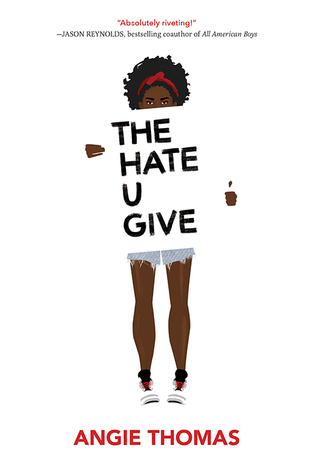
The Hate U Give

The Hate U Give. Angie Thomas. 2017. 444 pages. [Source: Library]

First sentence: I shouldn't have come to this party.

Premise/plot: The Hate U Give is a thoughtful, intense, compelling, relevant, and timely book. The book opens with a party. When the party becomes violent, Starr and Khalil leave quickly hoping to avoid drama and danger. Unfortunately, their car is pulled over by a cop on their way home. The situation escalates within minutes; Starr will be forever haunted by the memory of a (white) cop killing her friend right in front of her. The book is about the aftermath of that shooting, and also of Starr's difficulties finding her voice and overcoming her fears.

My thoughts: What did I appreciate most about this one? I'd have to say the strong characterization of ALL the characters. Starr, her mother, her father, her siblings and half-siblings, her boyfriend, her uncle, her friends. A few words about Starr are perhaps in order. Well, she identifies closely with the Fresh Prince of Bel-Air. Though she still lives in Garden Heights, she attends a mostly white private school. She feels stuck being "the black girl" in her class. Stuck may not be the right word. Then again, maybe it is. She doesn't feel safe being her absolute true self in that environment. She filters things. In her own neighborhood, she doesn't quite fit in either. Going to that school, that rich-person school, that white-person school makes her different, not in a good way. It is only at home that she's able to authentically be her whole self all the time. What led to her being sent to that school is the fact that she witnessed her best friend being killed in a drive-by shooting: they were both ten. Now violence has again turned her world upside down...but this time she's old enough to do something in response if she's brave enough.

Is the book issue-driven? Yes. Is that a bad thing? I don't think so. Not in this case. I think any person who has watched the news in the past few years can see that this book addresses real issues in an authentic way. I think for an issue book to work, it HAS to have strong characters. Since this one does, it works beautifully.

I will say it was a difficult read for me personally. The book has (understandably) strong language. It has a good bit of profanity. This profanity includes blasphemy. I am NOT saying the book is inauthentic, that the profanity is out of place or doesn't belong. The situations in the book are INTENSE and DRAMATIC. I am also NOT saying that the book is inappropriate for readers. I think in many ways this book is a must-read. I could see this one as being a great choice for classrooms and book clubs. Books should be judged for what they are, not for what any one reader wishes or hopes they were instead. I'd be surprised if this one isn't recognized with a few big awards.

© 2017 Becky Laney of Becky's Book Reviews

Wednesday, August 02, 2017

Great Expectations

Great Expectations. Charles Dickens. 1860. 640 pages. [Source: Library]

First sentence: My father's family name being Pirrip, and my Christian name Philip, my infant tongue could make of both names nothing longer or more explicit than Pip. So, I called myself Pip, and came to be called Pip.

Premise/plot: Can any Charles Dickens' novel easily--painlessly--be condensed into a couple of sentences that summarizes the plot and introduces the characters in an enticing, compelling way? I say NO. But I'll try. (Because I'm stubborn like that!)

Pip is a young man being raised by his older sister and his brother-in-law--the Gargerys. Mrs. Joe isn't all that nice to him, but, Joe--a blacksmith--is a godsend. The novel opens with some excitement. Pip has been approached--in a cemetery--by a shady character, a grown man, a man readers learn to be an escaped convict. He wants a file--to rid him of his chains--and some food. He's depending on Pip for both. Does Pip have a choice in helping him? Not really. (Though Pip is used to threats since he lives with his sister.) Some time later, Pip is given another opportunity. This time an eccentric old lady, Miss Havisham, wants Pip to be a companion for her and her adopted daughter, Estella. Does Pip have a choice? Again I'll say not really. The meeting is memorable and life-changing. Both his meeting of Miss Havisham and of Estella will change him for better or worse. It is this meeting that brings about his angst--his discontent. After meeting these two, he's no longer content in his home being raised by Joe and Mrs. Joe. He's no longer content being barely literate. He's no longer content with the idea of apprenticing to Joe and following in his footsteps. He wants what seems to be impossible: to be a gentleman--to walk, talk, act, live as a gentleman. But never say never, right? One day--in the middle of his apprenticeship to Joe--his life takes another turn. A lawyer approaches him with glad tidings: he's now a man with expectations. The catch: his benefactor wants to remain anonymous. His life from that moment on will change dramatically. He's being given the opportunity to become a new man. But does new always mean better? And what about those he leaves behind? Joe and Biddy, in particular. (Biddy is a young woman who has come to live with the family after Mrs. Joe is seriously injured. Biddy is of their class but has some education.) He's thrust into a whole new world, and, his manners and morals can sometimes lag behind. Pip goes to live with the Pockets; he becomes best-best friends with Herbert Pocket. Herbert christens him "Handel." The two go through much together; their friendship is deep and sincere. Life seems to be going swell, going according to Pip's grand plan, when Pip learns an unsettling truth. He learns the identity of his benefactor. Pip is shaken, confused, and ANGSTy once again. What is he to do now?! The foundation of his hopes and dreams has collapses. His big plan of marrying Estella seems to be truly impossible now. But not just that plan but all his plans seem to be off-track now. Who can he depend on in this crisis? From this point on, in my opinion, the novel shifts from being a coming-of-age story to a dramatic MYSTERY. So much ACTION and DRAMA are packed into the last hundred or so pages.

My thoughts: I recommend reading Great Expectations at a steady pace. It is not one to rush through in one or two days. If you do, chances are you won't remember what you read, and the novel won't stir up your emotions. It is not one to read slowly hit-or-miss style. If you don't read in it every day or every other day, you might not remember much either. The greatest danger may be that you won't connect with the characters or care about them. And unless you become attached to a character or two, the book won't stay with you. This was my third time to read the novel. In high school, I waited until the day before it was due to open it. It was a NIGHTMARE reading experience. I hated every minute of it. In college, I don't think I made the same mistake twice. I don't think I procrastinated. I think my sin in that instance was holding a grudge and reading it with a closed mind and heart. Since graduating college, I've read Dickens voluntarily. And this year I decided to read Great Expectations--as if for the first time. The goal: to read it with fresh eyes, open heart, open mind, looking for what made Great Expectations GREAT.


What was great about Great Expectations? I really enjoyed the characters, the themes, and the contrasts. What kind of contrasts? Love and hate, foolishness and wisdom, bitterness and forgiveness, friends and enemies, pride and humility. For example, we have two characters that live for revenge and thrive on bitterness to a certain degree. Abel Magwitch and Miss Havisham. Miss Havisham may be the more memorable of the two. She is living in a her worst moment, perpetuating the agony of it. She was jilted at the altar, and from that moment on her life stopped. Instead of moving on with her life, instead of finding a reason to keep living, she became filled with hate, pain, anger, bitterness. Not far behind her is Abel Magwitch. He has an enemy and there is this constant need to get him, to get revenge, to come out on top, to win no matter what. And this enemy haunts him--taunts him. Abel has his good side, as does Miss Havisham. But their worldview is tainted more by hate than love, more by this need to hurt others than to love.

What unites this novel is Pip. And a large part of Pip's identity is his undying, never changing love for Estella. It's unrequited love at that. Pip loves Estella. Estella does not love Pip. Estella loves Estella. I'm not sure if Dickens was trying to enter into the debate of nature versus nurture or not. But Estella has been raised to hate, raised to hurt. Miss Havisham thinks she's protecting Estella from having her heart broken by showing her day in and day out what happens from trusting a man. But in reality, Estella doesn't have a heart to hurt. She doesn't even have a heart to love the woman who raised her. Pip has trouble seeing the real Estella. His Estella is an idealized version, perhaps a version of who she could be if she'd been raised differently, if she'd allow herself to be human, if she'd allow herself to be vulnerable.
"You must know," said Estella, condescending to me as a brilliant and beautiful woman might, "that I have no heart,—if that has anything to do with my memory." I got through some jargon to the effect that I took the liberty of doubting that. That I knew better. That there could be no such beauty without it. "Oh! I have a heart to be stabbed in or shot in, I have no doubt," said Estella, "and of course if it ceased to beat I should cease to be. But you know what I mean. I have no softness there, no—sympathy—sentiment—nonsense."
Then, Estella being gone and we two left alone, she turned to me, and said in a whisper,— "Is she beautiful, graceful, well-grown? Do you admire her?" "Everybody must who sees her, Miss Havisham." She drew an arm round my neck, and drew my head close down to hers as she sat in the chair. "Love her, love her, love her! How does she use you?" Before I could answer (if I could have answered so difficult a question at all) she repeated, "Love her, love her, love her! If she favors you, love her. If she wounds you, love her. If she tears your heart to pieces,—and as it gets older and stronger it will tear deeper,—love her, love her, love her!" Never had I seen such passionate eagerness as was joined to her utterance of these words. I could feel the muscles of the thin arm round my neck swell with the vehemence that possessed her.
"Hear me, Pip! I adopted her, to be loved. I bred her and educated her, to be loved. I developed her into what she is, that she might be loved. Love her!" She said the word often enough, and there could be no doubt that she meant to say it; but if the often repeated word had been hate instead of love—despair—revenge—dire death—it could not have sounded from her lips more like a curse. "I'll tell you," said she, in the same hurried passionate whisper, "what real love is. It is blind devotion, unquestioning self-humiliation, utter submission, trust and belief against yourself and against the whole world, giving up your whole heart and soul to the smiter—as I did!" When she came to that, and to a wild cry that followed that, I caught her round the waist. For she rose up in the chair, in her shroud of a dress, and struck at the air as if she would as soon have struck herself against the wall and fallen dead.
"Herbert," said I, laying my hand upon his knee, "I love—I adore—Estella." Instead of being transfixed, Herbert replied in an easy matter-of-course way, "Exactly. Well?" "Well, Herbert? Is that all you say? Well?" "What next, I mean?" said Herbert. "Of course I know that." "How do you know it?" said I. "How do I know it, Handel? Why, from you." "I never told you." "Told me! You have never told me when you have got your hair cut, but I have had senses to perceive it. You have always adored her, ever since I have known you. You brought your adoration and your portmanteau here together. Told me! Why, you have always told me all day long. When you told me your own story, you told me plainly that you began adoring her the first time you saw her, when you were very young indeed." "Very well, then," said I, to whom this was a new and not unwelcome light, "I have never left off adoring her. And she has come back, a most beautiful and most elegant creature. And I saw her yesterday. And if I adored her before, I now doubly adore her."
"O Estella!" I answered, as my bitter tears fell fast on her hand, do what I would to restrain them; "even if I remained in England and could hold my head up with the rest, how could I see you Drummle's wife?" "Nonsense," she returned,—"nonsense. This will pass in no time." "Never, Estella!" "You will get me out of your thoughts in a week." "Out of my thoughts! You are part of my existence, part of myself. You have been in every line I have ever read since I first came here, the rough common boy whose poor heart you wounded even then. You have been in every prospect I have ever seen since,—on the river, on the sails of the ships, on the marshes, in the clouds, in the light, in the darkness, in the wind, in the woods, in the sea, in the streets. You have been the embodiment of every graceful fancy that my mind has ever become acquainted with. The stones of which the strongest London buildings are made are not more real, or more impossible to be displaced by your hands, than your presence and influence have been to me, there and everywhere, and will be. Estella, to the last hour of my life, you cannot choose but remain part of my character, part of the little good in me, part of the evil. But, in this separation, I associate you only with the good; and I will faithfully hold you to that always, for you must have done me far more good than harm, let me feel now what sharp distress I may. O God bless you, God forgive you!"
Favorite character: I think my favorite character was definitely Joe Gargery. Joe loved Pip unconditionally. Joe loved Pip even when Pip was being a brat or a snob--which was often especially in the first half of the book. Pip did nothing to earn Joe's unconditional love and support. Pip often thought of Joe as a fool, as ridiculous, as an embarrassment. But this reader saw him differently. I didn't need a late hour epiphany to see how awesome and amazing Joe was.

Favorite relationship: I really LOVED Herbert and Handel's friendship. I love how these two supported one another, confided in one another, wanted the best for one another. Herbert knew Pip--his strengths, his weaknesses--and loved him as a brother. That brotherly love was returned. When Pip came of age, he thought of Herbert first. How can I use my wealth to help Herbert get a start in life? When Pip's world started crashing in, I loved that Pip thought first of what this meant to Herbert and only secondly to what it meant for him and his dreams. I loved how these two seemed to understand one another. In hard, dangerous times or easy-going good times, these two were there for each other.

Favorite scene: I think one of my favorite scenes is between Pip and Miss Havisham. He is an adult now; he knows at last who his benefactor was; his own dreams are gone--his illusions shattered. He's come to ask for her help: he is not asking for money for himself, but money for his friend, Herbert, in setting him up in a career. His maturity in this scene effected me.
"If I give you the money for this purpose, will you keep my secret as you have kept your own?" "Quite as faithfully." "And your mind will be more at rest?" "Much more at rest." "Are you very unhappy now?" She asked this question, still without looking at me, but in an unwonted tone of sympathy. I could not reply at the moment, for my voice failed me. She put her left arm across the head of her stick, and softly laid her forehead on it. "I am far from happy, Miss Havisham; but I have other causes of disquiet than any you know of. They are the secrets I have mentioned." After a little while, she raised her head, and looked at the fire Again.
"It is noble in you to tell me that you have other causes of unhappiness, Is it true?" "Too true." "Can I only serve you, Pip, by serving your friend? Regarding that as done, is there nothing I can do for you yourself?" "Nothing. I thank you for the question. I thank you even more for the tone of the question. But there is nothing." She presently rose from her seat, and looked about the blighted room for the means of writing. There were none there, and she took from her pocket a yellow set of ivory tablets, mounted in tarnished gold, and wrote upon them with a pencil in a case of tarnished gold that hung from her neck.
She read me what she had written; and it was direct and clear, and evidently intended to absolve me from any suspicion of profiting by the receipt of the money. I took the tablets from her hand, and it trembled again, and it trembled more as she took off the chain to which the pencil was attached, and put it in mine. All this she did without looking at me. "My name is on the first leaf. If you can ever write under my name, "I forgive her," though ever so long after my broken heart is dust pray do it!" "O Miss Havisham," said I, "I can do it now. There have been sore mistakes; and my life has been a blind and thankless one; and I want forgiveness and direction far too much, to be bitter with you."
© 2017 Becky Laney of Becky's Book Reviews

Friday, June 10, 2016

Gidget

Gidget. Frederick Kohner. 1957. 154 pages. [Source: Bought]

I must admit I was disappointed by Frederick Kohner's Gidget. Here are some things you should know: 1) It was originally published in 1957. 2) It is to some degree based on a true teen girl named Kathy, nicknamed Gidget. 3) Fredrick Kohner, the author, based the book on his own daughter and on his own daughter's coming of age story. 4) It is set in Malibu in the mid 1950s. 5) The book became popular enough that a movie was made. 6) Presumably the movie and book were doing so well, it became a TV show. There was something sweet and verging on innocent about the first movie and about the TV show. Not so the book. It may make it more realistic in some people's opinion. 7) The book is written in first person.

The heroine, Franzie, a.k.a "Gidget," is fifteen years old and in love with the beach, the ocean, all things surf, including surfers--no matter their age. She considers herself all grown up, or, at the very least, mostly grown up. I personally prefer "clean" or even "squeaky clean" books in terms of language. This one has a lot of bad language, and, in particular a lot of taking the Lord's name in vain. I was NOT expecting Gidget to have the mouth that she does, because that is certainly not depicted in the movie or the TV show!!! Her days are devoted to the beach, to surfing, to hanging out with as many surfer guys as she can. She becomes particularly close to two. One being "the love of her life" Jeff (aka Moondoggie) and the other Cass (Big Kahuna). Perhaps because her first sex-dream is of Jeff, she becomes convinced that he is the one and that they are meant to be together forever and ever and of course she must share her dream with him and tell him how much he means to her!
There is great longing and much curiosity in Gidget. She's a boy-chaser. (Also she wants to smoke and drink and be one of the guys.) She doesn't want to be thought of as a fifteen year old girl who should be at home with her parents. Her thoughts are definitely becoming more and more focused on one thing. She's scared to death of it and longing for it at the same time. When Jeff begins to show some interest in her--physical interest--she's more than okay being the "other woman." Who cares if he's got a girlfriend?! He's hers for the summer. His girlfriend isn't here at the beach. His girlfriend doesn't even surf. Surely she's not worth any consideration! Jeff's lips are HER LIPS...at least until college starts back up in the fall.

One could easily say that nothing and everything happens in this one.

Nothing if you are looking at it in terms of events alone. It's a bit repetitive. Wake up. Go to beach. Follow Moondoggie around. Surf. Get sick for a week or maybe two. Get better. Go to beach. Have awkward conversations with brother-in-law and parents. Go to beach. Sneak out to all-night beach orgy. Go surfing. Make silly reflective statements about how mature you are now as compared to then.

Everything if you are looking at it in terms of capturing very angst-y, awkward, embarrassing moments that may be common enough to one and all but more cringe-worthy than anything else.

One thing that makes it creepy, for me, is that it is a father writing about his daughter. Even if it's fifty-fifty in its origins--half fictional, half based on true events/people--it's still a bit weird for me when I think about a father writing about his daughter's lust and curiosity. There are just some scenes in this one that are uncomfortable if you keep this in mind. Other scenes are just awkward. Like when Jeff tries to explain to Gidget that dreams are dreams are dreams and not actual reality or signs from the universe that you belong together.

Reading the book did make me appreciate the movie more. The changes made between the book and the movie were for the best, I think. The romance comes across better, cuter.

© 2016 Becky Laney of Becky's Book Reviews

Sunday, August 09, 2015

Walk Two Moons

Walk Two Moons. Sharon Creech. 1994. HarperCollins. 280 pages. [Source: Bought]

Gramps says that I am a country girl at heart, and that is true. I have lived most of my thirteen years in Bybanks, Kentucky, which is not much more than a caboodle of houses roosting in a green spot alongside the Ohio River. 

Did I love Sharon Creech's Walk Two Moons? Yes and no. On the one hand, it's a book that I know I would have either--as a kid-- avoided at all costs (if anyone had dropped hints of how sad it was) OR found myself hating, bitterly regretting having picked it up in the first place. There was a time I thought all sad books should be labeled. So at least you were making an informed decision before you got swept up in the story and invested a part of yourself in it. On the other hand--as an adult--I couldn't help finding it a beautiful and compelling story.

Sal--the heroine--is on a road trip with her grandparents (Gram and Gramps). They are on their way to "see" Sal's mother. That's what readers are told, and, as an adult I connected the dots early on. (Sal's world is upset when her Dad moves them to a new town after learning that the mom wouldn't be coming back.) But much is left a mystery for the reader. I can't honestly say how I would have interpreted the text as a kid. It doesn't really matter. The trip is enlivened by Sal's storytelling. She is telling the story of her new friend, her classmate, her almost-neighbor: Phoebe. (Readers also hear of other friends--classmates--including a boy named Ben.) Phoebe's life is also becoming something of a mess. Though Sal is better at spotting the signs than Phoebe herself. The book alternates between focusing on the past--Sal's new life, her friendships, her memories, her emotions--and the present, the road trip. Both stories are compelling. Mainly through dialogue, the grandparents become fully fleshed characters that you can't help loving and admiring. The way they love Sal, and, cherish her. There is just something sweet about this family. And readers do get to know them better than any other adult in the novel. Unfortunately, I think that is why the book left me angry. Part of me angry anyway. THE ENDING. I did not see it coming. And it was beyond cruel to this reader. Was it realistic? Yes. Looking back were their signs that it was coming? Probably. But though I guessed one reason why the novel was one of those dreaded SAD books. I didn't the second. And the second HURT so much.

Walk Two Moons is the 1995 Newbery winner.

Have you read Walk Two Moons? What did you think? Like it? Love it? Hate it? Do you like sad books? Or do you avoid them when you can?

© 2015 Becky Laney of Becky's Book Reviews

Wednesday, August 05, 2015

Wish You Well

Wish You Well. David Baldacci. 2000/2007. Grand Central Publishing. 432 pages. [Source: Library]

I enjoyed reading David Baldacci's Wish You Well. That is, I "enjoyed" it as much as one can enjoy a book with so much heartache in it. Some of the heartache was completely predictable, I won't lie. But some of it wasn't.

Readers meet Lou (Louisa) and Oz (Oscar). These two undergo a lot in the course of a year. The family is in a car crash. Their father dies at the scene. Their mother is left in a coma, of sorts. She's able to eat and drink, but, not to talk or walk. She's essentially dead to the world, unable to give any sign to anyone that she is still in there. The two go to live with a great-grandmother in Virginia. This great-grandmother raised their father. Her name is Louisa. Life in the country is certainly different than life in New York City, but the two adjust quickly. They enjoy spending time with Diamond, an orphan boy around their age, and Eugene, a black man who lives and works with them on the farm. Their mother lives with them as well. They manage to nurse her and do all the farm work as well. One man, a young lawyer, takes it upon himself to visit the family often. Cotton reads to Alicia (the mother) as often as he can. The children quickly bond with him. So they've experienced loss certainly, but, they've made new friends as well.

Is life perfect? Not really. Oz and Lou would give anything to have their parents back. And Oz especially is still counting on his mom waking up again. Lou secretly wants this just as badly. But she's older, and "wiser," and doesn't want anyone to know that she believes in wishes and happy endings. She can't help herself for wanting and wishing, but, she's ashamed of it at the same time. She hates herself for it in a way.

The book chronicles their adventures and misadventures in the country. The setting is 1940, by the way. I won't spoil the book; yes, a few things are predictable. But not everything in my opinion.

Wish You Well is a coming-of-age story written for adults. Don't be confused by the child narrator, this one really is an adult book.

What I liked best was the characterization and the setting. I liked Lou and Oz and Diamond. I liked Louisa and Cotton. I liked spending time with them. And the historical setting was a nice touch. 


© 2015 Becky Laney of Becky's Book Reviews

Thursday, July 09, 2015

Wish Girl (2015)

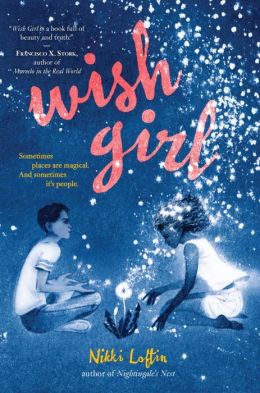
Wish Girl. Nikki Loftin. 2015. Penguin. 256 pages. [Source: Library]
 The summer before I turned thirteen, I held so still it almost killed me.
Did I enjoy reading Nikki Loftin's Wish Girl? Yes, very much. It does have its melancholic moments: Peter is a troubled boy--the victim of bullying--and he becomes close friends with a girl dying of cancer. But overall, the focus is on the magical properties of friendship, art, and nature.

Peter and his family have recently moved to Texas. The dad is out of a job, and, his parents are fighting A LOT. But part of the tension in the family comes from everyone worrying about Peter. Why they are so worried about him remains a mystery for much of the book, though adults may guess early on.

It's true enough that Peter is troubled. But for Peter it was never just the fact that he was physically bullied in the past--and the present. It was the fact that he felt he was never heard, never understood, never appreciated for being who he is, accepted as is. It's this feeling out of place--even at home--that leads him into depression and despair.

So Peter may not be thrilled about every aspect of the move, but, he discovers a special place, a valley, I believe, that changes EVERYTHING in his mindset. It is in this place that he meets the wish girl for the very first time. And being a bit clueless, he doesn't catch on that she's got cancer and is in fact dying. But eventually, these two strangers become very close friends... and in that process he learns more about himself, how to be true to himself.

 I liked this one.

© 2015 Becky Laney of Becky's Book Reviews

Friday, May 15, 2015

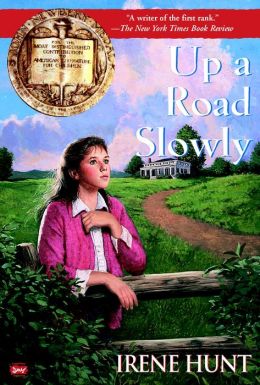
Up A Road Slowly (1966)

Up A Road Slowly. Irene Hunt. 1966. 208 pages. [Source: Bought]

I loved, loved, loved Irene Hunt's Up A Road Slowly. Is it one of the best coming-of-age stories that I've read? Perhaps. At least one of the best I've read lately. I think out of all the Newbery books I've read this year (newly read as opposed to reread) this one would probably be my favorite and best. It reminded me--in a good way--of Good Morning, Miss Dove and Emily of New Moon.

Julie is the heroine of Up A Road Slowly. When we first meet Julie, she's a child: around seven years old. Her mom has just died, and her father is sending off his two youngest children to Aunt Cordelia. (The oldest, Laura, is in her final year of high school, I believe. Christopher is the brother.) How will Julie adapt to her move to the country? to her new house? to living with her aunt whom she barely knows? It isn't easy certainly. But truth be told, Julie would probably struggle some with her emotions no matter what.

So essentially, readers watch Julie grow from seven to seventeen (or eighteen) throughout the novel. Readers get to know Julie, Aunt Cordelia, and Uncle Haskell very, very well. One of my favorite things about the novel was it's characterization. Hunt did a great job at making her characters achingly human. Readers also get to know her classmates and friends. 

Did I have a favorite character? Of course. I loved Julie, I did. And I am really, really happy with whom she ended up with. It made me giddy in fact. But I think my favorite character may just be Aunt Cordelia herself.

Have you read Up A Road Slowly? Did you like it? love it? hate it? I'd love to hear what you thought of it!

© 2015 Becky Laney of Becky's Book Reviews
Friday, October 17, 2014

Reread #42 The Eye of the World

The Eye of the World (Wheel of Time #1) Robert Jordan. 1990. Tor. 814 pages. [Source: Bought]

The Wheel of Time turns, and Ages come and pass, leaving memories that become legend. Legend fades to myth, and even myth is long forgotten when the Age that gave it birth comes again. In one Age, called the Third Age by some, an Age yet to come, an Age long past, a wind rose in the Mountains of Mist. The wind was not the beginning. There are neither beginnings nor endings to the turning of the Wheel of Time. But it was a beginning.

The Eye of the World is the first in Robert Jordan's Wheel of Time series. I first reviewed this one in October 2012. I thought the book was promising, that it had great potential. As the first book in a long series, it also serves as an introduction. An introduction not just to the world or to the main characters, but an introduction to the writing style: the details, the descriptions, the narration, the foreshadowing. It also hints at the complexity. Hints. (If you think there are a lot of names--both people and place--to keep up with in the first book, then you should know it only becomes more challenging in later books. It isn't necessarily good or bad that this is so. It just is.)

To keep it very simple, The Eye of the World is a coming-of-age adventure-quest story. It is all about the journey, or, you could just as easily say it is all about the chase. Eye of the World is essentially setting the stage for a big battle between the forces of good and evil.

The Eye of the World introduces readers to a handful of characters. Three young men who could potentially change the world for better or worse: Rand, Perrin, and Mat. Two young women who follow them into danger: Egwene and Nynaeve. Both have significant roles to play in the books ahead. Neither really steal the show in this first book. We learn that both women are able to touch the True Source (One Power) though they've not received training. Both women intrigue Moiraine, the Aes Sedai who has promised to protect them all--to the best of her ability. She knows that the Dark One seeks to destroy these three men, and quite possibly all those that stand in his way. Moiraine and Lan, her warder, will do what they can but they know it will be a continual struggle, a challenge, to stay a step or two ahead of the evil that pursues them.

There are also other characters introduced in this book that I'd like to mention. I love, love, love Loial. He's introduced relatively late in this one. But I adore him! He's an Ogier. There is also Thom Merrilin. He's a gleeman--an entertainer, storyteller, musician, juggler, etc. He travels with this group at the very beginning. There's also a young girl, Min, who is able to a certain degree to see the future. Readers also briefly meet Elayne, Gawyn, and Galad. And Queen Morgase. And the queen's Aes Sedai, Elaida.

It had been two years since I'd read this one. It was interesting to see what I remembered, and what I'd completely forgotten. I liked this one very much upon rereading. I enjoyed so many things about it still.

Quotes:
Not more than twenty spans back down the road a cloaked figure on horseback followed them, horse and rider alike black, dull and ungleaming. It was more habit than anything else that kept him walking backward alongside the cart even while he looked. The rider’s cloak covered him to his boot tops, the cowl tugged well forward so no part of him showed. Vaguely Rand thought there was something odd about the horseman, but it was the shadowed opening of the hood that fascinated him. He could see only the vaguest outlines of a face, but he had the feeling he was looking right into the rider’s eyes. And he could not look away. Queasiness settled in his stomach. There was only shadow to see in the hood, but he felt hatred as sharply as if he could see a snarling face, hatred for everything that lived. Hatred for him most of all, for him above all things.
He was hoping his father had not noticed he was afraid when Tam said, “Remember the flame, lad, and the void.” It was an odd thing Tam had taught him. Concentrate on a single flame and feed all your passions into it—fear, hate, anger—until your mind became empty. Become one with the void, Tam said, and you could do anything.
Strangers and a gleeman, fireworks and a peddler. It was going to be the best Bel Tine ever.
Aes Sedai and wars and false Dragons: those were the stuff of stories told late at night in front of the fireplace, with one candle making strange shapes on the wall and the wind howling against the shutters. On the whole, he believed he would rather have blizzards and wolves. Still, it must be different out there, beyond the Two Rivers, like living in the middle of a gleeman’s tale. An adventure. One long adventure. A whole lifetime of it.
“What kind of need would be great enough that we’d want the Dragon to save us from it?” Rand mused. “As well ask for help from the Dark One.”
“I still think you shouldn’t come,” he said. “I wasn’t making it up about the Trollocs. But I promise I will take care of you.” “Perhaps I’ll take care of you,” she replied lightly. At his exasperated look she smiled and bent down to smooth his hair. “I know you’ll look after me, Rand. We will look after each other. But now you had better look after getting on your horse.”
The Aes Sedai you will find in Tar Valon are human, no different from any other women except for the ability that sets us apart. They are brave and cowardly, strong and weak, kind and cruel, warm-hearted and cold. Becoming an Aes Sedai will not change you from what you are.
But hope is like a piece of string when you’re drowning; it just isn’t enough to get you out by itself.

© 2014 Becky Laney of Becky's Book Reviews
Sunday, December 01, 2013

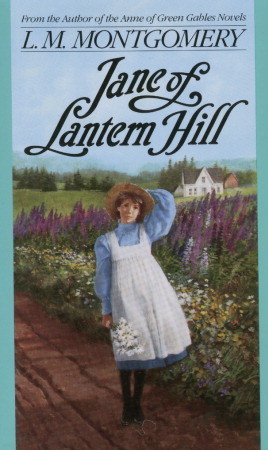
Sunday Salon: Reading Jane of Lantern Hill

Jane of Lantern Hill. L.M. Montgomery. 1937. 274 pages. [Source: Bought]

Jane of Lantern Hill was one of the few L.M. Montgomery books that I had not read before this year. While I found Pat of Silver Bush and Mistress Pat extremely disappointing, I found Jane of Lantern Hill to be practically perfect in every way. (If Pat had been my first introduction to L.M. Montgomery, I'm not sure I'd have ever voluntarily picked up another Montgomery book.) I just loved, loved, loved Jane of Lantern Hill.

Jane is our heroine. She lives with her mother, aunt, and grandmother. All three call her Victoria. It is not a happy home for all live in fear or reverence of the grandmother. Her mother is a forgiven prodigal. She returned home with a three year old daughter. (She did not divorce her husband; divorce is unforgivable.) Jane has always assumed that her father was dead. When she learns the truth, she's one confused child. Her relatives only confuse her more. If he is mentioned at all, it is to say that he did not want her, that he never loved her, that she is nothing to him. So it is with dread that Jane learns she is to spend an entire summer with him. He lives on Prince Edward Island. If he never wanted her, why does he want her now?

Once Jane is reunited with her father, her Dad, then the magic happens. It's a lovely coming-of-age novel about Jane discovering who she is and who she isn't! It's about her getting to know and love her Dad. It's about her finding a home, finding a place to belong, a place in the community. Jane is a great narrator! I can hardly do the book justice by summary.

Jane of Lantern Hill is thoroughly satisfying!

Favorite quotes:
Sometimes Jane thought drearily that there must be something the matter with her when there were so many people she didn't like. 
If any one doesn't like the Bible there's something wrong either with him or with the way he was introduced to it. We must do something about it. The Bible is a wonderful book, my Jane. Full of corking good stories and the greatest poetry in the world. Full of the most amazingly human 'human nature.' Full of incredible, ageless wisdom and truth and beauty and common sense. 
Dad read words as if he tasted them.
© 2013 Becky Laney of Becky's Book Reviews

Tuesday, June 04, 2013

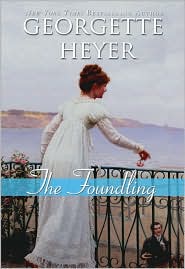
The Foundling (1948)

The Foundling. Georgette Heyer. 1948/2009. Sourcebooks. 439 pages.

I remember struggling through The Foundling when I first read it in 2010, but this time I enjoyed it much more. The romance isn't strong in this one. It is a 'coming of age' story in a way. Gilly (our hero) is in his twenties but so inexperienced in the real world that he's got a lot to learn before he becomes a "real man." This book is about his adventure into manhood, how he learned how capable he really is in interacting with the world. How he doesn't have to rely on his servants and staff for every single little thing.

Gilly's adventure starts when he decides to "help" his cousin, Matthew, deal with blackmailers. He will go in his cousin's place and handle the situation himself. It worked surprisingly well, but, it wasn't without consequences! For in his journey he picks up TWO unpredictable charges. A young man who is running away from his tutor, and, a young woman who is without any sense whatsoever. He also makes a very determined enemy.

If you're looking for romance and only for romance, The Foundling may prove quite disappointing. This is about his journey: the places he goes, the places he stays, the people he meets, the dangers he meets, the dangers he overcomes. Readers meet several interesting characters: some good guys, some not-so-good guys.

There are better Heyer novels that I would recommend first, but this one is enjoyable enough.

© 2013 Becky Laney of Becky's Book Reviews

Monday, April 29, 2013

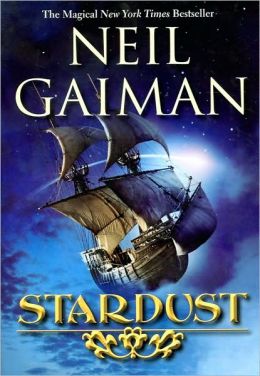
Stardust (1998)

Stardust. Neil Gaiman. 1998. 368 pages.

There was once a young man who wished to gain his Heart's Desire. And while that is, as beginnings go, not entirely novel (for every tale about every young man there ever was or will be could start in a similar manner) there was much about this young man and what happened to him that was unusual, although even he never knew the whole of it. 

Stardust is probably my favorite Neil Gaiman novel. It's set during the Victorian time period, and it has a classic fantasy-adventure feel to it. There is definitely some romance to it--it isn't a children's book, there's some adult content after all. All the elements work together for an enjoyable read!

In Victorian novels, it isn't unusual for an author to begin his or her story with extensive background, providing readers with information that sooner or later may prove important. Details on where the story is set, what life is like in that community, the families that live there, the story--romantic or practical--of the main character's parents, perhaps even going into great detail on the successes and failures, hopes and disappointments. Wilkie Collins, for example, can spend fifty pages or so just setting up the background for his novel. Gaiman spends the first chapter of Stardust doing just that, he sets up the family history so he can move the story forward sixteen or seventeen years and get off to a proper start in chapter two with the actual hero of the story, Tristran. Is this necessary?! Yes, in Tristran's case for his parentage makes him very unique. Still, it was a little unsettling to me--the first time at least. But I think it works.

There is a loveliness to the writing, the storytelling. It is rich in detail, in places, and at times very creative. I definitely enjoyed following Tristran Thorn on his quest. I liked seeing him transform into someone a bit wiser and kinder. I thought we met plenty of interesting characters along the way. Some of these characters I liked more than others! But overall, I definitely liked it. I think I loved it more the first time I read it, however.

When I first read Stardust in 2008, I wasn't as familiar with the time period as I am now, so paragraphs like this one meant little to me:
The events that follow transpired many years ago. Queen Victoria was on the throne of England, but she was not yet the black-clad widow of Windsor: she had apples in her cheeks and a spring in her step, and Lord Melbourne often had cause to upbraid, gently, the young queen for her flightiness. She was, as yet, unmarried, although she was very much in love. Mr. Charles Dickens was serializing his novel Oliver Twist; Mr. Draper had just taken the first photograph of the moon, freezing her pale face on cold paper; Mr. Morse had recently announced a way of transmitting messages down metal wires. (5)
Update: I've now seen the movie! It is quite different from the book! I enjoyed some of the changes, but not quite all of them. I think I definitely prefer the book to the movie. I thought the book was more clever, perhaps. I think one of my favorite things about the movie was the soundtrack! It was quite lovely!

© 2013 Becky Laney of Becky's Book Reviews

Thursday, July 22, 2010

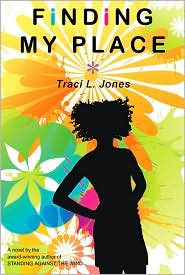
Finding My Place (MG/YA)


Finding My Place. Traci L. Jones. 2010. May 2010. FSG. 192 pages.

For most people, the big news during the fall of 1975 was the second assassination attempt on President Ford. Not for me. For me, that October was the month my father, Morris Ray Baker, and my mother, Annie Louise Baker, decided to completely ruin my life. Oh, they claimed it was not only a good move for our family, but a step forward for our race as a whole. My parents were big on doing their part to uplift the race, which meant I was expected to do my part as well.

Tiphanie, our narrator, is convinced that this move to a new neighborhood, a new school, is bad news. She'll be starting a new school where she'll be one of two black students--Bradley being the other. Tiphanie is unsure of it all. Are people staring at her because she's new? Or are they staring because she's black? Are people ignoring her because that's just the way they are? Would any new student get the same treatment? Or are her classmates racist? She doesn't want to overreact. But she can't help wishing that they'd been a warmer welcome. More people smiling, more people talking to her, asking her to be a part of their group.

Not everyone is shy. Jackie Sue is anything but shy. Some might argue she's a bit too blunt. (She tells Tiphanie her name is spelled wrong, and that none of the white guys at their school would be brave enough to date her. Even if they wanted to, they'd be too afraid of what others would think.) But Jackie Sue and Tiphanie are soon good friends. But not everyone is happy about this friendship. Clay, for example, is openly hostile. He doesn't want Jackie Sue talking to Tiphanie. And he certainly doesn't want Jackie inviting Tiphanie back to her trailer home. Tiphanie's parents aren't thrilled by the friendship either. They think their daughter could do better. Jackie Sue's mom, well, she leaves much to be desired. So while they wouldn't ever forbid Tiphanie from being friends with her, they take every opportunity to encourage Tiphanie to make other friends. Tiphanie's parents have definite opinions--on who they want their daughter to be, what they expect from her, who she should be friends with, etc.

Tiphanie is trying to discover who she is exactly. Trying to balance what she wants with what her parents' want. I liked this one. It's a universal story in many ways.

© Becky Laney of Becky's Book Reviews

Tuesday, July 13, 2010

Jumpstart the World (YA)


Jumpstart the World. Catherine Ryan Hyde. 2010. October 2010. Random House. 192 pages.

"This is a beautiful cat," my mother said. She was staring into a cage at about eye level. I sidled over just enough to get a peek at the cat in question. A long-haired silvery Persian mix. He was beautiful all right, in an aloof sort of way. I'm not a big fan of aloof. Besides, I already had a cat in mind. I just hadn't found the nerve to announce it yet.

Looking to read about another troubled teen? Meet Elle. She's fifteen-almost-sixteen. And when the novel opens, she's moving into her own apartment. Why? Well, her mother thought it would make her life easier, her relationship with her boyfriend easier, if her daughter left the house. What kind of mother would allow her daughter--at that age--to live on her own in New York City? Well, I'll let you decide for yourself...

Elle is a bit angry, a bit defiant, especially when it comes to her tense relationship with her mom. But Elle needs someone in her life. She needs someone to love her, to look after her, to listen to her, to understand her. And Elle might just have found the perfect someone in her neighbor, Frank. (Yes, she has a bit of a crush.)

Frank and Molly see how much Elle needs a friend, and they welcome her into their lives. Elle enjoys playing Scrabble with Frank and learning about photography from Molly. But what Elle doesn't know about Frank, well, it's a little surprising, a little unexpected. He's transgender.

Jumpstart the World is a story of a young woman learning what it means to be a friend, learning what it means to belong. It's a complex novel starring broken people living life the best they can. I do like the fact that the characters are so human.

© Becky Laney of Becky's Book Reviews
Thursday, March 18, 2010

After Ever After (MG/YA)

After Ever After by Jordan Sonnenblick. 2010. February 2010. Scholastic. 272 pages.

Five years after Drums, Girls & Dangerous Pie was published, readers finally get the chance to learn what happened next. Our protagonist isn't Steven this time round, no, it is finally time to hear from Jeffrey himself. As is only fitting now that Jeffrey is entering the eighth grade.

Jeffrey has spent most of his life being That Boy Who Had Cancer. And in some ways Jeffrey is tired of being that person. The person who has to worry every time he feels under the weather. The cancer has impacted him, of course, physically, mentally, and emotionally. And even all these years later, he is still effected by it.

Tad and Jeffrey are friends, best friends. Tad, like Jeffrey, had cancer as a kid. He understands what it's like to be That Boy Who Had Cancer. In some ways, it's even more obvious to outsiders because it left him in a wheelchair. But. Tad is determined to help his friend do the impossible--to pass the test, the big test, and graduate. Jeffrey, perhaps jokingly at first, agrees to be tutored, if he can help his friend in return. He wants Tad to be able to walk across the stage. Can both of these boys do the impossible?

After Ever After in addition to being a great coming-of-age novel, is a delightful tale of first love. Lindsey, Lindsey, Lindsey. Oh how Lindsey sweeps him right off his feet!
Lindsey sat down, and the smell of her perfume wafted across to me. I was hypnotized. Mr. Laurenzano started taking attendance, and when he got to her name, I repeated it in my mind: Lindsey Abraham. Such a perfect name: five syllables that rolled right across the tongue. Lindsey Abraham. I wondered how much it would hurt to get those fourteen letters tattooed on my arm. (15)
But this one has humor as well as heart. See how Jeffrey describes his gym teacher:
In gym, I thought for sure we would be safe from the test lecture. I was wrong. There are five gym teachers in my school, four of whom are sane. The fifth, Mr. McGrath, was in charge of my class. (40)
What is this one about? It's about friendship. It's about young love. It's about standardized testing. It's about grand gestures. It's about life.

I'd definitely recommend this one!

Other reviews: 5 Minutes for Books, The Reading Zone, Readingjunky's Reading Roost.

© Becky Laney of Becky's Book Reviews
Tuesday, March 16, 2010

Olive's Ocean (MG)


Olive's Ocean. Kevin Henkes. 2003. HarperCollins. 224 pages.

"Are you Martha Boyle?"
Martha nodded.
"You don't know me," said the woman at the door. "Olive Barstow was my daughter. I was her mother."


Who was Olive? That was a question difficult to answer in life, and it becomes even more difficult in death. At least for Martha, the heroine of Kevin Henkes' Olive's Ocean. So who was she? She was a classmate of Martha's. But. She was invisible. No one paid any attention to her at all. Well, except for a few who picked on her now and then. She wasn't worth anyone's time or notice. A nobody. What happened to Olive? She was hit by a car while riding her bicycle.

Martha was surprised to find Mrs. Barstow at the door. She comes bearing a page from Olive's journal. It seems that while Martha didn't notice Olive all that much, Olive noticed Martha. She wrote, "I hope I get to know Martha Boyle next year (or this summer). I hope that we can be friends. That is my biggest hope. She is the nicest person in my whole entire class." Of course, the journal entry says much more than that. It shows Martha that Olive was a real person with hopes and dreams and fears, a person who in many ways is just like her.

This note changes Martha. It changes how she sees herself in a way. It makes her a bit more introspective and thoughtful. As Martha prepares to go on her family vacation to the ocean, many things are on her mind. Can she find peace by the ocean? by spending time with her grandmother? by spending time with the cute boy next door?

It's a summer of change for Martha. No doubt about that!

I'm not a big fan of the cover. I think it's taken me this many years to read it--despite it being a Newbery Honor book--because the cover just didn't do much for me. I do think the book is worth reading by the way!

© Becky Laney of Becky's Book Reviews