Showing posts with label 1948. Show all posts

Tuesday, May 09, 2017

Corduroy

Corduroy. Don Freeman. 1948/1968. 32 pages. [Source: Library]

First sentence: Corduroy is a bear who once lived in the toy department of a big store.

Premise/plot: Corduroy is a toy bear wearing overalls with a missing button. He didn't exactly realize his button was missing until it was pointed out to him. That night, he searches for his missing button unsuccessfully. Fortunately, the next day a LOVELY little girl buys him and takes him home.
"You must be a friend," said Corduroy. "I've always wanted a friend." "Me too!" said Lisa, and gave him a big hug.
My thoughts: I loved this one as a child. It doesn't really get any sweeter. The ending is just about perfect.

Text: 3 out of 5
Illustrations: 5 out of 5
Total: 8 out of 10


© 2017 Becky Laney of Becky's Book Reviews

Saturday, February 18, 2017

Blueberries for Sal

Blueberries for Sal. Robert McCloskey. 1948. 56 pages. [Source: Library]

First sentence: One day, Little Sal went with her mother to Blueberry Hill to pick blueberries.

Premise/plot: Little Sal and Little Bear both love, love, love to eat blueberries. Little Sal's mother is picking blueberries to can for winter; Little Bear's mother is eating blueberries--and encouraging Little Bear to eat blueberries--so they can save up lots of fat for hibernating that winter. Little Sal becomes tired, and ultimately becomes separated from her mother. Little Bear also becomes separated. Both follow clues to find their mothers...but a mix-up results anyway!

My thoughts: I grew up listening to my mom read this one. So many good memories! I adore this one. It is easy to recommend.

Text: 4.5 out of 5
Illustrations: 4.5 out of 5
Total: 9 out of 10

© 2017 Becky Laney of Becky's Book Reviews

Tuesday, May 05, 2015

Three Tales of My Father's Dragon

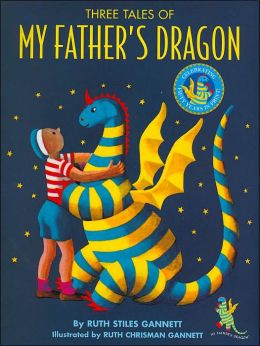
Three Tales of My Father's Dragon. Ruth Stiles Gannett. Illustrated by Ruth Chrisman Gannett. 1987. Random House. 242 pages. [Source: Library]

I really enjoyed reading My Father's Dragon (1948), Elmer And the Dragon (1950), and The Dragons of Blueland (1951), all by Ruth Stiles Gannett. (My Father's Dragon was a Newbery Honor book for 1949.) I'd read My Father's Dragon before many years ago--long before I started blogging--but this was my first opportunity, I believe, to read the two sequels.

I loved the way My Father's Dragon opens:
One cold rainy day when my father was a little boy, he met an old alley cat on his street. The cat was very drippy and uncomfortable so my father said, "Wouldn't you like to come home with me?" This surprised the cat--she had never before met anyone who cared about old alley cats--but she said, "I'd be very much obliged if I could sit by a warm furnace, and perhaps have a saucer of milk." "We have a very nice furnace to sit by, said my father, "and I'm sure my mother has an extra saucer of milk." My father and the cat became good friends but my father's mother was very upset about the cat. She hated cats, particularly ugly old alley cats. "Elmer Elevator," she said to my father, "if you think I'm going to give that cat a saucer of milk, you're very wrong. Once you start feeding stray alley cats you might as well expect to feed every stray in town, and I am not going to do it!"
 This opening hooked me. It is through the cat--his cat--that he learns of a baby dragon in desperate need of help. He tells of the Island of Tangerina and Wild Island. He learns about the captive dragon and the dangerous residents of the island. He is determined to help free the dragon. The cat helps him form a plan...

The first book is all about his going to the islands, his adventures and misadventures as he's looking for the dragon--it's a good thing he came to the island well-prepared! Does he find the dragon? You can guess the answer to that. Of course he does!

My Father's Dragon is a delightful fantasy book for very young readers. It's short and quite satisfying.

In Elmer and the Dragon, Elmer starts his journey home--by dragon. His new dragon friend will fly him home. But neither Elmer or the dragon know the way home precisely. Elmer ends up having just as many adventures returning home as he did running away from home. One of the stops along the way is Feather Island, the home of all 'lost' canaries.

In The Dragons of Blueland, the dragon sets off to return to his own family that he hasn't seen since his captivity. He's anxious to be reunited. But when he returns, he learns that his own family--his very large family--has been trapped in their cave. The entrance is guarded by men intent on capturing them or perhaps even killing them. He needs to find a way to help his family! So he seeks out Elmer...

All three books are great. It's oh-so-easy to recommend these.

© 2015 Becky Laney of Becky's Book Reviews

Saturday, February 07, 2015

Seuss on Saturday #6

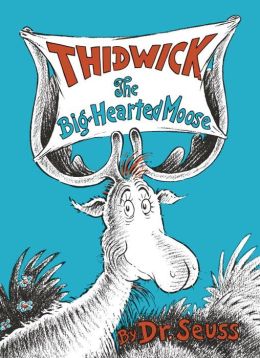
Thidwick The Big-Hearted Moose. Dr. Seuss. 1948. Random House. 48 pages. [Source: Library]

First sentence:
Up at Lake Winna-Bango...the far northern shore...
Lives a huge herd of moose, about sixty or more,
And they all go around in a big happy bunch
Looking for nice tender moose-moss to munch.
Premise/plot: Is Thidwick your typical moose? Yes and no. On the one hand, he loves to munch moose-moss. On the other hand, he's the only moose that would put up with THAT MANY guests living in/on his antlers. Thidwick is a "big-hearted" moose who hasn't learned to say no or speak up for himself. He's ever-so-polite. But his "guests" well, they're pesky pests who lack consideration. The guests just keep on multiplying page by page.

My thoughts: I'd never read Thidwick the Big-Hearted Moose. I suppose I should have predicted that hunters would see him and chase him--wanting his head and antlers to mount. But I didn't. So it came to me as a shock, as did the ending. (Think Jon Klassen's I Want My Hat Back and This Is Not My Hat.) I can't say I loved this one. But it was okay for me.

My favorite quote:
Well what would YOU do
If it happened to YOU?
Have you read Thidwick The Big Hearted Moose? Did you like it? love it? hate it? I'd love to hear what you thought of it!

If you'd like to join me in reading or rereading Dr. Seuss' picture books (chronologically) I'd love to have you join me! The next book I'll be reviewing is Barthlomew and the Ooblecks.


© 2015 Becky Laney of Becky's Book Reviews

Sunday, May 25, 2014

The Franchise Affair (1948)

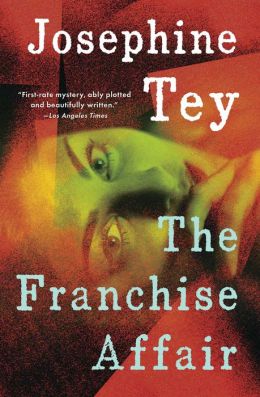
The Franchise Affair. Josephine Tey. 1948. 304 pages. [Source: Book I bought]

Robert Blair is a lawyer. He lives a boring life; nothing terribly exciting or thrilling ever happens. And. He doesn't seem to mind that his life is mostly predictable. But then one day he receives a call from Marion Sharpe. She is in need of a lawyer; she needs one as soon as possible. Yes, she knows that his firm doesn't specialize in criminal law; yes, she knows he's never handled any case quite like hers before. Yes, she'd be willing to find another lawyer if necessary--if charges are brought against her and if the case were to go to trial. But can he come NOW! He agrees. He rushes to The Francise. He meets Marion and her mother. He meets Inspector Grant. He hears what these two ladies are being accused of. He meets the young woman, Betty Kane, accusing them. He's left a bit speechless. Kane's story: I was waiting for the bus, these two "old" ladies offered me a ride, I accepted, they took me to their home, wouldn't let me leave, locked me in the attic, denied me food unless I worked for them doing some mending, they beat me too! After four weeks I managed to escape! Grant and Blair are speechless as are the women. The story seems weird and unrealistic. Grant's instincts are telling him that the Kane girl is a crazy attention-seeker who is a liar through and through. Blair also thinks the Kane girl is a liar. He also thinks she's immoral. There HAS to be a man involved. Kane had to have met a guy over vacation and run off with him and made up this horrible story when that love affair fell apart. Both Blair and Grant are relying on instincts and making quick judgments. Grant, at the start of the novel, does not want to make a case of this. He does not believe there has been an actual crime.

But. The story will not go away. Kane will tell her story, keep her story alive in the papers. The community will turn against the Sharpe women at the Francise. Things will get uncomfortable and dangerous.

Blair is determined that the best defense is to prove that Betty Kane is a terrible, horrible mess of a girl. She's far from good and honest and respectable. He wants to expose this girl, show her that she can't go around accusing good, honest women like the Sharpes of horrible crimes. She shouldn't be allowed to get away with it.

Grant, Tey's detective, is barely in this one. He is in a few scenes, but, for the most part this is Robert Blair's story, his chance to have an exciting life, to play hero.

The Franchise Affair is not my favorite Tey novel, but, it was a pleasant read.

© 2014 Becky Laney of Becky's Book Reviews

Tuesday, June 04, 2013

The Foundling (1948)

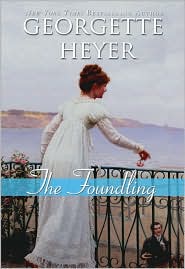
The Foundling. Georgette Heyer. 1948/2009. Sourcebooks. 439 pages.

I remember struggling through The Foundling when I first read it in 2010, but this time I enjoyed it much more. The romance isn't strong in this one. It is a 'coming of age' story in a way. Gilly (our hero) is in his twenties but so inexperienced in the real world that he's got a lot to learn before he becomes a "real man." This book is about his adventure into manhood, how he learned how capable he really is in interacting with the world. How he doesn't have to rely on his servants and staff for every single little thing.

Gilly's adventure starts when he decides to "help" his cousin, Matthew, deal with blackmailers. He will go in his cousin's place and handle the situation himself. It worked surprisingly well, but, it wasn't without consequences! For in his journey he picks up TWO unpredictable charges. A young man who is running away from his tutor, and, a young woman who is without any sense whatsoever. He also makes a very determined enemy.

If you're looking for romance and only for romance, The Foundling may prove quite disappointing. This is about his journey: the places he goes, the places he stays, the people he meets, the dangers he meets, the dangers he overcomes. Readers meet several interesting characters: some good guys, some not-so-good guys.

There are better Heyer novels that I would recommend first, but this one is enjoyable enough.

© 2013 Becky Laney of Becky's Book Reviews

Tuesday, March 12, 2013

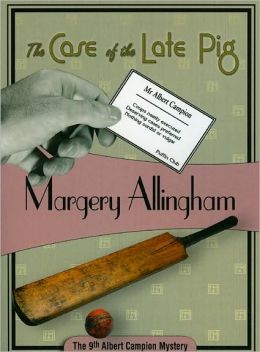
The Case of the Late Pig (1948)

The Case of the Late Pig. Margery Allingham. 1948. 144 pages.

I absolutely LOVED, LOVED, LOVED Margery Allingham's The Case of the Late Pig. This was my first introduction to Albert Campion, and I just have to say that I love him! I do! I love him. This mystery had me hooked from the very beginning. The first sentence reads, "The main thing to remember in autobiography, I have always thought, is not to let any damned modesty creep in to spoil the story. This adventure is mine, Albert Campion's, and I am fairly certain that I was pretty nearly brilliant in it in spite of the fact that I so nearly got myself and old Lugg killed that I hear a harp quintet whenever I consider it. It begins with me eating in bed." Isn't that a WONDERFUL way to start a book, a mystery?! Old Lugg, by the way, is his valet.

The book begins with Lugg reading aloud the deaths in the Times to his master as he's eating in bed. Albert isn't exactly thrilled at this 'new' behavior of his valet which he picked up from keeping company with another valet. Albert is glancing through his own letters as well. Suddenly he makes a connection: one of his old school mates has died. A man with the nickname of Pig Peters. (R.I. Peters is his real name.) Pig Peters was a bit of a bully--almost always a bully. But. Campion did promise himself (and Peters, I believe) that he would attend his funeral. So off to the funeral they go. It's a very strange funeral--little attended. And all would be well, except that Pig Peter's funeral was in January...and his body turns up again in June! And it's obvious to Campion that the death is only a few hours old...

This mystery delights cover to cover. I absolutely LOVED the writing, the dialogue, the characterization. IT was just a joy to read this one!!!


Read The Case of the Late Pig
  • If you want to read a really GREAT mystery
  • If you enjoy British mysteries
  • If you enjoy vintage mysteries
  • If you enjoy Margery Allingham
  • If you enjoy cozy mysteries
© 2013 Becky Laney of Becky's Book Reviews

Thursday, December 20, 2012

And There I Stood With My Piccolo

And There I Stood With My Piccolo. Meredith Willson. 1948/2009. University of Minnesota Press. 256 pages.

I enjoyed reading Meredith Willson's first autobiography, And There I Stood With My Piccolo, which was first published in 1948. The book isn't an organized biography by any means, but each chapter contains a sketch or two about his life and experiences. Some of these experiences are from his youth and childhood in Mason City, Iowa, but, many are from his experiences as an adult musician. Readers learn about his time in New York City, San Francisco, Hollywood, Pasadena, etc. The book is about his experiences as a musician, a composer, a professional in the radio industry. These are stories about places he's lived, places he's traveled, people he has met, people he has worked with closely, etc. There are even plenty of sketches about quite common things. The book isn't even chronological, he might spend one chapter talking about working on a radio show and the next chapter talk about playing marbles as a boy or going to see fireworks. But. If you don't mind rambling, if you enjoy conversational books, this one might be just right for you. I am glad I kept reading even if I didn't exactly "love" each and every chapter. I think the book is enjoyable for the point of view it provides on the entertainment industry of the 1920s, 30s, and 40s.

My favorite quote comes close to the end:

If I ever write another symphony, I'd like to take a crack at something that would include all the promise of the train whistle and engine shoofing. The promises and dreams are in many ways more wonderful than the fulfillments. (254-255)
My next-favorite quote is found at the beginning:
An old Moravian flute player once told me a story that went like this: A very important king hired a whole orchestra to play for him one night during his supper, just because he felt lonesome. This orchestra played great and the king was so delighted that before going to bed he said, 'Boys, your playing gave me the whips and jingles, and just for that you can all go to my countinghouse and fill your instruments with gold pieces.' I can still hear that happy clatter as sack after sack of golden tiddlies streamed into the tuba and slithered down the neck of the bassoon and spilled out over the bells of the French horns. And there I stood with my piccolo. (7)

 Read And There I Stood With My Piccolo
  • If you like reading biographies and autobiographies
  • If you like conversational books with sketches or vignettes 
  • If you are interested in learning more about what life was like in the 1920s, 30s, 40s
  • If you are interested in music or the entertainment industry (New York, Hollywood, etc.)

© 2012 Becky Laney of Becky's Book Reviews

Saturday, May 28, 2011

Peony

Peony. Pearl S. Buck. 1948/2006. Moyer Bell. 352 pages.

It was spring in the city of K'aifeng, a late spring in the northern Chinese province of Honan. Behind the high city walls the peach trees, planted in courtyards, bloomed earlier than they did upon the farms spreading over the level plains around the moat. Yet even in such shelter the peach blossoms were still only rosy buds at Passover.

Is it possible to be fascinated by a book that you don't quite like? I think so for I found Peony by Pearl S. Buck to be completely fascinating and compelling and yet not quite to my liking. Narrated by a bondmaid, Peony, readers learn about a Jewish community living within the Chinese city of K'aifeng in the early 19th century. Peony, a Chinese servant who was "bought" as a young child to be a companion to the couple's young son, David, a woman who comes to fall in love with him. It is an all-consuming, sometimes quite manipulative love, a forbidden love, but a forever kind of love nonetheless.

Ezra and Madame Ezra could never accept this servant as a daughter-in-law. But both are fond of her in their own way. As for David, he couldn't imagine life without Peony nearby. He promises that as long as he lives, she'll always always have a place in his home. But does he love her? At the beginning? Not really. Does he even know what love is?!

It is Madame Ezra's greatest desire for her son, David, to marry Leah, the daughter of the rabbi. It is her greatest desire that her son will come to embrace the Jewish faith, study under the rabbi, and maybe just maybe take his place since the rabbi's son, Aaron, is no good. She even invites Leah to live with them in their home. Hoping that Leah will be able to persuade David that he is more Jewish than Chinese. (David's father, Ezra, had a Chinese mother and a Jewish father.)

But. David is more like his father, Ezra, than his mother. David tries to learn about Judaism from the rabbi. He reads what he is supposed to read. He studies what he is supposed to study. But he has a hard time believing that God is real, that his people are chosen, that a wrathful God--a jealous God--could be a good God, a holy God, a just God. Instead, David comes to believe that religions are mostly the same--all man-made and essentially nonsense. He's closer to "accepting" the teachings of Confucius than the teachings of the Torah. He brings the rabbi to despair and breaks his mother's heart--for a time at least.

So his mother is pushing him to marry Leah. And Peony is pushing him to marry a pretty (but mindless) Chinese girl, Kueilan. For she believes that she could get along better with her than Leah. That if he chooses Leah--and the faith--that she'll be pushed out of his life. She even goes so far as to write both sides of their love letters! Peony has flaws--plenty of flaws! And it wasn't easy for me to stay on good terms with her.  

So Peony chronicles the lives of this Jewish family. It examines the tension between being Jewish and being Chinese. It examines how living in China for several centuries--at least--has had an impact on their faith, their culture, their teachings. It explores the decay of this community. How almost each generation weakens the faith, weakens the community. Each generation coming to compromise more and more of their faith.

So I liked elements of this one. I found the story itself to be fascinating. The novel covers several decades--at least--of this Jewish community from the point of view of one prominent family. And the afterword by Wendy R. Abraham was equally fascinating. I learned how much was fact, how much was fiction. How Pearl Buck played with the chronology a bit, but was true enough in some ways to do this community justice. But. I can't say that I "liked" the characters themselves--David and Peony especially. I found my heart breaking--along with his mother's heart--when David rejected faith in the one true God. I found it sad--very sad--to see the decay of the faith. How when the rabbi died there was no one within the community to take his place, there was no one left to carry on his work, his teachings. And Peony? Well. I found her to be selfish and manipulative and deceitful. So I liked some things; didn't like other things.

I did find it to be well-written. I think I liked this one more than the Good Earth trilogy, but I still think Kinfolk is my favorite.

© 2011 Becky Laney of Becky's Book Reviews

Thursday, February 24, 2011

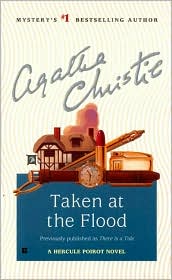
Taken at the Flood

Taken at the Flood. Agatha Christie. 1948/1984. Penguin. 256 pages.


In every club there is a club bore. The Coronation Club was no exception; and the fact that an Air Raid was in progress made no difference to normal procedure.

 Set, for the most part, in Warmsley Vale, this Hercule Poirot mystery focuses on a dysfunctional family in crisis: the Cloade family. Gordon Cloade made a lot of promises--promises it turns out he couldn't keep. He promised to provide for many--if not most--of his family. He helped them with their bills. He helped them with their dreams. His family was comfortable accepting his financial assistance. So when Gordon Cloade dies shortly after his marriage, everyone is upset. For his marriage changes everything, his wife will receive everything. His wife, an American widow, is a young beauty named Rosaleen. She's accompanied by her brother, David Hunter. The Cloade family hates them both. Though some family members play friendly--hoping to get a little money from her now and then. But David is always at her side telling her that her husband's family would love to see her dead.

So who's the victim? How does Poirot get involved? Well. A man shows up in town wanting to see David Hunter. He claims that he has proof that Rosaleen's first husband, a Mr. Underhay, is still alive. He wants money, of course, or he threatens to go to the Cloade family who will only be too happy to have this proof. For if Rosaleen's first husband was still alive when she married Gordon, then she wasn't legally his wife, and the family would get the money. This "Enoch Arden" is murdered--and the main suspect is David Hunter! But did he do it?

Lynn, one of the family, is involved in a very unhealthy love triangle in Taken at The Flood. Since returning home from the war, she's been restless. She's engaged to Rowley, but she's finding herself fascinated by the devilish David Hunter. And he's flirting back. Which will she choose? And will her choice prove deadly?

I enjoyed this one. It was exciting and fascinating. The family is a tangled mess, and Poirot has much to untangle before he can find all the pieces he needs to solve this one.

"Rowley. What's Rowley?"
"A better man than you--touch him if you dare," she said lightly.
"I've no doubt he's a better man than me--but I do dare. I'd dare anything for you, Lynn."
She was silent for a moment or two. She said at last.
"What you don't understand is that I love Rowley."
"I wonder."
She said vehemently: "I do, I tell you, I do."
David looked at her searchingly.
"We all see pictures of ourselves--of ourselves as we want to be. You see yourself in love with Rowley, settling down with Rowley, living here contented with Rowley, never wanting to get away. But that's not the real you, is it, Lynn?"
"Oh what is the real me? What's the real you, if it comes to that? What do you want?"
"I'd have said I wanted safety, peace after storm, ease after troubled seas. But I don't know. Sometimes I suspect, Lynn, that both you and I want--trouble." (58)

© 2011 Becky Laney of Becky's Book Reviews

Friday, August 20, 2010

The Foundling


The Foundling. Georgette Heyer. 1948/2009. Sourcebooks. 439 pages.

When the young gentlemen strolling through the park with his gun on his shoulder and an elderly spaniel at his heels came within sight of the house it occurred to him that the hour must be farther advanced than he had supposed, for the sun had sunk below the great stone pile, and an autumnal mist was already creeping over the ground.

The Duke of Sale (Gilly) is twenty-four. But. He's never lived his own life, or made his own decisions. He's had an entourage for as long as he can remember. An entourage that is determined to keep him safe, healthy, and comfortable. An entourage that Gilly feels discourages his independence, his individuality. He's never known a day of freedom.

Until. His cousin Matthew shares his troubles--he is being blackmailed. And the Duke determines to "solve" this family problem all on his own. He'll do it by being nobody. Without "being" the Duke, without being the head of the family. No. He wants to see if he's capable of being a man. Of thinking and acting like a man.

Does he succeed? At over four-hundred pages, you can imagine he does. But this new freedom doesn't come without risks and challenges and mishaps. He'll pick up not one but two strangers along the way. One young man, Tom, who is foolish and prank-loving. And one young woman, Belinda, a foundling, he "rescues" from an "uncle" who doesn't have the best of intentions. Belinda will BELIEVE any man who offers her a purple dress, you see. Or a ring. She's as silly as silly can be. But Belinda is NOT the love interest of Gilly. (I was quite relieved!)

The Foundling is not my favorite Georgette Heyer. It is a bit too long. There were so many potential ending places in the last hundred pages. Places where one more paragraph could have nicely done the job. But. For whatever reason, this ending would not be rushed. I liked it, but didn't love it.

© Becky Laney of Becky's Book Reviews