Showing posts with label 1950. Show all posts

Tuesday, March 25, 2025

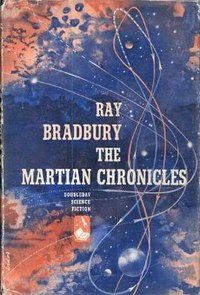
29. The Martian Chronicles


29. Martian Chronicles. Ray Bradbury. HarperCollins. 1997 edition. 288 pages. [Source: Library] [5 stars, science fiction, speculative fiction, classic, short stories]

First sentence: One minute it was Ohio winter, with doors closed, windows locked, the panes blind with frost, icicles fringing every roof, children skiing on slopes, housewives lumbering like great black bears in their furs, along the icy streets.
And then a long wave of warmth crossed the small town. A flooding sea of hart air; it seemed as if someone had left a bakery door open. The heat pulsed among the cottages and bushes and children. The icicles dropped, shattering, to melt. The doors flew open. The windows flew up. The children worked off their wool clothes. The housewives shed their bear disguises. The snow dissolved and showed last summer's ancient green lawns.
Rocket summer. The words passed among the people in the open, airing houses. Rocket summer. The warm desert air changing the frost patterns on the windows, erasing the art work. The skis and sleds suddenly useless. The snow, falling from the cold sky upon the town, turned to a hot rain before it touched the ground. Rocket summer. People leaned from their dripping porches and watched the reddening sky.  

Premise/plot: Martian Chronicles is a collection of Mars-themed short stories. It has been published in several different editions. New stories kept getting added, for example, small edits here and there. The earliest stories are from the 1940s. Each chapter can (and does) stand alone. The stories do have a flow, and, perhaps some do depend on what has gone before. But there is not one main character. It doesn't follow a particular person or family. 

This time around [I might have rearead this one a half dozen times or so] I read it from the Library of America edition (2021). It uses the *original* dates. And it includes all of the stories, I believe. 

January 1999 Rocket Summer
February 1999 Ylla
August 1999 The Summer Night
August 1999 The Earth Men
March 2000 The Taxpayer
April 2000 The Third Expedition
June 2001 And the Moon Be Still As Bright
August 2001 The Settlers
December 2001 The Green Morning
February 2002 The Locusts
August 2002 Night Meeting
October 2002 The Shore
November 2002 The Fire Balloons
February 2003 Interim
April 2003 The Musicians
May 2003 The Wilderness
June 2003 Way in the Middle of the Air
2004-2005 The Naming of Names
April 2005 Usher II
August 2005 The Old Ones
September 2005 The Martian
November 2005 The Luggage Store
November 2005 The Off Season
November 2005 The Watchers
December 2005 The Silent Towns
April 2026 The Long Years
August 2026 There Will Come Soft Rains
October 2026 The Million Year Picnic

My thoughts on individual stories, and, first sentences from the stories

"Ylla"

They had a house of crystal pillars on the planet Mars by the edge of an empty sea, and every morning you could see Mrs. K eating the golden fruits that grew from the crystal walls, or cleaning the house with handfuls of magnetic dust which, taking all dirt with it, blew away on the hot wind.
A story told solely from the perspective of the Martians, in this case, a husband and wife. A husband has a very definite reaction to his wife's strange dreams. She dreams of a man, Nathaniel York, coming in a ship, in a rocket, and landing. The dream even tells her where and when. But her controlling and perhaps jealous husband has a way of dealing--for once and for all--with his wife's dreams.

"The Earth Men"
Whoever was knocking at the door didn't want to stop. Mrs. Ttt threw the door open. "Well?"
The story of the second expedition. Let's just say that the welcoming committee wasn't quite what they expected! First, NO ONE wanted to bother with them, then they were greeted by a strange assortment of Martians all claiming to be from Earth. And then....well, that wouldn't be polite of me to spoil it!
"The Third Expedition" (aka Mars is Heaven)
The ship came down from space. It came from the stars and the black velocities, and the shining movements, and the silent gulfs of space. It was a new ship; it had fire in its body and men in its metal cells, and it moved with a clean silence, fiery and warm. In it were seventeen men, including a captain. 
This one is a classic short story that you may have stumbled across in another context from The Martian Chronicles. (I've heard two radio adaptations, for example.) And the title is self-explanatory. It is the story of what happens when the third expedition lands. It is the story of what they see and  WHO they see. It is a story that stretches you, perhaps. But it's a good one!

"--And the Moon Be Still As Bright"
It was so cold when they first came from the rocket into the night that Spender began to gather the dry Martian wood and build a small fire. He didn't say anything about a celebration; he merely gathered the wood, set fire to it, and watched it burn.
And now we're on to the fourth expedition, the fourth rocket ship to successfully land on Mars. This time they manage to stay alive past the initial day or two or three. This is the story of what happens when one of the crew members, Spender, goes off on his own to learn the Martian culture, to explore the ruins, to explore the cities, to examine the artifacts and remnants of a culture that is gone with the wind. What happens next...well....there are a million reasons why readers shouldn't sympathize with Spender, but, like Captain Wilder, they may feel the pull all the same.


"The Settlers"
The men of Earth came to Mars. They came because they were afraid or unafraid, because they were happy or unhappy, because they felt like Pilgrims or did not feel like Pilgrims. There was a reason for each man. They were leaving bad wives or bad jobs or bad towns; they were coming to find something or leave something or get something, to dig up something or bury something or leave something alone. They were coming with small dreams or large dreams or none at all.
One of my favorite vignettes. For some reason it reminds me of John Steinbeck.

"Night Meeting"
Before going on up into the blue hills, Tomas Gomez stopped for gasoline at the lonely station.
There is something haunting and fantastical about this short story of a human and Martian meeting and not exactly seeing the same reality.

"The Fire Balloons"
Fire exploded over summer night lawns. 

 I first read "The Fire Balloons" in another collection of Ray Bradbury stories. I didn't, at the time, see it as being part of The Martian Chronicles. (And, in fact, it wasn't part of the edition I first read.) But now it is one of my favorite stories! In it two priests go to Mars as missionaries. One at least was expecting, was hoping, to meet Martians, to actually BE a missionary TO Martians, to an alien species. So when given the opportunity of going out into the hills and trying to communicate with blue balloon-like hovering creatures OR ministering to humans who have migrated to Mars, the answer is clear to Father Peregrine. But do the Martians need his church? This story has one of my favorite quotes:
"Father Peregrine, won't you ever be serious?"
"Not until the good Lord is. Oh, don't look so terribly shocked, please. The Lord is not serious. In fact, it is a little hard to know just what else He is except loving. And love has to do with humor, doesn't it? For you cannot love someone unless you put up with him, can you? And you cannot put up with someone constantly unless you can laugh at him. Isn't that true? And certainly we are ridiculous little animals wallowing in the fudge bowl, and God must love us all the more because we appeal to His humor."
 "The Wilderness"
Oh, the Good Time has come at last--
It was twilight and Janice and Leonora packed steadily in their summer house, singing songs, eating little, and holding to each other when necessary. But they never glanced at the window where the night gathered deep and the stars came out bright and cold.

This is another story that I ended up loving. And it was new-to-me too, it not being part of the original. But in this story we meet two women who are about to travel to Mars to get married and settle down. (The men having gone first.) The story likens exploring and settling Mars to exploring and settling the Old West (places like Wyoming, California, Oregon, etc.) It is about how the two handle their last night on Earth.
Is this how it was over a century ago, she wondered, when the women, the night before, lay ready for sleep, or not ready, in the small towns of the East, and heard the sound of horses in the night and the creak of the Conestoga wagons ready to go, and the brooding of oxen under the trees, and the cry of children already lonely before their time?...Is this then how it was so long ago? On the rim of the precipice, on the edge of the cliff of stars. In their time the smell of buffalo, and in our time the smell of the Rocket. Is then then how it was? And she decided, as sleep assumed the dreaming for her, that yes, yes indeed, very much so, irrevocably, this was as it had always been and would forever continue to be. 

"Way In the Middle of the Air" 

"Did you hear about it?"
"About what?"
For better or worse this story exists. It does. I can see why some editions sweep it under the rug and pretend it doesn't exist. Is that the right call? Maybe. Maybe not. It concerns a racist family airing very vocally their views about 'a certain race' [the n-word is used throughout] joining the space race and going to Mars. It is a violent story. It is an ugly story. I didn't feel it enhanced the collection as a whole. However, it is what it is. And when the story was written racism WAS in play. It would have been written before the Civil Rights movement and perhaps gives one vignette of the times.

"Usher II" (aka Carnival of Madness)

"During the whole of a dull, dark and soundless day in the autumn of the year, when the clouds hung oppressively low in the heavens, I had been passing alone on horseback, through a singularly dreary tract of country, and at length found myself, as the shades of evening drew on, within view of the melancholy House of Usher..." Mr. William Stendahl paused in his quotation. There, upon a low black hill, stood the house, its cornerstone bearing the inscription: 2036 A.D.

I remembered this as being one of the stories in A PLEASURE TO BURN, a Ray Bradbury collection celebrating the creative stories leading up to the writing/publishing of Fahrenheit 451. And it was first published as "Carnival of Madness." But it was also part of Ray Bradbury's book, The Martian Chronicles. And it is perhaps one of the most memorable of the collection. It is a true must read for anyone who loves Fahrenheit 451, for it continues on some of the same themes. I don't want to say too much about it really, because it shouldn't be spoiled at all if you want to get the full enjoyment of it!

"The Martian"
The blue mountains lifted into the rain and the rain fell down into the long canals and old LaFarge and his wife came out of their house to watch. 
An elderly couple have come to Mars and one night they are surprised by the appearance of their "son" (who died and was buried back on Earth). Their "son" doesn't want to leave the house, and is enjoying his family too much to risk getting "trapped" by going into the city and interacting with others. This story is creepy.


"The Luggage Store," "The Off Season," "The Watchers," "The Silent Towns," "The Long Years," "There Will Come Soft Rains," and "The Million Year Picnic."

These stories, I feel, work best as a sequence showing what happens both on Earth and Mars when the worst happens--atomic war on Earth. In "The Luggage Store," one speculates that his business will improve greatly if the war happens, if the worst happens. He feels that everyone will want to go back home to Earth to be with their loved ones, to find out if their loved ones are okay, to try to piece their society and civilization back together. In "The Off Season" readers learn that the war has started and the destruction has begun. There is nothing truly comical about it, but, it does happen to be told from the point of view of a man who has just opened a hot dog stand. "The Watchers" shows the people leaving Mars to return to Earth--for better or worse. "The Silent Towns" and "The Long Years" are two stories set on Mars. The first, "The Silent Towns" is told from the point of view of a man who chose to stay behind. He's lonely, but not THAT lonely it turns out. He does meet one woman who stayed behind, but, he decides that his own company is enough after all. "The Long Years" sees the return of Captain Wilder, I believe, who discovers a man and his family. There is a twist, however, which prevents this one from being a happy story. "There Will Come Soft Rains" is a very, very, very lonely story where we get a glimpse--just a small glimpse perhaps--of the desolation and destruction of life as we know it in at least one human city. We see the ending of an era, perhaps. There are no human characters in this one. "The Million Year Picnic" resonates even more when seen back-to-back with "There Will Come Soft Rains." In this story, readers meet a family: parents and sons who have come to Mars on their own private Rocket--a rocket that has been hidden away for many years, a rocket that has been saved for a true emergency. We meet a father who has prepared for THE END in a big, big way.


© 2025 Becky Laney of Becky's Book Reviews

Saturday, November 19, 2022

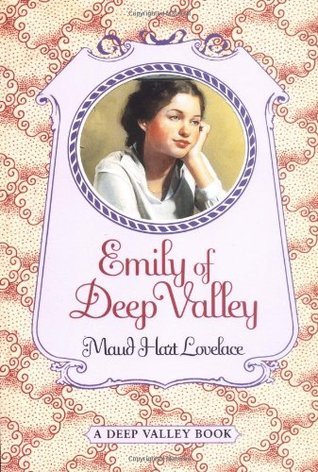
155. Emily of Deep Valley


Emily of Deep Valley. Maud Hart Lovelace. 1950. 304 pages. [Source: Library]

First sentence: "It's the last day of high school...ever," Annette said. She said it gaily, swinging Emily's hand and pulling her about so that they faced the red brick building with its tall arched windows and doors, its elaborate limestone trimming, its bulging turrets and the cupola that made an ironical dunce's cap on top of all. Annette threw a kiss at it, then lifted her right hand and opened and shut the fingers in a playful wave. "Good-by, old jail!" she said. "Don't you dare call the Deep Valley High School a jail!" Emily tone was joking but there was warmth in it, too. 

Premise/plot: Emily Webster, our orphan protagonist, loves her home in Deep Valley, no question. But when almost all of her classmates either go away to college or university [or marry] and she is left behind seemingly on her own [to represent the Class of 1912] in Deep Valley, well, she gets a little out of sorts. While her classmates and chums are busy living new lives--with new opportunities, experiences, adventures--Emily is left not even with the same old, same old. For she no longer "belongs" in high school. [Though she attempts to find joy in life by still going to all the games. That works for a while. Until she realizes that NO, she's not in high school. She's a grown woman not a child. No matter of pretending will change that.] Her days are filled with caring for her grandfather, a Civil War veteran, but not completely filled. Not in the way they are filled in her daydreams. She tries various interests and hobbies. One of which leads to perhaps the biggest change in her life: her interest in the Little Syrian [immigrant] community in Deep Valley. She befriends a few Syrian boys and through them takes an interest in the neighborhood at large. 

Emily longs for a love story. It's quite easy to imagine a perfectly perfect romantic lead, but imagining herself into that story is a little more bumpy. She wants to be wanted and fears she never will be wanted. 

Emily of Deep Valley chronicles about a year of time May 1912 to May 1913.

My thoughts: I really LOVED this one. It was new to me. I liked this coming of age novel very much. It was written in 1950 and set in 1912/1913 so it definitely qualifies as historical fiction. I liked the setting very much--both the time period and the geographical setting. [Fictional town of Deep Valley, Minnesota]

Quotes:

In Deep Valley, as everywhere, the Roosevelt-Taft feud was tearing friends and family apart. Emily favored Roosevelt, believing, as Jane Addams did, that he spoke for the cause of social justice.

Depression settled down upon her, and although she tried to brush it away it thickened like a fog.

“A mood like this has to be fought. It’s like an enemy with a gun,” she told herself. But she couldn’t seem to find a gun with which to fight.

She did bring home books from the library, in armloads, replenishing them every two or three days. She read avidly, indiscriminately, using them as an antidote for the pain in her heart.

She wrote more letters than she received.
“They certainly are slow in answering,” she thought, beginning a letter to Nell who already owed her a letter. “But then,” she admitted to herself, “they’re not living in my life the way I’m living in theirs.” 

At church next day Dr. MacDonald said something that helped her. Emily’s mind kept drifting away from the sermon to last night’s fun. But suddenly this sentence flashed out—it was a quotation from Shakespeare, she thought: “Muster your wits: stand in your own defense.” She had no idea in what sense he had used it, but it seemed to be a message aimed directly at her. “Muster your wits: stand in your own defense,” she kept repeating to herself on the long walk home.

She forced herself to conversational overtures but they sounded hollow. No one seemed to respond. “I shouldn’t be trying so hard. No one else is trying,” she thought.

“I tag them around, but I’m like a shadow. Well, I won’t do it anymore!” She wasn’t tired of her friends, but she was tired of pursuing them as though her own life were worthless. 

© 2022 Becky Laney of Becky's Book Reviews

Tuesday, February 08, 2022

23. I, Robot


I, Robot. Isaac Asimov. 1950. 304 pages. [Source: Library]

First sentence: I looked at my notes and I didn’t like them. I’d spent three days at U.S. Robots and might as well have spent them at home with the Encyclopedia Tellurica.
Susan Calvin had been born in the year 1982, they said, which made her seventy-five now. Everyone knew that. Appropriately enough, U.S. Robot and Mechanical Men, Inc., was seventy-five also, since it had been in the year of Dr. Calvin’s birth that Lawrence Robertson had first taken out incorporation papers for what eventually became the strangest industrial giant in man’s history. Well, everyone knew that, too.

Premise/plot: I, Robot is a collection of interconnected stories dealing with humanity's volatile (ever-changing) relationship with robot technology. The framework is a narrator (a reporter) interviewing people and accessing files and records. There are recurring characters in some of the stories. But not all the stories are connected tightly with one another. Each story really focuses on the advancement of robot (technology) and how that evolution effects humanity. Is the advancement of robots endangering humanity? Are the three laws enough? Are there good, valid reasons to fear robots? Or do the robots truly just want to protect humanity?

The stories are "Robbie," "Runaround," "Reason," "Catch That Rabbit," "Liar," "Little Lost Robot," "Escape!" "Evidence," "The Evitable Conflict." 

The three laws are
1) A robot may not injure a human being or, through inaction, allow a human being to come to harm
2) A robot must obey orders givein to it by human beings except where such orders would conflict with the First Law.
3) A robot must protect its own existence as long as such protection does not conflict with the First or Second Law.

My thoughts: I had LOW expectations. I was surprised by how much I liked the stories. But even more surprised by how much I liked the writing in these stories. I was expecting premise-heavy, plot-driven action. I wasn't expecting there to be depth and substance. I wouldn't go so far as to say that it is character-driven. (It's not really.) But it is thoughtfully written. 

Some of the stories (aka chapters) were previously published in magazines during the 1940s. 

Quotes:

“Fifty years,” I hackneyed, “is a long time.”
“Not when you’re looking back at them,” she said. “You wonder how they vanished so quickly.”
She went back to her desk and sat down. She didn’t need expression on her face to look sad, somehow.
“How old are you?” she wanted to know.
“Thirty-two,” I said.
“Then you don’t remember a world without robots. There was a time when humanity faced the universe alone and without a friend. Now he has creatures to help him; stronger creatures than himself, more faithful, more useful, and absolutely devoted to him. Mankind is no longer alone. Have you ever thought of it that way?”
“I’m afraid I haven’t. May I quote you?”
“You may. To you, a robot is a robot. Gears and metal; electricity and positrons.—Mind and iron! Human-made! If necessary, human-destroyed! But you haven’t worked with them, so you don’t know them. They’re a cleaner better breed than we are.”
I tried to nudge her gently with words, “We’d like to hear some of the things you could tell us; get your views on robots. The Interplanetary Press reaches the entire Solar System. Potential audience is three billion, Dr. Calvin. They ought to know what you could tell them on robots.”

Slowly, the robot obeyed. His photoelectric eyes focused reproachfully upon the Earthman.
“There is no Master but the Master,” he said, “and QT-1 is his prophet.”
“Huh?” Donovan became aware of twenty pairs of mechanical eyes fixed upon him and twenty stiff-timbred voices declaiming solemnly:
“There is no Master but the Master and QT-1 is his prophet!”
“I’m afraid,” put in Cutie himself at this point, “that my friends obey a higher one than you, now.”
“The hell they do! You get out of here. I’ll settle with you later and with these animated gadgets right now.”
“No,” said Powell bitterly, “he’s a reasoning robot—damn it. He believes only reason, and there’s one trouble with that—” His voice trailed away.
“What’s that?” prompted Donovan.
“You can prove anything you want by coldly logical reason—if you pick the proper postulates. We have ours and Cutie has his.”
“Then let’s get at those postulates in a hurry. The storm’s due tomorrow.”
Powell sighed wearily. “That’s where everything falls down. Postulates are based on assumption and adhered to by faith. Nothing in the Universe can shake them. I’m going to bed.”
“Oh, hell! I can’t sleep!”
“Neither can I! But I might as well try—as a matter of principle.”

The unwritten motto of United States Robot and Mechanical Men Corp. was well-known: “No employee makes the same mistake twice. He is fired the first time.”

Oh, well that’s too bad. I mean, your field-engineers are swell, but can’t we get you into this? Didn’t you ever have a robot go wrong on you? It’s your anniversary, you know.”
And so help me she blushed. She said, “Robots have gone wrong on me. Heavens, how long it’s been since I thought of it. Why, it was almost forty years ago. Certainly! 2021! And I was only thirty-eight. Oh, my—I’d rather not talk about it.”
I waited, and sure enough she changed her mind. “Why not?” she said. “It cannot harm me now. Even the memory can’t. I was foolish once, young man. Would you believe that?”
“No,” I said.
“I was. But Herbie was a mind-reading robot.”
“What?”
“Only one of its kind, before or since. A mistake,—somewheres—”


© 2022 Becky Laney of Becky's Book Reviews

Thursday, December 06, 2018

The Lion, The Witch, and The Wardrobe

The Lion, The Witch, and the Wardrobe. (The Chronicles of Narnia #1) C.S. Lewis. Illustrated by Pauline Baynes. 1950. 186 pages. [Source: Bought]

 First sentence: ONCE THERE WERE FOUR CHILDREN whose names were Peter, Susan, Edmund and Lucy.

Premise/plot: During the second world war, the Pevensie children are evacuated to the country. Peter, Susan, Edmund, and Lucy accidentally discover a magical country--Narnia--within a wardrobe in a spare room. Lucy discovers Narnia first and meets a faun, Mr. Tumnus. Next to enter is the turkish-delight-loving Edmund. He meets the Queen--or the White Witch. But it isn't long before all four children enter Narnia and change the course of its history--not to mention their own lives--forever.

My thoughts: I love, love, love The Lion, The Witch, and the Wardrobe. I had forgotten how SHORT a read it really is. Perhaps because the movie adds so much drama and action. If I had to guess, I'd say that it would take a person longer to watch the movie than to actually read the book. At least if you're a somewhat fast reader like I am. 

I love that the book doesn't focus on battles and blood. Yes, readers know that there is a fierce battle taking place, but Lewis' focus is elsewhere. While the battle rages on, readers are with Lucy, Susan, and Aslan. We are eye-witnesses not to the battle but to Aslan's resurrecting power as he reawakens the statues and assembles his liberated 'army' to join in the battle.

No matter what the movie may be, the book is not action-driven. It is character-driven. It is focused on relationships and feelings. I loved that as a child and I love that now. That being said, the movie is very good.

Quotes:  
  • Daughter of Eve from the far land of Spare Oom where eternal summer reigns around the bright city of War Drobe, how would it be if you came and had tea with me?
  • And really it was a wonderful tea. There was a nice brown egg, lightly boiled, for each of them, and then sardines on toast, and then buttered toast, and then toast with honey, and then a sugar-topped cake.
  • And the tune he played made Lucy want to cry and laugh and dance and go to sleep all at the same time.
  • “It’s—it’s a magic wardrobe. There’s a wood inside it, and it’s snowing, and there’s a Faun and a Witch and it’s called Narnia; come and see.
  • “I see you are an idiot, whatever else you may be,” said the Queen. “Answer me, once and for all, or I shall lose my patience. Are you human?
  • “A door. A door from the world of men! I have heard of such things. This may wreck all. But he is only one, and he is easily dealt with.
  • The more he ate the more he wanted to eat, and he never asked himself why the Queen should be so inquisitive.     
  • “Why don’t they teach logic at these schools? There are only three possibilities. Either your sister is telling lies, or she is mad, or she is telling the truth. You know she doesn’t tell lies and it is obvious that she is not mad. For the moment then and unless any further evidence turns up, we must assume that she is telling the truth.
  • “But do you really mean, sir,” said Peter, “that there could be other worlds—all over the place, just round the corner—like that?
  • “I don’t want to go a step further and I wish we’d never come. But I think we must try to do something for Mr. Whatever-his-name-is—I mean the Faun.
  • “They say Aslan is on the move—perhaps has already landed.” And now a very curious thing happened. None of the children knew who Aslan was any more than you do; but the moment the Beaver had spoken these words everyone felt quite different.
  • At the name of Aslan each one of the children felt something jump in its inside. Edmund felt a sensation of mysterious horror. Peter felt suddenly brave and adventurous. Susan felt as if some delicious smell or some delightful strain of music had just floated by her. And Lucy got the feeling you have when you wake up in the morning and realize that it is the beginning of the holidays or the beginning of summer.
  • “Who is Aslan?” asked Susan. “Aslan?” said Mr. Beaver. “Why, don’t you know? He’s the King. He’s the Lord of the whole wood, but not often here, you understand.
  • “Turn him into stone? If she can stand on her two feet and look him in the face it’ll be the most she can do and more than I expect of her.
  • “Aslan a man!” said Mr. Beaver sternly. “Certainly not. I tell you he is the King of the wood and the son of the great Emperor-beyond-the-Sea. Don’t you know who is the King of Beasts? Aslan is a lion—the Lion, the great Lion. 
  • “if there’s anyone who can appear before Aslan without their knees knocking, they’re either braver than most or else just silly.
  • “Safe?” said Mr. Beaver; “don’t you hear what Mrs. Beaver tells you? Who said anything about safe? ‘Course he isn’t safe. But he’s good. He’s the King, I tell you.
  • “I’m longing to see him,” said Peter, “even if I do feel frightened when it comes to the point.
  • “Didn’t I tell you,” answered Mr. Beaver, “that she’d made it always winter and never Christmas? Didn’t I tell you? Well, just come and see!
  • He was a huge man in a bright red robe (bright as holly berries) with a hood that had fur inside it and a great white beard that fell like a foamy waterfall over his chest.
  • He was so big, and so glad, and so real, that they all became quite still. They felt very glad, but also solemn.
  • People who have not been in Narnia sometimes think that a thing cannot be good and terrible at the same time.
  • “Please—Aslan,” said Lucy, “can anything be done to save Edmund?” “All shall be done,” said Aslan. “But it may be harder than you think.
  • “Here is your brother,” he said, “and—there is no need to talk to him about what is past.” Edmund shook hands with each of the others and said to each of them in turn, “I’m sorry,” and everyone said, “That’s all right.
  • “Oh, you’re real, you’re real! Oh, Aslan!” cried Lucy, and both girls flung themselves upon him and covered him with kisses. 
  • “It means,” said Aslan, “that though the Witch knew the Deep Magic, there is a magic deeper still which she did not know. Her knowledge goes back only to the dawn of time.
  • But if she could have looked a little further back, into the stillness and the darkness before Time dawned, she would have read there a different incantation.
  • She would have known that when a willing victim who had committed no treachery was killed in a traitor’s stead, the Table would crack and Death itself would start working backward.
  • “Does he know,” whispered Lucy to Susan, “what Aslan did for him? Does he know what the arrangement with the Witch really was?
  • “Oughtn’t he to be told?” said Lucy. “Oh, surely not,” said Susan. “It would be too awful for him. Think how you’d feel if you were he.
  • “All the same I think he ought to know,” said Lucy. But at that moment they were interrupted.
  • But if the Professor was right it was only the beginning of the adventures of Narnia.

© 2018 Becky Laney of Becky's Book Reviews

Saturday, November 26, 2016

The Purple Pussycat

The Purple Pussycat. Margaret Hillert. 1950. 31 pages. [Source: Bought]

First sentence: We can not play now. We have work to do. Can you help me? Now we can go. Come with me. I want you to come.

Premise/plot: A boy's toy--a purple pussycat--has adventures on his own once the boy falls asleep.
The copyright of my copy of the book says 1981. The book was a part of Follett's Just Beginning To Read series. The whole book has just a fifty-eight word vocabulary. And perhaps that simplicity keeps it from being a wow of a plot.

My thoughts: Was it worth the quarter I paid for it? Probably. The series promises COLORFULLY ILLUSTRATED books, and, I won't deny that these illustrations are colorful. I'm not sure you'd see anything like them published today. (The house the boy lives in desperately needs the Property Brothers, in my opinion.) Once the (toy) cat begins his adventures outside, I think the book becomes more interesting.

Text: 3 out of 5
Illustrations: 3 out of 5
Total: 6 out of 10


© 2016 Becky Laney of Becky's Book Reviews

Tuesday, May 05, 2015

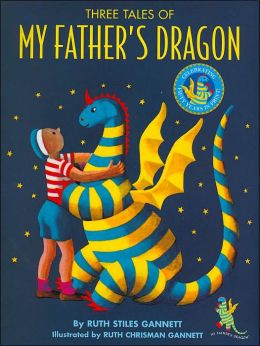
Three Tales of My Father's Dragon

Three Tales of My Father's Dragon. Ruth Stiles Gannett. Illustrated by Ruth Chrisman Gannett. 1987. Random House. 242 pages. [Source: Library]

I really enjoyed reading My Father's Dragon (1948), Elmer And the Dragon (1950), and The Dragons of Blueland (1951), all by Ruth Stiles Gannett. (My Father's Dragon was a Newbery Honor book for 1949.) I'd read My Father's Dragon before many years ago--long before I started blogging--but this was my first opportunity, I believe, to read the two sequels.

I loved the way My Father's Dragon opens:
One cold rainy day when my father was a little boy, he met an old alley cat on his street. The cat was very drippy and uncomfortable so my father said, "Wouldn't you like to come home with me?" This surprised the cat--she had never before met anyone who cared about old alley cats--but she said, "I'd be very much obliged if I could sit by a warm furnace, and perhaps have a saucer of milk." "We have a very nice furnace to sit by, said my father, "and I'm sure my mother has an extra saucer of milk." My father and the cat became good friends but my father's mother was very upset about the cat. She hated cats, particularly ugly old alley cats. "Elmer Elevator," she said to my father, "if you think I'm going to give that cat a saucer of milk, you're very wrong. Once you start feeding stray alley cats you might as well expect to feed every stray in town, and I am not going to do it!"
 This opening hooked me. It is through the cat--his cat--that he learns of a baby dragon in desperate need of help. He tells of the Island of Tangerina and Wild Island. He learns about the captive dragon and the dangerous residents of the island. He is determined to help free the dragon. The cat helps him form a plan...

The first book is all about his going to the islands, his adventures and misadventures as he's looking for the dragon--it's a good thing he came to the island well-prepared! Does he find the dragon? You can guess the answer to that. Of course he does!

My Father's Dragon is a delightful fantasy book for very young readers. It's short and quite satisfying.

In Elmer and the Dragon, Elmer starts his journey home--by dragon. His new dragon friend will fly him home. But neither Elmer or the dragon know the way home precisely. Elmer ends up having just as many adventures returning home as he did running away from home. One of the stops along the way is Feather Island, the home of all 'lost' canaries.

In The Dragons of Blueland, the dragon sets off to return to his own family that he hasn't seen since his captivity. He's anxious to be reunited. But when he returns, he learns that his own family--his very large family--has been trapped in their cave. The entrance is guarded by men intent on capturing them or perhaps even killing them. He needs to find a way to help his family! So he seeks out Elmer...

All three books are great. It's oh-so-easy to recommend these.

© 2015 Becky Laney of Becky's Book Reviews
Sunday, April 19, 2015

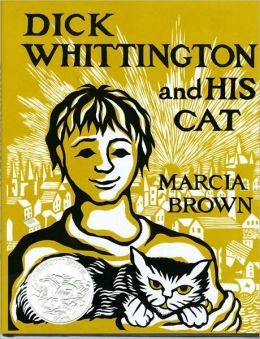
Dick Whittington and His Cat (1950)

Dick Whittington and His Cat. Told and cut in linoleum by Marcia Brown. 1950. Simon & Schuster. 32 pages. [Source: Bought]

First sentence: Long ago in England there lived a little boy named Dick Whittington. Dick's father and mother died when he was very young, and as he was too small to work, he had a hard time of it.

Premise/plot: Dick Whittington, an orphan, goes to London to seek his fortune--or at least a somewhat better life. It won't be easily come by that's for sure! He eventually finds work in the home of a merchant as a cook's assistant. With his one penny, he happens to buy a cat who is an excellent mouser. The cat will be the key to it all: his eventual success.
Not long after this, Mr. Fitzwarren had a ship ready to sail. He called all his servants into the parlor and asked them what they chose to send to trade. All the servants brought something but poor Dick. Since he had neither money nor goods, he couldn't think of sending anything. "I'll put some money down for him," offered Miss Alice, and she called Dick into the parlor. But the merchant said, "That will not do. It must be something of his own." "I have nothing but a cat," said Dick. "Fetch your cat, boy," said the merchant, "and let her go!" 
My thoughts: Loved the story. Dick Whittington and His Cat received a Caldecott Honor in 1951. I can't say that I particularly "liked" the illustrations. (But I didn't dislike them either.) I enjoyed the story more though.

Have you read Dick Whittington and His Cat? What did you think? Do you have a favorite Caldecott or Caldecott Honor book? 


© 2015 Becky Laney of Becky's Book Reviews

Saturday, February 21, 2015

Seuss on Saturday #8

If I Ran the Zoo. Dr. Seuss. 1950. Random House. 64 pages. [Source: Library]

First sentence:
"It's a pretty good zoo,"
Said young Gerald McGrew,
"And the fellow who runs it
Seems proud of it, too."
"But if I ran the zoo,"
Said young Gerald McGrew,
"I'd make a few changes.
That's just what I'd do..."
Premise/Plot: Gerald dreams of all the changes he'd make if he ran the zoo. He wouldn't dream of having ordinary animals that you could see at any zoo. No, he wants fantastic animals that have never been seen or heard of. His animals have strange names and come from faraway places. His animals still need to be discovered, hunted, captured. The zoo he dreams up will be something.

My thoughts: This one is silly enough. It is ALL about the rhyme. Making up ridiculous-yet-fun sounding names for animals and countries. For better or worse, sometimes the text and/or the illustrations don't quite hold up so well.
I'll hunt in the mountains of Zomba-ma-Tant
With helpers who all wear their eyes at a slant,
And capture a fine fluffy bird called the Bustard
Who only eats custard with sauce made of mustard.
and
I'll go to the African island of Yerka
And bring back a tizzle-topped Tufted Mazurka,
A kind of canary with quite a tall throat.
His neck is so long, if he swallows an oat
For breakfast the first day of April, they say
It has to go down such a very long way
That it gets to his stomach the fifteenth of May. 
In the last example, it isn't so much what is said as to how it is illustrated. 

Have you read If I Ran the Zoo? Did you like it? love it? hate it? I'd love to hear what you thought of it.

If you'd like to join me in reading or rereading Dr. Seuss' picture books (chronologically) I'd love to have you join me! The next book I'll be reviewing is Scrambled Eggs Super!

© 2015 Becky Laney of Becky's Book Reviews

Sunday, March 23, 2014

In the Best Families (1950)

In the Best Families. (Nero Wolfe). Rex Stout. 1950. 272 pages. [Source: Book I Bought]

Wow! What a book, what a mystery! I absolutely loved, loved, loved Second Confession, but, I think I loved this one just as much. Three Nero Wolfe mysteries are closely linked together: And Be A Villain, Second Confession, and In the Best Families. Second Confession and In the Best Families especially fit together well. They introduce a character, Nero Wolfe likes to call "X" because he doesn't want to casually drop this bad guy's real name too often. X made threats in And Be A Villain and Second Confession, and in Second Confession X knew just how to make Nero suffer: by destroying his orchids. But nothing compares to the danger in In The Best Families.

It starts with a client, of course, all of his mysteries start with a client! Mrs. Rackham wants her husband investigated. She doesn't want to expose him, she's not out to publish any wrong-doings, she just wants to know herself what her husband has been up to. He used to ask her for money, now, he has his own resources, and she's doubtful that he's coming by them through honest hard work. They arrange for Archie Goodwin to come to her estate disguised as himself, he'll be "investigating" the poisoning of her cousin's dog. He'll be asking questions, lots of questions. Some are naturally suspicious. Who is paying for this investigation? The poor cousin (Leeds) or Mrs. Rackham herself? Since the dog survived and ultimately no harm was done, and since this all happened over a month ago, why pay Nero Wolfe prices for the answers?!

Goodwin was to spend the night at the cousin's small home (he's just a "quick" walk away from Mrs. Rackham's quite-large estate). But does Archie get a good night's sleep?! NO!!! When Archie calls Nero Wolfe with the details--Mrs. Rackham is dead--something unexpected happens. After much aggravation with the local police, still without any sleep, Archie returns home and discovers something shocking: NERO WOLFE IS GONE! Arrangements have been made for his orchids, for his cook, Fritz, and for Archie himself.

Archie all on his own?! Archie solving his own cases? Yes this book is quite unique!!!

I would love to tell more, because it's lovely through and through, but I won't. This book has so many great, great scenes!!!

© 2014 Becky Laney of Becky's Book Reviews

Monday, July 29, 2013

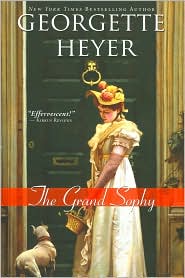
The Grand Sophy (1950)

The Grand Sophy. Georgette Heyer. 1950/2009. Sourcebooks. 372 pages. [Source: Review Copy]

The first time I read it, I found Sophy Stanton-Lucy to be a delightful, sometimes mischievous, matchmaker. I was not as delighted the second time around. I still think The Grand Sophy is a fun book, however. It's just that I've read better Heyer novels perhaps.

Sophy Stanton-Lucy is going to stay with her aunt, uncle, and cousins while her father travels. She is a young woman of marriageable age. She's just the right age to be a companion to her cousin, Cecelia Rivenhall. Almost everyone from the family loves and adores her. She has a way of livening things up, bringing joy with her wherever she goes. She's hardly predictable! There are a few people, however, who have reservations about her. One is her cousin, Charles Rivenhall. He isn't quite sure that Sophy is a good influence on her cousins. Why would any proper young lady bring a pet monkey with her? She's just so different from all the society ladies. Charles' fiancee Eugenia Wraxton is another who has doubts. The difference between the two is this: Charles is won over, quite won over by his cousin, and Eugenia, well, let's just say that the more the novel goes on, the more she comes to hate or disapprove of Sophy. Charles comes to see Eugenia in a new light. She can lecture on and on and be quite interfering. He also sees that his own family does not quite "like" to spend time in Eugenia's company. The contrast between Eugenia and Sophy is oh-so-evident.

Most of The Grand Sophy focuses on the adventures and misadventures of Sophy and her cousins. Cecelia's love life, for example, leads to many of these adventures. There are quite a few men interested in courting her. And Sophy is often around for these encounters. She is very observant, a bit wiser than Cecelia perhaps, and she has plans and designs on how to help her favorite (Lord Charlbury) win Cecelia's heart in the end.

It was a fun, light novel, a good historical romance. It might not be my absolute favorite Georgette Heyer novel, but, it was a good read all the same. Do you have a favorite Heyer novel?

© 2013 Becky Laney of Becky's Book Reviews
Tuesday, April 16, 2013

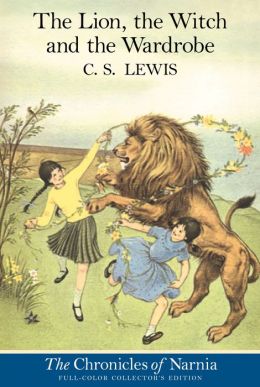
The Lion, The Witch, and The Wardrobe (1950)

The Lion, The Witch, and The Wardrobe. C.S. Lewis. 1950. HarperCollins. 224 pages.

Once there were four children whose names were Peter, Susan, Edmund, and Lucy. This story is about something that happened to them when they were sent away from London during the war because of the air-raids.

The Lion, The Witch, and the Wardrobe is one of my favorite, favorite children's books. Lucy Pevensie is one of my favorite, favorite heroines. And I love and adore this oh-so-delightful fantasy-adventure novel.

It is THE FIRST book in the Chronicles of Narnia series. It is the only book worthy of being considered as THE FIRST book in the series.

In The Lion, the Witch, and The Wardrobe, four children are sent into the country during World War II. Peter, Susan, Lucy, and Edmund are just beginning to settle into their new home when Lucy stumbles into the magical world of Narnia. At first, Lucy is the only one. But Edmund also comes into Narnia before the others. And while there he is fooled by the "Queen" of Narnia. But Narnia soon sees all four children.

Narnia is not a land at peace. Not at all. For the land is under a spell--an enchantment--the White Witch--the supposed Queen of the land--has made it always winter and never Christmas. And the lives of the children--all four children--are in grave danger when they're in Narnia. For there is a prophecy that four humans--two sons of Adam and two daughters of Eve--will come to rule the land as Kings and Queens and restore peace and order to the kingdom. The children's journey to Narnia, their quest to meet Aslan at the Stone Table, and their battle to save Narnia and their brother from the grasp of the evil and wicked witch....are unforgettable adventures that deserve to be experienced again and again by readers of all ages. You're never too old to experience the magic of Narnia.

While the movie depicts them as being doubtful and regretting setting foot in Narnia and shows them wanting to go home all the time and leave the fighting for others to do, the book tells a different story.
The children are mostly welcoming to the adventure before them. The book perhaps has less drama, the adventure seems to go smoother at times. The movie adds SO MUCH INTENSITY whenever possible. Dramatic scenes are added throughout, sometimes keeping in full spirit with the book, other times not so much. There are things that I absolutely LOVE AND ADORE about the film. (One of my favorite, favorite scenes, for example, is the meeting between Lucy and Mr. Tumnus. The film gets it so right!!!) I LOVE AND ADORE the entrance to Narnia and the first impressions of this strange-but-lovely world. And there are so many things about the movie that are just charming and just about perfect. (I think the soundtrack is just about perfect!!!) The movie doesn't just add drama, humor is added as well, especially with Mr. and Mrs. Beaver. The film deviates from the book in places so that it can be a good movie. Lewis did not waste time spend time writing battle scenes or strong confrontations. The focus is on the characters and the ultimate outcome, and not necessarily how every little thing worked towards that end.

I love The Lion, The Witch, and The Wardrobe for the characters, for the writing, and for the world-building. Narnia is not always a safe place to be, but I always found it beautiful and inviting, always memorable. I always found Aslan to be quite interesting as a character! I loved hearing the other characters talk about him and interact with him. I especially love seeing Lucy with Aslan! Their relationship is perhaps the strongest or deepest. Perhaps I feel that way because Lucy is the one who gets the most time with him throughout the whole series.

I had read the book dozens of times before seeing the movie, but I'm curious if the book would make the same impression, resonate the same way, if one watched the movie first?

Favorite quotes:
And now a very curious thing happened. None of the children knew who Aslan was any more than you do; but the moment the Beaver had spoken these words everyone felt quite different. Perhaps it has sometimes happened to you in a dream that someone says something which you don't understand but in the dream it feels as if it has some enormous meaning--either a terrifying one which turns the whole dream into a nightmare or else a lovely meaning too lovely to put into words, which makes the dream so beautiful that you remember it all your life and are always wishing you could get into that dream again. It was like that now. At the name of Aslan each one of the children felt something jump in its inside. Edmund felt a sensation of mysterious horror. Peter felt suddenly brave and adventurous. Susan felt as if some delicious smell or some delightful strain of music had just floated by her. And Lucy got the feeling you have when you wake up in the morning and realize that it is the beginning of the holidays or the beginning of summer.
“Safe?” said Mr. Beaver; “don’t you hear what Mrs. Beaver tells you? Who said anything about safe? ‘Course he isn’t safe. But he’s good. He’s the King, I tell you.”
“If there's anyone who can appear before Aslan without their knees knocking, they're either braver than most, or else just silly.”

© 2013 Becky Laney of Becky's Book Reviews
Tuesday, June 12, 2012

The Martian Chronicles (YA/Adult)

1997, edition of The Martian Chronicles
Martian Chronicles. Ray Bradbury. HarperCollins. 1997 edition. 288 pages.
One minute it was Ohio winter, with doors closed, windows locked, the panes blind with frost, icicles fringing every roof, children skiing on slopes, housewives lumbering like great black bears in their furs, along the icy streets.
And then a long wave of warmth crossed the small town. A flooding sea of hart air; it seemed as if someone had left a bakery door open. The heat pulsed among the cottages and bushes and children. The icicles dropped, shattering, to melt. The doors flew open. The windows flew up. The children worked off their wool clothes. The housewives shed their bear disguises. The snow dissolved and showed last summer's ancient green lawns.
Rocket summer. The words passed among the people in the open, airing houses. Rocket summer. The warm desert air changing the frost patterns on the windows, erasing the art work. The skis and sleds suddenly useless. The snow, falling from the cold sky upon the town, turned to a hot rain before it touched the ground. Rocket summer. People leaned from their dripping porches and watched the reddening sky. (1)
The 2012 Mass Paperback of The Martian Chronicles
I LOVE, LOVE, LOVE Ray Bradbury's The Martian Chronicles. This is the second or third time I've read this one. And each time I read it, I end up loving it even more. It's like each time I'm surprised by how much I love it. Like in between readings I forget how engaging and compelling it is. I settle into thinking that it was just me exaggerating things (again). That it couldn't possibly be that good. But no. It is that good.

The edition I read this time had twenty-seven stories; some of these 'stories' are just vignettes, or short preludes, transition pieces of a paragraph or two. But many are full-length stories. There are some great stories in this one.
  • January 2030 Rocket Summer
  • February 2030 Ylla
  • August 2030 The Summer Night
  • August 2030 The Earth Men
  • March 2031 The Taxpayer
  • April 2031 The Third Expedition
  • June 2032 --And the Moon Be Still as Bright
  • August 2032 The Settlers
  • December 2032 The Green Morning
  • February 2033 The Locusts
  • August 2033 Night Meeting
  • October 2033 The Shore
  • November 2033 The Fire Balloons
  • February 2034 Interim
  • April 2034 The Musicians
  • May 2034 The Wilderness
  • 2035-2036 The Naming of Names
  • April 2036 Usher II
  • August 2030 The Old Ones
  • September 2036 The Martian
  • November 2036 The Luggage Store
  • November 2036 The Off Season
  • November 2036 The Watchers
  • December 2036 The Silent Towns
  • April 2057 The Long Years
  • August 2057 There Will Come Soft Rains
  • October 2057 The Million Year Picnic
1950 edition of The Martian Chronicles
I wasn't aware that there were different editions of this one, and that the stories could vary depending on the edition. Also the dates have been modified (by thirty years) in some editions, like the edition I read this time around. The very, very newest edition has the original dates, 1999-2026. This newest edition does not have "The Fire Balloons." Also, instead of "The Wilderness" it has "Way in the Middle of the Air."

My thoughts on individual stories, and, first sentences from the stories

"Ylla"
They had a house of crystal pillars on the planet Mars by the edge of an empty sea, and every morning you could see Mrs. K eating the golden fruits that grew from the crystal walls, or cleaning the house with handfuls of magnetic dust which, taking all dirt with it, blew away on the hot wind.
A story told solely from the perspective of the Martians, in this case, a husband and wife. A husband has a very definite reaction to his wife's strange dreams. She dreams of a man, Nathaniel York, coming in a ship, in a rocket, and landing. The dream even tells her where and when. But her controlling and perhaps jealous husband has a way of dealing--for once and for all--with his wife's dreams.

"The Earth Men"
Whoever was knocking at the door didn't want to stop. Mrs. Ttt threw the door open. "Well?"
The story of the second expedition. Let's just say that the welcoming committee wasn't quite what they expected! First, NO ONE wanted to bother with them, then they were greeted by a strange assortment of Martians all claiming to be from Earth. And then....well, that wouldn't be polite of me to spoil it!


"The Third Expedition" (aka Mars is Heaven)
The ship came down from space. It came from the stars and the black velocities, and the shining movements, and the silent gulfs of space. It was a new ship; it had fire in its body and men in its metal cells, and it moved with a clean silence, fiery and warm. In it were seventeen men, including a captain. 
This one is a classic short story that you may have stumbled across in another context from The Martian Chronicles. (I've heard two radio adaptations, for example.) And the title is self-explanatory. It is the story of what happens when the third expedition lands. It is the story of what they see and  WHO they see. It is a story that stretches you, perhaps. But it's a good one!

"--And the Moon Be Still As Bright"
It was so cold when they first came from the rocket into the night that Spender began to gather the dry Martian wood and build a small fire. He didn't say anything about a celebration; he merely gathered the wood, set fire to it, and watched it burn.
And now we're on to the fourth expedition, the fourth rocket ship to successfully land on Mars. This time they manage to stay alive past the initial day or two or three. This is the story of what happens when one of the crew members, Spender, goes off on his own to learn the Martian culture, to explore the ruins, to explore the cities, to examine the artifacts and remnants of a culture that is gone with the wind. What happens next...well....there are a million reasons why readers shouldn't sympathize with Spender, but, like Captain Wilder, they may feel the pull all the same.

"The Settlers"
The men of Earth came to Mars. They came because they were afraid or unafraid, because they were happy or unhappy, because they felt like Pilgrims or did not feel like Pilgrims. There was a reason for each man. They were leaving bad wives or bad jobs or bad towns; they were coming to find something or leave something or get something, to dig up something or bury something or leave something alone. They were coming with small dreams or large dreams or none at all.
One of my favorite vignettes. For some reason it reminds me of John Steinbeck.

"Night Meeting"
Before going on up into the blue hills, Tomas Gomez stopped for gasoline at the lonely station.
There is something haunting and fantastical about this short story of a human and Martian meeting and not exactly seeing the same reality.

"The Fire Balloons"
Fire exploded over summer night lawns. 
 I first read "The Fire Balloons" in another collection of Ray Bradbury stories. I didn't, at the time, see it as being part of The Martian Chronicles. (And, in fact, it wasn't part of the edition I first read.) But now it is one of my favorite stories! In it two priests go to Mars as missionaries. One at least was expecting, was hoping, to meet Martians, to actually BE a missionary TO Martians, to an alien species. So when given the opportunity of going out into the hills and trying to communicate with blue balloon-like hovering creatures OR ministering to humans who have migrated to Mars, the answer is clear to Father Peregrine. But do the Martians need his church? This story has one of my favorite quotes:
"Father Peregrine, won't you ever be serious?"
"Not until the good Lord is. Oh, don't look so terribly shocked, please. The Lord is not serious. In fact, it is a little hard to know just what else He is except loving. And love has to do with humor, doesn't it? For you cannot love someone unless you put up with him, can you? And you cannot put up with someone constantly unless you can laugh at him. Isn't that true? And certainly we are ridiculous little animals wallowing in the fudge bowl, and God must love us all the more because we appeal to His humor."
 "The Wilderness"
Oh, the Good Time has come at last--
It was twilight and Janice and Leonora packed steadily in their summer house, singing songs, eating little, and holding to each other when necessary. But they never glanced at the window where the night gathered deep and the stars came out bright and cold.
This is another story that I ended up loving. And it was new-to-me too, it not being part of the original. But in this story we meet two women who are about to travel to Mars to get married and settle down. (The men having gone first.) The story likens exploring and settling Mars to exploring and settling the Old West (places like Wyoming, California, Oregon, etc.) It is about how the two handle their last night on Earth.
Is this how it was over a century ago, she wondered, when the women, the night before, lay ready for sleep, or not ready, in the small towns of the East, and heard the sound of horses in the night and the creak of the Conestoga wagons ready to go, and the brooding of oxen under the trees, and the cry of children already lonely before their time?...Is this then how it was so long ago? On the rim of the precipice, on the edge of the cliff of stars. In their time the smell of buffalo, and in our time the smell of the Rocket. Is then then how it was? And she decided, as sleep assumed the dreaming for her, that yes, yes indeed, very much so, irrevocably, this was as it had always been and would forever continue to be. 
"Usher II" (aka Carnival of Madness)
"During the whole of a dull, dark and soundless day in the autumn of the year, when the clouds hung oppressively low in the heavens, I had been passing alone on horseback, through a singularly dreary tract of country, and at length found myself, as the shades of evening drew on, within view of the melancholy House of Usher..." Mr. William Stendahl paused in his quotation. There, upon a low black hill, stood the house, its cornerstone bearing the inscription: 2036 A.D.
I remembered this as being one of the stories in A PLEASURE TO BURN, a Ray Bradbury collection celebrating the creative stories leading up to the writing/publishing of Fahrenheit 451. And it was first published as "Carnival of Madness." But it was also part of Ray Bradbury's book, The Martian Chronicles. And it is perhaps one of the most memorable of the collection. It is a true must read for anyone who loves Fahrenheit 451, for it continues on some of the same themes. I don't want to say too much about it really, because it shouldn't be spoiled at all if you want to get the full enjoyment of it!

"The Martian"
The blue mountains lifted into the rain and the rain fell down into the long canals and old LaFarge and his wife came out of their house to watch. 
An elderly couple have come to Mars and one night they are surprised by the appearance of their "son" (who died and was buried back on Earth). Their "son" doesn't want to leave the house, and is enjoying his family too much to risk getting "trapped" by going into the city and interacting with others. This story is creepy.

"The Luggage Store," "The Off Season," "The Watchers," "The Silent Towns," "The Long Years," "There Will Come Soft Rains," and "The Million Year Picnic."

These stories, I feel, work best as a sequence showing what happens both on Earth and Mars when the worst happens--atomic war on Earth. In "The Luggage Store," one speculates that his business will improve greatly if the war happens, if the worst happens. He feels that everyone will want to go back home to Earth to be with their loved ones, to find out if their loved ones are okay, to try to piece their society and civilization back together. In "The Off Season" readers learn that the war has started and the destruction has begun. There is nothing truly comical about it, but, it does happen to be told from the point of view of a man who has just opened a hot dog stand. "The Watchers" shows the people leaving Mars to return to Earth--for better or worse. "The Silent Towns" and "The Long Years" are two stories set on Mars. The first, "The Silent Towns" is told from the point of view of a man who chose to stay behind. He's lonely, but not THAT lonely it turns out. He does meet one woman who stayed behind, but, he decides that his own company is enough after all. "The Long Years" sees the return of Captain Wilder, I believe, who discovers a man and his family. There is a twist, however, which prevents this one from being a happy story. "There Will Come Soft Rains" is a very, very, very lonely story where we get a glimpse--just a small glimpse perhaps--of the desolation and destruction of life as we know it in at least one human city. We see the ending of an era, perhaps. There are no human characters in this one. "The Million Year Picnic" resonates even more when seen back-to-back with "There Will Come Soft Rains." In this story, readers meet a family: parents and sons who have come to Mars on their own private Rocket--a rocket that has been hidden away for many years, a rocket that has been saved for a true emergency. We meet a father who has prepared for THE END in a big, big way.

Read The Martian Chronicles
  • If you love science fiction
  • If you like science fiction
  • If you enjoy short stories; if you don't enjoy short stories
  • If you are a fan of Ray Bradbury
  • If you are a fan of the Twilight Zone

© 2012 Becky Laney of Becky's Book Reviews