Showing posts with label 1966. Show all posts

Wednesday, September 20, 2023

160. A Papa Like Everyone Else


A Papa Like Everyone Else. Sydney Taylor. 1966. 176 pages. [Source: Library] [mg historical fiction; j historical fiction; children's classic]

First sentence: Gisella sat very still, her pale green eyes round with wonder. Again the miracle was happening! She had seen it many times before, but always her pulse quickened with the mystery of it. 

Premise/plot: A Papa Like Everyone Else is set in Czechoslovakia circa 1918/1919. Szerena and Gisella long for a 'papa like everyone else' since their papa is far away in America. He went a year before the war started to find a job, to get established, to earn enough to bring his family over. The world war changed plans significantly. But now the war is over and the family hopes to be reunited soon. Meanwhile, life on the farm in the farm village continues on. This is a 'slice of life' glimpse at a rural Jewish family from the time period. There isn't "action" or major plot points so much as it is just capturing the 'old world' life as experienced by one Jewish family. (There is at least one chapter with some excitement. But mostly just flavor of life, normal, ordinary, routine.) 

My thoughts: I didn't enjoy this one as much as All of A Kind Family. But I liked it well enough. I am very glad I was able to read it. I've always wanted to read more Sydney Taylor. 

© 2023 Becky Laney of Becky's Book Reviews

Tuesday, February 22, 2022

28. Total Recall


Total Recall. Philip K. Dick. 1966. 31 pages. [Source: Library]

First sentence: He awoke--and wanted Mars. The valleys, he thought. What would it be like to trudge among them?

Premise/plot: Originally published as a short story called, "We Can Remember It For You Wholesale," it was adapted into the film Total Recall. Douglas Quail, our hero, is always dreaming--day and night--of going to Mars. But since going to Mars is NOT in his budget realistically, he is hoping that visiting Rekal, Incorporated, for (false) implanted memories (complete with souvenirs) will be almost as good. Maybe his wife still wouldn't approve, but, even if it just shuts him up a bit, maybe she won't stay annoyed with him. (He does go on and on and on about wanting to go to Mars.) But...turns out that implanting memories isn't as straight forward as he thought it would be...suddenly his life is turned upside down and inside out.

My thoughts: I enjoyed this one so much!!! I had low expectations. I'm not all that familiar with Philip K. Dick's work. This story made me want to read more of his books to see what else I've been missing out on.

I have not watched the film adaptation yet, but I hope to get to it soon.


© 2022 Becky Laney of Becky's Book Reviews

Sunday, August 28, 2016

The Crate Train

The Crate Train. Dorothy Z. Seymour. 1966. 25 pages. [Source: Bought]

First sentence: Dot and Pat played train. They played in the basement. They had some old crates. They made the train out of crates.

Premise/plot: Dot, Pat, and Baby Sam play together in the basement. Are they playing well together? Well, that's debatable. Perhaps because they are in the basement instead of upstairs, they have the freedom to argue more with each other? Each kid wants to boss the others around and dictate HOW they play train. Except for Baby Sam, I think I would get tired of Pat and Dot pretty quickly in real life.

My thoughts: This is a very, very simple book. I think the activity itself would be great fun--playing train using empty crates. Do I think reading about it is as fun as doing it? Not really.

The Crate Train is one of the books in the Early-Start Preschool Reader series. I much prefer Ann Likes Red and Ballerina Bess.

Text: 3 out of 5
Illustrations: 3 out of 5
Total: 6 out of 10
© 2016 Becky Laney of Becky's Book Reviews

Thursday, June 09, 2016

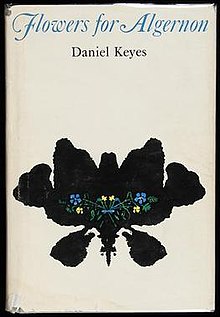
Flowers for Algernon

Flowers for Algernon. Daniel Keyes. 1966. 311 pages. [Source: Library]

First, I have to say that I am definitely glad I made time to finally read this one! It has been on my to-be-read list for way too many years. And I don't regret the time I spent with Charlie Gordon.

The book is the journal of the main character, Charlie Gordon. The journal consists of his 'progress reports.' The novel opens with him about to become the subject of a scientific experiment. If it works, his IQ will improve dramatically, radically. His IQ is high enough now for him to function living on his own. (He does janitor work.) But his IQ isn't high enough for him to really learn how to read, write, remember. What he does have in abundance: a big, big, big heart, and an ambitious spirit dedicated to learning and becoming. He doesn't know what he's missing, but, he knows he's missing something. He has no real actual memories of who he was, of his family life, of his childhood. His low IQ isn't just "robbing" him of a bright future, but, of his past as well.

Even though I don't usually love first person narratives, in this case, it works really well. Charlies growth is documented in his progress reports. And readers should make the effort to read between the lines some. It isn't that Charlie is an unreliable narrator, just, that he isn't always completely self-aware. (Who is?!?!) Readers are given enough clues to decide for themselves what Charlie Gordon is like.

Will the experiment work? What are the side effects? Is Charlie being used or taken advantage of by the scientists? Did he make the right choice?

I can't decide what is the most heartbreaking about this bittersweet coming-of-age story. I think though that I'll go with the way Charlie was treated by his mother. Those scenes when Charlie remembers his childhood, his mother, his father, his sister, that is what is heartbreaking. The way his mother mistreated him, and Charlie's straight-forward, matter-of-fact remembering. The way it's done is not manipulative at all, in my opinion. But it's very emotional.

The scenes that may just stay with me though are the ones about Charlie standing up to the scientists saying YOU DIDN'T MAKE ME. I WAS A PERSON BEFORE. YOU SHOULD HAVE ALWAYS TREATED ME AS A PERSON, A PERSON WITH FEELINGS AND RIGHTS. YOU DIDN'T GIVE ME VALUE BY MAKING ME SMART, I ALWAYS WAS VALUABLE. YOU TREAT ME LIKE AN OBJECT. I'M NOT AN OBJECT OF YOUR MAKING.

So yes this one is worth reading!


© 2016 Becky Laney of Becky's Book Reviews

Friday, May 15, 2015

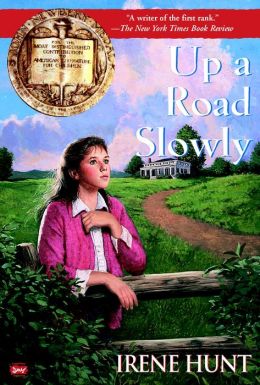
Up A Road Slowly (1966)

Up A Road Slowly. Irene Hunt. 1966. 208 pages. [Source: Bought]

I loved, loved, loved Irene Hunt's Up A Road Slowly. Is it one of the best coming-of-age stories that I've read? Perhaps. At least one of the best I've read lately. I think out of all the Newbery books I've read this year (newly read as opposed to reread) this one would probably be my favorite and best. It reminded me--in a good way--of Good Morning, Miss Dove and Emily of New Moon.

Julie is the heroine of Up A Road Slowly. When we first meet Julie, she's a child: around seven years old. Her mom has just died, and her father is sending off his two youngest children to Aunt Cordelia. (The oldest, Laura, is in her final year of high school, I believe. Christopher is the brother.) How will Julie adapt to her move to the country? to her new house? to living with her aunt whom she barely knows? It isn't easy certainly. But truth be told, Julie would probably struggle some with her emotions no matter what.

So essentially, readers watch Julie grow from seven to seventeen (or eighteen) throughout the novel. Readers get to know Julie, Aunt Cordelia, and Uncle Haskell very, very well. One of my favorite things about the novel was it's characterization. Hunt did a great job at making her characters achingly human. Readers also get to know her classmates and friends. 

Did I have a favorite character? Of course. I loved Julie, I did. And I am really, really happy with whom she ended up with. It made me giddy in fact. But I think my favorite character may just be Aunt Cordelia herself.

Have you read Up A Road Slowly? Did you like it? love it? hate it? I'd love to hear what you thought of it!

© 2015 Becky Laney of Becky's Book Reviews

Thursday, November 28, 2013

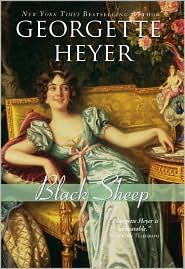
Black Sheep (1966)

Black Sheep. Georgette Heyer. 1966/2008. Sourcebooks. 280 pages. [Source: Library]

I love this one. It was great to get a chance to reread it.

Abigail (Abby) Wendover and Selena Wendover are the two aunts responsible for raising their young niece, Fanny, a young lady who is just getting ready to come out in society. When the novel opens, Abby has just returned to Bath from visiting some of her brothers and sisters. So she has missed the early stages of Fanny's young love. Fanny has fallen in forever-and-ever love with Stacy Calverleigh, a man with a bit of a reputation.

While no one can deny that he comes from a good family, it's also undeniable that since Stacy has come of age, the family's financial standing has continued to fall. He desperately needs to marry money if he's going to "save" the family home and keep up appearances--living a certain lifestyle.

Fanny may be young, but she'll inherit a great deal of money when she comes of age. Enough to tempt young Calverleigh. That's how Abby and her brother, James, see it anyway. Selena, well, she's easily charmed. And Stacy has a way of making her think the best of him. Abby fears that Stacy may convince Fanny to elope with him.

Soon after Abby returns home, Miles Calverleigh arrives. He's the "black sheep" of the Calverleigh family. (He's been in India for years.) He has come to Bath quite unaware that his nephew, Stacy, has been there.

Can Abby convince Miles to intervene? Will Miles see his young nephew's affair as being any of his concern? After all, he has never met the boy.

What starts out as "concern" for Fanny and Stacy, develops into something more--much much more. Has Abby found love at last? Will her sister, Selena, let Abby go? And should she care what Selena and her brother, James, think of her relationship with Miles?

I love, love, love this one! I love the romance between Miles and Abby. And I love the romance between Fanny and Oliver. I think I was able to appreciate Oliver much more the second time around! I love how Miles chooses to intervene!!! And I love, love, love the ending! So satisfying! 

© 2013 Becky Laney of Becky's Book Reviews

Tuesday, January 22, 2013

The Case of the Worried Waitress (1966)

The Case of the Worried Waitress: A Perry Mason mystery. Erle Stanley Gardner. 1966. 151 pages.


Perry Mason and Della Street were having lunch at Madison's Midtown Milestone. 


I believe this is only the second Perry Mason mystery I've read. I did enjoy this one more. I really loved it. In this mystery, Perry Mason takes pity on his 'worried waitress' and leaves her a good enough tip so that she can come consult with him at his office. (He also leaves his card.) Kit Ellis, the waitress, has newly moved across the country to live with her aunt, her only remaining relative. So why is she so worried? Well, it seems that her aunt is poor--she is always bargain shopping for their groceries, and even what she does bring home leaves Kit a bit hungry. But when Kit learns that almost all of her aunt's errands--including the grocery shopping going from store to store to store to store--are done in a taxi, well, she's puzzled. How can her aunt afford to take a taxi cab and keep it waiting while she shops? And then there's what Kit found in her aunt's closet...

Mason's advice to the young woman is to GET OUT OF THAT HOUSE. That very day she should GET OUT. But that may be more difficult than even Mason can imagine...

I just loved this one!!! Recommended for all fans of Perry Mason!

Read The Case of the Worried Waitress
  • If you enjoy mysteries, vintage mysteries
  • If you enjoy mystery series
  • If you like or love Perry Mason
© 2013 Becky Laney of Becky's Book Reviews

Wednesday, June 08, 2011

The Cat Who Could Read Backwards

The Cat Who Could Read Backwards. Lilian Jackson Braun. 1966. Compass Press. 227 pages.

Jim Qwilleran, whose name had confounded typesetters and proofreaders for two decades, arrived fifteen minutes early for his appointment with the managing editor of the Daily Fluxion. 

Jim Qwilleran is a new reporter in town. His days of working at a big paper in a big city are behind him--at least for now. And his new assignment, well, it wouldn't be his first choice, or second, or third. For his new job will have him covering artists. And Jim, well, he knows very little about art--especially "modern" art. Since there is already an art critic on staff, one who writes "reviews," he's a little confused about what this new job would require of him. Turns out, he's supposed to focus on the human-interest side of the art scene. So even though he'd rather be writing bigger stories, better stories, money is money is money.

Qwilleran only thought the local art scene would be boring. For within weeks of his taking the job, the owner of a local art gallery is murdered! And this murder is soon followed by an "accidental" death of another local artist. And then by the art critic himself! Can Jim Qwilleran, with a little help from a Siamese cat, solve these crimes?!

I loved this one. I did. I just loved it. I enjoyed Jim Qwilleran right from the start. And as soon as Qwilleran began taking care of his landlord's cat--his landlord having gone out of town for the week--well, I knew it was love. I loved Koko. I did. I thought the mystery was well written and playful and fun. Just something cozy and satisfying about it cover to cover.

Cats have many gifts that are denied humans, and yet we tend to rate them by human standards. To understand a cat, you must realize that he has his own gifts, his own viewpoint, even his own morality. A cat's lack of speech does not make him a lower animal. Cats have a contempt of speech. Why should they talk when they can communicate without words? They manage very well among themselves, and they patiently try to make their thoughts known to humans. But in order to read a cat, you must be relaxed and receptive. (69)

© 2011 Becky Laney of Becky's Book Reviews

Friday, April 01, 2011

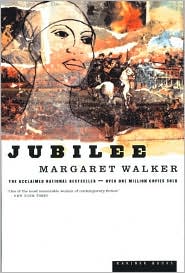
Jubilee

Jubilee. Margaret Walker. 1966. 512 pages.

"May Liza, how come you so restless and uneasy? You must be restless in your mind."
"I is. I is. That old screech owl is making me nervous."
"Wellum, 'tain't no use in your gitting so upsot bout that bird hollering. It ain't the sign of no woman nohow. It always means a man."
"It's the sign of death."

Jubilee chronicles Vry's life. As a child. As a woman. As a daughter. As a mother. As a wife. As a slave. As a freedwoman. Before, during, and after the Civil War. During Reconstruction. It is a story of survival, of endurance, of incredible strength, of incredible integrity, of hope and despair, of fear and courage.

It's not an easy read. Because Vry's life was not an easy life. There's a necessary harshness, cruelty, and pain to it. For Vry was a slave. She may have been biracial. She may have looked white even. But she was a slave and her mistress NEVER let her forget it for a moment. The picture readers get of slavery is not pretty, not romanticized. The language is strong.

I thought Jubilee was wonderfully written. It's a powerful read, a compelling one. Very emotional. Very memorable. I would definitely recommend this one!

Vry's advice to a new slave:

Don't never grin in that white woman's face. She don't know what you mean. I was borned here, and I been here all my life, and you don't see me grinning bout nothing, now does you? Well, they ain't nothing here to grin about, that's how come I ain't grinning. (131)

Vry's prayer:

Lawd, God-a-mighty, I come down here this morning to tell you I done reached the end of my rope, and I wants you to take a-hold. I done come to the bottom of the well, Lord, and my well full of water done run clean dry.
I come down here, Lord, cause I ain't got no where else to go. I come down here knowing I ain't got no right, but I got a heavy need. I'm suffering so, Lord, my body is heavy like I'm carrying a stone. I come to ask you to move the stone, Jesus. Please move the stone! I come down here, Lord, to ask you to come by here, Lord. Please come by here!
We can't go on like this no longer, Lord. We can't keep on a-fighting, and a-fussing, and a-cussing, and a-hating like this, Lord. You done been too good to us. We done wrong, Lord, I knows we done wrong. I ain't gwine say we ain't done wrong, and I ain't gwine promise we might not do wrong again cause, Lord, we ain't nothing but sinful human flesh, we ain't nothing but dust. We is evil peoples in a wicked world, but I'm asking you to let your forgiving love cover our sin, Lord.
Let your peace come in our hearts again, Lord, and we's gwine try to stay on our knees and follow the road You is laid before us, if You only will.
Come by here, Lord, come by here, if you please. And Lord, I wants to thank You, Jesus, for moving the stone! (454-55)

Vry's advice to her son:

Keeping hatred inside makes you git mean and evil inside. We supposen to love everybody like God loves us. And when you forgives you feels sorry for the one what hurt you, you returns love for hate, and good for evil. And that stretches your heart and makes you bigger inside with a bigger heart so's you can love everybody when your heart is big enough. Your chest gets broad like this, and you can lick the world with a loving heart! Now when you hates you shrinks up inside and gets littler and you squeezes your heart tight and you stays so mad with peoples you feel sick all the time like you needs the doctor. Folks with a loving heart don't never need no doctor. (457)

© 2011 Becky Laney of Becky's Book Reviews

Wednesday, June 23, 2010

Black Sheep


Black Sheep. Georgette Heyer. 1966/2008. Sourcebooks. 280 pages.

A little before eight o'clock, at the close of a damp autumn day, a post-chaise entered Bath, on the London Road, and presently drew up outside a house in Sydney Place.

Abigail (Abby) Wendover and Selena Wendover are the two aunts responsible for raising their young niece, Fanny, a young lady who is just getting ready to come out in society. When the novel opens, Abby has just returned to Bath from visiting some of her brothers and sisters. So she has missed the early stages of Fanny's young love. Fanny has fallen in forever-and-ever love with Stacy Calverleigh, a man with a bit of a reputation.

While no one can deny that he comes from a good family, it's also undeniable that since Stacy has come of age, the family's financial standing has continued to fall. He desperately needs to marry money if he's going to "save" the family home and keep up appearances--living a certain lifestyle.

Fanny may be young, but she'll inherit a great deal of money when she comes of age. Enough to tempt young Calverleigh. That's how Abby and her brother, James, see it anyway. Selena, well, she's easily charmed. And Stacy has a way of making her think the best of him. Abby fears that Stacy may convince Fanny to elope with him.

Soon after Abby returns home, Miles Calverleigh arrives. He's the "black sheep" of the Calverleigh family. (He's been in India for years.) He has come to Bath quite unaware that his nephew, Stacy, has been there.

Can Abby convince Miles to intervene? Will Miles see his young nephew's affair as being any of his concern? After all, he has never met the boy.

What starts out as "concern" for Fanny and Stacy, develops into something more--much much more. Has Abby found love at last? Will her sister, Selena, let Abby go?

I loved this one. I did. I loved Abby. I loved Miles. I loved the way these two clicked right from the start. I loved the banter the two share. I loved the way that neither really denies the attraction. How Abby doesn't necessarily fight the attraction she feels for Miles. She likes spending time with him. She likes his company. And she isn't one of those to say, well, what will the neighbors think. (Now, Abby, does care a little about what her family thinks.) Miles is unlike so many of the other men that Abby has known. But she likes him just the way he is. I loved how these two accept one another as is. These two are oh-so-compatible.

I would definitely recommend Black Sheep.

© Becky Laney of Becky's Book Reviews

Wednesday, June 03, 2009

The Moon Is A Harsh Mistress


Heinlein, Robert A. 1966. The Moon Is A Harsh Mistress.

I see in Lunaya Pravda that Luna City Council has passed on first reading a bill to examine, license, inspect--and tax--public food vendors operating inside municipal pressure. I see also is to be mass meeting tonight to organize "Sons of Revolution" talk-talk.

Manuel Garcia O'Kelly-Davis (called "Man" or "Mannie" by his friends) is the narrator of this Hugo-Award-Winning science fiction novel. In the first chapter, we meet Mannie and Mike. Who is Mike? Well, technically, he's a computer. The main computer on Luna, or the moon, to be exact. Manuel is the first (but not the last) to discover that this computer is alive. (I had to keep reminding myself that this was probably a new or newish idea at the time it was published. That figures like Data (from Star Trek) and Jane (from Speaker of the Dead) didn't exist. That these characters that I'm familiar with most likely draw their roots from Heinlein's Mike.) That he has a mind, a will, a personality of his own. When we first meet this pair, Mike is wanting to learn about humor, about what makes something funny, what makes for a good joke, and what doesn't. (See, why it reminded me of Data!) And Mannie is trying to help him out. Mike asks a favor of Mannie--well, several favors really. One, he asks Mike to attend a meeting, to record it for him so he can have it in his files. It is a meeting that the computer has been shut out of. It is this "talk-talk" of the Sons of the Revolution. Two, he asks Mike to help him be funny. He prints out a list of jokes, and he wants Mannie to mark which ones are funny and why.

Mannie does attend the meeting. While there, he meets two people who will ultimately change his life: Wyoming Knott (called Wyoh) and Professor Bernardo de la Paz (called Prof). Both have radically different ideas about the future of Luna, but both agree that the Luna Authority (led by The Warden) should be challenged. When the meeting is interrupted--turns quite ugly--the people fight their way out. (Never underestimate a Loonie!) Wyoh and Mannie flee together and hide in an out-of-the-way hotel room. While there, he decides that she is trustworthy and might just make a good friend for Mike. They meet. And Mike becomes Michelle. (He adopts a different personality 'to be' when talking with her.) Then the three of them decide to bring in The Prof into the circle, or mix, and a Revolution is born. Can two men, one woman, and a super-smart-but-not-so-funny computer take over the moon? Read for yourself and see in The Moon Is A Harsh Mistress.

My thoughts on the novel:

The style of this one is a bit sparse or jagged. Which isn't a bad thing. I got used to the abbreviated grammar--the elimination of some personal pronouns and articles and such. But it might come across as awkward until you get used to it.

The novel presents an interesting and strange arrangement of marriage. Marriage on the moon is rarely between one man and one woman. The scarcity of women, led to a woman being allowed (and encouraged) to bring in more men into the marriage. The novel talks (but not too in-depthly) about various kinds of marriages--specifically line marriages and clan marriages. I would have liked to known more, actually, about how these two differed. Mannie, for example, is part of a line marriage. There are several men, several women, all different ages.) The book does say that these marriages are happy ones and that they almost always work out.

The politics. The economics. The ecology. Not always interesting if I'm honest. It was interesting, in a way, to see war as being the answer. Prof believes--and Mike confirms--that the resources of the moon will be depleted in a little under eight years if grain shipments continue to Earth. Earth isn't really compensating Luna very much, for one thing, but another is that the grain is taking precious water out of the eco-system. And it's not being replenished. With each shipment worsening the long-term viability of the planet (at least for human use), something has to be done and fast.

Overall, I thought this one had a great beginning. The first third of the novel (maybe the first half) had me thoroughly hooked. I was loving Mike and Mannie. I was into the drama. Either I began to lose focus all on my own, or the novel got a bit bogged down in the political issues there in the middle. It became "this happened. Then this happened. And then this happened. And then this other thing happened." So it became more distant, at least to me. But at the same time, it didn't bog down enough for me to give up on it either.

So would I recommend it? Yes and no. If you love science fiction, then you'd probably enjoy this one. At least you might consider giving it a try. If it doesn't work out, no harm done. (That's what libraries are there for after all.) If you're not a fan of science fiction and are curious as to what it's all about, I'd probably start with another title if I'm being honest. (Maybe Foundation by Isaac Asimov instead?) The more you love thinking about politics and society and the behind-the-scenes making and breaking of a government, the more you'll enjoy this one. (Orson Scott Card goes there in some of his books, but to me, the more a book becomes about war and politics and power struggles, the boggier it becomes and less of an adventure. Not that all books have to have adventure, mind you.

Have you read this one? What did you think about it? Which other Heinlein novels might I enjoy? If you haven't read this one, what do you think about the merging of politics into sci-fi adventure stories in general?

© Becky Laney of Becky's Book Reviews