Showing posts with label Civil War. Show all posts

Wednesday, June 06, 2018

Varina

Varina. Charles Frazier. 2018. Ecco. 368 pages. [Source: Library]

First sentence: Things fell apart slowly before they fell apart fast.

Premise/plot: James Blake has come to Saratoga Springs in search of answers. He's seeking an audience with Varina Davis, the widow of Jefferson Davis. The year is 1906. Why does he think she'll be able to help? His memories of his childhood are few and far between--a blurry mess. He's recently read in a book that Mrs. Davis took him in--perhaps off the street, perhaps from a mulatto she knew--as a young child. He wants to know who he is--first of all--and why she did it second. Why would the First Lady of the South--this was during the Civil War after all--take in a colored child and raise him with her own children in the nursery, treat him as one of her own? Did she do it out of love? out of pity? as a novelty? Did she see him as human or a pet project?

These two questions: "Who am I?" and "Who is she?" fuel the novel forward. In the book, he's James or Jimmie and she is simply V. The novel is arranged into six or perhaps seven meetings. The story is told in part through dialogue--their conversations together, what their meeting all these decades later brings back to her mind. But the story is also told in part through flashbacks. Readers get very brief sketches of her life throughout her life. It isn't just a story of the war years. And it is definitely not a straightforward account of her experiences during the war and after the war. She clings to no cause and has no agenda in romanticizing the past.

As she seeks to answer his questions perhaps she answers a few of her own as well.

My thoughts: This is a fiction novel. I wish he'd included a note saying if anything in the novel is remotely true or if it's all from his own imagination. What was the real Varina Davis like? Who were her friends? who were her enemies? Did she really battle her in-laws fiercely? Did she really try to make her way to Florida so she could escape to Cuba? What kind of person was she? What kind of legacy did she leave behind? The portrait he sketches is oh-so-human.

Don't expect a traditional historical novel with a straight-forward plot.

© 2018 Becky Laney of Becky's Book Reviews

Friday, April 01, 2011

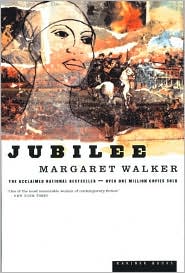
Jubilee

Jubilee. Margaret Walker. 1966. 512 pages.

"May Liza, how come you so restless and uneasy? You must be restless in your mind."
"I is. I is. That old screech owl is making me nervous."
"Wellum, 'tain't no use in your gitting so upsot bout that bird hollering. It ain't the sign of no woman nohow. It always means a man."
"It's the sign of death."

Jubilee chronicles Vry's life. As a child. As a woman. As a daughter. As a mother. As a wife. As a slave. As a freedwoman. Before, during, and after the Civil War. During Reconstruction. It is a story of survival, of endurance, of incredible strength, of incredible integrity, of hope and despair, of fear and courage.

It's not an easy read. Because Vry's life was not an easy life. There's a necessary harshness, cruelty, and pain to it. For Vry was a slave. She may have been biracial. She may have looked white even. But she was a slave and her mistress NEVER let her forget it for a moment. The picture readers get of slavery is not pretty, not romanticized. The language is strong.

I thought Jubilee was wonderfully written. It's a powerful read, a compelling one. Very emotional. Very memorable. I would definitely recommend this one!

Vry's advice to a new slave:

Don't never grin in that white woman's face. She don't know what you mean. I was borned here, and I been here all my life, and you don't see me grinning bout nothing, now does you? Well, they ain't nothing here to grin about, that's how come I ain't grinning. (131)

Vry's prayer:

Lawd, God-a-mighty, I come down here this morning to tell you I done reached the end of my rope, and I wants you to take a-hold. I done come to the bottom of the well, Lord, and my well full of water done run clean dry.
I come down here, Lord, cause I ain't got no where else to go. I come down here knowing I ain't got no right, but I got a heavy need. I'm suffering so, Lord, my body is heavy like I'm carrying a stone. I come to ask you to move the stone, Jesus. Please move the stone! I come down here, Lord, to ask you to come by here, Lord. Please come by here!
We can't go on like this no longer, Lord. We can't keep on a-fighting, and a-fussing, and a-cussing, and a-hating like this, Lord. You done been too good to us. We done wrong, Lord, I knows we done wrong. I ain't gwine say we ain't done wrong, and I ain't gwine promise we might not do wrong again cause, Lord, we ain't nothing but sinful human flesh, we ain't nothing but dust. We is evil peoples in a wicked world, but I'm asking you to let your forgiving love cover our sin, Lord.
Let your peace come in our hearts again, Lord, and we's gwine try to stay on our knees and follow the road You is laid before us, if You only will.
Come by here, Lord, come by here, if you please. And Lord, I wants to thank You, Jesus, for moving the stone! (454-55)

Vry's advice to her son:

Keeping hatred inside makes you git mean and evil inside. We supposen to love everybody like God loves us. And when you forgives you feels sorry for the one what hurt you, you returns love for hate, and good for evil. And that stretches your heart and makes you bigger inside with a bigger heart so's you can love everybody when your heart is big enough. Your chest gets broad like this, and you can lick the world with a loving heart! Now when you hates you shrinks up inside and gets littler and you squeezes your heart tight and you stays so mad with peoples you feel sick all the time like you needs the doctor. Folks with a loving heart don't never need no doctor. (457)

© 2011 Becky Laney of Becky's Book Reviews
Tuesday, March 08, 2011

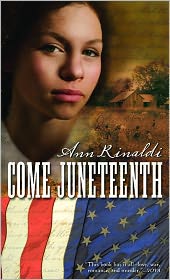
Come Juneteenth (YA)

Come Juneteenth. Ann Rinaldi. 2007. Houghton Mifflin Harcourt. 256 pages.

From the prologue: Last night when the fire burned low, when the last of the sweet potatoes under the logs was just a crisp fragrance left of our supper, long after my brother Gabriel had taken his last swig from the flask in his haversack and wiped his mouth with the back of his hand and turned over in his bedroll on the other side of the fire and grunted his good night, last night I lay awake long and unblinking in the spark-filled distance above me. 

From chapter one: I was in the pumpkin patch, counting the ones that were good enough for Old Pepper Apron, our cook, to make into bread.

Secrets. Lies. Lives torn apart. Not by the Freedom War, the War Between the States, the Civil War. But by lies told during those years by masters to their slaves. Come Juneteenth is set in Texas in 1865. Texas slaveholders--like our heroine's father--were able to keep Lincoln's Emancipation Proclamation secret. For two years. Out of necessity? Out of greed? Out of fear? Out of hate or anger? Perhaps we'll never know all the reasons. Luli, our heroine, has struggled with this secret. So has her brother, Gabriel, for both care--in VERY different ways--for Sis Goose, a slave woman who is legally a slave--owned by the family's aunt, but someone who has been raised--since she was a baby--as a member of the family. Luli considers her a sister--an older sister. The two have been very close at times. Though growing up has changed some things. And Gabriel? Well, he's very much in love with Sis Goose. He plans on marrying her and living happily ever after. After, you know, he gets back from fighting the Indians. So when the truth does come out, when the slaves are freed, when the Yankees arrive, well, Sis Goose feels hurt and betrayed and very angry by the family she's loved. 

Come Juneteenth is dramatic and intense. The story is told in flashes by Luli. The transitions between past and present can be tricky, but, for the most part, I liked it.

© 2011 Becky Laney of Becky's Book Reviews
Saturday, January 08, 2011

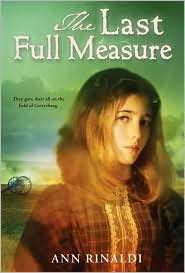
The Last Full Measure (MG/YA)

The Last Full Measure. Ann Rinaldi. 2010. [November 2010]. Harcourt. 218 pages.

"Where are you going, Tacy?"

Set in Gettysburg, Pennsylvania in 1863, The Last Full Measure is Ann Rinaldi's latest historical novel. It stars the Stryker family. Our heroine, Tacy, is fourteen. She has two older brothers and a father in the war. But during these troubling summer months, she's going to mature quickly. She'll have to having witnessed some of the atrocities of war. When the novel opens, Tacy's biggest problem is her brother, David, the brother who was unable to join the army because of his bad leg. He has been put in charge of the family; it is his duty to "protect" his mother and his sister, and to look after their home. The responsibility weighs heavily on him, transforming him into a man Tacy can barely recognize. Who is this bossy brother ordering her about? Who is this man that shouts and yells and threatens? Though, perhaps, Tacy needs someone to tell her no--for her own sake.

As the novel progresses, readers get a glimpse of the war, the battle as it unfolds. Readers see the harshness, the devastation, the madness of war. One might think that the battle itself would provide the climax of this one. That its darkest moments would be in the battle itself. But. That's just the beginning. And Tacy's darkest days come after the battle.

I found The Last Full Measure a compelling read. I read it in one sitting, in one afternoon. I enjoyed Tacy as a character. I liked her perspective. How she wasn't above questioning the world around her. And perhaps most importantly, how she wasn't perfect.

But it was a difficult read for me. I reached a point where I was like NO! Are you serious?! Why?! And after that point, it was hard for me to "like" this one. I'm not saying it's not a good book. I'm not saying that it isn't realistic. Or that it isn't well-researched. That it isn't true to the times. But still, it didn't go the way I wanted it to go.

© 2011 Becky Laney of Becky's Book Reviews

Wednesday, December 30, 2009

The Mostly True Adventures of Homer P. Figg (MG)


Philbrick, Rodman. 2009. The Mostly True Adventures of Homer P. Figg. Scholastic. 224 pages.

My name is Homer P. Figg, and these are my true adventures. I mean to write them down, every one, including all the heroes and cowards, and the saints and the scalawags, and them stained with the blood of innocents, and them touched by glory, and them that was lifted into Heaven, and them that went to the Other Place.

I didn't know what to expect from this one. The cover, well, the cover didn't do much for me. But I enjoyed this one. A lot more than I thought I would. Especially considering the fact that this one is set during the Civil War. The jacket flap describes this one as a "story filled with adventure, humor, and danger" and they do actually get that right. (Sometimes they really don't.)

At the heart of this one is a young boy, Homer, on a quest. His older brother was "volunteered" for the Union army. Sold into by his mean guardian, their mean guardian. Upset--and understandably so--Homer sets off to find his brother. He runs away. But he doesn't get far when danger finds him. Still no matter what happens--no matter who he meets and where he ends up--he is always trying to find his brother. All that other stuff, well, it just happens. What he does to find his brother, to save his brother, well, it's not a stretch to call it a bit heroic.

There were many things I enjoyed about this one. One of the top things is the writing. I love some of the descriptions, the narrative. I found it very appealing, very reader-friendly. (I know sometimes historical fiction can be hard to sell to readers of all ages. But the truth is it doesn't have to be boring.)

Far as I'm concerned, taking a bath is sort of like drowning, with soap. Never could abide it, not since I was a little baby. (119)


© Becky Laney of Becky's Book Reviews

Wednesday, November 25, 2009

Black Angels (MG, YA)


Brown, Linda Beatrice. 2009. Black Angels. Penguin. 260 pages.

Luke took the key out of the sideboard drawer in the dining room, took a rifle and put the key back very carefully.

Luke is a slave contemplating running away. He hopes to join up with the Union army. He isn't quite sure where or how. But he's ready to go off on an adventure. When he sets out initially, he is hoping to meet up with others. He's heard a handful of other slaves arranging a meeting place and time. But either he's too early or too late. But he's not to be alone for long. No, he'll meet up with two children as different as can be--at least on the surface. A slave girl, Daylily, who is fleeing from the horror of war. (She witnessed several murders at the hands of soldiers. She knows that if her hiding place had been discovered, she'd be dead as well.) And a young white boy, Caswell, who is also lost and alone and afraid. Can these three seemingly unlikely friends find a way to survive. Can they discover they're more alike than different? Can Luke lead them all to safety? Will any of the three ever find a "home" again?

This book is about survival, war, and friendship. It spans roughly a decade (though it focuses on a few months of the war). It was so compelling. Hard to put down.

© Becky Laney of Becky's Book Reviews