Showing posts with label gothic. Show all posts

Sunday, February 01, 2026

12. Frankenstein


12. Frankenstein (Oxford World's Classics). Mary Wollstonecraft Shelley. 1818/1998. 261 pages. [Source: Library, Audiobook, classic, science fiction, speculative fiction.]

First sentence: You will rejoice to hear that no disaster has accompanied the commencement of an enterprise which you have regarded with such evil forebodings.

Premise/plot: Robert Walton is on the adventure of a lifetime; he's always, always, always wanted to be an arctic explorer. He just wishes he had a best-good-buddy to share it with. As he's sharing his longing for a friend with his sister--via letter--he stumbles across a candidate for the job. He's a strange, odd man with one super-crazy story to tell. He's also a man full of warnings and woes. His name is Victor Frankenstein. You might have heard of him. Maybe.

Victor Frankenstein understands dreaming big. If asked what he wanted to be when he grew up, he might have responded oh-so-seriously: GOD. You see, Victor spends way too much time thinking about how life is created. Well. Perhaps I should rephrase that. When he's thinking about creation, he's thinking about how to reanimate DEAD BODIES and RECREATE life.

Frankenstein becomes more than a little obsessed with his science project. I personally could never figure out the appeal. He isn't interested in bringing the dead back to life--as is. That is, reanimating the life of a specific person. He is interested in piecing together bits and pieces of dead humans into a new super-human form. Taller. Stronger. Bigger. And definitely uglier. He isn't interested in prolonging life or reuniting families. What does he hope to gain by his creation? Does he see himself as a Creator? What does he owe his creature--if anything? What does his creature owe him--if anything?

If man is created in the image of God, is the monster created in the image of Frankenstein? Does the monster share the characteristics of Victor Frankenstein? Are the two more alike or different? Does the monster reveal the heart and mind of his Creator?

My thoughts: I've read Frankenstein so many times now. I think I've really only ever read the 1818 text of the novel. Most of the time I stick with the same copy I used in college.

I love the book.


© 2026 Becky Laney of Becky's Book Reviews

Tuesday, September 02, 2025

98. Whispers of Shadowbrook House


98. Whispers of Shadowbrook House. Rebecca Anderson. 2025. 272 pages. [Source: Library] [adult fiction, adult historical, adult romance, 3 stars]

First sentence: The rolling River Hamble weaves through land grown think with trees.

Premise/plot: Whispers of Shadowbrook House is a clean, gothic romance set in Victorian England. Oliver Waverly, the male main character, has returned to Shadowbrook House. He's not inherited--yet. He's unsure of the welcome he'll receive from his eccentric, reclusive uncle [or great uncle?]. His childhood was not the coziest--far from it. Pearl Ellicott is governess to young Maxwell, a sickly boy not expected to live to adulthood. Maxwell, I believe, is the grandson of the 'eccentric' uncle of Oliver. (Though I think he may be illegitimate? or the son of a daughter who can't inherit?) Pearl and Oliver take a great liking to one another. Pearl, Oliver, and Maxwell are soon often in each other's company. Maxwell has several health scares. Oliver and Pearl disagree on the best treatment for him. Pearl sides with the boy's grandfather in using the local doctor. Oliver wants the boy to see a specialist from the city. There's some conflict between the two because of disagreements about what is best for Maxwell and what is best for Shadowbrook (estate). He wants to sell when he inherits. Can Oliver and Pearl work out their differences and have a happily ever after?

My thoughts: Whispers of Shadowbrook is an almost for me. I wanted to love it. I didn't quite love it.

I enjoyed the characters of Oliver and Pearl and Maxwell. These three characters by far are the most developed in the novel. I wanted Oliver and Pearl to work out their differences. I enjoyed Maxwell.

I liked but didn't love the setting. The book is aiming to be gothic, to be vaguely spooky. I think this felt a bit forced. I did LIKE the hidden tunnels and rooms. I did like the old house with secrets yet to be discovered vibes. But I didn't like the way it felt forced to make the house be somehow, someway supernatural. I didn't want hints of is this house haunted? I didn't want the house to have feelings, needs, wants, etc.

I did NOT care for the spiritualist/medium story line. I get that this was legitimately 'a thing' that was trendy at the time. It is not out of line with history. I just hated the focus being on let's talk with dead people to see if we can heal the house, heal Maxwell, heal Pearl, heal all that live in the house. If only they'd make peace with their dead relatives, their futures will be brighter and happier.


© 2025 Becky Laney of Becky's Book Reviews

Friday, October 21, 2022

132. Vampiric Vacation


Vampiric Vacation: Sinister Summer #2. Kiersten White. 2022. 320 pages. [Source: Library]

First sentence: The day was decidedly sinister. But not in a charming Sinister-Winterbottom way.

Premise/plot: Theo(dora), Alex(ander) and Wil(helmina) are back in their second (mis)adventure novel. Their summer vacation continues. The novel opens when Aunt Saffronia drops them off at the Sanguine Spa--and then dashes off. Wil (the oldest) sticks to her phone and can't really be bothered. But Alex and Theo have much to explore--to seek and find. But it would be helpful if they had a little guidance as to what they were looking for. As they engage with the super-young staff and the Count himself, they become more curious and definitely more spooked. What is going on in this castle-spa-hotel???

My thoughts: I definitely engaged more with the first book in the series. I liked the water-park (amusement park) setting. The characters seemed fresh/original. It wasn't particularly being tied to any other book/story. This one has so many ties to Dracula that it was a little frustrating. At a certain point, it began to tell its own story and from there it improved. But it wasn't love cover to cover. I wasn't charmed like I had been with the first book. That being said, I do like the characters. And I'd definitely still be interested in reading book three in the series. The larger mystery is just beginning to unfold, I think. 


© 2022 Becky Laney of Becky's Book Reviews

Monday, July 11, 2022

84. Wretched Waterpark


Wretched Waterpark (Sinister Summer Series #1) Kiersten White. 2022. [June] 256 pages. [Source: Library]

First sentence: Their aunt was decidedly Sinister. But only because she was from their mother's side of the family. If she had been from their father's side of the family, she would have been decidedly Winterbottom. It had been a great trial for each of the Sinister-Winterbottom children to learn how to write their own names, something their usually thoughtful parents had neglected to think through.

Premise/plot: Wil (Wilhelmina), Theo (Theodora) and Alexander have been dropped off at their Aunt Saffronia's house for the summer, presumably. It all happened so suddenly. The aunt seems just as puzzled by the arrangement as they are. (Or is she???) But her idea of taking care of the children in (Wil is 16; the twins Theo and Alex are 12) involves buying them week-long passes for the local water part. But this isn't any ordinary water part. It is a gothic/goth waterpark that is decidedly odd and potentially sinister. With each moment spent at the park, the creepiness increases--or their awareness of the creepiness increases. Will these three children survive their week at the waterpark?

My thoughts:  If you are looking for a whimsical read with eerie, creepy atmosphere and plenty of mystery and suspense, this one may be for you. This isn't my favorite genre, however, the narrative style hooked me. Even though I don't seek out creepy-creep books that special in gothic atmosphere and unexplained mysteries, once I started reading chapter one, I just had to keep reading.


© 2022 Becky Laney of Becky's Book Reviews

Friday, July 23, 2021

68. The Dire Days of Willowweep


The Dire Days of Willowweep Manor. Shaenon K. Garrity. Illustrated by Christopher J. Baldwin. 2021. [July] 224 pages. [Source: Library]

First sentence: A dark and stormy night! Through windswept torrents I come...seeking my inmost heart's desire. My thirst is unslaked by the disconsolate storm; my need burns through the autumnal chill. Pleeeease can you reconsider my grade?

Premise/plot: Haley, our heroine, is more than a little obsessed with gothic novels. Her teacher--for better or worse--has told her enough is enough is enough. No more book reports on gothic novels. On Haley's walk home from school--in the rain--she crosses a bridge and sees a man (a stranger, of course) drowning. Despite his protests that he doesn't need help, she jumps in to save him. She soon finds herself in over her head...no she doesn't almost drown...but she does find herself in another universe.

Taken to Willowweep Manor, she finds herself LIVING in a world strongly/heavily influenced by gothic romances. She's keeping company with three brothers--Laurence, Cuthbert, and Montague. There's a housekeeper and a ghost in residence. She soon learns that she's in a pocket universe (pocket world???) and that there are leaks from other realities--cracks in the multiverse. An evil is invading Willowweep, and she may be called upon to help...

My thoughts: I really LOVED this graphic novel. For the record graphic novels are not in my top three--or even five--genres that I love and adore. I don't read many per year. But this one, this one is special. It was begging to be read. It is both a PARODY of gothic novels (which I have definitely read my fair share of over the years) and a fun venture into science fiction (with alternate universes!). 

There's a pamphlet guide to running this universe--not very helpful--that features an illustration vibing Miss Minutes in her cheerfulness and quirkiness.

The dialogue between the characters I found amusing and fun. Very light. Not taking itself too seriously. Not trying to be historical. It almost reminds me of Nathan Hale's touch of humor in his graphic novels. 

Haley: I've read about this. You wouldn't be one of those foreboding housekeepers who rules the manor with an iron fist and secretly fondles the mistress's lingerie, would you?
Wilhelmina: The mistress is no longer with us.
Haley: You didn't answer my question.

Montague: What do people in your universe do when reality starts springing leaks?
Haley: I'm not sure. Look at cat pictures until we feel better?

Laurence: We really have a ghost, eh?
Haley: Sort of. What I don't understand is why only I can see her.
Cuthbert: Oh, that's simple! You're a guest at the old manor. They always see ghosts. Especially if they're maidens.

Montague: Are you holding on all right?
Haley: Actually, yeah. This must be one of my maiden powers. I'm not sure what else I can do. Pine? Get the vapors? Tutor unsettling children?
Montague: I'm a choleric antihero, my chief power is having bad ideas.

 I enjoyed reading this one. Read it cover to cover in one sitting. When it was over, I was tempted to reread it--or at least parts of it.

© 2021 Becky Laney of Becky's Book Reviews

Friday, July 16, 2021

61. The Bone Maker


The Bone Maker. Sarah Beth Durst. 2021. [March] 496 pages. [Source: Review copy]

First sentence: Kreya always wore her coat with many pockets when she went out to steal bones.

Premise/plot: The war has been over for twenty-five years, but for the five heroes of Vos who "saved the world," it feels like yesterday. Especially for our heroine, Kreya, who has never come to terms with her husband's death. But all five heroes--Kreya, Jentt, Zera, Marso and Stran--have paid dearly for their so-called victory. 

The Bone Maker is dark fantasy with elements of horror, romance, and comedy. Definitely an adult novel. Mainly we get two points of view that of Kreya and Zera. Though readers get to know all five (yes, even the supposedly "dead" Jentt) heroes to some extent. (There are a few scenes from other points of view.)

So essentially the premise is, what if the grand victory wasn't really so FINAL and "the end." What if the heroes--twenty-five years later--are called upon to save the world again...in their middle age years.

My thoughts: The Bone Maker is an odd book. I think it will definitely appeal to some readers. Those that like their books spooky, creepy, with gothic, horror vibes. An unsettling discomfort that drives the plot forward. We've got dark magic that is ethically suspect. Big time ethically suspect. We've got heroes--and villains--using dark magic to raise the dead. The world building in this one has depth--we've got layers upon layers. Not just with the world-building but with the characterization as well. Perhaps not all five characters are given equal treatment. But what is spared on some of the heroes perhaps is poured out onto the villain. And perhaps that is how it should be. 

The book deals with some serious issues--grief, post traumatic stress disorder, trauma, war, mental health, etc. Not to mention the ethics of using dark magic. It explores what it means to be labeled a "hero" vs. labeled a "villain." But it also blends in some crude passages and slightly distasteful humor. Perhaps for a comedic effect that did nothing for me. I did at times expect it to veer into a philosophical direction and go a bit deeper, but it didn't really. 

The Bone Maker is set in a fantasy world. I have to keep reminding myself of that. The characters do not have any hope of resurrection (and reunion) outside of dark magic. This made me a bit sad.

This one reminded me of a couple science fiction shows. Babylon 5's "Quality of Mercy" and "Rising Star." (The first being from season one and the second being from season four.) There is a device in those episodes. If you've seen Babylon 5 you probably know what I'm talking about. Once you've seen how it is used in season four, even the introduction of the device in season one is brutal to the heart.

Star Trek The Next Generation's Time Arrow (Part I and II) also comes to mind.


© 2021 Becky Laney of Becky's Book Reviews

Sunday, May 16, 2021

46. John Eyre


John Eyre. Mimi Matthews. 2021. [August] 312 pages. [Source: Review copy]

First sentence: John Eyre stood over the freshly turned heap of earth, his head bent and his gloved hands clasped behind his back. The sun was breaking over the bleak Surrey Hills, a slowly rising rim of molten gold. It burned at the edges of the morning fog that blanketed the valley, pushing back the darkness, but doing nothing at all to alleviate the bone-numbing chill that had settled into his limbs.

Premise/plot: Mimi Matthews' newest book is a retelling of Jane Eyre. But it isn't your traditional retelling; it isn't a light update or a slight remix.

For one thing she reverses the genders of many of the characters. John Eyre is a tutor advertising for a new job, looking for new pupils. Mr. Fairfax contacts him about tutoring TWO wards of a widow woman, a Bertha (Mason) Rochester: two young lads Stephen and Peter. He makes his way to Yorkshire and Thornfield Hall...but his new job holds some surprises for him.

It keeps the historical setting--Victorian England 1840s. But it turns up the horror and thriller aspects by a thousand degrees. All while managing to hold onto the threads of romance.

My thoughts: John Eyre is the third Jane Eyre retelling I've read in the month of May. It is probably the most successful in my opinion. (I am not talking successful in terms of sales--it's not even releases yet--or even others ratings of it--again not released yet--but successful in terms of working for me personally.)

I loved the narrative. It is told from TWO perspectives. The present story is told from the perspective of John Eyre. (Though it is NOT told in first person--either first person past or first person present). Readers experience events as they unfold. Mystery is added in with the second perspective that of Bertha (Mason) Rochester. We come to know her story through LETTERS AND DIARIES. (A very Victorian way to add mystery and suspense and just plain old tell a good story. I can think of a handful of Victorian novels that use multiple narrators and multiple narrative techniques--including letters, diaries, etc.)

I love how the story is woven together. Trust me TWO stories are woven together--quite brilliantly in my opinion. The two stories are both CLASSIC NOVELS. One being Jane Eyre...the other being equally famous, equally dark (if not more so), both Victorian. I will NOT be the one to name names.

I love how she incorporates some of the best bits of Jane Eyre.

“You examine me, Mr. Eyre. Do you find me beautiful?” “No, ma’am.” The reply passed his lips before he’d fully deliberated on it. A feeling of horror followed. Had he just said…? Good lord. If a hole in the floor had opened up at that moment, he’d have gladly jumped into it. “Upon my word, sir, you’re a man of decided opinions. And you don’t cringe from uttering them, for all that you sit there as quiet and contemplative as a man of God.” “I beg your pardon. I ought to have said that questions about appearances are difficult to answer. Tastes differ so widely.” “I’m not to your taste, is that it?” He inwardly groaned. He was making things worse, but couldn’t seem to stop himself. Why couldn’t he have simply admitted to her beauty? He’d thought her beautiful before, hadn’t he? Strangely beautiful. And oddly forbidding.

I would recommend it to readers who love Victorian literature and are up for a good, solid spin on two of the best. 


© 2021 Becky Laney of Becky's Book Reviews

Wednesday, May 05, 2021

43. Mrs. Rochester's Ghost


Mrs. Rochester's Ghost. Lindsay Marcott. 2021. [August] 398 pages. [Source: Review copy]

First sentence: In my mind, I can picture it clearly. Thorn Bluffs. December 17. Their fourth wedding anniversary.

Premise/plot: Mrs. Rochester's Ghost by Lindsay Marcott is a contemporary retelling of Charlotte Bronte's Jane Eyre. This retelling is set in California. Our heroine, Jane, is down on her luck. She's lost her job and her mother within a short span of time. And she's recently discovered her boyfriend and best friend were having an affair. A quick summer getaway (free) sounds like just what she needs. In exchange for tutoring, Jane can stay in a little guest cottage at a big estate--Evan Rochester's estate. Sophia, his daughter, is a mess--and understandably so. These two have the potential to help one another. But Jane discovers in the weeks following that all may not be as it appears. In particular, her employer, Evan Rochester, is still under investigation for the death and/or disappearance of his wife, Beatrice, a former super model.

Jane will have to decide ultimately who she trusts...

My thoughts: Mrs. Rochester's Ghost alternates between two narrators--Beatrice and Jane. (Occasionally we also get the point of view of Evan Rochester.) As I mentioned earlier, it is a retelling of Jane Eyre. Was it successful??? I'll do my best to share my thoughts.

Is it successful as a mystery? Maybe. Mostly. Though I can't help but think that if it was told solely from Jane's point of view it would have been a better mystery/thriller. I think by having dual narration, readers learn a bit too much before the other characters become aware...thus losing some suspense. Even so, there's plenty of elements that make this one a decent mystery with a few gothic elements thrown in.

Is it successful as a romance? NO. Not really. Here's the problem, readers probably won't like to see the main character, Jane, get gaslighted by Evan Rochester for hundreds of pages. It's hard to believe that readers will cheer on this coupling when Mr. Rochester is clearly all about gaslighting the women in his life! Seriously. I don't have a problem with Jane choosing to have a fling with him--against her better judgment and ours--I can't really say I want this relationship to last long term.

Are the relationships well developed? I will say the relationship between Jane and Evan was more lusty-lust than true love. HOWEVER. I will say this, I really did enjoy the developing relationship between Sophia and Jane. It was a gradual building up of trust. It may appear a bit rushed towards the end of the novel. But I will forgive the novel that because this relationship is really the novel's greatest strength. I wouldn't say the novel was character-driven, far from it, but it has at least a little bit of development.

Is it successful as a retelling? In places I feel it does capture the essence of the original. Not in the romance between Jane and Rochester. There are scenes that I felt were inspired directly by the original that come off decently. (For example, Jane being haunted--feeling haunted--and the strange things she almost sees and definitely hears as she stays on the estate.)

I didn't find Mrs. Rochester's Ghost as compelling and engaging as The Wife Upstairs. However, Mrs. Rochester's Ghost definitely has more likeable characters.


© 2021 Becky Laney of Becky's Book Reviews

Monday, May 03, 2021

42. The Wife Upstairs


The Wife Upstairs. Rachel Hawkins. 2021. [January] 290 pages. [Source: Review copy]

First sentence: It is the absolute shittiest day for a walk. Rain has been pouring down all morning, making my drive from Center Point out here to Mountain Brook a nightmare, soaking the hem of my jeans as I got out of the car in the Reeds’ driveway, making my sneakers squelch on the marble floors of the foyer. But Mrs. Reed is holding her dog Bear’s leash, making a face at me, this frown of exaggerated sympathy that’s supposed to let me know how bad she feels about sending me out in the rain on this Monday morning.

Premise/plot: If Rod Serling and Alfred Hitchcock got together to retell Charlotte Bronte's Jane Eyre, it might look a little something like Rachel Hawkins' The Wife Upstairs.

What should you know going into it? Well, I'd say very little. I'll keep this section to a bare minimum. It's contemporary. Set in Alabama. A psychological thriller.

My thoughts: No doubt about it if I'd read this one in my night-owl days I'd have stayed up all night to read it in one sitting. As it is I had to split it into two readings. I definitely found it engaging and thought-provoking. (These characters stayed on my mind when I wasn't reading the book. I thought about them throughout the day as I was anticipating picking up the book again.)

It isn't strictly just a retelling of Jane Eyre. It's more like Jane Eyre is the jumping off place for a crazy psychological thriller. Crazy mostly in a good way.

One element completely lacking from The Wife Upstairs is what my mom would call the preachiness of Jane Eyre. Gone are all the religious/moral overtones and imagery. I doubt they'd work well in a contemporary novel anyhow.

I think the gothicness of Jane Eyre AND Rebecca combine well with the Southern setting.

It is told from three perspectives: Jane, Bea, and Eddie. (Though Hawkins keeps us waiting until the (very) end for Eddie's perspective). Because it isn't told in alternating chapters--rigidly going from one to the other in a strict pattern--the suspense builds and builds and builds. (In my opinion).

 Did I love it? I wouldn't say love is the right word. Depending on if you look for premise-driven and/or plot-driven books OR if you are mainly a fan of character-driven works. One or two words about the characters, I can't think of a single character (perhaps with the exception of all the dogs) that I'd classify as likeable. In other words, Hawkins isn't all about sympathetic characters that you cheer on and care about.

Is it clean? Not really. I'd say the number one reason it isn't clean is the language--lots of casual cussing. The language is far from ideal if that matters to you. The smut is kept to a bare minimum of description and gets very little page space. So I wasn't horribly bothered by the content.

Would I recommend it to Jane Eyre lovers that don't like psychological thrillers? No. Yes. Maybe.
No. I would not recommend The Wife Upstairs if Jane and Edward are your most favorite romantic couple of all time and one that you revisit a couple times a year. If what you love is the romance of the original--reader, I married him--then you'll probably be disappointed and not even call this a retelling. You might even call it a murder.
Yes. I would recommend if you enjoy the atmosphere of JANE EYRE and REBECCA and DRAGONWYCK. (Dragonwyck is by Anya Seton). This one is all about SUSPENSE, DANGER, MYSTERY, HORROR, THRILLS. If the actual feel-good romance and happily ever after ending was your least favorite part of the original, this one is for you.
Maybe. If you enjoy the original novel a great deal--perhaps even love and adore it--BUT are also open to psychological thrillers and suspense novels in general, then this one may appeal. If you're open to deconstructing and rearranging, then this one may just work well for you.

© 2021 Becky Laney of Becky's Book Reviews

Saturday, September 26, 2020

115. Jane Eyre


Jane Eyre. Charlotte Bronte. 1847. 532 pages. [Source: Bought]

First sentence: There was no possibility of taking a walk that day.


Premise/plot: Jane Eyre, our heroine, is an orphan who never in her wildest dreams imagines living happily ever after. Raised by a cruel aunt and taunted by mean-spirited and selfish cousins, she only hopes to escape misery and find contentment--albeit humble. Her adventure--or misadventure--begins after graduating Loward School as she takes the position of governess at Thornfield Hall. There she meets her charming and precocious pupil, Adele, and the brooding Mr. Rochester. The two enjoy each other's company--perhaps because no one else quite understands them. But the two aren't courting--at least not at first. Jane falls for him. But is he falling for her? Could he fall for her? Does she want him to reciprocate her feelings? Could the master of the house and a governess ever marry and live happily ever after?! But it isn't just social class dividing these two--Mr. Rochester has a dark secret from his past that might prove a dangerous obstacle for our loving couple.

My thoughts: I love this book. I do. I absolutely love it. It is one of my favorite books to reread every other year or so.


Quotes:

How all my brain was in tumult, and all my heart in insurrection! Yet in what darkness, what dense ignorance, was the mental battle fought!

Life appears to me too short to be spent in nursing animosity or registering wrongs. We are, and must be, one and all, burdened with faults in this world: but the time will soon come when, I trust, we shall put them off in putting off our corruptible bodies;

A new chapter in a novel is something like a new scene in a play;

“Jane, you offered me your shoulder once before; let me have it now.” “Yes, sir, yes; and my arm.”

“Thank you, Mr. Rochester, for your great kindness. I am strangely glad to get back again to you: and wherever you are is my home—my only home.”

“I ask you to pass through life at my side—to be my second self, and best earthly companion.”

“My bride is here,” he said, again drawing me to him, “because my equal is here, and my likeness. Jane, will you marry me?”

Human beings never enjoy complete happiness in this world. I was not born for a different destiny to the rest of my species: to imagine such a lot befalling me is a fairy tale—a day-dream.

Prejudices, it is well known, are most difficult to eradicate from the heart whose soil has never been loosened or fertilised by education: they grow there, firm as weeds among stones.

Reader, I married him.


© 2020 Becky Laney of Becky's Book Reviews

Thursday, September 18, 2014

My Cousin Rachel (1951)

My Cousin Rachel. Daphne du Maurier. 1951. 374 pages. [Source: Library]

Years ago I read and enjoyed Rebecca by Daphne du Maurier. I've been meaning to read more of her books ever since. My Cousin Rachel is the second of hers that I've read. I enjoyed it. I'm not sure I enjoyed it more than Rebecca. But I think it is safe to say that if you enjoyed Rebecca you will also (most likely) enjoy My Cousin Rachel.

My Cousin Rachel is narrated by Philip Ashley. He is the heir to his cousin Ambrose's estate. Ambrose took him in and raised him essentially. These two are close as can be. Daphne du Maurier knows how to do foreshadowing. In both Rebecca and My Cousin Rachel, she uses it generously giving readers time to prepare for tough times ahead. In this case, the foreshadowing is about Ambrose's trip abroad and his surprise wedding to a young woman, coincidentally a distant cousin, named Rachel. Rachel is a widow he meets in Italy. Instead of returning home to England, these two settle down in Italy--Florence, I believe. Philip is angsty to say the least. How dare my cousin do this to me! How dare he marry someone he barely knows! Philip spends months imagining Rachel's character and personality. She has to have an agenda! She has to be manipulative and scheming. She has to be TROUBLE. Now Philip doesn't voice his concerns to everyone he meets. He is more guarded, almost aware that it's silly of him to have this strong a reaction to someone he's never met. But Ambrose's happily ever after is short-lived. And not just because he dies. Ambrose wrote mysterious letters to Philip over several months. In these letters, Philip sees that all is not well. That there is something to his prejudice against Rachel. It seems that Ambrose has regrets, big regrets, about Rachel. The moodiest of all these letters reaches Philip after Ambrose's death.

So. What will Philip think of Rachel once he actually meets her? What will she think of him? Will they be friends or enemies? Will they trust one another? Should they trust one another? Whose story is based in reality? Is Rachel's accounting of Ambrose's last months true? Or was Ambrose right to mistrust Rachel? Will Philip be wise enough and objective enough to know what is going on?

The author certainly gives readers plenty to think about. Readers get almost all their information filtered through Philip's perspective. But I suppose the dialogue in the book might provide more. If one can trust Philip's recollection of it.

I think My Cousin Rachel is a character-driven gothic novel. It is certainly creepy and weird.

© 2014 Becky Laney of Becky's Book Reviews

Sunday, September 14, 2014

My Year with Jane: Northanger Abbey

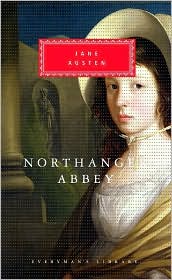
Northanger Abbey. Jane Austen. 1817/1992. Everyman's Library. 288 pages. [Source: Library]

No one who had ever seen Catherine Morland in her infancy, would have supposed her born to be an heroine. Her situation in life, the character of her father and mother, her own person and disposition, were all equally against her. 

I know I say this with every Austen review, but, it's true: I love her novels more each time I read them. Now that I've read Northanger Abbey three or four times, I have to admit that I really do love it. Perhaps not as much as I love, love, love Persuasion. But I really am very fond of it. I am especially fond of Henry Tilney. He may just be my favorite, favorite, favorite Austen hero.

My latest review of the novel is from 2011. I am going to challenge myself to keep the summary as brief as possible:

Catherine Morland, our heroine, loves to read; she especially loves to read gothic novels. When she travels to Bath with her neighbors, she meets a new best friend, Isabella Thorpe, and a potential soul mate, Henry Tilney. While Miss Thorpe ends up disappointing her, Catherine's journey is not in vain for her crush, Henry, has a saint for a sister. When invited to visit the Tilney household, Catherine is beyond excited to accept. Her time at Northanger Abbey, the Tilney's home, proves shocking, but not at all in the way she expected.

I love the newest movie adaptation. I would definitely recommend it.

My favorite quotes:
She had reached the age of seventeen, without having seen one amiable youth who could call forth her sensibility, without having inspired one real passion, and without having excited even any admiration but what was very moderate and very transient. This was strange indeed! But strange things may be generally accounted for if their cause be fairly searched out. There was not one lord in the neighbourhood; no — not even a baronet. There was not one family among their acquaintance who had reared and supported a boy accidentally found at their door — not one young man whose origin was unknown. Her father had no ward, and the squire of the parish no children. But when a young lady is to be a heroine, the perverseness of forty surrounding families cannot prevent her. Something must and will happen to throw a hero in her way.
The master of the ceremonies introduced to her a very gentlemanlike young man as a partner; his name was Tilney. He seemed to be about four or five and twenty, was rather tall, had a pleasing countenance, a very intelligent and lively eye, and, if not quite handsome, was very near it. His address was good, and Catherine felt herself in high luck. There was little leisure for speaking while they danced; but when they were seated at tea, she found him as agreeable as she had already given him credit for being. He talked with fluency and spirit — and there was an archness and pleasantry in his manner which interested, though it was hardly understood by her. After chatting some time on such matters as naturally arose from the objects around them, he suddenly addressed her with — ”I have hitherto been very remiss, madam, in the proper attentions of a partner here; I have not yet asked you how long you have been in Bath; whether you were ever here before; whether you have been at the Upper Rooms, the theatre, and the concert; and how you like the place altogether. I have been very negligent — but are you now at leisure to satisfy me in these particulars? If you are I will begin directly.” “You need not give yourself that trouble, sir.” “No trouble, I assure you, madam.” Then forming his features into a set smile, and affectedly softening his voice, he added, with a simpering air, “Have you been long in Bath, madam?” “About a week, sir,” replied Catherine, trying not to laugh. “Really!” with affected astonishment. “Why should you be surprised, sir?” “Why, indeed!” said he, in his natural tone. “But some emotion must appear to be raised by your reply, and surprise is more easily assumed, and not less reasonable than any other. Now let us go on. Were you never here before, madam?” “Never, sir.” “Indeed! Have you yet honoured the Upper Rooms?” “Yes, sir, I was there last Monday.” “Have you been to the theatre?” “Yes, sir, I was at the play on Tuesday.” “To the concert?” “Yes, sir, on Wednesday.” “And are you altogether pleased with Bath?” “Yes — I like it very well.” “Now I must give one smirk, and then we may be rational again.” Catherine turned away her head, not knowing whether she might venture to laugh. “I see what you think of me,” said he gravely — ”I shall make but a poor figure in your journal tomorrow.”
“My journal!” “Yes, I know exactly what you will say: Friday, went to the Lower Rooms; wore my sprigged muslin robe with blue trimmings — plain black shoes — appeared to much advantage; but was strangely harassed by a queer, half-witted man, who would make me dance with him, and distressed me by his nonsense.” “Indeed I shall say no such thing.” “Shall I tell you what you ought to say?” “If you please.” “I danced with a very agreeable young man, introduced by Mr. King; had a great deal of conversation with him — seems a most extraordinary genius — hope I may know more of him. That, madam, is what I wish you to say.” “But, perhaps, I keep no journal.” “Perhaps you are not sitting in this room, and I am not sitting by you. These are points in which a doubt is equally possible. Not keep a journal! How are your absent cousins to understand the tenour of your life in Bath without one?
My dear madam, I am not so ignorant of young ladies’ ways as you wish to believe me; it is this delightful habit of journaling which largely contributes to form the easy style of writing for which ladies are so generally celebrated. Everybody allows that the talent of writing agreeable letters is peculiarly female. Nature may have done something, but I am sure it must be essentially assisted by the practice of keeping a journal.”
“What are you thinking of so earnestly?” said he, as they walked back to the ballroom; “not of your partner, I hope, for, by that shake of the head, your meditations are not satisfactory.” Catherine coloured, and said, “I was not thinking of anything.” “That is artful and deep, to be sure; but I had rather be told at once that you will not tell me.” “Well then, I will not.” “Thank you; for now we shall soon be acquainted, as I am authorized to tease you on this subject whenever we meet, and nothing in the world advances intimacy so much.”
I have no notion of loving people by halves; it is not my nature. My attachments are always excessively strong.
I consider a country-dance as an emblem of marriage. Fidelity and complaisance are the principal duties of both; and those men who do not choose to dance or marry themselves, have no business with the partners or wives of their neighbours.” “But they are such very different things!” “ — That you think they cannot be compared together.” “To be sure not. People that marry can never part, but must go and keep house together. People that dance only stand opposite each other in a long room for half an hour.” “And such is your definition of matrimony and dancing. Taken in that light certainly, their resemblance is not striking; but I think I could place them in such a view. You will allow, that in both, man has the advantage of choice, woman only the power of refusal; that in both, it is an engagement between man and woman, formed for the advantage of each; and that when once entered into, they belong exclusively to each other till the moment of its dissolution; that it is their duty, each to endeavour to give the other no cause for wishing that he or she had bestowed themselves elsewhere, and their best interest to keep their own imaginations from wandering towards the perfections of their neighbours, or fancying that they should have been better off with anyone else. You will allow all this?” “Yes, to be sure, as you state it, all this sounds very well; but still they are so very different. I cannot look upon them at all in the same light, nor think the same duties belong to them.” “In one respect, there certainly is a difference. In marriage, the man is supposed to provide for the support of the woman, the woman to make the home agreeable to the man; he is to purvey, and she is to smile. But in dancing, their duties are exactly changed; the agreeableness, the compliance are expected from him, while she furnishes the fan and the lavender water. That, I suppose, was the difference of duties which struck you, as rendering the conditions incapable of comparison.”
“The person, be it gentleman or lady, who has not pleasure in a good novel, must be intolerably stupid. I have read all Mrs. Radcliffe’s works, and most of them with great pleasure. The Mysteries of Udolpho, when I had once begun it, I could not lay down again; I remember finishing it in two days — my hair standing on end the whole time.” “Yes,” added Miss Tilney, “and I remember that you undertook to read it aloud to me, and that when I was called away for only five minutes to answer a note, instead of waiting for me, you took the volume into the Hermitage Walk, and I was obliged to stay till you had finished it.” “Thank you, Eleanor — a most honourable testimony. You see, Miss Morland, the injustice of your suspicions. Here was I, in my eagerness to get on, refusing to wait only five minutes for my sister, breaking the promise I had made of reading it aloud, and keeping her in suspense at a most interesting part, by running away with the volume, which, you are to observe, was her own, particularly her own. I am proud when I reflect on it, and I think it must establish me in your good opinion.”
“I am very glad to hear it indeed, and now I shall never be ashamed of liking Udolpho myself. But I really thought before, young men despised novels amazingly.” “It is amazingly; it may well suggest amazement if they do — for they read nearly as many as women. I myself have read hundreds and hundreds. Do not imagine that you can cope with me in a knowledge of Julias and Louisas. If we proceed to particulars, and engage in the never-ceasing inquiry of ‘Have you read this?’ and ‘Have you read that?’ I shall soon leave you as far behind me as — what shall I say? — I want an appropriate simile. — as far as your friend Emily herself left poor Valancourt when she went with her aunt into Italy. Consider how many years I have had the start of you. I had entered on my studies at Oxford, while you were a good little girl working your sampler at home!” “Not very good, I am afraid. But now really, do not you think Udolpho the nicest book in the world?”
The word ‘nicest,’ as you used it, did not suit him; and you had better change it as soon as you can, or we shall be overpowered with Johnson and Blair all the rest of the way.” “I am sure,” cried Catherine, “I did not mean to say anything wrong; but it is a nice book, and why should not I call it so?” “Very true,” said Henry, “and this is a very nice day, and we are taking a very nice walk, and you are two very nice young ladies. Oh! It is a very nice word indeed! It does for everything. Originally perhaps it was applied only to express neatness, propriety, delicacy, or refinement — people were nice in their dress, in their sentiments, or their choice. But now every commendation on every subject is comprised in that one word.” 
It was no effort to Catherine to believe that Henry Tilney could never be wrong. His manner might sometimes surprise, but his meaning must always be just: and what she did not understand, she was almost as ready to admire, as what she did.
The past, present, and future were all equally in gloom.
Wherever you are you should always be contented, but especially at home, because there you must spend the most of your time.
© 2014 Becky Laney of Becky's Book Reviews

Tuesday, December 03, 2013

Cousin Kate (1968)

Cousin Kate. Georgette Heyer. 1968/2009. Sourcebooks. 384 pages. [Source: Bought]

Just how thankful should 'Cousin Kate' be to Aunt Minerva (Lady Broome)? Should receiving her aunt's "gifts" of shelter and clothes, obligate her in anyway to MARRY her cousin Torquil?! Kate Malvern is exceedingly thankful and quite patient considering the circumstances. She's accepted the fact that her "new" family has eccentricities, their own way of doing things, their own idea of what "normal" looks like. She even likes her cousin Torquil, in small doses when he isn't throwing a tantrum. But she likes someone else more! Someone who isn't losing it. Someone who doesn't aim guns at her all the while making excuses. Kate is falling in love with Philip. (Philip is the nephew of Sir Timothy; Aunt Minerva is Sir Timothy's SECOND wife.) And Philip is falling in love with her. He thinks that Kate will need rescuing, that his aunt (by marriage) is NOT to be trusted.

Cousin Kate is gothic and creepy. It doesn't quite match the intensity of Rebecca or Jane Eyre. But it's close.

Quotes starring Torquil and Kate:
He gave a low chuckle, and released his painful grip on her arm. ‘Strong, aren’t I?’ He flexed his long fingers, regarding them with an admiring smile. ‘I could strangle you one-handed, you know. Wouldn’t think it, to look at me, would you?’ ‘No, but as I haven’t had occasion to consider the matter there’s nothing wonderful in that!’ she retorted, rubbing her arm. His chagrined face stirred her sense of fun; she broke into laughter, and said: ‘Cry craven, Torquil! You have the wrong sow by the ear: I’m not so easily impressed!’ That made him echo her laughter. ‘Kate, Cousin Kate, do you call yourself a sow? I should never dare do so! You are the most unusual girl!’
She followed him down the steps to the stone bridge which was flung across the narrow end of the lake. He went ahead of her to the middle of the bridge, and stood there, leaning his arms on the parapet, and watching her with a mocking smile. ‘Come along!’ he coaxed. ‘I won’t throw you in!’ She laughed. ‘No, won’t you?’ ‘Not if you don’t wish it!’ ‘I most certainly do not wish it!’ ‘Don’t you? Not at all? I often think how pleasant it would be to drown.’ ‘Well, it wouldn’t be in the least pleasant!’ she said severely. ‘Are you trying to make my flesh creep? I warn you, I have a very matter-of-fact mind, and shall put you to a non-plus! What lies beyond the lake?’
Quotes starring Philip and Kate:
‘So I should hope! For God’s sake, Kate – ! I’m not flirting with you! I’m trying to tell you that I love you!’ ‘Oh!’ uttered Kate faintly. Mr Philip Broome, indignant at being given so little encouragement, said in goaded voice: ‘Now say you’re much obliged to me!’ ‘I don’t know that I am,’ responded Kate, almost inaudibly. ‘I – I don’t know what you mean!’ With all the air of a deeply reticent man forced to declare his sentiments, he said: ‘Exactly what I said! I LOVE YOU!’ ‘You needn’t shout! I’m not deaf !’ retorted Kate, with spirit. ‘I was afraid you might be! I could hardly have put it more plainly! And all you can say is Oh ! As though it was a matter of no consequence to you! If you feel that you can’t return my – my regard, tell me so! I’ve dared to hope, but I was prepared to have my offer rejected, and although it would be a severe blow, I trust I have enough conduct not to embarrass you by persisting!’ ‘You – you haven’t made me an offer!’ said Kate. She added hurriedly, and in considerable confusion: ‘I don’t in the least wish you to! I mean, I would far, far liefer you didn’t if you are trying to – Oh, dear, how very awkward this is! Mr Broome, pray don’t offer me a carte blanche !’ ‘A carte blanche ?’ he exclaimed, apparently stunned. By this time she was crimson-cheeked. She stammered: ‘Is – isn’t that the right term?’ ‘No, it is not the right term!’ he said savagely, drawing his horses in to the side of the lane, and pulling them to a halt. ‘What kind of a loose-screw do you take me for? Offer a carte blanche to a delicately bred girl in your circumstances? You must think I’m an ugly customer!’ ‘Oh, no, no! Indeed I don’t!’ He possessed himself of her hands, and held them in a hard grip. ‘I am proposing to you, Kate! Will you marry me?’ Her hands instinctively clung to his; a happiness she had never known before flooded her being; but she said foolishly: ‘Oh, no! Don’t! You can’t have considered – Oh, dear, how improper this is!’ Mr Philip Broome, after one swift glance round, dragged her roughly into his arms and kissed her. For a delirious moment Kate yielded, but every precept that Sarah had drummed into her head shrieked to her that she was violating every canon of propriety, and behaving without delicacy or conduct. She made a desperate attempt to thrust him away, uttering an inarticulate protest. He released her with unexpected alacrity, ejaculating: ‘I might have known it!’ and set his horses in motion again. ‘That’s what comes of proposing in a curricle!

© 2013 Becky Laney of Becky's Book Reviews

Friday, March 23, 2012

Eyeball Collector (MG/YA)

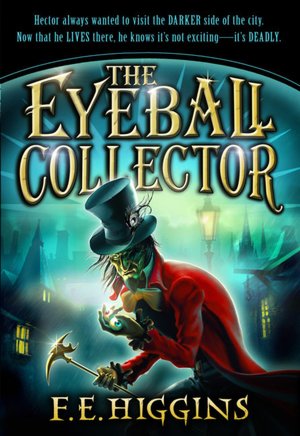
The Eyeball Collector. F.E. Higgins. 2009. Feiwel and Friends. 250 pages.

"Tartri flammis!" cursed Hector as his stomach tightened in a knot and his chest jerked violently with every beat of his heart. He rotated slowly on the spot, panting from the chase. His nose tingled with the stench that filled the air. Already his ears were pricking to the menacing sounds around him: screeches and wails, scraping and dragging, and the ominous unrelenting moaning. So this is fear, he thought. In a strange way it excited him.

See what reading one great book can do?! It can lead you to reading other great books! Yesterday, I was oh-so-happy to have read F.E. Higgin's The Bone Magician. And I was oh-so-happy that I'd thought ahead to check out all of her books at the same time. Because I just couldn't wait to get to The Eyeball Collector! And it did NOT disappoint. It was absolutely wonderful!

Six or seven years have passed since the events of The Black Book of Secrets and The Bone Magician. The Eyeball Collector is set in the same town as The Bone Magician, the dreadfully unpleasant city of Urbs Umida. (One thing you might notice if you read both books is that it seems Beag Hickory has made it as a poet at last. This novel is not only dedicated to Beag, it opens with one of Beag's poems, and in passing a reference is made in a bookshop to a book of Beag's poetry!) The Eyeball Collector can definitely be read on its own as a standalone--it's nice to know just in case you've got access to one but not all. But I do think that after getting a taste of Higgins' writing, you'll want to read them all.

The hero of The Eyeball Collector is a young boy, Hector Fitzbaudly. He's from the good side of town. (All the somebodies live on the North side of town.) Which makes him being on the wrong side of town--the South side, the too-close-to-the-stinky-river-side--a big mistake on his part. But he wanted adventure, excitement, he wanted to see how the other side lived. He didn't quite expect to be so completely robbed. But if that was the worst that happened to young Hector, he'd consider himself fortunate. For it isn't too long after that he witnesses someone--a one-eyed someone--trying to blackmail his father. His father gives in to the blackmailer's demands, but the blackmailer sells his story to the papers anyway. So all was for nothing. Long story short, Hector's father isn't long for this world. And soon he's an orphan, an orphan determined to find the man responsible for his father's downfall and death. He's determined to find this one-eyed man and kill him.

Of course, that's just one aspect of the story...

I loved so much about The Eyeball Collector. I loved the atmosphere and setting, the tone of this one. There is something delightfully-and-charmingly creepy about this one. The villains and even the heroes are a bit eccentric, you might say. And the storytelling, well, it kept me reading.

Read The Eyeball Collector
  • If you are a fan of F.E. Higgins
  • If you are a fan of middle grade or young adult fantasy
  • If you aren't quite a Dickens fan but you've always thought you should be
  • If you like atmospheric shady-gothic reads full of eccentric characters
  • If you're a cat lover who can forgive a book for killing off two cats

© 2012 Becky Laney of Becky's Book Reviews

Thursday, October 27, 2011

The Classics Circuit: Frankenstein

Frankenstein. Mary Shelley. 1818. Oxford World's Classics. 250 pages.

I am happy today to be reviewing Mary Shelley's Frankenstein for October's Classic Circuit Tour on Gothic Lit. Frankenstein just happens to be one of my favorite novels--though that hasn't always been the case. If you want to read a long ramble about how this short little novel became a favorite of mind, you may read my first review published in 2007. My second review of the novel was in 2009. If you want to read my thoughts on the graphic novel, I reviewed it just last year.

I'll be honest. If you have NOT read Frankenstein, then this discussion probably isn't for you. I don't know how to talk about Frankenstein without talking spoilers. 

Before I read Frankenstein (this time), I happened to read two young adult novels: Mister Creecher by Chris Priestly and This Dark Endeavour by Kenneth Oppel. Both novels challenged me to rethink the original novel. Mister Creecher urged me to examine excuses. And This Dark Endeavour showed me just how much we don't know about some of the characters. Specifically, how much we DON'T know about Henry (Clerval) and Elizabeth. I wouldn't say reading these two books exactly guided me in this rereading. I, of course, noticed a few things on my own.

Frankenstein is a great little novel. Readers meet two fully developed characters in Victor Frankenstein and the creature (or monster, if you must see him in that way). I've always been so caught up in their story--the dual narration--that I've never really noticed how undeveloped other characters are. What do we know of Elizabeth? She's sweet. She's beautiful. She's pure. What do we know of Henry? He's Frankenstein's best friend. The man who shows up when Frankenstein is in great need. But does he have much of a personality? Do we ever get a glimpse of who he is apart from the faithful friend? Elizabeth and Henry are the two people nearest and dearest to Victor. Because he's close to these two, the creature is able to use them to get to Victor. Then there is Robert Walton. His letters provide the framework for the novel. Walton himself is experiencing some loneliness and anxiety. He WANTS to be successful as an explorer. He wants to be the one to discover the Northwest Passage. It's a dream that is all risk. If he's successful, of course, it would all be worth it. But if he's not, well, at best that means disappointment and frustration, at worst, death. He LISTENS to the story--this incredible story. He's found Victor Frankenstein on the ice, he's sick and mad. He's not exactly a picture of mental health. And physically, he's in terrible shape. As Walton spends time--a LOT of time with Frankenstein, he records his story. Readers do get to know a little about Walton. We know he's determined, ambitious, curious. We know he's got some stubbornness to him. Some pride. Some desire for fame. But we also know that he has feelings. That he feels lonely and isolated. That he wants more than anything to find a friend, a true friend. He wants to be understood. He wants companionship. So there are THREE characters that Shelley really explores in her novel.

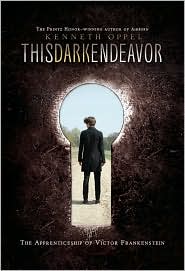
This Dark Endeavor was an interesting prequel to Frankenstein for many reasons. I won't mention all of them, don't worry. But what intrigued me most was the characterization of Elizabeth. Oppel's Elizabeth was strong, resilient, brave, and very smart. And Shelley's Elizabeth, well, she was oh-so-passively good and pure and sweet. Readers do know she loves Victor. Readers do know that she loves her Uncle and her cousins. We do know that she is a compassionate person because she pities Justine to the very end. But I still can't help seeing her existing just so she can be the ultimate victim.

Mister Creecher like John Kessel's short novellette, "Pride and Prometheus," is an expansion of Mary Shelley's original novel. Both are set in the waiting period. Victor Frankenstein has promised his creation, his creature, a mate. He travels to England--to London, to Oxford, etc.--and eventually Scotland with his friend Clerval. All the while struggling with his promise. Should he repeat his mistake? Do two wrongs make a right? Can Frankenstein take his creature at his word? Can Frankenstein take for granted that the creature can predict (and/or control) his potential mate? Can he play with fate like that? If the first creation turned his life upside down and ruined him completely, can the creation of a second really change that? undo it?

So Mister Creecher introduces a friend. A young teen boy named Billy. A thief. Billy himself is an outcast of sorts. He's dirty, despised, looked down upon, chased away. People judge him all the time too. The truth is, if he died no one would miss him. Not at all. He has no one in the world to look out for him, no one to call friend. He's a nobody too. So the two do potentially have some things in common. But Billy CANNOT stand how pitiful the creature is, how full of excuses. He hears Mr. Creecher go on and on and on and on and on about his sad and lonely and miserable existence. How friendless he is. How hopeless he is. How he is rejected by one and all. Mr. Creecher may LOOK different from others, but his story isn't all that unique. He's not the only one to EVER feel so dejected, lonely, and depressed.
'Shut up!' Billy snapped. 'Why do you have to be such a...'
He snarled and kicked a moss-covered branch and sent it tumbling into the darkness. Without the coachlights, the moon provided the only illumination to the scene.
'You see how it is for me,' said Creecher. 'I try to help and--'
'It's always about you, isn't it?' said Billy. 'Oh, poor me--I'm ugly and no one likes me. Boo hoo, boo hoo. Well, life ain't a bowl of cherries for the rest of us neither!'
'But you can live among them...'
Billy fumed for a few moments, unable to express his feelings. The truth was he had never felt part of 'them.' He had never belonged.
'Oh yeah. I can get treated like filth,' he replied. 'I can starve or steal. I can hang. If you want someone to feel sorry for you, you've come to the wrong place.' (191)
So when I read Frankenstein this time, I began noticing that this was more than a little true. The creature does complain a lot, and he does have an exceedingly long list of excuses. He blames Victor for everything. He sees each one of his crimes as being Victor's fault. "Victor made me do it. Victor created me. Victor's responsible for every (bad) decision I make. Yes, I knew it was wrong. But he made me. He made me with these big, strong hands. It couldn't possibly be my fault that I use them to kill. I couldn't hurt anyone at all if I didn't exist." And then there's "If only Victor had loved me..." "If only Victor had taken time to teach me, nurture me, show me how to be a good 'little' monster...I wouldn't have possibly strayed from the straight and narrow." When the creature is not blaming Victor, he's blaming the victims, or blaming the rest of humanity. He never really takes responsibility for his crimes. He does confess. I'm not saying he doesn't admit to being a killer. But he has excuses. He would rather be the victim--the "real" victim--than a killer, a murderer. He wants Victor to be the bigger bad guy, the ultimate bad guy.

It's hard not to pity the creature. It's really, really hard not to feel compassion for him. Especially at the beginning as his story unfolds. It is easy to see his point. It is easy to see that Victor's rejection of him wounded him deeply and warped him a bit. Each rejection just pushes him a little closer to the edge. The more education he receives--through observation, through reading, etc--the more difficult it is for him to just be. He learns of love, of family, of friendship, of joy, of happiness, of laughter. These ideas haunt him because they are unattainable. He'll never feel any of these 'lighter' emotions, he'll feel--and plenty--but he turns to anger, frustration, bitterness, revenge, hate. He gives himself over to hate and revenge. And once he goes bad, pity may remain but it's not exactly a healthy compassion. The truth remains. Did the creature have a choice? Did he know right from wrong and knowingly choose to commit wrong time and time again? The creature felt that becoming a murderer was his only choice, that there was no other choice he could have made. But is that true?

I do think that the creature was acting like an immature child. Maybe a well-read immature child. But I do think he was acting out to get Victor's attention. Victor is a character, on the other hand, that is troublesome almost from the start. It is easy to relate to the creature's loneliness, his outcast state, his wanting a friend. It is harder to relate to Victor's mad obsession to create life, to play at being a god, to gain too much control over the natural world, to venture too far into the unknown, to act without ANY thought at all, to be completely reckless and foolish. Victor seems like a tragically flawed character who couldn't have known any other destiny. And readers really don't know WHY Victor made the decisions he made. Not really. (At least this reader can't fathom.)

So Frankenstein is an emotional read--very powerful, very haunting.

You may also find these books helpful:

Frankenstein's Monster by Susan Heyboer O'Keere.
The Casebook of Victor Frankenstein by Peter Ackroyd.
A Monster's Notes by Laurie Sheck.
Mister Creecher by Chris Priestly
This Dark Endeavour by Kenneth Oppel
"Pride and Prometheus" by John Kessel
AngelMonster by Veronica Bennett.
Wildly Romantic by Catherine M. Andronik.

© 2011 Becky Laney of Becky's Book Reviews

Wednesday, August 27, 2008

Jane Eyre's Daughter


Newark, Elizabeth. 2008. Jane Eyre's Daughter.

The oak pulpit rises high above the congregation.

I had *every* intention of rereading Jane Eyre before tackling this literary spin-off, Jane Eyre's Daughter. I've only read Eyre once, and that was way back in the fall of 2001. [You know, the semester that was difficult both personally (grandfather's death) and nationally (9/11).] And I still *plan* on rereading it if there's time this fall. It made it to several challenge lists including Carl's R.I.P. III. But when I got the email from the publisher saying that I should post my review as soon as possible, I decided that it was not the time to go traipsing down memory lane just because I'm a perfectionist.

What can I say about Jane Eyre's Daughter. The style. One of the reasons I'd hoped to reread the original was so that I could compare the two styles. To see if this one attempted to echo the original in literary style. I can't be the judge of that (at least not yet.) But I can talk about it all on its own. I found the style to be purposefully put-offish. Let me rephrase that if I can. The narrator has a definite attitude, a definite flair that could be put-offish if you were to meet her in real life. She's definitely not meek or weak or waiting for Prince Charming. So that's what I meant, the narrative reflects the narrator. The style seems to be a distancing one. It's written in first person past tense, and that in and of itself creates distance between the reader and the characters or the reader and the action. As such the action isn't immediate either. What we're "reading" is a reflective narrative. We're being fed a story. Perhaps passively aggressively.

The characters. I liked elements of Janet's character. Was put off by some other elements. Found the family scenario to be odd if I'm quite honest. Which might be expected. Jane Eyre definitely was surrounded by dysfunction. And Mr. Rochester was definitely one odd guy--with good reason. So perhaps it's only natural that instead of a normal, loving family we've got one that has some flaws.

S
P
O
I
L
E
R

This is just a minor spoiler, so maybe you're brave enough to keep reading. One of the major "ick" factors in this book is Freudian in nature. Janet Rochester seems to be--and conscious of it too--in love with her father. She sees him as the perfect, perfect man. She imagines what it would be like to be in bed with her father, to be held in his arms. In other words, she wishes she was her mother. The man she ultimately falls for in fact is a man who looks to be an exact copy of her dear old dad. So much is this resemblance that she thinks for a good many chapters that he might be her half-brother. Still she loves him anyway. The scenes where she gushes about her father in a very romantic, almost sensual way were very squirmily icky.

End of Minor Spoiler.

Her relationship with her mother. Jane Eyre is shown to be a loving mother...except when it comes to her daughter. She loves her son, adores her son. He's her constant companion. But Jane Eyre just can't seem to like her daughter. Can't seem to love her daughter. As her daughter matures, she senses that she has a would-be rival for her husband's affections. She's jealous of any time they spend together. So she's very uptight and distant (read that *bitchy*) with her daughter, and a bit doting and overprotective of her son. His name is Oliver by the way.

But her parents are really very minor characters. Almost immediately, the whole Rochester family--minus the daughter--is tossed out of the book and sent on an extended round-the-world vacation. They essentially pack up everything, lease Thornfield, and tell their daughter..."we'll be back in three or four years. Don't get married until you're twenty-one." She's fifteen (maybe sixteen) when they leave. She's first sent to boarding school. Then sent to live with Colonel Dent after she graduates from finishing school.

The tone of Jane Eyre's Daughter is sufficiently gothic. There are secrets, lies, mysteries, romance, and a general uncomfortableness that feels appropriate for this Bronte spin-off. The mystery isn't as spectacularly shocking as the big reveal in Jane Eyre--crazy woman in attic--but the well-intentioned echo (this time in Colonel Dent's home) is intriguing in its own way.

I won't go into all the details, but it was a semi-satisfying read. I think it was well written, but for me, I didn't like some of the places this novel went. I think other readers might enjoy it more. Especially for fans of gothic romance with spooky settings and creepy tones. (Though I must applaud the fact that at least it wasn't sexually graphic. It could have been much much worse.) It was better than I expected.

Other reviews: Book-a-rama. Bronte blog.

© Becky Laney of Becky's Book Reviews