Showing posts with label 1989. Show all posts

Tuesday, March 28, 2023

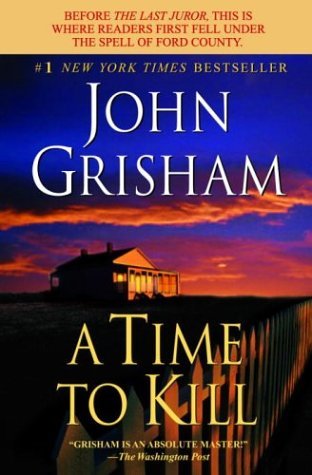
63. A Time to Kill


A Time to Kill. (Jake Brigance #1) John Grisham. 1989. 738 pages. [Source: Library]

First sentence: Billy Ray Cobb was the younger and smaller of the two rednecks. 

Premise/plot: Can Jake Brigance, a defense attorney, get his client, Carl Lee Hailey, to be declared not guilty by an all-white jury in Clanton, Mississippi. Carl Lee Hailey's VERY young daughter, Tonya, is gang-raped by two men--two rednecks. They are arrested and charged with the crime, but, Carl Lee Hailey dispenses his own justice--murdering them at the courthouse shortly after their arraignment. The rape AND the murder have turned the town--the county--upside down. People taking sides, feeling strongly on the subject. It also brings the Klan back to the county/town, and things escalate VERY quickly.

This one is packed with violence, with threats, with the n-word. It is an intense read. 

My thoughts: This one is so graphic, so violent, so in-your-face with racism. I knew it involved rape....and murder. I was expecting it to be rough and gritty--if you will. This one is packed with so much ugliness. And warning, you are THROWN right into it. The novel opens with a VIOLENT, disturbing, horrific crime in progress. 

I did find it compelling. I don't know that it was ever a pleasant read. It was almost always disturbing. But I am glad I read it. I'll be watching the movie soon. I may seek out more of his books. 


© 2023 Becky Laney of Becky's Book Reviews

Thursday, July 09, 2020

93. Madeleine

Madeleine. Elvi Rhodes. 1989/2011. 512 pages. [Source: Review copy]

 First sentence: Walking along the narrow street, her hand resting lightly in the crook of George Carter’s arm, Madeleine was filled to the brim with rebellious thoughts. They coursed through her body and tingled in her fingertips until she felt sure that they must be conveyed to the man beside her. The sensation was so physical that she found herself compressing her lips into a tight line as if to prevent her feelings spilling out into words; words which she knew would surprise, even shock, George, coming from someone on her way home from chapel. But then he was easily shocked, wasn’t he? He was so good, so upright. She doubted if he had ever had a rebellious thought in his life. And since he continued to walk along without so much as turning to look at her she doubted that he had the slightest inkling of how she was feeling at this moment.

Premise/plot: Madeleine is a historical romance novel set in the 1850s in Yorkshire. Madeleine, our heroine, is a servant for the Parkinson family. Readers are told that this is the wealthiest family in the small town of Helsdon. But they only ever mention two possibly three servants: a cook, Mrs. Thomas, and Madeleine. (If there's a butler or stable boy, he's never named. I wouldn't be surprised if there was one or the other or both. But maybe because they don't figure into the story they're not named or mentioned. I have a hard time believing that an actually wealthy family at that time would only have two to four servants.) Madeleine is first and foremost rebellious and angry. She's rebelling against her father who is religious and attends chapel whenever its doors are open. She's rebelling against the Parkinsons though really her conflict is just with the so-called spoiled daughter, Sophia, with whom she clashes upon occasion. Sophia our antagonist, if you will, is actually spoiled. (But I couldn't help feeling that I liked her better for the first half of the book. Because I'd take flighty and vain over rebellious, brooding anger and resentment any day.) Mr. Parkinson, a mill owner, brings home a french man, Leon Bonneau, who is in a similar line of work in France. Sophia falls head over heels in love--think Scarlett's obsession with Ashley. Madeleine waits upon Mr. Bonneau while he is staying there and the two become slightly slightly friendly. (Though neither is exactly swooning for the other....yet). But after a trip abroad goes WRONG, Madeleine finds herself quitting that job and taking up work as a weaver at a mill (you know, as you do). Will Madeleine be happier as a mill worker? Will Leon and Sophie marry? Will the Parkinsons continue to be "wealthy"?

My thoughts: I liked this one well enough to keep reading. At no point did I say enough is enough is enough I can't stand the characters anymore. But I did have a few thoughts. First, I think the author must really love Gone With The Wind. The dialogue seems a bit modeled after Scarlett O'Hara. Along with one or two elements. Second, there is a LOT of cocoa drinking going on. You would think that they'd be more tea drinking! Third, do romance writers purposely make their characters dim-witted so that obstacles loom larger and seem impossible?! I mean that would be one explanation why things with obvious and mostly easy solutions would seem IMPOSSIBLE AND AGONIZING. I'd rather believe the characters are silly and dim then the author is unaware. Fourth--and finally--Madeleine seems to be a relatively contemporary woman (perhaps born circa 1950 or 1960) than one born in the 1830s. She just seems a bit off. The other characters--perhaps because we don't live inside their minds--seem to be a slightly better fit with the 1850s.


© 2020 Becky Laney of Becky's Book Reviews

Wednesday, May 29, 2019

World at War: The Girl With the White Flag

The Girl With The White Flag. Tomiko Higa. Translated by Dorothy Britton. 1989. 130 pages. [Source: Bought]

First sentence from the introduction: On June 25, 1945, on the war-ravaged island of Okinawa, a young American army signal corps photographer took a remarkable photograph. It showed a little barefoot girl in tattered clothes waving a piece of white cloth tied to a crooked stick.

First sentence: I was born in Shuri, the ancient capital of Okinawa, which is now part of the city of Naha.

The Girl with the White Flag is the story of the author's childhood in war-time Japan. It begins by giving the reader ample background into the time and culture and place. We meet our heroine, a young girl who throughout the book spans the ages of five through seven. One of the first events she shares with readers is the death of her mother. She then relates what life was like with her father, two older sisters, and her older brother. This portion is hard to navigate. I think in some ways it is just as hard for modern readers to understand the family life--the harshness, the strictness, the discipline, as it is to understand the monstrosities of war and soldiers and starvation. (Or maybe that's just my take on it.)

About halfway through the narrative, the father disappears. He was on his somewhat routine mission of delivering food to the Japanese soldiers, but on this occasion he never returned home. The four children are left to fend for themselves. The American soldiers have just begun their invasion, their battle to capture this island. The children become refugees and the fight to survive has begun. The children ranged in age from 17 to 6. Somewhere along the way, however, two things happen--big things--that make this event even scarier: 1) Their brother dies one night from a stray bullet. 2) Within a few days of burying their brother, our narrator--the six/seven year old girl becomes lost--separated--from her sister.

The book recounts what it was like to be seven and alone and wandering in and out of danger. There was no safe place. Not really. Japanese soldiers weren't "safe." In fact, in her brief encounters with them she was almost killed. No, being near soldiers wasn't safe. The only "safe" soldier was a dead soldier. She did in fact scavenge around the dead soldiers looking for food.

Her will to survive was strong. Her stamina incredible in my opinion. The sights. The sounds. The smells. All surrounded her. Could have potentially traumatized her and paralyzed her into inaction.

If there is power in the Girl with The White Flag it is in its rawness, its simplicity, its boldness when it comes to being straightforward and honest. The story is incredible is powerful because it's true. Here is an eyewitness account of what it means to be seven and a refugee in a war zone. It can be brutal. It can be intense. But there is more to it than that.

I found The Girl with The White Flag to be an incredibly compelling read, a must-read for adults. 

© 2019 Becky Laney of Becky's Book Reviews

Wednesday, March 20, 2019

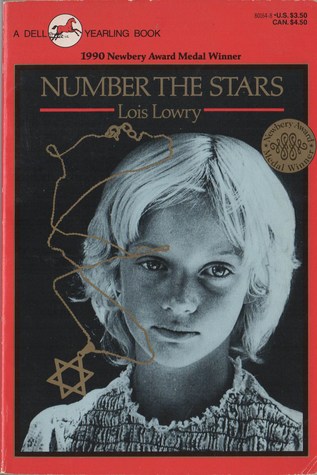
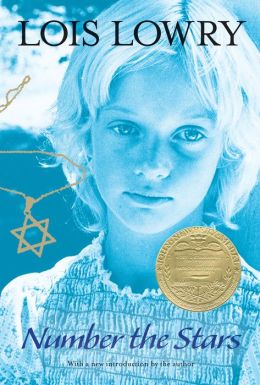
World at War: Number the Stars

Number the Stars. Lois Lowry. 1989. (Won Newbery in 1990) 137 pages. [Source: Bought]

 First sentence: "I'll race you to the corner, Ellen!" Annemarie adjusted the thick leather pack on her back so that her schoolbooks balanced evenly. "Ready?" She looked at her best friend.

Premise/plot: Annemarie Johansen stars in Lois Lowry's Number the Stars. She is a young girl living with her family in Denmark during World War II. She happens to have a Jewish best friend. She doesn't fully understand what is going on and why Hitler is the way he is; but she knows that Ellen's life is in danger. She must be brave and do her part.

My thoughts: Annemarie is the heroine of Number the Stars. I loved her. I loved her courage and loyalty. Ellen is Annemarie's best friend. I love that readers get an opportunity to see these two be friends before it gets INTENSE. I also love Annemarie's family. I do. I don't think I properly appreciated them as a child reader. One thing that resonated with me this time around was Annemarie's older sister, her place in the story. The setting. I think the book did a great job at showing what it could have been like to grow up in wartime with enemy soldiers all around. In some ways it was the little things that I loved best. For example, how Annemarie, Ellen, and Kirsti (Annemarie's little sister) play paper dolls together, how they act out stories, in this case they are acting out scenes from Gone with The Wind. I think all the little things help bring the story to life and make it feel authentic.

For a young audience, Number the Stars has a just-right approach. It is realistic enough to be fair to history. It is certainly sad in places. But it isn't dark and heavy and unbearable. The focus is on hope: there are men and women, boys and girls, who live by their beliefs and will do what is right at great risk even. Yes, there is evil in the world, but, there is also good.

© 2019 Becky Laney of Becky's Book Reviews

Friday, July 07, 2017

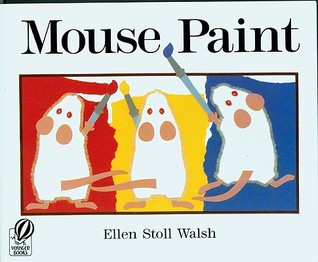
Mouse Paint

Mouse Paint. Ellen Stoll Walsh. 1989. 32 pages. [Source: Library]

First sentence: Once there were three white mice on a white piece of paper. The cat couldn't find them. One day, while the cat was asleep, the mice saw three jars of pain--one red, one yellow, and one blue. They thought it was Mouse Paint. They climbed right in.

Premise/plot: Mouse Paint is a concept picture book about colors. (Red and yellow make orange, etc.) But it's also a fun story about three mice who very much want to escape the attention of the cat.

My thoughts: I really enjoy this one. I have read it several times before, but never given it a review on the blog. My favorite line: "The red mouse stepped into a yellow puddle and did a little dance."

Text: 4.5 out of 5
Illustrations: 3.5 out of 5
Total: 8 out of 10

© 2017 Becky Laney of Becky's Book Reviews

Tuesday, December 20, 2016

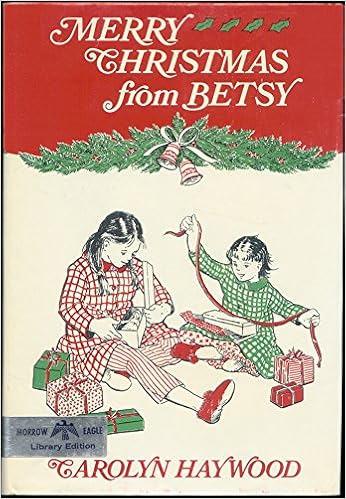
Merry Christmas From Betsy

Merry Christmas From Betsy. Carolyn Haywood. 1970/89. 192 pages. [Source: Bought]

First sentence: Thanksgiving was hardly over when Betsy and the rest of the children in the first grade began talking about Christmas.

Premise/plot: Merry Christmas From Betsy is a collection of the Christmas chapters from previous books in the Betsy series by Carolyn Haywood. The stories are sweet and charming and cute. The stories aren't all focused on Betsy either. Her younger sister, Star, who makes her arrival on Christmas Day as the "present that Betsy always wanted" is also a huge part of the book. Some stories focus on the anticipation of Christmas coming, others on Christmas Day itself. All are worth your time.

My thoughts: Really, really enjoyed this one! I haven't read all the Betsy books, but, the few I've read I've really enjoyed. I like spending time with Betsy, Star, their family, their friends.

© 2016 Becky Laney of Becky's Book Reviews

Thursday, September 29, 2016

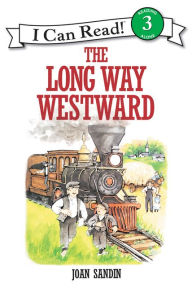
Long Way Westward

The Long Way Westward. Joan Sandin. 1989. 64 pages. [Source: Bought]

First sentence: "Look, Carl Erik," said Jonas, "the streets of America are not paved with gold."

Premise/plot: The Long Way Westward follows a Swedish immigrant family as they travel across parts of the United States to reach their new home in Minnesota. Their travel involves a lot of TRAINS. The immigrant experience of the late nineteenth century is captured quite well in this early chapter book.

My thoughts: It is so nice to have stumbled across historical fiction for the youngest of readers. Historical fiction was probably my first true genre to LOVE, LOVE, LOVE. And I think I would have really enjoyed this one if I'd read it as a kid. As an adult, I can still appreciate it and recommend it to teachers, parents, and grandparents to share with young readers in their lives.

© 2016 Becky Laney of Becky's Book Reviews

Saturday, September 26, 2015

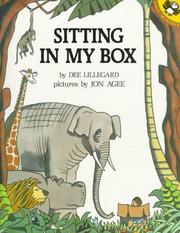
Sitting In My Box

Sitting In My Box. Dee Lillegard. Illustrated by Jon Agee. 1989. 32 pages. [Source: Library]

First sentence: Sitting in my box. A tall giraffe knocks. "Let me, let me in" So I move over.

Premise/plot: A young boy is reading a book while sitting in a box when....a tall giraffe, an old gray elephant, a big baboon, a grumpy lion, and a hippopotamus intrude in a delightfully predictable way. They ALL want in HIS box, of course. But is there room for so many animals in such a small box?! What can he do?! What will he do?! Read for yourself and see in this imaginative book.

My thoughts: Enjoyed this one very much. Though I do wish it said, "Let me in, let me in!" instead of "let me, let me in." But other than that, this one is definitely delightful and just FUN for sharing aloud. (I loved the "not me, not me, not me, not me" page, for example).

For another picture book about boxes, try A Mighty Fine Time Machine by Suzanne Bloom. That one is also quite charming.

Text: 4 out of 5
Illustrations: 3 out of 5
Total: 7 out of 10

© 2015 Becky Laney of Becky's Book Reviews

Friday, September 25, 2015

The True Story of the 3 Little Pigs

The True Story of the 3 Little Pigs. Jon Scieszka. Illustrated by Lane Smith. 1989. 32 pages. [Source: Library]

First sentence: Everybody knows the story of The Three Little Pigs. Or at least they think they do. But I'll let you in on a little secret. Nobody knows the real story, because nobody has ever heard my side of the story.

Premise/plot. A. Wolf (the narrator) wants readers (like you and me) to know the TRUTH. He is not a BIG BAD WOLF. He's not. Here's why: he was simply going to his neighbors' to ask for a cup of sugar. Why? Well, it was all for the best of causes: his dear granny's birthday cake. True, his neighbors all happened to be PIGS. But his intention was for SUGAR, AND SUGAR ALONE. It's not his fault that he had a cold and that his POWERFUL SNEEZES took out the first two pigs' houses. And it's not his fault that the pigs he found within the collapsed houses were DEAD. Perhaps it wasn't neighborly to EAT them after he found them dead. But it was the natural thing to do--he is a wolf, and pigs are tasty. He asks readers to trust his side of the story. Do you?!

My thoughts: This one is fun, fun, super-fun, just a true delight to read and reread. I've read it plenty of times since it was first published in 1989, but, this is the first time I've reviewed it. If you haven't read it yet, you should! You're never too old to pick this one up.

© 2015 Becky Laney of Becky's Book Reviews

Thursday, August 27, 2015

Shabanu: Daughter of the Wind

Shabanu: Daughter of the Wind. Suzanne Fisher Staples. 1989. 240 pages. [Source: Book I Bought]

Did I enjoy reading Shabanu: Daughter of the Wind? Not really. This Newbery Honor book doesn't fit my idea of what a Newbery or Newbery Honor book should be. I'm not sure that's fair on my part, and it could be a good thing to be a shockingly different children's book.

Shabanu is the young heroine of the novel. She's eleven or perhaps twelve. On the verge of "adulthood" in her culture, she's almost of marriageable age. Her wedding has already been arranged--a cousin--but it is about one year away still. Her sister's wedding, her sister is about thirteen, is months away when the novel opens. The arranged marriages for both of them are with their cousins. (I think one is 15, one 17. They are brothers). The novel is set in Pakistan. (I'm assuming contemporary-to-the-publication Pakistan). Shabanu and her family live in the desert, and live a more nomadic lifestyle. They travel from place to place depending on the time of year and the amount of water. Shabanu loves, loves, loves, LOVES tending the camels, and, she has definite favorites among them. She does not envy her sister being "all grown up." She enjoys the freedom she has as a child. Though it's not complete, absolute freedom ever. (I'm not saying it should be necessarily.)

The setting is interesting. Readers definitely get exposed to a whole new world, a camel-centric world. I thought there were at times a little too much information about the camels. (Warning: there's CAMEL SMUT)

If life had gone according to plan, the novel would not have taken a decidedly dark and depressing turn. But things went horribly wrong before her sister's wedding, and, Shabanu herself pays the price though she is not responsible or to blame for the souring of events. It seems most all the characters have a happier end than she herself does. That may or may not be completely realistic, but, it certainly isn't fair. It may push the extremes of what children consider NOT FAIR.

I'm not sure what response readers are to have with a novel like this. Shabanu may be the first or one of the first books readers come across that either a) stars a Muslim family, features a Muslim heroine, OR b) is set in Pakistan. I doubt the impression of either will be a good one, if that makes sense. Especially considering the ending.

© 2015 Becky Laney of Becky's Book Reviews

Sunday, May 03, 2015

Meet Phryne Fisher

Cocaine Blues. (Phryne Fisher #1) Kerry Greenwood. 1989/2007. Poisoned Pen Press. 175 pages. [Source: Library]

I wanted to like Cocaine Blues. I did. There were a few things about this mystery that I did enjoy. I enjoyed the setting. Australia in the 1920s. I enjoyed the fact that there were several story lines going on at once: how Phryne Fisher had several cases, or potential cases, that she was looking into. On the surface, at least, these are all unconnected interests. The first is perhaps the least entertaining, the "case" that brought her to Australia to begin with: a concerned father wanting to check up on his daughter. He thinks she's being poisoned. One story, as you might have guessed, is about cocaine. One of Phryne's new acquaintances is searching for 'the king' of cocaine. There's a third story as well, though I hesitate to tell you too much about ANY of the stories. The fact that there were multiple stories to follow or cases to solve helped the book a good deal. I also appreciated getting to know Phyrne's new maid. There were a few minor characters that I just liked almost from the start.

But what I didn't like is the amount of smut. Cocaine Blues is far from "clean" let's just say. There will be plenty of readers who will enjoy ALL the aspects of the mystery, but, I was not one of them.

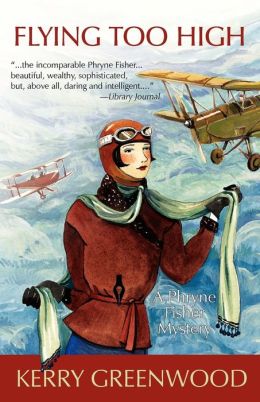
Flying Too High. Kerry Greenwood. 1990/2006. Poisoned Pen Press. 156 pages. [Source: Library]

Did I enjoy Flying Too High? Yes and no. Once I started, I felt I had to finish it. For better or worse. I'm disappointed with some of the content. I expect certain types of romance novels to have smut, but, I don't like the blending of smut into mysteries. I enjoy mysteries very much, smut not so much. (Some readers probably enjoy both, so this series will probably have fans.)

What I liked most about Flying Too High were the multiple mysteries involved. I liked following all three stories. I liked Phryne best when she was actively working on a case, and keeping her mind focused on the case. Sometimes she got TOO distracted. I thought she acted a bit unprofessional at times too.

I will probably not continue on with the series.


© 2015 Becky Laney of Becky's Book Reviews

Wednesday, April 01, 2015

Number the Stars (1989)

Number the Stars. Lois Lowry. 1989. (Won Newbery in 1990) 137 pages. [Source: Bought]

Number the Stars was probably one of the first fiction books I read about the Holocaust and World War II. (I know I also read The Hiding Place and The Diary of Anne Frank, but both of those are nonfiction.) What did I remember about Number the Stars after all these years? Well, I remembered that it was about a young girl who had a Jewish best friend. I remembered that the girl's family helped the friend and her family get out of Denmark. I remembered the intense scene where German soldiers come to her house looking for hidden Jews. But most of the details had faded away. So it was definitely time for me to reread.

Annemarie is the heroine of Number the Stars. I loved her. I loved her courage and loyalty. Ellen is Annemarie's best friend. I love that readers get an opportunity to see these two be friends before it gets INTENSE. I also love Annemarie's family. I do. I don't think I properly appreciated them as a child reader. One thing that resonated with me this time around was Annemarie's older sister, her place in the story. The setting. I think the book did a great job at showing what it could have been like to grow up in wartime with enemy soldiers all around. In some ways it was the little things that I loved best. For example, how Annemarie, Ellen, and Kirsti (Annemarie's little sister) play paper dolls together, how they act out stories, in this case they are acting out scenes from Gone with The Wind. I think all the little things help bring the story to life and make it feel authentic.

For a young audience, Number the Stars has a just-right approach. It is realistic enough to be fair to history. It is certainly sad in places. But it isn't dark and heavy and unbearable. The focus is on hope: there are men and women, boys and girls, who live by their beliefs and will do what is right at great risk even. Yes, there is evil in the world, but, there is also good.

© 2015 Becky Laney of Becky's Book Reviews

Wednesday, January 07, 2015

The Girl with the White Flag

The Girl With The White Flag. Tomiko Higa. Translated by Dorothy Britton. 1989. 130 pages. [Source: Bought]

The Girl with the White Flag is the story of the author's childhood in war-time Japan. It begins by giving the reader ample background into the time and culture and place.

One of the first events she shares with readers is the death of her mother. She then relates what life was like with her father, two older sisters, and her older brother. This portion is hard to navigate. I think in some ways it is just as hard for modern readers to understand the family life--the harshness, the strictness, the discipline, as it is to understand the monstrosities of war and soldiers and starvation. (Or maybe that's just my take on it.)

About halfway through the narrative, the father disappears. He was on his somewhat routine mission of delivering food to the Japanese soldiers, but on this occasion he never returned home. The four children are left to fend for themselves. The American soldiers have just begun their invasion, their battle to capture this island. The children become refugees and the fight to survive has begun. The children ranged in age from 17 to 6. Somewhere along the way, however, two things happen--big things--that make this event even scarier: 1) Their brother dies one night from a stray bullet. 2) Within a few days of burying their brother, our narrator--the six/seven year old girl becomes lost--separated--from her sisters.

The book recounts what it was like to be seven and alone and wandering in and out of danger. There was no safe place. Not really. Japanese soldiers weren't "safe." In fact, in her brief encounters with them she was almost killed. No, being near soldiers wasn't safe. The only "safe" soldier was a dead soldier. She did in fact scavenge around the dead soldiers looking for food.

Her will to survive was strong. Her stamina incredible in my opinion. The sights. The sounds. The smells. All surrounded her. Could have potentially traumatized her and paralyzed her into inaction.

If there is power in the Girl with The White Flag it is in its rawness, its simplicity, its boldness when it comes to being straightforward and honest. The story is incredible is powerful because it's true. Here is an eyewitness account of what it means to be seven and a refugee in a war zone. It can be brutal. It can be intense. But there is more to it than that.

I found The Girl with The White Flag to be an incredibly compelling read, a must-read for adults.

© 2015 Becky Laney of Becky's Book Reviews

Sunday, December 14, 2014

Eight Christmas Books

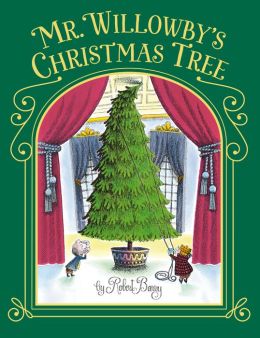
Mr. Willowby's Christmas Tree. Robert E. Barry. 1963. Random House. 32 pages. [Source: Library]

Mr. Willowby's Christmas tree came by special delivery. Full and fresh and glistening green--the biggest tree he had ever seen. He dashed downstairs to open the door--This was the moment he'd waited for.

I loved, loved, loved Mr. Willowby's Christmas Tree. It celebrates giving in a fun and playful way. Mr. Willowby starts off a long chain of giving when he chops off the top of his too-tall Christmas tree. A tree that is splendid in every other way. He gives the tree-top to the upstairs maid. She's delighted. Very delighted. How thoughtful! How cheery! But the tree is too-tall for her small room. The top must go! Chances are you can predict at this point how the story will go. But that doesn't mean it is in any way less delightful. This little tree-top gets passed down and re-trimmed again and again and again and again and again. And it's just WONDERFUL to see how much happiness and cheer it brings to others.

I loved the premise. I loved the writing. The rhyming was delightful. It worked very well for me! I think this one would make a great read-aloud. I also loved how uplifting it is. (After reading Baboushka and the Three Kings, I needed a cheery story!)

Why didn't someone tell me about this wonderful and charming picture book?! Why?! Well, I am glad to have discovered it now!

Which Christmas books would you consider classic? Which would you recommend?

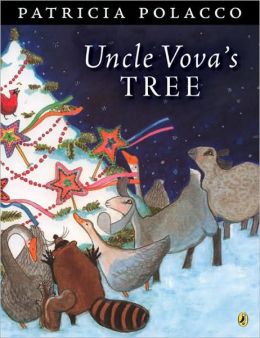
Uncle Vova's Tree. Patricia Polacco. 1989. Penguin. 32 pages. [Source: Library]

Uncle Vova's Tree is rich in detail and tradition. The author, Patricia Polacco, is drawing from her past and recalling some of her childhood Christmases. She writes, "As a child I celebrated Christmas as most American children did, but at Epiphany in January, my brother, my two cousins, my grandparents and I would go to the farm of my Great Uncle Vladimir and Aunt Svetlana to celebrate in the Russian tradition." The book recalls two family gatherings specifically. The first is Uncle Vova's last Christmas. Though of course, most everyone did not *know* it would be his last Christmas. The second is that first Christmas without him. The book definitely has tones of sadness, but, it is ultimately hopeful. Memories, good, strong happy memories, remain.

The book is rich in detail and tradition. It is informative in many ways. Did you know about the tradition of putting hay underneath the tablecloth to remember and honor the stable in Bethlehem where Jesus was born? But in addition to honoring tradition--in this case, Russian tradition--it also celebrates families. Readers meet a family that is close and loving and supportive. Little details make this one work well.

Too Many Tamales. Gary Soto. Illustrated by Ed Martinez. 1993. Penguin. 32 pages. [Source: Library]

Snow drifted through the streets and now that it was dusk, Christmas trees glittered in the windows.

Too Many Tamales is a great family-oriented Christmas story. Maria, our heroine, is helping her mom make tamales. She loves helping her mom, loves being grown-up in the kitchen. But things don't go smoothly with this first batch of tamales. And it is her fault. Mostly. Maria really, really, really wanted to try on her mom's ring. Unfortunately, this-too-big ring falls right into the masa mixture. Hours later, she realizes that she never took the ring off. She doesn't know for sure where the ring is. But she has a strong suspicion that it may very well be in one of the twenty-four tamales. With a little help from her cousins, Maria is in a race to find the ring before her mom--and all the other relatives--realize what has happened. Will she find the ring? Will her mom find out? Will her cousins ever want to eat another tamale?!

I liked this one very much.

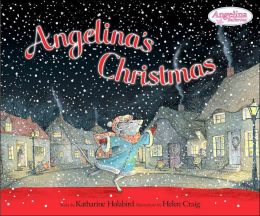
Angelina's Christmas. Katharine Holabird. Illustrated by Helen Craig. 1986. Penguin. 32 pages. [Source: Library]

Christmas was coming, and everyone at Angelina's school was working hard to prepare for the Christmas show.

I enjoyed reading Angelina's Christmas. I enjoyed meeting Angelina and her family. I loved how thoughtful and empathetic Angelina was. She realizes that there is one house in the village that is not decorated. She notices that there is one "old man huddled by a tiny fire." She learns from her parents that this old man is Mr. Bell, a retired postman. She decides that she will do something special for him so he won't be all alone at Christmas time. (And Angelina isn't the only one joining in to help make this Christmas memorable for Mr. Bell.) She makes him cookies, her mom sends along mince pies and fruit, her dad cuts him a Christmas tree. They visit him, Henry, Angelina's brother comes along too. But perhaps even more importantly than showing him kindness through things, they take the time to listen to him, to include him. This one is a lovely book.

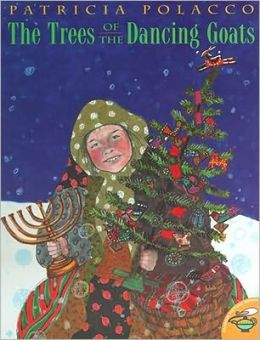
The Trees of the Dancing Goats. Patricia Polacco. 2000. Simon & Schuster. 32 pages. [Source: Library]

At our farm just outside Union City, Michigan, we didn't celebrate the same holidays as most of our neighbors...but we shared their delight and anticipation of them just the same.

I enjoyed reading The Trees of the Dancing Goats by Patricia Polacco. She is sharing yet another holiday memory with young readers in this picture book.

The story focuses on one holiday season when the town is hit by an epidemic, scarlet fever, I believe. The heroine's family is not sick, but, most of their neighbors are. As they are preparing to celebrate Hanukkah, they realize that most of their neighbors are too sick to prepare for and celebrate Christmas. They love their neighbors. They want to do something for them. Working together as a family, they decide to bring Christmas to their neighbors: food, a tree, decorations. Since they don't own any Christmas ornaments, they use animals carved out of wood. One of the animals, as you might have guessed, is a goat. When hung on the tree, it appears to be a dancing goat. Can one family bring Christmas cheer to a community?

I liked this one. I liked the family scenes very much. It is a thoughtful book. I'm glad I finally discovered it!

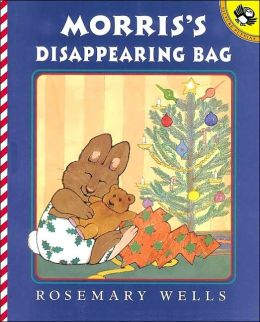
Morris' Disappearing Bag. Rosemary Wells. 1975. Penguin. 40 pages. [Source: Library]

It was Christmas morning. "Wow!" said Morris.

Morris' Disappearing Bag probably isn't my favorite Rosemary Wells, but, this one is enjoyable enough that it's worth reading at least once or twice. Morris stars in this one. He has three older siblings: one big brother, Victor, and two older sisters, Rose and Betty. It is a Christmas book, of course. After all the presents are opened, the three older siblings play with their presents and play with each others presents. Victor got hockey stuff. Betty got a chemistry set. Rose got a beauty kit. They take turns sharing. Much fun is had. But not by all. For Morris has only his present (a teddy bear) to play with. He doesn't get a turn with his siblings' presents. But that changes when Morris discovers a fantastic present under the tree. A bag. A disappearing bag. Whatever is in the bag disappears. His siblings all want a turn, and, he lets them in the bag. While his siblings have disappeared for the day, Morris plays with their stuff before settling into bed with his bear.

Max's Christmas. Rosemary Wells. 1986. Penguin. 32 pages. [Source: Library]

I love watching Max and Ruby. I've seen the adaptation of Max's Christmas plenty of times before I read the book. If you like the show, chances are you'll enjoy reading this book. It is very similar. For those new to these lovable siblings, Ruby is the older sibling. She seems to be raising Max all on her own. (Ruby and Max don't have parents. They have a Grandma, but, she does not live with Max and Ruby.) Max is the younger sibling. He is many things: cute, clever, curious. Yes, he can be mischievous, but, he is also super-observant. I love, love, love them both. I might like Max a tiny bit better than Ruby. But still. I love them both.

In this book, readers join Ruby and Max on Christmas Eve night. Ruby is trying her best to get Max to get ready for bed, to go to sleep. Max is excited, of course. Once he knows that Santa is coming to his house tonight, he wants to see it for himself. So he goes downstairs to wait for Santa....

I liked this one very much.

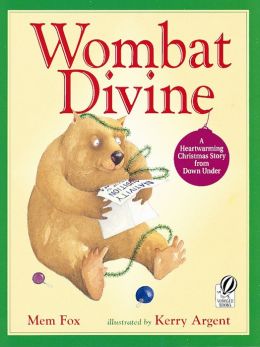
Wombat Divine. Mem Fox. Illustrated by Kerry Argent. 1995/1999. HMH. 32 pages. [Source: Library]

I found Mem Fox's Wombat Divine to be charming. I loved Wombat. He loves, loves, loves Christmas. More than anything, he wants a part in the nativity play. At the auditions, he tries his best. But there are so many parts that he's just not right for. I love the refrain, "Don't lose heart. Why not try for a different part?" which is used throughout the whole auditioning process. He auditions for Archangel Gabriel, Mary, a wise king, Joseph, an innkeeper, and a shepherd. But there's one role that he'd be just perfect playing. Can you guess it?

I liked this one. I thought it was cute and sweet. I liked the writing. I found it unique and oh-so-right.

© 2014 Becky Laney of Becky's Book Reviews

Sunday, December 07, 2014

Ten Christmas Picture Books

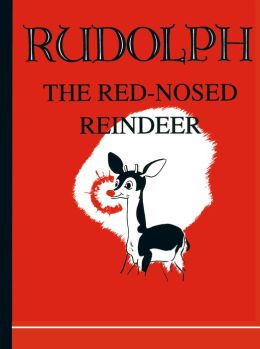
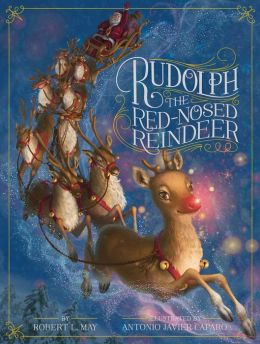
Rudolph the Red-Nosed Reindeer. Robert Lewis May. Illustrated by Denver Gillen. 1939/1990. Applewood Books. 32 pages. [Source: Library]

I enjoyed this one more than I thought I would. This is the original story by Robert L. May with the original illustrations by Denver Gillen. It is so different from the song and the stop-motion animated special. And I think it was the fact that it was different that made me appreciate it more.

The story is told in rhyme. It's essentially one long (perhaps poorly punctuated) poem. Here's how it begins:
Twas the day before Christmas, and all through the hills
The reindeer were playing…enjoying the spills
Of skating and coasting, and climbing the willows…
And hop-scotch and leap-frog (protected by pillows!)
While every so often they'd stop to call names
At one little deer not allowed in their games:--
"Ha ha! Look at Rudolph! His nose is a sight!"
"It's red as a beet!" "Twice as big!" "Twice as bright!"
While Rudolph just wept.
What else could he do?
He knew that the things
they were saying were true!
Readers first meet Rudolph, a young deer who is teased by his peers. He does NOT live at the North Pole. And he's not one of Santa's own reindeer.
What we do learn is that he's a very good, very obedient deer who is expecting Santa to leave him some lovely presents because he's been so very, very good.

Readers then meet Santa and learn of the horrible weather conditions that prove most challenging. Santa starts out on his trip, it isn't until he's delivering presents to Rudolph's house that he notices the brilliant light of his nose.

Santa then decides to wake him up and ask for his help. The rest of the journey goes much easier for Santa!

The book concludes with Santa returning Rudolph to his family, to his hometown. He is now a hero, of course.

I liked this one. I liked some of the rhymes more than others. There are definitely some quirky lines!
Come Dasher! Come Dancer! Come Prancer and Vixen!
Come Comet! Come Cupid! Come Donner and Blitzen!
Be quick with your suppers! Get hitched in a hurry!
You, too, will find fog a delay and a worry!"
And Santa was right. (As he usually is!)
The fog was as thick as a soda's white fizz.
The book is definitely text-heavy. So a longer attention span would be needed for little ones to enjoy this one.

The copy I read was a facsimile edition. A 75th Anniversary edition with new illustrations was released in September 2014.

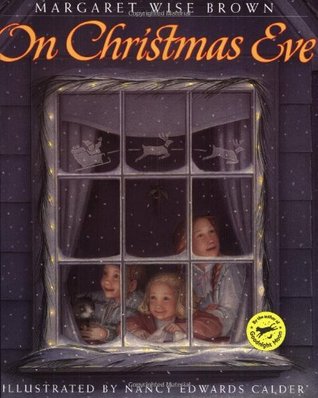
On Christmas Eve. Margaret Wise Brown. Illustrated by Nancy Edwards Calder. 1938/1961/1996. HarperCollins. 32 pages. [Source: Library]

It was the middle of the night. And night of all  nights it was Christmas.

I enjoyed Margaret Wise Brown's On Christmas Eve. It is a descriptive look at what Christmas--at what Christmas Eve--is like for children. It focuses on simple things: what your eyes see, what your ears hear, what your nose smells, what your hands and feet touch. It seeks to capture the emotion of the holiday: the excitement, the waiting, the longing.

Lots of details, lots of adjectives. It's rich in imagery and description. There is also a bit of repetition. The text is lyrical in places.

I can't say that I loved it. But it was very enjoyable. I was also glad to see that one of the presents under the tree was a train. The children are just in awe of the magic of Christmas, of the stockings and packages, of the snow falling outside, of the carolers outside.

It was a sweet story about three siblings.

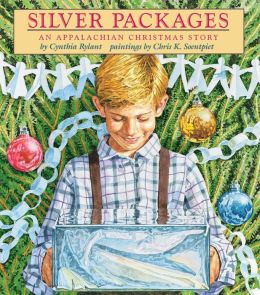
Silver Packages: An Appalachian Christmas Story. Cynthia Rylant. Illustrated by Chris K. Soentpiet. 1987. Scholastic. 32 pages. [Source: Library]

Silver Packages is a picture book for older readers most likely. I wouldn't say it is for an exclusively adult audience. But I think readers need some perspective in order to appreciate the book fully. I think it can resonate with readers, it has the potential. But I don't think the emotional reaction would be--or even should be--automatic. One can't assume that every reader will respond with tears and "this is the best book I've ever read!!!"

Silver Packages is about giving back to the community. In this instance, one very specific community--Appalachia. The book is about the Christmas Train. It starts with one man who wants to show his appreciation for the community that helped him when he needed it. He was injured in an accident, the community took in this stranger and nursed him back to health without asking for anything in return. He decides that he will come every year--by train--and hand out packages to the children who meet the train. These packages are wrapped in silver paper. Every story needs a protagonist. Silver Packages introduces us to Frankie. Readers first meet Frankie as a boy. He's a boy with a dream. He wants to be a doctor. And he really, really, really wants a doctor kit for Christmas. But each year, he's slightly disappointed. He receives a handful of silver packages through the years. Every gift seems to have a toy--something a boy or girl might want--and something a boy or girl might need. The practical gifts include: socks, mittens, hats, scarves, etc. Readers later see Frankie all grown up. He is a doctor. He reflects on his life, on his past Christmases, he has a light-bulb moment. He decides it is his turn to give back to the community in his own special way. It's a book about kindness and gratefulness and community awareness.

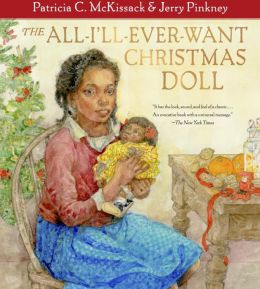
The All-I'll-Ever-Want Christmas Doll. Patricia C. McKissack. Illustrated by Jerry Pinkney. 2007. Schwartz & Wade. 40 pages. [Source: Library]

Christmas always came to our house, but Santy Claus only once in a while.

I haven't read The All-I'll-Ever Want-Christmas Doll in years. It was just as good as I remembered. The book is set during the Depression. A little girl, Nella, knows that her family is poor, that Santy may not come this year at all. Yet, she can't resist writing to him all the same begging for a Baby Betty doll. Her two sisters perhaps think a little less of Nella for her dreaming so big. She shouldn't expect so much from Christmas. But on Christmas morning, there are a few surprises. Each girl gets a Christmas sack filled with walnuts, peppermint candy, an orange, and a box of raisins. But there is one present, one special present remaining: a doll. Nella thinks the doll should be HERS and hers alone. After all, her sisters haven't gone around talking about the doll nonstop, her sisters didn't write Santa a letter begging for the doll. Why should she have to share the doll with them? But does the doll make her happy? Is the doll truly all she'll ever want? She has a few lessons to learn for sure!

I really enjoyed the story and the message.

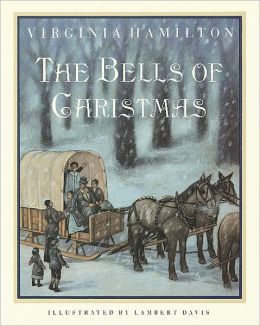
The Bells of Christmas. Virginia Hamilton. Illustrated by Lambert Davis. 1989/1997. Houghton Mifflin Harcourt. 64 pages. [Source: Library]

I didn't dislike Virginia Hamilton's The Bells of Christmas. But I didn't love, love, love it either. I think it depends on what exactly you're expecting from a Christmas book. The Bells of Christmas is very much a celebration of a Christmas long ago. Christmas 1890. Readers meet a young boy, Jason Bell, and experience the holiday through his perspective. We learn about his mom and dad, his brothers and sisters, his cousins, his aunt and uncle, his friend, Matthew. The book is set over a period of several days. Among the things readers learn that Jason's dad is a carpenter, that he wants his sons to join him in his business one day, his dad has only one leg, that his dad wears a peg leg part of the time and is in his wheel chair the rest of the time. Readers also learn that Jason is just a wee bit obsessed with wheels--mainly trains, but, also wagons, etc. The book has plenty of detail and characterization which is a good thing. Jason is waiting for quite a few things: 1) he can't wait for Christmas morning and presents! 2) he can't wait for the Bells to arrive--his uncle and aunt and cousins, 3) he is excited about church, most everyone is performing and participating in some way. (Jason is singing a solo.) The book perhaps seeks to capture one Christmas for one extended family. It is a pleasant, enjoyable book. It isn't quite a chapter book or novel. It isn't quite a picture book.
 
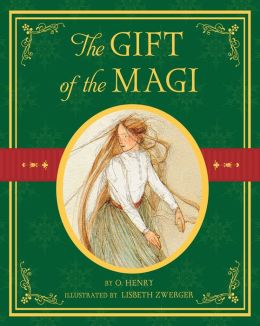
The Gift of the Magi. O. Henry. Illustrated by Lisbeth Zwerger. 1905/2006. Simon & Schuster. 32 pages. [Source: Library]

I've seen adaptations of The Gift of the Magi--who hasn't? (My favorite is Bert and Ernie and Mr. Hooper.) But this is the first time I've read the actual short story. I haven't decided how I feel about it. Is this couple wise or foolish? Or are they at times foolish and at times wise?

The wife, Della, takes extraordinary pride in her long hair. She doesn't seem the vain sort except for when it comes to her hair. And even if she is vain about it, there's no indication it's anything besides a private vanity. The wife apparently has been coveting expensive hair combs as well. The husband, Jim, takes extraordinary pride in the family watch. The narrator uses exaggeration when discussing the woman's long hair and the man's gold watch. I didn't love the narrator. In fact, I think the narrator is a distraction. He won't let the reader forget for a moment that this is a precious story.
Now, there were two possessions of the James Dillingham Youngs in which they both took a mighty pride. One was Jim's gold watch that had been his father's and his grandfather's. The other was Della's hair. Had the queen of Sheba lived in the flat across the airshaft, Della would have let her hair hang out the window some day to dry just to depreciate Her Majesty's jewels and gifts. Had King Solomon been the janitor, with all his treasures piled up in the basement, Jim would have pulled out his watch every time he passed, just to see him pluck at his beard from envy.
The wife can't afford a gift for her husband. The husband can't afford a gift the wife. The wife knows this--or should know this. The husband knows this--or should know this. The wife has saved $1.87. The husband might have saved a small sum as well. Readers don't know one way or the other. Both husband and wife will have something to offer the other, however. Something more than love. For both have decided--quite independently--to give sacrificially. To give up what they supposedly value most: her hair, his watch. And this giving up wasn't to support the family, but, to support the other's vanity.

I think actions can speak more than words. I think the narration took away some of my enjoyment of this one. It felt odd at times. There were sentences that were eloquent and refined and then it would slip into something else.
"It's sold, I tell you--sold and gone, too. It's Christmas Eve, boy. Be good to me, for it went for you. Maybe the hairs of my head were numbered," she went on with sudden serious sweetness, "but nobody could ever count my love for you. Shall I put the chops on, Jim?"
I think I like the adaptations better.

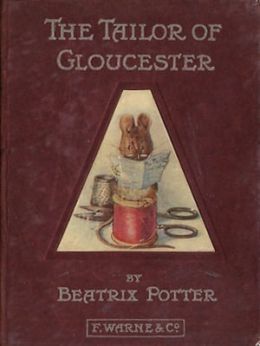
The Tailor of Gloucester. Beatrix Potter. 1903. 58 pages. [Source: Library] 
In the time of swords and periwigs and full-skirted coats with flowered lappets—when gentlemen wore ruffles, and gold-laced waistcoats of paduasoy and taffeta—there lived a tailor in Gloucester.
He sat in the window of a little shop in Westgate Street, cross-legged on a table, from morning till dark.
All day long while the light lasted he sewed and snippeted, piecing out his satin and pompadour, and lutestring; stuffs had strange names, and were very expensive in the days of the Tailor of Gloucester.
I enjoyed rereading Beatrix Potter's The Tailor of Glouchester. In this delightful Christmas tale, readers meet a tailor, a cat named Simpkin, and some lovely mice. It is several days before Christmas. He's working hard to finish a coat and waistcoat for the Mayor of Glouchester. The Mayor is getting married on Christmas day. The tailor has just enough money to finish the coat. Not a penny to spare. He sends his cat, Simpkin, with his money to buy what he needs: a little for himself (food: bread, sausage, milk) a little for his work (one twist of cherry-coloured silk). It is only after the fact that he questions whether he should have sent the cat or gone himself. The cat returns, but, in a mood. The cat is upset for he's discovered that the tailor freed the mice he had captured and hid under the teacups. The cat hides the twist. The man is upset, of course, and sick. He takes to his bed unable to work. The oh-so-thankful mice go to his shop and finish his work for him. But since they are one twist short, they are unable to finish completely. Still, they do what they can, and they do a wonderful job. The cat who spies them at work, I believe, has a change of heart and gives the twist to the old man on Christmas morning. He has just enough time to finish. The Mayor is very, very pleased. And the tailor's luck changes for the better, and his business is much improved. This one is a lovely, delightful read from start to finish.

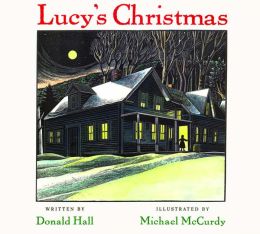
Lucy's Christmas. Donald Hall. Illustrated by Michael McCurdy. 1998. Houghton Mifflin Harcourt. 40 pages. [Source: Library]

I enjoyed reading Lucy's Christmas by Donald Hall. Lucy's Christmas is a picture book set in 1909 in New Hampshire. In the fall of 1909, Lucy and her family start preparing for Christmas. For Lucy, this means starting to make her own gifts for her family and friends. It pays to plan ahead since so many gifts take time, and thought must be placed into each gift. She's not the only one thinking ahead. This year the family is ordering a new stove for the kitchen. The family has spent a lot of time browsing in the Sears catalog. Lucy's choice is the one the family decides upon: the Glenwood Kitchen Range. The focus is not just on gifts: planning, making, giving, receiving. The focus is also on family life and community life. Readers get glimpses of the school and church. Both places are very busy! I enjoyed this glimpse into the past! It was interesting to see the family prepare for the new year--1910. The enthusiasm in the story is sweet. The author's note reveals that this picture book is based on family history.

I really liked this one very much. I liked Lucy and her family. I liked the fact that the church plays such a HUGE role in the Christmas celebrations. There are gifts, it's true. But it's not commercialized and selfish.

Baboushka and the Three Kings. Ruth Robbins. Illustrated by Nicholas Sidjakov. 1960/1986. Houghton Mifflin Harcourt. 32 pages. [Source: Library]

Long ago and far away, on a winter's evening, the wind blew hard and cold around a small hut.

Baboushka and the Three Kings won the Caldecott Medal in 1961. It is Russian folktale with a Christmas setting. The three kings--wise men--come to Baboushka's hut. They only stay a few minutes. Long enough to extend an invitation to the old woman. Will she join them in their procession, in their quest, to find the Babe, the Child? She'd love to join them, she'd love to bring gifts to the Child. But she is not ready to go just yet. Couldn't they all wait until morning? Couldn't they wait for her to finish up a few small, tiny chores first? Couldn't they wait for the storm to clear? Their answer was firm. Their journey to the Child was too important to postpone. They couldn't linger longer. She watched them depart. But they were not easy men to forget. The next morning, she begins a journey of her own. A journey that will take her far. But will her journey lead her to where she wants to go?

It's a simple story, nicely written. "It is no ordinary Babe they seek. Yes! I must go and follow them! To find the new Babe, to offer Him her gift, was now her one yearning. This thought burned in her mind like a candle in the dark." It is also nicely illustrated. The illustrations complement the text well. Both illustrations and text have a different flavor, an authentic flavor, but not exactly American. After several readings, I came to appreciate both a bit more.

In case you're unfamiliar with the story, the book is bittersweet at best. While it is true that Russian children everywhere look forward to Baboushka's gifts each year as her journey continues, it is also true that Baboushka's journey has no happy ending. She never finds the Child. She is never able to give Him her gifts.

Polar Express. Chris Van Allsburg. 1985/2009. Houghton Mifflin Harcourt. 32 pages. [Source: Library]

The Polar Express is one of my favorite Christmas books. It is. The book is a thousand times better than the movie. (Though the soundtrack of the movie isn't bad.) So if you've only seen the movie, you might want to give the book a try to. You might have a different response to it.

The Polar Express is about belief and doubt--in Santa. It's told in the first person, so we never learn the protagonist's name, but it is a little boy with a younger sister named Sarah. One Christmas Eve, the little boy is awakened by The Polar Express. He goes to the North Pole on the Polar Express train, there are other passengers too. All presumably boys and girls on the verge of not-believing. At the North Pole, he sees Santa, reindeer, and elves. He happens to be chosen to receive the first gift of Christmas. He asks for a bell from Santa's reindeer. This gift is not in his possession for long, however, because he has a hole in his pocket. On Christmas day, he receives a special gift under the tree: the bell he had lost. He can hear it. His sister can hear it. But his parents do not. The book ends wonderfully with a message for "all those who truly believe."

I loved this one cover to cover, though I love the ending most of all.


© 2014 Becky Laney of Becky's Book Reviews

Thursday, March 06, 2014

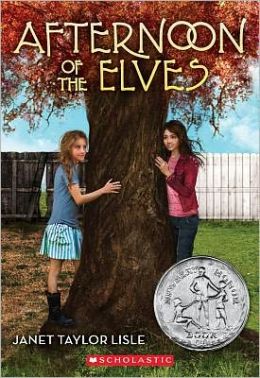
Afternoon of the Elves (1989)

Afternoon of the Elves. Janet Taylor Lisle. 1989. Scholastic. 128 pages. [Source: Review copy]

I enjoyed reading Afternoon of the Elves. At its heart, the novel is simply about an unlikely friendship, and how that friendship impacts the two girls. Sara-Kate is the oldest of the girls. She does not have any friends at school. She is not exactly invisible, but, her real self is not seen by anyone. If Sara-Kate were successfully invisible at school, perhaps the girls would not go to so much trouble to talk about her all the time, to tell of scandalous doings, to share every rumor, perhaps to invent every rumor. They are noticing Sara-Kate for all the wrong reasons: she doesn't look like me, she doesn't dress like me, she doesn't act like me, she doesn't talk like me. Hillary, the youngest girl, is Sara-Kate's neighbor. Sara-Kate has NEVER to anyone's knowledge invited another girl to play with her. But she does invite Hillary into her backyard. She shows her an elf-village. Hillary isn't exactly sure that elves are real, that they do in fact live in a village in her neighbor's backyard. But the "proof" of such a village does exist. And together these two girls meet almost daily through the fall. They keep it to the yard. They keep the subjects limited. No probing questions on subjects Sara-Kate would rather avoid. But. Hillary, eventually, comes to realize that some of the rumors she thought were mere lies had some basis in truth.

The book is interesting. Sara-Kate is mysterious: veiling her darkest truths but at the same time showing glimpses here and there that do hint at her desperate need to be seen and loved and helped. Hillary is observant enough to know that Sara-Kate likes to have control, that she hates to be vulnerable. She comes to think of her friend as an elf, having all the elf qualities that she learns about from Sara-Kate. Hillary does make decisions. She decides to NOT listen to her friends. She chooses to befriend Sara-Kate even though no one else likes her. She does decide to go over to her friend's house every day despite the fact that her mother does not approve. She decides that her mother just doesn't know Sara-Kate, and that her mother is wrong to think the worst of Sara-Kate and her mother. She decides to steal money from her mother's purse to help Sara-Kate when she realizes that her friend has no food in the house. Hillary never has to make the hardest decision. She never has to make the ultimate choice of keeping her friend's secret no matter what, or, telling her mom. I'm not sure what Hillary would have decided.

© 2014 Becky Laney of Becky's Book Reviews