Showing posts with label 1961. Show all posts

Tuesday, August 11, 2026

59. The Phantom Tollbooth


59. The Phantom Tollbooth. Norton Juster. Illustrated by Jules Feiffer. 1961/2011. Random House. 272 pages. [Source: Library] [5 stars, children's fantasy, children's classic]

First sentence: There was once a boy named Milo who didn't know what to do with himself--not just sometimes, but always.

Premise/plot: Milo, our hero, is about to have an "impossible" adventure. His day starts out very ordinary, however, by the end of the day Milo will be quite transformed!

It starts with a mysterious gift-box. It holds a tollbooth for him to construct, also included are instructions, rule books, and a map. He randomly chooses to go to Dictionopolis. But though that is his original destination, Milo finds that travels--magical or not--take some thought and intention.

My thoughts: I loved, loved, loved this one! I first read it in September 2013. I'm only now rereading it, but, this should be one I read again and again more frequently.

The writing is AMAZING. It is clever, rich in meaning and symbolism. And it is oh so quotable! One of those rare books where you could almost open up the book to any page and find a gem worth quoting!

Loved the writing, loved the creativity, loved the characters!

Favorite quotes:
“Expect everything, I always say, and the unexpected never happens.”
“You may not see it now," said the Princess of Pure Reason, looking knowingly at Milo's puzzled face, "but whatever we learn has a purpose and whatever we do affects everything and everyone else, if even in the tiniest way. Why, when a housefly flaps his wings, a breeze goes round the world; when a speck of dust falls to the ground, the entire planet weighs a little more; and when you stamp your foot, the earth moves slightly off its course. Whenever you laugh, gladness spreads like the ripples in the pond; and whenever you're sad, no one anywhere can be really happy. And it's much the same thing with knowledge, for whenever you learn something new, the whole world becomes that much richer.”
“So many things are possible just as long as you don't know they're impossible.”
“Everybody is so terribly sensitive about the things they know best.”
“And remember, also," added the Princess of Sweet Rhyme, "that many places you would like to see are just off the map and many things you want to know are just out of sight or a little beyond your reach. But someday you'll reach them all, for what you learn today, for no reason at all, will help you discover all the wonderful secrets of tomorrow.”
“In this box are all the words I know…Most of them you will never need, some you will use constantly, but with them you may ask all the questions which have never been answered and answer all the questions which have never been asked. All the great books of the past and all the ones yet to come are made with these words. With them there is no obstacle you cannot overcome. All you must learn to do is to use them well and in the right places.” 


© 2026 Becky Laney of Becky's Book Reviews

Sunday, September 17, 2017

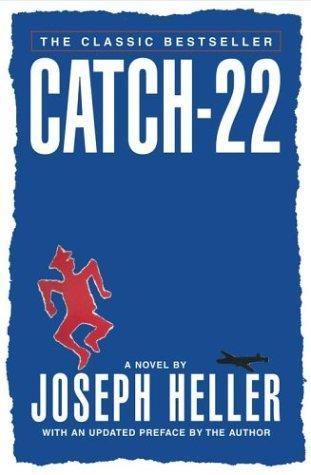
Catch-22

Catch-22. Joseph Heller. 1961. 453 pages. [Source: Library]

First sentence: It was love at first sight. The first time Yossarian saw the chaplain he fell madly in love with him. Yossarian was in the hospital with a pain in his liver that fell just short of being jaundice. The doctors were puzzled by the fact that it wasn't quite jaundice. If it became jaundice they could treat it. If it didn't become jaundice and went away they could discharge him. But this just being short of jaundice all the time confused them.

Premise/plot: Catch-22 is set during the Second World War near the Italian front. Yossarian, our protagonist, is ruled by one thing: the desire to stay alive another day. He doesn't want to be a hero. He doesn't want to do his duty. He doesn't want to be a team-player. He doesn't want to follow orders, not if following orders means dying. He's a terrible, terrible soldier and he knows it.
Yossarian was a lead bombardier who had been demoted because he no longer gave a damn whether he missed or not. He had decided to live forever or die in the attempt, and his only mission each time he went up was to come down alive. (29)
Throughout the novel, the number of flight missions needed to complete the tour of duty keeps increasing. Yossarian didn't mind--quite so much anyway--doing his part if the end was in sight. Say he'd flown 35 out of 40 missions. But to know that no matter how many you fly, your squadron's missions will keep increasing is too much. By the end, I want to say it's eighty missions before you can get sent home. Meanwhile, his friends--some of them his close friends--keep dying.

If I had to sum it up simply I'd say Catch-22 was one man's struggle to stay alive and stay sane in the attempt. Is he successful at the staying sane? You'll have to judge for yourself.

 
My thoughts: I didn't love, love, love everything about this one. It is far from clean in terms of profanity and adult situations. But I really enjoyed the narration. I thought it was a very well-written novel. I found it funny.
"Can't you ground someone who's crazy?" "Oh, sure. I have to. There's a rule saying I have to ground anyone who's crazy." "Then why don't you ground me? I'm crazy. Ask Clevinger." (45)
"Is Orr crazy?" "He sure is," Doc Daneeka said. "Can you ground him?" "I sure can. But first he has to ask me to. That's part of the rule." "Then why doesn't he ask you to?" "Because he's crazy," Doc Daneeka said. "He has to be crazy to keep flying combat missions after all the close calls he's had. Sure, I can ground Orr. But first he has to ask me to." "That's all he has to do to be grounded?" "That's all. Let him ask me." "And then you can ground him?" Yossarian asked. "No. Then I can't ground him." "You mean there's a catch?" "Sure there's a catch," Doc Daneeka replied. "Catch-22. Anyone who wants to get out of combat duty isn't really crazy." (45-6)
There was only one catch and that was Catch-22, which specified that a concern for one's own safety in the face of dangers that were real and immediate was the process of a rational mind. Orr was crazy and could be grounded. All he had to do was ask; and as soon as he did, he would no longer be crazy and would have to fly more missions.(46)
History did not demand Yossarian's premature demise, justice could be satisfied without it, progress did not hinge upon it, victory did not depend on it. That men would die was a matter of necessity; which men would die, though, was a matter of circumstance, and Yossarian was willing to be the victim of anything but circumstance. (68)
"The enemy," retorted Yossarian with weighted precision, "is anybody who's going to get you killed, no matter which side he's on, and that includes Colonel Cathcart. And don't you forget that, because the longer you remember it, the longer you might live. (124)
You know, that might be the answer--to act boastfully about something we ought to be ashamed of. That's a trick that never seems to fail. (139)
Something was terribly wrong if everything was all right and they had no excuse for turning back. (140)
It was one thing to maintain liaison with the Lord, and they were all in favor of that; it was something else though to have Him hanging around twenty-four hours a day. (201)
"What in the world are Wisconsin shingles?" asked Yossarian. "That's just what the doctor's wanted to know!" blurted out the chaplain proudly, and burst into laughter. "There's no such thing as Wisconsin shingles. Don't you understand. I lied. I made a deal with the doctors. I promised that I would let them know when my Wisconsin shingles went away if they would promise not to do anything to cure them. (363)


© 2017 Becky Laney of Becky's Book Reviews

Tuesday, March 14, 2017

Stop Stop

Stop Stop. Edith Thacher Hurd. Illustrated by Clement Hurd. 1961. 64 pages. [Source: Bought]

First sentence: It was Saturday. Suzie's mother and Suzie's father had gone away.

Premise/plot: Miss Mugs is Suzie's babysitter for the day. She is very particular. Everything--everyone--must be very, very clean. Before the two can go to the zoo, everything has to meet her approval. (Even the curtains!) This critical eye continues at the zoo. But some animals don't appreciate her outspoken opinions! One animal has a way of getting back at her!

My thoughts: I grew up with this one. It is fun! I loved the 'justice' of this one. I've always loved elephants. Miss Mugs did need a reminder of what matters most. As an adult, I wonder if the parents picked her BECAUSE she would clean the house top to bottom. I would choose Miss Mugs rather than Amelia Bedelia to babysit.


© 2017 Becky Laney of Becky's Book Reviews

Monday, September 19, 2016

Emily's Runaway Imagination

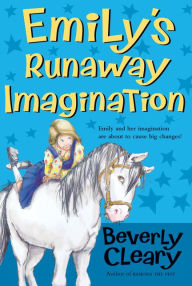
Emily's Runaway Imagination. Beverly Cleary. 1961. 288 pages. [Source: Bought]

First sentence: The things that happened to Emily Bartlett that year!

Premise/plot: Emily Bartlett is the heroine of Beverly Cleary's Emily's Runaway Imagination. Emily has many adventures or misadventures, many of which center around the formation of the first public library in her town. I would categorize the book as historical fiction. Reference is made to a world war, and, I think it may even be the first world war. One of the adventures involves Emily's grandpa getting a car. And having a car is a novelty in their town. Most people either walk, ride horses, drive a horse and wagon.

My thoughts: I really LOVE this one. If I read this one growing up, I only read it once. It's even possible this is one we didn't own. It took me so long to get to it as an adult because the local library doesn't have a copy of it. I bought this battered copy of it at my local charity shop for a quarter.

Favorite quotes:
"There are still books left to choose from," answered Mama.
And there were! Just think of it, real library books right here in Pitchfork, Oregon. The Dutch Twins, the Tale of Jemima Puddleduck--what a tiny book that was! Emily had not known they made such little books. The Curly-Haired Hen, English Fairy Tales. But no Black Beauty. Oh, well, perhaps another time. Emily chose English Fairy Tales because it was the thickest, and Mama wrote her name on a little card that she removed from a pocket in the book. Emily now had a library book to read. (117)
"Ma'am, is it all right if I get some books for my family?" he asked.
Mama smiled at the boy. "I don't believe I have seen you in Pitchfork before. Do you live in the country?"
"No, ma'am. I live in Greenvale," he answered. "We read about the library in the Pitchfork Report and I walked down the railroad track to see if we could get some books too."
"Why, that's at least four miles," said Mama, "and four miles back again."
The boy looked at the floor. "Yes ma'am."
"Of course you may take books for your family," said Mama. This boy wanted to read. That was enough for her. It made no difference where he lived. (118)


© 2016 Becky Laney of Becky's Book Reviews

Thursday, June 16, 2016

James and the Giant Peach

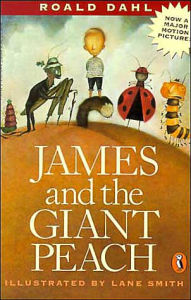
James and the Giant Peach. Roald Dahl. Illustrated by Quentin Blake. 1961. 146 pages. [Source: Library]

First sentence: Here is James Henry Trotter when he was about four years old.

Premise/plot: James, our hero-orphan being raised by two horrid aunts (one horribly fat, one terribly skinny), finds his fortune changing quickly one day when he meets a complete stranger--an older man--who promises to show him something wonderful and then pulls something out of his pocket...a small white paper bag filled with tiny green almost-glowing things. He's given instructions on how to use these green things to have a super-wonderful life. But. On his way home, he trips and the green things are lost...on the ground....but that is not the end. The title should give away the rest.

My thoughts: This one was weird and silly and unexpected and unique. I didn't hate it certainly. It is very Dahl. But I didn't love it. I find Dahl's lack of characterization annoying in some ways because instead of characterization we don't get more action or more adventure, we just get cruelty. Cruelty seems to be one thing all Dahl books have in common.
Aunt Sponge was enormously fat and very short. She had small piggy eyes, a sunken mouth, and one of those white flabby faces that looked exactly as though it had been boiled. She was like a great white soggy overboiled cabbage. (6)
I liked this one better once James enters the giant peach and meets all the insects who have been effected by the mystery green things.

© 2016 Becky Laney of Becky's Book Reviews

Saturday, September 12, 2015

Momo's Kitten

Momo's Kitten. Mitsu and Taro Yashima. 1961. Viking. 33 pages. [Source: Bought]

First sentence: Momo's family moved out West from New York City to Los Angeles, but Momo did not see any ranches or cowboys around her. Instead of these, on the way home from the nearby market one afternoon she found a miserable kitten under a geranium bush by the sidewalk. "If your father says it's all right, you may keep the kitty," Mother said. Momo made herself ready to cry in case Father should say it was not all right.

Premise/plot: Momo, the heroine, finds a stray kitten and gets to keep it. To her surprise, but probably not to her parents' surprise, her cat, Nyan-Nyan grows up to have kittens of her own. She's not allowed to keep the kittens, but consoles herself, in a way, by making birth certificates for each kitten as they are given away. The illustration of the certificate I found quite charming. I would say this is a good, old-fashioned first-pet story.

My thoughts: I love, love, LOVE Umbrella by Taro Yashima. I do. It's one of my favorite, favorite books. Momo's Kitten is another story starring Momo. So if you love Umbrella, you may just want to seek this out-of-print book out. Did I love it as much as Umbrella? Probably not. But I am glad I read it. I definitely enjoyed the text. Some illustrations I loved. Other illustrations not so much. I definitely found the illustrations for Umbrella to be more appealing.

Text: 4 out of 5
Illustrations: 3 out of 5
Total: 7 out of 10

© 2015 Becky Laney of Becky's Book Reviews

Thursday, June 25, 2015

Return to Gone-Away (1961)

Return to Gone-Away. Elizabeth Enright. 1961/2000. Houghton Mifflin Harcourt. 224 pages. [Source: Library]

I really enjoyed reading Elizabeth Enright's Gone-Away Lake. I didn't enjoy reading the sequel nearly as much. Was I not in the right mood? Perhaps. I hope it was just a mood thing. It felt like the magic--the energy--was gone.

The book features many of the same characters, and tells of their further adventures in the spring and summer the following year. Their adventures AFTER they have purchased the old-and-crumbling house.

Portia, the heroine, reconnects with Julian, her cousin. Foster, Portia's younger brother, reconnects with the friends he's made in the community. All the children enjoy spending time with Mrs. Cheever and Mr. Payton. Adventures are to be had in their new house that requires fixing-up in every room and then some. Adventures also to be had outside in nature. Each chapter focuses on some mini-adventure that one of the children is having.

While I found myself connecting and caring with the characters in the first book, I didn't with the second.

© 2015 Becky Laney of Becky's Book Reviews

Saturday, May 16, 2015

Seuss on Saturday #20

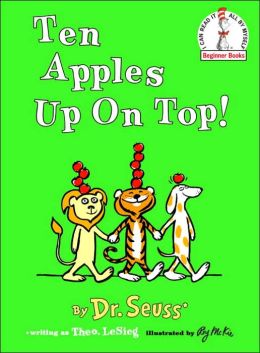
Ten Apples Up On Top! Dr. Seuss (Theo LeSeig). Illustrated by Roy McKie. 1961. Random House. 72 pages. [Source: Library]

 First sentence: One apple up on top! Two apples up on top! Look, you. I can do it, too. Look! See! I can do three! 

Premise/plot: A lion, a dog, and a tiger take turns boasting about how many apples they can balance on top of their heads. It's not enough to have a lot of apples, you also have to do wild and crazy things while balancing a lot of apples up on top. By the end, everyone has had quite an adventure. How many animals will end up with apples up on top?

My thoughts: Last week, I reviewed The Sneetches and Other Stories. And the week before that I reviewed Green Eggs and Ham. Ten Apples Up on Top is a bit disappointing when compared to some of his other books. Though I should mention that it was published under the name Theo LeSieg and not Dr. Seuss. It is not illustrated by Dr. Seuss.   

Have you read Ten Apples Up On Top? Did you like it? love it? hate it? I'd love to know what you think of it!

If you'd like to join me in reading or rereading Dr. Seuss (chronologically) I'd love to have you join me! The next book I'll be reviewing is Dr. Seuss' Sleep Book.

© 2015 Becky Laney of Becky's Book Reviews

Saturday, May 09, 2015

Seuss on Saturday #19

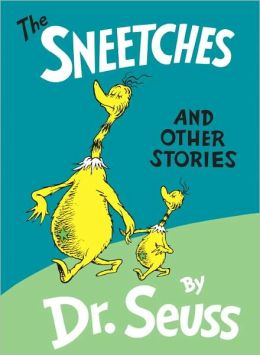
The Sneetches and Other Stories. Dr. Seuss. 1961. Random House. 65 pages. [Source: Library]

First sentence of The Sneetches:
Now, the Star-Belly Sneetches
Had Bellies with stars.
The Plain-belly Sneetches
Had none upon thars.
First sentence of The Zax
One day, making tracks
In the prairie of Prax,
Came a North-Going Zax
And a South-Going Zax.
First sentence of Too Many Daves
Did I ever tell you that Mrs. McCave
Had twenty-three sons and she named them all Dave?
First sentence of What Was I Scared Of?
Well...
I was walking in the night
And I saw nothing scary.
For I have never been afraid
Of anything. Not very.
Plot/Premise of The Sneetches: Star-Belly Sneetches and Plain-Belly Sneetches have trouble playing and working together. The Plain-Belly Sneetches are envious of the Stars on the Star-Belly Sneetches. And the Star-Belly Sneetches look down on the Plain Belly sort. Sylvester McMonkey McBean takes advantage of the whole situation with his "Star On" and "Star Off" machine. He makes a LOT of money in the process. Will the Sneeches ever learn?

Plot/Premise of The Zax: A North-Going Zax and a South-Going Zax meet. Neither Zax will budge because, of course, the North-Going Zax will only go North, and the South-Going Zax will only go South. Take a step in the wrong direction?! Never! How long will these two be stubborn?

Plot/Premise of Too Many Daves: The premise of this one is simple and clearly stated in the first sentence: The McCave family has too many sons named Dave. The joy in this one comes from reading it aloud. All the names she wished she'd chosen. Names like "Hoos-Foos" "Putt-Putt" and "Oliver Boliver Butt." 

Plot/Premise of What Was I Scared Of? The narrator of this one claims he's not scared of anything. But one night when he sees a pair of pale green pants with nobody inside them...he becomes very frightened indeed. Will he ever overcome his fear? Should he overcome his fear?

My thoughts on The Sneeches: This is a fun story. And it's so very quotable! This is a great start to a great story collection.

My thoughts on The Zax: Another fun story, and very true to life. Sometimes people are really that stubborn.

My thoughts on Too Many Daves: This one is shorter than the others perhaps, but, it's quite enjoyable! Some of the names are quite memorable too.

My thoughts on What Was I Scared Of? This one is probably my most favorite of all. I love, love, love this one. I had the record of this book, but, it is the audio narration of this one that has stayed with me the most. It is just a wonderful little story. And so quotable!!!
After that, a week went by.
Then one dark night in Grin-itch
(I had to do an errand there
And fetch some Grin-itch spinach)...
Well, I had fetched the spinach.
I was starting back through town
When those pants raced round a corner
And they almost knocked me down!
and
I ran and found a Brickel bush.
I hid myself away.
I got brickels in my britches
But I stayed there anyway. 
and
I said, "I do not fear those pants
With nobody inside them."
I said, and said, and said those words.
I said them. But I lied them. 
Have you read The Sneetches and Other Stories? What did you think of it? Did you like it? love it? hate it? Is it one you grew up reading?

If you'd like to join me in reading or rereading Dr. Seuss (chronologically) I'd love to have you join me! The next book I'll be reviewing is 10 Apples Up on Top.

© 2015 Becky Laney of Becky's Book Reviews

Sunday, December 07, 2014

Ten Christmas Picture Books

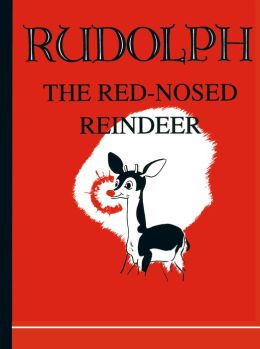
Rudolph the Red-Nosed Reindeer. Robert Lewis May. Illustrated by Denver Gillen. 1939/1990. Applewood Books. 32 pages. [Source: Library]

I enjoyed this one more than I thought I would. This is the original story by Robert L. May with the original illustrations by Denver Gillen. It is so different from the song and the stop-motion animated special. And I think it was the fact that it was different that made me appreciate it more.

The story is told in rhyme. It's essentially one long (perhaps poorly punctuated) poem. Here's how it begins:
Twas the day before Christmas, and all through the hills
The reindeer were playing…enjoying the spills
Of skating and coasting, and climbing the willows…
And hop-scotch and leap-frog (protected by pillows!)
While every so often they'd stop to call names
At one little deer not allowed in their games:--
"Ha ha! Look at Rudolph! His nose is a sight!"
"It's red as a beet!" "Twice as big!" "Twice as bright!"
While Rudolph just wept.
What else could he do?
He knew that the things
they were saying were true!
Readers first meet Rudolph, a young deer who is teased by his peers. He does NOT live at the North Pole. And he's not one of Santa's own reindeer.
What we do learn is that he's a very good, very obedient deer who is expecting Santa to leave him some lovely presents because he's been so very, very good.

Readers then meet Santa and learn of the horrible weather conditions that prove most challenging. Santa starts out on his trip, it isn't until he's delivering presents to Rudolph's house that he notices the brilliant light of his nose.

Santa then decides to wake him up and ask for his help. The rest of the journey goes much easier for Santa!

The book concludes with Santa returning Rudolph to his family, to his hometown. He is now a hero, of course.

I liked this one. I liked some of the rhymes more than others. There are definitely some quirky lines!
Come Dasher! Come Dancer! Come Prancer and Vixen!
Come Comet! Come Cupid! Come Donner and Blitzen!
Be quick with your suppers! Get hitched in a hurry!
You, too, will find fog a delay and a worry!"
And Santa was right. (As he usually is!)
The fog was as thick as a soda's white fizz.
The book is definitely text-heavy. So a longer attention span would be needed for little ones to enjoy this one.

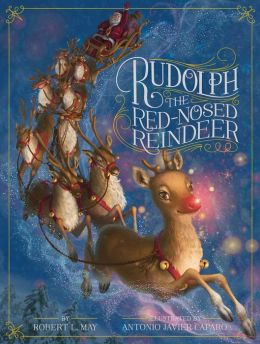
The copy I read was a facsimile edition. A 75th Anniversary edition with new illustrations was released in September 2014.

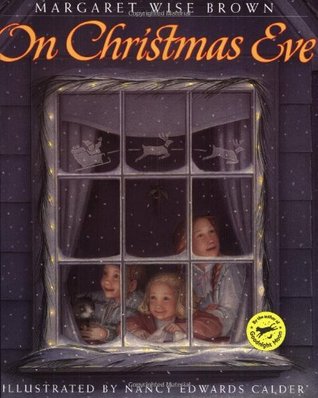
On Christmas Eve. Margaret Wise Brown. Illustrated by Nancy Edwards Calder. 1938/1961/1996. HarperCollins. 32 pages. [Source: Library]

It was the middle of the night. And night of all  nights it was Christmas.

I enjoyed Margaret Wise Brown's On Christmas Eve. It is a descriptive look at what Christmas--at what Christmas Eve--is like for children. It focuses on simple things: what your eyes see, what your ears hear, what your nose smells, what your hands and feet touch. It seeks to capture the emotion of the holiday: the excitement, the waiting, the longing.

Lots of details, lots of adjectives. It's rich in imagery and description. There is also a bit of repetition. The text is lyrical in places.

I can't say that I loved it. But it was very enjoyable. I was also glad to see that one of the presents under the tree was a train. The children are just in awe of the magic of Christmas, of the stockings and packages, of the snow falling outside, of the carolers outside.

It was a sweet story about three siblings.

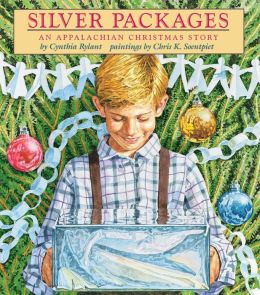
Silver Packages: An Appalachian Christmas Story. Cynthia Rylant. Illustrated by Chris K. Soentpiet. 1987. Scholastic. 32 pages. [Source: Library]

Silver Packages is a picture book for older readers most likely. I wouldn't say it is for an exclusively adult audience. But I think readers need some perspective in order to appreciate the book fully. I think it can resonate with readers, it has the potential. But I don't think the emotional reaction would be--or even should be--automatic. One can't assume that every reader will respond with tears and "this is the best book I've ever read!!!"

Silver Packages is about giving back to the community. In this instance, one very specific community--Appalachia. The book is about the Christmas Train. It starts with one man who wants to show his appreciation for the community that helped him when he needed it. He was injured in an accident, the community took in this stranger and nursed him back to health without asking for anything in return. He decides that he will come every year--by train--and hand out packages to the children who meet the train. These packages are wrapped in silver paper. Every story needs a protagonist. Silver Packages introduces us to Frankie. Readers first meet Frankie as a boy. He's a boy with a dream. He wants to be a doctor. And he really, really, really wants a doctor kit for Christmas. But each year, he's slightly disappointed. He receives a handful of silver packages through the years. Every gift seems to have a toy--something a boy or girl might want--and something a boy or girl might need. The practical gifts include: socks, mittens, hats, scarves, etc. Readers later see Frankie all grown up. He is a doctor. He reflects on his life, on his past Christmases, he has a light-bulb moment. He decides it is his turn to give back to the community in his own special way. It's a book about kindness and gratefulness and community awareness.

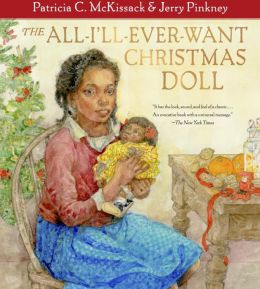
The All-I'll-Ever-Want Christmas Doll. Patricia C. McKissack. Illustrated by Jerry Pinkney. 2007. Schwartz & Wade. 40 pages. [Source: Library]

Christmas always came to our house, but Santy Claus only once in a while.

I haven't read The All-I'll-Ever Want-Christmas Doll in years. It was just as good as I remembered. The book is set during the Depression. A little girl, Nella, knows that her family is poor, that Santy may not come this year at all. Yet, she can't resist writing to him all the same begging for a Baby Betty doll. Her two sisters perhaps think a little less of Nella for her dreaming so big. She shouldn't expect so much from Christmas. But on Christmas morning, there are a few surprises. Each girl gets a Christmas sack filled with walnuts, peppermint candy, an orange, and a box of raisins. But there is one present, one special present remaining: a doll. Nella thinks the doll should be HERS and hers alone. After all, her sisters haven't gone around talking about the doll nonstop, her sisters didn't write Santa a letter begging for the doll. Why should she have to share the doll with them? But does the doll make her happy? Is the doll truly all she'll ever want? She has a few lessons to learn for sure!

I really enjoyed the story and the message.

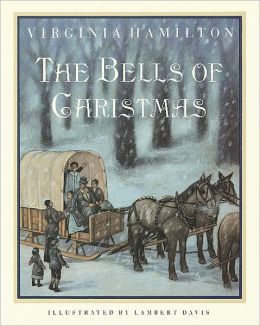
The Bells of Christmas. Virginia Hamilton. Illustrated by Lambert Davis. 1989/1997. Houghton Mifflin Harcourt. 64 pages. [Source: Library]

I didn't dislike Virginia Hamilton's The Bells of Christmas. But I didn't love, love, love it either. I think it depends on what exactly you're expecting from a Christmas book. The Bells of Christmas is very much a celebration of a Christmas long ago. Christmas 1890. Readers meet a young boy, Jason Bell, and experience the holiday through his perspective. We learn about his mom and dad, his brothers and sisters, his cousins, his aunt and uncle, his friend, Matthew. The book is set over a period of several days. Among the things readers learn that Jason's dad is a carpenter, that he wants his sons to join him in his business one day, his dad has only one leg, that his dad wears a peg leg part of the time and is in his wheel chair the rest of the time. Readers also learn that Jason is just a wee bit obsessed with wheels--mainly trains, but, also wagons, etc. The book has plenty of detail and characterization which is a good thing. Jason is waiting for quite a few things: 1) he can't wait for Christmas morning and presents! 2) he can't wait for the Bells to arrive--his uncle and aunt and cousins, 3) he is excited about church, most everyone is performing and participating in some way. (Jason is singing a solo.) The book perhaps seeks to capture one Christmas for one extended family. It is a pleasant, enjoyable book. It isn't quite a chapter book or novel. It isn't quite a picture book.
 
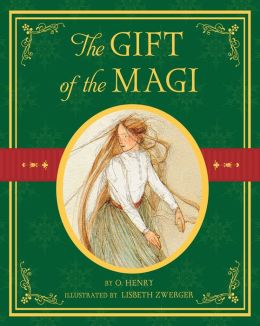
The Gift of the Magi. O. Henry. Illustrated by Lisbeth Zwerger. 1905/2006. Simon & Schuster. 32 pages. [Source: Library]

I've seen adaptations of The Gift of the Magi--who hasn't? (My favorite is Bert and Ernie and Mr. Hooper.) But this is the first time I've read the actual short story. I haven't decided how I feel about it. Is this couple wise or foolish? Or are they at times foolish and at times wise?

The wife, Della, takes extraordinary pride in her long hair. She doesn't seem the vain sort except for when it comes to her hair. And even if she is vain about it, there's no indication it's anything besides a private vanity. The wife apparently has been coveting expensive hair combs as well. The husband, Jim, takes extraordinary pride in the family watch. The narrator uses exaggeration when discussing the woman's long hair and the man's gold watch. I didn't love the narrator. In fact, I think the narrator is a distraction. He won't let the reader forget for a moment that this is a precious story.
Now, there were two possessions of the James Dillingham Youngs in which they both took a mighty pride. One was Jim's gold watch that had been his father's and his grandfather's. The other was Della's hair. Had the queen of Sheba lived in the flat across the airshaft, Della would have let her hair hang out the window some day to dry just to depreciate Her Majesty's jewels and gifts. Had King Solomon been the janitor, with all his treasures piled up in the basement, Jim would have pulled out his watch every time he passed, just to see him pluck at his beard from envy.
The wife can't afford a gift for her husband. The husband can't afford a gift the wife. The wife knows this--or should know this. The husband knows this--or should know this. The wife has saved $1.87. The husband might have saved a small sum as well. Readers don't know one way or the other. Both husband and wife will have something to offer the other, however. Something more than love. For both have decided--quite independently--to give sacrificially. To give up what they supposedly value most: her hair, his watch. And this giving up wasn't to support the family, but, to support the other's vanity.

I think actions can speak more than words. I think the narration took away some of my enjoyment of this one. It felt odd at times. There were sentences that were eloquent and refined and then it would slip into something else.
"It's sold, I tell you--sold and gone, too. It's Christmas Eve, boy. Be good to me, for it went for you. Maybe the hairs of my head were numbered," she went on with sudden serious sweetness, "but nobody could ever count my love for you. Shall I put the chops on, Jim?"
I think I like the adaptations better.

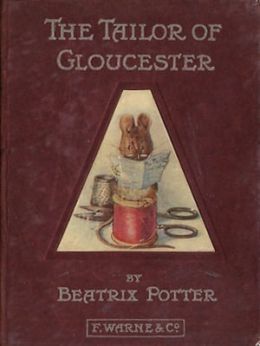
The Tailor of Gloucester. Beatrix Potter. 1903. 58 pages. [Source: Library] 
In the time of swords and periwigs and full-skirted coats with flowered lappets—when gentlemen wore ruffles, and gold-laced waistcoats of paduasoy and taffeta—there lived a tailor in Gloucester.
He sat in the window of a little shop in Westgate Street, cross-legged on a table, from morning till dark.
All day long while the light lasted he sewed and snippeted, piecing out his satin and pompadour, and lutestring; stuffs had strange names, and were very expensive in the days of the Tailor of Gloucester.
I enjoyed rereading Beatrix Potter's The Tailor of Glouchester. In this delightful Christmas tale, readers meet a tailor, a cat named Simpkin, and some lovely mice. It is several days before Christmas. He's working hard to finish a coat and waistcoat for the Mayor of Glouchester. The Mayor is getting married on Christmas day. The tailor has just enough money to finish the coat. Not a penny to spare. He sends his cat, Simpkin, with his money to buy what he needs: a little for himself (food: bread, sausage, milk) a little for his work (one twist of cherry-coloured silk). It is only after the fact that he questions whether he should have sent the cat or gone himself. The cat returns, but, in a mood. The cat is upset for he's discovered that the tailor freed the mice he had captured and hid under the teacups. The cat hides the twist. The man is upset, of course, and sick. He takes to his bed unable to work. The oh-so-thankful mice go to his shop and finish his work for him. But since they are one twist short, they are unable to finish completely. Still, they do what they can, and they do a wonderful job. The cat who spies them at work, I believe, has a change of heart and gives the twist to the old man on Christmas morning. He has just enough time to finish. The Mayor is very, very pleased. And the tailor's luck changes for the better, and his business is much improved. This one is a lovely, delightful read from start to finish.

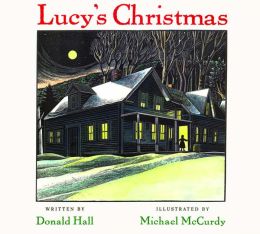
Lucy's Christmas. Donald Hall. Illustrated by Michael McCurdy. 1998. Houghton Mifflin Harcourt. 40 pages. [Source: Library]

I enjoyed reading Lucy's Christmas by Donald Hall. Lucy's Christmas is a picture book set in 1909 in New Hampshire. In the fall of 1909, Lucy and her family start preparing for Christmas. For Lucy, this means starting to make her own gifts for her family and friends. It pays to plan ahead since so many gifts take time, and thought must be placed into each gift. She's not the only one thinking ahead. This year the family is ordering a new stove for the kitchen. The family has spent a lot of time browsing in the Sears catalog. Lucy's choice is the one the family decides upon: the Glenwood Kitchen Range. The focus is not just on gifts: planning, making, giving, receiving. The focus is also on family life and community life. Readers get glimpses of the school and church. Both places are very busy! I enjoyed this glimpse into the past! It was interesting to see the family prepare for the new year--1910. The enthusiasm in the story is sweet. The author's note reveals that this picture book is based on family history.

I really liked this one very much. I liked Lucy and her family. I liked the fact that the church plays such a HUGE role in the Christmas celebrations. There are gifts, it's true. But it's not commercialized and selfish.

Baboushka and the Three Kings. Ruth Robbins. Illustrated by Nicholas Sidjakov. 1960/1986. Houghton Mifflin Harcourt. 32 pages. [Source: Library]

Long ago and far away, on a winter's evening, the wind blew hard and cold around a small hut.

Baboushka and the Three Kings won the Caldecott Medal in 1961. It is Russian folktale with a Christmas setting. The three kings--wise men--come to Baboushka's hut. They only stay a few minutes. Long enough to extend an invitation to the old woman. Will she join them in their procession, in their quest, to find the Babe, the Child? She'd love to join them, she'd love to bring gifts to the Child. But she is not ready to go just yet. Couldn't they all wait until morning? Couldn't they wait for her to finish up a few small, tiny chores first? Couldn't they wait for the storm to clear? Their answer was firm. Their journey to the Child was too important to postpone. They couldn't linger longer. She watched them depart. But they were not easy men to forget. The next morning, she begins a journey of her own. A journey that will take her far. But will her journey lead her to where she wants to go?

It's a simple story, nicely written. "It is no ordinary Babe they seek. Yes! I must go and follow them! To find the new Babe, to offer Him her gift, was now her one yearning. This thought burned in her mind like a candle in the dark." It is also nicely illustrated. The illustrations complement the text well. Both illustrations and text have a different flavor, an authentic flavor, but not exactly American. After several readings, I came to appreciate both a bit more.

In case you're unfamiliar with the story, the book is bittersweet at best. While it is true that Russian children everywhere look forward to Baboushka's gifts each year as her journey continues, it is also true that Baboushka's journey has no happy ending. She never finds the Child. She is never able to give Him her gifts.

Polar Express. Chris Van Allsburg. 1985/2009. Houghton Mifflin Harcourt. 32 pages. [Source: Library]

The Polar Express is one of my favorite Christmas books. It is. The book is a thousand times better than the movie. (Though the soundtrack of the movie isn't bad.) So if you've only seen the movie, you might want to give the book a try to. You might have a different response to it.

The Polar Express is about belief and doubt--in Santa. It's told in the first person, so we never learn the protagonist's name, but it is a little boy with a younger sister named Sarah. One Christmas Eve, the little boy is awakened by The Polar Express. He goes to the North Pole on the Polar Express train, there are other passengers too. All presumably boys and girls on the verge of not-believing. At the North Pole, he sees Santa, reindeer, and elves. He happens to be chosen to receive the first gift of Christmas. He asks for a bell from Santa's reindeer. This gift is not in his possession for long, however, because he has a hole in his pocket. On Christmas day, he receives a special gift under the tree: the bell he had lost. He can hear it. His sister can hear it. But his parents do not. The book ends wonderfully with a message for "all those who truly believe."

I loved this one cover to cover, though I love the ending most of all.


© 2014 Becky Laney of Becky's Book Reviews

Thursday, October 24, 2013

Civil Contract (1961)

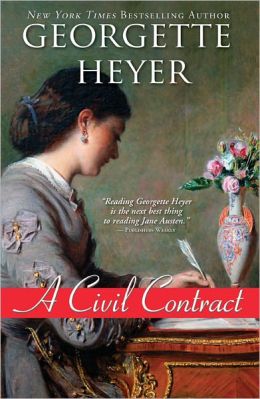
Civil Contract. Georgette Heyer. 1961/2009. Harlequin. 432 pages. [Source: Library]

Three years ago when I first read A Civil Contract, I'm not sure I appreciated it as it deserves. The romance between this husband and wife is a bit more subtle and less spectacular than some of Heyer's other romances, the ones without formulaic marriage of conveniences. This sub-genre can be charming, stories where husband and wives marry for whatever reason and only long after saying I do is love discovered and cultivated. Other similar Heyer titles include A Convenient Marriage and April Lady. A Civil Contract differs mainly in the fact that the heroine, Jenny, is thoroughly sensible and intelligent. She is NOT silly or flighty or incapable of rational thought and feeling. She is not gullible and foolish. In other words, she is not annoying to spend time with! She is actually a comfortable heroine. I really liked her!!!

A Civil Contract highlights all the reasons I just love and adore Georgette Heyer. I love her characters. I love the main characters, the hero, Adam, and the heroine, Jenny. I love almost all of the minor characters. Readers get to meet so many family members and friends. I love the glimpses into society. A Civil Contract is oh-so-rich in historical detail. This is something that I completely failed to appreciate until I began reading nonfiction books on the Regency period. After reading adult biographies on Caroline, the Princess of Wales, and George IV (Prince of Wales, Prince Regent), and Princess Charlotte (their daughter), I could really appreciate Heyer even more. Little sentences here and there that ground the book in reality.
'I can't tell you how refreshing it is to encounter a female who doesn't fall into ecstasies at the mere mention of Byron's name!'
'Are you quizzing me?' she asked bluntly.
'Of course I'm not! I'm no great judge of poetry, but surely Lord Byron's verses are extraordinarily over-rated?'
'Well, that's what I think,' she replied. 'But I have for long been aware that, try as I may, I don't appreciate poetry as I should. I did make the greatest effort to read the Bride of Abydos, however.'
'Unavailing, I collect?'
She nodded, looking a little conscience-stricken. 'Yes, though I daresay I should have persevered if the library had not sent me a parcel containing two books which I most particularly wanted to read. I found I could no longer concentrate my mind, and so abandoned the attempt. And one was perfectly respectable!' she said defensively, adding, in response to his lifted eyebrows: 'Mr Southey's Life of Nelson: has it come in your way?'
'Ah, yes! That is a noble work, indeed!...But what Miss Chawleigh, was the other work--not so respectable!--which lured you away from Abydos?'
'Well, that one was a novel,' she confessed.
'A novel preferred to Lord Byron! Oh, Miss Chawleigh! exclaimed Mrs. Quarley-Bix archly.
'Yes, I did prefer it. In fact, I turned to it with the greatest relief, for it is all about quite ordinary, real persons, and not about pirate chiefs, or pashas, and nobody kills anyone in it. Besides, it was excessively diverting, just as I guessed it would be.' She glanced shyly at Adam, and said with a tiny stammer: 'It is by the author of Sense and Sensibility'... (62-3)
Nor did Jenny recall that when she first saw him she suffered a considerable disappointment. At the age of two-and-fifty little trace remained of the handsome Prince...over whose beauty elderly ladies still sighed. Jenny beheld a middle-aged gentleman of corpulent habit, on whose florid countenance dissipation was writ large. He was decidedly overdressed; his corsets creaked audibly; he drenched his person with scent; and, when in repose, his face wore a peevish expression. But whatever good fairy had attended his christening had bestowed upon him a gift which neither time nor excesses would ever cause to wither. He was an undutiful son, and a bad husband, an unkind father, an inconstant lover, and an uncertain friend, but he had a charm which won forgiveness from those whom he had injured, and endeared him to such chance-met persons as Jenny, or some young officer brought to him by Lord Bathurst with an important dispatch. He could disgust his intimates, but in his more public life his bearing was always right; he never said the wrong thing; and never permitted a private vexation to impair his affability. Unmistakably a Prince, he used very little ceremony, his manners, when he moved amongst the ton, being distinguished by a well-bred ease which did not wholly desert him even when, as sometimes happened, he arrived at some party in a sadly inebriated condition. His private manners were not so good; but no one who saw him, as Jenny did, at his mother's Drawing-room, could have believed him capable of lying to his greatest supporter, taking a crony to listen to his father's ravings, treating his only child with boorish roughness, or floundering like a lachrymose porpoise, at the feet of an embarrassed beauty. (131-2)

© 2013 Becky Laney of Becky's Book Reviews

Thursday, April 14, 2011

The Pilgrimage

The Pilgrimage: The Unforgettable SF Masterpiece of the Strangers Among Us: The First Book of The People. Zenna Henderson. 1961. 255 pages.

The window of the bus was a dark square against the featureless night.

I enjoyed this science fiction novel very much! The novel opens with a young woman, Lea, contemplating suicide. But fate--in the form of a woman--intervenes. Karen reaches out to Lea at her most vulnerable moment and persuades her to take the first baby step towards life, towards hope. She encourages her to wonder. Karen takes her home, takes her to The People. The People are gathering nightly--they have decisions of their own to make, decisions just as important perhaps--but they are gathering to tell stories, to record their stories, their histories, their journeys. Lea, an outsider, hears things that are almost to incredible to believe.

Who are The People? Where did they come from? How can they do the things they do? Read and see for yourself!

I enjoyed the stories. I enjoyed the characters. I enjoyed the storytelling. Many of these stories could be described as coming-of-age stories. I'd definitely recommend this one.

Another review: Necromancy Never Pays.

© 2011 Becky Laney of Becky's Book Reviews
Thursday, August 26, 2010

Civil Contract


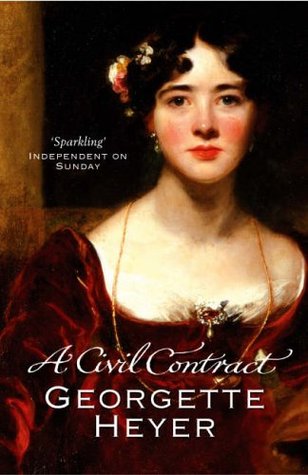
Civil Contract. Georgette Heyer. 1961/2009. Harlequin. 432 pages.

"The library at Fontley Priory, like most of the principal apartments in the sprawling building, looked to the south-east, commanding a prospect of informal gardens and a plantation of poplars, which acted as a wind-break and screened from view the monotony of the fen beyond."

Okay, so that first sentence doesn't even hint at what the story is about. And it offers little incentive to the reader. Fortunately, most readers need only hear Georgette Heyer's name to know that this may be a gem of a book. For those that aren't the "most" in the readers listed above, I'd like to think I'm doing my part. A Civil Contract is a satisfying read in a very gentle and subtle manner. I enjoyed it. Enjoyed the characters and the subtle complexities of its non-plot. This is a very human novel.

You're probably wondering, but what is it about??? Adam Deveril is a soldier whose father has just died. He's inherited a title--he's now Viscount Lynton--but he's also inherited an overwhelming debt. A debt that is due to negligence, gambling, and mismanagement. He's got a mother (Dowager is how she's referred to in the text), and two sisters Charlotte and Lydia. Charlotte is engaged to be married, so she's not one of his primary concerns. However, his mother and sister are. He's been advised that he should marry for money. He finds the idea repugnant. Especially at first. But even Lydia, his younger sister, knows that sacrifices are called for in this occasion. It is her discussions of how she needs to be marry an older man for his money to "rescue" the family, that has Adam pondering how much he's willing to do for his family.

The family home, Fontley, is at risk. All their property is at risk--most of their holdings are mortgaged already. And only their townhouse and Fontley remain. Adam feels that the honorable thing to do would be to sell everything they can and hope to break even. That is hope they have enough money to settle their debts. Whatever small amount may be left would be settled upon his sister for her dowry. He's not worried so much for himself, for his comfort. He knows that he can go soldiering again and live on his pay if need be.

Of course, this newly-discovered money problem does mean that he cannot marry his first love, his supposed one and only love Julia Oversley. They met when he was injured. She became enamored with a vision of a dashing, heroic soldier. He became enamored of her beauty and charm. The parents consented at the time, though Lord Oversley did feel they weren't well suited for one another. But now that he's poor and soon to be without a home, he knows the only honorable thing is to break the engagement. Oversley does agree with him. Julia's brokenhearted. Adam is melancholy but resolved that he's doing the right thing, the responsible thing.

Enter Jonathan Chawleigh. A very wealthy man, but not "genteel" or gentle bred. Oversley introduces the impoverished Adam to Chawleigh with the hopes that they can solve each other problems. Chawleigh has high hopes for his daughter, his only child, Jenny. He wants to see her marry a proper gentleman, a man with a title, a man with dignity and distinction. A man that is part of the ton. Adam is shocked at first, but the more he considers the idea, the more he comes to feel it would be doing the better thing for his family--his mother and sister. The couple does meet first. And Chawleigh was right, Jenny doesn't overwhelm men with her beauty and charm and grace. She's the opposite of Julia in a way. Shy. Intelligent. Meek. Forgiving. Generous. Unassuming. And practical. Above all else practical. For those that are familiar with it, think Proverbs 31. Jenny is the essence of a Proverbs 31 woman. So after meeting her, while not overwhelmed by her beauty, he sees that they could live together amicably. They'd "suit" each other. Neither is dishonest. She knows that her husband is in love with another woman. He knows that she knows he's in love with another woman. Yet this awkward situation somehow doesn't stay awkward. Not for long. She doesn't demand love. Her only hope--in the beginning--is for respect and dignity.

I loved Jenny. I did. I loved her father Jonathan. The scenes with him are just satisfyingly good. I loved Adam's aunt Lady Nassington. I loved Adam's sister Lydia. So many of the characters were just so wonderfully human, so thoroughly developed. I loved this quiet and gentle but always intelligent novel about marriage and love and family.

I wouldn't say that I liked A Civil Contract better than A Convenient Marriage. But it was so much better than April Lady!

© Becky Laney of Becky's Book Reviews

Saturday, March 14, 2009

The Winter of Our Discontent


Steinbeck, John. 1961. The Winter of Our Discontent. 304 pages.

When the fair gold morning of April stirred Mary Hawley awake, she turned over to her husband and saw him, little fingers pulling a frog mouth at her.
"You're silly," she said. "Ethan, you've got your comical genius."
"Oh say, Miss Mousie, will you marry me?"
"Did you wake up silly?"
"The year's at the day. The day's at the morn."
"I guess you did. Do you remember it's Good Friday?"
He said hollowly, "The dirty Romans are forming up for Calvary."


Despite it's rather odd opening, The Winter Of Our Discontent held my interest. It is the story of a man, Ethan Hawley, and his family, his good wife, Mary, his son, Allan, his daughter, Ellen. It's a story of the conflict between ambition and honesty. Ethan has always found himself to be a good man, a just man, an honest man. A man who plays by the rules.

Ethan comes from a legacy, a family with a long history in the area. He's as "established" as he can be. But he's not wealthy. Not anymore. His father lost the family fortune. And now Ethan finds himself--a grown man with two kids--a clerk in a grocery store. He's embarrassed that it's come to this. A Hawley, a man who just twenty years--give or take a few--would have been the big man, the boss man, sunk to working for another man--and not just another man, but an Italian immigrant. Marullo.

But Ethan is noticing the world around him. Noticing that businessmen--including his banking friends--are more concerned with money, with making a profit, than by doing right by their customers. Dollar signs have got them mesmerized. They don't see their family, their friends, their neighbors, their acquaintances. They've lived in town their whole life--know practically everyone--yet when it comes down to it--money comes first and foremost over being kind and compassionate and concerned. Everyone is looking out for their selves. Everyone is greedy. Everyone is selfish. If it's good for you--financially beneficial--then it's right for you no matter who else gets hurt. So Ethan begins to contemplate joining them. If everyone does business this way, lives this way, then maybe it's time he joins them, enters the so-called real world; maybe if he does then his wife will have something to be proud of. She wishes--the children wish as well--for more money. And her friend, Margie, says its in the cards. Her tarot card readings have shown that Ethan is about to strike it rich. With this "prophecy" Ethan decides to go for it...step by step. But will this descent into the "real world" be his undoing? Will his ambition lead to a happily ever after ending? Will his actions--some quite cutthroat when you think about it--be something he can be proud of at the end of the day?

The writing is quite good. Better than good when you think about it. I marked passage after passage. The subject matter is interesting--complex. The hard examination of life, love, marriage, and friendship in a community. I can't say that I "loved" this one; but I did appreciate it. The writing. The language. The complexity and substance.

A day, a livelong day, is not one thing but many. It changes not only in growing light toward zenith and decline again, but in texture and mood, in tone and meaning, warped by a thousand factors of season, of heat or cold, of still or multi winds, torqued by odors, tastes, and the fabrics of ice or grass, of bud or leaf or black-drawn naked limbs. And as a day changes so do its subjects...(514)
"Way I look at it, it doesn't matter about believing. I don't believe in extrasensory perception, or lightning or the hydrogen bomb, or even violets or schools of fish--but I know they exist. I don't believe in ghosts but I've seen them." (560)
A man who tells secrets or stories must think of who is hearing or reading, for a story has as many versions as it has readers. Everyone takes what he wants or can from it and thus changes it to his measure. Some pick out parts and reject the rest, some strain the story through their mesh of prejudice, some paint it with their own delight. A story must have some points of contact with the reader to make him feel at home in it. Only then can he accept wonders. (569)
What a frightening thing is the human, a mass of gauges and dials and registers, and we can read only a few and those perhaps not accurately. (576)
Sometimes I wish I knew the nature of night thoughts. They're close kin to dreams. Sometimes I can direct them, and other times they take their head and come rushing over me like strong, unmanaged horses. (587)
It's hard to know how simple or complicated a man is. When you become too sure, you're usually wrong. (634)
I wonder about people who say they haven't time to think. For myself, I can double think. I find that weighing vegetables, passing the time of day with customers, fighting or loving Mary, coping with the children--none of these prevents a second and continuing layer of thinking, wondering, conjecturing. Surely this must be true of everyone. Maybe not having time to think is not having the wish to think. (676)

© Becky Laney of Becky's Book Reviews
If you're reading this post on another site, or another feed, the content has been stolen.