Showing posts with label back-to-school. Show all posts

Wednesday, February 15, 2023

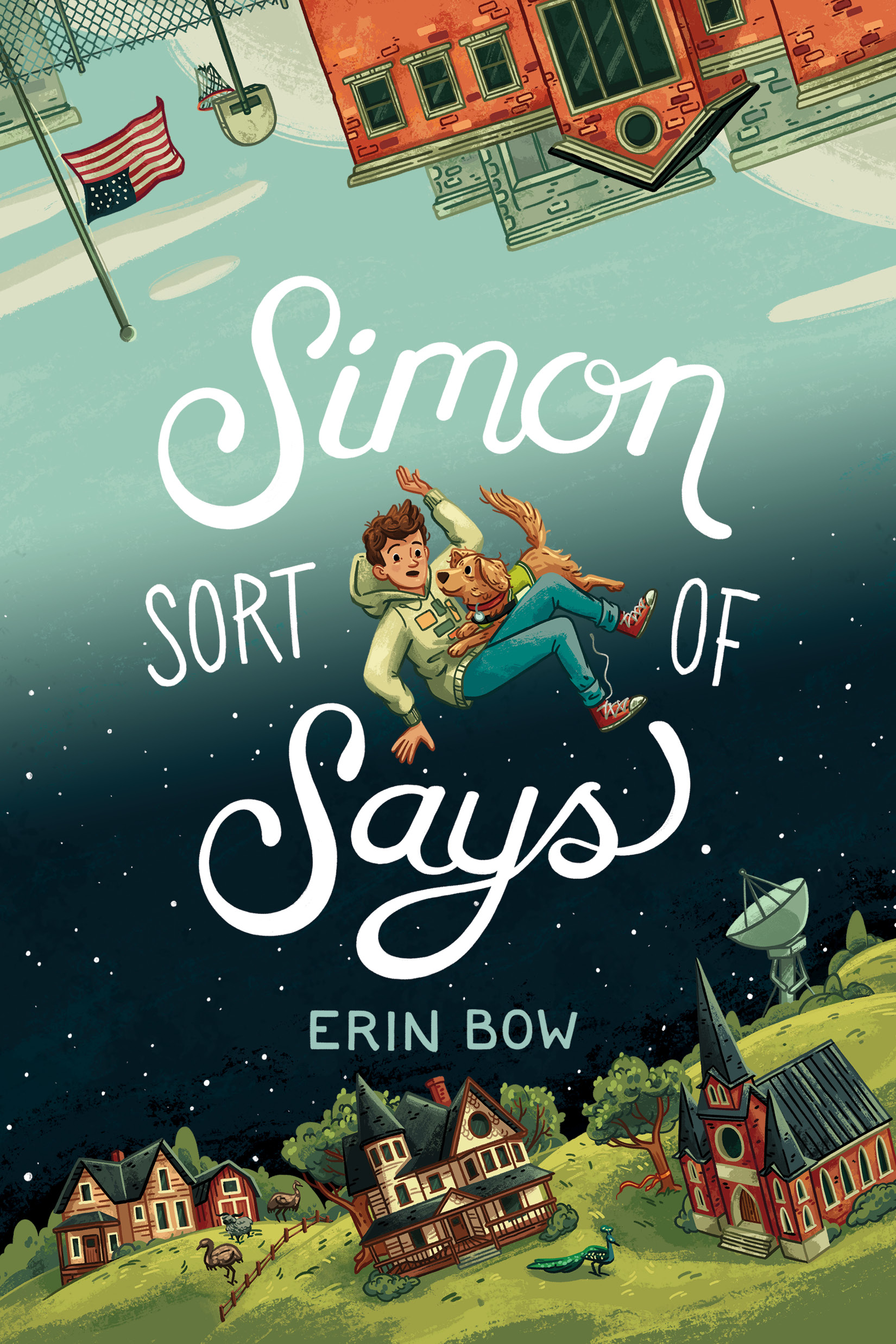
35. Simon Sort of Says


Simon Sort of Says. Erin Bow. 2023. [January] 320 pages. [Source: Library]

First sentence: People are always asking why my family came to the National Quiet Zone. Like we need a reason. I mean, who wouldn’t want to live in a place with no internet and no cell phones and no TV and no radio? Who wouldn’t want to live surrounded by emu farms in a town that’s half astrophysicists and half people who are afraid of their microwaves? I mean, isn’t that the American Dream? Hint: no. Obviously, there’s a story

Premise/plot: Simon and his family have moved to Grin and Bear It, Nebraska, in the "National Quiet Zone." The town is divided into two teams: "Team Science" and "Team Farm." [The scientists are listening for radio signals from outer space.] Simon is hoping to blend into his school--though he's neither team--as much as possible. He wants to 'fly under the radar' so to speak. But his developing friendship with Agate and Kevin might just bring him some unwanted attention...the tradeoff being the best friends he could ever hope for. 

Simon comes to town with a secret. He delights in the fact that there is no internet so that there no one can google his name and find out.

My thoughts: This one gets a million bonus points for quirkiness. Yet despite all the lighter, "quirky," moments this one hits heavy--in the heart. There are scenes that read like a punch in the gut. Simon's secret is that he is the sole survivor from his class after a school shooting. It changed Simon's life--and the lives of his parents--forever.

What I loved about this one was the characterization: ALL the characters--no matter how "big" or "small" "central" or "side" are developed. The narrative draws you into the story, into the community, into the characters' lives. I thought it was well done.

What I didn't quite love, however, was the theology. Granted, I'm not a Catholic. [His father is a deacon and program director]. I could understand how his son's experiences could shake/rattle/throw doubt upon his faith. However, I don't understand how he could maintain at least the outer profession of faith and religion yet preach--several times--in his belief, in his insistence, that there are no miracles, no providence, no sovereignty. He's applauded for embracing a "God of Chaos." This is a middle grade novel. It certainly isn't the place for a philosophical or theological discussion on the "Why is there evil?" or "If God is good, why is there evil?" or "If God is all-knowing or all-powerful, why is there evil?" or "Why does God allow evil?" There are other more appropriate places for that discussion. [I'm not saying it's not worth having...at all...] Again, I'm not a Catholic, so I'm not sure how 'shocking' or 'progressive' or 'controversial' that statement would be. It got me to thinking--that's all.   

© 2023 Becky Laney of Becky's Book Reviews

Friday, July 26, 2019

The True History of Lyndie B. Hawkins

The True History of Lyndie B. Hawkins. Gail Shepherd. 2019. 304 pages. [Source: Library]

First sentence: There is such a thing as honorable lying.

Premise/plot: The True History of Lyndie B. Hawkins is set in a small town, Love's Forge, in Tennessee in 1985. Lyndie B. Hawkins, our heroine, is having a time of it. Her family has recently moved in with her grandparents (Lady and Grandpa Tad). Her home life is full of TENSION and STRESS. Her dad--a Vietnam war veteran--may think he's hiding his alcohol problem from the rest of the family and the whole community...but...few are fooled. Lyndie knows SOMETHING is wrong even if she doesn't have a label--or a solution--for it. Half the stress for Lyndie is knowing that she can't share the stress; she has to keep her family's secrets. No matter what questions her pastor, her teachers, her friends, her neighbors ask...she knows that she has to be ready with a lie that protects her family's honor and privacy. This is endangering the relationship with her best friend, Dawn, who comes from a somewhat nosy neighboring family. Lyndie trusts Dawn as much as she trusts anyone...but is that enough to go against her family?!

Dawn's family is one of the kindest in town. They are taking in a juvenile delinquent, D.B., for a year. He's been sentenced to Pure Visions until he's eighteen; but the place is the stuff of nightmares. Lyndie becomes chummy with D.B., and she wants to fix his problems even if she can't fix her own...

My thoughts: This was a tough read for personal reasons. That's mostly a good thing. I think it's a sign that the author has written characters that are all-too-human and placed them in realistic situations that feel true to life. I loved, loved, loved Lyndie's interest in history and genealogy. I could relate to both. In addition, Lyndie LOVES research and libraries. I ached for Lyndie in places. I'm glad that this one ends with a bit of hope that this family can be helped, that patterns can be changed.

© 2019 Becky Laney of Becky's Book Reviews

Friday, May 17, 2019

Did You Hear What I Heard?

Did You Hear What I Heard? Kay Winters. Illustrated by Patrice Barton. 2018. 40 pages. [Source: Library]

First sentence: Breakfast is a flurry. Eggs in a hurry. People pop up like the toast.

Premise/plot: Kay Winters has written a collection of school-themed poems. This collection covers the whole school year--beginning to end. You'll find poems appropriate to share with students any time of year.

My thoughts: I liked this one. Poetry collections are interesting to review. Usually you find poems that you love and poems that are more meh. I definitely would say I found poems I enjoyed in this picture book. I didn't love each and every poem. But that's not really to be expected.

Text: 3 out of 5
Illustrations: 4 out of 5
Total: 7 out of 10

© 2019 Becky Laney of Becky's Book Reviews

Tuesday, September 25, 2018

The Opposite of Innocent

The Opposite of Innocent. Sonya Sones. 2018. 272 pages. [Source: Library]

First sentence:
The Friend of the Family
I've always been in love with Luke.
For as far back
as I can remember.
I used to climb into his lap,
throw my arms around his neck,
and tell him I was gonna marry him
when I grew up.
And Luke would smile down at me
and say,
"I'll wait for you, Lily. I promise."
 Premise/plot: The Opposite of Innocent is a verse novel for young adults. I hesitate to add for young adults--though perhaps not for the reason you might suspect. (I'll address this in 'my thoughts' below.) Lily, our narrator, is fourteen. She is head over heels in love with Luke, a twenty-nine year old man, a family friend who has known Lily's father practically forever. (Lily's parents think it is SO ADORABLE that their Lily has a "little girl" crush on Luke.) In fact, Luke is living with the family these days as he's looking for his own place. He's in no hurry and neither are they.

If Luke were to leave who would take care of their children? Who would take them to school? pick them up from school? stay home with them when they're sick? help them with their homework? take them to the library? If Luke weren't around, one of them at least would have to actually parent.

Lily doesn't dare to hope that Luke is as madly in love with her as she is with him. But lately she's been noticing him noticing her. Could her dreams finally be coming true at last? Does Luke LOVE her back?

My thoughts: The Opposite of Innocent handles a mature topic--sexual abuse. It is just as much of a must-read as Laurie Halse Anderson's SPEAK, in my opinion. It is intense, compelling, and dramatic. Dare I say more than a little scary?

As far as content goes, it is a mature topic. Lily is NOT ready for the relationship LUKE wants to have with her. Lily does not have the life-experience to know that Luke is manipulating her. Not only in the present tense, but that he has spent years manipulating her--grooming her. Not only her but her parents as well. Lily's parents trust Luke 110%. No reservations. No rules.

So it does get graphic. I won't lie and say this is a clean read when it isn't. But the fact that it is graphic should not keep (strict) parents from allowing their (teen) children to read it. It is too important a topic to ignore. It is a book that needs to be read and discussed. Parents should read the book too.

I'll go a step further. Adults should be reading this one. Parents. Teachers. Librarians. Anyone. Everyone.

The topic does stay front and center, but it is also very much character-driven. If you've not read Sonya Sones' novels before, you should give them a try.


© 2018 Becky Laney of Becky's Book Reviews

Wednesday, August 29, 2018

The Day They Came To Arrest The Book

The Day They Came To Arrest The Book. Nat Hentoff. 1982. 176 pages. [Source: Book I bought]

First sentence: "He's going to be right inside the door," Luke said to Barney as they neared the entrance to George Mason High School. "He's going to be standing there with that big phony smile and that chocolate voice."

Premise/plot: When a history teacher assigns The Adventures of Huckleberry Finn to her class to read, the book is challenged by angry parents. Will the book "be arrested" and removed from the reading list AND the school library? Or will the book remain available to students freely and without restrictions? Whose side is the principal on?

My thoughts: The Day They Came To Arrest The Book is a thousand and one times better than The Property of the Rebel Librarian. Primarily because it is more believable--both characters and situations. It is also more thought-provoking.

I appreciated the diverse opinions expressed in The Day They Came to Arrest The Book. The opinions cover a wide spectrum of thought. Perhaps with the exception of the unprincipled principal there are no villains, no bad guys. There are differences of opinion, yes, but no "good" guys and no "bad" guys. Not all opinions are informed opinions. But many are. That is, many people with strong opinions who are speaking up--on both sides--have actually read the book in question in its entirety. A few people have strong opinions and loud voices but haven't actually read the book--just bits and pieces. I think it's important to see that two good people can have differences of opinion.

What makes the principal so unprincipled? He's a sneaky guy. He does not want to fill out forms and paperwork. He doesn't want to go through the proper channels when it comes to book challenges. He'd rather pressure the teacher or the librarian into voluntarily removing the book with no fuss and no publicity. Because of his powerful position, because they fear losing their job, many go along with his "suggestions" that aren't really suggestions. But not this history teacher and not this librarian. The guidelines are in place and they will be followed...this time at least.

The book offers much food for thought--not only about banned books and censorship but also intellectual freedom in general. One of the arguments in the book is that it should be up to educators to choose wisely what to make available to their students. What to teach in their classrooms. What to have available in their libraries. Just because a book is published doesn't mean that it belongs in a school. The opposition claims that this 'choosing wisely' is a form of censorship. That to 'choose wisely' is limiting the student body's freedom to choose.

Personally, I think it makes the most sense. So long as school budgets are limited, it just makes the most sense to spend wisely and thoughtfully. I'll clarify that a tiny bit. Audience is key. Knowing your specific audience. A school librarian should have some idea on what students need, what students want, what teachers need, what teachers want. They should know which authors are popular and stay in circulation. They should know which genres circulate best. They should also read widely themselves. Quality should matter. That is what I mean by spending wisely. Making the most of each dollar. I don't mean that librarians should only buy books that they personally love, love, love and are custom-fit to their tastes and preferences.

One of the examples in the book is the hypothetical question: should a school library buy books written from the perspective that the holocaust never happened? Or should a library keep such 'trash' out of the library. Yes, such books exist--and others like them. But should a school library spend money on books like that because students should have the freedom to decide for themselves what is true and what is a lie?

I would classify this one as a YA book. Readers should know that it does use the n-word a lot in the context of discussing The Adventures of Huckleberry Finn. There are many times when Twain's novel is quoted. The novel also contains blasphemy--taking the Lord's name in vain. In terms of profanity it reminds me of Fahrenheit 451. The book is well worth reading in my opinion.

Quotes:
Show me a book that offends no one, and I will show you a book that no one, in the whole history of the world, has ever willingly read. (34)
You know, it's never the book that's really on trial. It's the author, even if he's dead. Remember that, Barney. Every time this sort of thing happens, it's a person who's being tried. For his ideas, his feelings, his memories, his fantasies, his yearnings, his language, which is his very self. To tell you the truth, I don't care what the book is. I hate to see words on trial. (83)
Once you give people, any group of people, the power to censor books, you're opening up quite a can of worms. And sooner or later, they can turn on you. (107)

© 2018 Becky Laney of Becky's Book Reviews
Wednesday, April 11, 2018

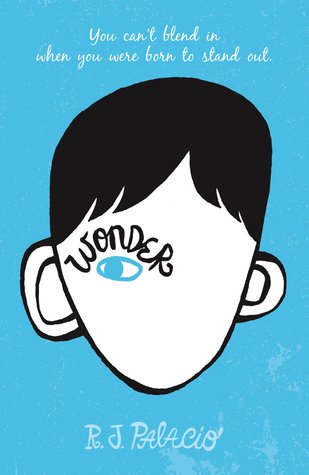
Wonder

Wonder. R. J. Palacio. 2012. Random House. 320 pages.

First sentence: I know I'm not an ordinary ten-year-old kid. I mean, sure, I do ordinary things. I eat ice cream. I ride my bike. I play ball. I have an Xbox. Stuff like that makes me ordinary. I guess. And I feel ordinary. Inside. But I know ordinary kids don't make other ordinary kids run away screaming in playgrounds. I know ordinary kids don't get stared at wherever they go. If I found a magic lamp and I could have one wish, I would wish that I had a normal face that no one ever noticed at all. I would wish that I could walk down the street without people seeing me and then doing that look-away thing. Here's what I think: the only reason I'm not ordinary is that no one else sees me that way.

Premise/plot: Wonder has many narrators but one central focus: August Pullman. Auggie is a wonder-ful kid but is he ordinary or extraordinary? Does looking different from everyone else make you abnormal and less human?

The book opens with August about to begin fifth grade at a new school. He's been home-schooled previously. Both for practical--medical--reasons and for personal--more emotional--reasons. But. The time has come. He is as ready as he'll ever be to enter the 'real' world and face the best and worst of human nature.

Before the school year begins, he meets the middle school principal, Mr. Tushman, and three of his future classmates: Julian, Jack Will, and Charlotte. But Auggie's first friend isn't a "buddy" assigned from the principal. It is a girl named Summer who joins him at the lunch table that first difficult day of school.

Via, August's older sister, has her own terrible first day of school. She's lost her best friend, Miranda, to an edgy "popular" crowd. Both Via and Auggie struggle to find that just-right "belonging" place in the wild and crazy jungle of school. Her story, in a small way, goes to show that looking normal, being pretty, isn't a guarantee of a problem-free life.

In fact, if the book has a message, it is that every single person struggles and faces challenges.

My thoughts: It is surprising that I'm just now rereading Wonder considering how much I loved, loved, loved it. Looking back, I see I reviewed it one month after its release. (Perhaps that was the best time of all to read it. Before the hype. Before the movie. I'm speaking generally.)

I loved the story, the writing, the characterization, the happy ending. What I didn't quite love was the not-so-happy ending for the dog. Don't get attached.

Favorite quotes:
When given the choice between being right or being kind, choose kind. (48)
"Why do I have to be so ugly, Mommy?" I whispered.
"No, baby, you're not..."
"I know I am."
She kissed me all over my face. She kissed my eyes that came down too far. She kissed my cheeks that looked punched in. She kissed my tortoise mouth. She said soft words that I know were meant to help me, but words can't change my face. (60)
August is the Sun. Me and Mom and Dad are planets orbiting the Sun. The rest of our family and friends are asteroids and comets floating around the planets orbiting the Sun. The only celestial body that doesn't orbit August the Sun is Daisy the dog, and that's only because to her little doggy eyes, August's face doesn't look very different from any other human's face. (82)
"Dad, I loved that helmet! It meant a lot to me! I was bummed beyond belief when it got lost--don't you remember?"
"Of course, I remember, Auggie," he said softly. "Ohh, Auggie, don't be mad. I'm sorry. I just couldn't stand seeing you wear that thing on your head anymore, you know? I didn't think it was good for you." He was trying to look me in the eye, but I wouldn't look at him. "Come on, Auggie, please try to understand," he continued, putting his hand under my chin and tilting my face toward him. "You were wearing that helmet all the time. And the real, real, real, real truth is: I missed seeing your face, Auggie. I know you don't always love it, but you have to understand...I love it. I love this face of yours, Auggie, completely and passionately. And it kind of broke my heart that you were always covering it up." (291)

© 2018 Becky Laney of Becky's Book Reviews
Saturday, May 27, 2017

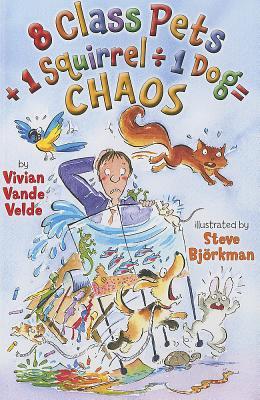
8 Class Pets + 1 Squirrel ÷ 1 Dog = Chaos

8 Class Pets + 1 Squirrel ÷ 1 Dog = Chao. Vivian Vande Velde. Illustrated by Steve Bjorkman. 2011. Holiday House. 68 pages. [Source: Library]

First sentence: Being a squirrel is the best thing in the world.

Premise/plot: One day a squirrel named Twitch ends up INSIDE the school. How? Why? Well, Twitch was seeking to outrun an OWL and a dog. Twitch had until then only been acquainted with the school pets through the windows. Now, he finds himself in need of a lot of FRIENDS and ADVICE. Why? Well, the dog--the principal's dog--follows him INSIDE as well. (The owl doesn't!!!) Soon, both are trapped by the closed doors. The dog remains in pursuit of the squirrel; the squirrel has to be quick, quick, quick. The end result is a LOT of laughs. Each chapter is narrated by a different animal.

My thoughts: This one was so much fun. I didn't expect it to be so FUNNY and enjoyable. I think the alternating narrators makes this one even better than it could have been. Almost every chapter has something worth quoting--worth sharing--to draw in reluctant readers. I think this would be a great read-aloud in the classroom.

For example,
A squirrel mother teaches her young all they need to know by the end of summer, but human children spend five years in School. Five years is long enough for a squirrel to grow very, very old, so it's a good thing we're faster learners. And the humans aren't even truly finished in five years!
Ms. Walters never talks about being in first grade, so I think she may have skipped first grade, too. But she does talk about last year's second grade class. I'm smart enough to know that means Ms. Walters was kept back. But I am polite enough not to mention it.

© 2017 Becky Laney of Becky's Book Reviews

Friday, May 19, 2017

My Pet Human Takes Center Stage

My Pet Human Takes Center Stage. Yasmine Surovec. 2017. Roaring Brook Press. 112 pages. [Source: Library]

First sentence: My name is Oliver. This is my pet human, Freckles. I have her well-trained. She feeds me treats. She rubs my belly. But today she's going to a new place of training. It's her first day of school.

Premise/plot: Oliver goes to school to be with Freckles. The school is pet-loving, so no big problem. In fact, there's a school club, Fur-ever Friends Club, that Freckles joins. The club is big on fund-raisers, and, this book is ALL about fund-raising. Freckles and her mom take in a foster-kitten during this time, and, Oliver is out of sorts about the attention being on another cat. Freckles idea is to TRAIN both of her cats for an act in the fund-raising show. Oliver has mixed-ideas about it. He doesn't want Freckles to be humiliated, and, he doesn't want the new kitten to do all the tricks and leave him looking stupid, and, he does like Freckles and want to please her....but is a cat trainable?

My thoughts: More happens in this second book, which, I think is a good thing. Oliver continues to be an entertaining cat. I like this series, but, I'm not sure I love it.


© 2017 Becky Laney of Becky's Book Reviews
Saturday, May 16, 2015

First Grade, Here I Come (2015)

First Grade, Here I Come. Tony Johnson. Illustrated by David Walker. 2015. [June] Scholastic. 32 pages. [Source: Review copy]

First sentence: I'm zooming off to first grade now. I need about five friends to play good games like hide-and-sneak and where-the-sidewalk-ends. Then all of us will crouch around like tigers on the prowl. We'll lash our tails and flash our eyes and clash our fangs and growl.

Premise/Plot. A boy shares his excitement about going to first grade. When the book begins, the boy thinks he NEEDS five friends in order to have a good year. By the end of the book, he decides that five isn't enough after all, he WANTS to be friends with everyone. The emphasis in this book is on play--imaginative play. It isn't on learning or sitting still or being obedient and following all the rules. Does the book say the boy has trouble not playing? It doesn't. But I imagine that anyone who LOVES to play that much, would struggle a bit--even if it's a tiny bit--when it was time to work and learn.

My thoughts: I didn't love the text. It was super descriptive, which could be a good thing. But. I am not sure the book flows well--narratively speaking--from page to page and scene to scene. It seemed a bit all over the place. Perhaps reflecting his personality?! That's certainly one way I could interpret it!!! I am not sure how I feel about this one.

Text: 3 out of 5
Illustrations: 3 out of 5
Total: 6 out of 10

© 2015 Becky Laney of Becky's Book Reviews
Thursday, September 11, 2014

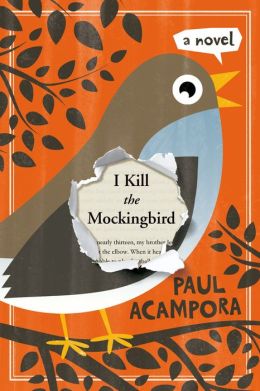
I Kill the Mockingbird (2014)

I Kill the Mockingbird. Paul Acampora. 2014. Roaring Book Press. 176 pages. [Source: Library]

Lucy, Michael, and Elena are best friends. They have almost always been best friends. I Kill The Mockingbird is about a secret summer project these three think up and orchestrate.

It starts with the announcement of Miss Caridas' summer reading list:
  • David Copperfield
  • Ender's Game
  • Fahrenheit 451
  • War Horse
  • War of the Worlds
  • The Giver
  • To Kill A Mockingbird
 Lucy remembers that Miss Caridas was not their only English teacher that year. She replaced another teacher, Mr. "Fat Bob" Nowak, who died of a heart attack in October. He had told the class that he would assign only one book for the summer: To Kill A Mockingbird. Lucy reminds her friends of this, and expresses how she wishes everyone would read it and WANT to read it. The friends think and consider and brainstorm. What if they could manipulate supply and demand and make people really desperate to find a copy and read it?

I Kill the Mockingbird is about that project, about their misshelving books at bookstores and libraries across the state of Connecticut, about their online campaign "I Kill the Mockingbird."

It's a quick read. It has some depth to it. Lucy is worried that her mom's cancer might come back someday. Lucy is still missing the teacher who died. Lucy and her friends are thinking about life and death and legacies. But it is in many ways a light novel about three best friends who love to read and who want others to love to read too. It would almost be impossible for me not to like--really, really like this novel about reading. I still haven't decided if I LOVED it or just really, really, really LIKED it.

© 2014 Becky Laney of Becky's Book Reviews
Thursday, August 21, 2014

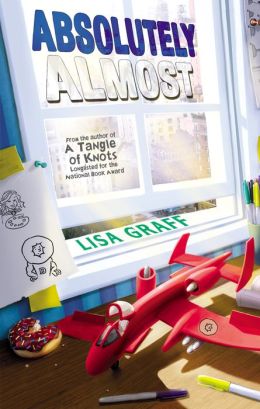
Absolutely Almost (2014)

Absolutely Almost. Lisa Graff. 2014. Penguin. 304 pages [Source: Library]

I loved Absolutely Almost. I think I loved it at least as much as Umbrella Summer. Maybe even a little bit more. I don't know. Time will tell. I don't actually have to choose between the two, right?! I can LOVE two GREAT books by one very talented middle grade author, can't I?!

Albie is the protagonist of Absolutely Almost. His narration gives the book a just right feel. It's a satisfying read about a boy who struggles with meeting expectations: his parents, his grandparents, his teachers, his own. He's never good or great, he's always only almost. Almost good at this or that. Almost ready for this or that. And this oppressive almost gets him down now and then. Not always, mind you. I don't want to give the impression that Albie is sad and depressed and unable to cope with life. Albie is more than capable of having a good time, of enjoying life, of appreciating the world around him.

I really appreciated Graff's characterization. Not only do readers come to love (in some cases I imagine love, love, love) Albie, but, all the characters are well written or well developed. Albie's parents at times seem to be disconnected, out of touch with who their son is, what life is like for him, what he wants, what he needs. But just when I get ready to dismiss them as neglectful or clueless, something would happen that would make me pause and reconsider. Readers also get to know several other characters: his nanny, Calista, his math teacher, Mr. Clifton, and his friend, Betsy. For the record, he does have more than one friend. But Betsy is his new friend, his first friend that he makes at his new school. It is their friendship that is put to the test in the novel. It is his relationship with Betsy that allows for him to progress a bit emotionally. If that makes sense. (So yes, I know that his best-best friend is Erlan. But Erlan has been his friend for as long as he can remember, probably since they were toddlers. He's completely comfortable in that friendship. Their friendship does come into the novel here and there. But for me, it wasn't the most interesting aspect of the novel.)

I loved the setting of Absolutely Almost. I loved how we get to spend time with Albie in school and out of school. I loved how we get to see him in and out of his comfort zone. I loved that we got to see his home life. We got to see for ourselves how he interacts with parents. I love how Albie is able to love his parents even if they don't really make him top priority. Especially his Dad. Albie's need for his Dad's attention, the right kind of attention, can be FELT. Albie held onto hope that one day his Dad would find time to spend with him, that one day his Dad would see him--really see him. There were moments that hope lessened a bit as Albie gave into his emotions-of-the-moment. But Albie's love for his dad always won out at the end. His hope would return.

The writing. I loved it. I did. I think the quality of the writing was amazing. There were chapters that just got to me. Their were paragraphs that just resonated with me. The writing just felt TRUE.

Absolutely, Almost is set in New York City.

© 2014 Becky Laney of Becky's Book Reviews

Wednesday, September 05, 2007

Travel the World: France: Tibili

Today's edition of Travel The World takes us to France. Originally published in 1996, Tibili: The Little Boy Who Didn't Want to Go To School was first published in America in 2002 by Kane/Miller. The author is Marie Leonard. The illustrator is Andree Prigent. Set in Africa, Tibili is the story of a little boy who didn't want to go to school.
Tibili is a happy little boy who laughs all the time, morning to night. Sometimes, if he is not too tired from playing all day, he even laughs himself to sleep.
But the laughter stops when his mother tells him that he'll be starting school the next year.

So he tries to talk to the animals and find ways out of going to school. He gets a lot of advice, but it is the advice of a spider named Crope that catches his attention. The spider tells him to find the big red stone and dig for the Box of Knowledge. If he can open this Box of Knowledge, he'll have his answer. He goes, he searchs, he finds. But alas, he can't find the directions on the Box of Knowledge because he doesn't know how to read. Instead of being discouraged, frustrated, or angry, Tibili hides the box and rushes home to his mother to ask WHEN school is starting.

The message the boy learns, it seems to me is that school has a purpose. Learning to read has a purpose. Reading DOES open the Box of Knowledge. Other books with this theme include Lauren Child's I Am Absolutely Too Small for School. (It's another 'international' title as a matter of fact. England.)

While it is natural for children to have doubts, worries, and fears about starting school for the first time, parents can reassure their children in many different ways that everything will be okay.

Friday, August 31, 2007

Poetry Friday: First Day of School

Viorst, Judith. 1995. Sad underwear and other complications. Illustrated by Richard Hull. New York: Atheneum Books For Young Readers. ISBN: 0-689-31929-0.

The First Day of School


Will they let me go when I need to go to the bathroom?
And what if I get lost lost on my way back to class?
And what if all of the other kids are a hundred, a thousand, a million times smarter than I am?
And what if we have a spelling test, or a reading test, or an…anything test, and I'm the only person who doesn't pass?
And what if my teacher decides that she doesn't like me?
And what if all of a sudden a tooth gets loose?
And what if I can't find my lunch, or I step on my lunch, or I (oops) drop my lunch down someplace like the toilet?
Will they just let me starve or will somebody lend me a sandwich? A cookie? A cracker? An apple?, Some juice?
And what if they say, "Do this," and I don't understand them?
And what if there's teams, and nobody picks me to play?
And what if I took off my sneakers, and also my socks, and also my jeans, and my sweatshirt and T-shirt,
And started the first day of school on the second day?

Extension

This poem lends itself well to extension activities. One book that comes to mind is Kevin Henkes' Wemberley Worried (2000). Wemberley is a very worried mouse. She like the child in the poem is very nervous about the first day of school. Another activity would be to have children write their own "what if" poem. (See also Shel Silverstein's "What If" (p. 90) in A Light In The Attic.)

Henkes, Kevin. 2000. Wemberley worried New York: Greenwillow. ISBN: 0688170277.
Silverstein, Shel. 1981. A light in the attic. New York: HarperCollins. ISBN: 006025673-7.

Poetry Friday roundup is at Mentor Texts

Monday, August 27, 2007

Does My Head Look Big In This?


Abdel-Fattah, Randa. 2007. Does My Head Look Big In This?

I have mixed feelings about Does My Head Look Big In This? My enthusiasm for the novel was not particularly consistent. (I liked the first third, I really liked the middle third, and I loved the last third.)

Amal Mohamed Nasrullah Abdel-Hakim is both your typical and untypical teen. As a Australian-Muslim-Palestinian, she feels she got "whacked with some seriously confusing identity hyphens" (5). To question one's identity is fairly typical--very standard--in YA literature. To deal with questions of race, prejudice, and faith is again fairly typical. But in most cases the race and faith in question is not Muslim (and Middle-Eastern). Hence why she is both typical and untypical. This makes the book good, but at times difficult to evaluate. Amal is a character that at the same time wants to be like everybody else, but she wants to be seen as special, unique, and one-of-a-kind. She wants to not stick-out in a crowd as being 'the Muslim' yet she is very proud of her culture, her religion, her faith. She wants to have it all. She doesn't want people to point, stare, and laugh. But she wants to be noticed. She wants to stand out. Again, I think that all teens--all people--go through a stage where they feel that the whole world is looking at them, staring at them, evaluating them, critiquing them, judging them, laughing at them, etc. I think every teen has the feeling that everyone is noticing them--watching for all the little flaws, waiting for them to make a mistake, etc. This sense of heightened awareness and the feeling that everything they do is more important that what it actually is. It is like going through life--your whole day, your whole week--like every moment could potentially be your most embarrassing moment ever. [Does that make any sense at all? What I'm trying to say is that they might be *imagining* the world is laughing at and judging them when really...no one is really paying that much attention.]

Amal is ready to wear the hijab. Inspired by an episode of Friends, where Rachel braves the crowd to perform Copa Cabana after an embarrassing walk down the aisle, Amal has made her decision. Her first day of school--in what is essentially her junior year in high school--will be the first day she'll wear the hijab (and be covered) in front of her classmates at McCleans Preparatory School. What the book does not mention until halfway through--and what really makes a difference in appreciating the novel--is that this school year is 2002. It has only been a year since the 9/11 attacks in America. (That anniversary is covered in the novel.) So this is when tension--global tension--is at an all-time high. This attack is still fresh, the wounds still on the surface. There has been no healing. So prejudice is in many ways more out in the open than one would naturally expect.

Amal doesn't know quite what to expect from her classmates--boys and girls--she doesn't know if she'll be teased, laughed at, ridiculed, called-names, etc. For the most part, her close circle of friends accept her. They're proud of her. Embrace her with open arms. It takes the rest of the class a few more days--to get used to this new image--before they're minds are made up one way or the other. But let's just say her circle of friends expands through the year, it is not that they're not kids who give her a hard time--there is the typical bully who likes to slander and ridicule and mock all the lowly students she deems unworthy--but she finds a great support system.

But this book is about more than being a Muslim. It is about being a teen. It is about being not quite grown-up and having growing pains. Of wanting more freedom than parents are willing to allow. It is about friendships. Amal hangs out with her friends. All the time. Friends are what her world revolves around at times. And the book does a great job in fleshing out these characters and their families.

So the issues faced are in many, many ways that of a typical teen. She is a teen with problems and issues that most kids can relate to and understand. But she is unique too. It's all a balancing act between being 'just like everyone else--especially your friends' and 'being yourself.' Which again I think is fairly normal stuff. At times Amal seems mature, and at other times immature. Sometimes she seems wise, sometimes she seems foolish.

Anyway, what annoyed me at times was Amal's behavior. At times she was disrespectful to her parents and to authority figures in general. And the same things that annoy me about other teen heroines--such as Georgia Nicolson--annoy me about Amal. She can be at times a bit whiny in spots. She can be disrespectful and sarcastic in her narration. But overall I do like her. And I did enjoy this book.

The Boy Who Would NOT Go To School

Leaf, Munro. 1935. (reprinted 1963) The Boy Who Would Not Go To School: Robert Francis Weatherbee.

Today I am highlighting one of my childhood favorites. (I'm assuming it is the 1963 edition since that was the latest copyright year given. Although it could be early 70s.) The Boy Who Would Not Go To School is Munro Leaf's third picture book. It was published a year before his most-famous book The Story of Ferdinand. Written and illustrated by Leaf, it is a simple story of a boy named Robert Francis Weatherbee who absolutely refused to go to school no matter what his parents said. Here is how Leaf introduces us to our 'hero': This is Robert Francis Weatherbee, who was just like you and me when he was little--only his ears were bigger. His parents liked to imagine him growing up to be a fireman, a policeman, a sailor, or even the president of the United States. But young Robert didn't say a word. When the time came for him to go to school, his father gave him a book, his mother gave him a pencil, and the girl next door gave him an apple. They showed him where to go--the school was right up the road--but Robert Francis Weatherbee would not---WOULD NOT---go to school. And so the reader comes to the first parable:

One day Robert Francis Weatherbee went for a long walk all by himself way down a road that went through the woods. In and out, in and out he walked between the trees, until he was so tired and hungry he was ready to go home. But he learns that if you can't read the road signs, you can't know which way home is. (I liked how the sign posts read: "The Wrong Way" and "Home This Way"). Robert had to wait for his father to come find him. And he missed out on a tasty supper.

So the years pass, Robert grows bigger. (Although his ears are still rather large.) And one day Robert is sitting at home daydreaming about all the things he wants. Most of all he wants a pony with black and white spots. He feels that his uncle, who lives in the west, would send him a pony if he asked for it. But as he goes to get a pen and paper he realizes that it's hopeless. He can't write. He doesn't know how to ask his uncle for that pony after all.

The years really pass now. Robert is all grown up. And I mean ALL grown up. One day, Robert Francis Weatherbee was very hungry, and he asked his mother for a piece of pie. His mother told him to go out and get her ten apples, and she would make a whole pie all for him. So he went out to the orchard, where apples grow on the trees, to pick ten nice big red apples. But when he got there, he didn't get any because he didn't know how many apples are ten--because.....[drumroll please] Robert Francis Weatherbee could not count because he would NOT go to school. So he did not get even a little piece of pie this big.

But this time Robert has learned his lesson. He KNOWS that he made a big mistake all those years ago refusing to go to school. And he's finally ready to enter those classroom doors! So...Robert Francis Weatherbee WENT TO SCHOOL and he learned to read and to write and to count, and he had a good time. The last illustrations show a grown man sitting in a very tiny desk next to two children.

I think there were many things I liked about this book growing up. I liked the drawings. This stick-figure boy and his family. His big ears. The simple parables that were ever-so-obvious yet could cause giggles because we were smarter than Robert. And I liked the charming message that it's never too late to start. That learning is for a lifetime. That learning is for everyone. And I really liked how it was being hungry for an apple pie that made all the difference in the world. I think that is the part that stuck with me through the years.

Many books have been written since The Boy Who Would Not Go To School was published that are very similar. That highlight the benefits and joys of school days. But this one remains a favorite.

http://www.munroleaf.com/

The Teacher's Funeral


Peck, Richard. 2004. THE TEACHER'S FUNERAL: A COMEDY IN THREE PARTS. New York: Dial. ISBN 0803727364

With a winning opening line--"If you're teacher has to die, August isn't a bad time of year for it" --THE TEACHER'S FUNERAL is off to great start. Set in 1904, Russell Culver, fifteen, narrates this hilarious novel about his family, his community--and above all else--his experiences at Hominy Ridge, the local one room schoolhouse. Miss Myrt Arbuckle, the former teacher, died weeks before school was supposed to begin. And no one could have been happier than the Culver boys Russell and Lloyd. . . that is until they realized that their older sister Tansy would be taking her place as teacher! With Tansy in charge, Russell soon learned that he couldn't get away with anything. THE TEACHER'S FUNERAL has everything you need for a successful novel: great writing (particularly his descriptions and dialogue), great characterization (including both primary and secondary characters), and great pacing. Peck sure knows how to tell a story. THE TEACHER'S FUNERAL is one of the best books of the year. It is a book that begs to be read aloud over and over again. (There is an audio book available as well.)

http://www.richardpeck.smartwriters.com/