Showing posts with label 1839. Show all posts

Monday, May 01, 2017

Oliver Twist

Oliver Twist. Charles Dickens. 1838/1839. 608 pages. [Source: Bought]
First sentence: Among other public buildings in a certain town, which for many reasons it will be prudent to refrain from mentioning, and to which I will assign no fictitious name, there is one anciently common to most towns, great or small: to wit, a workhouse; and in this workhouse was born; on a day and date which I need not trouble myself to repeat, inasmuch as it can be of no possible consequence to the reader, in this stage of the business at all events; the item of mortality whose name is prefixed to the head of this chapter.
 Premise/plot: Oliver Twist, the 'hero' of Charles Dickens novels, endures much drama before finally getting a happily ever after ending. 

Who is Oliver Twist? He's an orphan born in a workhouse. He's an orphan who dares ask for MORE gruel. He's a boy sold to an undertaker. He's a boy who's bullied to the point of running away. He's a boy who dreams that London holds the answers. He's a boy who falls into bad company. Coincidences surround Oliver. (He happens to be taken in to Mr. Brownlow's household. He happens to be taken into Mrs. Maylie's household. Both Brownlow and the Maylies knew his parent(s). Both care about what happens to him in the future. Both are on his side--Oliver is never truly alone against this mad, bad world.) He's a boy worth risking your life for--if you're Nancy. He's a boy that things happen to. Ever notice how all the drama just happens to him, because of him, around him, and Oliver is just there. (If Oliver is the hero, he's the most boring hero ever.)

The characters that are of interest in this one are: Nancy, Fagin, and Artful Dodger. If the novel is worth reading, it is because Dickens has peopled it with the likes of these, the least of these, the thieves and prostitutes. 

My thoughts: Here's my advice for what it's worth: Read the book before you see the movie or the musical. Every time you're tempted to watch an adaptation, make a point of rereading the book. That may slow down your eagerness some. Why this admittedly weird advice. I read this book years ago--years--and I've since seen about two or three adaptations. (Including the live musical a few weeks ago.) I had forgotten that most adaptations--if not all adaptations--really, really mess around with the plot. Some adaptations are better than others. (One adaptation in particular I wish I could get my time back!) But having all those adaptations in my head really ruined reading Dickens for me. 

For example, in the movie, Nancy helps kidnap Oliver Twist and brings him back to the thieves. He's held hostage until the end finale--the big showdown. A lot of intense stuff happens and Nancy is all about rescuing Oliver from his fate. In the book, Nancy helps kidnap Oliver Twist; Oliver is forced to help in a robbery; he's shot; he's abandoned; he's taken in by a kind and loving family; his happily ever after essentially begins right then and there; the book has hundreds of pages left where Oliver is safe and the drama is moving on without him. Plenty of drama. New characters are introduced--like Monks--old characters are also reintroduced--like Noah and Charlotte, Mr and Mrs. Bumble. But Oliver Twist has disappeared from the plot--almost proving that though this novel has his name, he's the least interesting character in it.

I think if you read the book with the expectation that he will be DOING anything except asking for more and accepting whatever comes his way, you'll be disappointed.

I think the most interesting character in this one is Fagin. Especially in the musical adaptation. He can MAKE the show. His songs are the most interesting, most entertaining, best for energizing the audience.

I think the next most interesting character is Nancy. Her scenes were very emotional. But I don't understand why she would keep going back knowing that her very life was in danger. I don't understand love like that. I hope I never do.


© 2017 Becky Laney of Becky's Book Reviews

Thursday, May 09, 2013

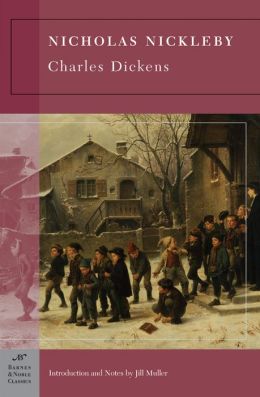
Nicholas Nickleby (1839)

Nicholas Nickleby. Charles Dickens. 1839. 817 pages.

I definitely enjoyed reading Charles Dickens' The Life and Adventures of Nicholas Nickleby. Soon after the novel opens, three members of the Nickleby family (Mrs. Nickleby, Nicholas, and Kate) travel to London to visit with Ralph Nickleby (Nicholas and Kate's uncle.) Mr. Nickleby has recently died leaving the family destitute. While they don't demand financial support from the relatively wealthy uncle, they are certainly hopeful that he will at the very least help Nicholas and Kate find positions to earn money.

One thing can be said with certainty: Ralph Nickleby is not a nice man, a kind man, a sociable man. I am not sure he treats anyone with respect or consideration. Emotional support will not be given, nor will direct financial help. He "helps" Nicholas get a job in a family-run school. The owner of the "school" is a scoundrel through and through. He also "helps" Kate get a job as an assistant seamstress. Neither job lasts terribly long. Kate loses her job when the seamstress goes bankrupt; Nicholas runs away from his job--taking along a young man named Smike--after beating up his employer. Any other "help" given to Kate is the opposite of what anyone could ever want. He introduces her to several despicable gentleman-in-name-only men, notably Sir Mulberry Hawk and Lord Frederick Verisopht. Kate finds their attentions repulsive and threatening, to a degree. Mr. Pluck and Mr Pyke are "friends" who help the two gentleman get in closer with the mother and daughter. The mother. OH WHAT I COULD SAY ABOUT HER!!!! Needless to say, the attentions from these two men cause her to lose a second job, a job I believe she found on her own. And Kate believes the danger to be real, as does Newman Noggs; he takes it upon himself to write Nicholas and alert him to the situation, bringing him back to London and reuniting the family for better or worse. (After Nicholas left his first job, he becomes an actor in a theatrical troupe!!!)

Most of the novel concerns the welfare of the Nickleby family as they try to make a life for themselves. Kate and Nicholas just want opportunities to work, to prove themselves capable workers. Mrs. Nickleby, well, she's just looking for someone--anyone--to talk at. They meet plenty of people--some good, some bad. Dickens novel has an extremely large cast of characters, and, yet the stories come together for the most part and a pleasant end is achieved. Nicholas Nickleby is not a romance like Our Mutual Friend. Other Dickens' novels have more romance (David Copperfield, Our Mutual Friend, Little Dorrit, Bleak House), but it is a thoroughly enjoyable novel. I enjoyed spending time with the characters. Some of my favorite "minor" characters were Charles and Ned Cheeryble, Tim Linkinwater, Miss La Creevy, and Mr. Lillyvick. Little details can bring delight. For example, the talk of the "United Metropolitan Improved Hot Muffin and Crumpet Baking and Punctual Delivery Company."

Favorite quotes:
To die is our heavy portion, but, oh, let us die with life about us; when our cold hearts cease to beat, let warm hearts be beating near; let our last look be upon the bounds which God has set to his own bright skies, and not on stone walls and bars of iron! 
'There are shades in all good pictures, but there are lights too, if we choose to contemplate them,' said the gentleman with the merry face. 
'The sun does not shine upon this fair earth to meet frowning eyes, depend upon it.'
'When a man's a bear, he is generally pretty independent.'
'His manner is rough,' said Kate.
'Rough!' cried Miss La Creevy, 'a porcupine's a featherbed to him! I never met with such a cross-grained old savage.'
Spite is a little word; but it represents as strange a jumble of feelings, and compound of discords, as any polysyllable in the language.
 Dreams are the bright creatures of poem and legend, who sport on earth in the night season, and melt away in the first beam of the sun, which lights grim care and stern reality on their daily pilgrimage through the world. 
 The plot was most interesting. It belonged to no particular age, people, or country, and was perhaps the more delightful on that account, as nobody's previous information could afford the remotest glimmering of what would ever come of it.
 Newman stopped; not at all disconcerted.
'I did ring.'
'I knew you did.'
'Then why do you offer to go if you know that?'
'I thought you rang to say you didn't ring,' replied Newman. 'You often do.' 
© 2013 Becky Laney of Becky's Book Reviews