Showing posts with label 1952. Show all posts

Friday, May 10, 2019

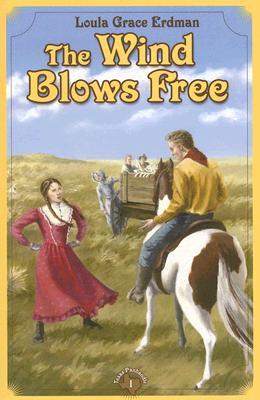
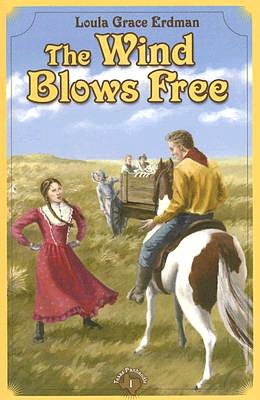
The Wind Blows Free

The Wind Blows Free. Loula Grace Erdman. 1952/2006. 271 pages. [Source: Library]

 First sentence: Melinda Pierce sat on the green plush seat of the railroad car, listening to the mocking song the wheels of the train were singing. All the way up from East Texas they had said the same thing--"Going away. Going away. Going away," they wailed. And sometimes they added, "Poor Melinda. Poor, poor Melinda."

Premise/plot: Set in the Texas Panhandle in the 1890s, The Wind Blows Free introduces us to the Pierce family. The father has lost his store and is resettling the family from East Texas to the Texas Panhandle. It will require more than a little adjusting. For example, going from wood or coal as a fuel source to COW CHIPS, or, going from a house with floors and carpets to a dirt floor. Melinda knows that she will not like it here; she is counting down the months, weeks, days, and hours until she can go back East. Her grandmother has promised that she can attend a high school back in East Texas--the same one her mother attended, I believe. But when the time comes will she be ready to say goodbye to her family? 

My thoughts: In the 1950s, Loula Grace Erdman wrote a historical trilogy set in the Texas Panhandle. Each book was narrated by a Pierce sister. The first book by the oldest, Melinda, the second book by the middle sister, Katie, the third book by the youngest, Carolyn. (There are NO BOOKS on the twins, Bert and Dick.) The novels are not necessarily dependent on one another. The age of each heroine happens to be fifteen. So in some cases, quite a few years have gone by since the previous book. But of course, if you've got access to all three books, I'd recommend reading them in order!

For those interested in pioneer stories, this will prove an interesting read. It isn't quite the same time period of the Little House books (it's set a few decades later), but the pioneer-feel is the same. 

I enjoyed this one more the second time. (I first read it in April 2012.) I gave more attention to the relationships this time around--notably that of Melinda and Dennis Kennedy and Melinda and Annie Foster.

This one is not what you'd call politically correct. It was written in the early 1950s and set in the 1890s. Native Americans are called Indians. The Pierce children especially seem afraid of potentially encountering Indians. They become a little bit more comfortable with the move after being assured that all the Indians are now living on reservations. The mother has passed along a family story or two of a past Indian encounter. This would be with the great-great-grandmother in Georgia. This story both thrills and frightens with each retelling. The girls go through a 'scary' encounter with an Indian that turns out to be TALL GRASS. It is what it is. I don't know that it does any good to pretend that history was different than what it was or to make fictional heroines radically counter the culture and times in which they lived.

I didn't grow up reading The Wind Blows Free. But I did grow up reading the second book in the series, The Wide Horizon. It was one of my favorites growing up.


© 2019 Becky Laney of Becky's Book Reviews

Tuesday, July 17, 2018

East of Eden

East of Eden. John Steinbeck. 1952. 601 pages. [Source: Bought]
First sentence: The Salinas Valley is in Northern California. 

Premise/plot: East of Eden is near-impossible to summarize in a few sentences. Other than the human condition--the human character itself--I'm not sure it is technically about anything. It examines why we are the way we are, how we justify the choices we make, how easy it is to deceive ourselves and others. Can you ever really know another person and love them unconditionally? Is every person a broken mess? Are some people better at hiding their brokenness?

Cyrus Trask has two sons--each by a different woman. Adam is his first born. Cyrus has IDEAS, fixed ideas about who Adam should be, what Adam should do. Charles is his second son. And Cyrus isn't any better at seeing the real Charles than he is the real Adam. The difference is that Cyrus doesn't even try the tiniest bit to love Charles. Charles from an early age knows that his father doesn't love him the same--treat him the same. And his deep hurt causes him to be mean. Self-control isn't his best quality--especially as a growing boy.

Adam and Charles do come to terms with each other--after their father's death. The two even become surprisingly close considering how volatile the relationship was when they were growing up. But someone does come between them again--a woman.

Cathy. Is Cathy the serpent in the garden of Eden? Perhaps. She's dangerous and manipulative, selfish and controlling. And she becomes the mother of Adam's twin sons: Caleb and Aron.

Caleb and Aron might have easily been orphans or near-orphans. Cathy's flight was interrupted by an extremely shocked Adam. She shot him when he got between her and the door, her and FREEDOM. After he was shot by his wife, he lost the will to live if by living you mean functioning in any normal, healthy way. For the first year--maybe even a little longer--the two boys didn't even have names.

But friends can take the place of family. Enter Samuel Hamilton and Lee. Lee is a "Chinaman" who worked for Adam since he moved to California. (Lee never really liked Cathy, found her unreadable, almost soulless. Samuel, a neighbor, also got a very vibe when around her.) Lee raised the boys, loved them like they were his own flesh and blood. Both Samuel and Lee were able to speak truth--the hard, cold, brutal TRUTH that he desperately needed to hear to wake him up and give him reason to live.

Many years pass in the novel. In fact, most of the novel takes place when Cal and Aron are near-grown sons, in their final years of high school. Readers see that Adam is blind to the fact that he's repeating the exact same mistakes his father made with him and Charles. Oh, he thinks he sees the situation clearly enough NOT to be making those same mistakes. Aron can do no wrong and Adam doesn't see any reason why Aron won't fulfill all his hopes and dreams. Cal's mistakes and brokenness are quite obvious to one and all. He's honest to everyone about his shortcomings. Surprisingly so in many ways. Cal seems all too self-aware; Aron, well, he lives in a dream world of his own making.

A large part of Aron's dream world is ABRA. The two met as children. It didn't take long for Aron to know that she was the one, that she was his storybook love, that their happily ever afters were tied to one another. But this fantasy story isn't enough for Abra. Not when she feels misunderstood and ignored. Aron, she thinks, has no interest in seeing the real her, the flesh-and-blood her, the her that is all-too-human. A future with Aron would mean being or becoming HIS version of Abra. She doesn't want that--but she's not quite sure how to break into Aron's dream world and introduce reality.

Cal accepts reality as is. Oh he has hopes and dreams. One hope is that his father might one day love him as he loves Aron. But he knows that may never happen. Fortunately, Cal has LEE and ABRA to keep him grounded.

Aron's dream world is destined to crash and crumble, and unfortunately Cal is responsible for throwing Aron into the deep end of reality leaving him to sink or swim. He feels that responsibility. One could argue that someone should have taken that responsibility much, much, much earlier. That the secret should never have been a secret that long. Still, it was not done from a place of loving concern but of misdirected anger.

Can Cal ever forgive himself? Can others forgive him too?

My thoughts: I found it a difficult read to get into at first. But by the end I was fully engaged. It is a well-written, thought-provoking read. It touches on the nature versus nurture argument. But what I enjoyed most were the themes of friendship and family.

Quotes:
It doesn't matter that Cathy was what I have called a monster. Perhaps we can't understand Cathy, but on the other hand we are capable of many things in all directions, of great virtues and great sins. And who in his mind has not probed the black water?
Maybe we all have in us a secret pond where evil and ugly things germinate and grow strong. But this culture is fenced, and the swimming brood climbs up only to fall back. Might it not be that in the dark pools of some men the evil grows strong enough to wriggle over the fence and swim free? Would not such a man be our monster, and are we not related to him in our hidden water? It would be absurd if we did not understand both angels and devils, since we invented them. (447)
There are no ugly questions except those clothed in condescension. (482)
"The ways of sin are curious," Samuel observed. "I guess if a man had to shuck off everything he had, inside and out, he'd manage to hide a few little sins somewhere for his own discomfort. They're the last things we'll give up." (484)
When a man says he does not want to speak of something he usually means he can think of nothing else. (586)
Whenever a human has a nickname it is a proof that the name given him was wrong. (588)
"No story has power, nor will it last, unless we feel in ourselves that it is true and true of us." (594)
"IF a story is not about the hearer he will not listen. And I here make a rule--a great and lasting story is about everyone or it will not last. The strange and foreign is not interesting--only the deeply personal and familiar." (596)
In the dawn Dessie was awakened by the chill of pain that came to her at intervals. It was a rustle and a threat of pain; it scampered up from her side and across her abdomen, a nibbling pinch and then a little grab and then a hard catch and finally a fierce grip as though a huge hand had wrenched her. When that relaxed she felt a soreness like a bruise. It didn't last very long, but while it went on the outside world was blotted out, and she seemed to be listening to the struggle in her body. (730)
Nearly everyone has his box of secret pain, shared with no one. (815)
Try to believe that things are neither so good nor so bad as they seem to you now. (829)
Laughter at yourself comes last of all in a mad race with death, and sometimes it isn't in time. (835)
Nobody has the right to remove any single experience from another. Life and death are promised. We have a right to pain. (937)


© 2018 Becky Laney of Becky's Book Reviews

Sunday, June 25, 2017

Prisoner's Base

Prisoner's Base. (Nero Wolfe #21) Rex Stout. 1952. 209 pages. [Source: Bought]

First sentence: In Nero Wolfe's old brownstone house on West Thirty-fifth street that Monday afternoon in June, the atmosphere was sparky. I mention it not to make an issue of Wolfe's bad habits, but because it is to the point. It was the atmosphere that got us a roomer.

Premise/plot: Priscilla Eads shows up at Nero Wolfe's house expecting--hoping--that she can stay there for a week, that she can pay him room and board. She's hiding out from someone--a lawyer, a business partner. Archie lets her in, and tells her she can stay temporarily at least. The final word will come from Nero Wolfe, and he's not to be disturbed at the moment. (Readers can guess why.) Before the evening is out, two things occur: someone comes looking for her and wanting to hire Wolfe to find her AND Wolfe kicks Miss Eads out of his house. The next day, can you guess who's dead?!

Archie blames himself and takes it upon himself to FIND THE KILLER NO MATTER WHAT. And Wolfe finds himself with Archie as a client!!! Miss Eads was an heiress and she was about to come into a lot of stock and money as her birthday approached...

My thoughts: I really enjoy Rex Stout's Nero Wolfe series. I love, love, love, LOVE Archie Goodwin. This is a very satisfying, very quick read.

Quotes:
"If I had said I had read about you and seen a picture of you, and you fascinated me, and I wanted to be near you for one wonderful week, you'd have known I was lying." "Not necessarily. Millions of women feel like that but they can't afford the fifty bucks a day."
© 2017 Becky Laney of Becky's Book Reviews

Friday, September 16, 2016

The Borrowers

The Borrowers. Mary Norton. Illustrated by Beth and Joe Krush. 1952/2006. HMH. 192 pages. [Source: Library]

First sentence: It was Mrs. May who first told me about them.

Premise/plot: Ever wondered why there's never a safety pin when you need one? Readers meet a family of Borrowers who live under the kitchen floor in an older house. Pod is the 'borrower' of the family. He knows the routines of the 'human beans' and can go out and about without being seen, most of the time. He doesn't mind being seen by the matriarch of the family at night. (She thinks she's hallucinating because she's had a couple too many drinks.) His wife, Homily, is quite satisfied to stay safely in her house behind dozens of locked gates and such. (She gives him plenty of instruction on what to borrow, however.) The couple's daughter is Arrietty, and, she is the book's heroine by my reckoning. She meets a boy that has come to stay--recuperate--for a couple of months. They become very, very good friends. She reads to him. He brings her and her parents STUFF for their home. (He 'borrows' freely from the house, most notably from a doll house that everyone seems to have forgotten about.)

Readers learn about the dangers of being a Borrower and 'the good old days' when the house was FULL of families. Arrietty fears that her family is the last living in the house.

My thoughts: This one is super fun. It is also quite suspenseful at the end!!!! I definitely recommend this one!

© 2016 Becky Laney of Becky's Book Reviews

Monday, February 01, 2016

Death on the Riviera

Death on the Riviera. John Bude. 1952/2016. Poisoned Pen Press. 250 pages. [Source: Review copy]
 
Did I enjoy reading John Bude's Death on the Riviera?! Yes! I might even go so far as to call it a gush-worthy read? Why? Purely because I found it hard to put down, and, just overall satisfying to read. Is it the best ever mystery novel? Probably not. But was it a joy to spend time with? Yes, very much.

Inspector Meredith (C.I.D) and Acting-Sergeant Freddy Strang head to Southern France in this mystery novel. They are teaming up with the local police to stop a gang of criminals from printing counterfeit money and introducing it into the currency. The prime suspect--the leader of the gang--is English. But though it is late in coming--very, very late in coming--this one is a murder mystery as well. So there are at least two 'big' stories going on in this delightful golden-age detective novel.

Why did I find it so delightful? Probably for me, the number one reason is the characters and characterization as shown off so well in the dialogue. I really, really enjoyed Freddy Strang's presence in this one. And his attempted romance was just cute and sweet in all the right ways. It was never the focus of the book, but, it was like the chocolate bits in a trail mix. I also enjoyed the setting and the plot and the solution.

The book was originally published in 1952, and it has been republished in 2016.

© 2016 Becky Laney of Becky's Book Reviews

Sunday, April 12, 2015

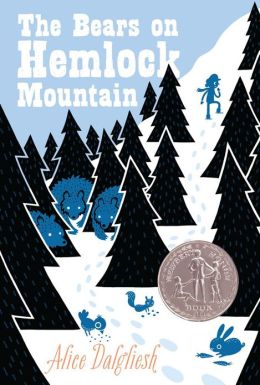
The Bears on Hemlock Mountain (1952)

The Bears on Hemlock Mountain. Alice Dalgliesh. Illustrated by Helen Sewell. 1952. 64 pages. [Source: Bought]

Jonathan lived in a gray stone farmhouse at the foot of Hemlock Mountain. Now Hemlock Mountain is not a mountain at all, it was a hill, and not a very big one. But someone had started calling it Hemlock Mountain, and the name had stuck. Now everyone talked about "going over Hemlock Mountain." 
It was the year when Jonathan was eight that he went over Hemlock Mountain. He was a fine big boy for his age. That was why his mother could send him over the Mountain all by himself. 

I enjoyed reading Alice Dalgliesh's The Bears on Hemlock Mountain. Jonathan, the hero, is sent on a mission by his mother over the mountain. He is to fetch his aunt's biggest iron pot and bring it back to his mother. The family--the whole family--will be coming soon, and she'll need it. The very first signs of spring are just beginning. Will there be bears on the mountain? Will they have woken up yet? Are there bears living on the mountain at all--awake or sleep?

Jonathan and his mother find themselves both dwelling on the same thought: bears. (She at home; Jonathan on his journey). Both repeat to themselves:
There are no bears on
Hemlock Mountain
No bears at all
Of course there are no bears on Hemlock Mountain
No bears, no bears, no bears, no bears at all.
His journey will take him up and down the mountain twice. Once on the way to his aunt's house. Once on the way back to his own house. Can he make it there and back before the sun sets? Or will he get distracted and into some trouble?! Will readers learn if there are bears on the mountain?


© 2015 Becky Laney of Becky's Book Reviews

Friday, April 03, 2015

Henry and Beezus (1952)

Henry and Beezus. Beverly Cleary. 1952. HarperCollins. 224 pages. [Source: Library]

I definitely enjoyed rereading Henry and Beezus. Unlike the Ramona series, I've only read the Henry Huggins books once or twice. Henry Huggins, our hero, really, really wants a bicycle. His parents can't afford to give him one, and, he doesn't expect it of them. He doesn't feel entitled to it. If only there was a way to earn enough money to buy it himself.

"Henry and The Roast." Readers meet Henry and Ribsy, learn of his great desire for a bicycle, and witness Ribsy steal a roast from the neighbor's barbecue. Readers also meet Henry's nemesis: Scooter, a boy with a bicycle and a paper route. A boy who happens along just in time to "save the day" or save the roast and save Ribsy from a dog fight.

"Henry Gets Rich." Henry discovers abandoned boxes of gumballs. He needs Beezus' red wagon to carry them back home. But borrowing the wagon means getting Beezus and Ramona to tag along with him.
"Ramona," coaxed Beezus, "can't you play that game some other time?"
"What game?" asked Henry. He couldn't see that Ramona was playing any game.
"She's playing she's waiting for a bus," explained Beezus.
Henry groaned. It was the dumbest game he had ever heard of. "Doesn't she know it isn't any fun just to sit on a box?" he asked, looking nervously up and down the street. If only he could be sure no one else had discovered his gum!
"Sh-h," whispered Beezus. "She thinks it's fun and I don't want her to find out it isn't. It keeps her quiet." Then she said to her little sister, "If you get in the wagon, Henry and I'll pull you and you can pretend you're riding on the bus." (40)
Henry thinks the gum a great discovery. He can even sell it to all his friends and classmates. He can make some money for his bike fund. But the teachers aren't happy about all the gum. (Neither are the janitors). And he finds it increasingly hard to sell gum after the first day or two. Maybe the gum wasn't such a wonderful discovery after all.

"The Untraining of Ribsy" Henry has the opportunity to take over Scooter's paper route for a week. A dollar will help his bike fund that's for sure. But can he stop Ribsy from "stealing" papers on the route? Beezus and Ramona make an appearance in this chapter as well. In fact, it is Ramona who accidentally provides a solution.

"Henry Parks His Dog" and "Beezus Makes A Bid" Henry, Beezus, and Ramona go to a police auction. Henry's trying to buy a bicycle at the auction with his $4.04. (He had to spend a dime to buy Ramona a snack. He didn't want to stop at the store and "park his dog" outside, but, he had to do something to get Ramona to behave.) Will he get a good deal? Or will all the kids tease him?

"The Boy Who Ate Dog Food" Everyone is excited about the grand opening of Colossal Market. There will be prizes and free samples. Henry and his parents go. As do Beezus and her family, I believe. (I think all the neighbors go.) Henry is lucky and unlucky. He wins something. But the prize, at first, feels very unlucky. He won $50 of work at a BEAUTY SALON. He doesn't need manicures, waves, and facials. Everyone is laughing. Which leads him to accept a dare to eat dog food. But then he realizes that he can SELL his prize and get the money for what he wants most...


© 2015 Becky Laney of Becky's Book Reviews

Sunday, September 28, 2014

The Singing Sands (1952)

The Singing Sands. Josephine Tey. 1952. 224 pages. [Source: Bought]

It was six o'clock of a March morning, and still dark. The long train came sidling through the scattered lights of the yard, clicking gently over the points.

Inspector Alan Grant is on holiday. He's had to take a personal holiday because of his mental health condition. He's had a nervous break, I suppose. Suddenly, he's weighed down by fear and anxiety, and shame. He doesn't want everyone to know what his mind is doing to him. Little things that he's always taken for granted now are tormenting him: riding in a train, sleeping in a sleeper car, riding in a car, riding in a plane. He's become claustrophobic.
Well, at least he had managed not to open the door last night. But the triumph had been dearly bought. He was drained and empty, a walking nothingness. "Don't fight it," the doctor had said. "If you want to be in the open, go into the open." But to have opened the door last night would have meant a defeat so mortal that he felt there would be no recovery. It would have been an unconditional surrender to the forces of Unreason. So he had lain and sweated. And the door had stayed closed. (4)
The morning after his sleepless night, Grant discovers a dead body. "Number B Seven" is found dead in his sleeper. Grant, who is not on duty, gets a very good look at him, and he accidentally picks up the dead man's newspaper. He takes it with him by chance. Later, when he's arrived at his cousin's house, I believe, he realizes what he did. He notices for the first time that the paper had been written on. It contains a few lines of poetry. Grant isn't sure if the man was writing an original poem, or, if he was writing down someone else's poem. But either way, those lines and that handwriting make an impact on him. He can't stop thinking about "Number B Seven." Even though he's supposed to be on vacation, resting and relaxing, and FISHING.

As you have probably guessed, Grant is not going to do much relaxing on his vacation. Oh. He does try. But he keeps thinking about this case. A case that others at Scotland Yard have already closed. They've identified the body and the cause of death. End of story. But it's not enough for Grant. He thinks there is more to the story...and since this is his story, his FINAL story, I might add...he's right!

I liked this one. I am not sure I loved it. But I liked spending time with Grant.

© 2014 Becky Laney of Becky's Book Reviews
Tuesday, June 19, 2012

Mrs. McGinty's Dead

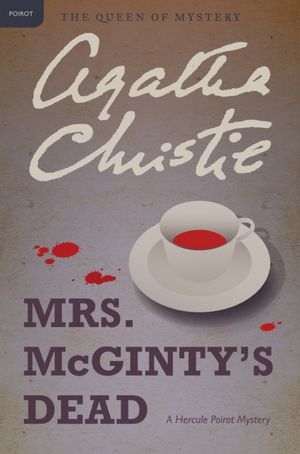
Mrs. McGinty's Dead. Agatha Christie. 1952/2011. HarperCollins. 272 pages. 

I definitely LOVED Mrs. McGinty's Dead. I really, really, really LOVED the surprise appearance of Ariadne Oliver. But, of course, the main star of this one is Hercule Poirot. The novel starts off rather unpleasantly with Poirot thinking to himself how wonderful he is, how marvelous he is, and how much he needs someone to talk to so he can show off how wonderful he is. So when he receives an unexpected visit from Superintendent Spence who is asking him to take on a closed case, well, he can't resist. Spence was one of the men who helped convict James Bentley of murder, but, he's having doubts, strong doubts. He believes that if Bentley is executed, well, they'll be executing an innocent man. He's not sure who killed Mrs. McGinty, but he knows that Poirot can solve this case better than anyone else. So Poirot travels to the village of the crime and he learns what only he can learn...

I LOVED this one!!! Loved hearing Mrs. Oliver talk about her writing, loved seeing her "work with" someone who is adapting her character, her main detective, into a play. Loved hearing her grumble and complain about her Finn detective.

This one is a great mystery, and, it was just so much fun to spend time with Christie's characters.

Read Mrs. McGinty's Dead
  • If you're a fan of Agatha Christie, Hercule Poirot, or Mrs. Oliver
  • If you're a mystery lover
© 2012 Becky Laney of Becky's Book Reviews

Thursday, April 19, 2012

The Wind Blows Free (MG)

The Wind Blows Free. Loula Grace Erdman. 1952/2006. Bethlehem Books. 271 pages.

Melinda Pierce sat on the green plush seat of the railroad car, listening to the mocking song the wheels of the train were singing. All the way up from East Texas they had said the same thing--"Going away. Going away. Going away," they wailed. And sometimes they added, "Poor Melinda. Poor, poor Melinda." 

In the 1950s, Loula Grace Erdman wrote a historical trilogy set in the Texas Panhandle. Each book was narrated by a Pierce sister. The first book by the oldest, Melinda, the second book by the middle sister, Katie, the third book by the youngest, Carolyn. The novels are not necessarily dependent on one another. The age of each heroine happens to be fifteen. So in some cases, quite a few years have gone by since the previous book. But of course, if you've got access to all three books, I'd recommend reading them in order!

After their father loses his store in a fire, the Pierce family resettles in the Texas Panhandle. It will require some adapting by each family member, of course, though the twins, Bert and Dick, seem to have it best of all the children. They just can't stop from saying 'oh golly' every time they enter a scene. But for Melinda, the move is doubly hard. She can't stop thinking that she was meant to stay in East Texas and attend the same ladies academy as her best friends. And the move west seems to have doubled her responsibilities. Melinda's "new life" doesn't get off to the best of starts. For while she's busy daydreaming, her youngest sister wanders away. And it takes hours and hours to find her. But the afternoon isn't a complete loss for there is one special young man, Dennis Kennedy, who helps Melinda search for her sister.

For those interested in pioneer stories, this will prove an interesting read. It isn't quite the same time period of the Little House books (it's set a few decades later), but the pioneer-feel is the same. I liked the first book, The Wind Blows Free. It is Melinda's coming-of-age story, readers see how she comes to accept the move and even come to love her new life. But it probably isn't the best of the trilogy.

Read The Wind Blows Free
  • If you are looking for more pioneer stories with a "Little House" feel
  • If you are looking for historical fiction set in Texas, in the Texas Panhandle
  • If you can get past dated (or outdated) references to Native Americans. (The book has Melinda recounting her great-grandmother's oh-so-scary experience with Indians as a child in Georgia. Melinda does seem worried that she might accidentally see an Indian, but everyone assures her that Indians are only to be found on reservations these days, so she need not worry about that.)

© 2012 Becky Laney of Becky's Book Reviews

Friday, August 05, 2011

They Do It With Mirrors

They Do It With Mirrors. (Miss Marple). Agatha Christie. 1952/2011. HarperCollins 224 pages.

Mrs. Van Rydock moved a little back from the mirror and sighed. 

Ruth Van Rydock wants her good friend, Jane Marple, to do her a favor. She's worried about their mutual friend Carrie Louise Serrocold. She has a feeling that Carrie Louise is in trouble or in danger. And so she's arranged a visit for Miss Marple. After a few small lies are told to smooth the way, Carrie Louise is happy to welcome her old friend into her home. Miss Marple is introduced to the STRANGE, STRANGE bunch of folks living or working on the estate. Her husband, Lewis. Her daughter, Mildred. Her granddaughter, Gina, and her husband, Walter. Her stepsons from her second marriage, Stephen and Alex Restarick. Her companion-caretaker, Juliet Bellever. Her husband's assistant, Edgar Lawson. (Carrie Louise has been married three times--and it shows. She's carried over wealth and property, but, also children and grandchildren, etc.) Her husband's pet project has him working with juvenile delinquents with part of the estate being converted into a school of sorts. I won't lie, it was a bit confusing at first to see how these characters connect to one another--if they connect to one another. It helps that almost every character seeks out Miss Marple in the days after her arrival. One by one they "unburden" themselves and complain freely about anything and everything.

Of course, it turns out that Ruth had VERY good reason to worry about her friend. And Miss Marple it seems arrived just in time for the drama. Soon there's a murder to be solved...can she solve it in time before more lives are lost?

I enjoy Miss Marple. I do. There is just something satisfying about reading Agatha Christie. While They Do It With Murders isn't my new favorite or anything, it is an enjoyable mystery. Not perfect. But definitely enjoyable enough to recommend.

Ruth to Miss Marple:
"You've always been a sweet innocent looking creature, Jane, and all the time underneath nothing has ever surprised you, you always believe the worst."
"The worst is so often true," murmured Miss Marple.
"Why you have such a poor idea of human nature, I can't think--living in that sweet peaceful village of yours, so old world and pure."
"You have never lived in a village, Ruth. The things that go on in a pure peaceful village would probably surprise you."
"Oh I daresay. My point is that they don't surprise you." (9)

Inspector Curry and Miss Marple:
"This is all very distressing I know. But we've just got to get the facts clear. Get it all clear."
"Oh yes, I know," said Miss Marple. "So difficult, isn't it? To be clear about anything, I mean. Because if you're looking at one thing, you can't be looking at another. And one so often looks at the wrong thing, though whether because one happens to do so or because you're meant to, it's very hard to say. Misdirection, the conjurers call it. So clever, aren't they?" (90)

© 2011 Becky Laney of Becky's Book Reviews
Tuesday, April 19, 2011

The Voyage of the Dawn Treader

The Voyage of the Dawn Treader. C.S. Lewis. 1952. HarperCollins. 256 pages.

There was a boy called Eustace Clarence Scrubb, and he almost deserved it. His parents called him Eustace Clarence and masters called him Scrubb. I can't tell you how his friends spoke to him, for he had none.

The Voyage of the Dawn Treader is one of my favorite, favorite books. There are seven books in the Chronicles of Narnia, this is the third. Yes, third. For there is NO other way to read the books then in their proper order: The Lion, The Witch, and the Wardrobe, Prince Caspian, The Voyage of the Dawn Treader, The Silver Chair,  The Horse and His Boy, The Magicians Nephew, and The Last Battle.

This third adventure stars Lucy and Edmund Pevensie and their cousin, Eustace Scrubb. These three are transported to Narnia--much to Lucy and Edmund's delight and Eustace's horror and disbelief--through a magical painting. Lucy remarking one day that the ship in the picture looks Narnian, that those waves look like they're moving. Once on board this ship, they meet King Caspian. They join him on his quest to find his father's missing friends, these "seven lost lords": Lord Bern, Lord Octesian, Lord Restimar, Lord Rhoop, Lord Mavramorn, Lord Revilian, and Lord Argoz.

The book is a series of adventures; these adventures being loosely tied together by their one mission, one quest, of discovering the fate of these seven lords. They are NOT out to save the world, NOT out to save Narnia from a dark and evil threat. They are adventuring for the sake of adventuring. They are facing risks, yes, because they are curious and brave and loyal. But they are not facing risks because there is evil lurking and threatening to destroy everything they know and love. Why mention this? Well, if you saw the movie, you might have gotten a different idea of their adventures.

What do I love about this one? The characters and the stories! I love to see how Eustace is turned into a dragon. I love, love, love how he's restored and healed by Aslan. That scene being oh-so-magical! (And the movie? Well? They don't quite capture it the way the book did. They changed things throughout.) There are so many elements that I just loved in this one! Lucy "helping" the invisible dufflepuds, Dark Island and the albatross, etc. And then, of course, there is Reepicheep!!!

So do I recommend this one?! Yes!!! How did I feel about the movie? Well, there were places I enjoyed it. But they rearranged things; they changed things; they added and subtracted. And there were a few scenes that just felt tedious. (The big scene that is supposed to be the climax; the big battle). But it was a beautiful movie. It was compelling even if it was different. Were the changes necessary? I'm not convinced they were. Especially how they felt the need to add conflict and tension between the characters--when there wasn't any in the book. But it wasn't a horrible adaptation.

© 2011 Becky Laney of Becky's Book Reviews