Showing posts with label apocalyptic fiction. Show all posts

Monday, October 07, 2024

80. The Dead and the Gone

The Dead and the Gone. Susan Beth Pfeffer. 2008. 336 pages. [Source: Library] [4 stars] [YA dystopian; YA Science fiction; YA Fiction]


First sentence: At the moment when life as he had known it changed forever, Alex Morales was behind the counter at Joey's Pizza, slicing a spinach pesto pie into eight roughly equal pieces.

The dead & the gone is the companion novel to Susan Beth Pfeffer's Life As We Knew It. While Miranda's story--set in Pennsylvania--chronicles her life from May through March of that decisive year, Alex's story--set in New York City--chronicles his life from May through December. Both are family-oriented. Miranda's life being closely tied to her mom and two brothers; Alex's life being closely tied to his two younger sisters, Brianna and Julie. But Alex's story is stronger in many ways. For Alex is the head of the family--for better or worse. Alex is the one making life-and-death decisions. His mom vanished on May 18th--the day the asteroid struck the moon. His dad may or may not have survived the first terrible week. Having been in Puerto Rico for a funeral, he's unable to make contact with his family. And, well, the coasts were hit hard--again and again. So even surviving the first tsunamis might not mean much in the long term. His older brother, Carlos, is in the Marines. He was far from home when it happened, and while he's able to send word--by phone or mail--a few times throughout the book. He's not the one in charge. He's not the one responsible for making the tough decisions on how to best survive. So while Miranda has to grow-up, it is a gradual growing into adulthood. She still has her relaxed moments. There is never one moment for Alex to relax. He carries a heavy weight day and night.

I enjoyed rereading Life As We Knew It and the dead & the gone back to back. There are things I love about both books. Things I appreciate about both books. One thing that makes the dead & the gone a very different story is the focus on faith and community. The dead & the gone is faith-oriented. Alex and his family are Catholics. They all attend Catholic school. They all regularly attend mass. They take their faith, their spirituality, their religion very seriously. The words mean something. The faith means something to them. Something real. Something personal. While each of the siblings has their own reaction--response--to the crisis, none loses their faith, none lose hope completely. I loved seeing this Catholic community in action. I loved seeing the Catholic church reaching out in love and compassion--with great hope and faith--to their community, to their parishioners. There were so many great scenes of this faith-in-action. Where people were responding with their hearts in faith as opposed to acting out of fear and anxiety. It's courageous and wonderful.

The dead & the gone has a broader outlook as well. While the electricity isn't reliable on a day-by-day basis in the dead & the gone, it is certainly more stable than in Life As We Knew It. Alex is connected to the larger world. He hears--for better or worse--more about the world at large. He is more aware of what is going on in other states. While Miranda and her family may go weeks or months without contact to other survivors, Alex is out of the house most days--at least before the flu epidemic comes. He's not as isolated as Miranda. Does not being so isolated help him cope? Maybe. But every day, every week is a struggle. Alex does things he'd NEVER thought he'd be doing.

Is Alex more of a hero than Miranda? I'm not sure that is exactly fair. Miranda has her courageous moments too. (I'm thinking of the woodstove mishap.) But. Alex's story has power no doubt about it.
I would definitely recommend both books.

"Give the scientists some time and they'll figure out what to do."
"This is too big for the scientists," Lorraine said. "Only God can save us now."
"Then He will," Alex said. (13)

God save their souls, Alex prayed. God save ours. It was the only prayer he could think of, no matter how inadequate it might be. It offered him no comfort, but he repeated it unceasingly. As long as he prayed he didn't have to think. He didn't have to remember. He didn't have to decide. He didn't have to acknowledge he was entering a world where no one had laid out the rules for him to follow, a world where there might not be any rules left for any of them to follow. (65)

"She says you've been having bad dreams."
"Aren't you?" Julie asked. "Isn't everyone?"
Alex burst out laughing. "Only sane people," he said. "Okay, maybe not Bri. But everyone else is."
"Are things going to get better?" Julie asked. "Is that why you listen to the news all the time, because someday things are going to get better?"
Alex shook his head. "That's not why I listen," he replied. "That's why I pray but not why I listen."
"Do you think God listens?" she asked.
"Bri thinks so," Alex said. "Father Franco thinks so." (81)

It was hard being alone in the apartment staring at an unringing phone, haunted by the food in the kitchen, which he wouldn't allow himself to touch, haunted even more by the image of his mother drowning in the subway that very first night. He tried reading. He tried praying. He tried push-ups. He tried counting the cans of soup. He listened to the radio, using up the twenty-dollar batteries. The world was coming to an end. Well, that was nothing new. (123)

"And what's so special about you that you deserve compassion?" Father Mulrooney said. "You have shelter. You have food. You have family and friends. I'm supposed to feel pity for you because of a cut cheek?"
"You don't understand at all," Alex said. "I have shelter for as long as no one thinks about it. Once they do, once they realize my father is gone, they can throw us out. I have food only if I get lunch here. We're down to almost nothing at home, and I have to make sure my kid sister eats. She is my family right now, because my parents are both gone and my older brother is in the Marines somewhere and I sent my other sister to live at a convent with strangers. My cheek was cut because I got caught in a food riot, with my kid sister, and we ended up with no food anyway. I'm not asking you to pity me. I pity me enough for the two of us. But when one of your students asks you for food, you shouldn't say no and feel righteous about it. That's not what Christ would have done, and you know it." (133)

"What do you have planned for tomorrow?"
Alex shrugged. "The usual," he said. "Checking on the elderly, studying theology, fighting for survival. Same old, same old." (151)

"I know it's wrong to feel that way about God and I know it's wrong to not feel anything. I hate it. I don't hate God. I hate not loving Him." (184)


© 2024 Becky Laney of Becky's Book Reviews

Tuesday, July 25, 2023

138. Shift Omnibus


Shift. Hugh Howey. 579 pages. 2013. [Source: Book I Bought] [adult science fiction; dystopia; futuristic; apocalyptic]

First sentence: Troy returned to the living and found himself inside of a tomb.

Premise/plot: Shift is the second book published in the Silo science fiction series by Hugh Howey. It is a series of flashbacks. It spans centuries. It reveals how the Silo(s) came to be. It isn't until the end of the novel that the action catches up to Wool.

So there are essentially two or three stories: 1) Donald's story of how the Silo project came to be and how the world ended; 2) Donald/Troy's various shifts through the centuries as manages the Silo project(s). 3) Jimmy (aka Solo)'s never-ending nightmare as the "only" survivor of his Silo. He's not really the one and only survivor--as revealed in Wool. But he might as well be...to some extent. It's all survival of the fittest, shoot to kill, trust no one. This section has  CAT. (I'd forgotten about the cat). 

My thoughts: Jimmy's story was SO compelling and heartbreaking. This character and his experiences have sticking power. I don't think I'll soon forget him. Troy/Donald is perhaps a less likeable character. Perhaps. He's a pawn in many ways. Even if he'd "woken" up and seen the truth about how things were going down, what could he have done???? Is there anything he could have done? anything he could have said? I don't think there is. 

I do think this is a thought-provoking read. It is MORE political than Wool (in my opinion). But it was written political in a time BEFORE politics went...I'm trying to think of a good, polite way to say it...before politics became so very, very, incessantly divisive and explosive for the nation. So it doesn't feel like it was written with a hammer directed at anyone in particular. (Which I appreciated.) 

I've never read the third book in the series. So I'm not sure how the series ends....but I have to keep going now.


© 2023 Becky Laney of Becky's Book Reviews

Sunday, March 06, 2022

34. Wakers


Wakers. Orson Scott Card. 2022. 400 pages. [Source: Library]

First sentence: Because he was a teenager, and teenagers take pleasure in exploring wacky ideas, Laz Hayerian had wondered since the sixth grade whether we are the same person when we wake up that we were when we went to sleep. Specifically, he wondered if he was the same person, because sometimes his dreams persisted in memory as if they had been real events. Did dream memories change him the way real memories did? 

Premise/plot: Laz, our protagonist, wakes up in a coffin-like box alone in a warehouse of clones or would-be-clones. The other coffins/beds are either empty or with dead clones. He finds his way to an exit only to discover that he is alone. Not just alone, but a long-long-long-long time alone. From what he can deduce, humans haven't been living in this town/city for years--decades. So he has to find clothes, food, water, shelter. And a way to protect himself against wild animals--including pack dogs that have had generations without human ownership, care, or interaction.

Some of this plays out day by day by day by day by day. But some plays out in what would be a montage sequence. After months on his own, he goes back to his beginning...and discovers that out of all the clones (or would-be-clones) there is one--a young teen girl about his own age--that is not dead, whose coffin-bed is still functioning. She is his only chance of a companion...but being the last two people doesn't mean that she's his Eve and he's her Adam. 

Both have different powers that make them "weird." He can side-step into different time-streams (think of them as being alternate realities). She can see other time-streams (sorta; she can see all the options and how they would play out in time-streams). Their weird gifts complement each other. She seems to know all about his gift; he has no clue about hers. 

Long story short--these two carry a heavy burden, if "the world" (aka "the human race") is to be saved, they will have to work together and find a way to use their gifts in a way that they have never ever been used before.

My thoughts: If I had to sum up this book in one word--TEDIOUS. But of course, I am going to let it go at just one word. In all honesty, this four hundred page book felt like it had a thousand pages, each one just as slow and boring as watching grass grow. 

The first third of the book had survival vibes. It was all about Laz using a long-abandoned remnants of modern society to try to survive. He had no answers to his questions. He didn't even know what questions to ask. He spent a LOT of time in his head and we readers were along for the ride. After Laz was joined by Ivy, well, the questions doubled, the answers remained elusive. But the tedium quadrupled. Seriously, you would think the fact that he now has human companionship would make the book more interesting, the plot move faster, but, nope. The dialogue was SO tedious and weighted with science-y science talk. Theoretical. Hypothetical. Speculative. Even when readers discover that the survival of the human race depends on these two, the plot stays as thick and sluggish as can be.

I think if you were looking for a premise-driven novel, you'd be disappointed by the slow pace. The world building is not as substantive as the premise would call for. We learn nothing about how this future world works. The development of the world, the peopling of the world, its strengths and flaws. The premise remains shallow.

I think if you were looking for an action/plot-driven novel, you'd be disappointed. It is very little action, all dialogue. And there is nothing compelling about the pacing. At all. I am not saying that there might not be a few readers who get super excited about the speculative theoretical nature of all this science-y science talk. Maybe there are.

I think you were looking for a character-driven novel, you'd be disappointed. We get to know two characters. And I won't lie and say that these two characters lack development. They are developed. It is just that that development doesn't necessarily make them fascinating, interesting, compelling, relatable, enjoyable. Neither is conventionally likeable. Perhaps that isn't fair. Ivy and Laz relate to each other. Ivy and Laz like each other. Ivy and Laz trust each other.

Quote: "When you invent a story to explain all the known facts, then of course the known facts will fit the story," said Laz, "It's a reciprocal arrangement."


© 2022 Becky Laney of Becky's Book Reviews

Tuesday, October 22, 2019

Alas, Babylon

Alas, Babylon. Pat Frank. 1959. 323 pages. [Source: Library]

First sentence: In Fort Repose, a river town in Central Florida, it was said that sending a message by Western Union was the same as broadcasting it over the combined networks. This was not entirely true. It was true that Florence Wechek, the manager, gossiped. Yet she judiciously classified the personal intelligence that flowed under her plump fingers, and maintained a prudent censorship over her tongue. The scandalous and the embarrassing she excised from her conversation. Sprightly, trivial, and harmless items she passed on to friends, thus enhancing her status and relieving the tedium of spinsterhood. If your sister was in trouble, and wired for money, the secret was safe with Florence Wechek. But if your sister bore a legitimate baby, its sex and weight would soon be known all over town.

Premise/plot: Randy Bragg is the hero of this apocalyptic/post-apocalyptic science fiction classic. One day—soon after the novel opens—Randy receives a telegram with a code word: Alas, Babylon. It is from his brother, Mark. The message may confuse Florence, but the message is perfectly clear to Randy. The end is near—nuclear war is imminent. Mark knows that he won’t survive, but he’s hoping that by sending his wife, Helen, his son, Ben Franklin, and his daughter, Peyton, that they will. The message proves timely. Mark’s prediction comes true. Will Randy and his neighbors know how to keep themselves alive in the dark, bleak days and weeks ahead? Will life go on? What will that life look like? What kind of future will humanity have?

My thoughts: I believe this is my third time to read Alas, Babylon. I absolutely love this one. It is such a fascinating read. It reads closer to a survival adventure story than anything else. It does indeed pose the big what if that would have been on the minds of every reader at the time it was published. What if war happens? What if it’s nuclear war? Can nuclear war be won? Will humanity stand a chance of surviving? What would life be like after such a disaster? But this is so much more than a premise driven novel. The characters are so well done...as are the relationships.
© 2019 Becky Laney of Becky's Book Reviews

Tuesday, October 08, 2019

On the Beach

On the Beach. Nevil Shute. 1957. 296 pages. [Source: Library]

 First sentence: Lieutenant-Commander Peter Holmes of the Royal Australian Navy woke soon after dawn.
Premise/plot: On the Beach is a behind the scenes glimpse of the end of the human race as seen through the eyes of an American (Dwight Towers) and several Australians (Peter and Mary Holmes, Moira Davidson, John Osborne). It is set after an extremely brief but devastating war. There is only one way this one will end—the death of every single character. Not even Shakespeare was this brutal. The novel poses the question: is war worth it? When all is said and done is pride, greed, ambition, love of power, stubbornness, selfishness, the need to be right...worth the extinction of humanity. In case you didn’t pick up on it, this one is a bit didactic or agenda-driven. Nuclear warfare is bad, bad, all kinds of bad. It’s a lose/lose situation. It is preventable if everyone uses common sense. It is too late for the fictional world Shute has created, but it is not too late for us in the real world.

My thoughts: This novel is bleakity-bleak. Hope is not to be found here. It isn’t just that life as we know it is over...it isn’t that we’ve been sent back to the dark ages...it isn’t that 80% of the population has died. No. Every human on the planet is either dead, dying, or soon to be dying. Death is stalking the characters, creeping closer and closer as the seasons change and the wind blows the poison—the radiation—closer and closer. The book isn’t about the destination, but the journey. How do these characters choose to live day after day knowing what it is coming?! What changes? What stays the same? Who do they choose to spend time with? What do they choose to do? How do they cope? Do they cope?

I don’t expect every apocalyptic novel or post-apocalyptic novel to deal with religious themes or undertones. God is not to be found within this one. None of the characters believe in God or even a god. Faith and religion—spirituality—is not a part of this one. None of the characters seem to believe in heaven or hell.
This would not be at all surprising if published now, but would it have seemed so in 1957? Would readers have wondered why the characters didn’t pray, make peace with God, find comfort in a faith community?

I also wonder if it would have been controversial at the time it was published in regards to how it ended. Having pills ready and waiting at the pharmacy available for request—free of charge—to anybody who wants the “dignity” of ending their own life. I think times have probably changed in regards to this as well.

The hardest part was the fact that Peter and Mary have a baby. They have to plan to kill their baby so that she is not left on her own in case she outlives her parents.

If there is a theme it is live for today because humans are stupid.

© 2019 Becky Laney of Becky's Book Reviews

Friday, September 27, 2019

The Lightest Object in the Universe

The Lightest Object in the Universe. Kimi Eisele. 2019. 325 pages. [Source: Library]

First sentence: Thirteen days into the second month of the year, the lights began to go out.

Premise/plot: The Lightest Object in the Universe is a post-apocalyptic romance novel starring Carson Waller and Beatrix Banks. When the darkness comes (which is after the deadly flu, by the way) Carson and Beatrix are lovers separated by a continent. He lives in New York; she lives in California. They’ve always used technology to communicate on a near daily basis. They visit one another via plane. Their love blossomed before...life as they knew it, as everyone knew it disappeared in a matter of days. Carson heads out on foot—following railway tracks—to California. Beatrix, meanwhile, has a tough choice to make. Should she stay put and work on turning her own community into a communal haven? Or should she follow the vague directions of her fellow roommates?! The chapters do not alternate narrators—for better or worse. Each chapter switches back and forth and back and forth. There are no design indicators to let readers—perhaps sleepy readers—know who is narrating.

My thoughts: This is a good example of an almost love for me. On the one hand, I enjoy post-apocalyptic novels; I enjoy dystopian novels. The community Beatrix becomes a part of seems utopian. The community (the Center) that both Carson and Beatrix are skeptical of is definitely dystopian. This has a light thread of romance which acts as hope. On the other hand, this stayed a premise driven novel. The characters remained a bit too distant for me. I wanted them to find each other again, I did. But I didn’t really feel a true connection with either. There was a potential for tension and suspense. But I never felt the life-and-death danger of this new world they were adjusting to.

I don’t regret my time. But I don’t see myself rereading this one.

© 2019 Becky Laney of Becky's Book Reviews

Friday, November 16, 2018

The Calculating Stars

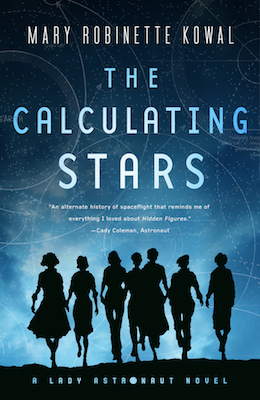
The Calculating Stars (Lady Astronaut #1) Mary Robinette Kowal. 2018. Tor. 432 pages. [Source: Library]
First sentence: Do you remember where you were when the Meteor hit? I've never understood why people phrase it as a question, because of course you remember.

Premise/plot: The Calculating Stars is set in an alternate reality 1950s. There are two what-ifs. One is small. One is big. What if Dewey had won the presidential election instead of Truman? What if a meteor--an extinction event--had struck earth in 1952? The heroine of the book is a former WASP, a current computer for NACA, a wife of an engineer, Nathaniel York. Her name is Elma York and within Kowal's fictional universe she may be better known to the world as LADY ASTRONAUT.

In the weeks following he devastating event, Elma York realizes that the worst is yet to come. It's just a matter of time--mere decades--before the earth becomes uninhabitable. The earth will experience great climate change. The earth will begin to heat up and will keep heating up. If humanity is to survive, it needs to find a way to leave the planet. But can she--and her fellow scientists--convince the powers of the dangers? Or will politics get in the way? (For example, there are a few convinced that the meteor wasn't a meteor but something that originated from the Soviet Union. Yet another example, some are convinced that men should go into space and colonize--but only men. Don't they realize that women would be absolutely essential to any colony? How can you "save" the human race without women?)

The book is about the struggle to get men--and women--into space in an effort to save humanity. It won't be easy. There's the science and engineering aspect of it. There's also the political and social aspect. Issues of sexism and racism play a large role in the novel. It is interesting to consider how some things stay the same--in this alternate reality--and how other things change. (For example, the Soviet Union dissolves; the Korean war ceases; there is no space race between nations. The world comes together as one to solve the problem. Astronauts can come from all nations.)

My thoughts: I didn't love, love, love this one. In many ways it was a compelling read. I loved Hidden Figures. I do have an interest in the history of the space program. I enjoy science fiction. I found it interesting that our hero and heroine are Jewish. But two things kept me from loving it.

I prefer my fiction on the cleaner side. This one had profanity--blasphemy--and smut. Way too much detail is given about Elma and Nathaniel's intimate life. But even this isn't my number one complaint of the book....

My number one complaint is a technical one. Kowal consistently uses WASPs instead of WASP. WASP stands for Women Airforce Service Pilots. PILOTS plural. WASP is already plural--it never needs an S added to it. Never. Every time I saw WASPs in the text, it was like finger nails on a chalkboard. I am not sure how much Kowal actually researched the WASP. I think she spent her time researching other things. (She does have a bibliography, but she lists no books about the WASP.) There was also one place where she mentions a WASP delivering planes overseas during the war. This is not something WASP did. (I think she did this because it was a convenient way to have had two characters met in the past.)

I spent almost four years of my life editing and proofreading oral histories of the WASP. I read up on books about the WASP as job training (in addition to watching documentaries) and often read biographies and autobiographies as well. Writers would come to the special collections library and do research.

© 2018 Becky Laney of Becky's Book Reviews

Thursday, March 22, 2018

Thunderhead

Thunderhead (Arc of a Scythe #2) Neal Shusterman. 2018. 5014 pages. [Source: Library]
First sentence: Peach velvet with embroidered baby-blue trim. Honorable Scythe Braums loved his robe. True, the velvet became uncomfortably hot in the summer months, but it was something he had grown accustomed to in his sixty-three years as a scythe.

Premise/plot: Thunderhead is the sequel to Scythe. If you haven't read Scythe yet, you should. What should you know about the series? Well...it's set in the future. Many advancements have been made. Immortality is the norm--for most. Gone are the days where you could die of disease or old age. Most people who die can be revived. Dead has become deadish. But a small percentage of the population is gleaned each year. That is the role of the Scythes. Readers meet many scythes in the first novel in the series. Two of the main characters in the first book were Rowan and Citra. Both characters are back in the sequel. Rowan has adopted the name "Scythe Lucifer" and is on a mission of his own. Citra has adopted the name "Scythe Anastasia." Two main characters that take prominence in Thunderhead are the THUNDERHEAD and Greyson Tolliver.

The Scythes are finding themselves divided into two factions: the 'old' guard that believe that the role of scythe is honorable but heavy with responsibility and the 'new order' which believe that killing is an exhilarating joy. They don't work with heavy hearts and solemnity. No, they approach the job as a pleasure. Scythe Anastasia and Scythe Curie are of the old guard faction.

There are some truly EVIL characters in Thunderhead.

My thoughts: I'm not sure I have words. The ending left me crushed and broken. (I can only compare it perhaps to listening to the whole Hamilton soundtrack.) I think the book is well written and well plotted. It almost goes without saying that it is incredibly compelling--intense and dramatic.

I do recommend the series. Read them back to back if you can. I did not reread the first book. If there is a third book, I will try to make a point to reread all the books.

© 2018 Becky Laney of Becky's Book Reviews

Sunday, January 22, 2017

Canticle for Leibowitz

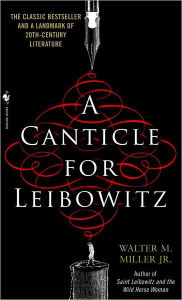
A Canticle for Leibowitz. Walter M. Miller Jr. 1959. 335 pages. [Source: Bought]

First sentence: Brother Francis Gerard of Utah might never have discovered the blessed documents, had it not been for the pilgrim with girded loins who appeared during that young novice's Lenten fast in the desert.

Premise/plot: Canticle for Leibowitz is divided into three parts: "Fiat Homo," "Fiat Lux" and "Fiat Voluntas Tua." Centuries pass between each part, I believe. Essentially what you need to know is that it's post-apocalyptic. The novel opens several centuries (at the very least) after nuclear disaster has wiped out society--at least as we know it. Knowledge is feared and simplicity embraced. A group of monks in the desert cling to what remains of book-knowledge. They memorize. They copy. They wait. They wait knowing that humanity may never be ready for their wisdom. Readers get to know a few monks in each part. The book is not bleak from cover to cover, however, by the end the message is that humanity is incapable of learning from their past mistakes and no matter how many centuries pass, humanity is always its own biggest threat.

My thoughts: This is the first time I ever-ever wished I'd paid more attention in Latin class. Just as Jane Eyre is sprinkled with French, this one is sprinkled with Latin. My general thoughts are that once is not enough to really get everything there is to get. I was reading for big-picture ideas, and not really savoring the details and looking for all possible meanings. My first impression is that it's good, but, depressing. Also thought-provoking.


Favorite quotes:
  • "How can a great and wise civilization have destroyed itself so completely?" "Perhaps," said Apollo, "by being materially great and materially wise, and nothing else." (119)
  • If you try to save wisdom until the world is wise, Father, the world will never have it. (208)
  • It never was any better, it never will be any better. It will only be richer or poorer, sadder but not wiser, until the very last day. (216)
  • The freedom to speculate is essential...(216)
  • Men must fumble awhile with error to separate it from truth, I think--as long as they don't seize the error hungrily because it has a pleasanter taste. (218)
  • If we're born mad, where's the hope of Heaven?" (240)
  • When mass murder's been answered with mass murder, rape with rape, hate with hate, there's no longer much meaning in asking whose ax is the bloodier. Evil, on evil, piled on evil.(259)
  • Too much hope for Earth had led men to try to make it Eden, and of that they might well despair until the time toward the consumption of the world.(264)
  • It is the soul's endurance in faith and hope and love in spite of bodily afflictions that pleases Heaven. (292)
  • The trouble with the world is me. (305)


© 2017 Becky Laney of Becky's Book Reviews

Monday, October 03, 2016

The Last One

The Last One. Alexandra Oliva. 2016. 304 pages. [Source: Library]

First sentence: The first one on the production team to die will be the editor.

Premise/plot: What if a virus/plague destroyed life-as-we-know-it in the United States while a survival-themed reality TV show was being filmed? What if the twelve contestants didn't know what was going on in the outside world? What if they stumbled upon the truth but didn't believe it, clinging to the fact that the reality show has a big budget and a cruel sense of humor? Well, I don't know about "they," but Zoo whose perspective we share is the LAST ONE to know the truth.

My thoughts: Didn't care for this thriller. I didn't find it as compelling as 'a thriller' should have been. Zoo--and all the other characters--are minimally developed. And the action/adventure aspect of it lacked suspense because while Zoo may have been the last to know that all the dead and decaying bodies were real, readers were never in the dark. Readers are smarter than Zoo for about 90% of the book. Since Zoo wasn't fully fleshed out as a character--with depth and substance--I didn't get much from her chapters. Though I preferred her chapters--the "now" chapters--to the "then" chapters which focused exclusively on the television show and the twelve contestants. There was no reason to truly keep reading--other than stubbornness (I have plenty)--since there was no suspense.

I think it comes down to this: if I can't have character-driven fiction (my favorite favorite) then give me ACTION with suspense, lots and lots and lots of tension and suspense. Force me to "enter into temptation" and contemplate peeking ahead to the end. Keep me focused on what may or may not happen next. Throw in twists and surprises, if you want. Keep me guessing about the motivations of this character or that character. But somehow, someway engage me. I don't personally think it's suspense when readers know it's real from page one and the main character is the last one to know just about everything there is to know.


© 2016 Becky Laney of Becky's Book Reviews

Wednesday, July 02, 2014

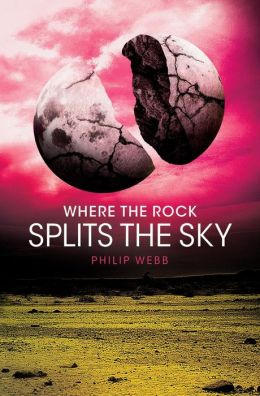
Where The Rock Splits the Sky (2014)

Where The Rock Splits the Sky. Philip Webb. 2014. Scholastic. 272 pages. [Source: Review copy]

Where The Rock Splits The Sky definitely has a unique and intriguing premise: there has been alien invasion which destroyed the moon and altered life on earth forever. Some areas are more affected than others. There is "the zone" where anything and everything can happen: no natural rules or laws apply. This "zone" is in the new-old west. Yes, this science fiction has a very western feel to it. Outlaws and sheriffs. Horses and Stagecoaches. Of course, modern technology does not work in the zone. The good news, and this novel desperately needs good news, is that the heroine discovers that ALIENS are just as vulnerable INSIDE the zone as un-invaded humans. She doesn't know why, she doesn't particularly care about the why.

Megan, Luis, and Kelly set off into the zone. Technically, Kelly is a friend they pick up in the zone after their official mission has started. But. Kelly is probably the most intriguing character in the novel. I'm not sure she's meant to be. All three join together, but, all three have their own personal agenda. Luis wants revenge, in other words, he wants to kill some aliens. Kelly is looking for answers. Twenty years of her life is missing. She wants to know if any of her family or friends have survived. And Megan, the heroine, wants to find her father. Megan is the leader of the three, she is the one most in-touch with the zone, most sensitive to its strangeness.

Where The Rock Splits the Sky is not my kind of book. I'm allergic to westerns even if there are aliens it seems. I was hoping the science-fiction would overcome that. It didn't quite work for me, but, it might work for you.

© 2014 Becky Laney of Becky's Book Reviews

Friday, March 29, 2013

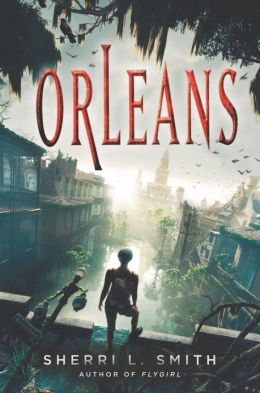
Orleans (2013)

Orleans. Sherri L. Smith. 2013. Penguin. 336 pages.

Orleans is intense and I suspect unforgettable. The novel is set after the Delta and/or the Gulf Coast have been cut off from the rest of the United States. (There being an actual wall to prevent people from entering/exiting.) The reason is simple: Delta Fever is too contagious and there isn't a cure. Everyone is infected with the fever, but each blood type responds differently to the disease or virus. This separates everyone into groups or tribes according to blood type.

Fen, our heroine, is O positive. But soon after the novel begins, her tribe is attacked. Her chieftain, Lydia, goes into premature labor because of the attack. The baby survives, she doesn't. Fen and the baby are what is left of this tribe, and Fen is desperate to provide a better life for this baby. Her goal is ambitious and dangerous. She wants to find a way to smuggle the baby out before it catches the fever. She wants to reach the wall.

Sometimes helping, sometimes hindering, Fen's ambitions is a young scientist named Daniel. Daniel dreams big too. He is desperate to find a cure. That is why he is there illegally.

Orleans is incredibly intense and impossible to put down. If you enjoy disaster and/or survivor fiction, then this one is a must read! It is extremely creepy in places, which I think will definitely appeal to some readers! But even if you don't like horror elements, you may find yourself hooked.

Read Orleans
  • If you enjoy great world-building
  • If you enjoy meeting strong heroines
  • If you enjoy survivor or disaster novels
  • If you enjoy dystopian or post-apocalyptic fiction
  • If you like darker stories with some horror elements

© 2013 Becky Laney of Becky's Book Reviews

Wednesday, February 08, 2012

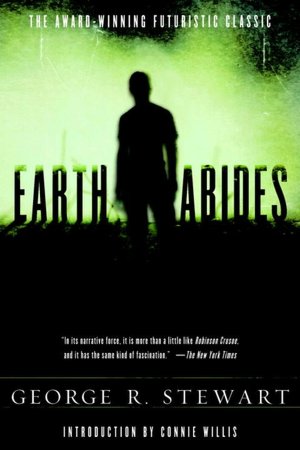
Earth Abides

Earth Abides. George R. Stewart. 1949/2006. (Introduction to this edition by Connie Willis!) Random House. 368 pages.

Just as he pulled himself up to the rock ledge, he heard a sudden rattle, and felt a prick of fangs.

Earth Abides almost leaves me speechless. I almost don't know what I could say about this one. I am definitely glad I read it.

Did I find it thrilling and compelling and wonderful? Sometimes. Maybe not as thrilling as you might expect a futuristic apocalyptic novel to be. Think more along the lines of Robinson Crusoe. Slow and steady with some adventuresome scenes. But mainly a more thoughtful novel.

Ish Williams, our hero, was bitten by a rattle snake. He makes it to his cabin before the sickness completely overwhelms him, and he does what he can to try to survive the snake bite. But nothing is certain, and he knows it. What he didn't expect, what he couldn't possibly have imagined, is that while he's been off camping, off having his nature-inspired adventures, his own brush with death via snake bite, the whole world has changed. The earth's population has dropped to almost nothing. In fact, it takes Ish a couple of chapters, at least, to find another survivor. And several more chapters to find a survivor sober enough, rational enough to want to spend any amount of time with. But Ish is determined and intellectual, a real thinker. He will find some way to go on with life, find some way to build a little pocket of society again.

The novel is broken into several sections. Some sections cover a few months, a few years, and other sections cover twenty or thirty years. Some sections are very detailed, very focused on individuals, others not so much. Some characters are definitely developed well, others not so much. Ish is definitely one of the most developed characters, most introspective and reflective characters that I've encountered in science fiction. (Perhaps not more than Ender or Andrew Wiggin in his Speaker of the Dead status.) That doesn't mean I love him necessarily, but it may mean I remember him.

Earth Abides isn't as emotional as it might have been or could have been. Ish just isn't a show-your-emotions type of guy. He is reflective and intellectual. He's resourceful. He knows a little bit about everything. He's a handy guy to have around. But he's not going to go on and on and on about his feelings. He's not going to weep or go crazy. He's not going to lose it just because the world as he knows it has ended. He's disconnected, in a way, yet his detachment may enable him to survive in this new world.

Read Earth Abides
  • If you're looking to read vintage science fiction, a classic apocalyptic, post-apocalyptic novel
  • If you're interested in survival stories
  • If you're interested in a generational story

© 2012 Becky Laney of Becky's Book Reviews

Wednesday, December 29, 2010

The Scorch Trials (YA)

The Scorch Trials. James Dashner. 2010. Random House. 368 pages.

She spoke to him before the world fell apart.

The Scorch Trials is the sequel to The Maze Runner. Thomas and the other Gladers thought the game was over. They thought they had beat the system. They thought they had been rescued. They certainly celebrated that victory. But the opening chapters of The Scorch Trials reveal that the games have just begun. Thomas and his friends will have to survive a second phase of testing in order to be "cured" of the disease that they've just recently learned they have. (Confused? Well, it's meant to be mysterious.)

What is Thomas' role in all of this? What clues to the present danger can be revealed in his dreams--his memories--of the past? And what about Teresa? The woman whom he can communicate with telepathically? Is she to be trusted? Or is she a betrayer?

The Scorch Trials was certainly an intense read. Very suspenseful. Very mysterious. It kept me guessing. I certainly didn't predict where this one was going.

I would recommend these to fans of The Hunger Games trilogy and the Chaos Walking Trilogy.

© Becky Laney of Becky's Book Reviews

Wednesday, October 13, 2010

Maze Runner (YA)

The Maze Runner. James Dashner. 2009. Random House. 384 pages.

He began his new life standing up, surrounded by cold darkness and stale, dusty air.

The Maze Runner is certainly compelling--very suspenseful. It's an action-packed dystopian novel. Thomas, our narrator, awakes to find his memory gone. He knows his first name. Nothing more. He's in a strange place. But he's not alone. There are others like him. Others his own age. Others whose memories have been erased--they call themselves the Gladers. They've got a system in place. A system that seems to be working. For the most part. Still there are plenty of creepy things about his new life. There are rules to learn. And while they are forthcoming with the rules--they're not always good at explaining to Thomas why these rules are in place. Can Thomas find the answers he so desperately wants?

I enjoyed The Maze Runner. It is very intense, very exciting, very mysterious. Readers--like Thomas--don't have all the answers by the end of the book. There is a second novel in this series, The Scorch Trials, which releases in October.

© Becky Laney of Becky's Book Reviews

Monday, June 28, 2010

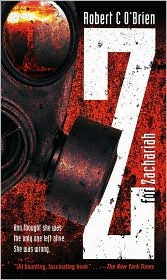
Z for Zachariah


Z for Zachariah. Robert C. O'Brien. 1974. 250 pages.

I am afraid.
Someone is coming.
That is, I think someone is coming, though I am not sure, and I pray that I am wrong.


Ann Burden learns that there are some things worse than loneliness in Robert C. O'Brien's Z for Zachariah. It has been almost a year since Ann's world fell apart, since a week-long war destroyed the world as she knew it. Almost a year since she's seen another person. Ann has been living in a valley. For better or worse, this valley, her home, remained untouched by the nuclear disaster that destroyed the surrounding area, killing everyone and everything. Ann has managed to survive just fine on her own. But her strength will be tested now that a stranger is approaching her valley.
It is still hard for me to realize, even after all this time, that I am not going to be anything, not ever have a job or go anywhere or do anything except what I do here. (131)
I enjoyed Z for Zachariah. I wouldn't say I loved it exactly. But I thought it was interesting and I'm glad I read it. I will say that I thought the jacket description revealed way too much.


© Becky Laney of Becky's Book Reviews
Thursday, May 20, 2010

Ship Breaker (YA)


Ship Breaker. Paolo Bacigalupi. 2010. May 2010. Little Brown. 326 pages.

Nailer clambered through a service duct, tugging at copper wire and yanking it free.

This futuristic novel wowed me. It is set on what was once the Gulf Coast. Nailer and his friends from the light crew are scavengers. They scavenge the ruins of what once was--mainly ships and tankers--looking for valuable (and now scarce) metals and other resources.

Loyalty is everything--and the crew is bonded together by blood. To join the crew you must take a blood oath to be there for one another. If you break your oath, then you're out. And being on your own in this crowd, in this community, something you want to avoid at all costs. Desperate times and all. You have to be a certain weight and height to be on the light crew--to fit places most wouldn't--and it's hard, demanding work.

Nailer's best friend is a young woman named Pima. These two are together (after a BIG, BIG storm) when they make an extraordinary find. They find a newly wrecked clipper ship--a private ship. And this kind of luck doesn't come along twice in a lifetime. As they are searching the ship and making a plan, they discover something even more surprising. The ship's sole survivor, a young girl named Nita. She's the daughter of a somebody. She's wealthy. She's unbelievably wealthy. What's to be done now? To trust or not to trust? Can someone that rich understand the depth of poverty? The desperation that comes along with not having enough to eat? of having no real place to call home?

I loved this one. Bacigalupi has created an intense world--dark and desperate and cruel in many ways--and given readers a unique cast of characters. It's a very compelling read. (Definitely one hard to put down!)

© Becky Laney of Becky's Book Reviews

Sunday, April 25, 2010

Enclave


Enclave by Kit Reed. 2009. Tor. 368 pages.

Departure Day. It's almost time. Gangplank up, repel all boarders. Destination: the last safe place.

Where to start? Sargent, one of our narrators, has started Clothos Academy. He is claiming it is the last safe place on Earth for our children. For the right price, of course, parents can rest assured that their child will be safe come what may. The world may end tomorrow, but this Academy on the top of a mountain, can withstand anything. Or so he claims. But is he really doing it for the children? And is the world really on the brink of destruction?

The Enclave has multiple narrators. This can be hit or miss with me. I don't always appreciate novels with that approach. But with The Enclave I think it works. I liked seeing the different perspectives. Because the truth is this isn't one person's story to tell.

One of my favorite characters was Killer Stade. He was one of the reasons I kept reading. He is one of the teens being "saved" in these end times. And I thought his voice worked a bit better than some of the adult ones.

The Enclave had an interesting premise. I picked it up thinking it was one thing, and while it wasn't quite what I expected, I don't regret reading it. But. I had some issues with this one. I thought the ending was a bit rushed, a bit fragmented. The epilogue didn't quite work for me.


© Becky Laney of Becky's Book Reviews
Saturday, October 03, 2009

The Good Humor Man


Fox, Andrew. 2009. The Good Humor Man. Tachyon Publications. 280 pages.

First paragraph: I remember cheese. I remember pizza; real pizza. Deep-dish, Chicago-style, four-cheese pizza, fresh from the oven, the cheese steaming and bubbling on top like cooling lava.

The Good Humor Man is the sometimes amusing, sometimes disturbing 'tribute' to Fahrenheit 451. In fact, this one's full title is "The Good Humor Man, Or, Calorie 3501."

The year is 2041. Our narrator, Dr. Louis Shmalzberg, is a Good Humor man. His job is to seek out and destroy junk food. Well, all food deemed 'unhealthy' by the powers that be. All people caught with contraband are stripped of their health insurance cards. And if you've got a medical condition that requires prescriptions and medical care, well, too bad for you. You shouldn't have been tempted by a bar of chocolate, a cup cake, or a slice of cheese. If people don't willingly give up the forbidden food items when they're caught, then most Good Humor men won't hesitate to shoot you dead. You simply shouldn't have resisted. But Louis is different. In a way. Yes, he's a Good Humor man. But he's got a soul. Sometimes, when no one is looking, he takes a bit of the forbidden food. Not for himself, mind you, but for his father. Did I mention our narrator is in his sixties? Well, he is. And his father is in a nursing home. And his father has a weakness for sweets. And his father just can't understand why the government went nuts and started taking away all the good food and replacing it with genetically engineered healthy foods, diet foods, foods meant to speed up your metabolism. What Dr. Louis Shmalzberg discovers when he visits his father is disturbing and shocking. Something with widespread repercussions.

How many people think there may just be an evil corporation involved?

This book is more than just a little weird. The initial premise--what I just wrote about above--is interesting, intriguing even. But that's just the bare basics. This one goes places you may not be comfortable going. It's a strange, strange book. The doctor and his father were both plastic surgeons. In fact, his father is the first doctor in the United States to perform liposuction. Do you want to guess his first patient? The King himself. Elvis Presley. His father's most prized possessions are jars of Elvis' fat. That and a few personal items from Elvis that he got as gifts after the procedure.

The world is in danger--humanity's survival is being threatened--can decades old belly fat from the late, great King save the world in its darkest hour?

How do I feel about this one? Honestly, I'm not sure. It goes so many places all at once. I think it becomes more complicated than it needs to be. I think it tries to do too much in some ways. But the two basic premises are ones that I enjoyed. One, that government could outlaw unhealthy food and make eating cheese or chocolate or cake or potato chips or whatever a crime. Two, that science could (whether purposefully or accidentally) make a goof-up so bad that life as we know it is threatened. Scientists playing god is not a new theme in fiction. And this genetic engineering twist where the scientists create something that they can't control or are having a hard time controlling...well, it's an interesting little plot device. But there are other plot threads that are even more disturbing (if you can believe it).

I think if you try to pick this one apart and look for messages about society--about food, about body image, about science, about religion, about government, about culture, about race and ethnicity, about life and love itself--then it's going to start falling apart. I don't think this should be read as an allegory. I don't think it should be taken all that seriously. If you're looking for a quirky little book then this one might work for you.

© Becky Laney of Becky's Book Reviews

Tuesday, September 15, 2009

Go-Go Girls of the Apocalypse


Gischler, Victor. 2008. Go-Go Girls of the Apocalypse. Simon & Schuster. 324 pages.

This is how Mortimer Tate ended up killing the first three human beings he'd laid eyes on in nearly a decade:

It'd been nine years since the end. And Mortimer Tate (startled into loneliness by the three unexpected visitors on his mountain top) is only now considering rejoining the human race--what's left of it at least. He saw it coming. He had been prepared. It hadn't been easy. It hadn't been comfortable. But he'd gotten by. Always. But is that enough for him now? He's full of questions. What does the world look like now? What does America look like? Are there still cities and towns? And whatever happened to his ex-wife?

Mortimer lives in a dangerous world. A world I'm glad not to be a part of. It's a bit too bloody and lusty for me. Women and booze are commodities, don't you know? And life is cheap, really cheap. (That's because it's easier to shoot first and not bother asking questions.) Which is why, in a way, Mortimer is surprised by one man in particular, Bill, (Buffalo Bill) who befriends him. Saves his life is more like it. These two pair up--in a good, old buddy kind of way--and once that happens can a road trip be very far away? True, there are no cars. But that won't keep these two from having adventures and thrills. Danger is everywhere. America (or at least the South) is rules by two factions. One being the Red Czar. (Red Stripes? Red something-or-other in any case.) The other being Joey Armageddon's Sassy-A-Go-Go Strip Club. These two groups are heading for a showdown, and Bill and Mortimer are fated to be caught in the middle.

Perhaps this goes without saying, but Go-Go Girls of the Apocalypse is not for the easily offended. The language. Some sex. Some violence. It's not for everyone. I think you have to have a certain sense of humor.

© Becky Laney of Becky's Book Reviews